Within Georgia Monsters
When Georgia Wildlife Becomes Monster Lore
Georgia's lesser-known creature stories often begin with real wildlife glimpsed badly in marshes, forests, farms and suburbs.
On this page
- Panther rumours and disputed big cat claims
- Swamps, blackwater and older local legends
- How ordinary animals become extraordinary stories
Page outline Jump by section
Introduction
Georgia’s “phantom panther” stories are best understood as a meeting point between real wildlife, difficult landscapes and a very old human habit: turning an uncertain glimpse into a memorable animal tale. The creature most often claimed is a large black cat — usually called a panther, cougar or mountain lion — seen crossing a road, slipping into woods, or moving at the edge of a farm or swamp. State wildlife officials, however, say confirmed evidence for a breeding population of big cats in Georgia is lacking, and most reports are better explained by bobcats, dogs, coyotes, bears, otters, house cats seen under odd conditions, or rare one-off animals rather than a hidden resident species.[Georgia Wildlife]georgiawildlife.comGeorgia WildlifeMountain Lion Sightings Not Likely in GeorgiaBig cat sightings usually turn out to be simply a case of mistaken identity…
That does not make the stories worthless. In Georgia, wildlife mix-ups reveal how monster lore forms in practice. A blackwater swamp can hide an alligator just below the surface; a trail-camera bobcat can look bigger than it is; a feral hog can become “Hogzilla” once photography, rumour and local pride get involved. Georgia’s lesser-known creature lore is often not about invented monsters replacing nature, but about nature being glimpsed at the wrong angle, in the wrong light, at exactly the right moment for folklore.
Panther rumours and disputed big-cat claims
The black panther is one of Georgia’s most persistent mystery animals because it sits just close enough to reality to feel plausible. Cougars once ranged widely across eastern North America, Florida panthers still survive in south Florida, and the word “panther” is used loosely in the South for several kinds of large cat. Add Georgia’s forests, farms, river bottoms and mountain roads, and the rumour has a ready-made habitat.
The official position is much cooler. Georgia’s Wildlife Resources Division says mountain lion sightings in the state are “not likely” and that big-cat reports usually prove to be mistaken identity involving more ordinary animals. The agency also says it takes reports seriously and investigates where appropriate, which is important: the sceptical explanation is not that everyone is lying, but that most sightings do not produce the kind of evidence needed to confirm a large cat.[Georgia Wildlife]georgiawildlife.comGeorgia WildlifeMountain Lion Sightings Not Likely in GeorgiaBig cat sightings usually turn out to be simply a case of mistaken identity…
A 2022 WTOC report captured the tension neatly. Georgia DNR staff told the station that the previous year had produced 65 reported big-cat sightings statewide, with none confirmed. The same report also noted why local debate remains alive: Georgia has had a small number of credible or confirmed mountain-lion-related incidents, including the famous 2008 Troup County case.[https://www.wtoc.com]wtoc.comSource details in endnotes.
That 2008 case is the single strongest reason many Georgians resist a simple “there are no big cats” answer. A hunter near LaGrange in Troup County shot and killed a mountain lion while deer hunting; genetic testing later showed it was a federally endangered Florida panther. The U.S. Fish and Wildlife Service reported that the hunter pleaded guilty to unlawful take of a Florida panther and was sentenced in 2011. Georgia DNR’s own summary also identifies the animal as a Florida panther and describes the resulting federal fine, probation and hunting-licence restriction.[Georgia Wildlife]georgiawildlife.comGeorgia WildlifeMountain Lion Sightings Not Likely in GeorgiaBig cat sightings usually turn out to be simply a case of mistaken identity…
The crucial distinction is between a confirmed wandering individual and a hidden breeding population. A single Florida panther reaching west Georgia proves that an extraordinary animal can appear in the state. It does not prove that black panthers are living and reproducing across Georgia’s woods and swamps. The Georgia Biodiversity Portal says it is “almost a certainty” that the Florida panther no longer occurs in Georgia as a resident, while federal records treat the eastern puma or eastern cougar as extinct, with recent validated eastern records explained by escaped or released captives, Florida panthers, or western animals dispersing far from established ranges.[georgiabiodiversity.org]georgiabiodiversity.orgOpen source on georgiabiodiversity.org.
The black colour adds another problem. In everyday speech, “black panther” can mean a melanistic leopard or jaguar, both animals from outside Georgia’s native wildlife. North American cougars are not known to maintain a confirmed melanistic population in the way popular panther stories imagine. So a Georgia “black panther” report usually carries two questions at once: was it really a large wild cat, and was it really black rather than darkened by shadow, distance, wet fur, backlighting or a brief view at dusk?
Why Georgia keeps producing panther stories
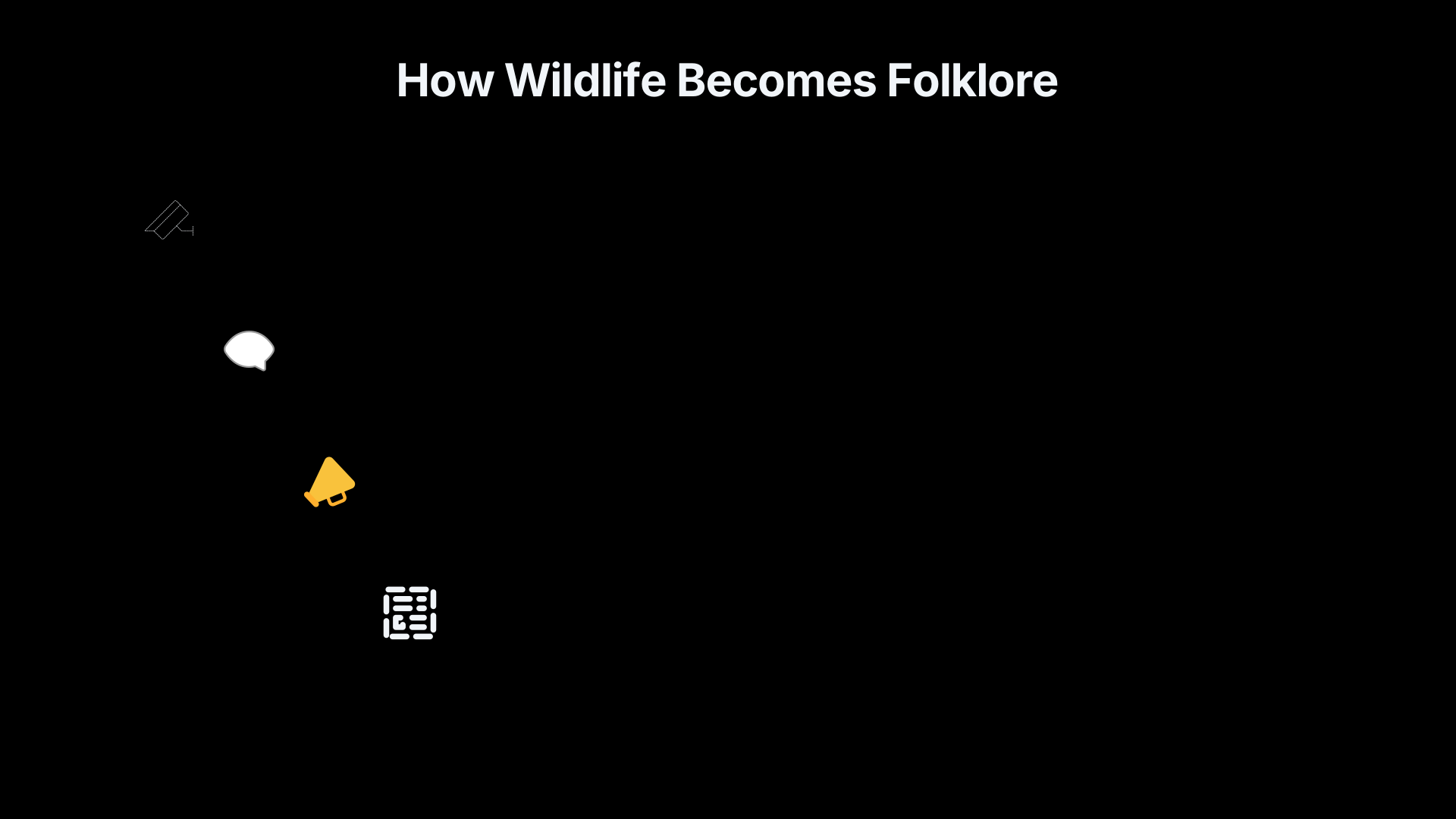
Panther rumours cluster naturally in places where sightlines are poor and wildlife encounters are quick: wooded suburbs, river corridors, farm edges, mountain counties, hunting properties and swampy lowlands. These are exactly the places where a person may see only a silhouette, a long tail-like shape, a dark body moving through cover, or a pair of eyes reflecting from a roadside ditch.
Several ordinary Georgia animals can become “panther-like” under those conditions.
Bobcats are the most important suspect. They are real wild cats, they occur in Georgia, they can look surprisingly large on trail cameras, and their short tails are not always obvious when the view is obscured. A 2019 Pickens County case shows the mechanism clearly: a trail-camera image from Pickens County Airport was first suspected locally to show a mountain lion, but Georgia DNR identified it as a bobcat. The newspaper follow-up reported that the case drew a strong response from readers who insisted they had seen mountain lions, illustrating how one ambiguous image can become a local debate rather than a settled identification.[pickensprogress.com]pickensprogress.commountain lions not here says dnrmountain lions not here says dnr
Coyotes, dogs and house cats can also be misread, especially at night. A black domestic cat crossing a road close to the viewer may be mentally scaled up in memory; a dog or coyote moving low through brush may briefly resemble a large cat; a bear cub or young bear seen partially through vegetation may read as something else entirely. Georgia DNR specifically lists bobcats, house cats, dogs, coyotes, bears and even river otters among animals that can generate big-cat reports.[Georgia Wildlife]georgiawildlife.comGeorgia WildlifeMountain Lion Sightings Not Likely in GeorgiaBig cat sightings usually turn out to be simply a case of mistaken identity…
River otters are a particularly useful reminder that “cat-like” does not always mean feline. In water or along banks, a slick dark animal with a long body and tail can look much stranger than it is. Georgia’s panther lore overlaps with swamp and river lore because many sightings happen near low, wet places where people get partial views of animals entering or leaving water.
The social mechanism matters too. A person who says “I saw something strange” may be uncertain. A neighbour replies, “People around here have always seen panthers.” The next retelling is no longer just an unidentified animal; it is a new entry in a known local pattern. That pattern becomes stronger when photos are blurry, when official statements feel dismissive, or when a confirmed outlier — such as the Troup County Florida panther — is used as proof that any later sighting could be true.
Swamps, blackwater and older local legends
Georgia’s swamp lore is not only about panthers. The Okefenokee and other blackwater landscapes give the state a setting where ordinary wildlife already feels uncanny. Dark water hides scale. Peat mats tremble. Animal calls carry strangely at night. Reflections, fog, eyeshine and submerged movement can make a living wetland feel staged for a monster story.
The New Georgia Encyclopedia describes the Okefenokee Swamp and its surroundings as a distinctive folk region, with legends, tall tales and personal experience narratives shaped by isolation, religion, local speech and encounters with bears, alligators and the natural world. It singles out fishing guide Lem Griffis, who entertained visitors near Fargo with crafted “whoppers”, showing how swamp storytelling could be a local performance as well as a record of belief.[New Georgia Encyclopedia]georgiaencyclopedia.orgNew Georgia Encyclopedia Okefenokee Swamp FolkloreNew Georgia Encyclopedia Okefenokee Swamp Folklore
This is important for Georgia cryptid history because swamp lore is not always a claim that one specific unknown species exists. Often it is a storytelling environment. A strange light, a noise from the water, a bear at the edge of camp, a huge alligator or a barely seen animal on a floating island can become a tale that warns, entertains and marks the swamp as a place where outsiders should be humble.
The wildlife itself is impressive enough to do much of the work. The U.S. Fish and Wildlife Service describes the Okefenokee as one of the largest intact freshwater environments in the world and the largest blackwater swamp in North America. The refuge’s official material highlights black bears, gopher frogs, American alligators, owls and other animals; another FWS page estimates roughly 15,000 alligators in the swamp.[U.S. Fish and Wildlife Service]fws.govU.S. Fish and Wildlife Service Animals in the Okefenokee SwampU.S. Fish and Wildlife Service Animals in the Okefenokee Swamp
Alligators are especially good at becoming “something else”. Georgia Public Broadcasting reported on UGA Coastal Ecology Lab observations that large, eerie shadows just below the surface of Georgia blackwater swamps are often sleeping alligators. The explanation is simple but wonderfully suited to folklore: an alligator that might bask openly in daylight may sleep underwater when conditions are cooler or warmer below the surface, leaving only a dark shape in murky water.[Georgia Public Broadcasting]gpb.orgOpen source on gpb.org.
At night, eyeshine can multiply the effect. GPB later reported on a striking nighttime gathering of alligators in the Okefenokee, where reflected eyes appeared across the dark swamp. A trained researcher may see predator ecology; a visitor primed by local stories may see a living field of watching lights.[Georgia Public Broadcasting]gpb.orglight focused on dark swamp revealed eyes far we could see ga team sayslight focused on dark swamp revealed eyes far we could see ga team says
How ordinary animals become extraordinary stories
Georgia’s wildlife mix-ups usually follow a recognisable chain. The animal does not have to be imaginary. In fact, the strongest stories often begin with something real.
First comes a brief encounter. A driver sees a dark shape cross a road. A hunter checks a trail camera. A fisherman sees a roll in black water. A homeowner hears a scream or crash in the woods. The moment is fast, incomplete and emotionally charged.
Then comes interpretation. The witness reaches for the nearest category: panther, bear, swamp monster, giant hog, unknown creature. The chosen label depends on local vocabulary as much as biology. In one county, a dark cat-like animal becomes a panther. In a swamp, a submerged shape becomes a monster. In south Georgia farm country, an enormous pig becomes a once-in-a-generation beast.
Then comes retelling. The story gains scale, confidence and sometimes measurements. “Big” becomes “huge”. “I could not identify it” becomes “it was definitely a panther”. “A large hog” becomes “Hogzilla”.
Hogzilla, from Alapaha in south Georgia, is a perfect example of the border between real animal and monster lore. The animal was not a phantom. It was a real, unusually large hog killed in 2004, and National Geographic investigators later confirmed that it existed, while reducing the more spectacular early claims. ABC News reported National Geographic’s conclusion that Hogzilla was real but not as large as first claimed, weighing about 800 pounds and showing unusual DNA from a wild-hog and domestic-pig background. Georgia DNR’s feral-hog material also gives the broader ecological context: feral hogs are an invasive species that damage crops, native plants, livestock, forests and ecosystems.[ABC News]abcnews.comABC News The Mystery of Hogzilla SolvedABC News The Mystery of Hogzilla Solved
The lesson is not that every monster report is false. It is that real animals can be mythologised when evidence is partial, presentation is dramatic and the setting already feels wild. Hogzilla became famous because there was a body, a photograph, a dispute over size, a media investigation and a state already associated with swamps and oversized wildlife. Panther stories usually lack that level of physical evidence, but they run on the same engine: a plausible animal category, a dramatic encounter and a community ready to argue about what was seen.
The difference between a claim, a legend and a useful wildlife report
A good Georgia mystery-beast page has to hold two ideas together. People do sometimes see unusual animals. At the same time, most extraordinary wildlife claims need stronger evidence than memory, especially when the claim involves a breeding population of large predators.
For panthers, the most useful evidence would be clear photographs or video with scale, tracks verified by specialists, scat or hair suitable for DNA analysis, a carcass, or repeated confirmations from independent sources in the same area. Georgia DNR’s rare-species reporting page encourages people to submit sightings of rare and little-known wildlife, including trail-camera photos and first-hand encounters, because good records can help document distribution and trends.[Georgia Wildlife]georgiawildlife.comOpen source on georgiawildlife.com.
That reporting framework also helps separate folklore from field evidence. A story can be culturally valuable even if it is not biologically confirmed. An Okefenokee tale about a frightening bear or alligator encounter may preserve local knowledge about risk. A panther rumour may reveal where people feel the woods are changing, where suburbs press into habitat, or where residents distrust official explanations. A misidentified bobcat may still be a genuine wildlife encounter worth understanding.
The strongest sceptical reading of Georgia’s phantom panthers is therefore not “nothing happened”. Something usually did happen: an animal crossed a road, a camera caught a shape, a person heard a cry, or a shadow moved in black water. The question is whether the evidence supports the named monster. In most cases, official and ecological evidence points back towards known animals, rare wanderers, escaped captives, scale errors, shadow, and the storytelling pressure of a state rich in wild-looking places.

Why the legend survives
Georgia’s phantom-panther and swamp-creature stories survive because they do useful cultural work. They make familiar landscapes feel alive. They give rural roads and wetlands a sense of depth. They let people argue over the boundary between official knowledge and lived experience. They also keep attention on the real animals that make Georgia strange without needing invented beasts: alligators sleeping invisibly under dark water, bears moving through swamp forests, bobcats caught at odd angles, feral hogs large enough to damage land and start legends.
The best way to enjoy these stories is not to flatten them into either “true” or “fake”. A confirmed Florida panther in Troup County shows that rare surprises can happen. Georgia DNR’s repeated cautions show that recurring sightings are not the same as a confirmed population. Okefenokee folklore shows that swamps produce stories as naturally as they produce mist, eyeshine and hidden movement. Hogzilla shows how a real animal can become a monster once the telling begins.
In that sense, Georgia’s wildlife mixups are not a weak corner of the state’s cryptid tradition. They are one of its clearest mechanisms. They show the exact moment where ecology becomes folklore: a real creature, seen badly, in a place already famous for mystery, retold until the animal in the story is larger, darker and harder to dismiss than the animal that first crossed the road.
eBay marketplace picks
Marketplace Samples
Live-tested eBay searches with available results related to this page.
Endnotes
1.
Source: wtoc.com
Link:https://www.wtoc.com/2022/09/15/debate-over-possible-big-cat-sightings-ga/
Source snippet
[https://www.wtoc.comDebate](https://www.wtoc.comDebate) over possible big cat sightings in Ga.15 Sept 2022 — They say last year, there were 65 reported big cat sighti...
2.
Source: fws.gov
Title: newnan man sentenced killing florida panther georgia
Link:https://www.fws.gov/story/2011-08/newnan-man-sentenced-killing-florida-panther-georgia
3.
Source: georgiabiodiversity.org
Link:https://georgiabiodiversity.org/portal/profile?es_id=16537&group=all
4.
Source: pickensprogress.com
Title: mountain lions not here says dnr
Link:https://pickensprogress.com/mountain-lions-not-here-says-dnr/
5.
Source: pickensprogress.com
Title: community bucks dnr s claim that mountain lions aren t here
Link:https://pickensprogress.com/community-bucks-dnr-s-claim-that-mountain-lions-aren-t-here/
6.
Source: fws.gov
Title: U.S. Fish and Wildlife Service Animals in the Okefenokee Swamp
Link:https://www.fws.gov/story/2024-05/animals-okefenokee-swamp
7.
Source: fws.gov
Link:https://www.fws.gov/refuge/okefenokee
8.
Source: gpb.org
Link:https://www.gpb.org/news/2023/01/05/large-eerie-shadows-lurking-below-surface-of-georgias-blackwater-swamps-are-alive
9.
Source: gpb.org
Title: light focused on dark swamp revealed eyes far we could see ga team says
Link:https://www.gpb.org/news/2025/08/27/light-focused-on-dark-swamp-revealed-eyes-far-we-could-see-ga-team-says
10.
Source: fws.gov
Title: long extinct eastern cougar be removed endangered species list correcting
Link:https://www.fws.gov/press-release/2018-01/long-extinct-eastern-cougar-be-removed-endangered-species-list-correcting
11.
Source: fieldreport.caes.uga.edu
Title: resolving human nuisance wildlife conflicts
Link:https://fieldreport.caes.uga.edu/publications/B1248/resolving-human-nuisance-wildlife-conflicts/
12.
Source: gacoast.uga.edu
Title: coastal ecology lab
Link:https://gacoast.uga.edu/extension/coastal-ecology-lab/
13.
Source: rivercenter.uga.edu
Title: the okefenokee swamp
Link:https://rivercenter.uga.edu/the-okefenokee-swamp/
14.
Source: wtoc.com
Title: debate over possible big cat sightings ga
Link:https://www.wtoc.com/video/2022/09/15/debate-over-possible-big-cat-sightings-ga/
15.
Source: nature.org
Link:https://www.nature.org/en-us/get-involved/how-to-help/places-we-protect/okefenokee-national-wildlife-preserve/
16.
Source: georgiawildlife.com
Link:https://georgiawildlife.com/mountain-lion-sightings-not-likely-georgia
Source snippet
Georgia WildlifeMountain Lion Sightings Not Likely in GeorgiaBig cat sightings usually turn out to be simply a case of mistaken identity...
17.
Source: georgiaencyclopedia.org
Title: New Georgia Encyclopedia Okefenokee Swamp Folklore
Link:https://www.georgiaencyclopedia.org/articles/arts-culture/okefenokee-swamp-folklore/
18.
Source: abcnews.com
Title: ABC News The Mystery of Hogzilla Solved
Link:https://abcnews.com/GMA/Technology/story?id=599913
19.
Source: georgiawildlife.com
Link:https://georgiawildlife.com/feralhogs
20.
Source: georgiawildlife.com
Link:https://georgiawildlife.com/report-species-sightings
21.
Source: facebook.com
Link:https://www.facebook.com/GeorgiaWildlifeNetwork/posts/im-just-going-to-say-itthere-are-no-established-populations-of-black-panthers-wo/850090037579710/
22.
Source: facebook.com
Link:https://www.facebook.com/GeorgiaWildlifeNetwork/posts/in-an-effort-to-help-clear-up-some-confusion-below-are-the-differences-between-a/416780187577366/
23.
Source: georgiawildlife.com
Link:https://georgiawildlife.com/regulations/trapping
24.
Source: georgiawildlife.com
Link:https://georgiawildlife.com/preventing-wildlife-conflicts
25.
Source: georgiawildlife.com
Title: GA2026 Hunting&Fishing Regulations
Link:https://georgiawildlife.com/sites/default/files/wrd/pdf/regulations/GA2026_Hunting%26Fishing%20Regulations.pdf
26.
Source: georgiawildlife.com
Title: GA Hunting & Fishing Popular Guide 2024 25
Link:https://georgiawildlife.com/sites/default/files/wrd/pdf/regulations/GA%20Hunting%20%26%20Fishing%20Popular%20Guide%202024-25.pdf
27.
Source: georgiawildlife.com
Link:https://georgiawildlife.com/about/contact
28.
Source: georgiawildlife.com
Title: Georgia Hunting Regulations Guide 2016 2017
Link:https://georgiawildlife.com/sites/default/files/wrd/pdf/Georgia-Hunting-Regulations-Guide-2016-2017.pdf
29.
Source: georgiawildlife.com
Link:https://georgiawildlife.com/nuisance
30.
Source: Wikipedia
Title: Black panther
Link:https://en.wikipedia.org/wiki/Black_panther
31.
Source: Wikipedia
Title: Eastern cougar
Link:https://en.wikipedia.org/wiki/Eastern_cougar
32.
Source: Wikipedia
Title: Okefenokee Swamp
Link:https://en.wikipedia.org/wiki/Okefenokee_Swamp
33.
Source: Wikipedia
Link:https://en.wikipedia.org/wiki/Hogzilla
34.
Source: espn.com
Link:https://www.espn.com/outdoors/general/news/story?id=2465573
35.
Source: georgiaencyclopedia.org
Link:https://www.georgiaencyclopedia.org/articles/arts-culture/okefenokee-swamp-folklore/m-575/
36.
Source: cryptidz.fandom.com
Link:https://cryptidz.fandom.com/wiki/Hogzilla
37.
Source: snopes.com
Link:https://www.snopes.com/fact-check/hogzilla/
Additional References
38.
Source: youtube.com
Link:https://www.youtube.com/watch?v=h3SZDBX6xRc
Source snippet
The Shocking Truth About Eastern Cougars EXPOSED...
39.
Source: youtube.com
Title: Big cat video has Paulding County resident worried
Link:https://www.youtube.com/watch?v=uUwbp_CFgHM
Source snippet
Large bobcat in neighborhood worries parents as they prepare to trick-or-treat with kids...
40.
Source: smyrnaga.gov
Link:https://www.smyrnaga.gov/services/report/nuisance-animal-and-or-stray
41.
Source: federalregister.gov
Link:https://www.federalregister.gov/documents/2018/01/23/2018-01127/endangered-and-threatened-wildlife-and-plants-removing-the-eastern-puma-cougar-from-the-federal-list
42.
Source: wdam.com
Link:https://www.wdam.com/video/2022/09/16/are-there-big-cats-georgia/
43.
Source: reddit.com
Link:https://www.reddit.com/r/Cryptozoology/comments/rgl4py/black_panthers_in_appalachia/
44.
Source: reddit.com
Link:https://www.reddit.com/r/Georgia/comments/1cgpfpu/can_someone_tell_me_what_animal_did_this/
45.
Source: facebook.com
Link:https://www.facebook.com/NewsNowGA/posts/-caught-on-camera-in-midway-gafor-years-stories-of-black-panthers-have-been-pass/1508004668004788/
46.
Source: georgiaconservancy.org
Link:https://georgiaconservancy.org/okefenokee/
47.
Source: wbrc.com
Link:https://www.wbrc.com/video/2022/09/15/debate-over-possible-big-cat-sightings-ga/
Topic Tree