Within Alaska Cryptids
What Moves Beneath Lake Iliamna?
The Iliamna Lake Monster sits where deep-water mystery, giant fish rumours and real Alaska wildlife explanations meet.
On this page
- Lake Iliamna as monster habitat
- Reported shapes, wakes and water sightings
- Sturgeon, salmon and other explanations
Page outline Jump by section
Introduction
The Iliamna Lake Monster is Alaska’s best-known lake-creature story because it sits in a place where the ordinary wildlife is already remarkable. Lake Iliamna is huge, cold, deep and salmon-rich: Alaska’s largest freshwater lake, roughly 77 miles long, up to 22 miles wide and close to 1,000 feet deep in places. It also holds a rare resident population of freshwater harbour seals and major runs of sockeye salmon, so a large dark shape moving below the surface is not automatically a fantasy. The honest answer is that no confirmed unknown animal has been documented in the lake, but reports of “Illie” are unusually interesting because several real animals — seals, large fish, salmon-feeding predators, or possibly misidentified wakes and logs — can explain parts of the legend without explaining every dramatic claim.[alaska.gov]adfg.alaska.govThe lake also supports several populations of freshwaterAlaska Department of Fish and GameIliamna Lake Seals: Local and Scientific UnderstandingIliamna Lake and its tributaries are critical spa…
Why Lake Iliamna feels built for a monster story
Lake Iliamna gives a water-monster legend the three things it needs: size, poor visibility and a living food web big enough to make large-animal rumours feel plausible. The lake drains southwest through the Kvichak River into Bristol Bay, and Alaska Department of Fish and Game describes Iliamna and its tributaries as important spawning grounds for Chinook, coho and sockeye salmon, as well as home to several freshwater fish populations. Its scale matters too. At around 1,600 square miles by ADF&G’s description, and up to about 300 metres deep, the lake is not a pond where every unusual animal should be quickly accounted for.[Alaska Department of Fish and Game]adfg.alaska.govThe lake also supports several populations of freshwaterAlaska Department of Fish and GameIliamna Lake Seals: Local and Scientific UnderstandingIliamna Lake and its tributaries are critical spa…
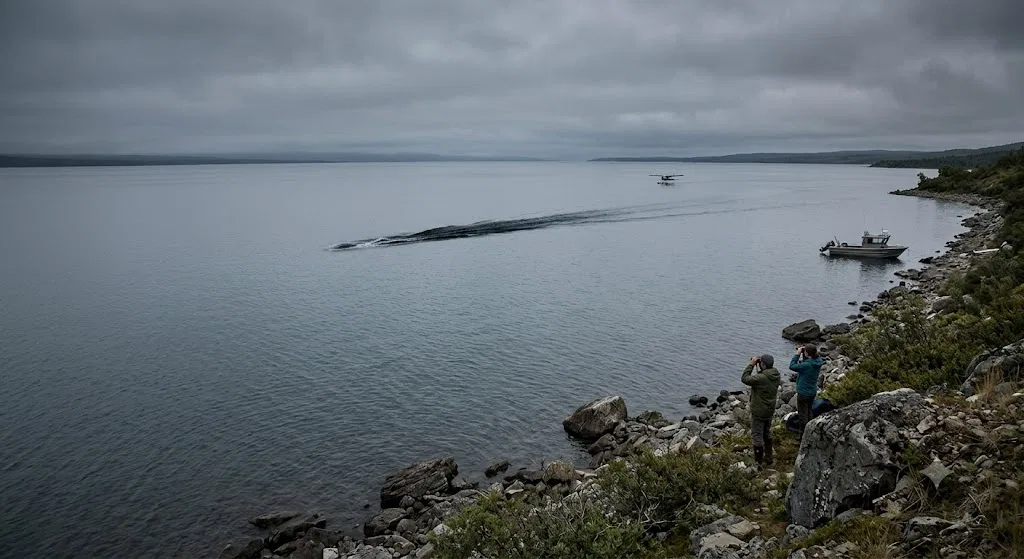
That does not mean a hidden monster is likely. It means the setting is good at producing difficult sightings. A large animal seen from a skiff, a low aircraft, or a shore camp can change shape with distance, glare and chop. A seal surfacing in rough water can look like a head or fin. A line of swimming fish, diving birds, floating timber, or wind-driven standing waves can become a single travelling body when viewed briefly. Iliamna also has a long season of ice, storm and remoteness, which makes follow-up observation harder than it would be at a roadside lake.
The legend’s modern appeal comes from this overlap between wild story and real ecology. Iliamna is not only a “monster lake”; it is a salmon nursery, a subsistence landscape and the only United States lake known for a resident freshwater harbour seal population. That gives the story a different flavour from a purely folkloric lake dragon. Even sceptical readers can see why people keep asking whether some large, ordinary-but-unexpected animal is behind at least some reports.[Alaska Department of Fish and Game]adfg.alaska.govDepartment of Fish and Game Iliamna Lake SealDepartment of Fish and Game Iliamna Lake Seal
What witnesses usually describe
The Iliamna creature is usually described less like a plesiosaur and more like a giant fish or shark. Popular accounts often mention dark bodies, blunt heads, visible fins, strong wakes and lengths somewhere around 10 to 20 feet, with some versions stretching the estimate to 30 feet. Fish Alaska Magazine’s 2021 account, based on interviews and local monster-hunting efforts, summarised the common modern description as dark, shark-like, often seen near the surface and sometimes seen in more than one individual.[Fish Alaska Magazine]fishalaskamagazine.comFish Alaska Magazine Iliamna Lake MonsterFish Alaska Magazine Iliamna Lake Monster
That description is important because it narrows the most useful explanations. “Illie” is not normally reported as a long-necked Nessie-style animal. The strongest recurring image is of something broad, dark and fish-like moving through cold water. Some stories add behaviour: animals feeding on salmon, approaching waterfowl, or supposedly moving with enough force to create a conspicuous wake. Those behavioural details are harder to evaluate because many are second-hand, retold in cryptid articles, outdoor writing or television-friendly formats rather than in formal field reports.
The story also gained public attention through reward and media cycles. The Anchorage Daily News is widely reported to have offered a $100,000 reward around 1979 or 1980 for conclusive evidence of the creature; Associated Press later noted that no one had photographed the animal despite fishing attempts and the old reward. Television programmes such as River Monsters and Expedition X then folded the Iliamna story into a broader entertainment tradition of cold-water monsters, but the stronger version of the mystery remains local and ecological rather than paranormal.[AP News]apnews.comAP NewsEffort seeks to uncover Iliamna Lake's purported monster11 May 2019 — The Anchorage Daily News once offered $100,000 for proof of…
The freshwater seal explanation is real, but incomplete
The most concrete “monster” in Lake Iliamna is not a monster at all. It is the Iliamna Lake harbour seal. NOAA and ADF&G sources describe a small harbour seal population that appears to live in the lake year-round, despite the lake’s connection to Bristol Bay through the Kvichak River. Federal records also note that aerial surveys since 2010 documented pupping in the lake, which supports the idea that these are not just occasional visiting marine seals.[NOAA Fisheries]fisheries.noaa.govfreshwater harbor seals lake iliamna alaska do they pup and overfreshwater harbor seals lake iliamna alaska do they pup and over
For monster reports, seals are a strong partial explanation. They are dark, air-breathing mammals that surface suddenly, dive quickly, create wakes, chase fish and appear in groups. A seal’s head, back and flippers seen separately in waves can look like a much longer creature than the animal really is. In poor light, a line of seals travelling or feeding can be misread as one large body. Because many Iliamna reports involve brief water sightings rather than captured specimens, this kind of misperception is not a weak excuse; it is exactly how many lake-monster sightings elsewhere are plausibly generated.
The seal explanation becomes even more compelling because Iliamna’s seals feed in the same dramatic setting as the legend. A 2008 study of resident harbour seals in the lake examined summer diet and partial consumption of adult sockeye salmon, while later work has strengthened the view that the lake population is unusual, isolated and scientifically important. In 2024, researchers reported that Iliamna Lake harbour seals are genetically distinct from nearby marine harbour seals and may represent a unique endemic form.[bbna.com]bbna.comOpen source on bbna.com.
Still, seals do not explain every claim neatly. Adult harbour seals are impressive, but they are not 20-foot fish. A witness who clearly sees a fish-like tail moving side to side would not be describing a seal. The better sceptical position is not “all sightings are seals”, but “Iliamna contains a rare, dark, fish-eating, surfacing mammal that can explain many ambiguous head, back, wake and group-sighting reports”.
Sturgeon: the classic giant-fish candidate
White sturgeon are the most traditional naturalistic answer for a giant fish in a North American lake. They can grow very large, have a prehistoric look, and are native to Pacific-draining waters of western North America. USGS lists white sturgeon as reaching about 6.1 metres and nearly a ton, with a native range along the Pacific Coast from Alaska Bay to central California and extreme north-western Montana. California’s fish agency similarly describes white sturgeon as the largest freshwater fish in North America, historically reaching about 20 feet, though such giants are now rare.[Nonindigenous Aquatic Species]nas.er.usgs.govNonindigenous Aquatic Species White Sturgeon (Acipenser transmontanusNonindigenous Aquatic Species White Sturgeon (Acipenser transmontanus
On paper, that sounds like a good match for a 10-to-20-foot “fish” seen in Iliamna. Sturgeon are big, long-lived, bottom-associated fish that can surface or roll in ways that startle observers. Their ridged bodies and shark-like silhouettes also fit some descriptions better than a seal does. This is why sturgeon remain a favourite among cryptozoology-minded writers and why River Monsters-style treatments found the idea attractive.[NOAA Institutional Repository]repository.library.noaa.govOpen source on noaa.gov.
The weakness is distribution and evidence. A sturgeon explanation would require either an overlooked population in the Iliamna-Kvichak system or rare individuals reaching the lake and remaining undetected by fisheries, surveys, subsistence users and biologists. That is not impossible in the loose storytelling sense, but it is a large claim. The more people fish, net, survey and study a lake, the less likely a breeding population of very large sturgeon becomes without hard evidence such as bones, carcasses, DNA, photographs or repeated captures.
There is also a behaviour problem. Some Iliamna accounts describe active predation on birds, salmon or even seals. Sturgeon are opportunistic feeders, but a sturgeon is not the obvious first choice for stories of fast surface pursuit. For sightings that describe a slow, huge, fish-like body, sturgeon is one of the cleaner hypotheses. For reports that emphasise hunting behaviour, it becomes less satisfying.
Salmon, pike, trout and the problem of size
Lake Iliamna is part of one of the great sockeye systems on Earth. ADF&G technical material on the Kvichak River-Iliamna Lake-Lake Clark drainage describes the Kvichak system as supporting the world’s largest run of sockeye salmon, and current fisheries material continues to treat the region as a major salmon and resident-fish landscape. That matters because dense fish runs create surface commotion: wakes, boils, splashes, feeding birds, seal activity and predator movement. A witness might not be seeing one huge animal so much as a cluster of normal animals acting together.[Alaska Department of Fish and Game]adfg.alaska.govOpen source on alaska.gov.
Large fish in the region also complicate simple dismissal. ADF&G sport-fishing material for Bristol Bay waters mentions resident species including rainbow trout, Dolly Varden, Arctic char, Arctic grayling, burbot, lake trout and northern pike. Subsistence papers for the Iliamna-Newhalen area also list pike, whitefish, lake trout, char, rainbow trout and grayling among freshwater fish taken under subsistence and sport provisions.[Alaska Department of Fish and Game]adfg.alaska.govOpen source on alaska.gov.
But there is a hard ceiling here. Big trout, pike or lake trout can be startling, especially in clear water or when seen from above, but they do not normally become 15-to-30-foot animals. Northern pike have been suggested in some recent popular speculation because they are predatory, long-bodied and capable of explosive attacks. Yet a truly gigantic pike population would raise the same evidence problem as sturgeon: where are the verified catches, carcasses, jaws, scales or consistent biological records?
The most plausible fish-based explanation may be mixed rather than singular. Some “monster” reports could come from salmon schools, large trout or pike, seals feeding among salmon, and the viewer’s brain joining several moving shapes into one animal. That is less glamorous than a single hidden species, but it fits the way real water sightings often happen: a brief glimpse, a lot of movement, and a powerful landscape doing half the storytelling.
Sleeper sharks: tempting, dramatic and difficult
Pacific sleeper sharks are another popular candidate because they match the “dark shark-like animal in cold northern water” description better than most fish. They are large predators of the North Pacific, associated with deep, cold water, and Alaskan waters are within their broader marine world. Popular Iliamna discussions often point to sleeper sharks because the lake is deep, connected ultimately to Bristol Bay, and full of salmon and seals — exactly the kind of prey base that makes the idea feel less absurd at first glance.[Fish Alaska Magazine]fishalaskamagazine.comFish Alaska Magazine Iliamna Lake MonsterFish Alaska Magazine Iliamna Lake Monster
The appeal is obvious. A sleeper shark can look like a dark submerged log. It can be much larger than ordinary freshwater fish. It is a real animal, not an invented dragon. If one were somehow able to enter the Kvichak system and tolerate freshwater for a period, it would instantly become a strong explanation for shark-like Iliamna reports.
The difficulties are equally obvious. Pacific sleeper sharks are marine sharks, not known freshwater lake residents. A continuing Iliamna population would require repeated movement into the lake or long-term adaptation to freshwater, both of which would be extraordinary and would need strong evidence. No confirmed specimen from the lake has been produced. The connection to Bristol Bay gives the hypothesis a route on a map, but a route is not the same as a documented biological pathway.
So the sleeper shark theory is best treated as the most cinematic plausible-animal idea, not the most secure one. It fits the silhouette and scale of some stories better than seals or trout, but it asks for a major biological exception that has not been demonstrated.
Wakes, logs and the lake itself
Not every Iliamna sighting needs an animal. Large cold lakes can produce convincing false bodies: wind lanes, standing waves, pressure ridges, drifting logs, submerged timber, floating debris, swimming bird formations and the surface effects of fish schools. In a lake as large as Iliamna, distance can be very hard to judge. A small object nearby and a large object far away can trade places in the imagination before a witness has time to check.
This is not an accusation that witnesses are foolish. It is a recognition that water is a difficult surface to read. A dark submerged log can seem to move if a boat is moving past it. A wake can persist after the animal that made it has dived. Several animals surfacing in sequence can become one long animal. A seal chasing fish below a flock of birds can make the whole patch of water look alive.
The “monster” label often arrives after the fact, when a strange movement becomes a story told on shore. Once Lake Iliamna already has a reputation, new sightings are interpreted through that frame. A witness does not merely see “something big in the water”; they see something in the lake where everyone knows something big has been seen before. That is how folklore and perception reinforce each other without anyone needing to invent a hoax.
Why the legend belongs to Alaska
The Iliamna Lake Monster is not just a generic lake monster dropped into Alaska. It reflects a specifically Alaskan combination of remoteness, subsistence knowledge, aviation, salmon abundance and dangerous water. Many modern reports are tied to boats, bush pilots, lodges, hunters, fishers and people moving across a landscape where water is both road and pantry. That is different from a tourist promenade where sightings happen beside gift shops.
The story also remains tangled with real conservation issues. Iliamna’s freshwater seals are not folklore; they are studied animals whose abundance, genetics, diet and vulnerability have been debated in scientific and regulatory settings. NOAA’s harbour seal dataset for Iliamna compiles aerial survey counts from 1984 to 2013, and federal endangered-species discussions have examined whether the lake seals warrant protection as a distinct population.[noaa.gov]fisheries.noaa.govOpen source on noaa.gov.
That gives the legend an unusually productive afterlife. A reader may arrive for the monster and leave knowing about one of the rarest seal situations in North America. The strange story becomes a doorway into real questions: how animals colonise freshwater, how salmon systems support predators, how local knowledge and scientific survey work meet, and how hard it is to study a cold, deep, remote lake.
The most plausible reading of “Illie”
The best evidence-aware interpretation is that the Iliamna Lake Monster is probably not one single confirmed mystery animal. It is more likely a cluster of reports shaped by real animals, difficult viewing conditions and a lake that genuinely contains unusual wildlife. The most grounded explanation for many sightings is the resident freshwater harbour seal population, especially for dark surfacing shapes, wakes, group movement and feeding activity. Large fish, salmon schools and ordinary lake effects can explain additional reports. Sturgeon and sleeper sharks remain more speculative because they fit some descriptions but lack direct confirmation from the lake.
That does not make the Iliamna legend worthless. In some ways, it makes it better. The story survives because it is perched on the edge of plausibility. Lake Iliamna is deep enough to hide things for a while, rich enough to feed large predators, remote enough to frustrate easy checking, and biologically unusual enough that even the sceptical explanation — a rare freshwater seal population hunting salmon in Alaska’s largest lake — sounds like a monster story before it sounds like science.
Amazon book picks
Further Reading
Books and field guides related to What Moves Beneath Lake Iliamna?. Use these as the next step if you want deeper reading beyond the article.
Field Guide to Lake Monsters, Sea Serpents, and Other Mystery...
Focuses on mysterious creatures reported in lakes and deep waters.
The United States of Cryptids
Places Alaska monster stories within wider American folklore.
Monsters of the Northwoods
Covers North American lake-monster traditions and how such legends develop.
eBay marketplace picks
Marketplace Samples
Live-tested eBay searches with available results related to this page.

Endnotes
1.
Source: adfg.alaska.gov
Title: The lake also supports several populations of freshwater
Link:https://www.adfg.alaska.gov/index.cfm?adfg=wildlifenews.view_article&articles_id=553
Source snippet
Alaska Department of Fish and GameIliamna Lake Seals: Local and Scientific UnderstandingIliamna Lake and its tributaries are critical spa...
2.
Source: adfg.alaska.gov
Title: Department of Fish and Game Iliamna Lake Seal
Link:https://www.adfg.alaska.gov/index.cfm?adfg=wildlifediversity.esaformercandidates&id=iliamna-lake-seal
3.
Source: fisheries.noaa.gov
Title: freshwater harbor seals lake iliamna alaska do they pup and over
Link:https://www.fisheries.noaa.gov/resource/peer-reviewed-research/freshwater-harbor-seals-lake-iliamna-alaska-do-they-pup-and-over
4.
Source: nas.er.usgs.gov
Title: Nonindigenous Aquatic Species White Sturgeon (Acipenser transmontanus)
Link:https://nas.er.usgs.gov/queries/factsheet.aspx?SpeciesID=300
5.
Source: repository.library.noaa.gov
Link:https://repository.library.noaa.gov/view/noaa/39770
6.
Source: adfg.alaska.gov
Link:https://www.adfg.alaska.gov/techpap/tp302.pdf
7.
Source: adfg.alaska.gov
Title: 2026sw sfregs bristolbay
Link:https://www.adfg.alaska.gov/static/regulations/fishregulations/PDFs/Southwest/2026sw_sfregs_bristolbay.pdf
8.
Source: adfg.alaska.gov
Link:https://www.adfg.alaska.gov/sf/FishingReports/index.cfm?ADFG=R2.summary&Area_key=19&RecordID=46
9.
Source: adfg.alaska.gov
Link:https://www.adfg.alaska.gov/download/indexing/Technical%20Papers/tp044.pdf
10.
Source: fisheries.noaa.gov
Link:https://www.fisheries.noaa.gov/inport/item/24457
11.
Source: adfg.alaska.gov
Link:https://www.adfg.alaska.gov/
12.
Source: newsrelease.adfg.alaska.gov
Link:https://newsrelease.adfg.alaska.gov/index.cfm?adfg=wildlifenews.main&issue_id=110
13.
Source: adfg.alaska.gov
Title: 2024sw sfregs complete
Link:https://www.adfg.alaska.gov/static/regulations/fishregulations/PDFs/Southwest/2024sw_sfregs_complete.pdf
14.
Source: adfg.alaska.gov
Link:https://www.adfg.alaska.gov/sf/FishingReports/index.cfm?ADFG=R2.summary&Area_key=19&RecordID=43
15.
Source: adfg.alaska.gov
Title: 2022sw sfregs complete
Link:https://www.adfg.alaska.gov/static/regulations/fishregulations/PDFs/Southwest/2022sw_sfregs_complete.pdf
16.
Source: adfg.alaska.gov
Link:https://www.adfg.alaska.gov/FedAidpdfs/FREDF-9-8%2817%29G-I-E.pdf
17.
Source: adfg.alaska.gov
Title: FMR18 27
Link:https://www.adfg.alaska.gov/FedAidPDFs/FMR18-27.pdf
18.
Source: adfg.alaska.gov
Title: 2024sw sfregs bristolbay
Link:https://www.adfg.alaska.gov/static/regulations/fishregulations/PDFs/Southwest/2024sw_sfregs_bristolbay.pdf
19.
Source: adfg.alaska.gov
Title: 2025sw sfregs complete
Link:https://www.adfg.alaska.gov/static/regulations/fishregulations/PDFs/Southwest/2025sw_sfregs_complete.pdf
20.
Source: adfg.alaska.gov
Link:https://www.adfg.alaska.gov/techpap/tp047.pdf
21.
Source: adfg.alaska.gov
Link:https://www.adfg.alaska.gov/index.cfm?adfg=wildlifenews.view_article&articles_id=871
22.
Source: adfg.alaska.gov
Link:https://www.adfg.alaska.gov/sf/FishingReports/index.cfm?ADFG=R2.archive&Area_key=19&RecordID=4587&Year=2018
23.
Source: adfg.alaska.gov
Title: 2021sw sfregs bristolbay
Link:https://www.adfg.alaska.gov/static/regulations/fishregulations/PDFs/Southwest/2021sw_sfregs_bristolbay.pdf
24.
Source: adfg.alaska.gov
Link:https://www.adfg.alaska.gov/static/regulations/regprocess/fisheriesboard/pdfs/2025-2026/bb/SP2_SP2025-002.pdf
25.
Source: repository.library.noaa.gov
Title: noaa 19940 DS1
Link:https://repository.library.noaa.gov/view/noaa/19940/noaa_19940_DS1.pdf
26.
Source: repository.library.noaa.gov
Title: noaa 67014 DS1
Link:https://repository.library.noaa.gov/view/noaa/67014/noaa_67014_DS1.pdf
27.
Source: repository.library.noaa.gov
Link:https://repository.library.noaa.gov/view/noaa/55944
28.
Source: fisheries.noaa.gov
Title: harbor seal lake iliamna refs akr
Link:https://www.fisheries.noaa.gov/s3//dam-migration/harbor-seal-lake-iliamna-refs-akr.pdf
29.
Source: media.fisheries.noaa.gov
Title: iliamna lake seal petition cbd 2020 508 compliant
Link:https://media.fisheries.noaa.gov/dam-migration/iliamna_lake_seal_petition-cbd-2020-508_compliant.pdf
30.
Source: fisheries.noaa.gov
Title: green sturgeon
Link:https://www.fisheries.noaa.gov/species/green-sturgeon
31.
Source: fisheries.noaa.gov
Link:https://www.fisheries.noaa.gov/
32.
Source: pubmed.ncbi.nlm.nih.gov
Link:https://pubmed.ncbi.nlm.nih.gov/29570825/
Source snippet
A Bayesian Analysis of Abundance, Trend, and Population...by PL Boveng · 2018 · Cited by 16 — Harbor seals in Iliamna Lake, Alaska...
33.
Source: apnews.com
Link:https://apnews.com/general-news-3780dc5c89b4458691bc92f88908ad3e
Source snippet
AP NewsEffort seeks to uncover Iliamna Lake's purported monster11 May 2019 — The Anchorage Daily News once offered $100,000 for proof of...
Published: May 2019
34.
Source: fishalaskamagazine.com
Title: Fish Alaska Magazine Iliamna Lake Monster
Link:https://www.fishalaskamagazine.com/iliamna-lake-monster/
35.
Source: bbna.com
Link:https://bbna.com/wp-content/uploads/2019/10/f0b26-hauser-et-al08.pdf
36.
Source: royalsocietypublishing.org
Title: Genetic and evolutionary divergence of harbour
Link:https://royalsocietypublishing.org/rsbl/article/20/10/20240166/63524/Genetic-and-evolutionary-divergence-of-harbour
37.
Source: Wikipedia
Link:https://en.wikipedia.org/wiki/Alaska
38.
Source: Wikipedia
Link:https://en.wikipedia.org/wiki/Lake
39.
Source: Wikipedia
Title: Iliamna Lake
Link:https://en.wikipedia.org/wiki/Iliamna_Lake
40.
Source: Wikipedia
Title: White sturgeon
Link:https://en.wikipedia.org/wiki/White_sturgeon
41.
Source: cryptidz.fandom.com
Title: Iliamna Lake Monster
Link:https://cryptidz.fandom.com/wiki/Iliamna_Lake_Monster
42.
Source: facebook.com
Link:https://www.facebook.com/groups/141086595460/posts/10164040335310461/
43.
Source: legendsofwindemere.com
Title: the iliamna lake monster
Link:https://legendsofwindemere.com/2024/10/07/the-iliamna-lake-monster/
44.
Source: fao.org
Title: White sturgeon
Link:https://www.fao.org/fishery/aqspecies/2878/en/en
45.
Source: rainbowking.com
Link:https://rainbowking.com/wildlife/
46.
Source: thealaskafrontier.com
Title: Iliamna Lake Monster
Link:https://thealaskafrontier.com/iliamna-lake-monster/
Additional References
47.
Source: youtube.com
Title: Lake Iliamna Monster Exposed | Expedition X S3 E7 | Discovery Channel India
Link:https://www.youtube.com/watch?v=Bfu3fTX0h7U
Source snippet
Is This The Loch Ness Monster of Alaska? | The Alaska Triangle...
48.
Source: youtube.com
Title: Is This The Loch Ness Monster of Alaska? | The Alaska Triangle
Link:https://www.youtube.com/watch?v=pwlTfUlAOcM
Source snippet
The Alaskan Lake Monster Mystery Finally Solved And It's Terrifying...
49.
Source: youtube.com
Title: New Evidence From Alaska Is Reviving the Lake Monster Mystery
Link:https://www.youtube.com/watch?v=YSP9P0ZGyW0
Source snippet
Alaska's Lake Monster Is REAL — And It's Bigger Than Anyone Imagined...
50.
Source: federalregister.gov
Link:https://www.federalregister.gov/documents/2016/11/17/2016-27690/endangered-and-threatened-wildlife-determination-on-whether-to-list-the-harbor-seals-in-iliamna-lake
51.
Source: researchgate.net
Link:https://www.researchgate.net/publication/384969178_Genetic_and_evolutionary_divergence_of_harbour_seals_Phoca_vitulina_in_Iliamna_Lake_Alaska
52.
Source: cabidigitallibrary.org
Link:https://www.cabidigitallibrary.org/doi/full/10.1079/cabicompendium.95645
53.
Source: facebook.com
Link:https://www.facebook.com/TravelChannel/posts/alaska-has-over-3-million-lakes-the-largest-covering-over-1000-square-miles-the-/1039622151530697/
54.
Source: facebook.com
Link:https://www.facebook.com/AnimalPlanet/videos/extreme-angler-jeremy-wade-searches-for-the-lethal-lake-monster-of-native-legend/996803550022430/
55.
Source: travelalaska.com
Link:https://www.travelalaska.com/things-to-do/fishing/planning-your-fishing-trip
56.
Source: facebook.com
Link:https://www.facebook.com/alaskapublic/posts/if-there-really-is-a-lake-monster-in-alaskas-largest-lake-a-group-of-researchers/2298051620258616/
Topic Tree