Within Georgia Monsters
Is Altie Georgia's Own River Monster?
Altie is Georgia's signature river monster, rooted in Darien, marsh water, local sightings and plausible animal confusion.
On this page
- Where the Altamaha ha legend lives
- What witnesses say they saw
- Sturgeon, alligators and muddy water explanations
Page outline Jump by section
Introduction
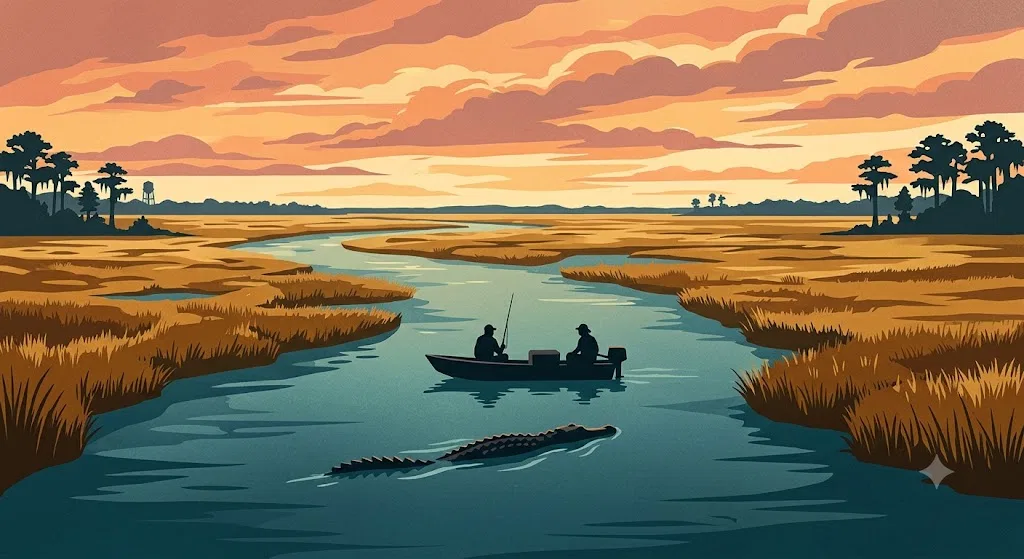
The Altamaha-ha, usually shortened to Altie, is Georgia’s best-known river monster: a long, dark, ridged creature said to move through the lower Altamaha River, Darien’s marsh channels, old rice-field canals and nearby coastal waters. The strongest evidence for it is not physical proof, but a long chain of place-based testimony: newspaper retellings, fishermen’s accounts, local folklore, tourism displays and a few modern media flurries. The most likely explanations are less monstrous but still very Georgian: sturgeon, alligators, gars, eels, floating logs, wakes, decomposing carcasses and the optical tricks of tidal marsh water. No verified body, DNA sample, clear photograph or scientific specimen has confirmed Altie as an unknown animal. That does not make the legend worthless. It makes it a revealing coastal Georgia story about how a real river, real wildlife and repeated human uncertainty can become a monster tradition.
Where the Altamaha-ha legend lives
Altie belongs most strongly to the lower Altamaha River system around Darien and McIntosh County. Local and popular accounts repeatedly place the creature near the river mouth, Butler Island, Fort King George, Cathead Creek, Smith Lake, abandoned rice fields, small creeks and the maze of marsh water where fresh river flow meets the Atlantic coast. Darien’s own visitor materials describe the Altamaha-ha as a legendary creature said to inhabit “small streams and abandoned rice fields near the mouth of the Altamaha River”, and the town has turned the creature into a friendly local mascot rather than a frightening threat.[discoverdarien.com]discoverdarien.comour sea monsterour sea monster
That geography matters. Altie is not just “a monster somewhere in Georgia”; it is tied to a particular kind of landscape. The lower Altamaha is wide, tidal, muddy, biologically rich and visually confusing. The river drains Georgia’s largest watershed, formed by the Ocmulgee and Oconee rivers, and NOAA describes migratory fish such as sturgeon and American shad using accessible habitats below major upstream barriers.[NOAA Fisheries]fisheries.noaa.govOpen source on noaa.gov. The scientific literature on shortnose sturgeon in the Altamaha also places study sites in the estuary near Darien, notes that the lowest 54 km are influenced by tides, and describes the river as undammed and relatively unaltered in its main stem.[OUP Academic]academic.oup.comOpen source on oup.com.
That combination gives the legend its power. A witness on a bank, bridge, fishing boat or houseboat may see only part of an animal: a back rolling at the surface, a tail, a snout, a wake, or a dark curve vanishing in brown water. The marsh does the rest. Distance flattens scale; ripples exaggerate length; a real fish can look like several humps; a log can seem to move when current and tide pull in different directions. The Altamaha-ha story thrives precisely because its home range is not a clear mountain lake. It is a shifting coastal river system full of life, shadows and partial views.
Darien has also given Altie a public face. In 2009, sculpture artist Rick Spears built an adult Altamaha-ha model for the welcome centre, based on eyewitness accounts; visitors can still pose with the creature there.[discoverdarien.com]discoverdarien.comour sea monsterour sea monster Creative Loafing’s 2011 feature found Altie on Darien signage, murals and the welcome-centre display, noting that the statue and local branding had made the monster part of McIntosh County’s visitor identity.[Creative Loafing]creativeloafing.comCreative Loafing Cover StoryCreative Loafing Cover Story That tourism afterlife does not prove the creature exists, but it explains why the legend remains visible even when hard evidence is absent.
What witnesses say they saw
Altie descriptions vary, but several features recur often enough to define the modern image: a long body, dark or grey skin, a ridged back, an alligator-like or crocodile-like snout, sometimes flippers, sometimes humps, and movement that does not quite match an ordinary fish. Creative Loafing summarised the reported “eyewitness consensus” as a dark, smooth hide with tyre-tread-like ridges, a narrow neck, prominent snout and flat, porpoise-like tail.[Creative Loafing]creativeloafing.comCreative Loafing Cover StoryCreative Loafing Cover Story Legends of America, a folklore-oriented source, gives a similar popular description: sturgeon-like body, bony ridge, front flippers, crocodile-like snout, protruding eyes and a usual size claim of roughly 20 to 30 feet, while also acknowledging that no physical evidence has been found.[Legends of America]legendsofamerica.comOpen source on legendsofamerica.com.
The most frequently repeated early newspaper-style account is Captain Delano’s reported sighting near St Simons Island below the mouth of the Altamaha. Later retellings say the account appeared in the Savannah Georgian in April 1830 and described a 70-foot animal with a barrel-like circumference and an alligator-shaped head, seen by Delano and five men aboard the schooner Eagle.[statesboroherald.com]statesboroherald.comaltamaha ha creature earns legendary statusThe 'Altamaha-ha' creature earns legendary status - Statesboro Herald… This is one of the legend’s strongest narrative anchors because it gives the story a named vessel, a named captain, multiple witnesses and a coastal setting close to the Altamaha’s mouth. It is still not biological evidence: it is a historical report filtered through later retellings, not a specimen.
The twentieth-century sightings are more local and more riverine. Reported clusters include timbermen in the 1920s seeing a large snake-like animal, hunters in 1935 describing a “giant snake”, Boy Scouts in the 1940s, Reidsville State Prison officials in the 1950s, two brothers at Clark’s Bluff in 1969, and several 1980 accounts near Cathead Creek and Smith Lake.[statesboroherald.com]statesboroherald.comaltamaha ha creature earns legendary statusThe 'Altamaha-ha' creature earns legendary status - Statesboro Herald… The Clark’s Bluff report is especially useful for understanding the ambiguity of Altie testimony: the witnesses reportedly first thought they were seeing a sturgeon, then changed their minds after noticing an alligator-like snout, a horizontal tail, a triangular ridge and pointed teeth.[Legends of America]legendsofamerica.comOpen source on legendsofamerica.com.
The 1980 reports show the same pattern. One account describes a dark, rough-skinned, roughly 20-foot creature half-stranded on a mud bank near Cathead Creek before it freed itself and submerged. Another describes two brown humps, 15 to 20 feet of apparent length, and a wake like a speedboat in Smith Lake.[statesboroherald.com]statesboroherald.comaltamaha ha creature earns legendary statusThe 'Altamaha-ha' creature earns legendary status - Statesboro Herald… These are memorable claims because they are concrete: named places, specific movements, rough measurements, and behaviour that sounds animal-like. They are also vulnerable to the usual problems of water sightings: no recovered body, no scale reference, brief viewing windows and descriptions shaped by expectation after the fact.
Why the testimony is interesting but not proof
Altie is a good example of a legend built from cumulative testimony rather than a single decisive case. The claims are spread across generations, often come from people who knew the river, and are not all identical copies of one another. That makes the tradition more interesting than a one-off hoax. At the same time, the evidence has the central weakness of most water-monster stories: it rarely survives the moment of observation.
The most important missing category is physical evidence. No verified Altamaha-ha carcass, skeleton, tissue sample, scale, tooth, egg, trackway or environmental DNA result has established the presence of a large unknown animal in the river. Local and folklore sources openly state that no physical evidence has been found.[Legends of America]legendsofamerica.comOpen source on legendsofamerica.com. This matters because the lower Altamaha is not an inaccessible ocean trench. It is a worked and visited coastal system used by fishermen, boaters, researchers, wildlife managers and tourism operators. A breeding population of large animals would be expected to leave more than stories: strandings, bycatch, remains, clear images, repeatable sonar targets or ecological traces.
The second problem is description drift. Altie is sometimes snake-like, sometimes sturgeon-like, sometimes eel-like, sometimes crocodile-snouted, sometimes flippered, sometimes hump-backed and sometimes 10 feet long rather than 70. Variation does not automatically disprove a witness tradition; people genuinely do describe frightening or unfamiliar animals differently. But variation makes it harder to treat the reports as observations of one consistent species.
The third problem is cultural feedback. Once a river has a named monster, later sightings are interpreted through that name. A strange wake becomes “maybe Altie”; a decomposed carcass becomes “baby Altie”; a ridged fish becomes “the river monster”. Creative Loafing found that Darien’s marketing had amplified the monster’s modern visibility, while also quoting the sculptor as saying he had to extrapolate the creature’s body because the descriptions were limited and there was no fossil-like evidence to guide anatomy.[Creative Loafing]creativeloafing.comCreative Loafing Cover StoryCreative Loafing Cover Story This is how folklore works: not as a simple lie, but as a loop between landscape, memory, retelling and local identity.

Sturgeon, alligators and muddy-water explanations
The most grounded explanation for many Altie reports is not one animal but several ordinary causes, each capable of producing a “monster” under the right conditions.
Sturgeon are the strongest biological comparison. Atlantic sturgeon can reach up to 14 feet and have bony plates, called scutes, running along the body, plus a shark-like tail and distinctive snout barbels.[NOAA Fisheries]fisheries.noaa.govFisheries Atlantic Sturgeon | NOAA FisheriesFisheries Atlantic Sturgeon | NOAA Fisheries Shortnose sturgeon are also genuinely important in the Altamaha system: recent research describes the river as supporting one of the largest shortnose sturgeon populations in the southern part of the species’ range, with adults and juveniles concentrated near the freshwater-saltwater interface during much of the year.[OUP Academic]academic.oup.comOpen source on oup.com. A large sturgeon rolling, surfacing or partly seen in turbid water could plausibly account for a ridged back, ancient-looking body, odd tail and sudden disappearance. It would not explain every reported detail, especially exaggerated lengths or alligator-like heads, but it is a serious natural candidate.
Alligators fit some head-and-wake reports. Georgia DNR says there are about 200,000 alligators in Georgia, typically south of the fall line, which includes the coastal plain where the lower Altamaha lies.[coastalgadnr.org]coastalgadnr.orgAmerican Alligator | Department Of Natural Resources DivisionAmerican Alligator | Department Of Natural Resources Division An alligator swimming with only its head, back or tail visible can be easy to misjudge, especially at dusk or from a moving boat. However, alligators also create a sceptical challenge for some Altie accounts: many local witnesses know what alligators look like. When a report insists the animal was not an alligator, that does not prove a monster, but it does show why the legend has persisted among river users rather than disappearing into a single easy answer.
Gar and long fish can create the “living fossil” effect. Alligator gar are often suggested in cryptid discussions because they are huge, armoured-looking fish with broad snouts and teeth. USGS describes alligator gar as coastal-estuary and major-river fish found in fresh, brackish and sometimes salt water, reaching nearly 10 feet.[Nonindigenous Aquatic Species]nas.er.usgs.govAlligator Gar (Atractosteus spatula) - Species Profile… The Florida Museum notes that alligator gar have elongated bodies, thick ganoid scales, a broad snout with fang-like teeth, and the habit of lying near the surface so they may look like logs.[Florida Museum]floridamuseum.ufl.eduFlorida Museum Alligator Gar – Discover FishesFlorida Museum Alligator Gar – Discover Fishes There is a caution, though: alligator gar are primarily Gulf Coastal Plain and Mississippi Basin animals, and Georgia sources more commonly discuss longnose, Florida and spotted gar. So gar-like confusion is plausible as a general visual mechanism, but claims of alligator gar specifically in the Altamaha should be treated carefully unless backed by a reliable local record.
Eels, manatees, otters and floating debris can add pieces of the puzzle. A large eel-like fish or swimming animal can supply the “snake” impression. An otter group can look like humps moving in sequence. A manatee, where present in coastal waters, can create a surprising broad back or wake. Logs and mats of vegetation can seem animated in tidal current, especially when water curls around them. None of these explains every Altie story, but a legend does not require one explanation for every report. It can be built from many misread moments that all get filed under the same monster name.
The 2018 Wolf Island carcass showed how Altie works now
The modern Altie legend had its most instructive recent test in March 2018, when images of a strange carcass-like object from Wolf Island National Wildlife Refuge spread through local and national media. The location mattered: Wolf Island sits in the same coastal region as the Altamaha-ha legend, so the object was quickly interpreted through the local monster story. National Geographic reported that scientists were divided between possibilities such as a decomposing fish and an outright hoax, but stressed that without a physical sample it would likely be impossible to determine the object’s origin.[National Geographic]nationalgeographic.comOpen source on nationalgeographic.com.
The sceptical red flags appeared quickly. Jacksonville University marine biologist Quinton White told News4Jax that the consensus among colleagues who had seen the photo was that it looked fake, and Georgia officials said they had not recovered a carcass to examine.[WJXT]news4jax.comWJXTMysterious Georgia sea creature a hoax?WJXTMysterious Georgia sea creature a hoax? National Geographic also quoted White saying the object looked too intact for normal decomposition, and University of Georgia naturalist John “Crawfish” Crawford as being convinced it was a constructed model of a baby Altamaha-ha.[National Geographic]nationalgeographic.comOpen source on nationalgeographic.com.
The later claimed explanation was even more revealing: Vice reported that the object was apparently a taxidermied shark with papier-mâché elements, associated with the viral hoax artist Zardulu.[VICE]vice.comThis Washed-Up Sea Creature Was the Work of Viral Hoaxer ZarduluThis Washed-Up Sea Creature Was the Work of Viral Hoaxer Zardulu Whether read as art stunt, hoax or internet myth-making, the Wolf Island case is valuable because it shows the difference between a monster-looking object and evidence. Without chain of custody, recovery, expert examination and testable material, even a startling carcass can become just another story.
It also shows how quickly Altie can be reactivated. A single image, a coastal location and a familiar monster outline were enough to move the legend from local folklore into national science-and-weird-news coverage. That is the twenty-first-century version of a riverbank rumour: not a fireside tale or a newspaper dispatch, but a viral photograph interpreted through an old name.
The changing story around Altamaha ha
The Altamaha-ha seems to have moved through three overlapping stages. The first is oral and local: Indigenous and settler-era stories of a large hissing or bellowing water creature in the river country. Modern sources often connect the legend to Muskogee or Lower Muskogee Creek tradition, though the details are usually repeated in secondary folklore accounts rather than presented with a clearly traceable primary oral-history source.[discoverdarien.com]discoverdarien.comour sea monsterour sea monster That uncertainty matters. It is reasonable to say the legend is commonly described as pre-colonial or Indigenous-rooted; it is less safe to claim that every modern Altie detail comes directly from a documented Indigenous tradition.
The second stage is newspaper and river-worker testimony: schooners, timbermen, hunters, fishermen, Boy Scouts and local officials. These accounts give Altie the shape of a witness-report cryptid. They also move the creature from mythic river being to possible animal: a thing with length, colour, teeth, ridges, a tail and behaviour.
The third stage is mascot and media creature. Darien’s welcome-centre sculpture, murals, billboard imagery and visitor storytelling make Altie approachable. The monster becomes part of a road-trip itinerary, not just a frightening unknown in the water.[Creative Loafing]creativeloafing.comCreative Loafing Cover StoryCreative Loafing Cover Story The 2018 Wolf Island story then added the internet layer: a strange image, rapid speculation, expert scepticism and a hoax-style afterlife.
That evolution does not cheapen the legend. It explains why Altie remains Georgia’s signature river monster. Unlike a purely imported “Loch Ness” comparison, Altie has a habitat, a town, a pattern of reports and a local economy of retelling. The creature has become a shorthand for the lower Altamaha itself: old, muddy, tidal, biologically rich and not always easy to read at a glance.
What would change the evidence picture?
For Altie to move from folklore and witness claim towards zoological possibility, the evidence would need to become physical, repeatable and independently examined. A clear photograph would help, but photos alone are weak in an era of hoaxes, models and digital manipulation. Better evidence would include a recovered carcass or tissue sample with documented chain of custody, DNA analysis from a reliable lab, repeated high-quality video from multiple angles, sonar paired with visual confirmation, or environmental DNA detections that do not match known local species.
The Altamaha is already studied by fisheries scientists, which makes the absence of such evidence important. Researchers use tools such as capture-mark-recapture sampling for sturgeon and environmental DNA to detect species presence in the basin.[OUP Academic]academic.oup.comOpen source on oup.com. If a large breeding population of unknown aquatic animals were present in the same system, it would not be impossible to miss, but it would become harder to explain the longer modern monitoring continues without biological traces.
The fairest conclusion is that Altie is not supported as a confirmed unknown animal. The evidence is testimonial, folkloric and circumstantial. Yet the legend is not random. It is attached to a real ecosystem that contains large, strange-looking animals, strong local memory and plenty of poor viewing conditions. Altie survives because the lower Altamaha gives people just enough to see something — and just enough muddy water to wonder what they missed.
eBay marketplace picks
Marketplace Samples
Live-tested eBay searches with available results related to this page.

Endnotes
1.
Source: discoverdarien.com
Title: our sea monster
Link:https://discoverdarien.com/our-sea-monster/
2.
Source: fisheries.noaa.gov
Link:https://www.fisheries.noaa.gov/feature-story/supporting-fisheries-research-and-restoration-georgias-largest-watershed
3.
Source: academic.oup.com
Link:https://academic.oup.com/mcf/article/16/3/1/7900056
4.
Source: statesboroherald.com
Title: altamaha ha creature earns legendary status
Link:https://www.statesboroherald.com/life/altamaha-ha-creature-earns-legendary-status/
Source snippet
The 'Altamaha-ha' creature earns legendary status - Statesboro Herald...
5.
Source: fisheries.noaa.gov
Title: Fisheries Atlantic Sturgeon | NOAA Fisheries
Link:https://www.fisheries.noaa.gov/species/atlantic-sturgeon
6.
Source: coastalgadnr.org
Title: American Alligator | Department Of Natural Resources Division
Link:https://coastalgadnr.org/american-alligator
7.
Source: nas.er.usgs.gov
Title: Nonindigenous Aquatic Species
Link:https://nas.er.usgs.gov/queries/FactSheet.aspx?speciesID=755
Source snippet
Alligator Gar (Atractosteus spatula) - Species Profile...
8.
Source: news4jax.com
Title: WJXTMysterious Georgia sea creature a hoax?
Link:https://www.news4jax.com/news/2018/03/19/mysterious-georgia-sea-creature-a-hoax/
9.
Source: vice.com
Title: This Washed-Up Sea Creature Was the Work of Viral Hoaxer Zardulu
Link:https://www.vice.com/en/article/this-washed-up-sea-creature-was-the-work-of-viral-hoaxer-zardulu/
10.
Source: fisheries.noaa.gov
Title: fish passage projects selected funding
Link:https://www.fisheries.noaa.gov/national/habitat-conservation/fish-passage-projects-selected-funding
11.
Source: repository.library.noaa.gov
Title: noaa 71183 DS1
Link:https://repository.library.noaa.gov/view/noaa/71183/noaa_71183_DS1.pdf
12.
Source: fisheries.noaa.gov
Title: restoring habitat migratory fish look back recovery act part 2
Link:https://www.fisheries.noaa.gov/feature-story/restoring-habitat-migratory-fish-look-back-recovery-act-part-2
13.
Source: videos.fisheries.noaa.gov
Title: restoring the ancient sturgeon
Link:https://videos.fisheries.noaa.gov/detail/videos/greater-atlantic-region/video/6316275674112/restoring-the-ancient-sturgeon?autoStart=true&page=1
14.
Source: fisheries.noaa.gov
Title: river herring
Link:https://www.fisheries.noaa.gov/species/river-herring
15.
Source: academic.oup.com
Link:https://academic.oup.com/mcf/article/8/1/595/7827139
16.
Source: creativeloafing.com
Title: Creative Loafing Cover Story
Link:https://creativeloafing.com/content-196415-cover-story—stalking-altie-does-georgia-have-its-own-loch-ness
17.
Source: legendsofamerica.com
Link:https://www.legendsofamerica.com/ga-altamahaha/
18.
Source: floridamuseum.ufl.edu
Title: Florida Museum Alligator Gar – Discover Fishes
Link:https://www.floridamuseum.ufl.edu/discover-fish/species-profiles/alligator-gar/
19.
Source: nationalgeographic.com
Link:https://www.nationalgeographic.com/animals/article/mysterious-sea-creature-washes-ashore-georgia-monster-spd
20.
Source: nationalgeographic.com
Title: dams threaten last sturgeon spawning grounds rioni river georgia
Link:https://www.nationalgeographic.com/animals/article/dams-threaten-last-sturgeon-spawning-grounds-rioni-river-georgia
21.
Source: twoegg.blogspot.com
Link:https://twoegg.blogspot.com/2019/10/altamahaha.html
22.
Source: ecos.fws.gov
Link:https://ecos.fws.gov/ecp/species/11338
23.
Source: paranormalfact.fandom.com
Link:https://paranormalfact.fandom.com/wiki/Altamaha
24.
Source: exploresouthernhistory.com
Title: The Altamaha-ha
Link:https://www.exploresouthernhistory.com/altamahaha.html
Additional References
25.
Source: youtube.com
Title: The Altamaha-ha, Georgia’s Loch Ness monster | 11 Minutes To Midnight
Link:https://www.youtube.com/watch?v=0IN1HAsm02Q
Source snippet
US Fishermen Filmed Unidentified River Creature in Georgia — The Altamaha River Just Got Weirder...
26.
Source: youtube.com
Link:https://www.youtube.com/watch?v=vhfE-Na15As
Source snippet
The Altamaha-ha (Georgia's River/Sea Monster)...
27.
Source: youtube.com
Title: US Fishermen Saw Something Huge in a River… And It Wasn’t a Fish
Link:https://www.youtube.com/watch?v=6pykOzSqlXk
Source snippet
The Altamaha-ha, Georgia's Loch Ness monster | 11 Minutes To Midnight...
28.
Source: regulations.gov
Link:https://www.regulations.gov/document/NOAA-NMFS
29.
Source: federalregister.gov
Link:https://www.federalregister.gov/documents/2010/10/06/2010-24461/endangered-and-threatened-wildlife-and-plants-proposed-listings-for-two-distinct-population-segments
30.
Source: youtube.com
Title: Giant Dinosaur Like Creature Reported In Altamaha River Again
Link:https://www.youtube.com/watch?v=9x33OIlE0hQ
Source snippet
Georgia Altamaha River Giant Monster Was Spotted Today...
31.
Source: youtube.com
Title: Georgia Altamaha River Giant Monster Was Spotted Today
Link:https://www.youtube.com/watch?v=ma_raRYbTY8
Source snippet
US Fishermen Saw Something Huge in a River… And It Wasn't a Fish...
32.
Source: researchgate.net
Link:https://www.researchgate.net/publication/241735086_Abundance_and_Recruitment_of_Juvenile_Atlantic_Sturgeon_in_the_Altamaha_River_Georgia
33.
Source: funtrivia.com
Link:https://www.funtrivia.com/quizzes/general/the_unexplained/cryptozoology_and_monsters.html
34.
Source: georgiabiodiversity.org
Link:https://georgiabiodiversity.org/portal/about-this-data
Topic Tree