Within Kansas Monsters
Did Kansas Fossils Inspire Flying Monster Reports?
Modern pterosaur stories in Kansas borrow power from the state's real fossil record, but fossil history is not living-animal evidence.
On this page
- Pteranodon and the Western Interior Sea
- Modern pterosaur like sighting claims
- Bird silhouettes, memory and prehistoric imagination
Page outline Jump by section
Introduction
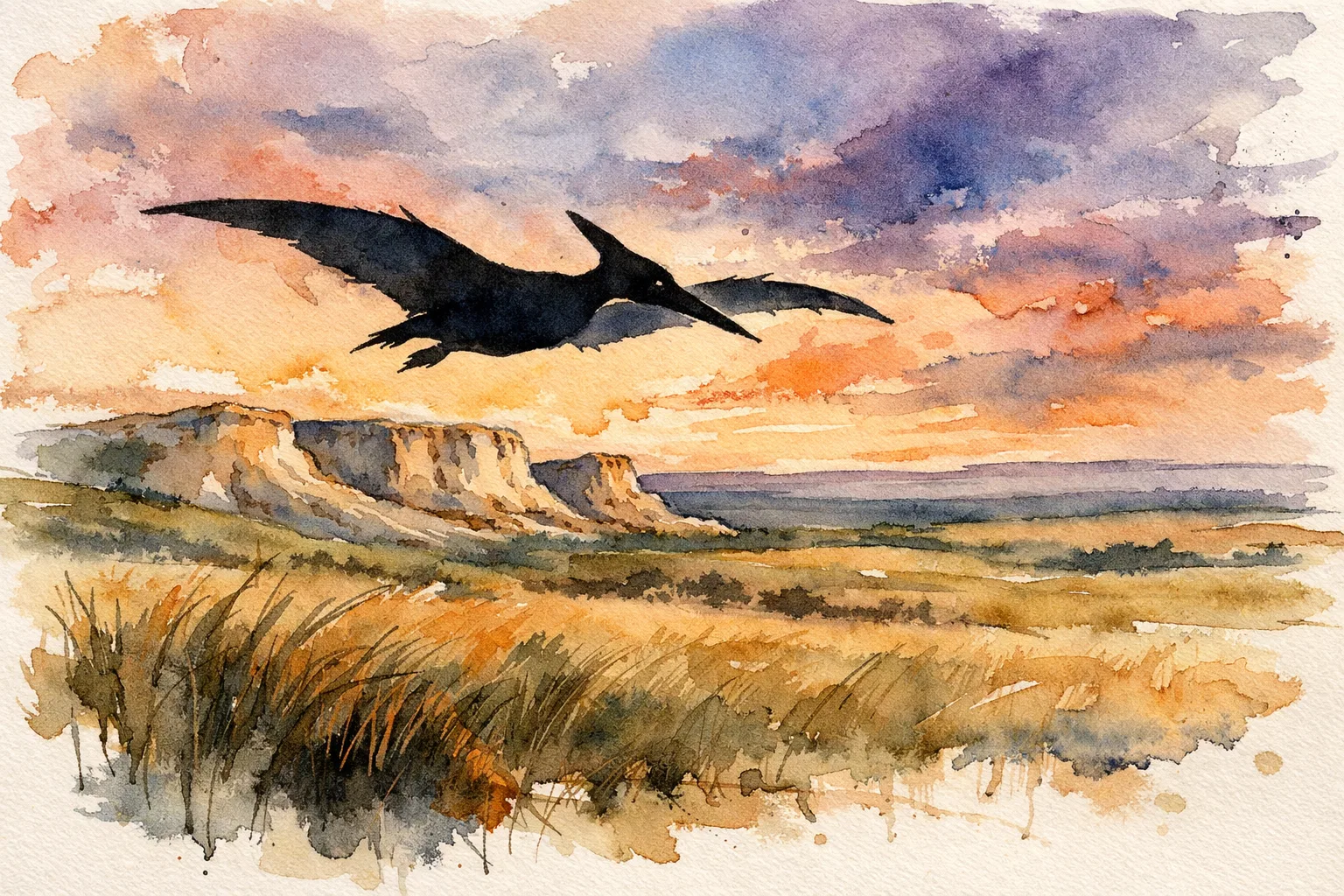
Kansas is one of the best places in North America to imagine a “living pterosaur” story, but that does not make the stories good evidence for a surviving prehistoric animal. The state really did have giant flying reptiles: Pteranodon fossils from western Kansas are famous enough that Kansas made Pteranodon its official state flight fossil in 2014. The modern monster claims, however, are a different kind of evidence. They are mostly anecdotal reports of huge, leathery-winged, pterodactyl-like shapes in the sky, often filtered through online cryptid culture and the state’s fossil identity rather than through physical proof.[KU News]news.ku.eduNews Featured news and headlines | KU NewsNews Featured news and headlines | KU News
That is why Kansas pterosaur claims are interesting even when they are not convincing zoology. They show how real deep-time science can become folklore fuel. A fossil gallery, a chalk badland, a schoolbook Pteranodon silhouette, a heron lifting from a creek, or a pelican circling high over water can all feed the same mental picture: something enormous, ancient and out of place above the plains.
Why Kansas Makes Pterosaurs Easy to Imagine
Kansas’s “sky monster” appeal begins with a geological surprise. Much of western Kansas was once part of the Western Interior Seaway, a broad Cretaceous sea that split North America during the age of dinosaurs. The Smoky Hill Chalk Member of the Niobrara Chalk has produced important remains of fish, sharks, mosasaurs, plesiosaurs, turtles, birds, dinosaurs and pterosaurs, giving the region a world-class fossil reputation.[kgs.ku.edu]kgs.ku.eduKG S–Smoky Hill Chalk Member, Niobrara ChalkKG S–Smoky Hill Chalk Member, Niobrara Chalk
For a monster-story reader, that matters because the landscape itself seems to authorise the image. Kansas is not borrowing a dragon from nowhere. Its rocks have produced real winged reptiles. GeoKansas, a University of Kansas educational site, describes Pteranodon as the Kansas pterosaur type familiar from the fossil record: a toothless, short-tailed flying reptile with hollow bones, crested skulls in mature males and a largest Kansas fossil wingspan of about 26 feet.[geokansas.ku.edu]geokansas.ku.eduPterosaur | Geo KansasPterosaur | Geo Kansas
The state has also made that fossil identity public. KU News reported that the 2014 state fossil law designated Tylosaurus as the Kansas marine fossil and Pteranodon as the Kansas flight fossil, with major specimens represented in Kansas museums and other collections. KU’s Leonard Krishtalka put the point in memorable local terms: for Kansas, mosasaurs and pterosaurs play the symbolic role that dinosaurs do for places such as Wyoming and Montana.[KU News]news.ku.eduNews Featured news and headlines | KU NewsNews Featured news and headlines | KU News
That symbolism helps explain the mechanism behind the legend. A person in Kansas who sees an oversized bird shape does not have to invent the prehistoric comparison from scratch. The state has already supplied the image: Pteranodon on museum displays, fossil posters, local science pages and popular retellings of the Western Interior Sea.

Pteranodon and the Western Interior Sea
The real Pteranodon was not a prairie dragon. It was a Cretaceous flying reptile associated with marine environments. Kansas’s famous chalk beds were deposited in an ancient seaway, not in the dry, modern agricultural landscape that visitors see today. That contrast is part of the appeal: a landlocked state turns out to have an oceanic fossil past.
The fossils are spectacular enough without adding a modern survival claim. Pteranodon was a reptile, not a bird, and it is known from Kansas as a toothless, crested pterosaur with a short tail. That last detail is important for cryptid claims, because many modern “living pterosaur” reports describe a long tail ending in a spade or diamond shape. A Kansas cryptid summary notices the problem directly: the reported monster combines a head crest and a long spade-tipped tail, but “there is no known species with both.”[geokansas.ku.edu]geokansas.ku.eduPterosaur | Geo KansasPterosaur | Geo Kansas
The fossil record also gives Kansas pterosaurs an ecological setting that feels vivid and dangerous. A 2018 study discussed in Smithsonian Magazine examined a Pteranodon specimen from the Smoky Hill Chalk region with a shark tooth associated with its neck vertebrae. The article notes that the area was a marine deposit of the Western Interior Seaway and that the fossil suggests an interaction between Pteranodon and the large Cretaceous shark Cretoxyrhina, though whether it was predation or scavenging cannot be treated as a cinematic certainty.[Smithsonian Magazine]smithsonianmag.comOpen source on smithsonianmag.com.
For folklore, this is potent material. Kansas can offer not only “giant flying reptile” but “giant flying reptile over a vanished sea full of sharks and sea monsters”. The problem is that all of this is fossil evidence for the Cretaceous, not biological evidence for the present.
What Modern Kansas Pterosaur Claims Usually Say
Modern Kansas pterosaur reports are not a large, well-documented sighting tradition in the way that some states have Bigfoot databases or long-running lake monster folklore. The available material is thinner and more internet-driven. The clearest public cluster appears in cryptid retellings that cite reports gathered by Jonathan Whitcomb, a living-pterosaur advocate, and then repeat three Kansas-linked accounts.[clkeating.infprojects.fhsu.edu]clkeating.infprojects.fhsu.eduCryptids of KansasCryptids of Kansas
The most detailed account in that cluster is placed near Garden City in 1994. It describes a child seeing a huge dark-grey creature while running on a dirt road: roughly “the size of a small plane”, with no feathers, bat-like membrane wings, a long thin beak, a crest, and a long tail with a triangular tip. Other cited Kansas-style accounts are vaguer: something huge taking off from trees near Hudson, and a farm-road sighting of a very large bird that made the witness think of a pterodactyl.[clkeating.infprojects.fhsu.edu]clkeating.infprojects.fhsu.eduCryptids of KansasCryptids of Kansas
Those details are useful not because they prove a pterosaur, but because they show the pattern. The reports lean on a small set of recognisable visual cues:
- Leathery or bat-like wings, often used to separate the creature from birds.
- A long beak, which immediately evokes Pteranodon in popular imagination.
- A head crest, matching the schoolbook pterosaur silhouette.
- A long tail with a spade or triangle, closer to other pterosaur imagery than to Kansas Pteranodon.
- Large size, often compared to a small plane or given an estimated wingspan far beyond ordinary expectations.
This is exactly where the evidence becomes fragile. Size estimates of flying animals are notoriously difficult without a known object at the same distance. A bird passing low over a road, rising from a tree line, or gliding against a bright sky can look far larger than it is. Once the witness reaches for “pterodactyl” as the closest comparison, later memory may sharpen the outline into a more prehistoric shape.

Bird Silhouettes, Memory and Prehistoric Imagination
The simplest sceptical explanation is not that witnesses are foolish. It is that Kansas has real large birds, and some of them can look startlingly prehistoric under the wrong viewing conditions. The American White Pelican is especially relevant. Cornell Lab of Ornithology describes it as one of North America’s largest flying birds, with a wingspan of about 96 to 114 inches, a massive bill, very broad wings and long-distance soaring behaviour. Cornell’s overview even says its large head and heavy bill give it a “prehistoric look”.[All About Birds]allaboutbirds.orgOpen source on allaboutbirds.org.
A pelican is not a perfect match for every claim. It is pale rather than dark, and it does not have a long tail. But high overhead, backlit, or seen briefly, it supplies several ingredients that matter in a sky-monster report: huge wings, slow movement, a long head shape and a surprising sense of scale. A person who does not expect a bird that large over inland Kansas can easily experience the first second of recognition as shock rather than identification.
Great Blue Herons offer another route into the legend. Cornell describes them as the largest North American herons, with a long neck, dagger-like bill, broad rounded wings, trailing legs and a wingspan reaching roughly 66 to 79 inches. In flight, the tucked neck and trailing legs create a distinctive outline that can look odd to someone expecting a hawk, goose or crow.[All About Birds]allaboutbirds.orgOpen source on allaboutbirds.org.
Sandhill Cranes add a third possibility. They are large grey birds with a wingspan around 79 inches, they migrate high in the sky, and they are associated with prairies, grasslands and marshes. A crane seen at distance may not explain a leathery-winged monster report in every detail, but it helps explain why Kansas skies can produce “too big to be ordinary” impressions without requiring an extinct reptile.[All About Birds]allaboutbirds.orgOpen source on allaboutbirds.org.
The memory mechanism is just as important as the animal mechanism. A witness may first see “huge bird”. Later, after searching online, seeing Pteranodon reconstructions, or reading other “living pterosaur” accounts, the memory can become more structured: no feathers, bat wings, long beak, crest, tail. That does not mean the witness invented the experience. It means the interpretation may have grown around the experience.
The Long-Tailed Problem
One of the strongest internal clues against a straightforward Kansas Pteranodon explanation is the tail. Kansas’s actual Pteranodon is described as short-tailed. Many modern living-pterosaur stories, including the Kansas accounts repeated in cryptid circles, describe a long tail with a spade or triangular tip.[geokansas.ku.edu]geokansas.ku.eduPterosaur | Geo KansasPterosaur | Geo Kansas
That mismatch matters because it shows that the modern monster is not simply “a Pteranodon survived in Kansas”. It is a hybrid image. It borrows the Kansas fossil aura of Pteranodon, the popular pterodactyl outline of a crested head and long beak, and the long-tailed “ropen” or dragon-like motif common in living-pterosaur internet culture. The result is a creature that feels prehistoric to the public but does not map neatly onto the best-known Kansas fossil animal.
This is a common process in cryptid folklore. The reported animal does not have to match a zoological category cleanly. It has to match a mental category. For many readers and witnesses, “pterodactyl” simply means any large, leathery, ancient-looking flying thing. Kansas’s fossil record then gives that mental category a local address.
Why Fossils Are Powerful but Not Present-Day Evidence
The key distinction is simple: fossils can explain why a story feels plausible, but they do not prove a living population. Kansas has excellent evidence that pterosaurs lived there in the Cretaceous. It does not have comparable evidence that pterosaurs live there now.
A living population of large flying reptiles would be difficult to hide. Such animals would need food, breeding sites, deaths, droppings, tracks, nests, road casualties, clear photographs, repeated observations by birders, and eventually physical remains. Kansas is not an inaccessible jungle canopy. It is crossed by roads, farms, towns, reservoirs, hunters, wildlife officers, fossil collectors, birdwatchers and camera phones. A breeding population of aircraft-sized or even pelican-sized unknown reptiles would leave a broader evidence trail than scattered anecdotes.
This does not make the Kansas stories worthless. It changes what they are useful for. They are better read as fossil-fuelled sky folklore: modern sightings and memories shaped by the state’s prehistoric fame. The real pterosaurs belong to Kansas science; the living-pterosaur reports belong to Kansas monster culture.
How the Kansas Sky Monster Legend Changes Over Time
Kansas pterosaur claims appear to have grown less from old newspaper flaps and more from the meeting of three modern forces: fossil tourism, internet cryptozoology and visual misidentification. Earlier monster traditions often depended on local newspapers, travelling tales and named places. The pterosaur material spreads more like a themed claim: a witness sees a huge flying form, searches for “pterodactyl sighting”, finds living-pterosaur material, and the Kansas fossil record makes the connection feel locally meaningful.
That shift changes the legend’s centre of gravity. The place is still important, but not always in a precise way. Garden City, Hudson, rural roads, tree rows and Kansas City-area winged-creature rumours all matter as settings, yet the larger engine is the idea that Kansas was once pterosaur country. A modern report does not need a famous haunted bridge or a named monster pond. It only needs sky, distance, a startling silhouette and a fossil memory waiting in the background.[clkeating.infprojects.fhsu.edu]clkeating.infprojects.fhsu.eduCryptids of KansasCryptids of Kansas
This also explains why Kansas pterosaur stories sit beside, but apart from, the state’s other cryptid material. Sinkhole Sam is tied to a specific water feature. Kansas Bigfoot reports tend to follow wooded corridors and road encounters. Pterosaur claims are more thematic: they turn the whole western fossil landscape, and sometimes the wider Kansas sky, into a stage for prehistoric imagination.
What to Make of Kansas Pterosaur Claims
The most balanced reading is that Kansas has a genuine pterosaur heritage and a much weaker modern pterosaur case. The fossil side is strong: Pteranodon is deeply tied to Kansas chalk, Kansas museums and Kansas public science. The living-creature side is sparse, anecdotal and often shaped by descriptions that do not fit Pteranodon cleanly.[ku.edu]news.ku.eduNews Featured news and headlines | KU NewsNews Featured news and headlines | KU News
For a curious reader, the fun is not spoiled by that distinction. In fact, it makes the story better. Kansas pterosaur claims show how a state’s real deep past can haunt its present-day imagination. A pelican can become prehistoric in the right light. A heron can turn into a dragon for a few seconds. A child who knows what a Pteranodon looks like may look up at the sky and find the Cretaceous staring back.
The sky monster, then, is not best understood as a hidden animal waiting to be confirmed. It is a mechanism: fossil record plus landscape plus silhouette plus memory. Kansas really did have flying reptiles. Modern Kansas has stories about seeing them again. The gap between those two statements is where the legend lives.
Amazon book picks
Further Reading
Books and field guides related to Did Kansas Fossils Inspire Flying Monster Reports?. Use these as the next step if you want deeper reading beyond the article.
The Princeton Field Guide to Pterosaurs
Explains the real prehistoric animals behind many flying-monster claims.
The United States of Cryptids
Explains how local legends emerge around unusual creatures.
eBay marketplace picks
Marketplace Samples
Live-tested eBay searches with available results related to this page.




Endnotes
1.
Source: clkeating.infprojects.fhsu.edu
Title: Cryptids of Kansas
Link:https://clkeating.infprojects.fhsu.edu/final/pterosaur.html
2.
Source: kgs.ku.edu
Title: KG S–Smoky Hill Chalk Member, Niobrara Chalk
Link:https://www.kgs.ku.edu/Publications/Bulletins/225/02_intro.html
3.
Source: geokansas.ku.edu
Title: Pterosaur | Geo Kansas
Link:https://geokansas.ku.edu/pterosaur
4.
Source: kgs.ku.edu
Title: eduniobrara chalk (upper cretaceous)
Link:https://www.kgs.ku.edu/Publications/Bulletins/225/Bull225.pdf
5.
Source: kgs.ku.edu
Title: Ed Series18
Link:https://www.kgs.ku.edu/Publications/Bulletins/ED/EdSeries18.pdf
6.
Source: kgs.ku.edu
Title: KGSOFR1990 59
Link:https://www.kgs.ku.edu/Publications/OFR/1990/KGSOFR1990-59.pdf
7.
Source: kgs.ku.edu
Title: KGSOFR1989 5
Link:https://www.kgs.ku.edu/Publications/OFR/1989/KGSOFR1989-5.pdf
8.
Source: kgs.ku.edu
Title: 06 upcret
Link:https://www.kgs.ku.edu/Publications/Bulletins/Vol2/06_upcret.html
9.
Source: kgs.ku.edu
Title: KGSOFR1958 4
Link:https://www.kgs.ku.edu/Publications/OFR/1958/KGSOFR1958-4.pdf
10.
Source: kgs.ku.edu
Title: OFR90 60
Link:https://www.kgs.ku.edu/Publications/OFR/1990/OFR90-60.pdf
11.
Source: kgs.ku.edu
Link:https://www.kgs.ku.edu/Publications/Bulletins/Vol2/Vol2.pdf
12.
Source: sternberg.fhsu.edu
Link:https://sternberg.fhsu.edu/explore-exhibits/index.html
13.
Source: clkeating.infprojects.fhsu.edu
Link:https://clkeating.infprojects.fhsu.edu/final/bigfoot.html
14.
Source: vet.cornell.edu
Title: wayward one eyed pelican first its kind cornell wildlife hospital
Link:https://www.vet.cornell.edu/about-us/news/20191210/wayward-one-eyed-pelican-first-its-kind-cornell-wildlife-hospital
15.
Source: news.ku.edu
Title: News Featured news and headlines | KU News
Link:https://news.ku.edu/news/article/2014/04/09/kansas-designates-two-official-state-fossils
16.
Source: smithsonianmag.com
Link:https://www.smithsonianmag.com/smart-news/what-shark-tooth-doing-neck-flying-pterosaur-180971104/
17.
Source: allaboutbirds.org
Link:https://www.allaboutbirds.org/guide/American_White_Pelican/id
18.
Source: allaboutbirds.org
Link:https://www.allaboutbirds.org/guide/American_White_Pelican/overview
19.
Source: allaboutbirds.org
Link:https://www.allaboutbirds.org/guide/Great_Blue_Heron/id
20.
Source: allaboutbirds.org
Link:https://www.allaboutbirds.org/guide/Sandhill_Crane/id
21.
Source: cryptidz.fandom.com
Link:https://cryptidz.fandom.com/wiki/Ropen
22.
Source: Wikipedia
Title: Smoky Hill Chalk
Link:https://en.wikipedia.org/wiki/Smoky_Hill_Chalk
23.
Source: Wikipedia
Title: American white pelican
Link:https://en.wikipedia.org/wiki/American_white_pelican
24.
Source: Wikipedia
Link:https://en.wikipedia.org/wiki/Pteranodon
25.
Source: audubon.org
Link:https://www.audubon.org/field-guide/bird/american-white-pelican
26.
Source: ebsco.com
Link:https://www.ebsco.com/research-starters/geology/pteranodon
27.
Source: extension.oregonstate.edu
Link:https://extension.oregonstate.edu/incredible-creatures/birds
28.
Source: dinosaursandbarbarians.com
Link:https://dinosaursandbarbarians.com/2025/11/24/pteranodon/
29.
Source: statesymbolsusa.org
Link:https://statesymbolsusa.org/symbol-official-item/kansas/dinosaurs-fossils/pteranodon
Additional References
30.
Source: youtube.com
Title: Everything we know about Pteranodon (not pterodactyls)
Link:https://www.youtube.com/watch?v=DAH7w52EbGo
Source snippet
Cryptid Profile - The Ropen or "The Living Pterosaur"...
31.
Source: youtube.com
Title: Cryptid Profile
Link:https://www.youtube.com/watch?v=kHvBjCyb-Qg
Source snippet
Virtual Museum After Hours - Oceans of Kansas...
32.
Source: facebook.com
Link:https://www.facebook.com/JurassicWorldEvolution/posts/didyouknow-the-first-pteranodon-skull-was-found-in-kansas-usa-all-the-way-back-i/782438147250204/
33.
Source: facebook.com
Link:https://www.facebook.com/USFWS/posts/148250-american-white-pelicans-are-one-of-the-largest-birds-in-north-america-and/1359256472911612/
34.
Source: researchgate.net
Link:https://www.researchgate.net/publication/329658511_Evidence_for_the_Cretaceous_shark_Cretoxyrhina_mantelli_feeding_on_the_pterosaur_Pteranodon_from_the_Niobrara_Formation
35.
Source: researchgate.net
Link:https://www.researchgate.net/publication/360949111_Fossil_vertebrates_from_a_unique_marine_bonebed_of_the_Upper_Cretaceous_Smoky_Hill_Chalk_western_Kansas_USA_new_insights_into_the_paleoecology_of_the_Niobrara_Formation
36.
Source: instagram.com
Link:https://www.instagram.com/reel/DY9NcOhAlrX/
37.
Source: facebook.com
Link:https://www.facebook.com/theprehistoricworld/posts/a-jaw-dropping-sighting-in-ohio-has-left-locals-and-enthusiasts-buzzing-with-exc/876207638443003/
38.
Source: reddit.com
Link:https://www.reddit.com/r/Naturewasmetal/comments/cv63dj/a_shark_tooth_embedded_in_a_pterosaur_vertebra/
39.
Source: allosaurusroar.com
Link:https://allosaurusroar.com/allosaurus-roars-top-dozen-pteranodon-displays/
Topic Tree