Within New Mexico Monsters
Why Chupacabra Stories Fit Ranch Country
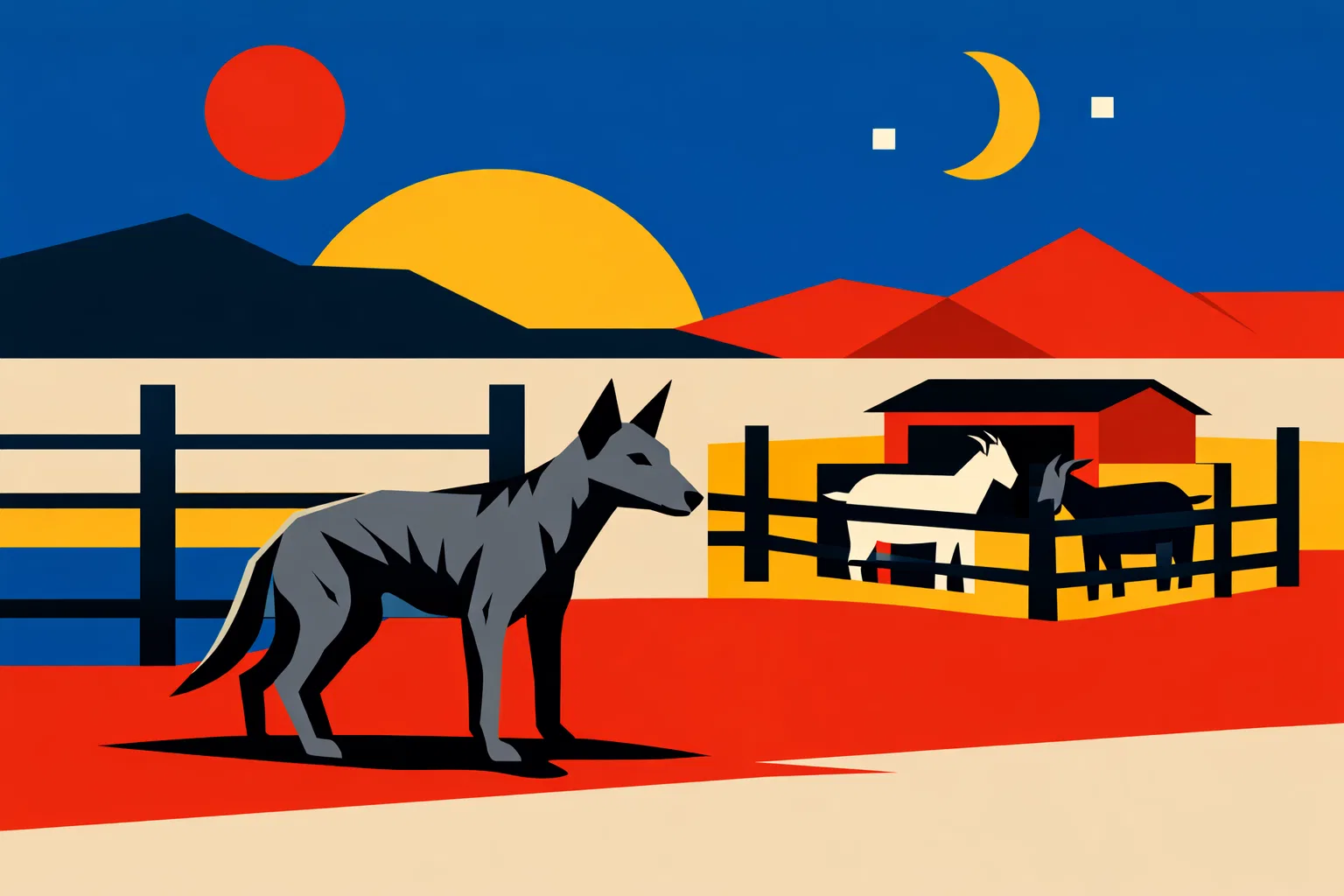
The chupacabra fits New Mexico ranch country because strange livestock losses and hairless coyotes can feed the same frightening story.
On this page
- How the Chupacabra Reached the Southwest
- Livestock Attacks and Hairless Canids
- Why Mange Makes Coyotes Look Monstrous
Page outline Jump by section
Introduction
In New Mexico, chupacabra stories work best when they are read as ranch-country mystery-beast reports rather than as evidence for a confirmed unknown animal. The modern chupacabra legend began in Puerto Rico in the mid-1990s, but its later Southwestern form often looks less like a spiny alien creature and more like a hairless dog, coyote or other canid seen near livestock. That is where New Mexico fits the tale: the state has open range, goats, sheep, calves, coyotes, feral dogs, dark roads, and enough real predator damage to make a strange carcass or night sighting feel ominous. The strongest explanation for many “chupacabra” animals in the American Southwest is not a hidden species, but mange — a mite-caused skin disease that can leave coyotes gaunt, bald, crusted, odd-coloured and frighteningly unlike themselves.[Cornell Wildlife Health Lab]cwhl.vet.cornell.eduWildlife Health Lab MangeWildlife Health Lab Mange
How the Chupacabra Reached the Southwest
The chupacabra is a relatively modern monster, despite the way it is sometimes presented as an ancient borderland terror. University of New Mexico Press describes Benjamin Radford’s Tracking the Chupacabra as a five-year investigation combining eyewitness accounts, field research, forensic analysis and folklore study; Radford’s work places the famous modern outbreak of the legend in the 1990s rather than in remote antiquity.[University of New Mexico Press]unmpress.comUniversity of New Mexico Press Tracking the ChupacabraUniversity of New Mexico Press Tracking the Chupacabra
That matters for New Mexico because the state did not have to invent the chupacabra from scratch. The creature arrived through media, Spanish-language and English-language retellings, borderland rumour, ranch talk, internet lists, and the wider Southwestern habit of attaching eerie explanations to unexplained animal deaths. In its first well-known Puerto Rican form, the creature was often described as more reptilian or alien-like. By the time many US reports were circulating, the “chupacabra” had become much more doglike: hairless, long-snouted, bony-backed, and often filmed or photographed as a strange animal on a road, ranch, or edge-of-town property.
New Mexico is especially receptive to that later version because its landscape already supplies the necessary ingredients. A rancher finding dead goats or sheep does not need a fully developed monster mythology to feel that something unnatural has happened. A driver seeing a bald, sick coyote in the beam of headlights does not need to know Puerto Rican folklore to reach for the most available label. “Chupacabra” becomes a name for the unsettling gap between a familiar animal and a frighteningly unfamiliar appearance.
There is also a local intellectual link. Radford, one of the best-known sceptical investigators of the chupacabra, lives in Corrales, New Mexico, and his book was published by University of New Mexico Press. That does not make the legend uniquely New Mexican, but it does give the state a strong place in the modern investigation and explanation of the creature.[University of New Mexico Press]unmpress.comUniversity of New Mexico Press Tracking the ChupacabraUniversity of New Mexico Press Tracking the Chupacabra

Why Ranch Country Gives the Story Its Shape
The chupacabra’s name means “goat-sucker”, and that livestock angle is why the legend feels at home in New Mexico’s ranching imagination. The state has real predator conflicts, and those conflicts are not evenly distributed. A USDA Wildlife Services environmental assessment for New Mexico notes that livestock predation can hit some producers seriously while leaving others with no damage, and it identifies coyotes as responsible for the majority of livestock losses among predators in the state context.[APHIS]aphis.usda.govOpen source on usda.gov.
That unevenness is important. Monster stories often grow in places where ordinary risk is real but hard to interpret. One ranch may have no trouble for months; another may lose lambs or kids during vulnerable periods. A carcass may be discovered after scavengers have altered it. Tracks may be faint or trampled. Blood may not be obvious. By the time a person finds the animal, the scene can look much stranger than the actual kill.
New Mexico State University’s guide to identifying livestock depredation makes the same practical point from the opposite direction: the first step is to determine whether the death was truly a predator attack, rather than scavenging, disease, starvation or some other cause. It recommends looking for signs such as blood trails, hair and hide, broken vegetation, displaced rocks or soil, tracks and scat before the carcass is disturbed.[NMSU Publications]pubs.nmsu.eduPublications Depredation Report 77 finalPublications Depredation Report 77 final
That careful approach is almost the opposite of how a legend spreads. A good depredation investigation slows the scene down. A chupacabra story speeds it up. One asks, “What signs are present?” The other asks, “What kind of thing could do this?” In the space between those two questions, a sick coyote can become a vampire beast.
Livestock Attacks and Hairless Canids
The “blood-drained livestock” part of chupacabra lore is one of its most memorable claims, but it is also one of the weakest evidentially. In ordinary predator and scavenger cases, the absence of obvious liquid blood does not prove that an animal has been drained. Blood can clot, settle internally, soak into tissue or soil, or become less visible after the body has been opened, moved, fed upon or left in heat.
That is why the more useful New Mexico question is not “what monster drinks blood?” but “what animals actually live here, attack livestock, scavenge carcasses, and sometimes look monstrous?” Coyotes are the obvious starting point. They are common, adaptable predators, and official New Mexico predator-management material treats them as a major source of livestock losses.[APHIS]aphis.usda.govOpen source on usda.gov.
Domestic dogs also complicate the picture. In many rural areas, dogs can harass or kill livestock, and their attacks may be confused with wild predator damage. A strange-looking dog with skin disease, or a coyote-dog hybrid in poor condition, can blur the line even further for a witness who only gets a brief look.
The American chupacabra’s doglike version took hold because it provided a ready-made interpretation for those sightings. A bald coyote’s tail can look ratlike. Its ears can seem too large. Its eyes can appear sunken. Its skin can look grey, blackened, leathery or blueish. Its spine and hips can stand out. In a photograph, it may look like an animal assembled from several species. In headlights, it may seem worse.
That does not mean every New Mexico chupacabra story is identical or equally explainable. Some are second-hand, some are jokes, some are folklore retellings, some are sincere witness claims, and some are attached to livestock losses that were never properly examined. But the recurring “hairless canid near livestock” pattern has a strong real-world mechanism behind it.

Why Mange Makes Coyotes Look Monstrous
Mange is the key biological explanation behind many Southwestern chupacabra claims. Sarcoptic mange is caused by mites; Cornell Wildlife Health Lab describes common signs as hair thinning or loss, thickened and wrinkled skin, scabs, crusts and secondary infections. Demodectic mange can also cause hair loss and dry, flaky, thickened skin.[Cornell Wildlife Health Lab]cwhl.vet.cornell.eduWildlife Health Lab MangeWildlife Health Lab Mange
Those symptoms map closely onto the modern doglike chupacabra image. A healthy coyote is usually recognisable: furred, alert, foxlike, and proportioned in a way most people can place. A severely mangy coyote may lose the visual cues that make it look like a normal coyote. Fur no longer softens the outline. The tail may become thin. The head may look oversized. The back may seem ridged. Exposed skin, scabbing and infection can create the impression of scales or armour.
Mange can also change behaviour in ways that increase sightings. The Wildlife Society reported on research suggesting that coyotes with mange may be more likely to use human food and other human-associated resources. In plain terms, a sick coyote may appear closer to homes, roads, bins, outbuildings or ranch activity than a healthy animal would.[The Wildlife Society]wildlife.orgThe Wildlife Society Mange Might be Causing More Coyote-Human InteractionsThe Wildlife Society Mange Might be Causing More Coyote-Human Interactions
That makes the legend self-reinforcing. The animal looks wrong because it is ill. It is seen in the wrong place because illness may push it towards easier food. It appears at the edge of human space, where people are already alert for threats to pets or livestock. Then the label “chupacabra” supplies a dramatic explanation before wildlife disease gets a chance.
Why the Explanation Fits New Mexico Particularly Well
New Mexico’s chupacabra lore is not only about biology. It is also about setting. A hairless canid in a suburban park may become a neighbourhood curiosity. A hairless canid near goats, sheep, chickens or calves becomes something more charged. The same animal looks different when it is seen beside a corral at dusk.
The state’s geography helps too. New Mexico has desert edges, river valleys, mountain foothills, ranch roads and settlements where wild and domestic animals overlap. Coyotes can move through all of these environments. So can loose dogs. So can stories. The borderland setting also lets the chupacabra feel culturally plausible: the legend is associated with Puerto Rico, Mexico, the wider Southwest and Spanish-speaking media, while New Mexico sits in a region where Anglo, Hispano, Indigenous and Mexican American story-worlds often meet.
That does not mean every use of the legend is old, local or culturally deep. Some New Mexico chupacabra references are plainly internet-age monster culture. Some are tourist-friendly or pop-cultural. Netflix’s family adventure film Chupa, for example, used New Mexico filming locations including Albuquerque, Las Vegas, Mora County, Santa Fe, San Miguel County and southern New Mexico, showing how the creature has become a screen-friendly Southwestern fantasy as well as a ranch-country rumour.[Netflix in Your Neighborhood New Mexico]netflixinyourneighborhoodnm.comOpen source on netflixinyourneighborhoodnm.com.
The important distinction is between folklore fit and factual proof. New Mexico is a good home for chupacabra stories because its ranch landscapes make the story feel believable. That is different from saying the chupacabra has been shown to exist as an unknown animal.
How to Read a New Mexico Chupacabra Claim
A useful way to approach a New Mexico chupacabra report is to separate the claim into parts. The label may be folkloric, but the underlying event may still involve a real animal, a real livestock loss, or a real wildlife disease problem.
First, ask what was actually seen. Was there a living animal, a carcass, tracks, a trail-camera image, or only a dead goat or sheep? A clear photograph of a hairless canid points in a different direction from a vague story about bloodless livestock.
Second, ask whether the livestock death was examined properly. New Mexico State University’s depredation guidance stresses the importance of distinguishing predation from scavenging and other causes before deciding what killed an animal. That is crucial, because a carcass found after scavengers arrive can look like the result of a much stranger attack than it was.[NMSU Publications]pubs.nmsu.eduPublications Depredation Report 77 finalPublications Depredation Report 77 final
Third, look for mange signs. Hair loss, thickened skin, crusting, scabbing, poor condition and a ratlike tail all support the mangy-canid explanation. Cornell’s wildlife health material makes clear that mange can produce exactly the kind of severe hair and skin changes that make a familiar animal look uncanny.[Cornell Wildlife Health Lab]cwhl.vet.cornell.eduWildlife Health Lab MangeWildlife Health Lab Mange
Fourth, be cautious with “blood-drained” claims. Without a veterinary necropsy, that phrase is usually an interpretation, not a demonstrated fact. It may reflect the appearance of the carcass rather than a literal absence of blood.
Finally, check whether the story improves as evidence gets better. Strong evidence would include clear images, preserved biological samples, necropsy results, DNA testing, tracks, and a documented chain of custody. Chupacabra stories often do the opposite: they are most dramatic when evidence is thinnest, and become more ordinary when wildlife experts can examine the animal.
What the Chupacabra Adds to New Mexico Monster Lore
The chupacabra gives New Mexico a different kind of monster from Bigfoot in the forests or giant-bird tales over open country. It is not mainly a wilderness-survival story. It is a boundary story: wild and domestic, natural and unnatural, folklore and disease, predator damage and misread evidence.
That is why the mangy-coyote explanation should not be treated as a boring end to the tale. It is the part that makes the legend most revealing. Mange turns an ordinary animal into something visually wrong. Ranch losses turn an ordinary predator problem into a frightening mystery. Media gives the mystery a name. The result is a creature that can feel ancient, even though its modern form is recent; local, even though it travelled widely; and supernatural, even when the animal at the centre may be a sick coyote standing in the wrong light.
For New Mexico, the chupacabra is best understood as a modern ranch-country legend with a plausible wildlife core. The monster is not confirmed. The fear, the livestock stakes, the strange sightings and the diseased canids are real enough to explain why people keep seeing it.
Amazon book picks
Further Reading
Books and field guides related to Why Chupacabra Stories Fit Ranch Country. Use these as the next step if you want deeper reading beyond the article.
Tracking the Chupacabra
Directly examines the legend, evidence, folklore, and canid explanations.
Mysterious America
Provides broader context for mystery-animal reports in North America.
American Monsters
Includes discussion of modern American monster traditions such as the chupacabra.
Monsters of the Gévaudan
Useful for understanding how monster stories emerge from real landscapes and fears.
eBay marketplace picks
Marketplace Samples
Live-tested eBay searches with available results related to this page.
Endnotes
1.
Source: cwhl.vet.cornell.edu
Title: Wildlife Health Lab Mange
Link:https://cwhl.vet.cornell.edu/resource/mange
2.
Source: aphis.usda.gov
Link:https://www.aphis.usda.gov/sites/default/files/nm-2021-pdm-ea.pdf
3.
Source: pubs.nmsu.edu
Title: Publications Depredation Report 77 final
Link:https://pubs.nmsu.edu/_ritf/RITF77.pdf
4.
Source: wildlife.org
Title: The Wildlife Society Mange Might be Causing More Coyote-Human Interactions
Link:https://wildlife.org/mange-might-be-causing-more-coyote-human-interactions/
5.
Source: aphis.usda.gov
Title: protect livestock from predators
Link:https://www.aphis.usda.gov/operational-wildlife-activities/protect-livestock-from-predators
6.
Source: aphis.usda.gov
Title: wildlife services
Link:https://www.aphis.usda.gov/wildlife-services
7.
Source: aphis.usda.gov
Title: coyotes wdm technical series
Link:https://www.aphis.usda.gov/sites/default/files/coyotes-wdm-technical-series.pdf
8.
Source: aphis.usda.gov
Title: va 2015 livestock ea
Link:https://www.aphis.usda.gov/sites/default/files/va-2015-livestock-ea.pdf
9.
Source: vet.cornell.edu
Title: sarcoptic mange scabies
Link:https://www.vet.cornell.edu/departments-centers-and-institutes/riney-canine-health-center/canine-health-topics/sarcoptic-mange-scabies
10.
Source: nmdeptag.nmsu.edu
Title: wildlife programs
Link:https://nmdeptag.nmsu.edu/wildlife-programs.html
11.
Source: jornada.nmsu.edu
Link:https://jornada.nmsu.edu/files/bibliography/334.pdf
12.
Source: unmpress.com
Title: University of New Mexico Press Tracking the Chupacabra
Link:https://www.unmpress.com/9780826350152/tracking-the-chupacabra/
13.
Source: netflixinyourneighborhoodnm.com
Link:https://netflixinyourneighborhoodnm.com/?title=chupa
14.
Source: abcnews.com
Link:https://abcnews.com/Technology/chupacabra-sighting-texas-wildlife-biologist-pictures-prove-legend/story?id=14054232
15.
Source: benjaminradford.com
Title: tracking the chupacabra
Link:https://benjaminradford.com/tracking-the-chupacabra/
16.
Source: folkbestiary.com
Title: new mexico
Link:https://folkbestiary.com/new-mexico/
17.
Source: Wikipedia
Link:https://en.wikipedia.org/wiki/Chupacabra
18.
Source: Wikipedia
Title: Tracking the Chupacabra
Link:https://en.wikipedia.org/wiki/Tracking_the_Chupacabra
19.
Source: dep.nj.gov
Link:https://dep.nj.gov/wp-content/uploads/njfw/mange.pdf
20.
Source: yumpu.com
Link:https://www.yumpu.com/en/document/view/51677143/coyote-new-mexico-game-and-fish
21.
Source: dnr.wisconsin.gov
Link:https://dnr.wisconsin.gov/topic/wildlifehabitat/disease/Mange
22.
Source: urbancoyoteresearch.com
Link:https://urbancoyoteresearch.com/coyote-info/disease
Additional References
23.
Source: youtube.com
Title: El Chupacabra Debunked? New Evidence Suggests Legendary Beast Isn’t Real
Link:https://www.youtube.com/watch?v=z-ndgbOuttc
Source snippet
Chupacabra–Coyote Connection? The Mystery of the Blue Dogs...
24.
Source: ncwildlife.gov
Link:https://www.ncwildlife.gov/connect/have-wildlife-problem/wildlife-conflicts/common-wildlife-diseases/mange
25.
Source: mass.gov
Link:https://www.mass.gov/info-details/mange-in-wildlife
26.
Source: youtube.com
Title: CHUPACABRA interview with Benjamin Radford
Link:https://www.youtube.com/watch?v=RGylxSAzgug
Source snippet
El Chupacabra Debunked? New Evidence Suggests Legendary Beast Isn't Real...
27.
Source: facebook.com
Link:https://www.facebook.com/6NewsKCEN/posts/a-mangy-dog-coyote-chupacabra-what-do-you-think-the-mystery-animal-could-be/667331255429187/
28.
Source: apvnm.org
Link:https://apvnm.org/ban-on-coyote-killing-contests/
29.
Source: medium.com
Link:https://medium.com/%40eyegiene/benjamin-radfords-tracking-the-chupacabra-the-vampire-beast-in-fact-fiction-and-folklore-d7350760e8b0
30.
Source: facebook.com
Link:https://www.facebook.com/ErinSaidItWould/posts/chupacabra-sighting-kold-news-13-viewer-steve-r-managed-to-grab-a-quick-photo-of/1152229730035557/
31.
Source: instagram.com
Link:https://www.instagram.com/cbdoflascruces/
32.
Source: reddit.com
Link:https://www.reddit.com/r/NewMexico/comments/18g0z6p/curious_question_does_new_mexico_have_its_own/
Topic Tree