Within New Mexico Monsters
Are New Mexico's Sky Monsters More Than Birds?
New Mexico's giant-bird stories need careful sorting between Indigenous thunderbird traditions, modern cryptid claims and ordinary big birds.
On this page
- Thunderbird Tradition and Cultural Meaning
- Modern Reports of Oversized Flying Creatures
- Cranes, Owls, Bats and Distance Illusions
Page outline Jump by section
Introduction
New Mexico’s sky-monster stories sit at the meeting point of three different things: Indigenous thunderbird traditions, modern claims of oversized flying creatures, and ordinary large birds seen under dramatic desert conditions. The result is a legend that feels local without being easy to pin down. A sandhill crane lifting out of Bosque del Apache at dawn, an owl crossing a road at night, or hundreds of thousands of bats pouring from Carlsbad Cavern can all look uncanny for a few seconds. At the same time, New Mexico also has a small but persistent modern “giant bird” tradition, especially around southern New Mexico and the Doña Ana and Organ Mountains, where reports have been linked by some cryptid writers to extinct teratorns.
The careful answer is that New Mexico has strong sky-lore, real spectacular bird and bat phenomena, and a handful of modern giant-bird claims, but no verified evidence for a living prehistoric bird or literal thunderbird. The legend is most useful when treated as a layered story: cultural meaning first, eyewitness claims second, and natural explanations always close at hand.
Thunderbird Tradition and Cultural Meaning
The word “thunderbird” is often used in cryptid writing as if it simply means “enormous mystery bird”, but that flattens a much older and more complex set of Indigenous traditions. Across North America, thunderbirds or thunder-beings are powerful spiritual figures associated with storms, protection, upper-world power and natural force. Audubon’s account of thunderbird traditions stresses that their attributes vary by tribe and even by family line, and that ethnographic records contain hundreds of references across Native cultures rather than one single, standardised monster profile.[Audubon]audubon.orgRulers of the Upper Realm, Thunderbirds Are PowerfulRulers of the Upper Realm, Thunderbirds Are Powerful
That matters for New Mexico because the state’s modern monster lists often borrow the thunderbird name to describe any huge bird seen in the Southwest. A thunderbird in cultural tradition is not the same thing as a biological claim about an unknown species. In many Indigenous contexts, the being belongs to ceremony, story, cosmology and moral order. In modern cryptid retellings, by contrast, it is often turned into a possible surviving animal: a giant eagle, a living teratorn, a pterosaur-like creature, or a winged predator big enough to carry off livestock. Those are very different categories of story.
New Mexico’s wider cultural landscape makes the thunderbird especially easy to absorb into public symbolism. Albuquerque’s municipal flag, adopted in 1968, includes a stylised bird symbol often described as a thunderbird alongside the Zia sun symbol and the city’s founding year.[Wikipedia]WikipediaFlag of Albuquerque, New MexicoFlag of Albuquerque, New Mexico That does not prove a local monster tradition in itself, but it shows how a sky-bird image can become part of civic identity, Southwestern design and local imagination.
For readers of monster lore, the key distinction is respect and accuracy. It is fair to discuss how thunderbird imagery influences New Mexico cryptid storytelling. It is less fair to treat sacred or culturally specific traditions as raw material for a “creature file”. A thunderbird tradition may explain why a huge bird in a storm feels meaningful, but it should not be reduced to a blurry animal sighting.

Why New Mexico’s Sky Makes Giant Birds Feel Plausible
New Mexico is a particularly good stage for sky-monster stories because the horizon is huge. Open desert, mountain ridges, mesas, high winds and sudden weather changes all make distance hard to judge. A large bird gliding above a ridge can look much bigger than it is if there is no familiar object nearby for scale. A flock rising at dawn can seem like one enormous moving shadow. A nocturnal bird seen briefly in headlights can become a creature with impossible wings.
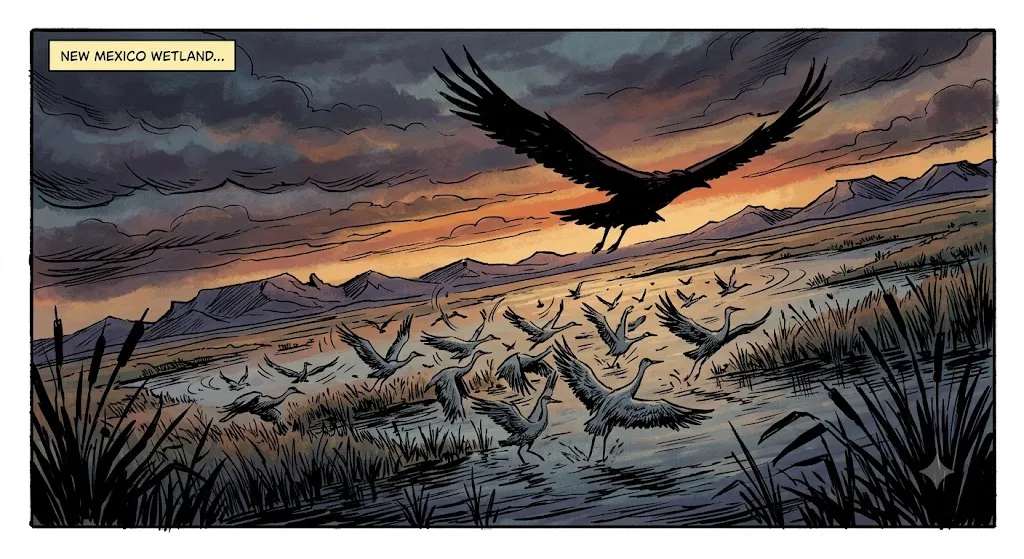
The state also has real, impressive flying animals. Bosque del Apache National Wildlife Refuge in Socorro County is famous for wintering cranes, geese and ducks; the U.S. Fish and Wildlife Service describes the refuge as a 57,331-acre site established in 1939 as a critical stopover for migrating waterfowl, with tens of thousands of cranes, geese and ducks wintering there.[U.S. Fish and Wildlife Service]fws.govOpen source on fws.gov. The refuge’s wildlife-watching guidance notes that the greatest bird numbers usually appear from early November to late January, when snow geese and sandhill cranes roost in water and fly out around dawn.[U.S. Fish and Wildlife Service]fws.govOpen source on fws.gov.
Sandhill cranes are not cryptids, but they are big enough to startle people who are not expecting them. The National Wildlife Federation describes sandhill cranes as four to five feet tall, with a wingspan up to 6.5 feet.[National Wildlife Federation]nwf.orgSandhill Crane New MexicoSandhill Crane New Mexico When a group of cranes lifts off in cold light, calling loudly over the Rio Grande Valley, the scene has exactly the kind of scale and strangeness that later stories can exaggerate.
Owls add another layer. The National Park Service identifies the great horned owl as the largest owl found in New Mexico, a nocturnal predator that may be seen “flying high and wide” at White Sands after dark.[National Park Service]nps.govNational Park Service Great Horned OwlNational Park Service Great Horned Owl Owls can look larger than they are because of their broad wings, silent flight and sudden appearance. A barn owl or great horned owl crossing a road at windscreen height can feel less like a bird and more like a pale, silent shape with a face.
Then there are bats. Carlsbad Caverns National Park hosts one of New Mexico’s most famous sky spectacles: the mass evening outflight of Brazilian free-tailed bats. The National Park Service says visitors can watch several hundred thousand bats leave Carlsbad Cavern from April through mid-October, and older park material notes that the summer colony can range from hundreds of thousands to more than a million during migration peaks.[National Park Service]nps.govNational Park Service Brazilian Free-Tail Bat OutflightNational Park Service Brazilian Free-Tail Bat Outflight A single bat is small; a churning column of bats at dusk is a different visual experience altogether. It can look like smoke, a living cloud, or something much larger than the animals composing it.
Modern Reports of Oversized Flying Creatures
The best-known New Mexico giant-bird claim centres on southern New Mexico. A Las Cruces local account describes resident Dave Zander reporting two enormous birdlike creatures on 19 July 2007 near the Doña Ana and Organ Mountains, with wingspans he estimated at least 20 feet.[LasCruces.com]lascruces.comLas Cruces.com -Uncanny Mysteries of the BorderlandsLas Cruces.com -Uncanny Mysteries of the Borderlands The same story has circulated in cryptid spaces with additional details: Zander had spent years hiking and fossil hunting in the area; he described the creatures as perched less than a mile away before one dropped from the mountain and spread huge wings; later retellings compare the size to small planes.[Tapatalk]tapatalk.comLarge Bird's in the Cooke's areaLarge Bird's in the Cooke's area
This case matters because it gives New Mexico’s sky-monster lore a specific modern anchor rather than a vague “people say” tradition. It has a named witness, a reported date, a landscape, and a claimed scale. It also has the weaknesses common to cryptid reports: no specimen, no clear photograph, no independent biological confirmation, and an estimate made across distance in mountainous terrain.
Some cryptid writers connect the Zander report and similar Southwestern accounts to teratorns, extinct giant birds known from the fossil record. The National Park Service describes Teratornis merriami as an extinct bird of prey with an 11- to 12-foot wingspan, about one third larger than living condors.[National Park Service]nps.govthe giant birdthe giant bird That is enormous by modern bird standards, but still notably smaller than the 20-foot wingspan claimed in the Las Cruces report. Larger teratorn relatives did exist elsewhere in the Americas, but the leap from “giant birds once existed” to “giant birds still live in New Mexico” is not supported by mainstream evidence.
The teratorn angle is still useful, because it explains why the story feels different from a generic thunderbird tale. A thunderbird is usually a spiritual or mythic figure. A teratorn is a real extinct animal. Modern New Mexico sky-monster lore often slides between those two meanings: the creature is given the wonder of folklore and the supposed plausibility of palaeontology. That blend is powerful storytelling, but it is not the same as proof.
There are also scattered claims of pterosaur-like creatures in New Mexico and the wider Southwest. These tend to be even harder to evaluate. A pterosaur is not a bird, and there is no accepted evidence that any pterosaurs survived the end-Cretaceous extinction. Reports of leathery wings, long tails or “prehistoric” silhouettes often resemble the way people describe something they cannot quickly classify, rather than a stable pattern pointing to one animal.
Cranes, Owls, Bats and Distance Illusions
Most New Mexico sky-monster reports can be tested by asking a simple question: what normal flying thing would be present in that place, at that season, in that light?
For central New Mexico wetlands, cranes and geese are the first candidates. Bosque del Apache has seasonal fly-outs and fly-ins that draw photographers precisely because they are dramatic. The U.S. Fish and Wildlife Service describes dawn take-offs and dusk returns of sandhill cranes and snow geese in winter, with the birds leaving water roosts for fields and returning to marshes.[U.S. Fish and Wildlife Service]fws.govU.S. Fish and Wildlife Service Winter Scenes | U.S. Fish & Wildlife ServiceU.S. Fish and Wildlife Service Winter Scenes | U.S. Fish & Wildlife Service In poor visibility, a line of cranes can merge into one dark moving form; at a distance, a bird with a six-foot wingspan can be doubled or tripled in a witness’s memory.
For mountain and desert-edge reports, raptors and vultures matter. New Mexico has many large soaring birds, and a bird riding thermals along a ridge may appear nearly motionless. Turkey vultures, eagles and hawks can look larger when seen from below, especially if the viewer has no reliable scale. A bird close to the observer but assumed to be far away will seem impossibly large; a bird far away but assumed to be close can seem to move in unnatural ways.
For night reports, owls and bats are especially important. Great horned owls are large, nocturnal and visually striking, while Carlsbad’s bat outflights show how many small animals can form one overwhelming sky event.[National Park Service]nps.govNational Park Service Great Horned OwlNational Park Service Great Horned Owl A witness who sees a dark, fast, silent shape at dusk may not have enough information to identify it. The brain fills the gap with the nearest available story: giant bird, bat-winged creature, thunderbird, pterosaur, or something stranger.
Distance illusion is the quiet engine behind many sky-monster claims. People are good at judging the size of objects on the ground because trees, cars, buildings and other people provide scale. In the open sky, those cues disappear. A bird crossing the moon, a ridge or a storm cloud may look gigantic simply because the observer misjudges how far away it is. The same problem affects speed: a nearby small bird can seem to shoot across the sky, while a distant large bird can look eerily slow.

The Fossil Temptation
Fossils give New Mexico’s giant-bird stories a seductive edge. The Southwest did once have a much stranger Pleistocene world, with extinct megafauna and large scavenging birds. Teratorns were real, and the National Park Service’s description of Teratornis as a huge extinct bird of prey gives cryptid writers a ready-made candidate for “what people might be seeing”.[National Park Service]nps.govthe giant birdthe giant bird
But fossils can easily be misused in monster lore. Evidence that an animal lived in a region thousands or millions of years ago does not show that it survives there now. To argue for a living population of giant birds in New Mexico, there would need to be modern physical evidence: bones, feathers, nests, clear photographs, repeated observations by qualified observers, roadkill, genetic material, or ecological signs of a breeding population. A few dramatic sightings do not meet that standard.
The fossil link is better understood as imaginative pressure. Knowing that giant birds once existed makes modern reports feel less impossible. It gives a witness’s description a prehistoric vocabulary. It also changes the tone of the story: the sky monster becomes not just a spirit or omen, but a possible remnant from deep time. That is why teratorns keep appearing in New Mexico cryptid writing even though the evidence for survival is thin.
A sceptical reading does not make the story worthless. It simply separates three claims that are often tangled together:
- Cultural claim: thunderbird traditions are meaningful and widespread in Native North America.
- Historical-natural claim: large extinct birds such as teratorns once existed.
- Modern biological claim: an unknown giant bird still lives in New Mexico.
The first two are well supported in their proper contexts. The third remains unverified.

Where the Legend Clusters in New Mexico
New Mexico’s sky-monster associations tend to cluster around places where dramatic sky experiences already happen. Southern New Mexico, especially the Las Cruces area, is important because of the Dave Zander account and later teratorn retellings. The Doña Ana, Robledo and Organ Mountain landscapes provide exactly the kind of ridgelines, shadows and soaring conditions that make large-bird claims feel visually plausible.[LasCruces.com]lascruces.comLas Cruces.com -Uncanny Mysteries of the BorderlandsLas Cruces.com -Uncanny Mysteries of the Borderlands
The Middle Rio Grande Valley has a different kind of sky drama. Bosque del Apache is not a cryptid site in the usual sense, but it is one of the best places in the state to understand how real birds become spectacular. Thousands of cranes and geese moving at sunrise or sunset can create a monster-story atmosphere without requiring a monster at all.[U.S. Fish and Wildlife Service]fws.govOpen source on fws.gov.
Carlsbad Caverns belongs to the same interpretive map. Its bat flights are not giant-bird sightings, but they shape New Mexico’s broader “sky creature” imagination. A mass of bats leaving a cave at dusk is one of the state’s great natural uncanny scenes. It demonstrates how scale, timing and expectation can turn ordinary animals into a near-mythic event.[National Park Service]nps.govNational Park Service Brazilian Free-Tail Bat OutflightNational Park Service Brazilian Free-Tail Bat Outflight
Albuquerque adds a symbolic rather than eyewitness cluster. The thunderbird-like form on the city flag shows how sky-bird imagery can become part of public identity, while nearby Petroglyph National Monument and the wider Rio Grande corridor encourage people to connect sky, stone, storm and story. The problem is not that these associations are false; it is that they are often blended too quickly into a single monster narrative.
What Would Count as Better Evidence?
New Mexico’s giant-bird claims are intriguing because they are visual, place-specific and tied to real landscapes. They are weak because they remain anecdotal. A convincing modern case would need more than an impressive wingspan estimate. It would need repeated observations under good conditions, ideally by multiple independent witnesses with birding or wildlife experience. It would also need physical traces that fit a large unknown animal: feathers much larger than known species, nesting evidence, droppings, prey remains, or clear imagery with reliable scale.
The strongest sceptical explanations do not require witnesses to be dishonest. Most people are not trained to estimate wingspan at a distance, especially when looking at a ridge, a storm front or a low-light sky. A sandhill crane, eagle, vulture, owl or even a group of birds can become a “giant” through distance error, surprise and memory. In southern New Mexico, where mountains create dramatic backdrops and soaring birds can ride thermals for long periods, those mistakes are especially easy to make.
Hoax and folklore borrowing also play a role. The American thunderbird has a long afterlife in books, television, podcasts and internet cryptid lists. Once a region becomes associated with giant birds, later sightings are more likely to be described in the same language. A witness may see “a huge bird”, but the retelling becomes “a thunderbird” or “a teratorn”. That does not mean every report is invented; it means the story has a ready-made costume.
Why New Mexico’s Sky Monsters Endure
New Mexico’s thunderbird and giant-bird lore endures because it feels perfectly fitted to the state. The skies are wide, the mountains make scale uncertain, the wetlands fill with cranes, the caves release bats, and older sky traditions give the air above the desert a sense of power. A mystery bird in New Mexico does not need much help from fiction; the landscape already supplies the stagecraft.
The most balanced reading is also the most interesting one. New Mexico’s sky monsters are not just “real animal or fake story”. They are a shifting mix of sacred tradition, public symbolism, fossil imagination, eyewitness uncertainty and spectacular wildlife. A crane flock at Bosque del Apache is not a thunderbird, but it helps explain why thunderbird stories still feel emotionally convincing. A teratorn fossil does not prove survival, but it shows that giant birds are not impossible in principle. A Las Cruces sighting does not establish a species, but it gives the state’s modern giant-bird lore a memorable local case.
So are New Mexico’s sky monsters more than birds? Sometimes they are less than the legend claims: cranes, owls, vultures, bats, shadows and misjudged distance. Sometimes they are more than ordinary misidentification: a way of talking about storms, mountains, deep time, Indigenous tradition and the unsettling grandeur of the Southwestern sky. The creature may not be confirmed, but the conditions that keep it flying through New Mexico stories are very real.
Amazon book picks
Further Reading
Books and field guides related to Are New Mexico's Sky Monsters More Than Birds?. Use these as the next step if you want deeper reading beyond the article.
Thunderbirds
Directly matches the page's focus on oversized birds and thunderbird lore.
The Field Guide to North American Monsters
Includes giant birds and other legendary North American creatures.
eBay marketplace picks
Marketplace Samples
Live-tested eBay searches with available results related to this page.



Endnotes
1.
Source: audubon.org
Title: Rulers of the Upper Realm, Thunderbirds Are Powerful
Link:https://www.audubon.org/news/-rulers-upper-realm-thunderbirds-are-powerful-native-spirits
2.
Source: Wikipedia
Title: Flag of Albuquerque, New Mexico
Link:https://en.wikipedia.org/wiki/Flag_of_Albuquerque%2C_New_Mexico
3.
Source: lascruces.com
Title: Las Cruces.com -Uncanny Mysteries of the Borderlands
Link:https://lascruces.com/uncanny-mysteries-of-the-borderlands/
4.
Source: tapatalk.com
Title: Large Bird’s in the Cooke’s area
Link:https://www.tapatalk.com/groups/ancientlosttreasures/large-bird-s-in-the-cooke-s-area-t5837.html
5.
Source: Wikipedia
Title: Thunderbird (mythology)
Link:https://en.wikipedia.org/wiki/Thunderbird_%28mythology%29
6.
Source: Wikipedia
Title: Sandhill crane
Link:https://en.wikipedia.org/wiki/Sandhill_crane
7.
Source: Wikipedia
Link:https://en.wikipedia.org/wiki/Teratornis
8.
Source: audubon.org
Link:https://www.audubon.org/magazine/how-land-acknowledgment-can-correct-stereotypes-american-history
9.
Source: audubon.org
Link:https://www.audubon.org/magazine/native-run-raptor-center-safeguarding-sacred-birds-feathers-and-practices
10.
Source: audubon.org
Link:https://www.audubon.org/section/indigenous-communities
11.
Source: audubon.org
Link:https://www.audubon.org/magazine/summer-2021/land-acknowledgment
12.
Source: audubon.org
Link:https://www.audubon.org/magazine/one-teams-mission-recover-indigenous-names-ontarios-birds
13.
Source: media.audubon.org
Title: 2013 annual report low res
Link:https://media.audubon.org/documents/2013_annual_report_low-res.pdf
14.
Source: caves.org
Link:https://caves.org/wp-content/uploads/Publications/JCKS/v87/87_4_Full.pdf
15.
Source: fws.gov
Link:https://www.fws.gov/refuge/bosque-del-apache
16.
Source: fws.gov
Link:https://www.fws.gov/refuge/bosque-del-apache/visit-us/activities/wildlife-watching
17.
Source: nwf.org
Title: Sandhill Crane New Mexico
Link:https://www.nwf.org/Magazines/National-Wildlife/2024/Fall/Conservation/Sandhill-Crane-New-Mexico
18.
Source: nps.gov
Title: National Park Service Great Horned Owl
Link:https://www.nps.gov/whsa/learn/nature/great-horned-owl.htm
19.
Source: nps.gov
Title: National Park Service Brazilian Free-Tail Bat Outflight
Link:https://www.nps.gov/cave/learn/nature/bft_bat_outflight.htm
20.
Source: nps.gov
Title: National Park Service The Bat Flight
Link:https://www.nps.gov/cave/blogs/the-bat-flight.htm
21.
Source: nps.gov
Title: the giant bird
Link:https://www.nps.gov/articles/000/the-giant-bird.htm
22.
Source: fws.gov
Title: U.S. Fish and Wildlife Service Winter Scenes | U.S. Fish & Wildlife Service
Link:https://www.fws.gov/story/winter-scenes
23.
Source: fws.gov
Link:https://www.fws.gov/story/great-drives-national-wildlife-refuges
24.
Source: nps.gov
Title: National Park Service Dawn of the Bats
Link:https://www.nps.gov/cave/planyourvisit/dawn-of-the-bats.htm
25.
Source: nps.gov
Title: National Park Service Bat Flight Program
Link:https://www.nps.gov/cave/planyourvisit/bat_flight_program.htm
26.
Source: facebook.com
Link:https://www.facebook.com/groups/1322525418956441/posts/1677596040116042/
27.
Source: cryptidz.fandom.com
Link:https://cryptidz.fandom.com/wiki/Thunderbird
28.
Source: flags.fandom.com
Link:https://flags.fandom.com/wiki/Albuquerque
29.
Source: nps.gov
Title: event details
Link:https://www.nps.gov/planyourvisit/event-details.htm?id=8C3A68EA-967D-2A48-8AB93EE749188BE6
30.
Source: nps.gov
Title: bat flight program
Link:https://www.nps.gov/thingstodo/bat-flight-program.htm
31.
Source: nps.gov
Title: Photos & Multimedia
Link:https://www.nps.gov/cave/learn/photosmultimedia/index.htm
32.
Source: nps.gov
Title: elma bat outflight
Link:https://www.nps.gov/thingstodo/elma-bat-outflight.htm
33.
Source: nps.gov
Title: First-Time Visitors
Link:https://www.nps.gov/cave/planyourvisit/first-time-visitors.htm
34.
Source: nps.gov
Link:https://www.nps.gov/cave/learn/upload/CAVE-Unigrid-Large-Print_Small-File.pdf
35.
Source: fws.gov
Link:https://www.fws.gov/species/mexican-spotted-owl-strix-occidentalis-lucida
36.
Source: fws.gov
Link:https://www.fws.gov/media/sandhill-crane-over-new-mexicos-bosque-del-apache-national-wildlife-refuge
37.
Source: fws.gov
Title: festival cranes 2025
Link:https://www.fws.gov/event/festival-cranes-2025
38.
Source: fws.gov
Title: reshaping bosque del apache climate ready future
Link:https://www.fws.gov/story/2022-08/reshaping-bosque-del-apache-climate-ready-future
39.
Source: fws.gov
Link:https://www.fws.gov/media/cranes-and-geese-bosque-del-apache-national-wildlife-refuge
40.
Source: fws.gov
Link:https://www.fws.gov/sites/default/files/documents/2025-09/2025-edited-crane-viewing-brochure.pdf
41.
Source: fws.gov
Link:https://www.fws.gov/story/how-best-enjoy-wildlife-refuge
42.
Source: fws.gov
Link:https://www.fws.gov/story/where-birds-are
43.
Source: fws.gov
Link:https://www.fws.gov/media/sandhill-cranes-fly-out-bosque-del-apache-refuge
44.
Source: fws.gov
Link:https://www.fws.gov/story/bird-festival-planner
45.
Source: stage.fws.gov
Link:https://stage.fws.gov/refuge/bosque-del-apache/species
46.
Source: fws.gov
Title: art hunt
Link:https://www.fws.gov/story/2018-05/art-hunt
47.
Source: fws.gov
Title: 2021 Crane Viewing Brochure
Link:https://www.fws.gov/sites/default/files/documents/2021%20Crane%20Viewing%20Brochure.pdf
48.
Source: fws.gov
Title: spring break sandhill cranes colorado
Link:https://www.fws.gov/story/2026-04/spring-break-sandhill-cranes-colorado
49.
Source: wanderingthewild.com
Title: bosque del apache national wildlife refuge
Link:https://wanderingthewild.com/2019/11/24/bosque-del-apache-national-wildlife-refuge/
50.
Source: desertusa.com
Title: Bosque del Apache National Wildlife Refuge
Link:https://www.desertusa.com/desert-new-mexico/bosque-del-apache.html?srsltid=AfmBOopnDMhT2UJkH2-XLiYeL70Uh-LRBk-lJF9l9dd6MaxzaQUz8SU4
51.
Source: nature.org
Title: sandhill crane
Link:https://www.nature.org/en-us/get-involved/how-to-help/animals-we-protect/sandhill-crane/
Additional References
52.
Source: youtube.com
Title: Thunderbird: The Most Powerful Creature in Native American Myth
Link:https://www.youtube.com/watch?v=FZye_hYmTc4
Source snippet
Thunderbird: Giant Prehistoric Bird Terrifying Pennsylvania...
53.
Source: youtube.com
Title: Thunderbird: Giant Prehistoric Bird Terrifying Pennsylvania
Link:https://www.youtube.com/watch?v=oaD5INjvdhg
Source snippet
The Legend of the Thunderbird - Mythology Documentary...
54.
Source: youtube.com
Title: The Legend of the Thunderbird
Link:https://www.youtube.com/watch?v=h-8h3nv-8Wo
Source snippet
Are Giant Thunderbirds Roaming the Alaskan Skies?...
55.
Source: instagram.com
Link:https://www.instagram.com/reel/DVJ1mWdjaZy/?hl=en
56.
Source: aol.com
Link:https://www.aol.com/articles/8-mexico-urban-legends-truly-152200000.html
57.
Source: nava.org
Link:https://www.nava.org/content.aspx?club_id=622278&module_id=486281&page_id=22
58.
Source: mvcranefest.org
Link:https://mvcranefest.org/about/
59.
Source: cryptomundo.com
Link:https://cryptomundo.com/bigfoot-report/big-bird/
60.
Source: coloradomagazineonline.com
Link:https://www.coloradomagazineonline.com/Southwest/Bosque_del_Apache/Bosque_del_Apache.htm
61.
Source: hawksaloft.org
Link:https://www.hawksaloft.org/wp-content/uploads/2011/03/Common_Raptors_for_website.pdf
Topic Tree