Within Michigan Monsters
Which Real Animals Feed Michigan Monster Reports?
Bears, wolves, cougars, moose and poor viewing conditions explain why some Michigan encounters can sound stranger than they are.
On this page
- Bears, wolves, moose and cougar evidence in Michigan
- Roadside darkness, wetlands and brief encounters
- How folklore changes the way witnesses describe animals
Page outline Jump by section
Introduction
Michigan monster stories often begin with a sensible question: what did the witness actually see? In many cases, the most plausible starting point is not a hidden species but a real animal glimpsed too quickly, too far away, or in the wrong light. Black bears can stand upright and look startlingly human-shaped. Wolves and coyotes can blur into “dogman” language when seen at night. Moose can appear enormous and awkward in Upper Peninsula wetlands. Cougars are the trickiest case of all, because Michigan does have verified cougar evidence, but the state also receives many reports that do not meet the standard for confirmation.[Michigan.gov]michigan.govBlack bearsBlack bears are the only bear species that occur in Michigan. Omnivorous, with diets including plants, nuts, insects, and occa…
That does not prove every Michigan cryptid report is “just” a bear, wolf, moose or cat. It does, however, explain why the state is such fertile ground for stories that sit between wildlife encounter, folklore and misidentification. Michigan has large mammals, dark roads, wetlands, heavy forest, resort-country rumour, and a long habit of turning odd animal moments into local legend.
The wildlife baseline matters before the monster story begins
Michigan is not an empty landscape into which imaginary creatures are simply projected. It is a state with enough real large wildlife to make some strange reports feel plausible at first hearing. The Michigan Department of Natural Resources says black bears are the only bear species in the state and that they use large forested areas, often mixed with wetlands. Recent public reporting from DNR figures puts the population at roughly 12,450 black bears, with most in the Upper Peninsula and a smaller but significant number in the Lower Peninsula.[Michigan.gov]michigan.govBlack bearsBlack bears are the only bear species that occur in Michigan. Omnivorous, with diets including plants, nuts, insects, and occa…
That geography overlaps neatly with many Michigan monster settings. Northern Lower Peninsula roads, Upper Peninsula two-tracks, swamp edges, cabin country, campgrounds, deer camps and lakeside communities are exactly the places where people are likely to see an animal briefly and under stress. A bear moving through brush, a coyote crossing a road, or a deer startled in headlights may be remembered less as a zoological observation than as a sudden, uncanny interruption.
The same point applies to wolves. Michigan’s established wolf population is centred in the Upper Peninsula, where a 2024 DNR survey estimated a minimum of 768 wolves, and official accounts note that the Upper Peninsula wolf population has exceeded recovery goals for more than two decades.[Michigan.gov]michigan.govwolves in michiganIn 2024, a DNR survey of wolf tracks estimated the minimum wolf population at 768 animals. The DNR is conducting a research project using… Wolves are not mystery beasts there; they are part of the actual ecosystem. Yet for a witness who expects only deer, raccoons or domestic dogs, a large canid seen briefly at night can still feel like something outside the normal order.
Moose add a different kind of distortion. They are not common enough for most visitors to expect them, but they are large enough to seem absurd when encountered unexpectedly. DNR’s January 2025 aerial survey estimated about 300 moose in the western Upper Peninsula core range, down from the 2023 estimate of 426.[Michigan.gov]michigan.govmoose populationIn the January 2025 aerial survey, biologists estimated approximately 300 moose within the western Upper Peninsula core range, down from… A moose half-hidden in alder, fog or roadside darkness is not likely to become a neat “moose sighting” in every retelling. It can become a huge shape, a high back, long legs, a moving shadow, or “something too big to be a deer”.
Why black bears can become upright monsters
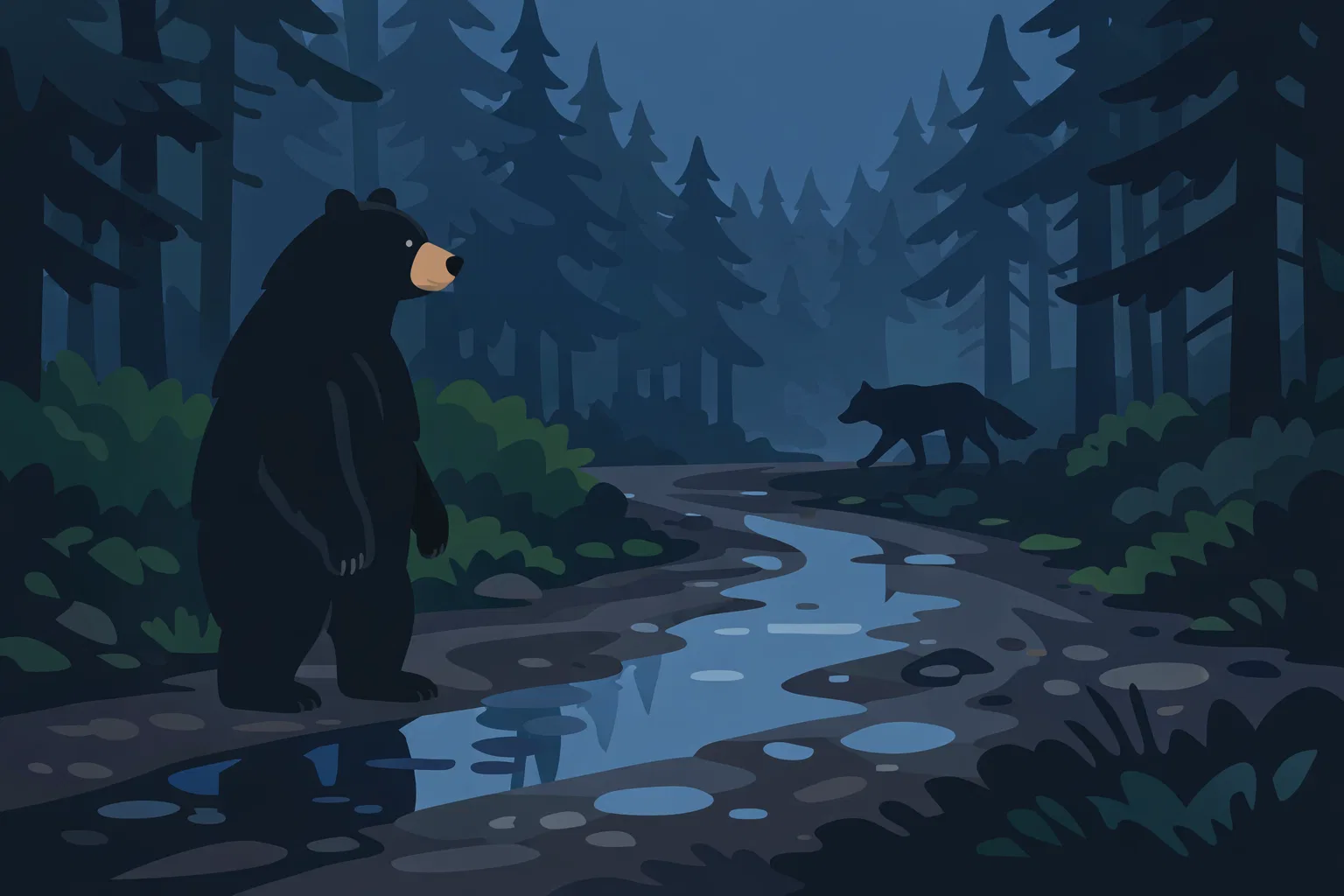
Black bears are the most useful sceptical explanation for some Michigan “hairy monster” reports because they combine three features that make witnesses uncomfortable: size, dark fur and occasional upright posture. DNR material describes adult male Michigan black bears as weighing between 150 and 400 pounds, with adult females generally smaller, and notes that black bears are about three feet high on all fours and about five feet when standing upright.[Michigan.gov]michigan.govLiving With Michigan Black BearsLiving With Michigan Black Bears A bear does not need to walk like a person for long to become memorable. It only needs to rise, sniff, paw at something, or shift position while partly hidden.
This matters for Bigfoot-like and swamp-monster-style reports in Michigan. A bear seen face-on through brush can appear broader than expected. A bear standing against a tree can seem taller than it is. A bear moving away on uneven ground can look strangely hunched. Add darkness, fear and distance, and the witness may not store the sighting as “bear”; they may store it as “big, black, upright, hairy, not human”.
The 1964 Dewey Lake Monster flap near Sister Lakes is a useful example of how quickly this kind of uncertainty can become public folklore. Reports described a large, hairy creature with glowing eyes, and later summaries of the case note that officials and commentators suggested ordinary explanations including a bear, while the story still became a local monster episode with curiosity seekers and commercial spin-offs.[Wikipedia]WikipediaDewey Lake MonsterDewey Lake Monster The important point is not that a bear has been proved as the culprit. It is that the reported features — large, hairy, frightening, partly glimpsed — sit in the same zone where a bear explanation becomes reasonable.
Bears also wander. DNR-linked public safety advice stresses that bears can be drawn towards human food such as bird feeders, bins, grills and pet food, and recent Michigan reporting has described bears turning up beyond the northern wildlands, including more developed areas.[Michigan.gov]michigan.govBlack bearsBlack bears are the only bear species that occur in Michigan. Omnivorous, with diets including plants, nuts, insects, and occa… That mobility matters for cryptid interpretation. A bear in a place where people do not expect a bear is more likely to be read as an anomaly.

Wolves, coyotes and the Dogman problem
Michigan’s Dogman legend is not simply a wildlife-identification issue. Its modern popularity is tied to folklore, radio culture, campfire storytelling and the appeal of a creature that is almost recognisable but not quite: part dog, part wolf, part person. Still, real canids help explain why some reports feel convincing to witnesses. Michigan has coyotes statewide, wolves in the Upper Peninsula, domestic dogs everywhere, and occasional confusion between these categories.
The DNR describes coyotes as common throughout Michigan in rural and urban areas, with greyish-brown colouring, dense fur that can make them appear larger, pointed ears, and a bushy black-tipped tail usually carried below the level of the back when running.[Michigan.gov]michigan.govOpen source on michigan.gov. Those details are exactly the sort of thing that can become distorted in a night encounter. A coyote with heavy winter fur may seem too large. A domestic dog running loose may seem too wild. A wolf-like animal seen for seconds may become “not a normal dog” by the time the story is told.
Wolves sharpen the problem because they are both real and locally restricted. In the Upper Peninsula, a wolf report is not automatically extraordinary; in much of the Lower Peninsula, it is far more unusual. That difference became clear in 2024, when a hunter in Calhoun County shot an animal he believed was a large coyote, and genetic testing confirmed it was a grey wolf — the first such confirmed case in southern Michigan in more than a century.[AP News]apnews.comOpen source on apnews.com. The incident is a perfect cautionary tale for cryptid readers: even experienced people can misread a canid in the field, and sometimes the surprising answer is still a known animal.
For Dogman-style reports, the misidentification pathway usually works through a few linked impressions:
- A large canid silhouette: wolf, coyote, dog or hybrid-looking animal seen at distance.
- Upright illusion: an animal rearing, jumping, climbing, standing on a bank, or passing behind vegetation that hides its lower body.
- Human-like framing: once the witness is thinking “it moved like a person”, later details may be remembered through that shape.
- Folklore vocabulary: in Michigan, a strange canid does not stay merely “a strange canid” for long; Dogman gives it a ready-made name.
None of this means every Dogman witness saw a coyote or wolf. It means the state’s real canids provide raw material that folklore can organise into a more dramatic creature.
Cougars are the hard case: real evidence, many false alarms
Cougars make Michigan mystery-animal debates more complicated than simple debunking allows. The DNR says cougars were native to Michigan but were eliminated from the state around the early twentieth century, with the last known wild cougar legally taken near Newberry in 1906. Since 2008, however, the agency has confirmed many cougar sightings, including physical evidence and trail-camera records, mostly in the Upper Peninsula.[Michigan.gov]michigan.govThere have been many confirmed cougar sightings since 2008, including two illegal harvests in the Upper Peninsula. This situation is not…
That verified evidence changes the tone of “phantom cat” stories. A reported big cat in Michigan is not automatically impossible. In March 2025, state biologists confirmed two cougar cubs on private land in Ontonagon County, described in news coverage as the first verified cougar reproduction in Michigan in more than a century.[Our Midland]ourmidland.comOur Midland First cougar cubs verified in Michigan in more than a centuryOur Midland First cougar cubs verified in Michigan in more than a century For a state where cougar claims were once widely treated as rumour, that is a major shift.
But this is also where careful standards matter. The DNR’s cougar guidance says sightings alone are not enough; agencies rely on physical evidence such as carcasses, DNA, tracks, photographs and other expert-verified signs.[Michigan.gov]michigan.govOpen source on michigan.gov. That standard protects both sides of the discussion. It stops sceptics from dismissing verified cougars as fantasy, and it stops enthusiasts from treating every large-cat story as proof.
Many alleged big-cat sightings still fall apart under scale, proportion or photographic review. In one Manistee County case, DNR officials concluded that photographs said to show a large unknown feline were likely a domestic housecat, citing body proportions, tail and leg length, head shape, colour and the animal’s height relative to nearby vegetation.[Manistee News Advocate]manisteenews.comManistee News Advocate DNR concludes investigation into mysterious cat sightingManistee News Advocate DNR concludes investigation into mysterious cat sighting That is exactly how ordinary animals become “phantom cats”: a photograph lacks scale, the viewer expects something dramatic, and the internet supplies the rest.
For Michigan cryptid misidentifications, cougars are therefore a lesson in both humility and restraint. Sometimes the animal really may be a cougar. Often it is not. The difference is not decided by how exciting the story sounds, but by tracks, images, DNA, carcasses, expert review and location.
Moose, deer and the power of an unexpected body shape
Not every misidentification points towards a predator. Herbivores can also create monster stories because their bodies look strange when the witness has only a partial view. Moose are the obvious Upper Peninsula example: tall legs, long face, high shoulders, dark body, awkward movement and wetland habitat. A moose at the edge of a road or pond can look less like a familiar animal than like several mismatched parts moving together.
Deer are more common, but that can make them deceptively important. Michigan’s Office of Highway Safety Planning reported more than 58,000 vehicle-deer crashes in 2024 and notes that deer are especially active around dawn and dusk, with many crashes on two-lane roads.[Michigan.gov]michigan.govOpen source on michigan.gov. Those are also prime conditions for strange-animal stories: low light, fast decisions, roadside glimpses and adrenaline.
A deer seen badly is rarely going to become a full-blown Bigfoot or Dogman by itself. But deer can contribute to partial reports: glowing eyes in the woods, a pale shape leaping across a ditch, antlers mistaken for branches, or a wounded animal moving in a way that seems wrong. In local storytelling, the witness may remember the emotional shock more strongly than the anatomical details.
This is one reason Michigan’s wetlands and road corridors matter so much. A creature standing in cattails may have its legs hidden. A deer on a bank may look much taller than it is. A moose in brush may seem to have no clear outline. A bear crossing a ditch may appear briefly bipedal. The landscape edits the animal before the witness does.
Roadside darkness, wetlands and brief encounters
Most monster reports are not calm, well-lit wildlife observations. They are brief events: a shape crosses the headlights; eyes flash from a tree line; something moves beside a swamp road; a large animal appears on a trail camera with no clear scale. Michigan is built for that kind of uncertainty. Forest edges, marshes, lake roads, hunting tracks and rural two-lane highways create repeated chances for partial sightings.
The timing often makes the problem worse. Many animals are most visible to people at the edges of the day, when human travel overlaps with wildlife movement. Official Michigan crash data highlights dawn and dusk as important deer-activity periods, and DNR bear advice notes that bears become active seasonally as they leave dens and search for food.[Michigan.gov]michigan.govOpen source on michigan.gov. Those are not “monster hours” in a supernatural sense. They are ordinary wildlife hours that happen to produce poor viewing conditions.
Wetlands add another layer. A black bear in swamp cover, a bobcat using brushy edges, or a moose moving through low vegetation may be visible only in pieces. The witness sees a back but not legs, eyes but not body, height but not distance. When the brain cannot complete the animal cleanly, it reaches for the nearest available pattern: bear, wolf, person, dog, big cat, monster.
Trail cameras solve some of these problems but create others. They can verify animals that people might otherwise doubt, as in some cougar cases. Yet they can also flatten depth, distort size, capture only one frame, and remove behaviour from context. A domestic cat close to a camera can look like a panther; a raccoon at an odd angle can look grotesque; a deer with motion blur can look like something with the wrong number of legs. The camera is evidence, but it is not automatically interpretation.
How folklore changes the animal after the sighting
The most interesting part of Michigan misidentification is not simply that people make mistakes. Everyone does. The interesting part is how a mistake, uncertainty or honest odd encounter can be reshaped by the story-world already waiting for it.
In a state without the Dogman legend, a witness might report “a big dark dog standing near the road”. In Michigan, the same report may be pulled towards a known narrative: upright canine, northern woods, frightening eyes, impossible speed, old local warnings. The folklore does not have to invent the whole event. It can supply the label, mood and expected details after the fact.
The Dewey Lake Monster shows the same process in a different form. What began as reports of a frightening large creature became a short-lived public flap, attracting police searches, newspaper attention, curiosity seekers and local commercial jokes.[Wikipedia]WikipediaDewey Lake MonsterDewey Lake Monster Once a community is talking about a monster, later sightings are no longer interpreted in a neutral space. People are watching for the creature, joking about it, fearing it, selling it, and fitting ambiguous details into the shared picture.
This does not mean witnesses are lying. Folklore often works through sincere interpretation. A person sees something real and confusing; the local legend offers a shape for the confusion. Over time, repeated stories can smooth away the awkward parts. “I saw something dark and large near the swamp” becomes “I saw the monster”. “It might have been a bear” becomes less memorable than “it stood like a man”.
A practical field guide for reading Michigan monster reports
A useful sceptical reading of Michigan cryptid reports does not start by mocking the witness. It starts by asking what ordinary animal would have been plausible at that place and time, and what parts of the report are actually specific enough to test.
For Michigan, the strongest wildlife clues usually include:
- Location: Upper Peninsula forest, northern Lower Peninsula bear range, southern Lower Peninsula farmland, shoreline, wetland or suburb.
- Body outline: bear-like bulk, canid shape, cat-like tail, deer or moose legs, or simply “large dark animal”.
- Movement: bounding, loping, rearing, climbing, swimming, limping, crossing a road, or standing still.
- Viewing conditions: headlights, dusk, fog, rain, snow, brush, distance, single trail-camera frame.
- Physical evidence: tracks with scale, clear photographs, hair, scat, DNA, carcass, expert-verified sign.
- Story pressure: whether the report appeared after local media attention, a known monster anniversary, a viral post, or a previous sighting nearby.
Bears best explain some large, dark, hairy, partly upright reports, especially in northern forest or wetland settings. Wolves and coyotes best explain many canid-shaped encounters, especially when the witness describes speed, a long muzzle, pointed ears or a dog-like body. Moose explain some very large, awkward, long-legged Upper Peninsula sightings. Cougars explain a smaller number of verified big-cat records, while domestic cats, bobcats, dogs and perspective errors explain many false alarms.
The key is not to force every story into one animal. Michigan’s real wildlife gives investigators a menu of plausible starting points, and the best explanation depends on the details.

Why misidentification makes Michigan folklore stronger, not weaker
It can feel disappointing to say that a monster story may have begun with a bear, wolf, moose, coyote or housecat. But misidentification does not drain the folklore of interest. It explains why the folklore keeps renewing itself.
Michigan’s legends work because they sit close to reality. There really are bears in northern woods and, increasingly, in places where residents may not expect them. There really are wolves in the Upper Peninsula and occasional canid surprises elsewhere. There really are verified cougar records, even though many claimed cougar sightings are not confirmed. There really are moose in the western Upper Peninsula, huge enough to startle anyone who has never met one in poor light.[michiganpublic.org]michiganpublic.orgdnr gives tips on interacting with black bears emerging from winter densdnr gives tips on interacting with black bears emerging from winter dens
That closeness gives Michigan monster stories their staying power. A completely impossible creature can be dismissed and forgotten. A strange roadside animal that might have been a bear, might have been a wolf, might have been a cougar, and might have been “something else” is harder to put away. The uncertainty leaves room for retelling.
The sensible conclusion is not that Michigan cryptids are secretly confirmed animals, nor that all witnesses are foolish. It is that the state’s wildlife, terrain and storytelling traditions constantly interact. Real animals create startling moments. Poor conditions make those moments ambiguous. Folklore gives them memorable names. By the time the story reaches the campfire, the diner, the local news archive or the internet, the animal may have already stepped out of biology and into legend.
Amazon book picks
Further Reading
Books and field guides related to Which Real Animals Feed Michigan Monster Reports?. Use these as the next step if you want deeper reading beyond the article.
Sasquatch: Legend Meets Science
Discusses evidence standards and alternative explanations.
eBay marketplace picks
Marketplace Samples
Live-tested eBay searches with available results related to this page.




Endnotes
1.
Source: michigan.gov
Link:https://www.michigan.gov/dnr/managing-resources/wildlife/nuisance-wildlife/black-bears
Source snippet
Black bearsBlack bears are the only bear species that occur in Michigan. Omnivorous, with diets including plants, nuts, insects, and occa...
2.
Source: michigan.gov
Title: wolves in michigan
Link:https://www.michigan.gov/dnr/education/michigan-species/mammals/wolves-in-michigan
Source snippet
In 2024, a DNR survey of wolf tracks estimated the minimum wolf population at 768 animals. The DNR is conducting a research project using...
3.
Source: michigan.gov
Title: moose population
Link:https://www.michigan.gov/dnr/education/michigan-species/mammals/moose/moose-population
Source snippet
In the January 2025 aerial survey, biologists estimated approximately 300 moose within the western Upper Peninsula core range, down from...
Published: January 2025
4.
Source: michigan.gov
Link:https://www.michigan.gov/dnr/education/michigan-species/mammals/cougars
Source snippet
There have been many confirmed cougar sightings since 2008, including two illegal harvests in the Upper Peninsula. This situation is not...
5.
Source: michigan.gov
Title: Living With Michigan Black Bears
Link:https://www.michigan.gov/-/media/Project/Websites/dnr/Documents/WLD/Archive/Misc-info/black_bears_brochure_ada.pdf?rev=2340507cef0a4f0a8cfbd36433aa2c7c
6.
Source: Wikipedia
Title: Dewey Lake Monster
Link:https://en.wikipedia.org/wiki/Dewey_Lake_Monster
7.
Source: michigan.gov
Link:https://www.michigan.gov/dnr/education/michigan-species/mammals/coyote
8.
Source: michigan.gov
Link:https://www.michigan.gov/dnr/education/michigan-species/mammals/cougars/photos
9.
Source: michigan.gov
Link:https://www.michigan.gov/dnr/education/michigan-species/mammals/cougars/common-cougar-questions
10.
Source: michigan.gov
Link:https://www.michigan.gov/msp/divisions/ohsp/ohsp-traffic-safety-programs/vehicle-deer-crashes
11.
Source: Wikipedia
Link:https://en.wikipedia.org/wiki/Michigan
12.
Source: Wikipedia
Title: Repopulation of wolves in Midwestern United States
Link:https://en.wikipedia.org/wiki/Repopulation_of_wolves_in_Midwestern_United_States
13.
Source: Wikipedia
Title: Michigan Dogman
Link:https://en.wikipedia.org/wiki/Michigan_Dogman
14.
Source: michigan.gov
Link:https://www.michigan.gov/dnr/managing-resources/laws/regulations/bear
15.
Source: michigan.gov
Link:https://www.michigan.gov/dnr/education/michigan-species/mammals/moose/research-updates
16.
Source: michigan.gov
Title: is bear country and here they come
Link:https://www.michigan.gov/dnr/about/newsroom/releases/2026/03/12/michigan-is-bear-country-and-here-they-come
17.
Source: michigan.gov
Link:https://www.michigan.gov/dnr/education/michigan-species/mammals/moose
18.
Source: michigan.gov
Title: history of moose in michigan
Link:https://www.michigan.gov/dnr/education/michigan-species/mammals/moose/history-of-moose-in-michigan
19.
Source: michigan.gov
Link:https://www.michigan.gov/dnr/things-to-do/hunting/bear
20.
Source: michigan.gov
Title: wolf population research
Link:https://www.michigan.gov/dnr/education/michigan-species/mammals/wolves-in-michigan/wolf-population-research
21.
Source: michigan.gov
Title: fur harvester
Link:https://www.michigan.gov/dnr/managing-resources/laws/regulations/fur-harvester
22.
Source: michigan.gov
Link:https://www.michigan.gov/dnr/managing-resources/wildlife/wildlife-publications
23.
Source: michigan.gov
Link:https://www.michigan.gov/dnr/things-to-do/hunting/trapping
24.
Source: wolf.org
Link:https://wolf.org/headlines/new-dnr-survey-shows-stable-wolf-population-in-michigans-u-p-survey-planned-for-l-p/
25.
Source: michiganpublic.org
Title: dnr gives tips on interacting with black bears emerging from winter dens
Link:https://www.michiganpublic.org/environment-climate-change/2026-03-16/dnr-gives-tips-on-interacting-with-black-bears-emerging-from-winter-dens
26.
Source: ourmidland.com
Link:https://www.ourmidland.com/news/article/black-bear-rescue-22292147.php
Source snippet
Though most of Michigan’s 12,000 black bears are found in the Upper and northern Lower Peninsulas, encounters elsewhere, like a recent on...
27.
Source: apnews.com
Link:https://apnews.com/article/3510fafdee34611dd36ab7ba751c7cd3
28.
Source: apnews.com
Link:https://apnews.com/article/caadd0bc4c0eefb5faa334d0c1a5a960
29.
Source: ourmidland.com
Title: Our Midland First cougar cubs verified in Michigan in more than a century
Link:https://www.ourmidland.com/news/article/michigan-cougar-cubs-confirmed-up-20219907.php
30.
Source: manisteenews.com
Title: Manistee News Advocate DNR concludes investigation into mysterious cat sighting
Link:https://www.manisteenews.com/news/article/DNR-concludes-investigation-into-mysterious-cat-17415913.php
31.
Source: nps.gov
Link:https://www.nps.gov/slbe/learn/nature/mammals.htm
32.
Source: twistingmyths.substack.com
Title: the dewey lake monster
Link:https://twistingmyths.substack.com/p/the-dewey-lake-monster
33.
Source: michiganpublic.org
Title: where are michigans moose
Link:https://www.michiganpublic.org/environment-climate-change/2026-02-13/where-are-michigans-moose
34.
Source: michiganpublic.org
Title: dnr says michigans black bear population is growing
Link:https://www.michiganpublic.org/environment-climate-change/2024-02-12/dnr-says-michigans-black-bear-population-is-growing
35.
Source: michiganpublic.org
Link:https://www.michiganpublic.org/environment-climate-change/2025-04-10/michigan-dnr-says-as-bears-continue-to-venture-south-we-can-take-steps-to-live-with-them
36.
Source: michiganpublic.org
Title: That black bear seen near Flat Rock is probably just
Link:https://www.michiganpublic.org/environment-climate-change/2026-05-13/that-black-bear-seen-near-flat-rock-is-probably-just-looking-for-a-new-home-and-love
37.
Source: michiganpublic.org
Title: researchers studying why michigans moose population isnt growing
Link:https://www.michiganpublic.org/environment-climate-change/2025-06-16/researchers-studying-why-michigans-moose-population-isnt-growing
38.
Source: michiganpublic.org
Title: cougar cubs seen again in the upper peninsula they were last seen in march
Link:https://www.michiganpublic.org/environment-climate-change/2025-12-18/cougar-cubs-seen-again-in-the-upper-peninsula-they-were-last-seen-in-march
39.
Source: michiganpublic.org
Link:https://www.michiganpublic.org/public-safety/2025-11-24/michigan-has-nations-4th-highest-rate-of-drivers-hitting-animals-auto-insurer-says
40.
Source: curator135.com
Title: the dewey lake monster
Link:https://curator135.com/2022/01/25/the-dewey-lake-monster/
41.
Source: cryptidz.fandom.com
Title: Dewey Lake Monster
Link:https://cryptidz.fandom.com/wiki/Dewey_Lake_Monster
42.
Source: dnr.wisconsin.gov
Link:https://dnr.wisconsin.gov/topic/WildlifeHabitat/cougar
Additional References
43.
Source: youtube.com
Title: This is Why Bears Are Mistaken for Bigfoot | Joe Rogan and Travis Barker
Link:https://www.youtube.com/watch?v=MuHw8RlZPTc
Source snippet
Michigan Dogman Sightings Hit Record Highs — New Map Reveals a Terrifying Pattern...
44.
Source: youtube.com
Title: DISCOVERING | Cougars in the U.P. | Arctic Grayling Stocked in U.P. Waters
Link:https://www.youtube.com/watch?v=rrXELRD78BE
Source snippet
Michigan DNR: Verified Footage Of a Male Cougar in Mackinac County...
45.
Source: youtube.com
Title: Michigan DNR: Verified Footage Of a Male Cougar in Mackinac County
Link:https://www.youtube.com/watch?v=fRQRukfdH5A
Source snippet
This is Why Bears Are Mistaken for Bigfoot | Joe Rogan and Travis Barker...
46.
Source: youtube.com
Title: Michigan sees rise in cougar sightings, DNR investigates surge
Link:https://www.youtube.com/watch?v=60lfNNdNwgM
Source snippet
DISCOVERING | Cougars in the U.P. | Arctic Grayling Stocked in U.P. Waters...
47.
Source: nps.gov
Link:https://www.nps.gov/articles/nocturnal_earthnight.htm
48.
Source: facebook.com
Link:https://www.facebook.com/smltownmonsters/posts/after-investigating-unusual-tracks-near-manistee-national-forest-the-conversatio/1611329190996691/
49.
Source: facebook.com
Link:https://www.facebook.com/Add995WYCD/posts/black-bears-are-pushing-further-south-in-michigan-according-to-the-dnr-heres-wha/1088718676606680/
50.
Source: instagram.com
Link:https://www.instagram.com/p/DaQ7w6dDzVI/
51.
Source: facebook.com
Link:https://www.facebook.com/michigandnr/posts/did-you-know-that-coyotes-are-now-found-all-across-michigan-including-urban-and-/1055623113269104/
52.
Source: facebook.com
Link:https://www.facebook.com/outdoortechlab/posts/dogman-dash-a-glimpse-into-the-unknown-something-terrifying-is-out-there-cryptid/122194578008026465/
Topic Tree