Within Texas Monsters
Texas's Frontier Wild Man Before Bigfoot
The Wild Man and Wild Woman of the Navidad show that Texas had humanlike mystery-beast stories long before modern cryptid culture.
On this page
- Navidad River bottomland folklore
- Wild people, frontier fear and newspaper retellings
- How older tales shaped later monster stories
Page outline Jump by section
Introduction
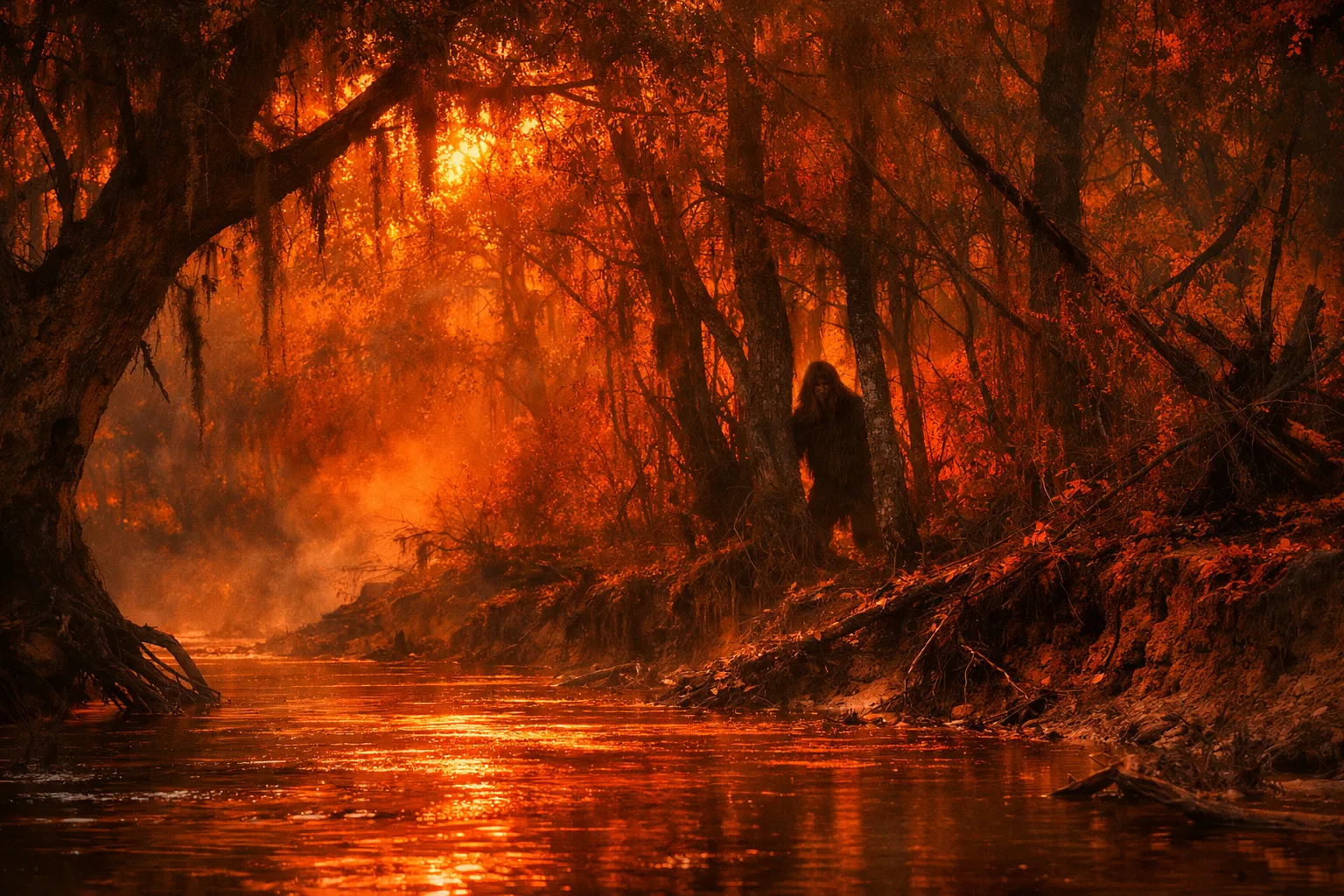
Texas’s Wild Man, or Wild Woman, of the Navidad is not best understood as a proven “missing creature”. It is a frontier legend that grew from reports of a humanlike figure living in the Navidad River bottoms of Lavaca County in the nineteenth century, long before modern Bigfoot culture gave Americans a familiar label for hairy, upright mystery-beasts. The story matters because it shows how Texas monster folklore began in a world of dense river thickets, scattered settlements, slavery, fear of the unknown, newspaper retellings and oral tradition. Later writers and cryptid fans sometimes recast the figure as an early Texas Bigfoot, but the strongest historical reading is more complicated: a mixture of real human suffering, local rumour, frontier anxiety and the way a half-seen person can become a monster in communal memory.[tpwmagazine.com]tpwmagazine.comOpen source on tpwmagazine.com.
Why the Navidad River bottoms made the story believable
The legend belongs to a specific landscape, not just to “Texas” in general. The key setting is the country around Sublime, in eastern Lavaca County, near the Navidad River. The Texas State Historical Association’s account of Sublime describes the old area as dense with yaupon, wild grape, oak and pecan, and notes that it was known as the territory of the “wild man of the Navidad”. It was also flood-prone country, with much of the bottomland used as unimproved cattle range rather than tidy settlement land.[Texas State Historical Association]tshaonline.orgsublime txsublime tx
That detail is crucial. Frontier monster stories often need a border zone: not complete wilderness, but not fully controlled farmland either. The Navidad bottoms supplied exactly that. A person could move through cover, leave tracks, raid kitchens or smokehouses, and vanish before anyone could give a calm, daylight description. In such a landscape, practical uncertainty easily became supernatural uncertainty. Was the intruder an animal, a ghost, an escaped person, a “wild woman”, or something stranger?
Modern environmental sources help explain why this kind of river-country could sustain mystery. The Lavaca-Navidad system lies in the Texas Gulf Coast region, where flat coastal-plain terrain, low soil permeability and rainfall-driven flows can produce flooding and difficult lowland conditions. The Lavaca-Navidad River Authority’s watershed material describes the wider basin as largely rural and agriculture-dominated, with low-flow periods punctuated by floods; that does not prove any monster claim, but it does fit the old story’s sense of wooded bottoms, marginal land and places where visibility and access were uneven.[Lavaca-Navidad River Authority]lnra.orgOpen source on lnra.org.
The Navidad legend also sits between two versions of Texas: the documented state of land grants, railways, post offices and historical markers, and the remembered state of night noises, missing food and stories carried from house to house. Sublime later became a small community with a post office, railway connection and ranching economy, but the older identity of the place remained tied to the river-bottom “wild man” reputation.[Texas Almanac]texasalmanac.comOpen source on texasalmanac.com.

What people said the Wild Man or Wild Woman did
The recurring details are more domestic than monstrous. In many retellings, settlers found food missing, tools taken and later returned, clothing repaired, and mysterious tracks near the Navidad. Texas Parks & Wildlife Magazine summarises the old story as involving mysterious footprints and occasional sightings of a hairy, ape-like figure in dense vegetation along the lower Navidad River, with many locals believing the figure was female.[Texas Parks & Wildlife Magazine]tpwmagazine.comOpen source on tpwmagazine.com.
That pattern is one reason the story feels older than modern cryptid lore. A contemporary Bigfoot report often centres on a brief roadside sighting, a roar, a wood-knock, a large footprint or a dark figure crossing a track. The Navidad tale is different. Its “evidence” is a sequence of small intrusions into settlement life: kitchens entered at night, objects moved, tools polished, clothing mended, food partly taken rather than simply stolen. The figure is frightening because it is near the household, but also strangely restrained.
The famous chase story sharpened the legend into a creature encounter. In the version retold by Texas Parks & Wildlife Magazine from Texas Folklore Society material, hunters with hounds and riders with lassos attempted to flush the figure from the river bottom. Something broke cover, ran towards thicker woods, and escaped when a pursuing rider’s horse shied. Witnesses reportedly described a female figure covered with hair, and a dropped wooden club was said to have been found afterwards, polished smooth.[Texas Parks & Wildlife Magazine]tpwmagazine.comOpen source on tpwmagazine.com.
For a reader interested in cryptids, that chase is the scene that makes the Navidad story feel like a proto-Bigfoot tale. It has the right ingredients: a wooded river bottom, hounds, a fleeting upright figure, unusual speed, hairiness, and a physical object left behind. Yet the same details can also be read as frontier folklore amplifying a human encounter. A frightened, unclothed or poorly clothed person running from armed riders in thick country could become “hairy” in confused observation, especially once the story had already primed witnesses to expect a wild creature.
Wild people, slavery and frontier fear
The most important sceptical explanation is not a misidentified bear or an unknown ape. It is that the Navidad “monster” tradition probably grew around one or more self-liberated or fugitive enslaved people living outside settlement control. Many later accounts identify the captured figure as an African man who did not speak English, sometimes embellished as an African chief’s or prince’s son. Those royal-origin details should be treated cautiously, because they sound like the kind of humanising flourish that folklore often adds after the fact. The underlying point, however, is historically plausible: nineteenth-century Texas slavery created conditions in which an escaped person might hide in bottomlands, raid for food, and be described by frightened settlers as something less than fully human.[tshaonline.org]tshaonline.orgevans mosesevans moses
The story’s gender shift is also revealing. The figure is called both Wild Man and Wild Woman, and some versions imagine a pair. Texas Parks & Wildlife Magazine notes that the fleeing figure in the chase story was believed by witnesses to be female; other accounts say a captured “wild woman” turned out to be male. The Texas State Gazette notice cited in later summaries reportedly referred to “an African” known as the Wild Woman of the Navidad, supposedly belonging to a man named Beckford, and sought an owner to claim the person.[tpwmagazine.com]tpwmagazine.comOpen source on tpwmagazine.com.
That is where the legend becomes uncomfortable, and where a public-facing cryptid page needs to be honest. The Navidad story is not just a quaint monster yarn. It was shaped by a slave society in which Black fugitives could be hunted, advertised, recaptured and sold. A person pushed outside legal protection could be converted in local talk into “the thing that comes”, a phrase preserved in later retellings as both eerie folklore and a sign of dehumanisation.[Wikipedia]WikipediaWild Man of the NavidadWild Man of the Navidad
The Texas State Historical Association entry on Moses Evans adds one useful historical anchor. Evans, a settler, soldier and surveyor, was associated with the so-called Wild Woman of the Navidad and was said to have pursued and caught the figure, only to discover that “she” was a runaway male slave. That does not settle every version of the story, but it supports the view that at least part of the legend attached itself to an actual fugitive human being rather than an unknown animal.[Texas State Historical Association]tshaonline.orgevans mosesevans moses
How the story entered print and folklore
The Wild Woman of the Navidad seems to have circulated orally before it became a stable printed legend. Texas Parks & Wildlife Magazine says the story was passed by word of mouth until Martin W. Kennedy told it in print in Legends of Texas, a Texas Folklore Society publication edited by J. Frank Dobie and published in 1924. The Portal to Texas History confirms that Legends of Texas includes “The Wild Woman of the Navidad” by Martin M. Kenney among its collected Texas legends, alongside buried treasure tales, supernatural stories and other local traditions.[Texas Parks & Wildlife Magazine]tpwmagazine.comOpen source on tpwmagazine.com.
That publication history matters because it marks a change in genre. In the nineteenth century, the story functioned as local alarm, rumour and frontier memory. In the twentieth century, it became Texas folklore: something collected, printed, retold and compared with other legends. Once inside folklore collections, the Navidad figure no longer depended on fresh sightings. It became a named tradition with a repeatable shape.
The old reports also gained authority through historical-marker culture. A marker account, reproduced by local marker and county-history sources, frames the figure as a mysterious runaway who appeared along the Navidad bottoms around 1836, hid by day, entered kitchens at night, took food, returned tools polished, was captured in the early 1850s, and later died as “Old Jimbo” in 1884. That marker-style summary is not the same as a court record or a full biography, but it shows how the state’s public-memory machinery converted a murky legend into a roadside historical narrative.[stxmaps.com]stxmaps.comSTX Maps Texas Historical MarkerSTX Maps Texas Historical Marker
The tale’s printed afterlife also explains why details vary. Some versions emphasise a Wild Woman; others a Wild Man; some describe a pair; some present a ghostlike intruder; some lean towards a Bigfoot-like creature; others foreground the captured African man. Variation is not a flaw in folklore. It is how folklore works. The stable core is not a single forensic description, but a repeated pattern: a hidden humanlike presence in the Navidad bottoms, household disturbances, fear among settlers and enslaved people, a failed or successful hunt, and a later attempt to explain the figure as a fugitive from slavery.
Was the Navidad figure an early Texas Bigfoot?
It is fair to call the Wild Woman of the Navidad one of Texas’s earliest humanlike mystery-beast traditions. It is less fair to present it as clear evidence for Bigfoot. Texas Parks & Wildlife Magazine explicitly places the late-1830s Navidad sightings among the first Texas references to what modern readers might call cryptids, while also noting that cryptozoology is considered pseudoscience by most scientists. The same article quotes a Texas Parks and Wildlife mammalogist saying there is no concrete proof that Bigfoot exists anywhere in the United States, let alone Texas.[Texas Parks & Wildlife Magazine]tpwmagazine.comOpen source on tpwmagazine.com.
The Bigfoot comparison became tempting because the visual shorthand overlaps: hair, upright movement, woods, footprints, evasiveness. But the historical setting points in another direction. The Navidad figure was tied to kitchens, tools, clothing, enslavement and possible recapture. Those are not normal animal traces. They are signs of human survival under desperate conditions.
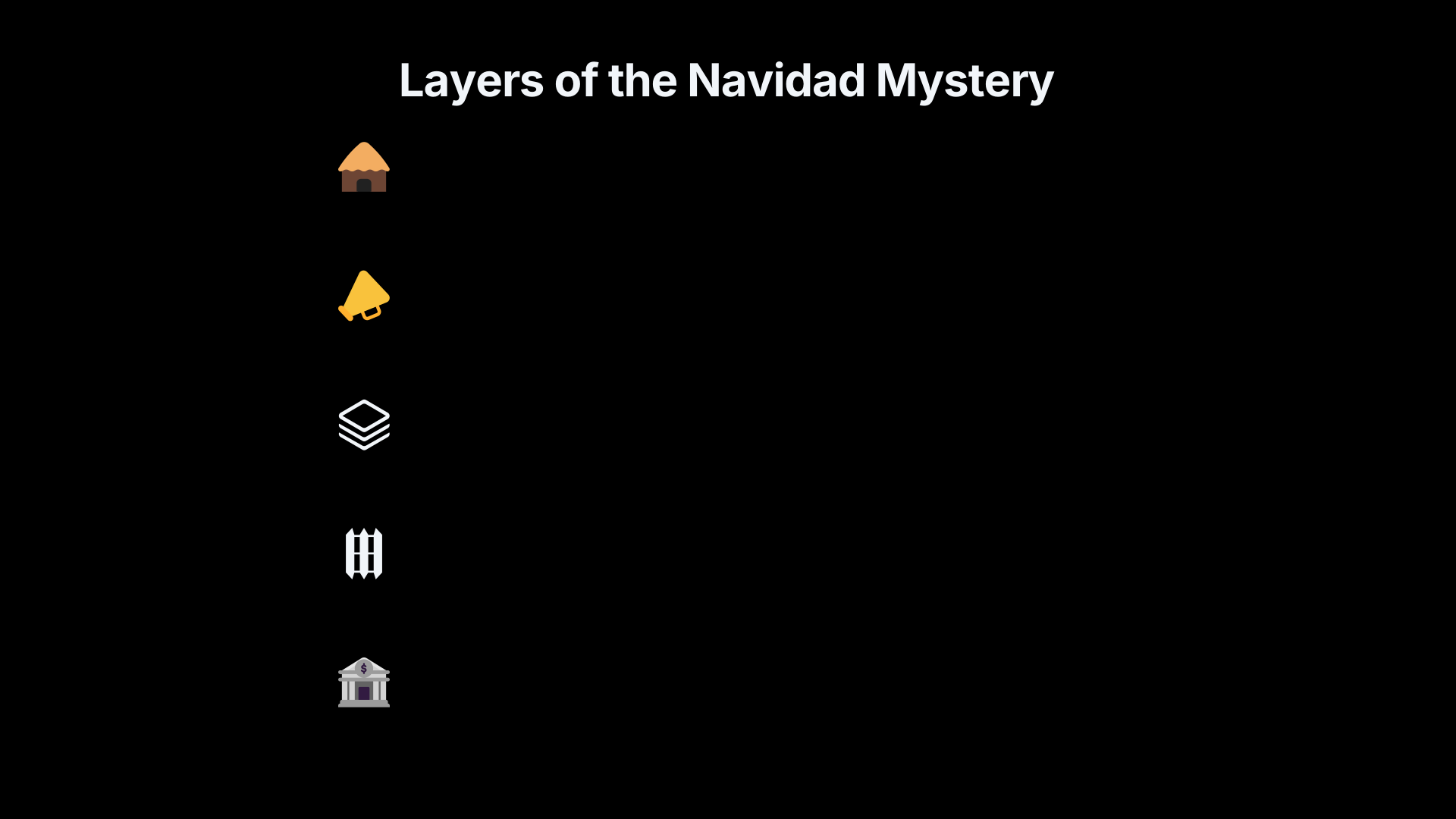
A balanced reading separates three layers:
- The likely historical layer: one or more fugitive enslaved people survived in the Navidad bottoms, frightening nearby residents and becoming the subject of searches, rumours and possibly newspaper notices.
- The folklore layer: oral retellings transformed the fugitive into a wild person, ghostly visitor or hairy “thing”, with chase scenes and strange object-details that made the story memorable.
- The cryptid layer: later Bigfoot culture reinterpreted the story as an early Texas Sasquatch-like case, especially because it involved a hairy, humanlike figure in wooded country.
This does not make the legend unimportant to Texas cryptid history. Quite the opposite. It shows that monster traditions do not always begin as claims about unknown animals. Sometimes they begin as social stories about fear, race, isolation, landscape and people living beyond the edge of recognised community.
Why frontier Texas produced humanlike monster folklore
The Wild Man of the Navidad belongs to a wider frontier pattern in which “wild people” stories appear wherever settlement meets difficult terrain and social anxiety. Nineteenth-century Texans lived with real dangers: disease, violence, isolation, enslavement, fugitive pursuit, animal predation, uncertain property boundaries, and limited law enforcement in some areas. A mysterious intruder in the woods was not automatically entertainment. It could be read as a threat to food stores, family safety, racial order or local control.
The figure’s humanlike nature made the story especially flexible. A wolf, bear or panther can be frightening, but it stays in the animal category. A wild human challenges categories. If the figure can sew, polish tools, carry a club, open doors or choose not to take everything, then the story becomes morally uneasy. Is the visitor a monster, a criminal, a victim, a ghost, or a person whom the community refuses to recognise?
That ambiguity is why the Navidad legend still has power. It is eerie, but the eeriness comes from the thin line between folklore and history. The “creature” is not simply outside civilisation; he or she is produced by civilisation’s own violence. Slavery, settlement pressure and frontier rumour all help create the conditions in which a fugitive person could be remembered as a monster.
This is also why the Navidad story should not be flattened into a simple Bigfoot precursor. Texas has later ape-man traditions, especially in East Texas woods and river systems, and those belong naturally beside modern Bigfoot reports. The Navidad case is older and stranger because it shows the human roots of some “monster” stories. It is a bridge between frontier legend, fugitive-slave history and the later American habit of reading hairy wild figures as cryptids.
How the legend changed in modern Texas culture
By the late twentieth and early twenty-first centuries, the Wild Man of the Navidad had become part of Texas’s broader strange-creature identity. Texas Parks & Wildlife Magazine placed it in a discussion that also mentioned chupacabras, Bigfoot, lechuzas and phantom black panthers, framing it as a predecessor to more familiar modern Texas cryptids.[Texas Parks & Wildlife Magazine]tpwmagazine.comOpen source on tpwmagazine.com.
The story also entered film culture. The 2008 film The Wild Man of the Navidad, directed by Duane Graves and Justin Meeks, presented the legend through a retro 1970s-style creature-feature lens. Tribeca’s festival listing described the film as realising an old Texas legend with a vintage horror feel and setting the story around Sublime, while the Austin Chronicle covered its Fantastic Fest screenings in 2008.[Tribeca]tribecafilm.com512ceb931c7d76e046001134 wild man of the navidad512ceb931c7d76e046001134 wild man of the navidad
That film afterlife matters because it shows the legend’s final transformation. A story that likely began with frontier fear and an enslaved fugitive becomes a regional horror brand: moonlit woods, rural isolation, hunters, blood, local colour and Bigfoot-style menace. The pop-culture version is not wrong to notice the story’s monster potential, but it necessarily simplifies the historical discomfort that makes the older tale more haunting.
Today, the Navidad Wild Man works best as an origin point in Texas monster folklore rather than as a solved zoological case. It gives Texas cryptid history a deep frontier layer before the Lake Worth Monster, before South Texas chupacabra carcasses, and before modern East Texas Bigfoot databases. It also warns readers that “monster” is sometimes a label communities place on whatever unsettles them most.
What the Navidad legend adds to Texas cryptid history
The Wild Man of the Navidad is valuable because it complicates the map. Texas cryptid lore is not only about strange animals in remote places; it is also about how people interpret unfamiliar movement through familiar land. The Navidad story turns a river bottom into a stage where ecology, slavery, settlement and storytelling meet.
Its strongest evidence is not biological evidence. There is no specimen, no reliable photograph, no scientific trackway and no reason to think a non-human primate lived in Lavaca County. The strongest evidence is cultural and historical: a named place, a persistent local tradition, an early folklore publication, a historical-marker narrative, a nineteenth-century newspaper-notice tradition, and later retellings that preserve the same core pattern.[unt.edu]texashistory.unt.eduThe Portal to Texas History Legends of TexasThe Portal to Texas History Legends of Texas
For monster-story readers, that may actually make the case more interesting. A fake-looking rubber monster can be dismissed. A frightened community trying to explain a hidden human presence in the woods is harder to shake. The Wild Man or Wild Woman of the Navidad survives because it is not only a question of “what was seen?” It is a question of what frontier Texans feared, what they failed to understand, and how a real person could be remembered as a creature of the bottoms.
Amazon book picks
Further Reading
Books and field guides related to Texas's Frontier Wild Man Before Bigfoot. Use these as the next step if you want deeper reading beyond the article.
Advanced Hunting on Deer and Elk Trails
Covers Texas cryptids, monster flaps and regional creature folklore directly.
eBay marketplace picks
Marketplace Samples
Live-tested eBay searches with available results related to this page.




Endnotes
1.
Source: Wikipedia
Title: Wild Man of the Navidad
Link:https://en.wikipedia.org/wiki/Wild_Man_of_the_Navidad
2.
Source: atlas.thc.texas.gov
Title: Atlas Texas Historical Commission Atlas Data
Link:https://atlas.thc.texas.gov/About/AtlasData
3.
Source: Wikipedia
Title: Whitsett, Texas
Link:https://en.wikipedia.org/wiki/Whitsett%2C_Texas
4.
Source: Wikipedia
Title: Navidad River
Link:https://en.wikipedia.org/wiki/Navidad_River
5.
Source: Wikipedia
Title: The Wild Man of the Navidad
Link:https://en.wikipedia.org/wiki/The_Wild_Man_of_the_Navidad
6.
Source: tceq.texas.gov
Title: lavaca river coordinating implementation
Link:https://www.tceq.texas.gov/waterquality/nonpoint-source/projects/lavaca-river-coordinating-implementation
7.
Source: atlas.thc.texas.gov
Link:https://atlas.thc.texas.gov/
8.
Source: atlas.thc.texas.gov
Link:https://atlas.thc.texas.gov/Map
9.
Source: atlas.thc.texas.gov
Link:https://atlas.thc.texas.gov/Account/Login
10.
Source: atlas.thc.texas.gov
Title: Data Download
Link:https://atlas.thc.texas.gov/Data/DataDownload
11.
Source: thc.texas.gov
Title: historical markers
Link:https://thc.texas.gov/preserve/preservation-programs/historical-markers
12.
Source: atlas.thc.texas.gov
Link:https://atlas.thc.texas.gov/About
13.
Source: tpwmagazine.com
Link:https://tpwmagazine.com/archive/2010/sep/legend/
14.
Source: tshaonline.org
Title: sublime tx
Link:https://www.tshaonline.org/handbook/entries/sublime-tx
15.
Source: texashistory.unt.edu
Title: The Portal to Texas History Legends of Texas
Link:https://texashistory.unt.edu/ark%3A/67531/metadc970102/
16.
Source: texasalmanac.com
Link:https://www.texasalmanac.com/places/sublime
17.
Source: lnra.org
Link:https://www.lnra.org/wp-content/uploads/2024/06/2024-Lavaca-Basin-Segment-1602-Watershed-Summary.pdf
18.
Source: tshaonline.org
Title: evans moses
Link:https://www.tshaonline.org/handbook/entries/evans-moses
19.
Source: lavacacountyhistory.org
Link:https://www.lavacacountyhistory.org/communities3.htm
20.
Source: stxmaps.com
Title: STX Maps Texas Historical Marker
Link:https://www.stxmaps.com/go/texas-historical-marker-wild-man-of-the-navidad.html
21.
Source: tribecafilm.com
Title: 512ceb931c7d76e046001134 wild man of the navidad
Link:https://tribecafilm.com/festival/archive/512ceb931c7d76e046001134-wild-man-of-the-navidad
22.
Source: texashistory.unt.edu
Link:https://texashistory.unt.edu/ark%3A/67531/metapth101018/m1/122/
23.
Source: discover.library.unt.edu
Link:https://discover.library.unt.edu/catalog/b5808063
24.
Source: texashistory.unt.edu
Link:https://texashistory.unt.edu/ark%3A/67531/metadc38306/m1/249/
25.
Source: texashistory.unt.edu
Link:https://texashistory.unt.edu/
26.
Source: facebook.com
Link:https://www.facebook.com/LavacaOEMHS/photos/the-lavaca-and-navidad-rivers-are-in-play-for-river-flooding-this-week-forecast-/3361130890780391/
27.
Source: facebook.com
Link:https://www.facebook.com/LNRAORG/
28.
Source: a.osmarks.net
Title: Wild Man of the Navidad
Link:https://a.osmarks.net/content/wikipedia_en_all_maxi_2020-08/A/Wild_Man_of_the_Navidad
29.
Source: cryptid.fandom.com
Title: Wild man of the navidad
Link:https://cryptid.fandom.com/wiki/Wild_man_of_the_navidad
30.
Source: tpwmagazine.com
Link:https://tpwmagazine.com/wildlife-conservation/seeds-of-knowledge-female-pioneers-of-texas-botany/
31.
Source: stxmaps.com
Title: Texas Historical Marker
Link:https://www.stxmaps.com/go/historical-markers-in-lavaca-county.html
32.
Source: tshaonline.org
Title: lavaca navidad river authority
Link:https://www.tshaonline.org/handbook/entries/lavaca-navidad-river-authority
33.
Source: greeksfilms.com
Title: The Wild Man of the Navidad
Link:https://greeksfilms.com/films/wild-man-of-the-navidad/
34.
Source: lnra.org
Title: annual water quality reports
Link:https://www.lnra.org/water/annual-water-quality-reports/
35.
Source: lnra.org
Title: Navidad River near Morales Flood Impacts. 38
Link:https://www.lnra.org/navidad-river-near-morales/
36.
Source: tvguide.com
Title: The Wild Man of the Navidad
Link:https://www.tvguide.com/movies/the-wild-man-of-the-navidad/cast/2000156474/
Additional References
37.
Source: youtube.com
Link:https://www.youtube.com/watch?v=Tl0exRuPmck
Source snippet
The Wild Man of the Navidad – Texas' Earliest Bigfoot?...
38.
Source: youtube.com
Title: The Creepiest Creatures Ever Reported in Texas
Link:https://www.youtube.com/watch?v=4Ht0sRElkO4
Source snippet
Wild Man of the Navidad Cryptids and Monsters: Wild Man of the Navidad, "the Thing", a Texas Bigfoot like creature...
39.
Source: youtube.com
Title: Exploring Texas’ Weird Folklore: Myths and Legends of the United States
Link:https://www.youtube.com/watch?v=yJiTkKFoxuI
Source snippet
The Creepiest Creatures Ever Reported in Texas...
40.
Source: facebook.com
Link:https://www.facebook.com/groups/OldWestHistoryConsortium/posts/1462587867224686/
41.
Source: facebook.com
Link:https://www.facebook.com/chroncom/posts/a-texas-man-hunting-for-treasure-in-a-local-thrift-store-accidentally-came-acros/10161648942447814/
42.
Source: facebook.com
Link:https://www.facebook.com/Mister.Brownwood/posts/a-century-old-rumor-says-there-is-over-1-million-in-gold-buried-just-outside-of-/2591316304547993/
43.
Source: ckwri.tamuk.edu
Link:https://www.ckwri.tamuk.edu/about/lavaca-navidad-river-authority
44.
Source: handwiki.org
Link:https://handwiki.org/wiki/Unsolved%3AWild_Man_of_the_Navidad
45.
Source: researchgate.net
Link:https://www.researchgate.net/figure/Lavaca-Navidad-River-fluvial-deltaic-system-study-area-showing-locations-of-coring_fig2_222945255
46.
Source: researchgate.net
Link:https://www.researchgate.net/figure/Lavaca-River-watershed_fig1_326378872
Topic Tree