Within Maine Monsters
Which Maine Monsters Were Meant as Jokes?
Lumber-camp creatures such as the Billdad and Tote Road Shagamaw reveal Maine's comic side of monster storytelling.
On this page
- Billdad and other joke beasts
- Tracks, bad luck and campfire invention
- Folklore versus cryptid claims
Page outline Jump by section
Introduction
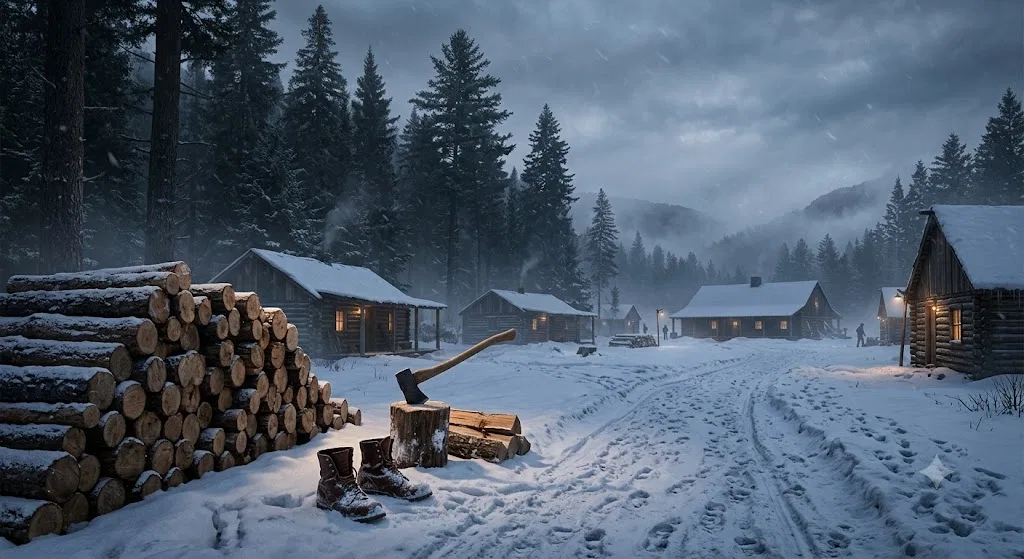
Maine’s fearsome critters were the monsters that winked back. Unlike a sea serpent report or a Bigfoot-style sighting, lumber-camp beasts such as the Billdad and the Tote-Road Shagamaw were usually told as comic “natural history”: straight-faced descriptions of impossible animals, delivered as if they were ordinary hazards of the north woods. Their job was not simply to frighten people. They explained odd tracks, strange splashes, missing tools, bad luck, camp boredom and the social sport of testing newcomers.
The best-known printed source is William T. Cox’s 1910 Fearsome Creatures of the Lumberwoods, a mock field guide that presents imaginary beasts with ranges, habits, illustrations and pseudo-scientific names. Cox himself framed the stories as logging-camp lore that travelled from camp to camp, often growing stronger in the telling, and he singled out the Penobscot and Kennebec as places where some tales he knew had begun.[Internet Archive]archive.orgOpen source on archive.org. In Maine, that makes fearsome critters useful for understanding not whether a monster was real, but how woods workers used monsters as humour, explanation and campfire theatre.
Why lumber camps made joke monsters believable
Maine’s logging world gave these stories the right stage. The Maine State Museum describes nineteenth- and early twentieth-century “long logging” as a winter system of crews working in the woods before spring river drives carried logs to sawmills; crews of roughly 25 to 60 men included choppers, barkers and teamsters, with camp life shaped by cold, hard labour and the importance of the cook.[Maine State Museum]mainestatemuseum.orgMaine State Museum Logging Camps, River Drives, and SawmillsMaine State MuseumLogging Camps, River Drives, and Sawmills - Maine State Museum… That setting matters because fearsome critters were not invented in comfortable parlours. They belonged to a working environment of darkness, repetitive labour, rough weather, animal tracks, sudden noises and long evenings.
The stories also suited a mobile occupation. Cox wrote that a lumberjack story “loses none of its interest” as it is carried from one camp to another, and that tales from the Penobscot and Kennebec could be retold, “strengthened and improved”, in far-away redwood camps.[Internet Archive]archive.orgOpen source on archive.org. That is a key mechanism. A good critter was portable. It could be attached to a local pond, tote road or camp cook, but the joke worked wherever men knew forests, tracks, axes, rivers and the pride of being hard to fool.
Fearsome critters also made use of real woods knowledge. The humour often depends on practical competence: recognising moose tracks, knowing a tote road, hearing a splash in a pond, understanding camp food, or respecting the cook-house. The joke is funnier because it borrows the grammar of expertise. Cox’s book heightens that effect by treating nonsense as taxonomy, even giving the creatures Latin-style classifications with help from George B. Sudworth, a dendrologist with the U.S. Forest Service.[Northern Woodlands]northernwoodlands.orgfearsome creatures of the lumberwoods with a few desert and mountain beastsNorthern WoodlandsFearsome Creatures of the Lumberwoods (With a… | Winter 2009 Issue Wood Lit…
The Billdad: Boundary Pond’s impossible fisher
The Billdad is the most Maine-specific of Cox’s comic beasts. In the 1910 text, it lives only on Boundary Pond in north-west Maine, in Hurricane Township. Cox describes a creature about the size of a beaver, with kangaroo-like hind legs, short front legs, webbed feet and a heavy hawk-like bill. Its hunting method is pure tall-tale engineering: it waits above the water, leaps past a rising trout, slaps the fish with its flat tail and eats the stunned catch.[Internet Archive]archive.orgOpen source on archive.org.
The location is part of the joke’s strength. A modern Bangor Daily News retelling places Boundary Pond in the far north-west corner of Franklin County, near Quebec, and presents it as remote enough that a strange water noise can still feel story-shaped.[Bangor Daily News]bangordailynews.comOpen source on bangordailynews.com. The Billdad is not merely “a funny animal from Maine”; it is a comic answer to a very specific sensory moment: a splash at night on a lonely pond.
The Billdad story also turns camp food into monster folklore. Cox says a Billdad was once killed on Boundary Pond and brought to a Great Northern Paper Company camp on Hurricane Lake, where the cook made it into slumgullion, a camp stew. The first man to taste it, Bill Murphy of Ambegegis, supposedly stiffened, ran to the lake, leapt out like a Billdad catching a fish, and sank. Since then, Cox says, no Maine lumberjack would touch Billdad meat “not even with a pike pole”.[Internet Archive]archive.orgOpen source on archive.org.
That last detail shows how the creature worked as a camp joke. It is built from several ordinary elements — a pond, a fish splash, a beaver tail, a camp cook, a stew, a named woods worker — then pushed into absurdity. It does not read like a modern eyewitness claim asking to be believed. It reads like a prank told with a perfectly serious face.
The Tote-Road Shagamaw: the beast that explains bad tracking
The Tote-Road Shagamaw is a different kind of joke. It is less about seeing a monster than about arguing over tracks. Cox gives its range as “from the Rangeley Lakes to the Allegash and across in New Brunswick”, placing it firmly in the Maine–borderlands logging world. The animal allegedly leaves bear tracks, then moose tracks, then bear tracks again, producing exactly the kind of evidence that could embarrass a woodsman who prides himself on knowing the forest.[Internet Archive]archive.orgOpen source on archive.org.
Cox’s explanation is gloriously unnecessary. The Shagamaw has front feet like a bear and hind feet like a moose. It walks for a quarter-mile one way, then inverts itself and walks on the other pair of legs for another quarter-mile. The named witness in the tale, Gus Demo of Oldtown, is said to have followed tracks that changed every 80 rods, or every quarter-mile, along a tote road or blazed line. From this, he reasons that the animal copied surveyors, timber cruisers and trappers, and can count only as high as 440.[Internet Archive]archive.orgOpen source on archive.org.
The joke works because it plays with the authority of the expert tracker. In a serious cryptid case, tracks might be offered as evidence. In the Shagamaw tale, tracks are the set-up. The changing prints do not prove a mystery animal; they create a comic trap for anyone too proud to admit confusion. A Bangor Daily News account summarises the same idea for modern readers: Maine loggers imagined a part-bear, part-moose creature that switched between walking on front and hind legs every quarter-mile, supposedly because it could not count beyond 440.[Bangor Daily News]bangordailynews.comOpen source on bangordailynews.com.
The “tote road” in the name is important. These were not remote fairy paths but working routes tied to supplies, surveying and logging movement. By making the creature follow tote roads and blazed lines, the tale turns the infrastructure of logging into the monster’s habitat. The Shagamaw is funny because it behaves like a badly over-literal woods professional.

Other joke beasts in the Maine woods
The Billdad and Shagamaw are the cleanest Maine examples, but they sit inside a wider bestiary of lumber-camp invention. Cox’s 1910 book included 20 imaginary animals from different regions, and later readers have treated it as a landmark of American logging folklore. Northern Woodlands notes that the volume is unusual because it is effectively a field guide to animals that do not exist, written in deadpan naturalist style with pen-and-ink illustrations and mock classifications.[Northern Woodlands]northernwoodlands.orgfearsome creatures of the lumberwoods with a few desert and mountain beastsNorthern WoodlandsFearsome Creatures of the Lumberwoods (With a… | Winter 2009 Issue Wood Lit…
Maine retellings often group the Billdad and Shagamaw with the Agropelter. The Agropelter is not as tightly tied to one Maine location; Cox and later summaries place it broadly in the northern woods. Its function, however, fits the same camp logic. It is a wiry, ape-like creature with long arms that tears branches from trees and throws them at passers-by. A modern Maine Tree Foundation folklore round-up describes it as a northern woods creature known for hurling limbs at unsuspecting loggers and eating owls and woodpeckers.[Mainetree]mainetree.orgMyths from Maine's WoodsMyths from Maine's Woods
That is another classic fearsome-critter mechanism: take a real nuisance — falling branches, cracked limbs, noises in trees, injuries in the woods — and give it a ridiculous culprit. The beast does not need a stable sighting record. Its purpose is to make the dangerous randomness of the forest narratable.
Maine Tree Foundation’s round-up also includes “Sock Saunders”, a camp trickster blamed when things went wrong, such as a missing axe or a tree falling the wrong way.[Mainetree]mainetree.orgMyths from Maine's WoodsMyths from Maine's Woods That figure is especially revealing because it shows the critter tradition shading into scapegoat humour. Some camp monsters had bodies; others were almost excuses with names. Either way, they helped transform irritation into a story everyone could recognise.
Tracks, splashes and bad luck: how the joke works
Fearsome critters survive because they are not random nonsense. They follow a repeatable comic pattern.
First, the tale starts with something a woods worker already knows: a splash, a trackway, a broken branch, a missing tool, a cook-house rumour, a dangerous lake, an awkward newcomer. The Billdad begins with the sound of something striking water at night on Boundary Pond. The Shagamaw begins with contradictory bear and moose tracks near camp.[Internet Archive]archive.orgOpen source on archive.org.[Internet Archive]archive.orgOpen source on archive.org.
Second, the story offers a fake expert explanation. The explanation is usually too detailed to be sensible: a beaver-sized kangaroo-bird that stuns trout; a bear-moose hybrid that counts paces; a beast whose meat makes a man imitate its fishing leap. This mock precision is the joke’s engine. It sounds like field observation while loudly violating common sense.
Third, the tale tests social belonging. A newcomer who swallows the story becomes part of the entertainment; an experienced hand recognises the game and may add a detail of his own. Cox’s introduction says lumber regions had “mysterious stories or vague rumours of dreadful beasts” used to entertain newcomers and frighten those unfamiliar with the woods.[Internet Archive]archive.orgOpen source on archive.org. Modern summaries of fearsome critters make the same point: these were tall-tale animals of logging camps, often used to pass time, explain odd happenings or play jokes on greenhorns.[A Book of Creatures]abookofcreatures.comA Book of Creatures Fearsome CrittersA Book of Creatures Fearsome Critters
Finally, the tale gives danger a comic mask. Logging was genuinely hard and hazardous; Maine’s museum material stresses winter labour, specialised crews, river drives and the centrality of camp organisation.[Maine State Museum]mainestatemuseum.orgMaine State Museum Logging Camps, River Drives, and SawmillsMaine State MuseumLogging Camps, River Drives, and Sawmills - Maine State Museum… Fearsome critters did not remove those risks, but they let workers laugh at a world where falling trees, freezing water, lost trails and bad luck were never far away.
Folklore versus cryptid claim
The most useful distinction is this: fearsome critters are part of Maine’s monster tradition, but they are not cryptid claims in the same way as a reported unknown animal. A modern cryptid claim usually asks, implicitly or explicitly, “Could this creature exist?” A fearsome critter usually asks, “Can I make you believe this for thirty seconds?”
That does not make the stories worthless. It makes them culturally rich. Cox’s text is not evidence for a biological Billdad; it is evidence that lumbermen and foresters enjoyed a style of deadpan, pseudo-scientific monster-making. Northern Woodlands is blunt about the book’s subject matter: it deals with animals that do not exist, residing in the folklore of early lumberjacks.[Northern Woodlands]northernwoodlands.orgfearsome creatures of the lumberwoods with a few desert and mountain beastsNorthern WoodlandsFearsome Creatures of the Lumberwoods (With a… | Winter 2009 Issue Wood Lit… The Bangor Daily News likewise treats the Maine creatures as legends from a 1910 publication rather than as active wildlife reports, noting that such beasts have not been reportedly seen since the early twentieth century in any serious sense.[Bangor Daily News]bangordailynews.comOpen source on bangordailynews.com.
That distinction matters for a Maine cryptid map. Cassie the sea serpent belongs with maritime sighting traditions. Bigfoot-style reports belong with testimonial mystery-animal claims. The Turner “mystery beast” belongs with modern media flaps and biological testing. The Billdad and Shagamaw belong in a different drawer: joke beasts, tall tales and camp folklore.
They still help explain why Maine produces good monster stories. The state’s deep woods, borderlands, ponds, logging roads and working folklore made the unbelievable feel locally flavoured. But with fearsome critters, the point was never to prove the woods contained a hidden species. The point was to show that, in a Maine logging camp, even a splash in the dark could become a creature — if the teller could keep a straight face long enough.
Amazon book picks
Further Reading
Books and field guides related to Which Maine Monsters Were Meant as Jokes?. Use these as the next step if you want deeper reading beyond the article.
Fearsome Creatures of the Lumberwoods
Foundational source for lumber-camp fearsome critters.
Fearsome Critters
Expands on the tradition of humorous North American woods creatures.
American Myths, Legends, and Tall Tales
Helps place fearsome critters within American storytelling traditions.
![Cover for American Myths, Legends, and Tall Tales [3 volumes]](https://covers.openlibrary.org/b/id/8893697-M.jpg)
American Myths, Legends, and Tall Tales [3 volumes]
First published 2016. Subjects: Folklore, united states, United states, social life and customs, Folklore, Encyclopedias, Social life and...
eBay marketplace picks
Marketplace Samples
Live-tested eBay searches with available results related to this page.


Endnotes
1.
Source: archive.org
Link:https://archive.org/stream/fearsomecreatur00coxgoog/fearsomecreatur00coxgoog_djvu.txt
2.
Source: mainetree.org
Title: Myths from Maine’s Woods
Link:https://www.mainetree.org/post/myths-from-maines-woods
3.
Source: archive.org
Link:https://archive.org/details/fearsomecreatur00coxgoog
4.
Source: maine.gov
Link:https://www.maine.gov/msl/maine/vertfiles.shtml
5.
Source: lib.lumberwoods.org
Link:https://www.lib.lumberwoods.org/fclw/shagamaw.html
6.
Source: bestiary.us
Link:https://www.bestiary.us/bildad/en
7.
Source: lumberwoods.com
Link:https://www.lumberwoods.com/home.htm
8.
Source: youtube.com
Title: Fearsome Critters From Lumberjack Folklore
Link:https://www.youtube.com/watch?v=My4_Wkb9Fc0
Source snippet
Fearsome Creatures of the Lumberwoods - William T. Cox | Full Audiobook...
9.
Source: youtube.com
Title: Fearsome Creatures of the Lumberwoods
Link:https://www.youtube.com/watch?v=0NeoSV5Zt6c
Source snippet
The Fearsome Critters of American Mythology...
10.
Source: mainestatemuseum.org
Title: Maine State Museum Logging Camps, River Drives, and Sawmills
Link:https://mainestatemuseum.org/learn/msm-at-home/logging-camps-river-drives-and-sawmills/
Source snippet
Maine State MuseumLogging Camps, River Drives, and Sawmills - Maine State Museum...
11.
Source: northernwoodlands.org
Title: fearsome creatures of the lumberwoods with a few desert and mountain beasts
Link:https://northernwoodlands.org/wood_lit/entry/fearsome-creatures-of-the-lumberwoods-with-a-few-desert-and-mountain-beasts
Source snippet
Northern WoodlandsFearsome Creatures of the Lumberwoods (With a… | Winter 2009 Issue Wood Lit...
12.
Source: bangordailynews.com
Link:https://www.bangordailynews.com/2020/02/09/arts-culture/in-the-maine-woods-beware-the-tote-road-shagamaw-billdad-and-agropelter/
13.
Source: abookofcreatures.com
Title: A Book of Creatures Fearsome Critters
Link:https://abookofcreatures.com/2017/02/08/fearsome-critters/
14.
Source: cryptidz.fandom.com
Link:https://cryptidz.fandom.com/wiki/Billdad
15.
Source: monster.fandom.com
Link:https://monster.fandom.com/wiki/Billdad
16.
Source: itsmth.fandom.com
Title: Fearsome Critters
Link:https://itsmth.fandom.com/wiki/Fearsome_Critters
17.
Source: cryptidz.fandom.com
Title: Fearsome Critters
Link:https://cryptidz.fandom.com/wiki/Fearsome_Critters
18.
Source: bangordailynews.com
Title: highlighted history of logging in maine 0vzoa9n507wn 2
Link:https://www.bangordailynews.com/2024/10/24/maine_forest_products_2024/highlighted_history_of_logging_in_maine-0vzoa9n507wn-2/
19.
Source: encyclopedia.pub
Link:https://encyclopedia.pub/entry/32212
20.
Source: abookofcreatures.com
Link:https://abookofcreatures.com/2021/04/12/billdad/
21.
Source: abookofcreatures.com
Link:https://abookofcreatures.com/category/united-states/page/3/
22.
Source: beastsoflegend.com
Title: fearsome critters
Link:https://beastsoflegend.com/bestiary/fearsome-critters/
23.
Source: jstor.org
Link:https://www.jstor.org/stable/24453993
24.
Source: strangenewengland.com
Title: The Billdad
Link:https://strangenewengland.com/podcast/billdad-maines-marsupial/
25.
Source: d1vzi28wh99zvq.cloudfront.net
Title: Fearsome Creatures of the Lumberwoods
Link:https://d1vzi28wh99zvq.cloudfront.net/pdf_previews/134964-sample.pdf
26.
Source: Wikipedia
Title: Fearsome critters
Link:https://en.wikipedia.org/wiki/Fearsome_critters
27.
Source: mythfolks.com
Title: Fearsome Critters
Link:https://www.mythfolks.com/fearsome-critters
28.
Source: books.google.com
Title: Fearsome Creatures of the Lumberwoods
Link:https://books.google.com/books/about/Fearsome_Creatures_of_the_Lumberwoods.html?id=3NSE0QEACAAJ
29.
Source: wamcpodcasts.org
Title: fearsome creatures
Link:https://wamcpodcasts.org/podcast/fearsome-creatures/
Additional References
30.
Source: youtube.com
Title: Mythical Creatures of Maine with Christopher Packard
Link:https://www.youtube.com/watch?v=nTePgsz0eEU
Source snippet
Ep 21: All About Mythical Creatures of Maine with Christopher Packard...
31.
Source: medium.com
Link:https://medium.com/%40mceachernj63/a-tangent-on-lumberjack-lore-786305972ed6
32.
Source: deviantart.com
Link:https://www.deviantart.com/nashoba-hostina/art/Billdad-193245290
33.
Source: mainememory.net
Link:https://www.mainememory.net/sitebuilder/site/1436/display?use_mmn=1
34.
Source: allthetropes.org
Link:https://allthetropes.org/wiki/Fearsome_Critters_of_American_Folklore
35.
Source: scribd.com
Link:https://www.scribd.com/document/512225577/Fearsome-critters
36.
Source: thecounty.me
Link:https://thecounty.me/2026/07/03/news/former-loggers-art-ushers-a-lumbermens-museum-into-a-new-historical-era/
37.
Source: mainememory.net
Link:https://www.mainememory.net/search/?keywords=Lumber+camps
38.
Source: maineforestandloggingmuseum.org
Link:https://www.maineforestandloggingmuseum.org/
39.
Source: lumbermensmuseum.org
Link:https://lumbermensmuseum.org/
Topic Tree