Within New York Cryptids
Is Champ More Than a Lake Legend?
Champ is New York's signature lake monster, with sightings, photographs and local tourism all tangled together.
On this page
- Lake Champlain sighting clusters
- The Sandra Mansi photograph
- Tourism, protection and sceptical explanations
Page outline Jump by section
Introduction
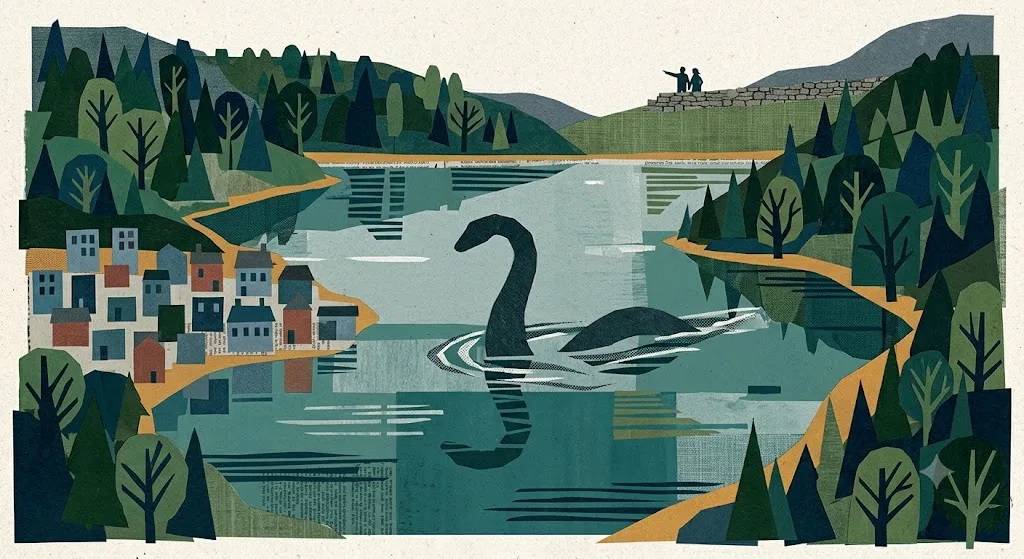
Champ is the Lake Champlain monster: a long-necked or serpentine creature said to live in the deep border water between New York and Vermont. The case matters for New York cryptid history because its strongest claims cluster on the New York shore around Port Henry and Bulwagga Bay, yet its evidence remains a debate rather than a discovery. There are old newspaper-style sea-serpent reports, hundreds of modern sighting claims, the famous Sandra Mansi photograph, underwater sound recordings, and recent video claims. There is also a long list of ordinary explanations: floating logs, large fish, otters, boat wakes, wave patterns, mirages, mistaken distance, and local storytelling momentum. Lake Champlain is large enough to feel mysterious, stretching about 120 miles with a maximum depth of about 400 feet, but no accepted physical specimen, DNA sample, or clear repeatable observation has established Champ as a real unknown animal.[lcbp.org]lcbp.orgLake Champlain Basin ProgramLake and Basin FactsLake and Basin Facts · Lake Length: 120 miles (193 kilometers). · Greatest Width: 12 mile…
Why Lake Champlain makes Champ feel possible
Lake Champlain is not a pond with a mascot. It is a long, cold, historically busy lake running north from Whitehall, New York, towards Quebec, with New York’s Adirondack shore on one side and Vermont on the other. The Lake Champlain Basin Program gives its length as 120 miles, its greatest width as 12 miles, its average depth as 64 feet, and its maximum depth as 400 feet between Charlotte, Vermont, and Essex, New York. Those dimensions help explain why a lake-monster story could survive here: from the shore, a distant animal, wake, log or line of birds can appear and vanish before anyone can judge scale properly.[Lake Champlain Basin Program]lcbp.orgLake Champlain Basin ProgramLake and Basin FactsLake and Basin Facts · Lake Length: 120 miles (193 kilometers). · Greatest Width: 12 mile…
The New York side is especially important because Port Henry and nearby Bulwagga Bay have become Champ’s home ground in the public imagination. Local tourism pages describe Bulwagga Bay as a place associated with many “sightings”, while Port Henry promotes Champ as an attraction tied to the lakefront, local signs and regional identity. That does not prove the creature exists, but it does show where the legend has attached itself most strongly: not to an abstract lake, but to a particular shore town that has learned to live with the monster as folklore, brand and unresolved question.[lakechamplainregion.com]lakechamplainregion.comOpen source on lakechamplainregion.com.
The setting also supplies several natural candidates for honest mistakes. Lake Champlain supports a busy fish community, and the Lake Champlain Basin Program says 93 fish species have been identified in the basin, including 78 native species. New York’s Department of Environmental Conservation describes lake sturgeon as one of the state’s largest freshwater fish, with mature adults usually 3 to 5 feet long but occasionally exceeding 7 feet and 300 pounds. A sturgeon is not a plesiosaur, but a large, ancient-looking fish seen briefly in broken light is exactly the kind of real animal that can stretch into a monster story.[Lake Champlain Basin Program]lcbp.orgOpen source on lcbp.org.
Where the sighting tradition clusters
Champ’s modern New York tradition is usually traced to an 1819 report near Port Henry. The William G. Pomeroy Foundation’s “Champy” marker page summarises the story of “Captain Crum”, who allegedly saw a huge black serpent at Bulwagga Bay on 22 July 1819 and gave it extravagant details: a seahorse-like head, three teeth, onion-coloured eyes, a white star on the forehead and a red band around the neck. That description is colourful enough to be memorable, but also colourful enough to raise a sceptical eyebrow. It reads less like a zoological field note than a nineteenth-century sea-serpent tale.[William G. Pomeroy Foundation]wgpfoundation.orgOpen source on wgpfoundation.org.
The 1870s helped turn scattered lake talk into a public monster tradition. The Pomeroy Foundation account notes that an 1873 New York Times report described a sensational sighting of an “enormous serpent” by a railroad crew, and that P. T. Barnum offered a reward for the “great Champlain serpent”. Barnum’s involvement matters because it placed Champ in the world of showmanship as well as eyewitness testimony. A reward from America’s most famous promoter did not verify the monster; it advertised the idea that the monster was worth chasing.[William G. Pomeroy Foundation]wgpfoundation.orgOpen source on wgpfoundation.org.
The sighting map then becomes uneven rather than random. Port Henry and Bulwagga Bay repeatedly appear in local telling, while Plattsburgh, the broader Adirondack Coast and the Vermont shore also share the legend. The official Lake Champlain Region tourism page says alleged sightings had reached 180 by 1992, with about 600 people claiming to have seen Champ across the lake. That number is impressive as folklore evidence: many people have reported something. It is weaker as biological evidence, because the reports vary widely and usually lack physical traces, sharp images, measured distance, or independent verification.[lakechamplainregion.com]lakechamplainregion.comOpen source on lakechamplainregion.com.
The important point is not that every witness is unreliable. It is that sighting clusters often form where stories are already expected. Once a bay has a “Champ sightings” sign and a town has a monster identity, ambiguous things on the water are more likely to be noticed, remembered and reported through that frame. Champ’s New York geography is therefore part evidence trail, part cultural map: Bulwagga Bay is where people look for Champ because that is where Champ is said to be.

The Sandra Mansi photograph
The most famous piece of Champ evidence is the Sandra Mansi photograph, taken in 1977 and publicly discussed in the early 1980s. It appears to show a dark body and long neck rising from the lake, and for decades it has been promoted by supporters as one of the clearest lake-monster photographs anywhere. Even sceptical investigators have treated it as important because it is not just a blur or a splash; it seems, at first glance, to show a recognisable form.[centerforinquiry.s3.amazonaws.com]centerforinquiry.s3.amazonaws.comOpen source on amazonaws.com.
That is why the photograph sits at the centre of the evidence debate. If it showed a living unknown animal, it would be extraordinary. But several problems stop it from carrying that weight. The location and depth were not firmly documented at the time; the negative was not available for later checking; only one photograph was taken; and the image was not made public immediately. Robert E. Bartholomew’s 2013 Skeptical Inquirer article argued that newly surfaced information raised further questions about the circumstances in which the picture was taken and later explained.[Skeptical Inquirer]skepticalinquirer.orgnew information surfaces on worlds best lake monster photo raising questionnew information surfaces on worlds best lake monster photo raising question
Sceptics Benjamin Radford and Joe Nickell have argued that the object could plausibly have been a floating log or tree trunk. That may sound deflating, but it is not a casual dismissal. A partly submerged log can produce a head-and-neck silhouette, especially when photographed from low shore level with limited scale clues. If gas, water movement or buoyancy shifts make a log rise, dip or roll, it may briefly seem animate. The photograph’s power is precisely that it looks animal-like without giving enough information to rule out a non-animal object.[Skeptical Inquirer]skepticalinquirer.orgOpen source on skepticalinquirer.org.
For believers, the Mansi photo remains the case’s best visual anchor. For sceptics, it is a lesson in how a single dramatic image can become stronger in legend than it is in evidence. A good photograph for folklore is not the same as a good photograph for biology. To establish a new large animal, the image would need context: exact location, depth, distance, lens information, sequence shots, original negative or file, independent witnesses, and ideally later physical evidence. The Mansi photograph has mystery and cultural force, but not enough verifiable detail to settle the question.
Sounds, videos and newer claims
Champ’s evidence debate did not stop with the Mansi photo. In 2003, researchers associated with the Fauna Communications Research Institute recorded unusual underwater sounds in Lake Champlain while working on a Discovery Channel project. A later paper, “Echolocation in a fresh water lake”, reported recordings from 2003, 2005 and 2009 and stated that known native creatures and recorded non-biological signals did not account for the sounds in the study’s comparison set.[ResearchGate]researchgate.netResearch Gate Echolocation in a fresh water lakeResearch Gate Echolocation in a fresh water lake
Those recordings are intriguing, but they do not prove Champ. “Unidentified sound” is not the same as “unknown monster”. Underwater acoustics can be messy: equipment noise, boat activity, fish movement, environmental sounds and limited sampling can complicate interpretation. The value of the hydrophone claims is that they move the debate beyond eyewitness memory and into recordable data. Their weakness is that a sound without a visible source, a specimen, or repeated independent confirmation remains ambiguous.
The 2005 Bodette-Affolter video added another modern layer. ABC News reported that fishermen Peter Bodette and Dick Affolter filmed something just under the water’s surface; Bodette said he was certain they saw something, but not certain what it was. ABC consulted retired FBI forensic image analysts, who reportedly found no obvious sign of manipulation but could not say what the footage actually depicted. That distinction is crucial: “not faked” does not automatically mean “monster”. It may simply mean an unclear video of a real but unidentified object, fish, wake or animal.[ABC News]abcnews.comABC News Is There a Monster in Lake Champlain?ABC News Is There a Monster in Lake Champlain?
Recent claims have kept Champ in the news cycle. In 2026, the New York Post reported on filmmakers Richard Rossi and Kelly Tabor, who said they noticed a large shape in footage filmed on Lake Champlain while making a children’s film connected to the legend. The report framed the clip as a possible new Champ sighting and tied it back to Port Henry and the famous 1977 image. As with earlier video claims, the interesting part is not that it proves Champ; it is that modern cameras continue to produce ambiguous material rather than the crisp, repeatable evidence one would expect if a large animal regularly surfaced in a heavily used lake.[New York Post]nypost.comThe footage caught the attention of The History Channel's "The UnXplained," whose producers called it the most compelling evidence of Cha…
The strongest sceptical explanations
The sceptical case against Champ is not simply “people are making it up”. Many reports may come from sincere observers seeing ordinary things under difficult conditions. Lake surfaces distort size and distance. A line of swimming animals can look like one long body. A floating log can become a neck. A sturgeon can look prehistoric. A boat wake can seem to move independently after the boat has passed. A patch of wind-ruffled water can create a travelling shape.
Several explanations matter most around Lake Champlain:(#endnote-23 “Endnote 23”)[dec.ny.gov]dec.ny.govlake champlain lake trout fishinglake champlain lake trout fishing
Large fish: Lake sturgeon are the obvious candidate because they are large, long-lived and visually striking. New York DEC says they can occasionally exceed 7 feet and 300 pounds, while the Lake Champlain Committee calls them the lake’s largest fish. They do not match every Champ description, but they can explain some “huge thing in the water” reports.[Department of Environmental Conservation]dec.ny.govDepartment of Environmental Conservation Lake SturgeonDepartment of Environmental Conservation Lake Sturgeon
Floating logs and debris: The Mansi photograph debate shows why driftwood matters. A branch, root mass or trunk can mimic a head, neck and body, especially in still water. If the object is photographed without scale markers, it can become difficult to judge whether it is a small object nearby or a large object farther away.[Skeptical Inquirer]skepticalinquirer.orgnew information surfaces on worlds best lake monster photo raising questionnew information surfaces on worlds best lake monster photo raising question
Otters, birds and grouped animals: A line of swimming animals can create the illusion of a multi-humped creature. This explanation is common in lake-monster debates generally because witnesses often see only parts of bodies rising and falling.
Wakes, waves and mirage effects: Long lakes create long sightlines. Wind, boat traffic, temperature differences and reflections can make ordinary surface patterns look purposeful or animate. The more distant the object, the more the observer’s expectation fills in missing detail.
Story pressure: Once Champ is famous, the lake is no longer neutral. Visitors scan the water for a monster. Local signs, festivals and souvenirs make the creature part of the viewing experience. That does not invalidate every report, but it does shape how ambiguous sightings are interpreted.
The biological objection is also serious. A single ancient reptile cannot survive for centuries. A real Champ would require a breeding population, food supply, habitat and some kind of detectable trace: bodies, bones, clear photographs, sonar records, DNA or repeated high-quality observations. Lake Champlain is large, but it is not untouched wilderness. It is fished, boated, studied and monitored. The lack of physical evidence weighs heavily against the idea of a large unknown vertebrate living there.
Tourism, protection and the New York afterlife
Champ survives partly because the legend is useful and loved. Port Henry declared its waters a safe haven for Champ in 1981; Vermont passed a House Resolution protecting Champ in 1982; and New York’s Assembly and Senate passed protective resolutions in 1983, according to the Lake Champlain Region’s tourism account. These measures are best understood as symbolic civic folklore, not scientific recognition of a confirmed species. They tell visitors: this lake has a monster story, and the community is in on it.[lakechamplainregion.com]lakechamplainregion.comOpen source on lakechamplainregion.com.
That civic embrace matters on the New York side. North Country Public Radio reported in 2020 that some Port Henry residents saw Champ as a possible boost for a hamlet still dealing with economic decline after the loss of older industry. In that context, Champ is not merely a creature claim. It is a local asset: a roadside reason to stop, a child-friendly mystery, a festival hook, a symbol that gives a small lakeside place a memorable identity.[NCPR]northcountrypublicradio.orgNCPRA struggling hamlet and a lake monster: Can 'Champ' helpNCPRA struggling hamlet and a lake monster: Can 'Champ' help
The tourism version of Champ is often playful, but it also changes the evidence debate. A monster that appears on signs and souvenirs becomes easier to remember and harder to separate from place pride. Supporters may feel that sceptics are attacking local culture, while sceptics may underestimate why the legend matters even if the animal is unproven. The fairest reading is to keep those questions separate. Champ can be culturally real in Port Henry and still biologically unconfirmed.
So, is Champ more than a lake legend?
Champ is more than a throwaway tall tale, but less than a confirmed animal. The legend has a long paper trail, a strong New York location in Port Henry and Bulwagga Bay, a famous photograph, modern audio and video claims, and real civic life around it. That makes it one of the most developed lake-monster traditions in the United States. It is not just “America’s Loch Ness Monster” pasted onto a map; it has its own shoreline, witnesses, tourism history and evidence arguments.[wgpfoundation.org]wgpfoundation.orgOpen source on wgpfoundation.org.
The evidence, however, remains stubbornly below the threshold needed for a new species or surviving prehistoric animal. The Mansi photograph is suggestive but context-poor. The hydrophone recordings are interesting but source-uncertain. The videos are ambiguous. The sightings are numerous but inconsistent. Known animals and lake conditions offer several plausible explanations for many reports, and no specimen or decisive physical trace has appeared despite two centuries of claims.
That is why Champ works so well as a New York cryptid. The story lives in the gap between a real lake and an unverified creature, between local pride and sceptical caution, between “I saw something” and “we can prove what it was”. The most honest answer is also the most durable one: Champ is a powerful Lake Champlain legend with some intriguing but inconclusive evidence, and the debate is the reason the monster keeps surfacing.
Amazon book picks
Further Reading
Books and field guides related to Is Champ More Than a Lake Legend?. Use these as the next step if you want deeper reading beyond the article.
Lake Monster Mysteries
Provides broader context for Champ alongside other lake legends.

Monsters of New York
First published 2013. Subjects: Zoology, Monsters, Animals, mythical, Folklore, united states, Parapsychology.
eBay marketplace picks
Marketplace Samples
Live-tested eBay searches with available results related to this page.

Endnotes
1.
Source: lakechamplainregion.com
Link:https://www.lakechamplainregion.com/heritage/champ
2.
Source: porthenrymoriah.com
Title: champ lake champlains monster
Link:https://www.porthenrymoriah.com/visit/attractions/champ-lake-champlains-monster
3.
Source: porthenrymoriah.com
Link:https://www.porthenrymoriah.com/visit/attractions/bulwagga-bay
4.
Source: centerforinquiry.s3.amazonaws.com
Link:https://centerforinquiry.s3.amazonaws.com/wp-content/uploads/sites/29/2003/07/22164717/p24.pdf
5.
Source: researchgate.net
Title: Research Gate Echolocation in a fresh water lake
Link:https://www.researchgate.net/publication/42439027_Echolocation_in_a_fresh_water_lake
6.
Source: centerforinquiry.org
Title: the joe i know
Link:https://centerforinquiry.org/blog/the-joe-i-know/
7.
Source: centerforinquiry.org
Title: new video of champ lake monster a skeptical analysis
Link:https://centerforinquiry.org/blog/new_video_of_champ_lake_monster_a_skeptical_analysis/
8.
Source: researchgate.net
Link:https://www.researchgate.net/publication/290101418_Lake_monster_mysteries_Investigating_the_world%27s_most_elusive_creatures
9.
Source: centerforinquiry.s3.amazonaws.com
Link:https://centerforinquiry.s3.amazonaws.com/wp-content/uploads/sites/29/2003/07/22164717/p18.pdf
10.
Source: lakechamplainregion.com
Link:https://www.lakechamplainregion.com/fishing/lake-champlain-the-lake
11.
Source: lcbp.org
Link:https://www.lcbp.org/about-the-basin/facts/
Source snippet
Lake Champlain Basin ProgramLake and Basin FactsLake and Basin Facts · Lake Length: 120 miles (193 kilometers). · Greatest Width: 12 mile...
12.
Source: skepticalinquirer.org
Link:https://skepticalinquirer.org/2003/07/legend-of-the-lake-champlain-monster/
13.
Source: lcbp.org
Link:https://www.lcbp.org/our-goals/healthy-ecosystems/biodiversity/fish-and-wildlife/
14.
Source: dec.ny.gov
Title: Department of Environmental Conservation Lake Sturgeon
Link:https://dec.ny.gov/nature/animals-fish-plants/lake-sturgeon
15.
Source: wgpfoundation.org
Link:https://www.wgpfoundation.org/historic-markers/10700-2/
16.
Source: skepticalinquirer.org
Title: new information surfaces on worlds best lake monster photo raising question
Link:https://skepticalinquirer.org/2013/05/new-information-surfaces-on-worlds-best-lake-monster-photo-raising-question/
17.
Source: abcnews.com
Title: ABC News Is There a Monster in Lake Champlain?
Link:https://abcnews.com/GMA/story?id=1648547
18.
Source: skepticalinquirer.org
Title: lake lsquomonsterrsquo resurfaces
Link:https://skepticalinquirer.org/exclusive/lake-lsquomonsterrsquo-resurfaces/
19.
Source: nypost.com
Link:https://nypost.com/2026/06/07/us-news/filmmakers-claim-theyve-caught-americas-loch-ness-monster-on-video-my-eyes-were-popping-out/
Source snippet
The footage caught the attention of The History Channel's "The UnXplained," whose producers called it the most compelling evidence of Cha...
20.
Source: northcountrypublicradio.org
Title: NCPRA struggling hamlet and a lake monster: Can ‘Champ’ help
Link:https://www.northcountrypublicradio.org/news/story/42815/20201208/a-struggling-hamlet-and-a-lake-monster-can-champ-help-port-henry
21.
Source: facebook.com
Link:https://www.facebook.com/vermontexplored/photos/did-you-know-whether-champ-makes-his-home-in-lake-champlain-or-only-in-our-imagi/1644312861037486/
22.
Source: reddit.com
Link:https://www.reddit.com/r/Cryptozoology/comments/zhgs7r/champ_photographed_on_lake_champlain_1977/
23.
Source: Wikipedia
Title: Lake Champlain
Link:https://en.wikipedia.org/wiki/Lake_Champlain
24.
Source: Wikipedia
Title: Joe Nickell
Link:https://en.wikipedia.org/wiki/Joe_Nickell
25.
Source: wgpfoundation.org
Title: origin of champ
Link:https://www.wgpfoundation.org/historic-markers/origin-of-champ/
26.
Source: skepticalinquirer.org
Title: chasing champ
Link:https://skepticalinquirer.org/category/chasing-champ/
27.
Source: cryptozoologycryptids.fandom.com
Link:https://cryptozoologycryptids.fandom.com/wiki/Champ
28.
Source: animated-character-database.fandom.com
Link:https://animated-character-database.fandom.com/wiki/Champ
29.
Source: cryptidz.fandom.com
Link:https://cryptidz.fandom.com/wiki/Champ
30.
Source: about-mythical-creatures.weebly.com
Link:https://about-mythical-creatures.weebly.com/champ.html
31.
Source: unsolved.com
Link:https://unsolved.com/gallery/champ/
32.
Source: dec.ny.gov
Title: lake champlain lake trout fishing
Link:https://dec.ny.gov/things-to-do/freshwater-fishing/places-to-fish/adirondack-lake-champlain/lake-champlain-lake-trout-fishing
33.
Source: dec.ny.gov
Title: lake champlain watershed program
Link:https://dec.ny.gov/nature/waterbodies/watersheds/management/lake-champlain-watershed-program
34.
Source: believingthebizarre.com
Title: the lake champlain monster
Link:https://believingthebizarre.com/the-lake-champlain-monster/
Additional References
35.
Source: academia.edu
Link:https://www.academia.edu/38388043/Americas_Loch_Ness_Monster_Champ
36.
Source: reddit.com
Link:https://www.reddit.com/r/Cryptozoology/comments/1g3k2n5/25_min_analysis_of_the_echolocation_sounds_katy/
37.
Source: facebook.com
Link:https://www.facebook.com/usfwsnortheast/posts/adult-lake-sturgeon-can-weigh-up-to-300-pounds-and-grow-to-7-feet-long-but-even-/898468595796613/
38.
Source: facebook.com
Link:https://www.facebook.com/nyFISH307/posts/an-nbc-television-crew-was-busy-filming-a-spot-on-the-elusive-sea-creature-champ/10156464757128213/
39.
Source: passageport.org
Link:https://passageport.org/things-to-do/bulwagga-bay-beach-and-campground-port-henery-and-bulwagga-bay-rv-park/
40.
Source: bcscc.ca
Link:https://bcscc.ca/champ-lake-champlain
41.
Source: ebsco.com
Link:https://www.ebsco.com/research-starters/social-sciences-and-humanities/champ-cryptozoology
42.
Source: hmdb.org
Link:https://www.hmdb.org/m.asp?m=109078
43.
Source: westhillbb.com
Link:https://westhillbb.com/blog/2021/04/champ-legend-vermont/
44.
Source: facebook.com
Link:https://www.facebook.com/groups/220365061802020/posts/543113706193819/
Topic Tree