Within Vermont Monsters
How Did Champ Become Vermont's Mascot?
Champ grew from Indigenous serpent traditions, nineteenth-century newspaper marvels and regional showmanship into a protected civic mascot.
On this page
- Great serpent traditions around the lake
- The Captain Crum report and newspaper spectacle
- Barnum, safe haven laws and tourism afterlives
Page outline Jump by section
Introduction
Champ became Vermont’s mascot because three different stories gradually fused: older Indigenous great-serpent traditions around Lake Champlain, nineteenth-century newspaper reports that read like a mix of eyewitness claim and frontier entertainment, and a later civic embrace that turned the creature into a protected regional icon. The result is not a clean “first sighting” story. It is a layered legend in which a sacred water-being, a suspiciously detailed newspaper monster, P. T. Barnum-style showmanship and modern tourism all helped shape the friendly long-necked figure now associated with Vermont’s lake country. Lake Champlain itself gives the legend room to breathe: it runs about 120 miles, reaches 400 feet deep between Charlotte, Vermont, and Essex, New York, and links Vermont, New York and Quebec in one long borderland of islands, fog, ferries and old shoreline stories.[Lake Champlain Basin Program]lcbp.orgLake Champlain Basin Program FactsLake Champlain Basin ProgramFacts - Lake Champlain Basin Program…
Great-serpent traditions around the lake
The deepest roots of the Champ story are not modern cryptozoology at all. Around Lake Champlain, Abenaki and Haudenosaunee/Iroquois traditions include powerful serpent or great water-being stories, and modern regional accounts often connect these traditions to the later Champ legend. Lake Champlain Sea Grant, based at the University of Vermont, identifies Gitaskog, also rendered Tatoskok, as a great horned serpent associated with peoples who call Lake Champlain Pitawbagw; the source describes this being as spiritual, elusive and connected to the lake’s older lore rather than as a biological animal waiting to be catalogued.[University of Vermont]uvm.eduOpen source on uvm.edu.
That distinction matters. It is tempting in monster tourism to treat Indigenous serpent traditions as if they were simply “early Champ sightings”. That makes the modern legend sound older and more evidential than it really is, but it also flattens a living cultural tradition into a cryptid footnote. A more careful reading is that Lake Champlain already had a mythic language for powerful beings in the water before settler newspapers began printing sea-serpent stories. Later writers then folded those older traditions into the familiar Champ narrative.
Regional tourism material makes the same link, but in a more popular style. The Lake Champlain Region account says Abenaki and Iroquois peoples had traditions of a large creature in the lake, described as a horned serpent or giant snake, and gives Gitaskog as the Abenaki name commonly attached to that creature in Champ retellings. It also notes that early Abenaki warnings to French explorers were framed around not disturbing the waters and the serpent.[Lake Champlain Region]lakechamplainregion.comLake Champlain Region Champ, the Lake Champlain Monster | Lake ChamplainLake Champlain Region Champ, the Lake Champlain Monster | Lake Champlain
The folkloric shape is important: an elusive water serpent is not the same thing as a plesiosaur, a prehistoric whale or a giant fish. Those later explanations belong to modern cryptozoology and newspaper speculation. The older serpent frame is more about place, power, danger, respect and the unknown qualities of a vast lake. That is one reason Champ feels more rooted than a one-off hoax. The Vermont version of the monster grew in a landscape where the lake was already imagined as animate, deep and not entirely tame.

Did Samuel de Champlain really see Champ?
The famous “Samuel de Champlain saw Champ in 1609” claim is one of the legend’s most persistent weak spots. Many retellings say the lake’s European namesake described a monster with a horse-like head or serpent-like body. The better-supported version is less dramatic: Champlain described an unusual large fish, and later writers recast that passage as a monster encounter.
The Lake Champlain Region account says Champlain is often wrongly credited as the first European to sight Champ and that close readings place the relevant observation near the St Lawrence River rather than as a clear Lake Champlain monster report. The quoted description concerns a fish called Chaousarou, said to reach impressive size, with a long snout, sharp teeth, pike-like body and hard silvery-grey scales. The same source says historians generally interpret this as a gar-like fish rather than Champ.[Lake Champlain Region]lakechamplainregion.comLake Champlain Region Champ, the Lake Champlain Monster | Lake ChamplainLake Champlain Region Champ, the Lake Champlain Monster | Lake Champlain
A historical marker account from the William G. Pomeroy Foundation makes the sceptical point even more directly: the popular Champlain quote is misleading, because his journals point to a garpike shown or described to him by Indigenous guides. Longnose gar can grow over six feet and have long toothy snouts, which makes them exactly the sort of “strange fish” that could become monster material in later retellings.[William G. Pomeroy Foundation]wgpfoundation.orgWilliam G. Pomeroy Foundation CHAMPY | William G. Pomeroy FoundationWilliam G. Pomeroy Foundation CHAMPY | William G. Pomeroy Foundation
This does not ruin the legend. In fact, it makes Champ more interesting. The Champlain story shows how folklore often grows by reinterpretation: a fish passage becomes a monster passage; a name attached to the lake becomes attached to the creature; and a later regional mascot gains the authority of an explorer’s journal. For evidence of an unknown animal, that is weak. For evidence of how stories gather prestige, it is very revealing.
The Captain Crum report and newspaper spectacle
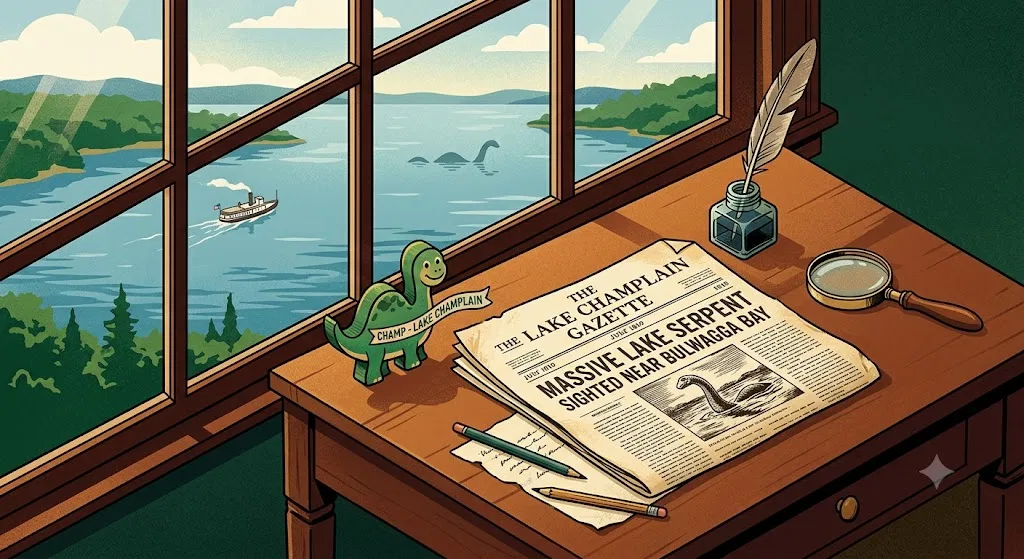
The first famous printed Champ account usually cited is the Captain Crum report in the Plattsburgh Republican of 24 July 1819. It places the sighting at Bulwagga Bay, near the New York side of the lake, where Crum was said to be aboard a scow when he saw a black monster around 187 feet long, with a sea-horse-like head, rising more than 15 feet out of the water.[Lake Champlain Region]lakechamplainregion.comLake Champlain Region Champ, the Lake Champlain Monster | Lake ChamplainLake Champlain Region Champ, the Lake Champlain Monster | Lake Champlain
The details are what make the report so memorable — and so suspicious. Crum supposedly saw three teeth, eyes the colour of a peeled onion, a white star on the forehead and a red belt around the neck, even though the object was said to be around 200 yards away.[Lake Champlain Region]lakechamplainregion.comLake Champlain Region Champ, the Lake Champlain Monster | Lake ChamplainLake Champlain Region Champ, the Lake Champlain Monster | Lake Champlain That is a wonderful image for folklore, but it is a difficult one for sober observation. The creature is not merely large; it is extravagantly described, almost heraldic, like something designed to be repeated in taverns, newspapers and lakeside gossip.
The Pomeroy Foundation marker account preserves the same essentials: the alleged 1819 sighting near Port Henry, the 187-foot black serpent, the sea-horse head and the strange ornamental details. It also notes that Bulwagga Bay has since become Champy’s “home base” in popular memory because so many later reports and tourist markers cluster around it.[William G. Pomeroy Foundation]wgpfoundation.orgWilliam G. Pomeroy Foundation CHAMPY | William G. Pomeroy FoundationWilliam G. Pomeroy Foundation CHAMPY | William G. Pomeroy Foundation
The title often associated with the 1819 report, “Cape Ann Serpent on Lake Champlain”, also hints at a wider newspaper culture. Sea-serpent stories were already a popular genre in the early nineteenth-century United States, with the Cape Ann/Gloucester sea serpent among the best-known coastal marvels. Dropping that kind of creature into Lake Champlain made the local report part of a broader entertainment pattern: a regional paper could turn a strange claim, joke, hoax or exaggerated anecdote into a shared spectacle.
The useful question is not simply “was Captain Crum lying?” It is “what kind of text is this?” Read as zoological evidence, the report is over-specific, over-sized and hard to credit. Read as folklore in print, it is a founding document: it gives Champ a location, a body, a scale, a date and a theatrical personality.

Why nineteenth-century newspapers loved lake monsters
Champ’s newspaper phase grew in a world where marvels sold. Local papers did not have to prove a lake monster in order to profit from one; they only had to make readers talk. A monster report could promote a town, fill column inches, entertain subscribers, and invite follow-up letters or rival sightings. Lake Champlain, with its cross-border traffic, steamboats, fisheries, military history and deep water, was well suited to this kind of story.
The 1870s were especially important. A New York Times report in 1873 described a railroad crew seeing the head of an “enormous serpent” with silvery scales, while Clinton County Sheriff Nathan H. Mooney also reported a water-serpent-like creature around 25 to 35 feet long. That same summer, the steamship W. B. Eddy was said to have run into Champ, nearly turning over according to passengers.[Lake Champlain Region]lakechamplainregion.comLake Champlain Region Champ, the Lake Champlain Monster | Lake ChamplainLake Champlain Region Champ, the Lake Champlain Monster | Lake Champlain
Those accounts shifted Champ from a single bizarre 1819 item into a recurring lake mystery. The witness types also mattered. A named sheriff, a railroad crew and steamship passengers sounded more socially respectable than an anonymous joker. Yet the reports still moved through a newspaper environment that rewarded drama. Every new sighting strengthened the impression that something was “going on” in Lake Champlain, even when the evidence remained anecdotal.
This is how a regional monster becomes sticky. It needs repetition, but not necessarily consistency. One report gives a serpent; another gives a scaly head; another gives a collision; another gives a giant fish-like body. The contradictions do not kill the legend. They let different audiences imagine their own Champ.
Barnum and the showman’s reward
P. T. Barnum’s involvement gave the Champlain serpent a perfect nineteenth-century publicity boost. In 1873, he offered a $50,000 reward for the hide of the “great Champlain serpent” for his mammoth World’s Fair show, according to regional accounts.[Lake Champlain Region]lakechamplainregion.comLake Champlain Region Champ, the Lake Champlain Monster | Lake ChamplainLake Champlain Region Champ, the Lake Champlain Monster | Lake Champlain The Pomeroy Foundation’s marker history also notes Barnum’s 1873 prize and says he put up a later $20,000 bounty in 1887 for the Champlain sea serpent, dead or alive.[William G. Pomeroy Foundation]wgpfoundation.orgWilliam G. Pomeroy Foundation CHAMPY | William G. Pomeroy FoundationWilliam G. Pomeroy Foundation CHAMPY | William G. Pomeroy Foundation
Barnum did not need Champ to be real in order for the reward to work. The offer itself was the advertisement. It made the lake monster feel valuable, huntable and nationally amusing. It also fitted Barnum’s talent for turning uncertainty into spectacle: the public could laugh, wonder, doubt and still buy into the story.
This showmanship changed the texture of Champ. The older serpent tradition belonged to cultural memory and place. The 1819 report belonged to newspaper marvels. Barnum pulled the creature into commercial entertainment. From that point onward, Champ was not only a thing people claimed to see; Champ was a thing people could market.
That legacy still shapes the creature’s afterlife. A monster with a reward attached becomes a public challenge. A monster repeatedly printed in newspapers becomes a regional brand. A monster attached to a scenic lake becomes tourism material. Vermont did not invent Champ alone — New York’s side of the lake is central to the early newspaper story — but Vermont helped turn the creature into a broader Lake Champlain identity.
From frightening serpent to protected mascot
The modern Champ is far friendlier than the old newspaper monster. Today the creature appears in children’s books, local logos, tourism material, waterfront statues and sports branding. The Lake Champlain Region account notes that Port Henry declared its waters a safe haven for Champ in 1981, Vermont passed a House Resolution protecting Champ in 1982, and New York followed with protective resolutions in 1983. The same source describes Champ as a cheerful regional figure, appearing with the Vermont Lake Monsters baseball team and in local businesses and merchandise.[Lake Champlain Region]lakechamplainregion.comLake Champlain Region Champ, the Lake Champlain Monster | Lake ChamplainLake Champlain Region Champ, the Lake Champlain Monster | Lake Champlain
That legal protection was symbolic, but symbols are exactly how mascots work. The point was not that legislators had proved a lake monster existed. It was that Champ had become part of the public imagination around Lake Champlain, worth protecting as a story, a joke, a tourist draw and a shared emblem.
Vermont Historical Society educational material captures this balance neatly. It notes sceptical explanations such as floating logs, lines of large sturgeon diving, or flocks of black birds flying low over the water, while also recording that Vermont’s House of Representatives passed an April 1982 resolution saying Champ should be protected from wilful acts causing death, injury or harassment.[Vermont History Explorer]vermonthistoryexplorer.orgVermont History Explorer The same page’s mixture of doubt, playfulness and state pride is very close to Champ’s modern role: maybe real, probably mis-seen, definitely beloved.
The ECHO, Leahy Center for Lake Champlain in Burlington has pushed that transformation further by presenting Champ as a mix of science, history, folklore and interactive imagination. Its permanent “Champ: America’s Lake Monster” exhibit invites visitors to examine reported sightings, real and unproven creatures, changing descriptions and the famous question of whether they believe in Champ.[ECHO, Leahy Center for Lake Champlain]echovermont.orgECHO, Leahy Center for Lake Champlain Champ: America's Lake MonsterECHO, Leahy Center for Lake Champlain Champ: America's Lake Monster That is a long way from Captain Crum’s 187-foot beast with onion-coloured eyes. It is Champ as public education, lake stewardship and local myth-making.
What Champ’s origin story really shows
Champ’s origin story is strongest when read as cultural history, not as a single chain of proof. The Indigenous serpent traditions show that Lake Champlain was already a place of powerful water-being stories. The Samuel de Champlain claim shows how a large fish description can be upgraded into monster lore. The Captain Crum report shows how a tall tale can become a founding “case”. Barnum’s reward shows how showmanship can transform local rumour into public spectacle. The safe-haven laws and museum exhibits show how a frightening serpent can become a protected civic mascot.
The evidence for an unknown animal remains thin. The most grounded explanations for many reports are ordinary lake phenomena: large fish such as gar or sturgeon, floating logs, birds skimming the surface, mirages, distance errors, waves, wakes and expectation. The Pomeroy marker account summarises several of these possibilities, including large fish and visual distortion from temperature inversions that can make sticks, shadows or animals appear larger or stranger than they are.[William G. Pomeroy Foundation]wgpfoundation.orgWilliam G. Pomeroy Foundation CHAMPY | William G. Pomeroy FoundationWilliam G. Pomeroy Foundation CHAMPY | William G. Pomeroy Foundation
Yet sceptical explanations do not make Champ disposable. They help explain why the legend keeps working. Lake Champlain is big enough to hide things from the eye, old enough to gather stories, busy enough to produce witnesses, and beloved enough that people want its monster to be friendly. Champ became Vermont’s mascot not because one report settled the matter, but because generations kept finding useful meanings in the same dark water: warning, wonder, comedy, commerce, local pride and the pleasure of looking twice at a ripple.
Amazon book picks
Further Reading
Books and field guides related to How Did Champ Become Vermont's Mascot?. Use these as the next step if you want deeper reading beyond the article.
American Monsters
Useful for comparing Champ's evolution with other regional creatures.
eBay marketplace picks
Marketplace Samples
Live-tested eBay searches with available results related to this page.


Endnotes
1.
Source: vermonthistoryexplorer.org
Title: Vermont History Explorer
Link:https://vermonthistoryexplorer.org/client_media/files/GreenMountaineer/vermontsveryown.pdf
2.
Source: legislature.vermont.gov
Link:https://legislature.vermont.gov/statutes/section/25/001/00082
3.
Source: youtube.com
Link:https://www.youtube.com/watch?v=H57Q2KZS_Qw
Source snippet
The Champ! | The Monster Project...
4.
Source: youtube.com
Title: The Champ! | The Monster Project
Link:https://www.youtube.com/watch?v=ymGpsEypXG4
Source snippet
Lake Champlain's Mysterious Creature: America's Loch Ness Monster...
5.
Source: lcbp.org
Title: Lake Champlain Basin Program Facts
Link:https://www.lcbp.org/about-the-basin/facts/
Source snippet
Lake Champlain Basin ProgramFacts - Lake Champlain Basin Program...
6.
Source: uvm.edu
Link:https://www.uvm.edu/seagrant/2024/11/26/who-is-the-serpent-that-calls-lake-champlain-home/
7.
Source: lakechamplainregion.com
Title: Lake Champlain Region Champ, the Lake Champlain Monster | Lake Champlain
Link:https://www.lakechamplainregion.com/heritage/champ
8.
Source: wgpfoundation.org
Title: William G. Pomeroy Foundation CHAMPY | William G. Pomeroy Foundation
Link:https://www.wgpfoundation.org/historic-markers/10700-2/
9.
Source: echovermont.org
Title: ECHO, Leahy Center for Lake Champlain Champ: America’s Lake Monster
Link:https://www.echovermont.org/animals-exhibits/champ-americas-lake-monster/
10.
Source: vermonthistory.org
Link:https://vermonthistory.org/client_media/files/Learn/2020%20resources/ChampActivity.pdf
11.
Source: echovermont.org
Link:https://www.echovermont.org/
12.
Source: Wikipedia
Title: Lake Champlain
Link:https://en.wikipedia.org/wiki/Lake_Champlain
13.
Source: Wikipedia
Title: ECHO, Leahy Center for Lake Champlain
Link:https://en.wikipedia.org/wiki/ECHO%2C_Leahy_Center_for_Lake_Champlain
14.
Source: cryptozoologycryptids.fandom.com
Link:https://cryptozoologycryptids.fandom.com/wiki/Champ
15.
Source: animated-character-database.fandom.com
Link:https://animated-character-database.fandom.com/wiki/Champ
16.
Source: science.howstuffworks.com
Link:https://science.howstuffworks.com/science-vs-myth/strange-creatures/champy.htm
17.
Source: neiwpcc.org
Link:https://neiwpcc.org/program-partners/lcbp/
18.
Source: reddit.com
Link:https://www.reddit.com/r/Cryptozoology/comments/zhgs7r/champ_photographed_on_lake_champlain_1977/
Additional References
19.
Source: youtube.com
Title: Lake Champlain’s Mysterious Creature: America’s Loch Ness Monster
Link:https://www.youtube.com/watch?v=a5ORlAZG2Gc
Source snippet
The Perplexing Legend of Vermont's Sea Monster...
20.
Source: facebook.com
Link:https://www.facebook.com/groups/acfa.cryptozoology/posts/1153148535048164/
21.
Source: publishersweekly.com
Link:https://www.publishersweekly.com/9781438444840
22.
Source: facebook.com
Link:https://www.facebook.com/1290WNBF/posts/a-large-creature-has-been-supposedly-spotted-many-times-in-new-york-states-3rd-l/1059378459525839/
23.
Source: publishersweekly.com
Link:https://www.publishersweekly.com/pw/authorpage/robert-e-bartholomew.html
24.
Source: ebsco.com
Link:https://www.ebsco.com/research-starters/social-sciences-and-humanities/champ-cryptozoology
25.
Source: westhillbb.com
Link:https://westhillbb.com/blog/2021/04/champ-legend-vermont/
26.
Source: facebook.com
Link:https://www.facebook.com/groups/242479246326368/posts/2074078783166396/
27.
Source: adktaste.com
Link:https://www.adktaste.com/blog/adirondacks-lake-champlain-champ-monster
28.
Source: facebook.com
Link:https://www.facebook.com/groups/220365061802020/posts/543113706193819/
Topic Tree