Within Alabama Cryptids
Is Alabama Really Bigfoot Country?
Alabama Bigfoot reports cluster in forests, ridges, creek bottoms and rural roads where brief sightings are easiest to misread.
On this page
- Reported sighting areas and landscape patterns
- How Alabama fits the national Sasquatch template
- Bears, people, shadows and other sceptical explanations
Page outline Jump by section
Introduction
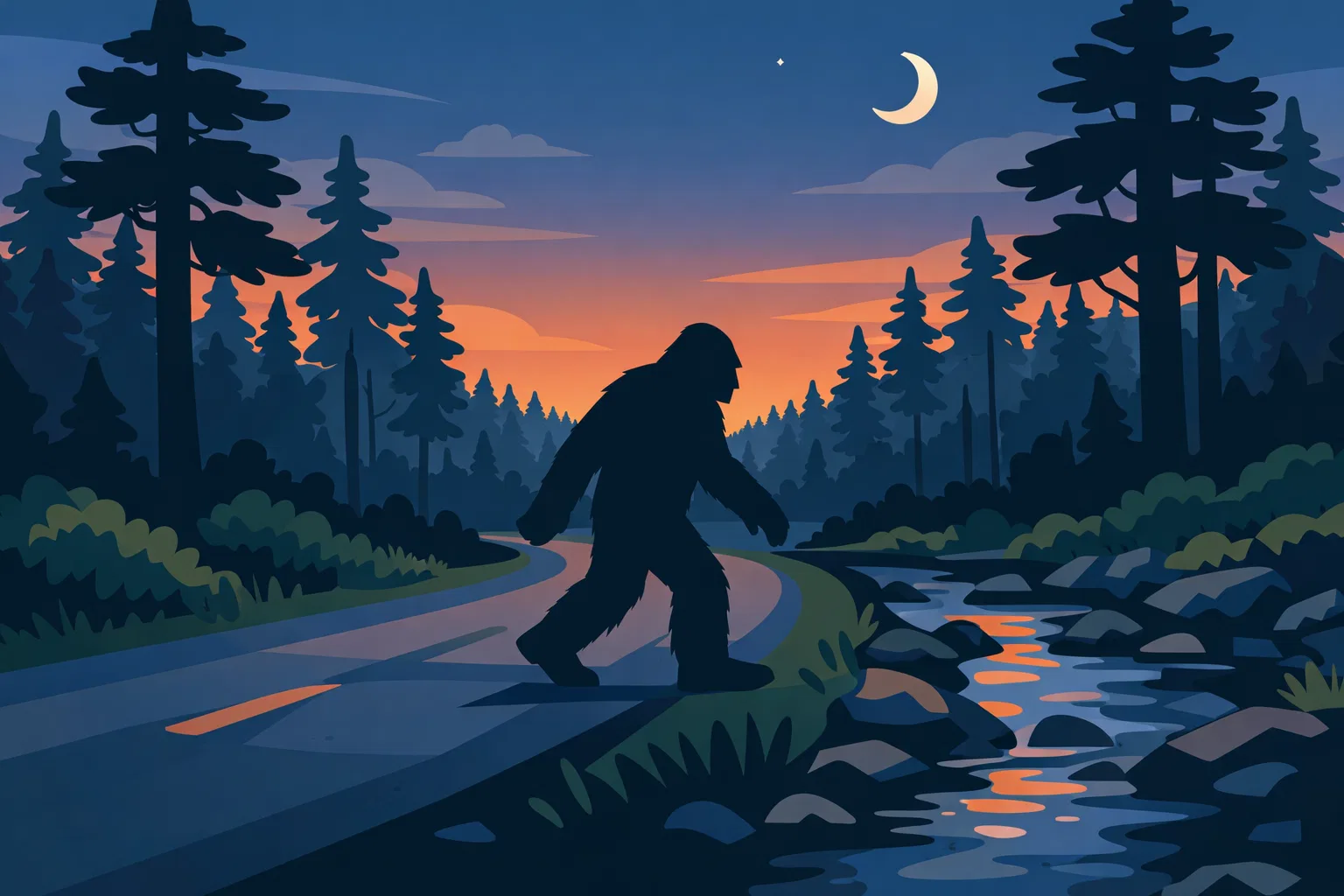
Alabama can fairly be called Bigfoot country in the folklore sense, but not in the zoological sense. The state has a large and varied landscape of pine woods, ridges, creek bottoms, hunting leases, national forests and quiet rural roads where brief encounters are easy to misread and easy to retell. The strongest evidence for Alabama Bigfoot is not a body, DNA sample or clear photograph. It is a pattern of witness reports: road crossings, figures at the edge of headlights, screams near fishing spots, large tracks in soft ground, and clusters of stories from forested counties. The Bigfoot Field Researchers Organization lists Alabama reports across many counties, with recent entries including Cleburne County near Heflin and the Georgia line, Baldwin County near Gulf Shores, and older clusters in Tuscaloosa, Morgan, Talladega, Walker, Blount and other rural or wooded areas.[bfro.net]bfro.netReports for AlabamaReports for Alabama
What makes Alabama’s Bigfoot tradition distinctive is not that it overturns the sceptical case against Sasquatch. It does not. What makes it interesting is how neatly the reports fit the state’s physical geography. Alabama has four national forests — Bankhead, Conecuh, Talladega and Tuskegee — covering more than 673,000 acres across 17 counties, from Appalachian and Cumberland Plateau terrain to Piedmont and Coastal Plain woods.[US Forest Service]fs.usda.govUS Forest Service Home | National Forests in Alabama | Forest ServiceUS Forest Service Home | National Forests in Alabama | Forest Service In other words, the setting is real even when the creature remains unproven: deep roads, broken sightlines, animal habitat, logging country, hunting land, and people travelling home after dark.
Where Alabama Bigfoot reports tend to cluster
Alabama Bigfoot stories are not evenly spread in the popular imagination. They gather around places where wooded cover, rough roads and human activity overlap: the Talladega National Forest area, north Tuscaloosa County roads, the Cleburne County corridor near the Georgia line, north Alabama ridges, and parts of south Alabama where Evergreen and Conecuh County have leaned into the legend.
The BFRO’s Alabama state listing is useful as a folklore map, not as proof. Its county table shows reports in dozens of counties, including five in Chilton, five in Morgan, five in Tuscaloosa, four in Blount, four in Talladega, four in Walker, three in Cleburne, three in Conecuh and three in Washington, among others.[bfro.net]bfro.netReports for AlabamaReports for Alabama These are small numbers over decades, and they come from a self-selecting database of people willing to report strange experiences. Still, the distribution tells us something about the kind of landscape that produces Alabama Bigfoot narratives: wooded roads, farms, creeks, ridges, forest edges and rural homes rather than city centres.
The most recent headline-style entries in the BFRO Alabama list also show the same pattern. A February 2023 Cleburne County report is described as a daylight sighting by two witnesses outside Heflin, about 10 miles from the Georgia border near Interstate 20. A June 2020 Cleburne County report describes a supposed Sasquatch crossing a forest road near the Alabama-Georgia state line. A November 2021 Baldwin County report is framed as a possible road-crossing sighting about five miles north-east of Gulf Shores.[bfro.net]bfro.netReports for AlabamaReports for Alabama That is the Alabama template in miniature: a road, a glimpse, a wooded edge, and a witness trying to make sense of something seen briefly.
This is why “forests and back roads” is more than a mood-setting phrase. It is the structure of the evidence. Many reports are not long encounters in open daylight. They are momentary sightings from moving vehicles, glimpses across curves, figures caught in headlights, or sounds heard while fishing, camping or returning home late. Such reports are exactly the kind that make a story memorable while also making verification difficult.
Talladega: the national-forest Bigfoot setting
Talladega National Forest is one of the strongest settings for Alabama Bigfoot lore because it supplies nearly every ingredient the national Sasquatch story needs: hills, heavy cover, camping, winding roads, wildlife and long stretches where a driver can feel alone. The BFRO’s Talladega County page lists reports including a 1999 alleged encounter while driving through Talladega National Forest, a 2000 large footprint in a sandy creek bank near the forest, a 2005 camper sighting at Cheaha Mountain State Park, and 2014 “strange occurrences” at a rural home outside Talladega.[bfro.net]bfro.netTalladega County, Alabama – Reports & ArticlesTalladega County, Alabama – Reports & Articles
One of the more vivid Talladega-linked accounts is the 1999 road encounter later filed with BFRO. The witness said she rounded a curve on a two-lane road at about 11 pm and saw a large, hairy figure close to the car. In the follow-up summary, the investigator described the reported animal as dark, reddish-haired, heavy, no-necked and briefly illuminated by headlights; the same summary notes that the area borders Talladega National Forest and has abundant water and cover.[bfro.net]bfro.netshow report.aspshow report.asp This is not independent proof of an unknown primate. It is, however, a classic Alabama Bigfoot report: a narrow road, a curve, headlights, a short viewing window, and a setting where black bear, wild hog, deer, turkey and other wildlife already belong.
Cheaha Mountain and the broader Talladega landscape also matter culturally. A mountain or forest road sighting feels more plausible to a witness than a suburban one because the surroundings already suggest remoteness. The mind does not need much help to turn “large dark form near the timber” into “something out there”. For sceptics, that same landscape cuts the other way: woods, curves and night driving create poor observation conditions. For believers, it creates habitat. That disagreement is the heart of Alabama’s Bigfoot debate.
Bone Camp Road and the back-road pattern
The Bone Camp Road reports in northern Tuscaloosa County show how a local road can become a mini-legend. In April 2014, a BFRO report described a driver turning onto Bone Camp Road from Highway 171 at about 9 pm and seeing a large figure standing in brush. The witness said the figure vanished when the car’s bright lights were switched on, and also claimed a previous sighting on the same road, along with local stories of a large figure near homes and strange tree formations.[bfro.net]bfro.netshow report.aspshow report.asp
Local coverage by Patch revisited the Bone Camp story in 2024, noting that Tuscaloosa County had five BFRO-listed reports from July 1999 to April 2014 and that the Bone Camp report had become part of a broader local appetite for odd nature stories. The article also made the important sceptical point that the evidence remains inconclusive, while observing that northern Tuscaloosa County has seen development and timberland changes that could alter how people encounter wildlife, shadows and wooded edges.[Patch]patch.comOpen source on patch.com.
Bone Camp is useful because it strips the Bigfoot question down to its everyday mechanics. There is no dramatic monster attack, no captured specimen, no laboratory evidence. There is a driver, a dark road, thick pine woods, a figure at the margin of sight, and then a story that gets repeated because it attaches itself to a named place. That is how many state-level cryptid traditions work. A road becomes more than a road; it becomes the place where someone saw something.
Cleburne County and the Georgia-line corridor
Cleburne County gives Alabama Bigfoot lore a different kind of geography: borderland woods and road corridors near Georgia. The BFRO county page lists three reports: a February 2023 daylight sighting outside Heflin, a June 2020 alleged Sasquatch crossing a forest road off I-20 near the Alabama-Georgia line, and a 1994 Class B report involving screams heard while fishing.[bfro.net]bfro.netCleburne County, Alabama – Reports & ArticlesCleburne County, Alabama – Reports & Articles
The Georgia connection matters because northeast Alabama is also one of the state’s real bear-recovery zones. Outdoor Alabama says that black bears have recently moved into northeast Alabama from north-west Georgia, especially DeKalb, Cherokee and Etowah counties, and have established a small but viable population there. It also notes that sporadic bear sightings have been documented elsewhere in the state.[Outdoor Alabama]outdooralabama.comOpen source on outdooralabama.com. That does not automatically explain every Cleburne Bigfoot report; Cleburne is not named in that particular core list. But it does place the region inside a wider landscape where large, dark, unexpected animals are no longer impossible surprises.
This is one reason the Cleburne-style road crossing is so interesting. A witness may sincerely report a bipedal, hair-covered figure, while a sceptic may ask what was actually seen, for how long, at what distance, and under what light. A bear, a person, a deer glimpsed at an odd angle, or a shadowed object near a road can all become stranger under pressure, especially when the sighting is sudden and the witness is already navigating traffic, curves or roadside cover.
Evergreen turned Bigfoot into civic folklore
South Alabama’s Bigfoot tradition is not only about witness reports. It is also about how a town can adopt a legend. In 2017, Evergreen’s city council voted to call the city the “Big Foot Capital of Alabama” after Bigfoot stories were discussed around the city’s Collard Green Festival. WSFA reported that Donald McDonald, associated with the television show Killing Bigfoot, said there had been numerous reports within a 20-mile radius of Evergreen; the council then voted unanimously for the title.[https://www.wsfa.com]wsfa.comOpen source on wsfa.com.
The Encyclopedia of Alabama also records Evergreen’s 2017 naming as the “Official Bigfoot Capital of Alabama”, placing it alongside the town’s festivals and local identity rather than treating it as a scientific claim.[Encyclopedia of Alabama]encyclopediaofalabama.orgEncyclopedia of Alabama EvergreenEncyclopedia of Alabama Evergreen That distinction is important. Evergreen’s Bigfoot identity is best read as civic folklore and roadside culture: a way to turn strange local stories into a recognisable hook for visitors, festivals, social media, merchandise and local pride.
This is not unusual in American Bigfoot culture. Towns across the country have used Sasquatch as a playful tourism emblem, especially where woods, hills or small-town road culture make the idea feel locally appropriate. Evergreen’s version is distinctly Alabama because it sits beside collard greens, Conecuh County identity and south Alabama pine-country storytelling. It shows how Bigfoot can move from “someone saw something near the woods” to “this is part of how our town tells stories about itself”.
How Alabama fits the national Sasquatch template
Alabama Bigfoot reports borrow the national Sasquatch template but translate it into Southern terrain. The standard American Bigfoot story usually involves a large upright hairy figure, a powerful smell or vocalisation, large tracks, a remote road or forest, and a witness who sees the creature briefly before it disappears. Alabama reports often keep those ingredients but place them in pine plantations, creek bottoms, Appalachian foothills, hunting roads, campgrounds and small rural communities.
The BFRO itself is central to this template because it standardised how many modern reports are collected and displayed. The organisation says its website launched in 1995 and became an early public database of Bigfoot/Sasquatch reports; it also says modern reports are not posted without some form of investigation, ranging from phone interviews to more involved field checks.[bfro.net]bfro.netBFR O Database History and Report Classification SystemBFR O Database History and Report Classification System That makes the BFRO useful for tracking claims, but it should not be confused with a neutral government wildlife database or peer-reviewed evidence of an unknown species.
Alabama’s reports also show why the national template travels so well. A driver in Talladega, a camper near Cheaha, a resident on Bone Camp Road and a witness near Heflin can all describe different events, yet readers recognise them as “Bigfoot reports” because the story grammar is the same: a large figure appears at the boundary between human space and wild space, then vanishes before anyone can properly document it.
The weakness is built into that grammar. The figure is almost always too brief, too dark, too far away, too anonymous or too poorly documented to settle the question. That does not make every witness dishonest. It does mean the reports are much stronger as folklore evidence than as biological evidence.
Bears, people, shadows and other sceptical explanations
The best sceptical explanations for Alabama Bigfoot reports do not require one universal answer. Some reports may be sincere misidentifications. Some may be embellished local stories. Some may be hoaxes. Some may involve real wildlife seen badly. Some may involve people, tree stumps, hunting gear, road signs, shadows, fear and memory.
Black bears are the most obvious animal comparison, especially in a state where bears are recovering. Outdoor Alabama says the state’s bears were historically concentrated in the south-west, especially Mobile, Washington and Clarke counties, while a small viable population has developed in the north-east after immigration from Georgia.[Outdoor Alabama]outdooralabama.comOpen source on outdooralabama.com. Alabama Cooperative Extension adds that sightings are most common in spring and summer, when young males disperse and adult males travel widely, and that development and habitat fragmentation can cause bears to cross roads, neighbourhoods and residential areas.[Alabama Cooperative Extension System]aces.eduOpen source on aces.edu.
Bear habitat also overlaps with many “mystery animal” settings. Outdoor Alabama describes black bears as animals of mixed hardwood and pine forests, dense undergrowth, small meadows, wetlands, streams and ponds, with males sometimes roaming over 15,000 acres.[Outdoor Alabama]outdooralabama.comOutdoor Alabama Black Bear | Outdoor AlabamaOutdoor Alabama Black Bear | Outdoor Alabama A large bear glimpsed at night, partly upright, moving through brush or crossing a rural road, can be startling even to someone familiar with ordinary wildlife. That said, bears do not explain every claimed detail in every report, especially descriptions of long-legged upright walking or human-like hands. The sceptical point is not that “it was always a bear”; it is that known animals and poor viewing conditions must be ruled out before inventing an unknown one.
There is also the broader Bigfoot evidence problem. Smithsonian Magazine summarised the long-running dispute around the famous 1967 Patterson-Gimlin film and quoted sceptic Benjamin Radford asking why the evidence has not improved despite the explosion in camera quality and availability.[Smithsonian Magazine]smithsonianmag.comSmithsonian Magazine Why Do So Many People Still Want to Believe in Bigfoot?Smithsonian Magazine Why Do So Many People Still Want to Believe in Bigfoot? That question applies sharply to Alabama. Hunters, drivers, campers, trail users and landowners now carry phones, trail cameras and dashcams in places where older reports depended on memory alone. Yet the Alabama record still consists mainly of witness accounts, not clear, repeatable physical evidence.
What would make an Alabama Bigfoot report stronger?
A stronger Alabama Bigfoot case would need evidence that survives ordinary wildlife explanations and can be checked by outsiders. A clear video with scale, location and continuity would matter more than a blurry clip. Multiple independent witnesses from different positions would matter more than one frightened driver. Tracks would be more useful if photographed with scale, cast properly, followed over distance and examined by qualified trackers. Hair, scat or tissue would only become meaningful if collected without contamination and tested by a credible laboratory.
Most Alabama reports do not reach that level. They remain in the category of testimony: sometimes vivid, sometimes sincere, sometimes locally important, but rarely decisive. The BFRO’s own database is built around witness accounts and follow-up assessment, and its Alabama list is valuable because it preserves the pattern of claims over time.[bfro.net]bfro.netBFR O Database History and Report Classification SystemBFR O Database History and Report Classification System It does not establish that a hidden primate population lives in the state’s forests.
That distinction makes the stories more interesting, not less. Alabama Bigfoot reports reveal how people interpret the border between known and unknown in familiar places. A forest road after dark is not just a transport route; it is a theatre of uncertainty. A creek bank track is not just mud; it becomes a clue. A scream while fishing is not just a sound; it becomes a story told again because it happened in a place where strangeness feels possible.
Why the legend keeps working in Alabama
Alabama’s Bigfoot legend survives because it is flexible. In north and east Alabama, it attaches itself to ridges, forests, Cheaha country, the Georgia line and older Appalachian-style woods lore. In Tuscaloosa County, it can attach itself to a named road such as Bone Camp. In south Alabama, it can become civic identity in Evergreen. Across the state, it blends with hunting culture, rural night driving, camping, timberland, bear recovery, and the long Southern habit of turning a strange encounter into a place-based tale.
The careful reading is neither “Bigfoot is real” nor “everyone is lying”. The better conclusion is that Alabama has the right geography, wildlife and storytelling culture for Bigfoot reports to feel at home. The forests and back roads supply the stage. The witness accounts supply the drama. The sceptical explanations supply the necessary caution. What remains is a living state legend: not confirmed natural history, but a durable Alabama mystery-beast tradition rooted in real landscapes where a brief shape in the headlights can still become something much larger by morning.
Amazon book picks
Further Reading
Books and field guides related to Is Alabama Really Bigfoot Country?. Use these as the next step if you want deeper reading beyond the article.
Sasquatch: Legend Meets Science
Directly addresses Sasquatch claims and interpretations.
eBay marketplace picks
Marketplace Samples
Live-tested eBay searches with available results related to this page.




Endnotes
1.
Source: bfro.net
Title: Reports for Alabama
Link:https://www.bfro.net/GDB/state_listing.asp?state=al
2.
Source: bfro.net
Title: Cleburne County, Alabama – Reports & Articles
Link:https://www.bfro.net/GDB/show_county_reports.asp?county=Cleburne&state=al
3.
Source: bfro.net
Title: Talladega County, Alabama – Reports & Articles
Link:https://www.bfro.net/GDB/show_county_reports.asp?county=Talladega&state=al
4.
Source: bfro.net
Title: show report.asp
Link:https://www.bfro.net/GDB/show_report.asp?id=25238
5.
Source: bfro.net
Title: show report.asp
Link:https://www.bfro.net/gdb/show_report.asp?id=44849
6.
Source: patch.com
Link:https://patch.com/alabama/tuscaloosa/april-marks-10-years-tuscaloosa-countys-last-bigfoot-sighting
7.
Source: wsfa.com
Link:https://www.wsfa.com/story/34477710/evergreen-council-names-city-big-foot-capital-of-alabama/
8.
Source: bfro.net
Title: BFR O Database History and Report Classification System
Link:https://www.bfro.net/gdb/classify.asp
9.
Source: bfro.net
Title: show report.asp
Link:https://bfro.net/GDB/show_report.asp?id=11156
10.
Source: bfro.net
Title: show report.asp
Link:https://www.bfro.net/GDB/show_report.asp?id=43963
11.
Source: bfro.net
Title: show report.asp
Link:https://www.bfro.net/gdb/show_report.asp?ID=67423&PrinterFriendly=True
12.
Source: bfro.net
Title: show report.asp
Link:https://www.bfro.net/GDB/show_report.asp?id=44986
13.
Source: bfro.net
Title: show report.asp
Link:https://www.bfro.net/gdb/show_report.asp?id=39620
14.
Source: bfro.net
Title: show report.asp
Link:https://www.bfro.net/gdb/show_report.asp?id=43120
15.
Source: bfro.net
Title: show report.asp
Link:https://www.bfro.net/gdb/show_report.asp?id=50178
16.
Source: bfro.net
Title: show county reports.asp
Link:https://www.bfro.net/GDB/show_county_reports.asp?county=Tuscaloosa&state=AL
17.
Source: bfro.net
Title: All Reports KMZ.aspx
Link:https://www.bfro.net/app/AllReportsKMZ.aspx
18.
Source: patch.com
Title: resurfacing work begins bone camp road
Link:https://patch.com/alabama/tuscaloosa/resurfacing-work-begins-bone-camp-road
19.
Source: forestry.alabama.gov
Title: 2011 Summer
Link:https://www.forestry.alabama.gov/Pages/Informational/Treasured_Forests/Magazine/2011_Summer.pdf
20.
Source: fs.usda.gov
Title: US Forest Service Home | National Forests in Alabama | Forest Service
Link:https://www.fs.usda.gov/r08/alabama
21.
Source: outdooralabama.com
Link:https://www.outdooralabama.com/black-bear/alabama-black-bears
22.
Source: encyclopediaofalabama.org
Title: Encyclopedia of Alabama Evergreen
Link:https://encyclopediaofalabama.org/article/evergreen/
23.
Source: aces.edu
Link:https://www.aces.edu/blog/topics/forestry-wildlife/black-bears-in-alabama-history-biology-reducing-conflict/
24.
Source: outdooralabama.com
Title: Outdoor Alabama Black Bear | Outdoor Alabama
Link:https://www.outdooralabama.com/carnivores/black-bear
25.
Source: smithsonianmag.com
Title: Smithsonian Magazine Why Do So Many People Still Want to Believe in Bigfoot?
Link:https://www.smithsonianmag.com/history/why-so-many-people-still-believe-in-bigfoot-180970045/
26.
Source: fs.usda.gov
Title: natural resources
Link:https://www.fs.usda.gov/r08/alabama/natural-resources
27.
Source: aces.edu
Title: alabama national forests
Link:https://www.aces.edu/blog/topics/forestry/alabama-national-forests/
28.
Source: aces.edu
Link:https://www.aces.edu/wp-content/uploads/2026/02/FOR-2198_Living-with-Black-Bears-in-Alabama_022026bL-G.pdf
29.
Source: Wikipedia
Title: Talladega National Forest
Link:https://en.wikipedia.org/wiki/Talladega_National_Forest
30.
Source: Wikipedia
Link:https://en.wikipedia.org/wiki/Bigfoot
31.
Source: encyclopediaofalabama.org
Title: national forests of alabama
Link:https://encyclopediaofalabama.org/article/national-forests-of-alabama/
Additional References
32.
Source: youtube.com
Title: Sasquatch Chronicles ft. by Les Stroud | Season 5 | Episode 16: Run Like Hell
Link:https://www.youtube.com/watch?v=DN93dowjNA8
Source snippet
Alabama Bigfoot of Little River Canyon Legend of LittleFoot | Southern Sasquatch...
33.
Source: instagram.com
Link:https://www.instagram.com/reel/DG9jWsMNmBB/?hl=en
34.
Source: facebook.com
Link:https://www.facebook.com/NorthAmericanBearCenter/posts/black-bears-of-north-america-alabama-edition-once-found-across-the-state-black-b/1197877025825702/
35.
Source: kaggle.com
Link:https://www.kaggle.com/datasets/chemcnabb/bfro-bigfoot-sighting-report
36.
Source: instagram.com
Link:https://www.instagram.com/p/DYj0lEWAZyx/
37.
Source: facebook.com
Link:https://www.facebook.com/alabamawildlifeandfreshwaterfisheries/posts/-bear-sightings-are-happening-across-alabama-and-that-means-its-time-to-be-bearw/1384444863715509/
38.
Source: pocketmags.com
Link:https://pocketmags.com/us/skeptical-inquirer-magazine/julyaugust-2026/articles/bigfoot-documentary-s-devastating-debunking?srsltid=AfmBOopcANa7lzL6ojcVg4b2aC-ClfuYL7_XeTKh12bjBHim_6yEIaCC
39.
Source: skepticalinquirer.org
Link:https://skepticalinquirer.org/2013/09/bigfoot-lookalikes-tracking-hairy-man-beasts/
40.
Source: facebook.com
Link:https://www.facebook.com/groups/expeditionbigfoot/posts/9521979747891887/
41.
Source: reddit.com
Link:https://www.reddit.com/r/bigfoot/comments/bx2qxo/bigfoot_in_bankhead_national_forest/
Topic Tree