Within Wisconsin Monsters
Which Real Animals Feed Wisconsin Monster Stories?
Bears, wolves, coyotes, bobcats and rare cougar records show how real animals can become mystery beasts in poor viewing conditions.
On this page
- Black bears, wolves and large canids
- Cougar scares and mistaken identity
- Tracks, darkness and memory effects
Page outline Jump by section
Introduction
Many Wisconsin monster reports become easier to understand when placed beside the animals that really live, wander through, or occasionally return to the state. A dark shape crossing a rural road may be a black bear. A wolf-like figure near a carcass may be a wolf, coyote, large dog, or canid with mange. A “panther” report may involve a rare dispersing cougar, but it may also be a bobcat, house cat, fox, dog, or misread track. Wisconsin’s wildlife does not explain every strange story neatly, but it does explain why the state is such fertile ground for mystery-beast claims.
The key is not to flatten folklore into “just animals”. Wisconsin legends such as the Beast of Bray Road, phantom big cats, and Northwoods monster stories work because they sit at the edge of real ecology. Bears, wolves, coyotes, bobcats and cougars are all plausible enough to make a witness pause, especially in darkness, snow, fog, headlights, brush, or panic. The question is not only “what animal was it?” but “what did the witness actually get a good enough look at?”
Why Wisconsin’s real predators make monster stories feel plausible
Wisconsin is not empty monster scenery. It has large mammals, thick cover, remote roads, lake country, farm edges, and long winter tracking conditions. Those details matter because the state’s creature stories often begin with a brief encounter rather than a long, clear observation: something runs across a road, stands at the edge of a field, feeds on a carcass, leaves a track, or appears in headlights for a few seconds.
The Wisconsin Department of Natural Resources says black bears are the only bear species found in the state, and adult males commonly weigh from 125 to 550 pounds, with exceptional animals much larger. The agency also describes the population as expanding, with bears still more common in the northern half but increasingly active farther south. That means a bear is not only a Northwoods possibility; in some years and places, it is a credible explanation for surprise sightings well beyond the old mental map of “bear country”.[Wisconsin DNR]dnr.wisconsin.govWisconsin DNRBlack Bears in WisconsinAdult males (called boars) typically weigh from 125-550 lbs., while females (sows) can weigh from 90…
Wolves add a different kind of plausibility. Wisconsin’s DNR describes the state wolf population as healthy and secure, while its depredation pages show that wolf conflicts with pets, hunting dogs and livestock are tracked seriously rather than treated as folklore. A large canid in the wrong light can be genuinely startling, and a real wolf near a road or carcass gives later retellings a natural route into “werewolf”, “dogman”, or “beast” language.[Wisconsin DNR]dnr.wisconsin.govWisconsin DNRWolves in WisconsinWisconsin's wolf population remains healthy and secure in the state. The department will continue its rob…
Cougars complicate the picture because they are both real and rare. The DNR maintains a Wisconsin cougar page with confirmed and probable observations, including trail-camera and Snapshot Wisconsin records. It also warns that many cougar reports are mistaken identifications, with house cats, fishers, bobcats, bears, dogs, foxes, coyotes and wolves among the animals confused with cougars or cougar tracks. That is exactly the territory where ordinary wildlife becomes monster material: a rare animal is possible, so a poor sighting gains dramatic power.[Wisconsin DNR]dnr.wisconsin.govOpen source on wisconsin.gov.
Black bears: the easiest animal to turn into a monster
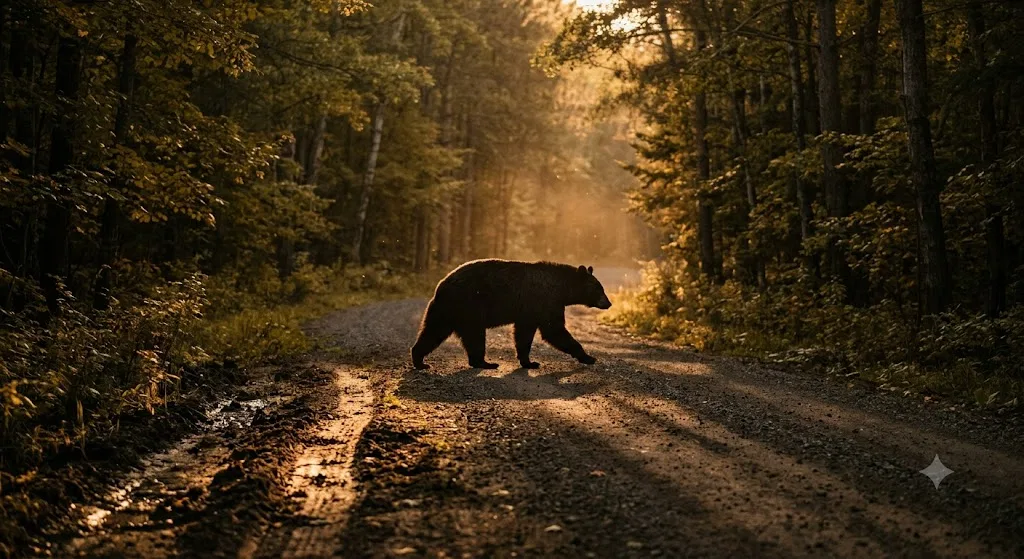
A black bear is one of the strongest natural explanations behind some Wisconsin “upright beast” reports, not because bears are mysterious, but because their behaviour can look wrong when seen briefly. A bear can rise on its hind legs to sniff or look around. It can move with surprising speed. Its dark body can blur into a single heavy shape at night. In headlights, a bear’s size and shoulder movement can seem exaggerated, especially if the witness is not expecting a bear in that part of the state.
That matters for Wisconsin because the state’s bear range and activity have expanded. The DNR notes that black bears are more common in the northern half of Wisconsin, but southern Wisconsin has seen increased activity in recent years; the agency also warns that bears can be drawn into suburban and urban-edge areas by food sources such as rubbish, bird feeders and campsites. A bear in a place where people do not expect one is more likely to be interpreted first as “something strange” rather than as a known animal.[Wisconsin DNR]dnr.wisconsin.govWisconsin DNRBlack bear management | | Wisconsin DNRAlthough black bears are more common in the northern half of the state, southern Wisc…
Bears also leave confusing signs. A partial track in mud, snow, or sand can look larger than life, and a rear bear track may be misread by someone expecting a giant canine, cat, or human-like print. Wisconsin’s own educational tracking material cautions that tracks look different in sand, snow, dust and mud, and that animals leave different patterns depending on how they move. That variability is a gift to monster stories, because a track is often treated as a fixed clue when it is really a distorted impression.[EEK WI]eekwi.orgEEK WITracking Down AnimalsEEK WITracking Down Animals
For Bray Road-style stories, a bear explanation does not need to match every detail. It only needs to account for some reports: a heavy animal near a ditch, a dark body near a carcass, a shape that seems to rise, or claw marks that acquire meaning after a local legend is already circulating. Once the “beast” label exists, later bear encounters can be folded into it even when the original witness might only have seen a large, dark animal for a moment.
Wolves, coyotes and large dogs: when a canid becomes a “dogman”
Wisconsin’s wolf and coyote ecology sits very close to the state’s werewolf-like folklore. The Beast of Bray Road, associated with the Elkhorn and Walworth County area, is usually described as a wolf-like or dog-like creature, sometimes upright, sometimes seen on all fours, and sometimes linked with roadsides, fields or carcasses. Sceptical explanations commonly point to wolves, coyotes, large domestic dogs, feral dogs, bears, hoaxes, and misread sightings rather than an unknown species.[Wikipedia]WikipediaBeast of Bray RoadBeast of Bray Road
The animal most often imagined in those reports is not a normal wolf standing calmly in daylight. It is a glimpse: a canid crossing a road, feeding, running through crops, turning its head in headlights, or appearing taller because of terrain. That distinction matters. A wolf, coyote or dog does not have to look exactly like a monster under ideal conditions. It only has to look wrong under bad conditions.
The DNR’s cougar-misidentification guidance is useful beyond cougar reports because it describes the general problem clearly: wild canids such as wolves and coyotes may be misidentified when they have mange, which can shorten the fur and make the tail look long and rope-like; mistakes are more likely in poor lighting, at long distances, when animals move quickly, when only part of the animal is seen, or when tracks are misread. Those are also the classic conditions of roadside monster sightings.[Wisconsin DNR]dnr.wisconsin.govOpen source on wisconsin.gov.
Large domestic dogs add another layer. A Great Pyrenees, Newfoundland, German shepherd, husky mix, wolf-dog hybrid, or loose farm dog can seem much stranger at night than in a yard. Dogs also behave differently from wild canids: they may wander, approach vehicles, bark, chase, scavenge, or move erratically. A witness who sees only the outline may remember “wolf”; a witness who sees size, eyeshine and odd movement may remember “monster”.
Tracks can deepen the confusion. A Wisconsin Public Radio report on winter tracking notes that experienced trackers look at more than one feature when distinguishing wolf and dog tracks, including line of travel: wolves tend to move in a straighter line, while domestic dogs often wander. The US Fish and Wildlife Service also notes a basic cat-versus-canid distinction: dogs, coyotes, wolves and foxes usually leave claw marks, while bobcats generally do not. For a casual observer, however, snow melt, mud, partial prints and excitement can blur these cues.[WPR]wpr.orgWho made that footprint? Wisconsin naturalist investigatesWho made that footprint? Wisconsin naturalist investigates
Cougar scares and the “phantom panther” problem
Cougar reports are different from many monster stories because cougars are not imaginary animals. They are large, real cats, and Wisconsin has verified some observations. The problem is that a verified cougar record does not make every big-cat story true. It makes the category more tempting.
The DNR’s cougar page is careful on this point. It documents confirmed and probable sightings, but also maintains a section on mistaken identities. That section is unusually valuable for Wisconsin monster interpretation because it names the ordinary animals that get upgraded into cougars: house cats, fishers, bobcats, bears by tracks, dogs, red foxes, coyotes and wolves. It also explains why mistakes happen: poor light, fast movement, long distance, partial views and track-identification errors.[Wisconsin DNR]dnr.wisconsin.govOpen source on wisconsin.gov.
This helps explain “phantom panther” stories in places such as the Driftless Area and rural southern Wisconsin. A long-tailed animal slipping through brush may be a fox or house cat seen without scale. A bobcat may look larger when photographed at a misleading angle. A dog or coyote with mange may seem oddly feline. A bear track may be taken as a big-cat print by someone who wants the exciting answer. And because real cougars occasionally pass through Wisconsin, the witness does not sound absurd for wondering.
The strongest sceptical position is not “there are no cougars in Wisconsin”. It is more precise: Wisconsin has documented cougars, but most dramatic local “panther” reports still need evidence. A clear trail-camera image, scale, location data, tracks assessed by specialists, DNA, or repeated independent documentation changes the conversation. A brief black shape at dusk does not.
There is also a folklore bonus: black panthers. Reports of black big cats are common in American mystery-beast traditions, but biologists have not documented black mountain lions. A 2025 public-radio feature on Great Lakes wildcat sightings made that point while discussing black-cougar lore in the Driftless region. That does not mean every witness invented what they saw; it means the specific “black cougar” interpretation is biologically unsupported and should push readers back toward bobcats, house cats, lighting, shadow, distance, or another animal.[Interlochen Public Radio]interlochenpublicradio.orgInterlochen Public Radio Between Myth and MigrationInterlochen Public Radio Between Myth and Migration

Bobcats, fishers and smaller predators that get promoted
Not every monster report needs a large animal behind it. Sometimes the animal is medium-sized, fast, unfamiliar and seen badly. Bobcats, fishers, foxes and coyotes all have the right ingredients: they are wild, secretive enough to surprise people, and common enough in parts of Wisconsin to appear near homes, farms, roads and trail cameras.
Bobcats are especially good at becoming “too large to be a cat” in memory. They have a compact, muscular body, tufted ears, a short tail, and a way of moving that looks very different from a house cat. A person who sees a bobcat at the edge of a driveway or in a field may reach first for cougar language, because “wild cat” plus surprise plus poor scale becomes “big cat”. The DNR includes bobcats among species mistaken for cougars, while its furbearer material places bobcat among the cat species seen in Wisconsin alongside rarer lynx and cougar records.[Wisconsin DNR]dnr.wisconsin.govOpen source on wisconsin.gov.
Coyotes can create the opposite mistake: not a “big cat”, but a strange canid. A healthy coyote is usually recognisable to someone who gets a good look. A coyote with mange, however, can lose the familiar fluffy outline. Its tail may look thin, its legs too long, its skin exposed, and its silhouette oddly unnatural. The DNR specifically notes that mangy wild canids can be mistaken for cougars; the same visual distortion can feed “chupacabra”, “dogman”, or “monster dog” rumours in other regional traditions.[Wisconsin DNR]dnr.wisconsin.govOpen source on wisconsin.gov.
Fishers are another useful reminder that unfamiliar does not mean impossible. They are not giant monsters, but they are dark, low, quick-moving carnivores. A fisher glimpsed at night can become a “black thing” in a yard or roadside ditch, especially when the witness sees only the body and tail. In Wisconsin’s monster ecology, these smaller predators matter because many reports begin without reliable scale.
Tracks, darkness and memory effects
The weakest part of many monster reports is also the most human: the witness may be honest and still mistaken. Seeing is not the same as measuring. A driver at night has seconds to interpret movement, size, colour, posture and distance, often through glass, glare, rain, snow, adrenaline and headlights. By the time the story is told, the brain has already started turning fragments into a coherent creature.
Vision research supports caution here. The National Academies’ review of eyewitness identification notes that short viewing times and low illumination reduce the visual information reaching the retina and increase uncertainty. Research on distance and eyewitness accuracy likewise finds that longer viewing distances reduce description and identification accuracy. These studies concern human identification rather than monster animals, but the underlying point applies: poor viewing conditions make confident detail less reliable.[National Academies]nationalacademies.orgOpen source on nationalacademies.org.
Animal signs can be just as slippery. Tracks are not perfect stamps. Snow can melt and widen a print. Mud can slump. Sand can collapse. A running animal may leave a different impression from a walking one. Wisconsin educational tracking material explicitly warns that tracks vary across sand, snow, dust and mud, while wildlife trackers often stress that gait, stride, pattern and context matter as much as a single footprint.[EEK WI]eekwi.orgEEK WITracking Down AnimalsEEK WITracking Down Animals
A practical way to read Wisconsin monster reports is to separate three layers:
- The observation: what was actually seen or found — a dark animal, a print, a howl, a carcass, eyeshine, a road crossing.
- The interpretation: what the witness thought it was — wolf, cougar, bear, dogman, big cat, unknown creature.
- The legend frame: the story category available nearby — Beast of Bray Road, phantom panther, Bigfoot, lake monster, Northwoods beast.
The legend frame can influence the interpretation without making the witness dishonest. In Walworth County, a wolf-like roadside animal has a ready-made name. In the Northwoods, a large dark shape may be pulled towards bear or Bigfoot. In the Driftless hills, a cat-like shape may become a panther. Folklore gives the sighting a vocabulary.
What evidence changes a monster report into a wildlife report?
The best wildlife explanations are not guesses thrown at a story to make it go away. They work when the details line up: habitat, behaviour, season, size, tracks, photos, scat, carcass evidence, known range, and independent confirmation. Wisconsin’s modern wildlife monitoring makes that standard clearer than it was in the old newspaper era.
Snapshot Wisconsin is a good example. The DNR describes it as a statewide trail-camera network used to monitor wildlife year-round and support management decisions. University of Wisconsin coverage has described the project as an effort to capture animals such as deer, bears, elk, coyotes, bobcats and badgers across the state. Trail cameras do not solve every mystery, but they raise expectations: if a large animal is repeatedly present in an area, good images may eventually appear.[Wisconsin DNR]dnr.wisconsin.govOpen source on wisconsin.gov.
The DNR’s wildlife observation system also shows what useful reporting looks like. It asks for species, observation type, number of animals, date, time, behaviour, habitat, and supporting evidence such as photos, video, scat or tracks. That kind of structured detail is exactly what many monster anecdotes lack. A vivid story may be culturally important, but a wildlife identification needs repeatable clues.[Wisconsin DNR]apps.dnr.wi.govOpen source on wi.gov.
For readers, the most useful questions are simple:
- Was the animal seen long enough to judge scale against a known object?
- Was there a photograph, video, trackway, scat, hair, DNA, or carcass evidence?
- Did the behaviour match a known Wisconsin animal?
- Did poor light, distance, speed, snow, fog, headlights or fear affect the sighting?
- Was the report made before or after the witness heard the local legend?
- Did wildlife officials, trackers, or biologists examine the evidence?
A “yes” to evidence does not automatically prove a monster. Usually it moves the report towards a known animal. A “no” does not prove the witness lied. It simply means the story remains a claim, memory, rumour, or piece of folklore rather than a confirmed biological record.

The real lesson behind Wisconsin’s mystery beasts
Real wildlife does not make Wisconsin’s monster stories boring. It makes them more interesting. A black bear in an unexpected county, a wolf crossing a farm road, a mangy coyote under a yard light, a bobcat mistaken for a cougar, or a rare dispersing mountain lion on a trail camera all show how thin the line can be between natural history and legend.
The strongest Wisconsin monster reading is therefore both curious and sceptical. The Hodag belongs to hoax and civic folklore. The Beast of Bray Road belongs to roadside witness tradition and modern dogman culture. Phantom cats belong to the uneasy space between verified cougar movement and frequent misidentification. Bigfoot-like reports belong to forests, wetlands and witness claims rather than confirmed zoology. Across all of them, real animals provide the raw material: bodies, tracks, sounds, shadows, movement and surprise.
That is why “it was probably an animal” should not be treated as a dull ending. In Wisconsin, it is often the beginning of the better question: which animal, under what conditions, seen by whom, and retold through which local legend?
Amazon book picks
Further Reading
Books and field guides related to Which Real Animals Feed Wisconsin Monster Stories?. Use these as the next step if you want deeper reading beyond the article.
Hunting Monsters
Focuses on distinguishing folklore from zoology and misidentification.
Monsters of Wisconsin
Shows how wildlife encounters become monster stories in Wisconsin.
eBay marketplace picks
Marketplace Samples
Live-tested eBay searches with available results related to this page.

Endnotes
1.
Source: dnr.wisconsin.gov
Link:https://dnr.wisconsin.gov/topic/WildlifeHabitat/BlackBears
Source snippet
Wisconsin DNRBlack Bears in WisconsinAdult males (called boars) typically weigh from 125-550 lbs., while females (sows) can weigh from 90...
2.
Source: dnr.wisconsin.gov
Link:https://dnr.wisconsin.gov/topic/WildlifeHabitat/bearmanagement
Source snippet
Wisconsin DNRBlack bear management | | Wisconsin DNRAlthough black bears are more common in the northern half of the state, southern Wisc...
3.
Source: dnr.wisconsin.gov
Link:https://dnr.wisconsin.gov/topic/WildlifeHabitat/wolf
Source snippet
Wisconsin DNRWolves in WisconsinWisconsin's wolf population remains healthy and secure in the state. The department will continue its rob...
4.
Source: dnr.wisconsin.gov
Title: DNRGray wolf depredation reports and maps
Link:https://dnr.wisconsin.gov/topic/WildlifeHabitat/wolf/maps
Source snippet
Wisconsin DNRGray wolf depredation reports and maps - Wisconsin DNRThe interactive Wolf Depredation Threats Map allows users to visually...
5.
Source: dnr.wisconsin.gov
Link:https://dnr.wisconsin.gov/topic/WildlifeHabitat/wolf/dogdeps
6.
Source: dnr.wisconsin.gov
Link:https://dnr.wisconsin.gov/topic/WildlifeHabitat/cougar
7.
Source: eekwi.org
Title: EEK WITracking Down Animals
Link:https://www.eekwi.org/sites/default/files/2023-01/Tracking-Down-Animals.pdf
8.
Source: Wikipedia
Title: Beast of Bray Road
Link:https://en.wikipedia.org/wiki/Beast_of_Bray_Road
9.
Source: wpr.org
Title: Who made that footprint? Wisconsin naturalist investigates
Link:https://www.wpr.org/wildlife/who-made-that-footprint-wisconsin-naturalist-investigates-animal-tracks
10.
Source: dnr.wisconsin.gov
Link:https://dnr.wisconsin.gov/topic/WildlifeHabitat/furbearers
11.
Source: dnr.wisconsin.gov
Link:https://dnr.wisconsin.gov/topic/research/projects/snapshot
12.
Source: apps.dnr.wi.gov
Link:https://apps.dnr.wi.gov/wildlifeobservation/
13.
Source: Wikipedia
Link:https://en.wikipedia.org/wiki/Wisconsin
14.
Source: Wikipedia
Link:https://en.wikipedia.org/wiki/Wolf
15.
Source: Wikipedia
Title: American black bear
Link:https://en.wikipedia.org/wiki/American_black_bear
16.
Source: dnr.wisconsin.gov
Link:https://dnr.wisconsin.gov/newsroom/release/115351
17.
Source: dnr.wisconsin.gov
Link:https://dnr.wisconsin.gov/topic/wildlifehabitat/wolfmanagementplan
18.
Source: dnr.wisconsin.gov
Link:https://dnr.wisconsin.gov/
19.
Source: dnr.wisconsin.gov
Link:https://dnr.wisconsin.gov/topic/hunt/bear
20.
Source: dnr.wisconsin.gov
Title: Black Bear
Link:https://dnr.wisconsin.gov/topic/WildlifeHabitat/orphan/BlackBear
21.
Source: dnr.wisconsin.gov
Link:https://dnr.wisconsin.gov/snapshot/articles/Aug2024
22.
Source: dnr.wisconsin.gov
Link:https://dnr.wisconsin.gov/topic/hunt/wolf
23.
Source: dnr.wisconsin.gov
Link:https://dnr.wisconsin.gov/newsroom/release/51936
24.
Source: dnr.wisconsin.gov
Link:https://dnr.wisconsin.gov/taxonomy/term/1186?page=56
25.
Source: dnr.wisconsin.gov
Title: lessons Advanced Flashcards
Link:https://dnr.wisconsin.gov/sites/default/files/topic/Research/lessons_Advanced_Flashcards.pdf
26.
Source: dnr.wisconsin.gov
Link:https://dnr.wisconsin.gov/wnrmag/2019/Fall/Snapshot
27.
Source: wolf.org
Link:https://wolf.org/wow/united-states/wisconsin/
28.
Source: wpr.org
Title: wisconsin wolf population 1200 estimates tracking
Link:https://www.wpr.org/news/wisconsin-wolf-population-1200-estimates-tracking
29.
Source: wpr.org
Title: wisconsin bear hunt licenses natural resources board
Link:https://www.wpr.org/news/wisconsin-bear-hunt-licenses-natural-resources-board
30.
Source: wpr.org
Title: researchers risk map helps predict wolf attacks wisconsin livestock
Link:https://www.wpr.org/agriculture/farm-animals/researchers-risk-map-helps-predict-wolf-attacks-wisconsin-livestock
31.
Source: bear.org
Link:https://bear.org/bear-facts/weight/
32.
Source: wisconsin.com
Link:https://www.wisconsin.com/
33.
Source: youtube.com
Title: Ep. 59 | Large Predator Management – Bears, Cougars, and Wolves
Link:https://www.youtube.com/watch?v=sgZFu4amigU
Source snippet
The Beast of Bray Road | Wisconsin's Most Terrifying Cryptid Encounter...
34.
Source: youtube.com
Title: The Beast of Bray Road | Wisconsin’s Most Terrifying Cryptid Encounter
Link:https://www.youtube.com/watch?v=BzqisSxACsU
Source snippet
Was This Wisconsin Town Terrorized by a Werewolf?...
35.
Source: interlochenpublicradio.org
Title: Interlochen Public Radio Between Myth and Migration
Link:https://www.interlochenpublicradio.org/podcast/points-north/2025-04-11/between-myth-and-migration
36.
Source: nationalacademies.org
Link:https://www.nationalacademies.org/read/18891/chapter/6
37.
Source: facebook.com
Link:https://www.facebook.com/groups/178359452670744/posts/1873963056443700/
38.
Source: facebook.com
Title: wisconsin dnr interactive wolf depredation map
Link:https://www.facebook.com/drjameskroll/posts/wisconsin-dnr-interactive-wolf-depredation-map/1266524121510738/
39.
Source: instagram.com
Link:https://www.instagram.com/p/DIPdf7KsbjU/
40.
Source: science.howstuffworks.com
Title: beast of bray road
Link:https://science.howstuffworks.com/science-vs-myth/strange-creatures/beast-of-bray-road.htm
41.
Source: zooniverse.org
Title: Snapshot Wisconsin | Zooniverse
Link:https://www.zooniverse.org/projects/zooniverse/snapshot-wisconsin
42.
Source: cryptidz.fandom.com
Title: Beast of Bray Road
Link:https://cryptidz.fandom.com/wiki/Beast_of_Bray_Road
43.
Source: basementofthebizarre.com
Title: beast of bray road
Link:https://basementofthebizarre.com/2025/06/05/beast-of-bray-road/
44.
Source: in.gov
Link:https://www.in.gov/dnr/fish-and-wildlife/wildlife-resources/animals/gray-wolf/
45.
Source: mountainlion.org
Title: wisconsin dnr releases cougar response guidelines
Link:https://mountainlion.org/2018/10/17/wisconsin-dnr-releases-cougar-response-guidelines/
46.
Source: mnmammals.d.umn.edu
Link:https://mnmammals.d.umn.edu/coyote
Additional References
47.
Source: slc.gov
Link:https://www.slc.gov/parks/animal-tracks-in-snow/
48.
Source: fws.gov
Link:https://www.fws.gov/story/snow-tracks
49.
Source: youtube.com
Title: Cougar spotted on trail camera in Fond du Lac County
Link:https://www.youtube.com/watch?v=9o0lKAzdUzg
Source snippet
Ep. 59 | Large Predator Management – Bears, Cougars, and Wolves...
50.
Source: researchgate.net
Link:https://www.researchgate.net/publication/385913862_Identifying_signals_of_memory_from_observations_of_animal_movements
51.
Source: facebook.com
Link:https://www.facebook.com/naturecommunications/posts/a-nature-communications-paper-presents-a-police-lineup-procedure-that-reveals-th/3183676118362444/
52.
Source: instagram.com
Link:https://www.instagram.com/reel/DUWJeCAAZ99/
53.
Source: reddit.com
Link:https://www.reddit.com/r/wolves/comments/1hs3aus/are_these_wolf_tracks/
54.
Source: facebook.com
Link:https://www.facebook.com/HistoryDefinedBlog/posts/beast-of-bray-road-the-chilling-true-story-behind-wisconsins-legendary-creature/720059990685044/
55.
Source: instagram.com
Link:https://www.instagram.com/reel/DXF4iOWiGNu/
56.
Source: wildlifesciencecenter.org
Link:https://www.wildlifesciencecenter.org/black-bear
Topic Tree