What Monsters Haunt Oregon's Wild Places?
Oregon’s monster folklore is dominated by Bigfoot, but the state’s cryptid map is richer than a single large footprint in the mud.
Page outline Jump by section
Introduction
Oregon’s monster folklore is dominated by Bigfoot, but the state’s cryptid map is richer than a single large footprint in the mud. Its stories run from Coast Range “wild man” reports and Blue Mountains tracks to Colossal Claude at the Columbia River Bar, lake monsters in Wallowa and Devils Lake, and older water-being traditions that later readers sometimes fold into cryptid culture. The best way to read these tales is not as a catalogue of proven animals, but as a layered Oregon tradition: newspaper entertainment, Indigenous and settler folklore, eyewitness claims, tourism, hoaxes, misidentified wildlife and the deep pull of forested country all working together. Oregon gives such stories unusually good habitat in a cultural sense as well as a physical one: forests cover more than 30.5 million acres, almost half the state, while the Cascade Range alone stretches roughly 260 miles through Oregon and covers about 17 per cent of the state.[Oregon]oregon.govOregon Department of Forestry: About Oregon's forests: Forest benefits: State of Oregon…[USGS]usgs.govCascade Mountain Range in Oregon | U.S. Geological SurveyCascade Mountain Range in Oregon | U.S. Geological Survey
The central answer is simple: Oregon’s most important cryptid tradition is Sasquatch, especially in the Coast Range, Cascades, Blue Mountains and southern Oregon, but its most distinctive non-Bigfoot legend may be Colossal Claude, the sea-serpent figure reported from the Columbia River mouth and Oregon coast in the 1930s and after. None of these creatures has been confirmed by mainstream zoology. Their value lies in what they reveal about Oregon’s landscapes, local memory, old newspapers, outdoor culture and the uneasy space between “I saw something” and “I know what it was”.
Why Oregon feels built for monster stories
Oregon offers the right ingredients for mystery-beast lore: dense conifer forests, mountain roads, foggy coastlines, deep lakes, logging history, Indigenous oral traditions, and a long newspaper culture happy to print strange animal accounts. The state’s forests range from Douglas-fir country in the Willamette Valley and Coast Range to ponderosa pine in the Cascades and Blue Mountains, creating exactly the sort of varied, half-seen terrain where a brief glimpse can become a lasting story.[Oregon]oregon.govOregon Department of Forestry: About Oregon's forests: Forest benefits: State of Oregon…
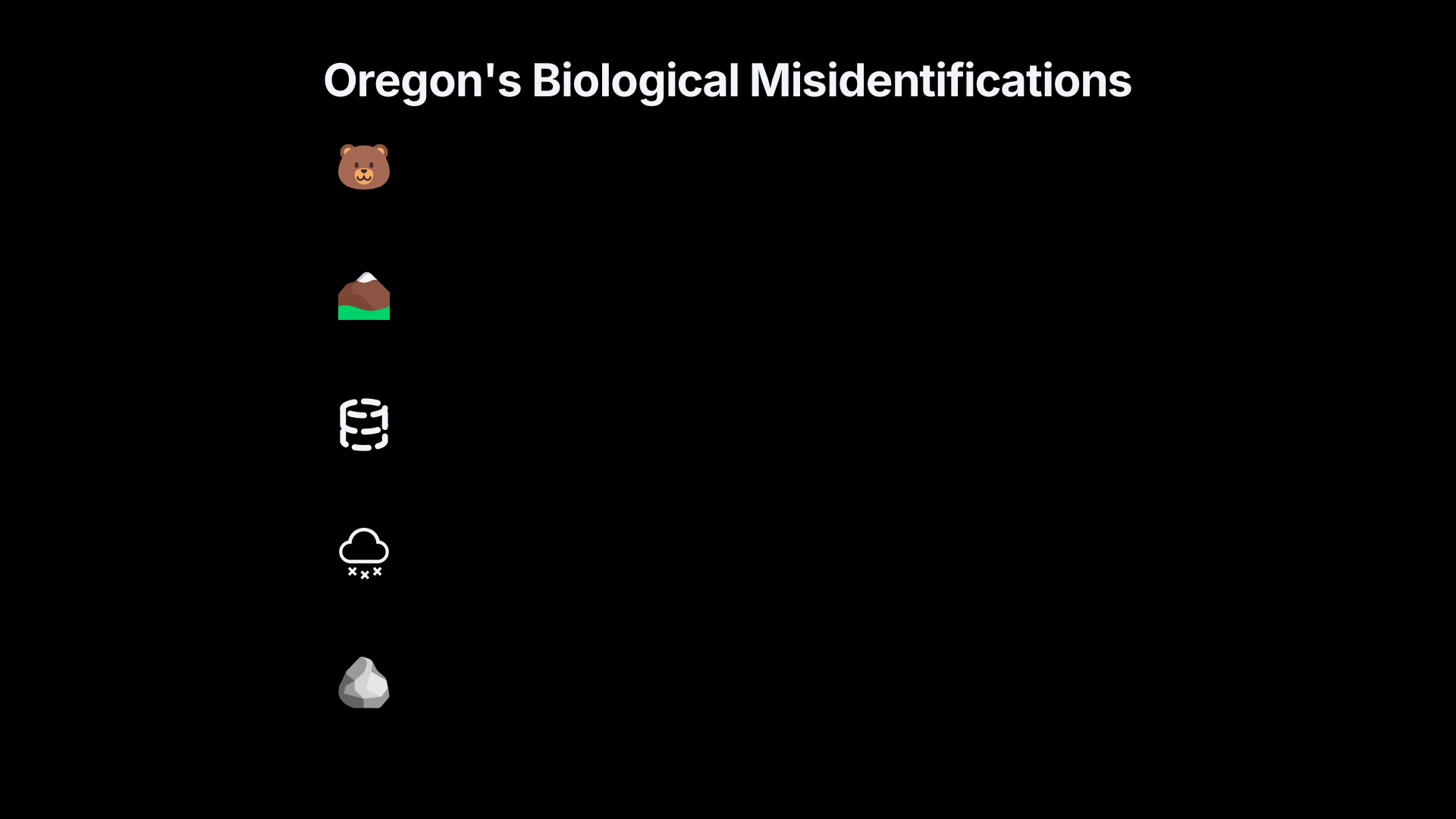
That does not mean the landscape proves the legends. It means Oregon gives legends room to breathe. A bear crossing a logging road at dusk, a cougar glimpsed on the edge of a subdivision, a seal, shark, whale carcass or floating tree offshore, or sound carrying oddly through a canyon can all become stranger in retelling. Oregon also has real large animals that are impressive enough to seed confusion: the state has roughly 25,000 to 30,000 black bears, which may be black, brown, cinnamon or blond, and more than 6,000 cougars, which are secretive enough that residents may rarely see them even when they live nearby.[myodfw.com]myodfw.comLiving with black bears | Oregon Department of Fish & WildlifeLiving with black bears | Oregon Department of Fish & Wildlife[myodfw.com]myodfw.comLiving with cougars | Oregon Department of Fish & WildlifeLiving with cougars | Oregon Department of Fish & Wildlife
The key distinction for readers is between folklore setting and biological evidence. Oregon is excellent country for stories about hidden creatures. It is also excellent country for misidentification, tracks distorted by mud or snow, old newspaper exaggeration and modern internet recycling.
Bigfoot is Oregon’s headline cryptid
The Oregon Encyclopedia describes Bigfoot as a large, mysterious humanoid said to inhabit Oregon and the wider West Coast, usually imagined as a hair-covered biped with ape-like features, great height and enormous footprints. It also notes the important sceptical baseline: most scientists reject Bigfoot as a real animal and explain the phenomenon through misidentified known animals, hoaxes and planted tracks.[Oregon Encyclopedia]oregonencyclopedia.orgBigfoot (Sasquatch) legend…
Oregon’s Bigfoot tradition begins, in the historical record, with early twentieth-century “wild man” reports rather than the later pop-culture creature. The Oregon Encyclopedia places the start of the state’s documented Bigfoot record in 1904, with settler reports of a hairy “wild man” in the Sixes River area of the Coast Range; miners and hunters then added similar stories in later decades. This matters because Oregon’s Sasquatch is not just a 1970s monster fad. It grows from older frontier language about “wild men”, later logging-road sightings, Indigenous traditions, and the mid-century rebranding of large-footed forest beings as “Bigfoot”.[Oregon Encyclopedia]oregonencyclopedia.orgBigfoot (Sasquatch) legend…
Reports cluster where readers would expect: forested counties, mountain corridors, logging country and recreation zones. The Bigfoot Field Researchers Organization’s Oregon listing is not scientific proof, but it is useful as a map of claim culture. It records reports by county, with relatively high counts in places such as Clackamas, Josephine, Douglas, Lane and Umatilla, and recent entries including wood-knock claims in Jackson and Clackamas counties. Those entries should be read as collected allegations rather than verified zoological records.[BFRO]bfro.netReports for OregonReports for Oregon
Oregon Bigfoot stories also overlap with Indigenous traditions, but this needs careful handling. The Oregon Encyclopedia notes that some Native communities in Oregon have related Bigfoot to older “wild men” or “stick Indian” traditions, while also stressing that these beings carry cultural and spiritual meanings that are not identical to modern cryptozoology. That distinction matters: turning every Indigenous being into a “cryptid” flattens living traditions into monster-hunting material.[Oregon Encyclopedia]oregonencyclopedia.orgBigfoot (Sasquatch) legend…

The Bigfoot Trap shows how belief became roadside culture
The most tangible monument to Oregon Bigfoot belief is not a body, bone or DNA sample. It is a wooden trap in the Rogue River-Siskiyou National Forest. The U.S. Forest Service describes the Collings Mountain Trail as passing “the only bigfoot trap in the world”, built in 1974 by the North American Wildlife Research Team after miner Perry Lovell reported 18-inch human-like tracks with a six-foot stride near the Applegate River. The trap was baited with carcasses for six years and, according to the Forest Service, caught only bears.[US Forest Service]fs.usda.govOpen source on usda.gov.
That detail is almost too perfect: the trap is a piece of cryptid theatre that also gives the sceptical answer in miniature. If a large, hairy animal visited bait in southern Oregon, the documented captures were bears, not unknown apes. Yet the trap’s survival as a hiking landmark shows how Bigfoot has become part of Oregon recreation and identity. People visit not because they expect the door to slam shut on a Sasquatch, but because the object lets them step into the story.
Modern tourism keeps doing the same work. Travel Oregon promotes a “Bigfoot Lover’s Guide” with events and themed experiences, including Oakridge’s Sasquatch Summer Fest, where visitors can hear presentations, join discussions and enjoy a festival atmosphere. That does not validate the creature, but it shows how Bigfoot has shifted from frightening woods rumour to playful, marketable Oregon folklore.[Travel Oregon]traveloregon.comTravel Oregon Bigfoot Lover's Guide to OregonTravel Oregon Bigfoot Lover's Guide to Oregon
Colossal Claude and Oregon’s sea-serpent coast
If Bigfoot belongs to Oregon’s forests, Colossal Claude belongs to the mouth of the Columbia River and the state’s uneasy coastal imagination. The Oregon Encyclopedia says sea-serpent lore has been part of Oregon coastal culture since at least the 1930s, when newspapers reported an unidentified creature at the Columbia River mouth, while broader speculation about unknown sea creatures had already circulated in regional print culture for decades.[Oregon Encyclopedia]oregonencyclopedia.orgSea Serpent Lore…
The classic Colossal Claude moment came in March 1934, when the crew of the lightship tender Rose reported seeing an unknown creature near the South Jetty at the mouth of the Columbia. Newspaper accounts described a long body, an estimated length of at least 40 feet, and a neck about eight feet long with a large head. Later Oregon coast reports added familiar sea-serpent features: horse-like or camel-like heads, long bodies, hairy or tan surfaces, and sightings near places such as Yachats, Tillamook Bay, Bandon and Nelscott.[Oregon Encyclopedia]oregonencyclopedia.orgSea Serpent Lore…
The Oregon Encyclopedia’s account is especially useful because it does not pretend the evidence is stronger than it is. A hairy mass called “Old Hairy” washed up near Delake in 1950 and was variously interpreted as a whale shark, whale blubber or an elasmobranch, a group that includes sharks and rays. That range of expert disagreement shows why sea-monster stories endure: ocean remains can be genuinely hard to identify once decomposed, but difficulty is not the same as proof of a new species.[Oregon Encyclopedia]oregonencyclopedia.orgSea Serpent Lore…
Colossal Claude also connects Oregon to the wider Pacific Northwest sea-serpent tradition, including Cadborosaurus, or “Caddy”, associated especially with British Columbia. Oregon reports appear to have faded by about 1960, though a 1963 Shell Oil underwater film of a strange animal off the Oregon coast briefly revived the theme. The creature in that film, nicknamed Marvin the Monster, was described as about 15 feet long with barnacled ridges and a corkscrew motion, but no scientific consensus emerged on its identity.[Oregon Encyclopedia]oregonencyclopedia.orgSea Serpent Lore…
Wallowa Lake and the monster under a beautiful surface
Wallowa Lake’s monster tradition is quieter than Bigfoot or Colossal Claude, but it is a good example of how a striking landscape can hold a legend. A Wallowa County historical account describes the lake as about four miles long, one mile wide, very clear, very cold and roughly 280 feet deep in the centre. It then gives a legend in which an enormous horned monster flees into the lake, is pursued by a Native man, and disappears in the centre; the pursuer also sinks and never returns.[oregongenealogy.com]oregongenealogy.comWallowa Lake Monster, Wallowa County, OregonWallowa Lake Monster, Wallowa County, Oregon
The modern internet often turns this into “Wally”, a lake monster comparable to other tourist-friendly lake cryptids. The older account is more interesting than that simplified version. It is less a zoological sighting report than a danger story attached to a real place: cold, deep water; a feared centre of the lake; a warning about venturing too far. In other words, the monster makes emotional sense even if it does not make biological sense.
A sceptical reading does not require sneering at the legend. Deep lakes are dangerous. Cold water kills. Stories about beings below the surface can encode caution, grief, place memory and respect. Wallowa Lake’s monster is therefore best treated as local folklore later pulled towards cryptid culture, rather than as a strong eyewitness case for an unknown animal.
Devils Lake, Amhuluk and the problem of calling every water-being a cryptid
Oregon’s water-monster material often blurs three different categories: Indigenous mythic beings, settler-era legends and modern cryptid claims. Devils Lake near Lincoln City is frequently presented online as the home of a tentacled monster, often with claims of Native tradition behind it. The available popular accounts are much thinner than the Bigfoot and Colossal Claude records, so this story should be handled cautiously: it is part of Oregon’s monster-tourism and folklore web, but not one of the state’s best-documented cryptid cases.
A stronger example of older water-being tradition is Amhuluk, associated with Kalapuya folklore. A. S. Gatschet’s 1891 “Oregonian Folk-Lore” includes “Amhuluk, the Monster of the Mountain Pool”, while Katharine Berry Judson’s 1910 collection, Myths and Legends of the Pacific Northwest, Especially of Washington and Oregon, helped preserve and circulate regional stories for later readers.[JSTOR]jstor.orgOpen source on jstor.org.[Internet Archive]archive.orgOpen source on archive.org.
Modern creature lists sometimes treat Amhuluk like an Oregon dragon cryptid, but that framing is only partly useful. In older folklore, such beings often explain danger, disease, drowning, landscape features or moral boundaries. They are not necessarily “animals waiting to be discovered”. For a public cryptid page, the fairest approach is to mention Amhuluk as part of Oregon’s deeper monster-like folklore while making clear that it belongs to Indigenous story traditions rather than modern eyewitness zoology.
Phantom cats, cougars and the animals people really do see
Oregon also has the ingredients for phantom-cat rumours: large predators, suburban edges, night sightings and real fear. But here the sceptical explanation is often simpler than the legend. Oregon’s cougar population is real, widespread and rebounding. The Oregon Department of Fish & Wildlife says cougars occupy most available habitat in the state, are expanding into lower-quality habitats that include human habitation, and are secretive animals that usually avoid people.[myodfw.com]myodfw.comLiving with cougars | Oregon Department of Fish & WildlifeLiving with cougars | Oregon Department of Fish & Wildlife
That makes Oregon different from places where “big cat” reports involve animals officially absent from the landscape. In Oregon, a large tawny cat seen briefly at dusk may not be a phantom at all. It may be a cougar doing what cougars do: moving quietly through cover, often noticed only at the edge of human space. The mystery comes from rarity of observation, not necessarily rarity of the animal.
Black bears play a similar role in Bigfoot scepticism. ODFW notes that Oregon’s black bears can be brown, cinnamon or blond as well as black, are agile swimmers and climbers, and prefer forests, trails and streams. A bear standing briefly, moving through brush, leaving distorted tracks or raiding bait is not a complete explanation for every Sasquatch claim, but it is an obvious first explanation for many large, dark, hairy-animal reports.[myodfw.com]myodfw.comLiving with black bears | Oregon Department of Fish & WildlifeLiving with black bears | Oregon Department of Fish & Wildlife
What counts as evidence in Oregon cryptid cases?
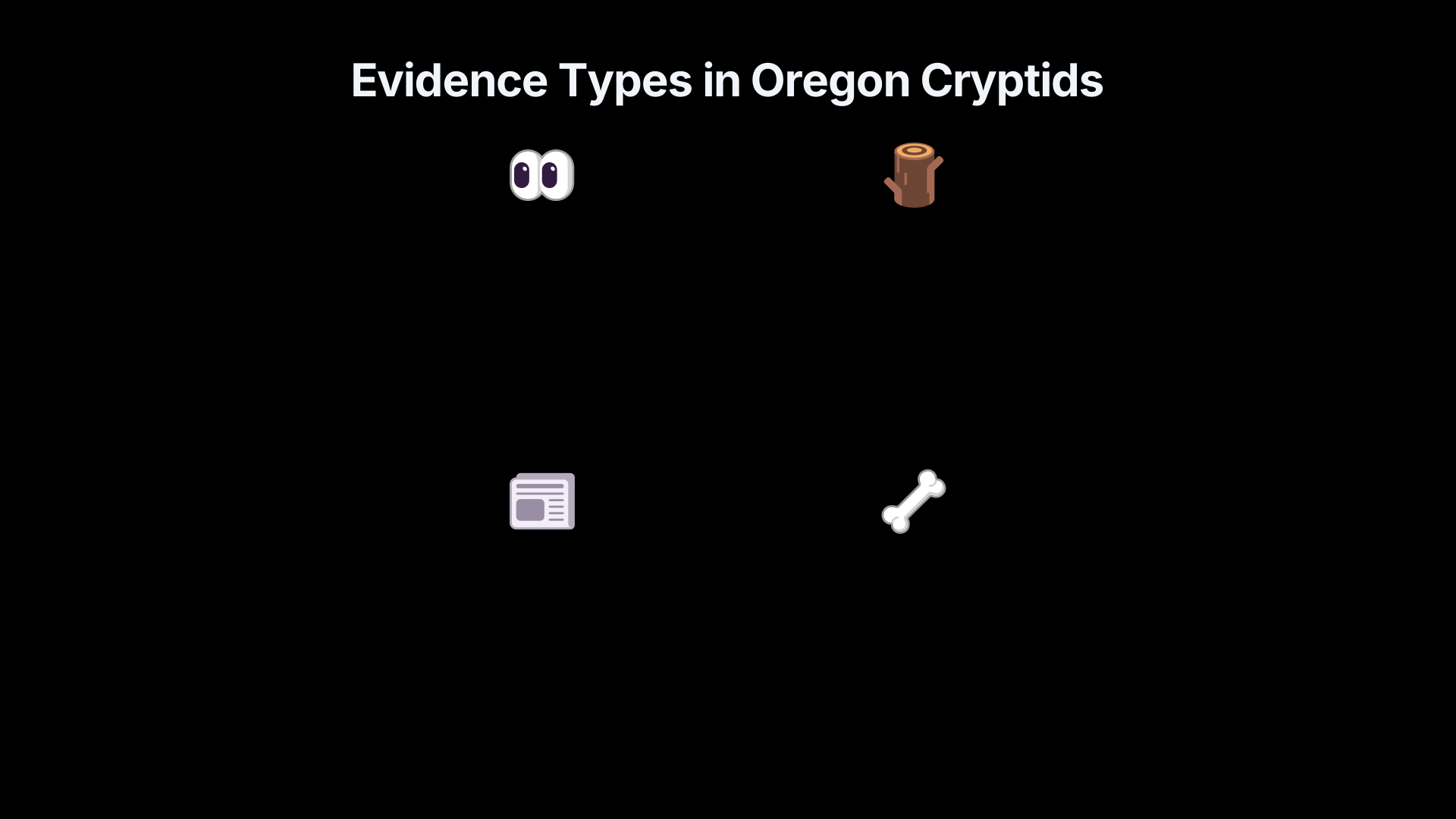
Oregon cryptid evidence usually falls into four buckets, and each has limits.
Eyewitness reports are the heart of the tradition. They are vivid, memorable and often sincere, but they are also vulnerable to distance, darkness, fear, expectation and later retelling. A report can be culturally important without being biologically conclusive.
Tracks and sounds dominate Bigfoot culture. Large footprints, wood knocks, whistles and screams are common in Oregon-style Sasquatch accounts. The problem is that tracks can be faked or distorted, while sounds in forests can be hard to locate and identify. The Oregon Encyclopedia notes that Bigfoot footprints have long been reported to organised groups, but also that most scientists remain sceptical and point to hoaxes and mistaken identification.[Oregon Encyclopedia]oregonencyclopedia.orgBigfoot (Sasquatch) legend…
Newspaper accounts are essential but tricky. Historic Oregon Newspapers provides a searchable archive of nearly 3.2 million pages dated from 1846 to 2026, which is invaluable for tracing how stories appeared and spread. But newspapers also printed jokes, sensational copy, wire-service oddities and tall tales. A story being old does not automatically make it reliable.[oregonnews.uoregon.edu]oregonnews.uoregon.eduHistoric Oregon Newspapers…
Physical remains are where most Oregon cryptid cases weaken. Colossal Claude has no confirmed specimen. Bigfoot has no accepted body, bones or DNA. Lake monsters have no verified carcass. The more a claim resembles an undiscovered large animal, the more it needs durable physical evidence, not just a compelling story.
Why the legends keep changing
Oregon’s monster stories have changed because Oregon itself has changed. In early settler and mining accounts, strange beings were often “wild men”, “ape men” or dangerous things at the edge of camp. In the logging and road-building era, Bigfoot became a creature of tracks, timber roads and occupational humour. In late twentieth-century pop culture, it became a mascot, a television subject, a festival theme and a roadside carving.
The same pattern appears on the coast. Nineteenth- and early twentieth-century sea-serpent material borrowed from maritime wonder tales and newspaper spectacle. By the 1930s, Colossal Claude had a local name and a cluster of reported sightings. By the later twentieth century, the sea serpent had become part of Oregon’s coastal legendarium even though sightings seemed to fade.[Oregon Encyclopedia]oregonencyclopedia.orgSea Serpent Lore…
Tourism did not invent Oregon cryptids, but it did soften them. Bigfoot, once framed as frightening, is now also a family-friendly logo, hike, festival subject and souvenir. That shift does not make the stories meaningless. It shows how folklore survives: not by staying fixed, but by finding new uses.
The most plausible reading of Oregon’s cryptid tradition
The most evidence-aware conclusion is that Oregon has a strong monster tradition, not a confirmed hidden megafauna population. Bigfoot is the state’s dominant cryptid because it fits Oregon’s forests, logging history, Indigenous and settler “wild person” traditions, and modern outdoor culture. Colossal Claude is the standout coastal mystery because it has named newspaper-era reports tied to a specific place, the Columbia River Bar and nearby Oregon coast. Wallowa Lake and Devils Lake belong more to local water-monster folklore, while Amhuluk points to an older and more culturally specific category of story that should not be casually reduced to monster-hunting.
The sceptical explanations are not boring footnotes. They are part of the Oregon story. Bears, cougars, decomposed marine animals, floating logs, seals, whales, bad light, prank tracks, newspaper embellishment and the psychology of wild places all help explain why claims arise and why they remain hard to settle. At the same time, the persistence of these stories says something real about Oregon: its landscapes still feel large enough, shadowed enough and culturally alive enough for people to wonder what else might be out there.
Amazon book picks
Further Reading
Books and field guides related to What Monsters Haunt Oregon's Wild Places?. Use these as the next step if you want deeper reading beyond the article.
Sasquatch: Legend Meets Science
Examines evidence claims and skepticism relevant to Oregon sightings.
Field Guide To Bigfoot, Yeti, & Other Mystery Primates Worldwide
Covers Bigfoot and related mystery-creature traditions that dominate Oregon folklore.
eBay marketplace picks
Marketplace Samples
Live-tested eBay searches with available results related to this page.

Endnotes
1.
Source: oregon.gov
Link:https://www.oregon.gov/odf/forestbenefits/pages/aboutforests.aspx
Source snippet
Oregon Department of Forestry: About Oregon's forests: Forest benefits: State of Oregon...
2.
Source: usgs.gov
Title: Cascade Mountain Range in Oregon | U.S. Geological Survey
Link:https://www.usgs.gov/publications/cascade-mountain-range-oregon
3.
Source: myodfw.com
Title: Living with black bears | Oregon Department of Fish & Wildlife
Link:https://myodfw.com/living-black-bears
4.
Source: myodfw.com
Title: Living with cougars | Oregon Department of Fish & Wildlife
Link:https://myodfw.com/articles/living-cougars
5.
Source: oregonencyclopedia.org
Title: Oregon Encyclopedia
Link:https://www.oregonencyclopedia.org/articles/bigfoot_sasquatch_legend/
Source snippet
Bigfoot (Sasquatch) legend...
6.
Source: bfro.net
Title: Reports for Oregon
Link:https://www.bfro.net/GDB/state_listing.asp?state=or
7.
Source: oregonencyclopedia.org
Title: Oregon Encyclopedia
Link:https://www.oregonencyclopedia.org/articles/sea-serpent-lore/
Source snippet
Sea Serpent Lore...
8.
Source: oregongenealogy.com
Title: Wallowa Lake Monster, Wallowa County, Oregon
Link:https://www.oregongenealogy.com/wallowa/womack/monster.htm
9.
Source: jstor.org
Link:https://www.jstor.org/stable/533930
10.
Source: archive.org
Link:https://archive.org/details/mythslegendsofpa00judsuoft
11.
Source: oregonnews.uoregon.edu
Link:https://oregonnews.uoregon.edu/
Source snippet
Historic Oregon Newspapers...
12.
Source: myodfw.com
Link:https://myodfw.com/big-game-hunting/species/cougar
13.
Source: myodfw.com
Link:https://myodfw.com/big-game-hunting/species/black-bear
14.
Source: myodfw.com
Link:https://myodfw.com/search?activity=All&phrase=black+bear&type=All
15.
Source: myodfw.com
Title: cougar quota zone
Link:https://myodfw.com/cougar-quota-zone
16.
Source: bfro.net
Link:https://www.bfro.net/gdb/
17.
Source: archive.org
Link:https://archive.org/details/mythslegendsofpa00juds
18.
Source: fs.usda.gov
Link:https://www.fs.usda.gov/r06/rogue-siskiyou/recreation/trails/collings-mountain-trail-943
19.
Source: traveloregon.com
Title: Travel Oregon Bigfoot Lover’s Guide to Oregon
Link:https://traveloregon.com/things-to-do/trip-ideas/favorite-trips/bigfoot-lovers-guide-to-oregon/
20.
Source: oregonencyclopedia.org
Link:https://www.oregonencyclopedia.org/about/authors/1000018/
21.
Source: oregonencyclopedia.org
Link:https://www.oregonencyclopedia.org/articles/?page=2&q=salmon+culture
22.
Source: oregonencyclopedia.org
Link:https://www.oregonencyclopedia.org/bigfoot-bobbie-and-beeswax/
23.
Source: oregonencyclopedia.org
Link:https://www.oregonencyclopedia.org/articles/?i=%2A&page=28&q=
24.
Source: oregonencyclopedia.org
Link:https://www.oregonencyclopedia.org/
25.
Source: oregonencyclopedia.org
Title: port orford meteorite hoax
Link:https://www.oregonencyclopedia.org/articles/port_orford_meteorite_hoax/
26.
Source: oregonencyclopedia.org
Link:https://www.oregonencyclopedia.org/themes/environment-and-natural-resources/
27.
Source: oregonencyclopedia.org
Link:https://www.oregonencyclopedia.org/articles/cascade_mountain_range/
28.
Source: abookofcreatures.com
Link:https://abookofcreatures.com/2019/01/21/amhuluk/
29.
Source: oregonhikers.org
Title: Bigfoot Trap Hike
Link:https://www.oregonhikers.org/field_guide/Bigfoot_Trap_Hike
30.
Source: cryptidz.fandom.com
Title: Colossal Claude
Link:https://cryptidz.fandom.com/wiki/Colossal_Claude
31.
Source: cryptidz.fandom.com
Link:https://cryptidz.fandom.com/wiki/Amhuluk
32.
Source: fairytalez.com
Title: Katharine Berry Judson
Link:https://fairytalez.com/is/authors/katharine-berry-judson/
33.
Source: fs.usda.gov
Link:https://www.fs.usda.gov/media/217847
34.
Source: fs.usda.gov
Link:https://www.fs.usda.gov/media/162817
35.
Source: truwe.sohs.org
Link:https://truwe.sohs.org/files/bigfoot.html
36.
Source: facebook.com
Link:https://www.facebook.com/groups/254399958305623/posts/1836250780120525/
37.
Source: facebook.com
Link:https://www.facebook.com/groups/745858165479981/posts/9491722754226768/
38.
Source: oregonwild.org
Link:https://oregonwild.org/resource/black-bear/
39.
Source: oregonwild.org
Link:https://oregonwild.org/resource/collings-mountain-bigfoot-trap/
40.
Source: eugenecascadescoast.org
Title: Sasquatch Summer Fest
Link:https://www.eugenecascadescoast.org/event/sasquatch-summer-fest/58032/
41.
Source: Wikipedia
Link:https://en.wikipedia.org/wiki/Bigfoot
42.
Source: Wikipedia
Title: Oregon Coast Range
Link:https://en.wikipedia.org/wiki/Oregon_Coast_Range
43.
Source: Wikipedia
Title: Bigfoot trap
Link:https://en.wikipedia.org/wiki/Bigfoot_trap
44.
Source: youtube.com
Link:https://www.youtube.com/watch?v=cbrOBX4WIZ0
45.
Source: tillamookcountypioneer.net
Title: oregon dept of fish wildlife living with wildlife cougars
Link:https://www.tillamookcountypioneer.net/oregon-dept-of-fish-wildlife-living-with-wildlife-cougars/
46.
Source: ir.library.oregonstate.edu
Link:https://ir.library.oregonstate.edu/downloads/vd66w358n
47.
Source: extension.oregonstate.edu
Title: em 9460 not all flames same coast range
Link:https://extension.oregonstate.edu/catalog/em-9460-not-all-flames-same-coast-range
48.
Source: thatoregonlife.com
Title: oregon bigfoot sightings sasquatch
Link:https://thatoregonlife.com/2024/07/oregon-bigfoot-sightings-sasquatch/
49.
Source: mountainlion.org
Link:https://mountainlion.org/us/oregon/
50.
Source: oregonforests.org
Link:https://oregonforests.org/sites/default/files/2017-05/What_do_western.pdf
51.
Source: blackdrago.com
Link:https://www.blackdrago.com/fame/amhuluk.htm
52.
Source: openlibrary.org
Title: Katharine Berry Judson
Link:https://openlibrary.org/authors/OL32527A/Katharine_Berry_Judson
53.
Source: oregondiscovery.com
Title: Devil’s Lake Legends
Link:https://oregondiscovery.com/devils-lake-legends
54.
Source: folkbestiary.com
Link:https://folkbestiary.com/oregon/
Additional References
55.
Source: youtube.com
Link:https://www.youtube.com/watch?v=PKScbbwuivw
Source snippet
12 Terrifying Legends That Still Haunt Oregon...
56.
Source: youtube.com
Title: Exploring Oregon’s Weird Folklore: Myths and Legends of the United States
Link:https://www.youtube.com/watch?v=se9Vd1xSOHU
Source snippet
Investigating 122 Squatch Prints in Oregon...
57.
Source: youtube.com
Title: 12 Terrifying Legends That Still Haunt Oregon
Link:https://www.youtube.com/watch?v=YKTxf1QJBLw
Source snippet
Exploring Oregon's Weird Folklore: Myths and Legends of the United States...
58.
Source: youtube.com
Title: Investigating 122 Squatch Prints in Oregon
Link:https://www.youtube.com/watch?v=stR9HhlRN4s
Source snippet
Former TV host explores Bigfoot mystery at Oregon research site...
59.
Source: vocal.media
Link:https://vocal.media/01/amhuluk-the-water-monster-of-the-columbia-plateau
60.
Source: tripadvisor.com
Link:https://www.tripadvisor.com/AttractionProductReview-g51774-d26612002-The_Bigfoot_Tour_in_Oregon-Boring_Clackamas_County_Oregon.html
61.
Source: facebook.com
Link:https://www.facebook.com/tillamookheadlightherald/posts/bigfoot-is-officially-helping-oregon-celebrate-the-countrys-250th-birthday/1619867203475937/
62.
Source: facebook.com
Link:https://www.facebook.com/newportnewstimes/posts/bigfoot-is-officially-helping-oregon-celebrate-the-countrys-250th-birthday/1483428823798615/
63.
Source: facebook.com
Link:https://www.facebook.com/groups/ForgottenOregon/posts/2083910461876881/
64.
Source: facebook.com
Link:https://www.facebook.com/groups/711951226054358/posts/1052713835311427/
Topic Tree
Follow this branch
Related pages 49
- Rhode Island Monsters
- Hawaii Monsters
- Illinois Cryptids
- Nebraska Cryptids
- Alabama Cryptids
- +44 more in sidebar