Within Colorado Cryptids
Is Bigfoot Hiding in Colorado's Mountains?
Colorado Bigfoot stories cluster in forested mountain corridors, but the evidence remains far weaker than the legend.
On this page
- Where Colorado reports cluster
- The Durango train video moment
- Why sightings are not proof
Page outline Jump by section
Introduction
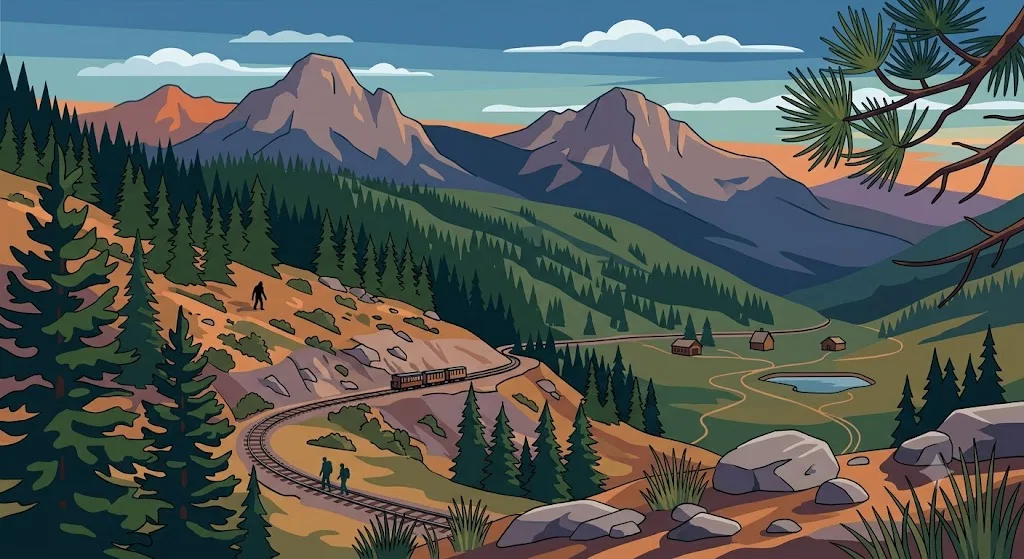
Colorado Bigfoot reports cluster where the story almost feels pre-built: forested Front Range slopes, central mountain passes, back roads near recreation towns, and the San Juan Mountains around the Durango train route. The claim is familiar — a tall, dark or hair-covered biped moving through timber or across a slope — but the evidence is much less solid than the legend. Colorado has many reported sightings in private Bigfoot databases, a few memorable local hotspots, and one viral 2023 train video near Silverton. What it does not have is a specimen, verified DNA, clear repeatable footage, or a chain of physical evidence strong enough to move Bigfoot from folklore into wildlife biology. That gap is the heart of the Colorado story: the Rocky Mountains make Bigfoot believable as a setting, but not proven as an animal.[bfro.net]bfro.netstate listing.aspReports for ColoradoMarch 2025, Boulder County (Class A) - TWO NIGHT AGO: Resident spots a bigfoot around 10pm walking up delosate road 1…
The most useful way to read Colorado Bigfoot material is not as a simple yes-or-no mystery. It is a layered evidence problem. Some reports are sincere eyewitness claims. Some may be misidentified bears, people, shadows, elk, tree stumps, or distant hikers. Some are boosted by tourism, local humour, and the pleasure of a good mountain story. Colorado’s Bigfoot tradition survives because those layers overlap in just the right landscape: enough wilderness to stir the imagination, enough visitors to generate stories, and enough uncertainty in poor footage to keep arguments alive.
Where Colorado Reports Cluster
The Bigfoot Field Researchers Organization, usually shortened to BFRO, is not a scientific wildlife agency. It is an enthusiast-run reporting database that publishes selected claims, classifies them by type, and has become one of the main public sources people use when discussing Bigfoot distribution. Its Colorado listing includes claims from across the state, including a March 2025 Boulder County “Class A” sighting report, a 2021 Hinsdale County sound report near Lake City, and a 2020 Chaffee County footprint-and-droppings report. Those entries show why the Colorado pattern feels persuasive to believers: the reports are scattered, but they often sit in mountain or foothill environments that readers already associate with remote wildlife.[bfro.net]bfro.netstate listing.aspReports for ColoradoMarch 2025, Boulder County (Class A) - TWO NIGHT AGO: Resident spots a bigfoot around 10pm walking up delosate road 1…
The strongest concentration in the popular Colorado Bigfoot map is not the flat eastern plains but the mountain belt. Park County, Teller County, El Paso County, Boulder County, Larimer County, Lake County and other mountain or foothill counties appear repeatedly in public sighting discussions. A 2020 Gazette summary, drawing on BFRO data, reported at least 126 Colorado sightings and highlighted counties such as Park and Teller among the most active in the state. Later local write-ups repeated Park County’s reputation, often noting that it had more listed reports than any other Colorado county in the BFRO dataset at the time.[Gazette]gazette.combelieve in bigfoot here are 7 colorado counties with the most sightingsbelieve in bigfoot here are 7 colorado counties with the most sightings
Park County is especially important because it links reports, scenery and local culture. BFRO’s Park County page includes claimed encounters around Bailey, Lost Creek Wilderness, Hartsel, Lake George and North Twin Cone, with reports involving hikers, campers, hunters, strange calls, wood knocks, rock throwing and fleeting visual encounters. These are classic Bigfoot ingredients: a remote-feeling setting, a brief observation, and a witness interpreting ambiguous sights or sounds as something large and human-like.[bfro.net]bfro.netOpen source on bfro.net.
Teller and El Paso counties form another useful cluster because they sit around the Pikes Peak region, a heavily visited landscape where wild terrain, tourist traffic and local legend meet. BFRO’s Teller County reports include alleged sightings and sound claims around Skaguay Reservoir, Victor, Florissant and Pike National Forest. Its El Paso County reports include claimed sightings west of Fort Carson, near Pikes Peak, and south of Colorado Springs. Whether or not the reports describe an unknown animal, the geography helps explain why the story persists: steep wooded country is close enough to large populations for many witnesses to pass through it.[bfro.net]bfro.netOpen source on bfro.net.
That pattern matters, but it also creates a trap. A map of reports is not a map of animals. It is a map of reports. It reflects where people hike, camp, hunt, drive at night, take scenic trips, read Bigfoot forums, and feel motivated to submit a story. Large counties can accumulate more reports simply because they cover more terrain. Tourist corridors can produce more claims because more people are watching the hillsides with phones and cameras. Colorado’s Bigfoot clusters are therefore culturally meaningful, but they are not proof of a breeding population.

Why the Mountains Make the Story Feel Plausible
Colorado gives Bigfoot stories three things they need: cover, scale and surprise. Much of the state’s mountain country is a mix of conifer forest, aspen groves, steep slopes, stream corridors, old mining roads, ski-town edges and camping areas. A dark animal seen for three seconds between trees can seem much larger than it is. A person moving on a distant hillside can look strangely proportioned. A bear briefly standing or walking upright can appear uncannily human when the observer is far away, startled, or already primed by the Bigfoot idea.
The real wildlife context helps explain why misidentification is such a serious issue. Colorado Parks and Wildlife says most campsites west of I-25 are in bear country, and black bears that learn people have food may visit campsites, picnic areas and resorts. The agency also notes that black bears can become accustomed to human food sources, which brings them closer to homes, roads and recreation areas. In other words, the same places where many people go looking for mountain adventure are also places where large, dark, intelligent mammals already live.[Colorado Parks and Wildlife]cpw.state.co.uslorado Parks and Wildlife Living with Bearslorado Parks and Wildlife Living with Bears
Mountain lions are relevant too, not because they look like Bigfoot, but because they show how much genuine large-animal activity occurs in Colorado’s foothills and canyons. Colorado Parks and Wildlife describes mountain lions as mainly living west of I-25 and in parts of south-east Colorado, with abundance in foothills, canyons and mesa country. Their presence reminds readers that the mountains are not empty stage scenery. They are active wildlife habitat, and real animals can produce screams, tracks, movement, carcasses, fear and confusion.[Colorado Parks and Wildlife]cpw.state.co.uslorado Parks and Wildlife Mountain Lionlorado Parks and Wildlife Mountain Lion
Seasonal animal movement adds another layer. Colorado Parks and Wildlife explains that elk and deer move between seasonal ranges, often shifting from higher to lower elevations as winter approaches, and that the state’s mountainous landscape can create shorter but concentrated movement routes. For Bigfoot reports, this matters because witness activity and animal activity overlap: hunters are out during seasons when wildlife is moving, campers hear sounds at night, and drivers see animals at dawn and dusk.[Colorado Parks and Wildlife]cpw.state.co.usOpen source on state.co.us.
The mountain setting therefore makes Colorado Bigfoot stories easy to imagine. It does not make them easy to verify. Plausibility as atmosphere is different from plausibility as biology. A landscape can be excellent monster country and still fail to produce a body, bones, reliable trail-camera images, verified hair samples, or other evidence expected for a large mammal.
The Durango Train Video Moment
The most famous recent Colorado Bigfoot episode came in October 2023, when passengers on the Durango & Silverton Narrow Gauge Railroad recorded and photographed a distant figure on a hillside near Silverton. The Durango Herald reported that Shannon Parker took photos on Sunday, 8 October 2023, while departing Silverton on the train, and that the video quickly spread to major entertainment and news outlets. The appeal was obvious: a scenic railway, multiple observers, a moving figure, and a high mountain backdrop that looked made for a cryptid clip.[Durango Herald]durangoherald.combigfoot sighting near silverton goes viralDurango HeraldBigfoot sighting near Silverton goes viral12 Oct 2023 — Bigfoot sighting near Silverton goes viral. Video is shown on TMZ…
The clip also showed why Bigfoot videos so often become argument machines rather than evidence. The figure was far away. Its scale was hard to judge. The footage did not show an uninterrupted close view, a face, anatomical detail, tracks being cast immediately afterwards, or any follow-up biological evidence. Viewers could read the same pixels in opposite ways: a large unknown animal, a person in a costume, a prank, or an oddly lit human figure. The ambiguity was not a minor flaw; it was the whole reason the video travelled.
Outside magazine treated the incident sceptically, describing the figure as appearing just south of Silverton and noting the strong possibility of a prank. The speculation intensified because the sighting happened in an area with a business connection to Sasquatch-themed camper branding, although the company associated with that online theory denied involvement. The important point is not that a prank was proven. It is that a prank, a person in costume, or a staged viral moment remained plausible enough to keep the footage from serving as strong evidence.[Outside Online]outsideonline.comOutside Online Colorado's Recent Sasquatch Sighting Is Probably a PrankOutside Online Colorado's Recent Sasquatch Sighting Is Probably a Prank
The Independent’s follow-up captured another revealing detail: Silverton residents and Bigfoot enthusiasts themselves did not necessarily treat the Colorado Rockies as classic Sasquatch home turf in the way the Pacific Northwest is often imagined. The town’s surprise at suddenly becoming a Bigfoot hotspot shows how modern monster geography can change quickly. One viral clip can temporarily redraw a folklore map, turning a mining and railway town into a cryptid destination for a week.[The Independent]independent.co.ukThe Independent'Bigfoot' has been spotted in a tiny town – and locals haveThe Independent'Bigfoot' has been spotted in a tiny town – and locals have
As a Colorado case study, the Durango video is valuable precisely because it is not conclusive. It shows the modern evidence cycle in miniature: a witness sees something; a phone or camera records it from a distance; social media amplifies it; news outlets repeat it; believers and sceptics freeze frames; alternative explanations multiply; and no physical evidence follows. That does not prove the witnesses were lying. It shows why sincere witnesses and viral footage still fall short of proving Bigfoot.
Why Sightings Are Not Proof
Eyewitness reports are the backbone of Colorado Bigfoot lore, but they are also the weakest form of evidence when used alone. Human perception is fast, interpretive and fragile. People do not see like cameras. They see through expectation, fear, lighting, distance, memory and context. A hiker in bear country who has just heard a heavy crash may interpret a dark upright shape differently from someone watching the same scene in full daylight with binoculars.
The BFRO classification system can make reports look more formal than they really are. A “Class A” report generally means the witness claims a clear visual encounter; “Class B” often means a less direct claim such as sound, tracks or a possible glimpse. Those categories may help organise stories, but they do not create independent verification. A clearly told report is still a report. It becomes stronger only when it is paired with testable, independently examined evidence.
Colorado reports often contain familiar Bigfoot motifs: wood knocks, whoops, thrown rocks, large footprints, bad smells, dark figures near roads, and animals seen by hunters or campers. Those details are interesting as folklore because they show how a shared Bigfoot language travels from case to case. But as evidence, they are vulnerable. Wood knocks can be made by people, falling branches or ordinary forest sounds. Whoops and screams can come from known wildlife, echoes or human callers. Footprints can be hoaxed, distorted by snow or mud, or misread after partial melting. A story becomes more dramatic when these details combine, but not necessarily more reliable.
The problem becomes sharper with physical traces. A footprint photograph without a clear scale, substrate record, location chain, and expert examination is weak. Hair without DNA confirmation is weak. Droppings without lab identification are weak. Audio without a known source may be intriguing, but unknown does not mean Bigfoot. The phrase “unidentified” is often treated as a door opening towards the extraordinary, when it may simply mean the evidence was too poor to identify.
This is why Colorado’s Bigfoot evidence remains stuck in the same place as most Bigfoot evidence nationally. It is abundant as story, but thin as biology. There are many claims of encounters. There is not a verified Colorado specimen, not a confirmed breeding population, and not a body of physical evidence that wildlife agencies or mainstream zoologists accept as demonstrating an unknown North American ape.
The Bear Problem
The most important sceptical explanation for Rocky Mountain Bigfoot reports is not that every witness is dishonest. It is that known animals can look strange under bad conditions, and the American black bear is the obvious candidate in many forested states. Colorado’s bear country overlaps with many mountain recreation areas, and bears may move near campsites and towns when food is available. That overlap does not explain every individual report, but it makes bear misidentification a recurring problem for the whole evidence pool.[Colorado Parks and Wildlife]cpw.state.co.uslorado Parks and Wildlife Living with Bearslorado Parks and Wildlife Living with Bears
This is not just casual scepticism. In 2009, J. D. Lozier, P. Aniello and M. J. Hickerson used Sasquatch reports as a deliberately cautionary example in ecological niche modelling, showing how convincing-looking range predictions can be generated from questionable occurrence data. Their study found a close environmental match between putative Sasquatch locations and black bear habitat, illustrating how poor data can make an imaginary or unverified animal appear ecologically plausible.[Wiley Online Library]onlinelibrary.wiley.comj.1365 2699.2009.02152.xj.1365 2699.2009.02152.x
A newer study by data scientist Floe Foxon extended the bear comparison across the United States and Canada. Published in the Journal of Zoology, it found that Sasquatch sightings were statistically associated with black bear populations even after accounting for human population and forest area. The study reported that, on average, every 1,000 additional bears was associated with a 4% increase in Sasquatch sightings, with about one Sasquatch sighting per 5,000 bears in the 2006 model. Foxon’s conclusion was careful but pointed: if Bigfoot is there, many supposed sightings could still be bears.[ZSL Publications]zslpublications.onlinelibrary.wiley.comZSL Publications Bigfoot: If it's there, could it be a bear?ZSL Publications Bigfoot: If it's there, could it be a bear?
For Colorado, the bear problem works in several ways:
- Distance and slope distort size. A bear on a hillside can appear taller, shorter, closer or farther away than it really is, especially when the viewer has no fixed reference point.
- Partial upright posture matters. Bears can stand or move briefly on hind legs, especially when investigating smells or looking around.
- Colour is not decisive. Black bears are not always jet black; colour phases can include brown or cinnamon tones, which complicates witness descriptions.
- Behaviour can be misread. A bear disappearing into timber, sitting down, turning sideways, or moving through brush may look oddly human from a distance.
- Bear habitat overlaps with report habitat. The same campsites, mountain towns and forest roads that generate Bigfoot claims are also places where bears may appear.
None of this proves that the Durango figure, a Park County report, or a Pikes Peak claim was definitely a bear. It means the burden of proof is high. In a state with real black bears, the evidence must be good enough to rule out black bears, humans and other ordinary explanations before Bigfoot becomes the best answer.
Tourism, Local Identity and the Bigfoot Feedback Loop
Colorado Bigfoot is not only a witness tradition. It is also a roadside and tourism tradition. Bailey’s Sasquatch Outpost and Discovery Museum is a clear example: a local business built around Bigfoot curiosity, merchandise, exhibits and the appeal of “Squatch” culture in a mountain town. Its own listing places it at 149 Main Street in Bailey, while travel pages describe it as a Bigfoot-themed stop with a museum, gifts and local legend appeal.[sasquatchoutpost.com]sasquatchoutpost.comOpen source on sasquatchoutpost.com.
This does not make Bailey’s reports fake. It means reports and tourism can reinforce each other. A county gets a reputation for sightings. A museum or shop gives that reputation a physical home. Visitors arrive already primed to imagine Bigfoot in the surrounding woods. More people watch for signs, share stories, take photos of ambiguous shapes, and submit reports. The legend becomes easier to encounter because the place has taught visitors what to look for.
The Pikes Peak region shows a lighter version of the same feedback loop. The well-known “Big Foot Xing” sign on the Pikes Peak Highway is a roadside joke, warning marker and photo opportunity all at once. Local coverage and travel pages treat it as part of the area’s quirky landscape rather than as wildlife evidence. It turns Bigfoot from a hidden creature into a tourist image: something to spot, photograph and joke about while driving through dramatic scenery.[Gazette]gazette.comOpen source on gazette.com.
The feedback loop matters because it can inflate perceived evidence. A place with Bigfoot branding will not necessarily produce more unknown animals, but it may produce more Bigfoot interpretations. People are more likely to remember, retell and report an ambiguous experience when the local culture has already supplied the label.
That is one reason Colorado’s Bigfoot tradition feels both modern and old-fashioned. It uses familiar campfire ingredients — remote woods, eerie sounds, hairy figures — but it spreads through shops, local tourism pages, social media clips, podcasts, news articles and viral arguments. The creature is imagined as ancient, yet the evidence cycle is very contemporary.
What Would Better Evidence Look Like?
A fair sceptical approach should not simply sneer at every witness. It should ask what kind of evidence would actually change the assessment. For a large unknown primate in Colorado, strong evidence would need to be physical, repeatable and independently examined. A clear close-range video would help, but footage alone can be faked or misread. A body, bones, teeth, tissue, verified hair with unexpected DNA, or multiple independent biological samples from a controlled setting would be much stronger.
Good field evidence would also need context. A footprint cast is more useful if investigators document the trackway, substrate, stride, weather, GPS location, scale, and chain of custody. Hair is more useful if collected cleanly and tested by a credible lab. Audio is more useful if paired with known wildlife comparisons and environmental records. Trail-camera images are more useful if the camera location, time stamps and original files are available for examination.
Colorado’s current public evidence usually does not reach that standard. The Durango video is memorable, but it is distant and ambiguous. BFRO reports are numerous, but they are self-selected witness accounts. Local hotspots are culturally rich, but they are not biological proof. Wildlife overlap, especially with black bears, gives sceptics a plausible explanation for many cases. The result is not “nothing happened”. It is “the available evidence does not justify the extraordinary conclusion”.
That distinction keeps the story honest without flattening it. People may really have been frightened on a trail near Bailey. A hunter may really have heard strange knocks in Pike National Forest. A train passenger may really have seen a baffling figure near Silverton. The weakness lies in the leap from “I saw something strange” to “Colorado has an undiscovered giant primate.”
Why Colorado Bigfoot Still Matters
Colorado Bigfoot endures because it fits the state’s emotional geography. The mountains are accessible but still intimidating. A person can leave Denver or Colorado Springs and be in steep timber, shadowed canyons or old mining country within a short drive. That nearness makes the legend powerful. Bigfoot is not imagined in some unreachable wilderness; it is imagined just beyond the trailhead, the campsite, the train window, or the bend in a forest road.
The legend also gives people a way to talk about uncertainty in a highly photographed age. Colorado’s Bigfoot stories ask a surprisingly modern question: why, when everyone carries a camera, do so many mysteries still arrive as blur, distance and doubt? The answer is not that the creature must be real. It is that mountains remain visually tricky, memory remains fallible, and digital media can make weak evidence travel faster than careful explanation.
Within Colorado’s wider monster tradition, Bigfoot is the serious one: less openly comic than the Slide-Rock Bolter, more persistent than one-off “mystery animal” flaps, and more tied to real landscapes than many imported paranormal tales. Its value is not as confirmed zoology, but as a living state-level folklore system built from reports, scepticism, tourism, wildlife ecology and the stubborn thrill of not being completely sure what moved between the trees.
The best reading of Rocky Mountain Bigfoot is therefore curious but cautious. Colorado has the forests, the mountains, the sightings and the stories. It has famous moments, especially the Durango train video. It has local hotspots where Bigfoot has become part of place identity. What it lacks is the kind of evidence that would make wildlife biology rewrite the mammal list. Until that changes, Colorado Bigfoot remains a compelling mountain legend with a serious evidence problem.
Amazon book picks
Further Reading
Books and field guides related to Is Bigfoot Hiding in Colorado's Mountains?. Use these as the next step if you want deeper reading beyond the article.
The United States of Cryptids
Places Colorado Bigfoot stories within national folklore.
eBay marketplace picks
Marketplace Samples
Live-tested eBay searches with available results related to this page.



Endnotes
1.
Source: bfro.net
Title: state listing.asp
Link:https://www.bfro.net/GDB/state_listing.asp?state=co
Source snippet
Reports for ColoradoMarch 2025, Boulder County (Class A) - TWO NIGHT AGO: Resident spots a bigfoot around 10pm walking up delosate road 1...
Published: March 2025
2.
Source: zslpublications.onlinelibrary.wiley.com
Title: ZSL Publications Bigfoot: If it’s there, could it be a bear?
Link:https://zslpublications.onlinelibrary.wiley.com/doi/abs/10.1111/jzo.13148
3.
Source: bfro.net
Link:https://www.bfro.net/gdb/
4.
Source: gazette.com
Title: believe in bigfoot here are 7 colorado counties with the most sightings
Link:https://gazette.com/2020/01/29/believe-in-bigfoot-here-are-7-colorado-counties-with-the-most-sightings/
5.
Source: bfro.net
Link:https://www.bfro.net/gdb/show_county_reports.asp?county=Park&state=co
6.
Source: bfro.net
Link:https://www.bfro.net/gdb/show_county_reports.asp?county=Teller&state=co
7.
Source: bfro.net
Title: show county reports.asp
Link:https://www.bfro.net/gdb/show_county_reports.asp?county=El+Paso&state=co
8.
Source: onlinelibrary.wiley.com
Title: j.1365 2699.2009.02152.x
Link:https://onlinelibrary.wiley.com/doi/abs/10.1111/j.1365-2699.2009.02152.x
9.
Source: onlinelibrary.wiley.com
Title: j.1365 2699.2009.02152.x
Link:https://onlinelibrary.wiley.com/doi/10.1111/j.1365-2699.2009.02152.x
10.
Source: zslpublications.onlinelibrary.wiley.com
Title: ZSL Publications Bigfoot: If it’s there, could it be a bear?
Link:https://zslpublications.onlinelibrary.wiley.com/doi/10.1111/jzo.13148
11.
Source: gazette.com
Link:https://gazette.com/2019/08/22/column-bigfoot-crossing-sign-tests-our-gullibility-b90cde38-c41e-11e9-9b4d-fbc7c8759fb5/
12.
Source: tripadvisor.com
Title: The Sasquatch Outpost
Link:https://www.tripadvisor.com/Attraction_Review-g33307-d8383421-Reviews-The_Sasquatch_Outpost-Bailey_Colorado.html
13.
Source: pikes-peak.com
Link:https://www.pikes-peak.com/national-sasquatch-awareness-day/
14.
Source: durangoherald.com
Title: bigfoot sighting near silverton goes viral
Link:https://www.durangoherald.com/articles/bigfoot-sighting-near-silverton-goes-viral/
Source snippet
Durango HeraldBigfoot sighting near Silverton goes viral12 Oct 2023 — Bigfoot sighting near Silverton goes viral. Video is shown on TMZ...
15.
Source: cpw.state.co.us
Title: lorado Parks and Wildlife Living with Bears
Link:https://cpw.state.co.us/living-bears
16.
Source: cpw.state.co.us
Link:https://cpw.state.co.us/species/black-bear
17.
Source: cpw.state.co.us
Title: lorado Parks and Wildlife Mountain Lion
Link:https://cpw.state.co.us/species/mountain-lion
18.
Source: cpw.state.co.us
Link:https://cpw.state.co.us/wildlife-migration-and-movement
19.
Source: outsideonline.com
Title: Outside Online Colorado’s Recent Sasquatch Sighting Is Probably a Prank
Link:https://www.outsideonline.com/outdoor-adventure/exploration-survival/bigfoot-sighting-durango-colorado/
20.
Source: Wikipedia
Link:https://en.wikipedia.org/wiki/Bigfoot
21.
Source: independent.co.uk
Title: The Independent’Bigfoot’ has been spotted in a tiny town – and locals have
Link:https://www.independent.co.uk/news/world/americas/bigfoot-sighting-in-colorado-silverton-sasquatch-b2434807.html
22.
Source: sasquatchoutpost.com
Link:https://www.sasquatchoutpost.com/?srsltid=AfmBOoq55K7YtSDpVpOKr37wi25tJ_WLX6rluFu1vOZSnxfplpjo4b7f
23.
Source: tripadvisor.co.uk
Title: Tripadvisor THE SASQUATCH OUTPOST
Link:https://www.tripadvisor.co.uk/Attraction_Review-g33307-d8383421-Reviews-The_Sasquatch_Outpost-Bailey_Colorado.html
24.
Source: cpw.state.co.us
Title: item.31 b 12 hmp draft 20211227 brian dreher dnr
Link:https://cpw.state.co.us/sites/default/files/dam/ayr2zctlcz/item.31-b-12_hmp_draft_20211227-brian_dreher-dnr.pdf
25.
Source: cpw.state.co.us
Link:https://cpw.state.co.us/Documents/Hunting/BigGame/DAU/Bear/B6DAUPlan.pdf
26.
Source: cpw.state.co.us
Link:https://cpw.state.co.us/state-parks/fishers-peak-state-park
27.
Source: cpw.state.co.us
Title: item.16 w 2 final updated
Link:https://cpw.state.co.us/sites/default/files/dam/rpvlf5mazx/item.16-w-2_final_updated.pdf
28.
Source: cpw.state.co.us
Link:https://cpw.state.co.us/sites/default/files/dam/tkkcm6ximy/item.38-d42_hmp_20220-brad_banulis_dnr.pdf
29.
Source: cpw.state.co.us
Title: state.co.us Jeff Davis, Director DATE
Link:https://cpw.state.co.us/sites/default/files/dam/05rrba2vsa/item.10_2024_big_game_license_recommendations_summary_and_dau_maps.pdf
30.
Source: cpw.state.co.us
Link:https://cpw.state.co.us/sites/default/files/dam/hdpsshqpxq/item.23_sw_deer_hmps_presentation_memo_12.29.23.pdf
31.
Source: cpw.state.co.us
Title: nw deer hmps for april 2023 pwc reduced
Link:https://cpw.state.co.us/sites/default/files/dam/ebohrkqgdo/nw_deer_hmps_for_april_2023_pwc_reduced.pdf
Published: april 2023
32.
Source: sasquatchoutpost.com
Link:https://www.sasquatchoutpost.com/?srsltid=AfmBOopntv2NOwuKeL-N78oCodTpFIOMHYkEuyYSTj05-dlNEd_Fzp1N
33.
Source: sasquatchoutpost.com
Link:https://www.sasquatchoutpost.com/museum?srsltid=AfmBOoqelLBIIVaJ2lokAi4sD46asDcQlRLFsQWikLZ4-FOrVK8ppkmt
34.
Source: reddit.com
Link:https://www.reddit.com/r/bigfoot/comments/5he87w/sasquatch_outpostsasquatch_encounter_discovery/
35.
Source: steamboatsprings.net
Title: Mountain Lions | Steamboat Springs, CO
Link:https://steamboatsprings.net/969/Mountain-Lions
36.
Source: instagram.com
Link:https://www.instagram.com/reel/DYq_Y1mj30r/
Additional References
37.
Source: youtube.com
Title: Bigfoot Evidence? Lost Creek Wilderness Fell Trees | Part 1
Link:https://www.youtube.com/watch?v=8ocA576upSU
Source snippet
Did We Find Bigfoot at Pikes Peak? | Real Bigfoot Sighting in Colorado...
38.
Source: vail.gov
Link:https://www.vail.gov/government/vail911/public-information/bear-information
39.
Source: youtube.com
Title: Colorado train passengers stumble upon bigfoot-like creature
Link:https://www.youtube.com/watch?v=5dmlnr6zTJc
Source snippet
Silverton Sasquatch... The Definitive Proof (Close up Video)...
40.
Source: youtube.com
Link:https://www.youtube.com/watch?v=RS3zKUCqBNA
Source snippet
Bigfoot Evidence? Lost Creek Wilderness Fell Trees | Part 1...
41.
Source: youtube.com
Link:https://www.youtube.com/watch?v=99XRRN3O0MI
Source snippet
Colorado train passengers stumble upon bigfoot-like creature...
42.
Source: researchgate.net
Link:https://www.researchgate.net/publication/367247671_If_it%27s_there_could_it_be_a_bear
43.
Source: researchgate.net
Link:https://www.researchgate.net/publication/216763696_Predicting_the_Distribution_of_Sasquatch_in_Western_North_America_Anything_Goes_with_Ecological_Niche_Modelling
44.
Source: bearsmartdurango.org
Link:https://bearsmartdurango.org/about-black-bears
45.
Source: facebook.com
Link:https://www.facebook.com/MirrorNow/posts/an-american-couple-shannon-parker-and-her-husband-stetson-claim-to-have-captured/651401913783169/
46.
Source: facebook.com
Link:https://www.facebook.com/groups/1294386217413894/posts/2535251949993975/
Topic Tree