Within Arizona Monsters
Why Arizona's Landscape Breeds Monster Stories
Forests, canyons, reservoirs and borderland wildlife corridors help ordinary animal encounters become extraordinary claims.
On this page
- Forests, canyons and the problem of scale
- Bears, mountain lions and ambiguous encounters
- Reservoir wakes, borderlands and rumour trails
Page outline Jump by section
Introduction
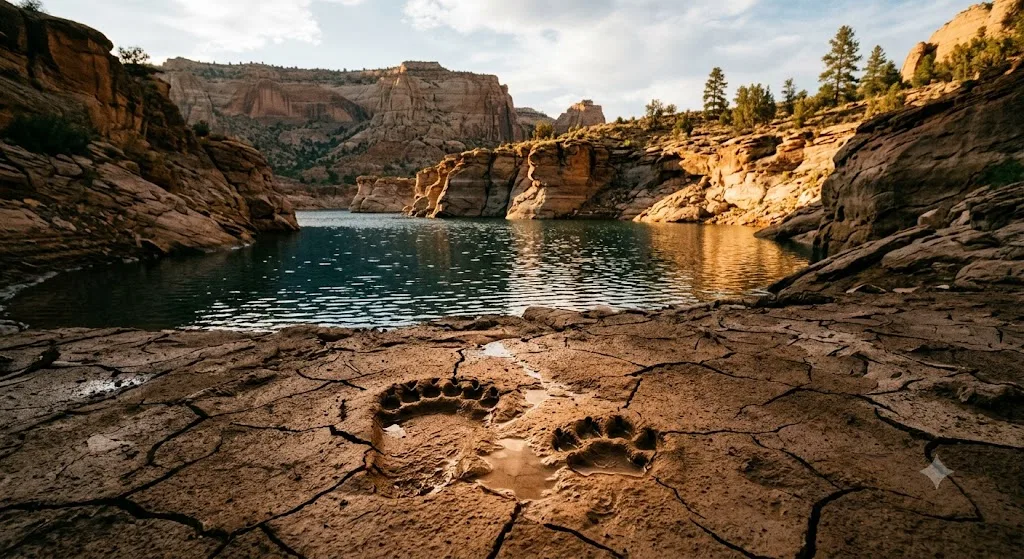
Arizona’s monster stories are often less about a single hidden beast than about places that make ordinary wildlife hard to read. Pine forests on the Mogollon Rim, shadowed canyons, desert reservoirs and borderland wildlife corridors all create the same problem: a brief sound, track, wake or shape can feel larger than life when distance, darkness and expectation do the rest. That does not prove the Mogollon Monster, phantom cats or lake creatures are real animals. It does explain why Arizona keeps producing convincing-sounding encounters. The state has real black bears, mountain lions, coyotes, bobcats, javelinas, large fish and rare borderland cats, and many of them move through habitats where people see only fragments. The result is a distinctive Arizona pattern: rugged terrain supplies mystery, wildlife supplies the raw material, and frontier storytelling turns the encounter into a monster.
Forests, canyons and the problem of scale
Arizona’s best-known creature setting is not the open desert of postcards, but the forested high country. The Mogollon Rim stretches across the northern half of the state as the southern edge of the Colorado Plateau, with cliffs, canyons, high-elevation woodland and extensive ponderosa pine country. Arizona Highways describes the state’s ponderosa belt as the largest contiguous ponderosa pine forest in the world, stretching from the New Mexico line to the South Rim of the Grand Canyon and across the White Mountains, the Mogollon Rim and the Coconino Plateau.[Arizona Highways]arizonahighways.comArizona HighwaysThe Grandmother of All PonderosasBut the largest contiguous ponderosa pine forest is in Arizona. This belt of evergreens…
That matters because monster reports often begin with scale failure. A person hears crashing brush at night, sees a dark figure between trees, finds disturbed ground near camp, or watches something move along a canyon wall. In open daylight, the brain has reference points. In broken pine forest, steep country and moonlit canyon edges, those reference points vanish. A bear standing briefly upright, an elk moving through brush, a mountain lion slipping across a wash, or coyotes calling from different directions can feel bigger, closer or stranger than it is.
The Mogollon Monster tradition sits directly in that high-country setting. It is usually described as Arizona’s Bigfoot-like legend: a large, hairy, foul-smelling creature associated with the Mogollon Rim and central or eastern Arizona. Arizona Highways traces one of the story’s early newspaper ancestors to a 1903 “wild man” report printed in The Williams News, framed around the Grand Canyon and pine-country adventure rather than modern cryptozoology.[Arizona Highways]arizonahighways.comArizona HighwaysNeither Hide Nor HairThe Mogollon Monster's urtext appeared in The Williams News on May 23, 1903. Below the masthead depi…
The important point is not that the 1903 report proves a hidden primate. It is that the geography fits the storytelling. The Rim is large enough, wooded enough and rough enough to make absence of evidence feel less decisive to believers. At the same time, it is visited by campers, hikers, hunters, anglers and Boy Scout groups — exactly the sort of witnesses who bring home vivid stories from nights outdoors. A remote landscape with frequent human recreation is ideal monster-story habitat: people are present often enough to have scares, but the terrain remains wild enough for those scares to feel unresolved.
Canyons intensify the effect. Sound can bounce, stretch and mislead. A scream, bark, cough or howl heard from below a rim or across a drainage may not reveal its source. The same is true visually: cliffs and slopes hide bodies while exposing only movement, eyeshine or silhouettes. Arizona’s canyon country therefore does not need an unknown animal to create a convincing “something was out there” moment. It needs darkness, distance, echo and a witness already primed by local lore.
Bears, mountain lions and ambiguous encounters
Arizona has real large mammals capable of generating monster-sized impressions. Black bears are found in most woodland habitats in the state, including pinyon-juniper, oak woodland, coniferous forest and chaparral. Arizona Game and Fish says their relative densities are highest along the Mogollon Rim, in the Mazatzal Mountains, and in the White and Pinaleño mountains. The same agency’s public guidance notes that bears are primarily found in higher-elevation woodland and forested regions, but can also occur in riparian areas and desert scrub.[Arizona Game & Fish Department]azgfd.comArizona Game & Fish DepartmentBlack Bear - Arizona Game & Fish…In Arizona, black bears are found in most woodland habitats, including…
A bear is a particularly good engine for a monster story because it can look wrong in several different ways. It may be cinnamon or brown rather than black; it can stand upright briefly; it can raid campsites when people leave food accessible; and it can leave tracks or disturbed ground that non-specialists may interpret poorly. University of Arizona Cooperative Extension also notes that Arizona black bears are not always black, with brown, cinnamon and dark blond colour phases, and that they live mainly in forest, woodland and chaparral habitats but sometimes occur near desert riparian areas.[UA Cooperative Extension]extension.arizona.eduUA Cooperative Extension Black BearsUA Cooperative Extension Black Bears
Mountain lions add a different kind of ambiguity. Arizona Game and Fish says they occur throughout the state, especially in mountainous areas with rugged terrain, canyons and rocky slopes. They are usually avoidant of people, but they do use wildland-urban edges, washes and parks as movement corridors.[Arizona Game & Fish Department]azgfd.comOpen source on azgfd.com.
That corridor detail is crucial for Arizona monster lore. It means a “phantom” animal does not have to belong in the witness’s backyard, campsite or roadside pull-off in order to pass through it. A mountain lion may appear in a place where the viewer did not expect a big predator, then vanish into a wash or rocky slope before anyone gets a clear look. Arizona Game and Fish also describes mountain lions as stalk-and-ambush predators that hunt mainly at night and cache uneaten kills under leaves, dirt or debris.[Arizona Game & Fish Department]azgfd.comArizona Game & Fish Department Mountain LionArizona Game & Fish Department Mountain Lion
To a startled witness, those facts can become folklore ingredients: a scream in the dark, eyeshine beyond the firelight, a half-covered carcass, a silent animal glimpsed at the edge of a road. In a sceptical reading, these are ordinary predator behaviours seen under poor conditions. In a legend-making reading, they become signs of an intelligent, territorial or unnatural creature.
Smaller animals can also sound larger than they are. Coyotes occur statewide and are often active at night, which makes their calls a familiar but still unsettling part of Arizona’s outdoor soundscape.[azstateparks.com]azstateparks.comOpen source on azstateparks.com. Bobcats, foxes and owls can produce cries that witnesses may describe in human terms; even reputable popular science explainers have noted that bobcat screams are often compared to a child or person in distress.[National Geographic]nationalgeographic.com151030 owl red fox animals scary screams halloween science151030 owl red fox animals scary screams halloween science When those sounds come from a canyon, wash or forest edge, the listener may never see the animal at all. The “monster” is built in the gap between hearing and identification.
Reservoir wakes and desert water rumours
Arizona’s water monsters have a different flavour from forest giants. The state is not known for a single famous lake monster on the scale of Loch Ness or Lake Champlain’s Champ. Instead, its reservoirs create temporary monster conditions: artificial lakes in dry landscapes, deep-looking water against desert rock, large fish, sudden wind, boat wakes, changing water levels and campfire rumours.
Reservoirs are especially good at producing false scale. A wake can outlast the boat that made it. A line of birds, submerged timber, a swimming mammal, a surfacing fish or wind crossing a narrow arm of water can look like a moving back or serpentine body. In a desert setting, water already feels exceptional; a large ripple on an otherwise still lake is easier to remember as a creature than as a physics problem.
The “monster fish” side of the story has a factual base. Arizona waters can produce very large catfish and bass, even if that does not imply unknown lake animals. Reports around Arizona angling regularly use monster language for outsized fish, and record-style accounts note flathead catfish over 70 pounds from Bartlett Lake and large channel catfish from Upper Lake Mary.[A-Z Animals]a-z-animals.comOpen source on a-z-animals.com. Such fish are not cryptids, but they help explain why lake rumours survive. Once people know a reservoir can hold animals heavier than a child, the leap from “huge fish” to “something enormous moved under the surface” becomes emotionally easy.
Changing water levels add another layer. San Carlos Lake, a man-made reservoir on the Gila River, was reported in June 2026 to have suffered a catastrophic fish die-off after drought conditions and water releases reduced water levels, leading to an indefinite closure for public safety. NASA Earth Observatory coverage described San Carlos Reservoir as less than 1% full in late May 2026 after exceptionally scarce snowpack in the Gila River watershed.[The Guardian]theguardian.comThe closure affects a site known for its 158 miles of shoreline and state-record fish including largemouth bass, crappie, bluegill, and c…
That modern event is not a monster sighting, but it shows how Arizona reservoirs can become uncanny landscapes. A lake that rises, shrinks, exposes shorelines, concentrates fish, smells of decay or suddenly closes can feel unstable and eerie. In folklore terms, that instability matters. Monster stories do not grow only from animals; they also grow from places that behave strangely.

Borderlands and rumour trails
Southern Arizona’s borderlands bring another mechanism into play: wildlife corridors. The Madrean Sky Islands — isolated mountain ranges rising from desert and grassland — connect Arizona with northern Mexico through ridgelines, washes, springs and oak woodland. Conservation groups and researchers describe these corridors as important for wide-ranging species, including black bears, mountain lions, ocelots and jaguars.[The Wilderness Society]wilderness.orgOpen source on wilderness.org.
This is where Arizona’s real wildlife can sound almost folkloric without being invented. Jaguars and ocelots are not everyday animals for most Arizonans, but they are part of the region’s conservation story. Sky Island Alliance reports recent camera detections of jaguars and ocelots near the Huachuca Mountains and describes the area as part of a jaguar corridor.[Sky Island Alliance]skyislandalliance.orgOpen source on skyislandalliance.org. The Guardian reported in 2024 on photographs and videos of a jaguar in southern Arizona’s Sky Islands, including the Whetstone and Huachuca mountains, and highlighted the importance of cross-border movement for the species.[The Guardian]theguardian.comphotographs wild jaguars return us aoephotographs wild jaguars return us aoe
For monster folklore, rare cats create a special kind of uncertainty. A witness who sees a large spotted or dark-looking animal at dusk may not have the vocabulary, lighting or confidence to identify it. Was it a mountain lion? A jaguar? A large bobcat seen badly? A domestic animal? A hoax? A rumour repeated from someone else’s trail camera? The borderlands make those questions harder because the region really is a meeting place for temperate, desert and subtropical species.
Corridors also move stories as well as animals. Ranch roads, hunting camps, border patrol routes, conservation camera networks, small towns and online local groups all pass along reports. A sighting that might once have remained a family anecdote can now become a regional rumour within hours. The habitat gives the animal somewhere to move; the human network gives the story somewhere to travel.
This does not mean every phantom-cat account in Arizona is secretly a jaguar. It means the state’s ecology leaves more room for uncertainty than a simple “there are no big cats here” dismissal. Mountain lions are widespread, bobcats are common, bears occupy mountain ranges, and rare borderland cats do occasionally appear in documented conservation contexts. The legend-making begins when those facts are mixed with poor visibility, second-hand retelling and the desire for a more dramatic animal than the evidence supports.
How Arizona habitats turn sightings into monsters
Arizona’s landscape breeds monster stories through a few repeating mechanisms rather than one grand mystery.
Distance makes animals grow. Across a canyon, on a ridge or at the far side of a reservoir, size is hard to judge. A normal animal can become a giant because there is no fence, person, car or tree trunk close enough to calibrate it.
Night removes the boring details. Many memorable reports happen at dusk, after dark or near camp. That is exactly when predators and scavengers may be active, but it is also when colour, body shape and movement become least reliable.
Sound travels strangely. Canyons, forests and washes can distort calls. A mountain lion, coyote group, bobcat or owl may be heard clearly but seen not at all. Once the source is invisible, the imagination supplies a body.
Real predators leave suggestive traces. Cached kills, tracks, scat, clawed logs, disturbed rubbish and raided camps can all feel like evidence of a creature with intent. In most cases, they fit known wildlife better than unknown monsters, but they are still powerful story objects.
Habitats overlap at the edges. Arizona’s wildland-urban interfaces, desert washes, riparian corridors and borderland mountains let animals appear where people do not expect them. Surprise is one of the strongest ingredients in a monster report.
Old storytelling frames survive. The Mogollon Monster, frontier wild-man tales, phantom cats and lake rumours give witnesses a ready-made language. Once a place is known for a creature, later ambiguous encounters are more likely to be filed under that name.
The evidence-aware view is not that Arizona’s habitats “create” monsters in a literal biological sense. They create monster conditions: incomplete perception, real wildlife, difficult terrain and a culture ready to preserve the strangest version of an encounter.
What this means for Arizona’s creature lore
The most useful way to read Arizona monster stories is as habitat-shaped folklore. The Mogollon Monster belongs to pine forests, Rim cliffs and campfire darkness. Phantom-cat stories belong to canyons, washes, borderland corridors and rare-but-real big-cat context. Lake rumours belong to reservoirs where wakes, giant fish, drought and sudden ecological change make water feel mysterious. Even desert stories often depend on movement corridors, night travel and animals appearing out of place.
That approach keeps the wonder without abandoning caution. Arizona does not need confirmed hidden apes, prehistoric birds or lake serpents to have a rich monster tradition. Its known animals are already impressive, its terrain is already disorienting, and its history is full of frontier exaggeration, outdoor recreation and local retelling. The monsters endure because the landscape keeps giving ordinary encounters just enough shadow to become extraordinary.
Amazon book picks
Further Reading
Books and field guides related to Why Arizona's Landscape Breeds Monster Stories. Use these as the next step if you want deeper reading beyond the article.
Abominable Science!
Examines environmental and psychological roots of monster sightings.
eBay marketplace picks
Marketplace Samples
Live-tested eBay searches with available results related to this page.



Endnotes
1.
Source: extension.arizona.edu
Title: UA Cooperative Extension Black Bears
Link:https://extension.arizona.edu/sites/extension.arizona.edu/files/attachment/BlackBears.pdf
2.
Source: azstateparks.com
Link:https://azstateparks.com/arizona-wildlife
3.
Source: wilderness.org
Link:https://www.wilderness.org/wild-places/arizona/conservation-southwest-borderlands
4.
Source: lovejoycenter.arizona.edu
Title: wildlife corridor mapping program
Link:https://lovejoycenter.arizona.edu/what-we-do/pathway-4-impactful-research/wildlife-corridor-mapping-program
5.
Source: azstateparks.com
Link:https://azstateparks.com/arizona-mountain-lions
6.
Source: arizonahighways.com
Link:https://www.arizonahighways.com/article/grandmother-all-ponderosas
Source snippet
Arizona HighwaysThe Grandmother of All PonderosasBut the largest contiguous ponderosa pine forest is in Arizona. This belt of evergreens...
7.
Source: Wikipedia
Title: Mogollon Rim
Link:https://en.wikipedia.org/wiki/Mogollon_Rim
8.
Source: arizonahighways.com
Link:https://www.arizonahighways.com/article/neither-hide-nor-hair
Source snippet
Arizona HighwaysNeither Hide Nor HairThe Mogollon Monster's urtext appeared in The Williams News on May 23, 1903. Below the masthead depi...
Published: May 23, 1903
9.
Source: azgfd.com
Link:https://www.azgfd.com/species/black-bear/
Source snippet
Arizona Game & Fish DepartmentBlack Bear - Arizona Game & Fish...In Arizona, black bears are found in most woodland habitats, including...
10.
Source: azgfd.com
Link:https://www.azgfd.com/wildlife-conservation/living-with-wildlife/living-with-bears/
11.
Source: azgfd.com
Link:https://www.azgfd.com/wildlife-conservation/living-with-wildlife/living-with-mountain-lions/
12.
Source: azgfd.com
Title: Arizona Game & Fish Department Mountain Lion
Link:https://www.azgfd.com/species/mountain-lion/
13.
Source: nationalgeographic.com
Title: 151030 owl red fox animals scary screams halloween science
Link:https://www.nationalgeographic.com/animals/article/151030-owl-red-fox-animals-scary-screams-halloween-science
14.
Source: a-z-animals.com
Link:https://a-z-animals.com/blog/discover-the-largest-channel-catfish-ever-caught-in-arizona/
15.
Source: theguardian.com
Link:https://www.theguardian.com/us-news/2026/jun/08/san-carlos-lake-arizona-fish-kill
Source snippet
The closure affects a site known for its 158 miles of shoreline and state-record fish including largemouth bass, crappie, bluegill, and c...
16.
Source: azgfd.com
Title: Arizona Game & Fish Department Wildlife and Habitat Connectivity
Link:https://www.azgfd.com/wildlife-conservation/planning-for-wildlife/wildlife-and-habitat-connectivity/
17.
Source: skyislandalliance.org
Link:https://skyislandalliance.org/our-work/conservation/border-restoration/
18.
Source: theguardian.com
Title: photographs wild jaguars return us aoe
Link:https://www.theguardian.com/environment/2024/feb/06/photographs-wild-jaguars-return-us-aoe
19.
Source: facebook.com
Link:https://www.facebook.com/azgfd/posts/the-weather-is-heating-up-and-soon-it-will-be-peak-season-for-black-bear-activit/1348231697335898/
20.
Source: facebook.com
Link:https://www.facebook.com/SkyIslandAlliance/posts/in-case-you-missed-our-recent-action-alert-theres-still-a-few-more-days-to-weigh/1278686704304965/
21.
Source: fs.usda.gov
Link:https://www.fs.usda.gov/r03/coconino/animals-plants/animals
22.
Source: awcs.azgfd.com
Title: montane conifer forests
Link:https://awcs.azgfd.com/habitats/montane-conifer-forests
23.
Source: azgfd.com
Link:https://www.azgfd.com/wildlife-conservation/living-with-wildlife/
24.
Source: cryptidz.fandom.com
Title: Mogollon Monster
Link:https://cryptidz.fandom.com/wiki/Mogollon_Monster
25.
Source: itsmth.fandom.com
Title: Mogollon Monster
Link:https://itsmth.fandom.com/wiki/Mogollon_Monster
26.
Source: Wikipedia
Title: Mogollon Monster
Link:https://en.wikipedia.org/wiki/Mogollon_Monster
27.
Source: arizonahighways.com
Link:https://www.arizonahighways.com/classroom/black-bear-0
28.
Source: nationalgeographic.com
Title: animal migration us mexico border wall
Link:https://www.nationalgeographic.com/animals/article/animal-migration-us-mexico-border-wall
29.
Source: azmemory.azlibrary.gov
Link:https://azmemory.azlibrary.gov/nodes/view/330949
Additional References
30.
Source: azdot.gov
Link:https://azdot.gov/business/environmental-planning/programs/wildlife-linkages
31.
Source: instagram.com
Link:https://www.instagram.com/p/DM5mbVxxWXk/
32.
Source: instagram.com
Link:https://www.instagram.com/p/DZYqQQKFB9-/
33.
Source: mountainlion.org
Link:https://mountainlion.org/about-mountain-lions/
34.
Source: instagram.com
Link:https://www.instagram.com/reel/DVndyLnjtU3/
35.
Source: azbw.com
Link:https://www.azbw.com/Arizona_Lake_List.php
36.
Source: instagram.com
Link:https://www.instagram.com/reel/DUjozyugWbw/?hl=en
37.
Source: facebook.com
Link:https://www.facebook.com/groups/ArizonaCampingFamilies/posts/2904468123111411/
38.
Source: facebook.com
Link:https://www.facebook.com/groups/wildlifephotogs/posts/1848584192328653/
39.
Source: azvacationhomerentals.com
Link:https://www.azvacationhomerentals.com/bobcats-in-our-backyards
Topic Tree