Within Oklahoma Monsters
What Other Mystery Beasts Does Oklahoma Claim?
Giant birds, black panthers and Choctaw shampe stories widen Oklahoma monster lore beyond the famous Sasquatch map.
On this page
- Giant bird and black panther reports
- The Choctaw shampe in modern retellings
- How smaller traditions link to Bigfoot culture
Page outline Jump by section
Introduction
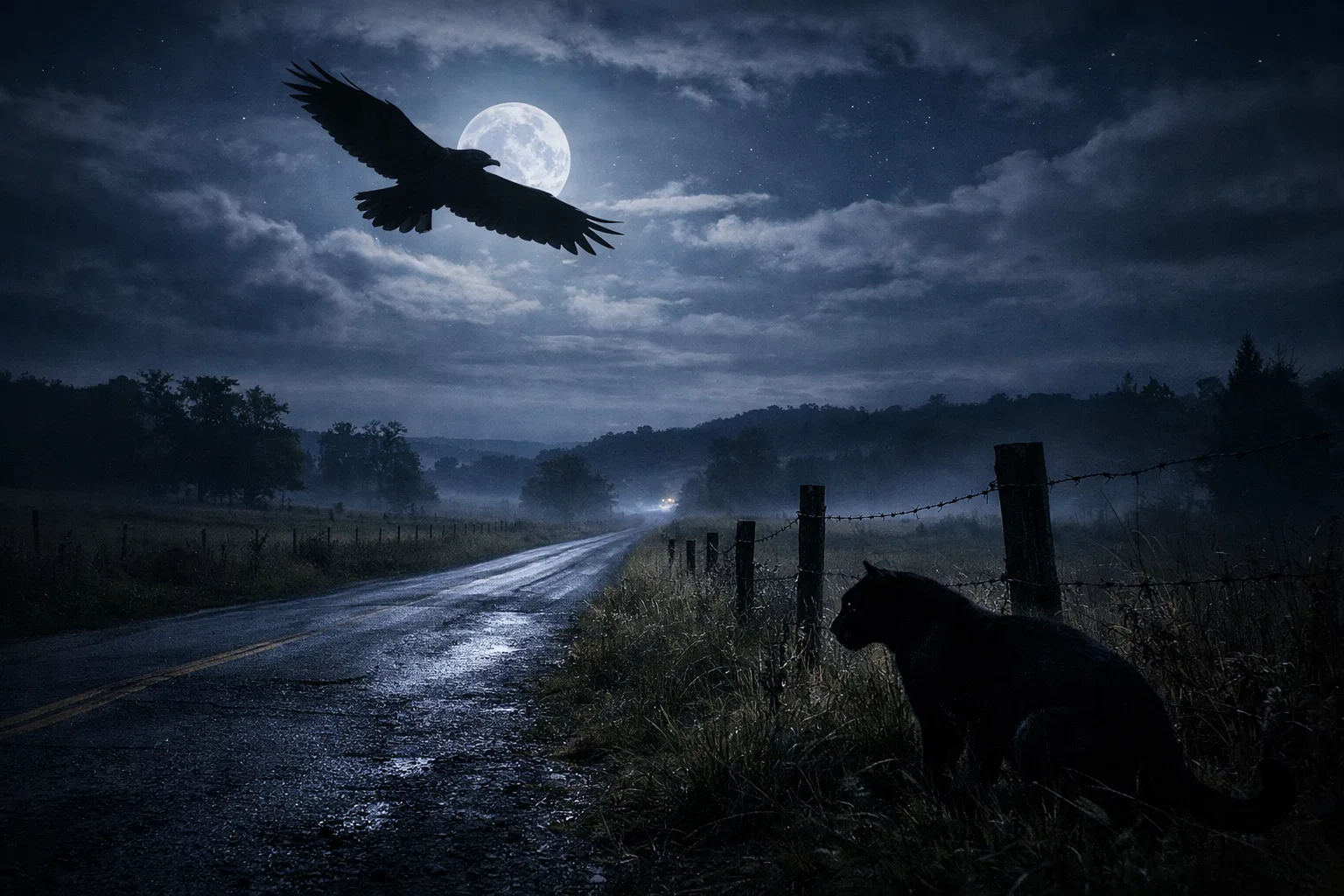
Oklahoma’s mystery-beast lore does not stop at Bigfoot. Around the edges of the state’s Sasquatch map are three smaller but persistent traditions: oversized “thunderbird” or giant-bird reports, rural black panther sightings, and modern retellings of the Choctaw shampe, a frightening figure sometimes pulled into Bigfoot discussions. The evidence is uneven. The black panther stories have the strongest real-animal context because Oklahoma does have confirmed mountain lions, though wildlife officials reject the idea of black mountain lions. Giant-bird reports are more scattered and are often easier to explain through pelicans, vultures or eagles. Shampe stories are best treated as folklore first, not zoology. Together, these traditions show how Oklahoma monster lore works beyond one famous hairy giant: ordinary landscapes, uncertain sightings and older story-worlds get braided into local mystery.
Why Oklahoma’s “other beasts” matter
Oklahoma’s best-known monster geography points towards the wooded southeast, where Bigfoot stories attach themselves to the Ouachita and Kiamichi country. The other beasts widen that map. Giant birds belong to open sky, reservoirs, migration routes and startled motorists. Black panthers belong to rural roads, deer country, livestock worries and the long memory of big cats in the American South. The shampe belongs to Choctaw story tradition, but modern cryptid writers sometimes treat it as a cultural ancestor or parallel to Sasquatch.
That does not mean all three are the same kind of claim. A reported black panther is usually presented as an animal sighting: a large, dark cat crossing a road or slipping into brush. A thunderbird report may be a cryptid sighting, a misjudged bird, or a modern echo of a much wider North American giant-bird tradition. The shampe is different again: a named being in Choctaw folklore, described in secondary folklore summaries as a malevolent ogre-like monster, sometimes giant, sometimes hairy, and especially associated with an unbearable smell.[Native Languages]native-languages.orgOpen source on native-languages.org.
The useful question is not “which one is real?” but “what kind of evidence is being offered?” Oklahoma’s other mystery beasts mostly survive through eyewitness memory, local retelling, online reports and folklore adaptation, rather than through physical specimens, clear photographs, verified tracks or repeatable wildlife evidence.
Giant-bird reports: thunderbirds, pelicans and the problem of scale
Giant-bird stories are attractive because the sky gives witnesses very few reference points. A bird seen above a road, over a lake or at the edge of dusk can look enormous, especially if it is low, backlit or unfamiliar. Oklahoma has at least occasional modern “thunderbird” reporting in cryptid circles: in 2024, the Singular Fortean Society published an Oklahoma account from a witness using the name Jason B., who described an unusually large winged creature in an email report. That is a useful example of the genre, but it remains an anecdotal account rather than independent proof of an unknown species.[A Singular Fortean]singularfortean.comA Singular Fortean Man Reports Sighting of 'Thunderbird' in OklahomaA Singular Fortean Man Reports Sighting of 'Thunderbird' in Oklahoma
The strongest sceptical explanation is not that witnesses are foolish. It is that Oklahoma genuinely has large birds. The Oklahoma Department of Wildlife Conservation describes the American white pelican as one of North America’s largest birds, averaging about 16 pounds and reaching an impressive 9- to 10-foot wingspan. That is large enough to astonish a person who expects pelicans only on coasts, yet the species is a familiar inland migrant and lake bird.[Oklahoma Wildlife Conservation]wildlifedepartment.comOpen source on wildlifedepartment.com.
Lake settings make this especially relevant. ODWC reported a tagged American white pelican photographed at Lake Thunderbird State Park in February 2022, where a photographer had gone looking for bald eagles and instead found about 200 pelicans. That single detail explains a lot about “giant bird” confusion: Oklahoma reservoirs can suddenly produce flocks of huge white birds where casual observers may not expect them.[Oklahoma Wildlife Conservation]wildlifedepartment.comtagged pelican photographed 950 miles nesttagged pelican photographed 950 miles nest
Vultures can also feed mystery-bird stories. ODWC notes that turkey vultures have wingspans of nearly six feet, can soar for hours, and are often mistaken for eagles because of their size. Their habit of riding thermals, circling in groups and appearing over carcasses gives them a dramatic presence that can seem stranger than it is, especially from a moving vehicle.[Oklahoma Wildlife Conservation]wildlifedepartment.comOpen source on wildlifedepartment.com.
This does not neatly solve every giant-bird claim. Some witnesses describe shapes that they interpret as pterosaur-like or unlike any familiar bird. But once the evidence is reduced to a brief sighting with no photograph, specimen or repeat observation, the most cautious reading is that Oklahoma’s thunderbird stories are a loose mystery-bird tradition rather than a strong case for an unknown animal.

Black panthers: the mystery cat with the best real-world hook
Black panther sightings are different from thunderbirds because they sit beside a confirmed wildlife story. Oklahoma does have mountain lions. ODWC says sightings and evidence of cougars in Oklahoma go back to the nineteenth century, including two cougars killed in southwest Oklahoma in 1852 and documented tracks near Canton Lake in 1953. The department also keeps a list of confirmed mountain lion sightings from 2002 onwards.[Oklahoma Wildlife Conservation]wildlifedepartment.commountain lionmountain lion
That real background gives black panther stories extra staying power. When a rural witness says they saw a big cat, the broad idea is not absurd. ODWC says mountain lions are reclusive, prefer dense cover or rocky and rugged terrain, and are most active near dawn and dusk. It also notes that males may average about seven feet from nose to tail tip, while females average about six feet. A fleeting tan mountain lion in poor light could easily become darker in memory, especially if seen at night or against shadowed brush.[Oklahoma Wildlife Conservation]wildlifedepartment.comOpen source on wildlifedepartment.com.
The problem is the colour. ODWC is blunt on this point: it calls black panthers a popular myth in North America and says there has never been a documented black mountain lion anywhere in the species’ range. It explains that “black panther” usually means a melanistic leopard or jaguar, not a cougar, and that such animals are not part of Oklahoma’s verified wildlife.[Oklahoma Wildlife Conservation]wildlifedepartment.comOpen source on wildlifedepartment.com.
ODWC also gives a practical reason why many panther reports stay unconfirmed. Although hundreds of mountain lion reports may be recorded, only a small percentage produce the hard evidence needed for confirmation, such as photographs, tracks, hair or scat. The department lists mistaken identity candidates that include bobcats, house cats, domestic dogs, coyotes, foxes, deer and even rabbits. That range may sound comical, but it reflects a real problem: size, colour and distance are very easy to misjudge in a sudden roadside encounter.[Oklahoma Wildlife Conservation]wildlifedepartment.comOpen source on wildlifedepartment.com.
Recent confirmations complicate the folklore without proving the black panther. In June 2025, ODWC announced photographic evidence of mountain lion kittens with adults in Osage County and Cimarron County, describing it as the first evidence that mountain lions may be breeding in Oklahoma. That is important for Oklahoma wildlife history, but it still points to tan mountain lions, not black mystery cats.[Oklahoma Wildlife Conservation]wildlifedepartment.commountain lion kittens confirmed oklahomamountain lion kittens confirmed oklahoma
So the fairest assessment is split. Oklahoma black panther lore probably contains some real big-cat encounters, some bobcat or dog misidentifications, and some stories reshaped by regional expectations. What it does not currently contain is accepted evidence for a population of black cougars, black jaguars or any other large black cat in the state.
The Choctaw shampe in modern retellings
The shampe is the most culturally sensitive of Oklahoma’s “other beast” traditions because it is not just a roadside creature report. It comes from Choctaw folklore, and modern cryptid writing often risks flattening folklore into monster-hunting evidence. The more careful approach is to treat the shampe as a story-being first, then ask why Bigfoot culture finds it so easy to borrow.
Folklore reference site Native Languages describes the shampe as a malevolent, ogre-like monster of Choctaw folklore, with versions in which it abducts Choctaw women or acts as a man-eater. Another summary notes that the shampe may be described as a giant or as a large hairy man, with its overpowering smell as a key feature. Those details explain the modern Bigfoot connection: size, hairiness, danger and bad smell are all familiar Sasquatch-story ingredients.[Native Languages]native-languages.orgOpen source on native-languages.org.
But the historical route matters. The Choctaw Nation of Oklahoma exists in Oklahoma because of forced removal from the Choctaw homeland in the Southeast. The Choctaw Nation describes the first removals, from 1831 to 1833, as among the darkest days in recorded Choctaw history, with more than a quarter of those removed dying during those years. The National Park Service likewise states that the Choctaw Nation of Oklahoma was formed by more than 13,000 Choctaw people removed from their homeland between 1831 and 1838.[Choctaw Nation of Oklahoma]choctawnation.comchoctaw removalschoctaw removals
That history helps explain why a Choctaw folklore figure may appear in Oklahoma monster discussions even if older story material points back to the broader Southeastern Choctaw world. Oklahoma did not simply “inherit” a creature rumour; it became home to living Choctaw communities whose stories, histories and cultural memory continued after removal. Modern cryptid writers then reframe some of those stories through the language of Bigfoot.
That reframing can be interesting, but it should not be treated as proof. A shampe story is not automatically an eyewitness report of a biological primate. It may be a warning tale, a monster story, a moral narrative, a spiritual being, a remembered danger of the woods, or some combination of those depending on teller and context. The Bigfoot comparison is a modern interpretive bridge, not a licence to strip the figure out of Choctaw tradition.
How these smaller legends link back to Bigfoot culture
Oklahoma’s other mystery beasts orbit Bigfoot because Bigfoot provides the state’s strongest monster framework. Once a region becomes known for Sasquatch, related stories are easier to absorb. A foul-smelling hairy shampe becomes “Choctaw Bigfoot”. A black panther becomes another elusive animal said to evade officials. A giant bird becomes one more sign that Oklahoma’s wild places may be stranger than maps suggest.
The connection is cultural rather than biological. These traditions share several story mechanics:
Fleeting encounters. Most reports happen quickly: a bird overhead, a cat crossing a road, a figure or smell in the woods. The short duration makes sincere mistakes more likely and also makes the story harder to disprove.
Difficult terrain. Southeastern woods, lake margins, ranchland, river bottoms and low-light rural roads all create uncertainty. They give legends room to breathe because visibility is poor and witnesses often cannot return with evidence.
Official caution versus local certainty. Wildlife agencies require hard evidence. Local witnesses often feel they know what they saw. The gap between those standards keeps legends alive, especially with black panthers and mountain lions.
Older stories meeting modern media. Folklore beings such as the shampe gain new audiences through cryptid websites, Bigfoot groups and local tourism language. The story changes as it moves from oral tradition or folklore summary into paranormal entertainment.
This is why Oklahoma’s other beasts matter even when the evidence is thin. They show that monster lore is not built only from famous cases. It is built from repeated uncertainty: the large bird that seems too big, the black cat that should not be there, the old story that sounds uncannily like a modern creature report.
What the record supports about Other Beasts
The evidence for Oklahoma’s non-Bigfoot mystery beasts is best read in layers. At the firmest level, Oklahoma has real large animals that can generate strange reports: confirmed mountain lions, large pelicans, vultures, eagles and other wildlife. ODWC’s mountain lion material shows that some once-doubted big-cat reports can become confirmed when photographs, carcasses or other physical evidence appear.[Oklahoma Wildlife Conservation]wildlifedepartment.comconfirmed sightingsconfirmed sightings
At the middle level are plausible but unverified sightings. A witness may genuinely see a large cat without producing enough evidence for confirmation. A driver may really see a huge bird but misjudge species or wingspan. These accounts are valuable as folklore and local testimony, but they cannot carry the weight of biological proof.
At the most interpretive level are modern cryptid retellings of older folklore. The shampe belongs here. It is highly relevant to Oklahoma monster culture because of Choctaw presence, removal history and Bigfoot-era reinterpretation, but it should not be reduced to a zoological claim. Its value is not that it proves Sasquatch; its value is that it shows how Indigenous story traditions, settler monster hunting and modern internet folklore can overlap uneasily in one state.
The result is a more interesting Oklahoma bestiary than a simple list of monsters. Giant birds test the limits of perception. Black panthers test the gap between official wildlife evidence and rural testimony. The shampe tests how carefully modern readers handle older cultural stories. None of them currently proves an unknown Oklahoma animal, but each adds a different kind of mystery to the state’s creature lore.
Amazon book picks
Further Reading
Books and field guides related to What Other Mystery Beasts Does Oklahoma Claim?. Use these as the next step if you want deeper reading beyond the article.
Field Guide to Lake Monsters, Sea Serpents, and Other Mystery...
Expands coverage beyond Bigfoot into other creature traditions.
eBay marketplace picks
Marketplace Samples
Live-tested eBay searches with available results related to this page.



Endnotes
1.
Source: native-languages.org
Link:https://www.native-languages.org/morelegends/shampe.htm
2.
Source: native-languages.org
Link:https://www.native-languages.org/choctaw-legends.htm
3.
Source: oklahoma.gov
Title: Tribes of OK Education Guide Choctaw Nation
Link:https://oklahoma.gov/content/dam/ok/en/osde/documents/services/american-indian-education/Tribes_of_OK_Education%20Guide_Choctaw_Nation.pdf
4.
Source: singularfortean.com
Title: A Singular Fortean Man Reports Sighting of ‘Thunderbird’ in Oklahoma
Link:https://www.singularfortean.com/news/2024/6/13/man-reports-sighting-of-thunderbird-in-oklahoma
5.
Source: wildlifedepartment.com
Link:https://www.wildlifedepartment.com/wildlife/field-guide/birds/american-white-pelican
6.
Source: wildlifedepartment.com
Title: tagged pelican photographed 950 miles nest
Link:https://www.wildlifedepartment.com/outdoorok/ooj/tagged-pelican-photographed-950-miles-nest
7.
Source: wildlifedepartment.com
Link:https://www.wildlifedepartment.com/wildlife/field-guide/birds/turkey-vulture
8.
Source: wildlifedepartment.com
Title: mountain lion
Link:https://www.wildlifedepartment.com/wildlife/field-guide/mammals/mountain-lion
9.
Source: wildlifedepartment.com
Title: confirmed sightings
Link:https://www.wildlifedepartment.com/wildlife/field-guide/mammals/mountain-lion/confirmed-sightings
10.
Source: wildlifedepartment.com
Link:https://www.wildlifedepartment.com/wildlife/field-guide/mammals/mountain-lion/research
11.
Source: wildlifedepartment.com
Title: mountain lion kittens confirmed oklahoma
Link:https://www.wildlifedepartment.com/outdoor-news/mountain-lion-kittens-confirmed-oklahoma
12.
Source: choctawnation.com
Title: choctaw removals
Link:https://www.choctawnation.com/news/iti-fabvssa/choctaw-removals/
13.
Source: Wikipedia
Link:https://en.wikipedia.org/wiki/Choctaw
14.
Source: reddit.com
Link:https://www.reddit.com/r/bigfoot/comments/dz36ln/shampe_the_choctaw_bigfoot/
15.
Source: choctawnation.com
Title: choctaw stories the possum and the wolf
Link:https://www.choctawnation.com/news/iti-fabvssa/choctaw-stories-the-possum-and-the-wolf/
16.
Source: choctawnation.com
Title: the treaty that forever changed our chahta peoples story
Link:https://www.choctawnation.com/news/chiefs-blog/the-treaty-that-forever-changed-our-chahta-peoples-story/
17.
Source: choctawnation.com
Title: Historical Documents
Link:https://www.choctawnation.com/about/history/historical-documents/
18.
Source: choctawnation.com
Title: irish connection
Link:https://www.choctawnation.com/about/history/irish-connection/
19.
Source: choctawnation.com
Title: ok history supplemental
Link:https://www.choctawnation.com/news/posts/ok-history-supplemental/
20.
Source: choctawnation.com
Link:https://www.choctawnation.com/about/history/
21.
Source: cryptidz.fandom.com
Link:https://cryptidz.fandom.com/wiki/Thunderbird
22.
Source: ou.edu
Link:https://www.ou.edu/gaylord/exiled-to-indian-country/content/choctaw
23.
Source: youtube.com
Link:https://www.youtube.com/watch?v=4lfm6NbAH6g
24.
Source: wildlifedepartment.com
Link:https://wildlifedepartment.com/Magazine/2019/2019NovDec.pdf
25.
Source: wildlifedepartment.com
Title: mountain lion killed after preying sheep
Link:https://www.wildlifedepartment.com/outdoor-news/mountain-lion-killed-after-preying-sheep
26.
Source: wildlifedepartment.com
Link:https://www.wildlifedepartment.com/hunting/wma/northeast/oologah-wma
27.
Source: wildlifedepartment.com
Title: white bass angler guide top tips area highlights
Link:https://www.wildlifedepartment.com/outdoorok/ooj/white-bass-angler-guide-top-tips-area-highlights
28.
Source: wildlifedepartment.com
Title: blue river public fishing and hunting area
Link:https://www.wildlifedepartment.com/outdoorok/ooj/blue-river-public-fishing-and-hunting-area
29.
Source: audubon.org
Link:https://www.audubon.org/field-guide/bird/american-white-pelican
30.
Source: okc-audubon.org
Title: american white pelican
Link:https://okc-audubon.org/american-white-pelican/
31.
Source: okhistory.org
Link:https://www.okhistory.org/research/removal
Additional References
32.
Source: youtube.com
Link:https://www.youtube.com/watch?v=zBpAjFY8YUk
Source snippet
Exploring Oklahoma's Weird Folklore: Myths and Legends of the United States...
33.
Source: youtube.com
Title: Exploring Oklahoma’s Weird Folklore: Myths and Legends of the United States
Link:https://www.youtube.com/watch?v=yXl6M0bE5qw
Source snippet
12 Terrifying Legends That Still Haunt Oklahoma | Brought to Life...
34.
Source: youtube.com
Title: 12 Terrifying Legends That Still Haunt Oklahoma | Brought to Life
Link:https://www.youtube.com/watch?v=ZRSuF9swBTc
Source snippet
Black Panthers in America?! The Mountain Lion Mystery No One Can Explain...
35.
Source: facebook.com
Link:https://www.facebook.com/bigfootevidence/posts/a-description-of-the-choctaw-legend-of-shampe-and-some-of-the-possibilities-for-/2524174200930872/
36.
Source: facebook.com
Link:https://www.facebook.com/smltownmonsters/videos/a-terrifying-sighting-near-lawndale-illinois-left-witnesses-stunned-after-a-mass/26578829371815759/
37.
Source: facebook.com
Link:https://www.facebook.com/groups/18864377410/posts/10160391986582411/
38.
Source: facebook.com
Link:https://www.facebook.com/groups/18864377410/posts/10162503998762411/
39.
Source: reddit.com
Link:https://www.reddit.com/r/Cryptozoology/comments/18niocw/black_panther_se_oklahoma/
40.
Source: cryptozoonews.com
Link:https://www.cryptozoonews.com/panther-ok-2/
41.
Source: reddit.com
Link:https://www.reddit.com/r/Edmond/comments/v6k8l2/black_panther_on_the_turnpike/
Topic Tree