Within North Dakota Monsters
Why Does the Miniwashitu Break the Ice?
The Miniwashitu turns the Missouri River's violent spring ice break-up into North Dakota's most vivid monster story.
On this page
- The red shaggy river monster in Prairie Smoke
- Ice, roaring water, and sacred danger
- How a frightening being became a modern cryptid
Page outline Jump by section
Introduction
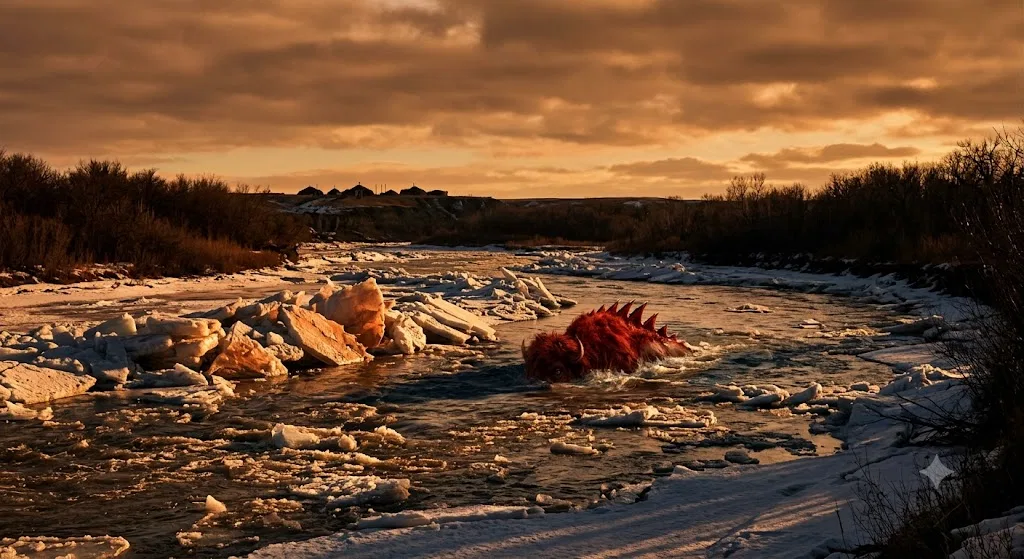
The Miniwashitu is North Dakota’s great river monster: a red, shaggy, one-eyed being said to live in the Missouri River and break the ice each spring with a jagged, saw-like back. Its best-known early printed form appears in Melvin Randolph Gilmore’s Prairie Smoke, where it is not presented as a modern eyewitness “case file”, but as a Dakota story explaining one of the Missouri’s most dramatic seasonal events: the roaring, dangerous break-up of winter ice. Gilmore’s account says the being moved upstream against the current, shone red in the water, and was so dreadful that seeing it by day could bring madness and death.[Project Gutenberg]gutenberg.orgThe Project Gutenberg eBook of Prairie Smoke, by Melvin Randolph Gilmore…
That makes the Miniwashitu one of North Dakota’s clearest bridges between Indigenous story, river danger, and modern cryptid lore. It is memorable because the creature is not just “in” the landscape; it behaves like the landscape. Its red flash, terrifying roar, and saw-toothed spine turn the spring ice break-up into a living force. In today’s monster culture, the Miniwashitu is often softened into a quirky Missouri River cryptid, but the older story is darker and more practical: it teaches awe, caution, and respect for a river that could feed, connect, trap, flood, and kill.
The red shaggy river monster in Prairie Smoke
Gilmore’s Prairie Smoke gives the Miniwashitu story under the direct heading “Cause of the Breaking Up of the Ice in the Missouri River in Springtime”. That title matters. It frames the being first as an explanation for a natural event, not as a roaming animal to be tracked like Bigfoot or a lake serpent. The text calls it a “mysterious being” in the stream of the Missouri, seldom seen by human beings and “most dreadful to see”. It appears in the middle of the river as a redness like fire, moving upstream against the current with a terrific roaring sound.[Project Gutenberg]gutenberg.orgThe Project Gutenberg eBook of Prairie Smoke, by Melvin Randolph Gilmore…
The description is unusually vivid for a short folklore item. The reported witness says the Miniwashitu was covered in hair like a buffalo, but red; it had one eye in the centre of its forehead, one horn above that eye, and a backbone “notched and jagged like an enormous saw”. After seeing it, the man’s vision darkened, he reached home, lost his reason, and soon died. Gilmore then gives the story’s mechanism: the Miniwashitu still lives in the Missouri and, in springtime, breaks up the ice as it moves upstream.[Project Gutenberg]gutenberg.orgThe Project Gutenberg eBook of Prairie Smoke, by Melvin Randolph Gilmore…
Read as monster lore, those details give North Dakota a striking creature: part buffalo, part cyclops, part river serpent, part living ice-saw. Read as environmental storytelling, the details are even more precise. The Miniwashitu is red like a flare in dark water. It roars like ice under pressure. Its back is a cutting edge. It travels against the current, an unnatural motion that suits a being powerful enough to disturb the whole river surface. The monster’s body is a map of the event it explains.
The story also has a built-in rule about seeing. A night-time glimpse is a streak of red in the river, but a daylight view is deadly. That is not just a horror flourish. It keeps the being at the edge of perception, where dangerous natural forces often live in folklore: heard before they are seen, glimpsed in fragments, known by their effects. The Miniwashitu is therefore not a creature with a neat modern sighting chronology. It is a warning-shaped presence attached to a seasonal threshold.
Why the Missouri River needed a monster
The Missouri River in North Dakota was never just scenery. Around the Knife and Missouri rivers, Mandan and Hidatsa villages formed major earthlodge communities, farming corn, beans and squash, trading with surrounding peoples, and living in a landscape where river access mattered deeply. The National Park Service describes the Missouri as a long-standing support for life in the region and notes that several Plains peoples’ histories intersect along the Missouri and Knife Rivers, near present-day central North Dakota.[National Park Service]nps.govOpen source on nps.gov.
That background helps explain why a river-ice monster would belong here. For agricultural and trading communities, winter ice could stop movement; spring break-up could restore passage, but it could also make the river violently unstable. Modern coverage of the Miniwashitu has stressed this same seasonal tension: around Bismarck, the Missouri could freeze across in winter, blocking the waterway for months, so the groaning return of open water was both relief and danger.[Atlas Obscura]atlasobscura.comAtlas Obscura In North Dakota, the Hideous Miniwashitu Ushers in SpringAtlas Obscura In North Dakota, the Hideous Miniwashitu Ushers in Spring
Gilmore’s own collection places Missouri River life in a world of fertile bottoms, timber, wild fruits, game, cultivated fields, and seasonal change. Just after the Miniwashitu tale, another Dakota story in Prairie Smoke describes a village near the river, rich with wood, berries, ducks, buffalo, deer, corn, beans, squash, sunflowers, and the “mysterious river” winding among dark trees.[Project Gutenberg]gutenberg.orgThe Project Gutenberg eBook of Prairie Smoke, by Melvin Randolph Gilmore… The Miniwashitu belongs to that kind of world: a place where the river gives abundance, but also demands attention.
The monster also fits the physical behaviour of northern rivers. North Dakota’s Department of Water Resources explains that spring break-up jams are usually more destructive than freeze-up jams because of the large amount of ice involved. It distinguishes gradual “thermal” break-up from “mechanical” break-up, where rapid rises in flow and water level break thick ice before it has weakened, allowing floes to accumulate and block the river.[swc.nd.gov]swc.nd.govUPDATE DUPDATE D That is the scientific language for what the legend makes immediate: the river can wake suddenly, loudly, and with force.
Ice, roaring water, and sacred danger
The Miniwashitu’s key action is not attacking a village, stealing livestock, or lurking in a lonely ravine. It breaks the ice. That gives the legend a mechanism: the monster is the imagined agent behind a real, recurring transformation of the Missouri River. A frozen surface that seemed solid becomes fractured, mobile, noisy, and dangerous. The river changes state, and the story gives that change a face.
Modern flood records show why this was not an abstract fear. In March 2009, ice jams on the Missouri River north and south of Bismarck caused serious flooding; the U.S. Geological Survey reported that the peak stage at Bismarck was the highest recorded there since the completion of Garrison Dam in 1954, and that the record high stages resulted from ice jams rather than simply record discharge.[U.S. Geological Survey]pubs.usgs.govOpen source on usgs.gov. A North Dakota Geological Survey article from the same year notes that two Missouri River ice jams near Bismarck dominated local and national news, and recalls that nineteenth-century bridge engineer George Shattuck Morison witnessed a massive 1880 ice jam with blocks piled up to 20 feet in places.[dmr.nd.gov]dmr.nd.govIce Jams LandslidesIce Jams Landslides
Those later records do not “prove” the Miniwashitu, of course. They do something more useful: they show that the legend is attached to a genuinely dramatic river process. Ice jams can raise water, push ice into piles, threaten bridges, and transform the river corridor in a matter of hours or days. The old image of a roaring being under the ice is not random decoration; it is a story-form response to a phenomenon that people living near the Missouri had reason to fear.
The saw-back is especially telling. In a modern monster profile, it may look like a fantasy design feature. In the ice legend, it is functional. A jagged back explains how the frozen river is cut open. The red colour is also more than costume. Gilmore’s version says the being made a redness in midstream like fire as it passed, a flash that fits the uncanny sight of moving water, reflected light, and broken ice after a long winter.[Project Gutenberg]gutenberg.orgThe Project Gutenberg eBook of Prairie Smoke, by Melvin Randolph Gilmore…
The “do not look” element adds sacred danger. The Miniwashitu is not merely dangerous because it can physically harm someone. It is dangerous because the sight itself overwhelms the witness. Seeing it by day leads to darkness, madness, writhing pain, and death in Gilmore’s account.[Project Gutenberg]gutenberg.orgThe Project Gutenberg eBook of Prairie Smoke, by Melvin Randolph Gilmore… In cryptid terms, that makes it a hard creature to treat as a normal animal. Its power is not just biological; it is taboo, awe, and river-force combined.

How the Miniwashitu became a North Dakota cryptid
The Miniwashitu’s modern life depends heavily on one short printed passage. HathiTrust’s catalogue records Prairie Smoke as Melvin Randolph Gilmore’s collection of prairie lore, published in Bismarck by the Bismarck Tribune print in a revised second edition in 1922, with subject headings including Dakota legends and North American folklore.[HathiTrust]catalog.hathitrust.orgHathi Trust Catalog Record: Prairie smoke | Hathi Trust Digital LibraryHathi Trust Catalog Record: Prairie smoke | Hathi Trust Digital Library That publication history matters because most modern retellings trace back, directly or indirectly, to Gilmore’s wording.
Gilmore was not writing a cryptid field guide. His collection includes Indigenous lore, plant stories, moral tales, sacred associations, and local traditions. The Miniwashitu became a cryptid later because modern readers lifted the being out of a seasonal explanatory tale and placed it into the “North Dakota monsters” category. Once that happens, the creature’s parts become a checklist: red buffalo-like hair, one eye, one horn, saw spine, Missouri River habitat, spring activity.
That shift is visible in recent popular coverage. Atlas Obscura presents the Miniwashitu as a North Dakota monster that ushers in spring, while also noting how modern renderings have made it less frightening: the old dreadful being becomes, in some retellings, a more charming cycloptic unicorn or “bipedal buffalo”.[Atlas Obscura]atlasobscura.comAtlas Obscura In North Dakota, the Hideous Miniwashitu Ushers in SpringAtlas Obscura In North Dakota, the Hideous Miniwashitu Ushers in Spring Cryptid wikis and enthusiast pages often go further, adding comparative labels or creature-profile traits that make it resemble better-known mystery beasts from elsewhere. Those adaptations help the legend travel online, but they can also flatten the original story’s relationship with the Missouri River.
The change is not necessarily “fake” in a simple sense. Folklore changes whenever it is retold. What changes here is the centre of gravity. In the older account, the main question is: why does the Missouri River ice break in spring? In the modern cryptid version, the question becomes: what kind of monster is the Miniwashitu? The first answer belongs to river danger and sacred explanation. The second belongs to creature catalogues, regional oddities, and road-trip monster culture.
What evidence exists, and what kind of claim is it?
The evidence for the Miniwashitu is strongest as folklore and weakest as zoology. The core source is a collected Indigenous story printed by Gilmore, not a chain of dated, independent animal sightings. The account contains a witness episode, but it is embedded inside a mythic explanation and has the logic of taboo: the man who sees the being loses reason and dies.[Project Gutenberg]gutenberg.orgThe Project Gutenberg eBook of Prairie Smoke, by Melvin Randolph Gilmore… That makes it very different from a modern report of an unknown animal crossing a road or surfacing in a lake.
A fair evidence-aware reading separates three layers:
As folklore, the Miniwashitu is well attested through Prairie Smoke and later retellings. Its details are stable enough to be recognisable: Missouri River, spring ice break-up, red shaggy form, one eye, one horn, saw-like spine, dread, madness, death.
As environmental explanation, the story maps closely onto real spring river hazards. North Dakota water officials describe destructive spring break-up jams and the mechanical forces that fracture thick ice during rapid rises in flow and water level.[swc.nd.gov]swc.nd.govUPDATE DUPDATE D Modern Missouri River flood history around Bismarck and Williston confirms that ice-related flooding has remained a serious regional issue into recent times.[U.S. Geological Survey]pubs.usgs.govOpen source on usgs.gov.
As a biological cryptid, the case is thin. There is no mainstream evidence for a large red, one-eyed, horned, saw-backed animal living in the Missouri River. The creature’s features make better sense as symbolic or mythic anatomy than as plausible zoology. Its back is designed to cut ice; its colour announces fire-like danger; its gaze carries taboo power.
That does not make the Miniwashitu unimportant. It means the right question is not “has science missed a river beast?” but “why did this particular river danger take this particular monster shape?” For North Dakota cryptid history, that is a valuable distinction. Some monster stories begin as alleged sightings. Others begin as sacred or cautionary explanations and later get repackaged as cryptids. The Miniwashitu is firmly in the second group.
Why the legend still feels local
The Miniwashitu remains one of North Dakota’s most distinctive monster traditions because it could not easily be moved somewhere else without losing meaning. Its story depends on the Missouri River, northern winter, spring thaw, ice break-up, and the long Indigenous presence along the Upper Missouri. The National Park Service’s account of the Knife River Indian Villages emphasises the deep settlement, farming, trade, and river-centred history of Mandan and Hidatsa communities near the Missouri and Knife Rivers.[National Park Service]nps.govOpen source on nps.gov.
It also depends on historical loss. The river brought trade and contact, but contact brought catastrophe. The National Park Service notes that a 1781 smallpox epidemic devastated Mandan villages and that an 1837 epidemic reduced the Mandan to as few as 125 individuals.[National Park Service]nps.govNational Park Service MandanNational Park Service Mandan North Dakota Studies similarly describes the 1837 Upper Missouri outbreak as killing approximately 90 per cent of all Mandans and half of the Arikaras and Hidatsas.[ndstudies.gov]ndstudies.govsection 3 smallpox epidemic 1837section 3 smallpox epidemic 1837 That history should not be forced into the Miniwashitu tale as if the monster “means” smallpox, but it does remind readers that the Missouri was both lifeline and corridor of danger.
This is why the Miniwashitu is more than a novelty beast. It carries a local pattern found across North Dakota’s stranger stories: water is useful, sacred, unpredictable, and frightening. Devils Lake has its serpent traditions; the Missouri has the Miniwashitu; Lake Sakakawea and other waterways collect newer rumours and retellings. The Miniwashitu is the most elegant of these because the creature’s job is so exact. It is not merely seen near the water. It is the break-up of the water.
Modern retellings can be playful without erasing that older depth. A mascot-like Miniwashitu can introduce readers to North Dakota folklore, but the older version deserves to remain visible: a red, shaggy river being whose roar announces the return of spring, whose saw-back cracks the Missouri open, and whose appearance warns that some forces should be respected before they are explained.
Amazon book picks
Further Reading
Books and field guides related to Why Does the Miniwashitu Break the Ice?. Use these as the next step if you want deeper reading beyond the article.
The United States of Cryptids
Helps readers compare local river monsters with other regional legends.
The Vanishing Hitchhiker
Explains how explanatory legends become enduring local stories.
eBay marketplace picks
Marketplace Samples
Live-tested eBay searches with available results related to this page.



Endnotes
1.
Source: gutenberg.org
Title: Project Gutenberg
Link:https://www.gutenberg.org/files/36012/36012-h/36012-h.htm
Source snippet
The Project Gutenberg eBook of Prairie Smoke, by Melvin Randolph Gilmore...
2.
Source: catalog.hathitrust.org
Title: Hathi Trust Catalog Record: Prairie smoke | Hathi Trust Digital Library
Link:https://catalog.hathitrust.org/Record/006577547
3.
Source: swc.nd.gov
Title: UPDATE D
Link:https://www.swc.nd.gov/pdfs/ice_jams_in_north_dakota.pdf
4.
Source: dmr.nd.gov
Title: Ice Jams Landslides
Link:https://www.dmr.nd.gov/ndgs/documents/newsletter/2009Summer/pdf/IceJamsLandslides.pdf
5.
Source: ndstudies.gov
Title: section 3 smallpox epidemic 1837
Link:https://www.ndstudies.gov/gr8/content/unit-ii-time-transformation-1201-1860/lesson-4-alliances-and-conflicts/topic-1-smallpox-epidemics-1781-1837-1851/section-3-smallpox-epidemic-1837
6.
Source: gutenberg.org
Link:https://www.gutenberg.org/ebooks/36012.epub.noimages
7.
Source: nps.gov
Link:https://www.nps.gov/articles/kniferiver.htm
8.
Source: atlasobscura.com
Title: Atlas Obscura In North Dakota, the Hideous Miniwashitu Ushers in Spring
Link:https://www.atlasobscura.com/articles/miniwashitu-missouri-river-north-dakota
9.
Source: pubs.usgs.gov
Link:https://pubs.usgs.gov/sir/2010/5225/
10.
Source: nps.gov
Title: National Park Service Mandan
Link:https://www.nps.gov/knri/learn/historyculture/mandan.htm
11.
Source: cryptidz.fandom.com
Link:https://cryptidz.fandom.com/wiki/Miniwashitu
12.
Source: Wikipedia
Title: Melvin Randolph Gilmore
Link:https://en.wikipedia.org/wiki/Melvin_Randolph_Gilmore
13.
Source: nps.gov
Title: knife river villages
Link:https://www.nps.gov/places/knife-river-villages.htm
14.
Source: nps.gov
Link:https://www.nps.gov/knri/learn/historyculture/hidatsa.htm
15.
Source: atlasobscura.com
Link:https://www.atlasobscura.com/things-to-do/north-dakota
16.
Source: atlasobscura.com
Link:https://www.atlasobscura.com/categories/monster-mythology
17.
Source: atlasobscura.com
Title: bismarck north dakota
Link:https://www.atlasobscura.com/things-to-do/bismarck-north-dakota
18.
Source: atlasobscura.com
Title: cryptozoologist interview monsters
Link:https://www.atlasobscura.com/articles/cryptozoologist-interview-monsters
19.
Source: usgs.gov
Title: missouri river basin floods april may 1950 north and south dakota
Link:https://www.usgs.gov/publications/missouri-river-basin-floods-april-may-1950-north-and-south-dakota
Published: may 1950
20.
Source: pubs.usgs.gov
Title: sir2010 5225
Link:https://pubs.usgs.gov/sir/2010/5225/pdf/sir2010-5225.pdf
21.
Source: pubs.usgs.gov
Link:https://pubs.usgs.gov/publication/sir20235064H/full
22.
Source: pubs.usgs.gov
Link:https://pubs.usgs.gov/wsp/1137a/report.pdf
23.
Source: pubs.usgs.gov
Link:https://pubs.usgs.gov/publication/wri864090
24.
Source: history.nd.gov
Link:https://www.history.nd.gov/exhibits/lewisclark/smallpox.html
25.
Source: ebsco.com
Link:https://www.ebsco.com/research-starters/history/knife-river-indian-villages
26.
Source: nationalparks.org
Link:https://www.nationalparks.org/explore/parks/knife-river-indian-villages-national-historic-site
27.
Source: puzzleboxhorror.com
Link:https://puzzleboxhorror.com/tag/miniwashitu/
Additional References
28.
Source: youtube.com
Link:https://www.youtube.com/watch?v=OyQmdG1XGkc
Source snippet
North Dakota is Kinda Haunted | Guide to the Unknown 340...
29.
Source: youtube.com
Title: Campfire Stories: Part 3 | Hiseerie
Link:https://www.youtube.com/watch?v=K9OndpbmH1M
Source snippet
12 Terrifying Legends from North Dakota That America Still Fears | Brought to Life...
30.
Source: facebook.com
Link:https://www.facebook.com/groups/2030822207183428/posts/2924343234497983/
31.
Source: pinterest.com
Link:https://www.pinterest.com/pin/in-north-dakota-the-hideous-miniwashitu-ushers-in-spring–403424079136404328/
32.
Source: npca.s3.amazonaws.com
Link:https://npca.s3.amazonaws.com/documents/1148/9481266e-f526-421b-9eef-51f92e7b10d2.pdf?1445978505=
33.
Source: facebook.com
Link:https://www.facebook.com/groups/National.Park.Service/posts/10161011125470832/
34.
Source: facebook.com
Link:https://www.facebook.com/groups/339568218773859/posts/737011282362882/
35.
Source: facebook.com
Link:https://www.facebook.com/Thehauntedgrovepod/posts/miniwashitu-is-north-dakotas-very-own-legendary-monster-scary-stories-and-terrif/799989955530486/
36.
Source: hangar1publishing.com
Link:https://hangar1publishing.com/blogs/cryptids/north-dakota-cryptids?srsltid=AfmBOorfaVzrbuWjVgL0i6veBpeClfV4-Mq9QKqeugDpfZWRSRmqJZB0
37.
Source: facebook.com
Link:https://www.facebook.com/groups/281886105961506/posts/1774307303386038/
Topic Tree