What Lurks in Louisiana's Monster Country?
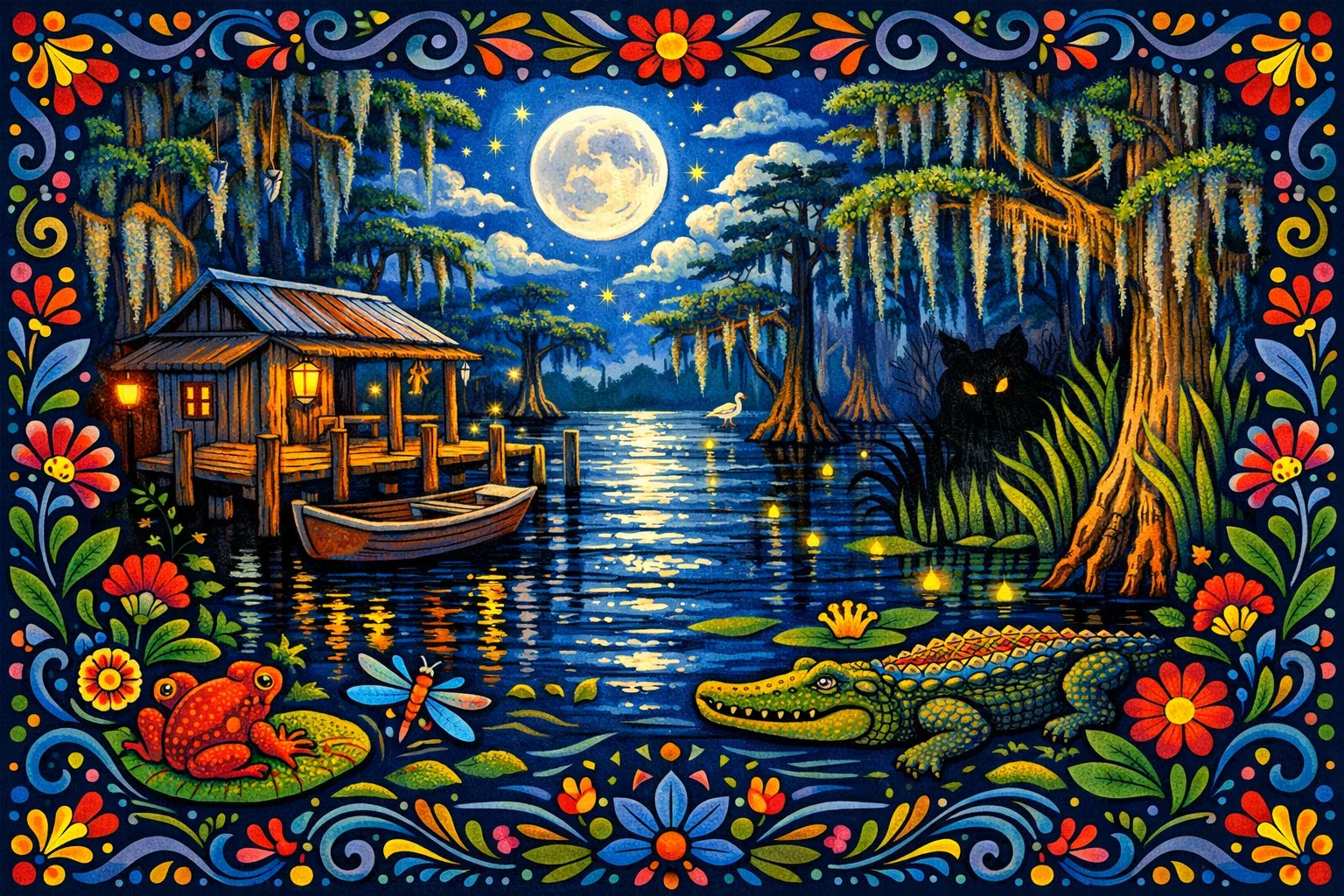
Louisiana’s monster lore is not built around one single creature. It is a swampy family of stories: the Rougarou of Cajun and Houma country, the Honey Island Swamp Monster near Slidell and the Pearl River, the Letiche of bayou folklore, scattered Bigfoot-style reports from forests and back roads, and newer urban legends such as New Orleans’s Grunch.
Page outline Jump by section
Introduction
The useful way to read these legends is to separate four things: inherited folklore, eyewitness claims, media-amplified cryptid cases and ordinary wildlife explanations. Louisiana has all four. The Rougarou is mainly a traditional shape-shifter and cautionary tale; the Honey Island Swamp Monster is closer to a modern cryptid case with named witnesses and alleged tracks; the Grunch is an urban legend that shifts from road dare to goat-like monster; and many “mystery beast” reports sit in a state where real animals already make loud, confusing, sometimes frightening evidence in mud, water and darkness.[64parishes.org]64parishes.orgOpen source on 64parishes.org.
Why Louisiana Is Such Good Monster Country
Louisiana gives monster stories a physical stage that is hard to beat. Honey Island Swamp, the place most closely associated with Louisiana’s Bigfoot-like legend, lies in the Pearl River area east of Slidell; the Louisiana Department of Wildlife and Fisheries describes Pearl River Wildlife Management Area as accessible by vehicle and boat, with ramps along U.S. Highway 90 and landings near Slidell and Pearl River.[wlf.louisiana.gov]wlf.louisiana.govOpen source on louisiana.gov. Other descriptions place Honey Island between the Pearl and West Pearl rivers, a cypress-tupelo swamp with limited road access, year-round flooding and dense second-growth wetland forest.[EBSCO]ebsco.comOpen source on ebsco.com.
That matters because Louisiana cryptids are rarely imagined in open country. They appear at the edge of visibility: bayous, cane fields, bottomland hardwoods, flooded timber, hunting camps, boat landings and roads that feel rural even when they are close to a city. The same places support real animals that can be startling when partly seen. Louisiana has alligators in such numbers that LDWF describes the wild population as having risen from fewer than 100,000 to more than 3 million over the past 50 years under managed harvest and farming systems.[wlf.louisiana.gov]wlf.louisiana.govOpen source on louisiana.gov. Feral hogs are also widespread and destructive; LDWF says LSU AgCenter estimates they cause $76 million in agricultural damage in Louisiana annually.[wlf.louisiana.gov]wlf.louisiana.govOpen source on louisiana.gov.
The state’s monster stories also grow from cultural layering. French, Cajun, Creole, Houma, Chitimacha, Catholic and modern tourist storytelling traditions overlap. A snake-shaped origin story for Bayou Teche appears on the Chitimacha Tribe’s own website, where the bayou’s bends are explained through a battle with a vast serpent.[Chitimacha Tribe of Louisiana]chitimacha.govTribe of Louisiana The Legend of Bayou TecheTribe of Louisiana The Legend of Bayou Teche That is not a cryptid report in the modern “eyewitness evidence” sense; it is landscape folklore. But it shows why Louisiana legends so often turn waterways into living things.
The Rougarou: Louisiana’s Best-Known Swamp Werewolf
The Rougarou is probably Louisiana’s most recognisable monster, but it is better understood as folklore than as a zoological claim. The Louisiana Endowment for the Humanities’ 64 Parishes describes the rougarou as a phonetic variation of the French “loup-garou”, or werewolf, and calls it one of the best-known figures in South Louisiana folklore. It also notes an important local twist: because wolves were scarce in the region, Louisiana rougarou stories often do not behave like straightforward European wolf-man tales.[64 Parishes]64parishes.orgOpen source on 64parishes.org.
In many tellings, the Rougarou is a night shape-shifter, part human and part beast. The curse can be passed on by drawing blood, which 64 Parishes identifies as a recognised folklore motif: disenchantment by drawing blood. The same source places the tradition especially among Cajun and Houma communities in Lafourche and Terrebonne Parishes, which helps explain why the creature belongs so strongly to bayous, wetlands and rural South Louisiana rather than to the whole state in an even way.[64 Parishes]64parishes.orgOpen source on 64parishes.org.
The Rougarou has also worked as a behavioural warning. Local explanations often frame it as the monster adults used to keep children from wandering, misbehaving or breaking religious rules. The National Wildlife Federation, writing about Louisiana wetlands, summarises the familiar version: a Cajun folklore beast with a man’s body and a wolf or dog’s head, prowling swamps and frightening children.[The National Wildlife Federation Blog]blog.nwf.orgThe National Wildlife Federation Blog Save the Swamp: But, Beware the “Rougarou”The National Wildlife Federation Blog Save the Swamp: But, Beware the “Rougarou” This does not make the story “fake” in a cultural sense. It means its main job was not to document a species, but to carry rules, fears and identity through oral tradition.
The modern afterlife of the Rougarou is unusually public. Houma hosts Rougarou Fest, a free family-friendly festival that celebrates bayou folklore with music, cultural activities, children’s events, Cajun food and the Krewe Ga Rou parade; proceeds support the South Louisiana Wetlands Discovery Center.[rougaroufest.org]rougaroufest.orgOpen source on rougaroufest.org. The monster has become a mascot for wetland identity: spooky enough to be fun, familiar enough to be local, and flexible enough to connect old stories with coastal education.

Honey Island Swamp Monster: Louisiana’s Bigfoot Case
The Honey Island Swamp Monster is the state’s most famous modern cryptid claim. It is usually described as a large, bipedal, hairy creature with yellow or red eyes, a foul smell and unusual tracks, often three- or four-toed depending on the retelling. The story clusters around Honey Island Swamp and the Pearl River area near Slidell in St. Tammany Parish.[Wikipedia]WikipediaHoney Island Swamp monsterHoney Island Swamp monster
The modern case is usually traced to Harlan Ford, a retired air traffic controller and wildlife photographer, and his hunting companion Billy Mills. Accounts differ in detail, but the common timeline says Ford and Mills claimed a first encounter in the early 1960s, then brought the creature wider attention in the 1970s with alleged footprint casts and stories of a dead boar with a torn throat.[Pearl River Swamp Tours, New Orleans]pearlriverswamptours.comPearl River Swamp Tours, New Orleans Honey Island Swamp LegendsPearl River Swamp Tours, New Orleans Honey Island Swamp Legends Ford’s story later gained a media afterlife: after his death in 1980, a reel of Super 8 film was reportedly found among his belongings and presented as possible footage of the creature.[Wikipedia]WikipediaHoney Island Swamp monsterHoney Island Swamp monster
The evidence is much weaker than the legend. Footprint casts are not independent proof; they can be misread, altered, hoaxed or made by ordinary animals in distorted mud. A sceptical assessment by the Center for Inquiry compared the Ford film’s role to the famous Patterson-Gimlin Bigfoot footage, arguing that the Honey Island film is hard to evaluate and visually unconvincing rather than decisive.[centerforinquiry.org]centerforinquiry.orghoney island swamp monster film a patterson knockoffhoney island swamp monster film a patterson knockoff The broader sceptical point is simple: a large breeding population of unknown primate-like animals in a swamp near roads, hunters, boat traffic and wildlife management areas would require stronger physical evidence than stories, casts and indistinct film.
Yet the Honey Island story persists because it is perfectly adapted to its setting. A remote-looking swamp, a named witness, a dead animal, strange tracks and a grainy film are exactly the ingredients that make a local mystery travel. Swamp tour companies and regional writers now present the creature as part of the area’s folklore, alongside real wildlife and local ecology.[Pearl River Swamp Tours, New Orleans]pearlriverswamptours.comPearl River Swamp Tours, New Orleans Honey Island Swamp LegendsPearl River Swamp Tours, New Orleans Honey Island Swamp Legends The monster may not be a proven animal, but it is now a proven part of Louisiana’s storytelling economy.
Letiche, Bayou Spirits and the Alligator-Child Motif
The Letiche sits between folklore and cryptid culture. It is not as commercially famous as the Rougarou or Honey Island Swamp Monster, but it is one of the stranger bayou figures attached to Louisiana. Basic descriptions call it a creature in Cajun folklore that haunts the bayous, sometimes understood as the soul of an unbaptised infant and sometimes as a human child raised by alligators.[Wikipedia]WikipediaOpen source on wikipedia.org.
Modern cryptid writing often folds the Letiche into the Honey Island Swamp Monster story, treating the two as related or even as names for the same creature. That is useful for atmosphere but risky as history. A Letiche tale about an abandoned child becoming part of the swamp is a different kind of story from a 1960s–1970s claim about a large hairy biped leaving tracks. One is closer to a cautionary or spiritual bayou legend; the other is framed like a wildlife mystery.[Wikipedia]WikipediaOpen source on wikipedia.org.
The alligator-child motif also makes sense in Louisiana because alligators are not imaginary background decoration there. They are real, common, economically managed animals. LDWF’s alligator programme treats them as a renewable natural resource, and the state’s alligator population is counted in the millions.[wlf.louisiana.gov]wlf.louisiana.govOpen source on louisiana.gov. In a place where children are warned about water, reptiles, boats and isolation, a story about the swamp raising—or taking—a child has obvious emotional force.
Bigfoot Reports Beyond the Swamp
Louisiana’s Bigfoot-style reports are not limited to Honey Island. The Bigfoot Field Researchers Organization lists reports from multiple Louisiana parishes, including recent entries in Calcasieu, Natchitoches and Sabine Parishes.[BFRO]bfro.netstate listing.aspstate listing.asp Individual reports often follow familiar Sasquatch patterns: a tall dark figure crossing a road, a hairy upright animal seen by a hunter, odd vocalisations, or tracks found in mud.[BFRO]bfro.netshow report.aspshow report.asp
Kisatchie National Forest is the obvious inland setting for these stories. The U.S. Forest Service says Kisatchie covers more than 604,000 acres across seven central and northern Louisiana parishes and was designated a national forest in 1930.[US Forest Service]fs.usda.govOpen source on usda.gov. Its longleaf pine, loblolly pine, hardwood bottoms, wilderness areas and recreation sites provide the kind of large, wooded landscape that Bigfoot reports tend to attach themselves to.[US Forest Service]fs.usda.govUS Forest Service WildernessUS Forest Service Wilderness
But a sightings database is not the same as biological evidence. BFRO reports are witness accounts, not confirmed animal records. They are valuable for mapping where people tell Sasquatch-like stories, but they do not establish that an unknown primate lives in Louisiana. The most cautious reading is that Louisiana has a regional Bigfoot tradition shaped by hunting culture, back-road encounters and large patches of forest, with Honey Island serving as the more famous swamp variant.
The Grunch: New Orleans’s Road-Dare Monster
The Grunch is a different sort of creature. It is usually tied to New Orleans or the surrounding river parishes, and its details shift dramatically: a goat-like humanoid, small leathery beings, a blood-drinking animal, a road monster, a “do not get out of the car” warning, or a local dare for teenagers. L’Observateur describes how the legend became attached to Evangeline Road in Montz in the 1970s, while also noting that other swampy towns around New Orleans adopted their own “Grunch Road” versions.[L'Observateur]lobservateur.comthe demon of evangeline roadthe demon of evangeline road
That mobility is the clue. The Grunch behaves like an urban legend more than a stable creature tradition. It needs a road, darkness, a ritual, a dare and a reason not to stop. Some versions use an injured goat as bait; others blend in Marie Laveau, devil-baby lore, chupacabra imagery or generic swamp monsters.[FOX Sports Radio]foxsportsradio.iheart.com2022 10 27 this is the creepiest urban legend in louisiana2022 10 27 this is the creepiest urban legend in louisiana The result is less a single ancient beast than a flexible New Orleans-area fright story that absorbs whatever the teller’s audience already fears.
The Grunch also shows how Louisiana monster lore can be modern without feeling modern. A road legend from the 1970s can borrow the mood of older bayou tales, the atmosphere of New Orleans occult tourism and the structure of teenage challenge folklore. It is not evidence for a hidden species, but it is good evidence for how quickly a place can turn an ordinary road into a monster habitat.
Lake and River Monsters: Caddo, Teche and the Water Itself
Louisiana does not have one dominant “Loch Ness” figure, but its waterways generate monster talk. Bayou Teche has the Chitimacha serpent story, in which the waterway’s shape records the death-throes of a huge snake defeated by Chitimacha warriors.[Chitimacha Tribe of Louisiana]chitimacha.govTribe of Louisiana The Legend of Bayou TecheTribe of Louisiana The Legend of Bayou Teche That story belongs to origin folklore rather than modern cryptozoology, but it is one of the state’s clearest examples of a monster explaining a landscape.
Caddo Lake, shared by Texas and Louisiana, has also produced monster rumours. The lake is more often marketed through East Texas folklore, but it sits on the state line and has Louisiana relevance through the Caddo region. Texas Highways notes that stories vary between a land creature seen on islands and a 20-foot water creature, with one suggested explanation being a stray manatee.[Texas Highways]texashighways.comTexas Highways Caddo Lake Inspires Legends and Lore in East TexasTexas Highways Caddo Lake Inspires Legends and Lore in East Texas A local history blog traces a 1969 flap around Mooringsport, Louisiana, describing reports of a dark 18- to 20-foot animal near Swanson’s Landing.[north-caddo-parish.blogspot.com]north-caddo-parish.blogspot.comthe legend of cypress cindythe legend of cypress cindy
These water stories are best treated as local curiosities, not as a major Louisiana monster tradition on the level of the Rougarou or Honey Island Swamp Monster. They matter because they show the same pattern in a different habitat: large, murky water invites scale mistakes, animal misidentification and story-making. Alligators, gar, logs, wakes, manatees and exaggerated fish can all become “something huge” under the right conditions.
What Real Wildlife Can Explain
The sceptical explanations for Louisiana cryptids do not require every witness to be lying. Many reports can begin with real animals, poor visibility and memory filling gaps after the shock. Feral hogs are an especially important candidate for strange tracks, screaming sounds, torn ground and aggressive movement in thick cover. USDA guidance notes that feral swine leave rooting damage, wallows, tree rubs, trails through dense vegetation, hoof tracks near water and scat that can contain animal remains.[APHIS]aphis.usda.govferal swineferal swine In a swamp-monster story, those signs can easily become “evidence” of something larger and stranger.
Black bears are another real factor. LDWF’s black bear programme aims to maintain a sustainable bear population in suitable Louisiana habitat, and the state’s bear history is part of its conservation identity.[wlf.louisiana.gov]wlf.louisiana.govblack bearblack bear A bear glimpsed upright, partly hidden or moving through timber can look disturbingly human for a moment. That does not explain every story, but it is a more plausible starting point than an undiscovered ape population.
Alligators explain a different category of fear: water disturbance, missing animals, night sounds and the sense that something old and powerful is just below the surface. Louisiana’s alligator population is large, visible and culturally central.[wlf.louisiana.gov]wlf.louisiana.govOpen source on louisiana.gov. Add bobcats, coyotes, raccoons, owls, nutria, snakes, deer and decomposing vegetation, and the bayou already supplies much of what monster stories need: eyeshine, odour, splashes, screams, tracks and sudden movement.
How later accounts reshaped Louisiana’s cryptid traditions
Louisiana’s older creature lore carried rules. The Rougarou warned children, reinforced religious or community boundaries and gave Cajun and Houma communities a memorable night creature. The Letiche warned about water, abandonment and the swamp’s power to transform. Bayou Teche’s serpent made geography into memory.[64parishes.org]64parishes.orgOpen source on 64parishes.org.
The twentieth century added cryptid structure. Honey Island became a case with named witnesses, alleged tracks, film, media attention and investigators. That is a different storytelling machine: it asks not only “What does this story teach?” but “Could this be real?” The Bigfoot boom in American culture gave Louisiana a vocabulary for its own hairy swamp figure, while television and tourism kept the case alive.[Wikipedia]WikipediaHoney Island Swamp monsterHoney Island Swamp monster
The late twentieth and early twenty-first centuries added festivals, blogs, ghost tours and internet lists. Rougarou Fest turns a once-frightening folklore figure into a public celebration that also raises money for wetland education.[rougaroufest.org]rougaroufest.orgOpen source on rougaroufest.org. The Grunch spreads as a road legend and online creature profile. Honey Island tours turn ecology and cryptid lore into the same outing. These changes do not necessarily weaken the stories. They show that Louisiana monsters survive by changing jobs: from warning, to wonder, to tourism, to local identity.
What Is the Most Credible Louisiana Cryptid?
If “credible” means best supported as a real unknown animal, none of Louisiana’s famous cryptids clears the bar. The Honey Island Swamp Monster has the most case-like material, but its evidence remains anecdotal, ambiguous and vulnerable to misidentification or hoax. The Rougarou is culturally stronger but zoologically weaker, because it belongs to shape-shifter folklore rather than animal reporting. The Letiche is a bayou spirit or monster tale, not a documented species. The Grunch is best read as an urban legend.[centerforinquiry.org]centerforinquiry.orghoney island swamp monster film a patterson knockoffhoney island swamp monster film a patterson knockoff
If “important” means most deeply rooted in Louisiana identity, the Rougarou probably wins. If “famous modern cryptid” is the measure, Honey Island Swamp Monster wins. If “best example of how stories mutate around roads, dares and city edges” is the question, the Grunch is the one to watch. Louisiana’s creature lore is strongest when read as a map of place: French and Cajun memory in the south, swamp and river fear around the Pearl, forest sightings in Kisatchie country, and New Orleans turning even a road into a stage for something with glowing eyes.
That is why Louisiana remains one of America’s great monster states. Not because the evidence proves hidden beasts, but because the state’s folklore, wildlife and wetland geography make the border between ordinary animal and legendary creature feel deliciously thin.
Amazon book picks
Further Reading
Books and field guides related to What Lurks in Louisiana's Monster Country?. Use these as the next step if you want deeper reading beyond the article.
The United States of Cryptids
Includes American monster traditions that parallel Louisiana stories.
eBay marketplace picks
Marketplace Samples
Live-tested eBay searches with available results related to this page.

Endnotes
1.
Source: 64parishes.org
Link:https://64parishes.org/entry/rougarou
2.
Source: wlf.louisiana.gov
Link:https://www.wlf.louisiana.gov/page/pearl-river
3.
Source: wlf.louisiana.gov
Link:https://www.wlf.louisiana.gov/page/feral-hogs
4.
Source: Wikipedia
Title: Honey Island Swamp monster
Link:https://en.wikipedia.org/wiki/Honey_Island_Swamp_monster
5.
Source: aphis.usda.gov
Title: feral swine
Link:https://www.aphis.usda.gov/operational-wildlife-activities/feral-swine
6.
Source: ebsco.com
Link:https://www.ebsco.com/research-starters/botany/honey-island-swamp
7.
Source: wlf.louisiana.gov
Link:https://www.wlf.louisiana.gov/page/alligator-management
8.
Source: chitimacha.gov
Title: Tribe of Louisiana The Legend of Bayou Teche
Link:https://www.chitimacha.gov/stories/legend-bayou-teche
9.
Source: rougaroufest.org
Link:https://rougaroufest.org/fest-info/
10.
Source: centerforinquiry.org
Title: honey island swamp monster film a patterson knockoff
Link:https://centerforinquiry.org/blog/honey_island_swamp_monster_film_a_patterson_knockoff/
11.
Source: Wikipedia
Link:https://en.wikipedia.org/wiki/Letiche
12.
Source: bfro.net
Title: state listing.asp
Link:https://www.bfro.net/GDB/state_listing.asp?state=la
13.
Source: bfro.net
Title: show report.asp
Link:https://www.bfro.net/GDB/show_report.asp?id=1458
14.
Source: bfro.net
Title: show report.asp
Link:https://www.bfro.net/gdb/show_report.asp?id=13350
15.
Source: fs.usda.gov
Link:https://www.fs.usda.gov/r08/kisatchie/about-area/faqs
16.
Source: fs.usda.gov
Title: US Forest Service Wilderness
Link:https://www.fs.usda.gov/r08/kisatchie/wilderness
17.
Source: north-caddo-parish.blogspot.com
Title: the legend of cypress cindy
Link:https://north-caddo-parish.blogspot.com/2017/01/the-legend-of-cypress-cindy.html
18.
Source: wlf.louisiana.gov
Title: black bear
Link:https://www.wlf.louisiana.gov/page/louisiana-black-bear
19.
Source: fs.usda.gov
Link:https://www.fs.usda.gov/r08/kisatchie
20.
Source: rougaroufest.org
Link:https://rougaroufest.org/
21.
Source: bfro.net
Title: show report.asp
Link:https://www.bfro.net/GDB/show_report.asp?id=1498
22.
Source: bfro.net
Title: show report.asp
Link:https://www.bfro.net/GDB/show_report.asp?id=80099
23.
Source: bfro.net
Title: show report.asp
Link:https://www.bfro.net/gdb/show_report.asp?id=67271
24.
Source: wlf.louisiana.gov
Title: ldwf reopens all roads on pearl river wma
Link:https://www.wlf.louisiana.gov/news/ldwf-reopens-all-roads-on-pearl-river-wma
25.
Source: wlf.louisiana.gov
Title: kisatchie national forest longleaf pine flatwoods savanna restoration project
Link:https://www.wlf.louisiana.gov/page/kisatchie-national-forest-longleaf-pine-flatwoods-savanna-restoration-project
26.
Source: wlf.louisiana.gov
Link:https://www.wlf.louisiana.gov/assets/Resources/Publications/Plants_and_Natural_Communities/Longleaf-Pine-Flatwoods-Savanna-Restoration-Project-Poster.pdf
27.
Source: wlf.louisiana.gov
Link:https://www.wlf.louisiana.gov/page/alligator
28.
Source: wlf.louisiana.gov
Title: alligator hunting
Link:https://www.wlf.louisiana.gov/page/alligator-hunting
29.
Source: wlf.louisiana.gov
Title: 2024 2025 Alligator Program Annual Report FINAL
Link:https://www.wlf.louisiana.gov/assets/Resources/Publications/Alligator/2024-2025-Alligator-Program-Annual-Report_FINAL.pdf
30.
Source: charlesgramlich.blogspot.com
Link:https://charlesgramlich.blogspot.com/2011/11/cryptozoology.html
31.
Source: Wikipedia
Link:https://en.wikipedia.org/wiki/Rougarou
32.
Source: Wikipedia
Title: Honey Island Swamp
Link:https://en.wikipedia.org/wiki/Honey_Island_Swamp
33.
Source: Wikipedia
Title: Pearl River Wildlife Management Area
Link:https://en.wikipedia.org/wiki/Pearl_River_Wildlife_Management_Area
34.
Source: Wikipedia
Title: Kisatchie National Forest
Link:https://en.wikipedia.org/wiki/Kisatchie_National_Forest
35.
Source: english-archive.louisiana.edu
Link:https://english-archive.louisiana.edu/rougarou/about.html
36.
Source: tpwd.texas.gov
Link:https://tpwd.texas.gov/newsmedia/releases/?req=20090303a
37.
Source: natchitoches.com
Link:https://natchitoches.com/listing/kisatchie-national-forest/
38.
Source: youtube.com
Title: The Legend of the Rougarou | Haunted Louisiana Folklore
Link:https://www.youtube.com/watch?v=jYgR0ukVa08
Source snippet
Honey Island Swamp Monster...
39.
Source: youtube.com
Title: Honey Island Swamp Monster
Link:https://www.youtube.com/watch?v=88Laoa06ADE
Source snippet
The Creepiest Creatures Linked to Louisiana...
40.
Source: youtube.com
Link:https://www.youtube.com/watch?v=amL4LMle-Ys
Source snippet
LSU Reveille...
41.
Source: lobservateur.com
Title: the demon of evangeline road
Link:https://lobservateur.com/2020/10/28/the-demon-of-evangeline-road/
42.
Source: blog.nwf.org
Title: The National Wildlife Federation Blog Save the Swamp: But, Beware the “Rougarou”
Link:https://blog.nwf.org/2019/10/save-the-swamp-but-beware-the-rougarou/
43.
Source: pearlriverswamptours.com
Title: Pearl River Swamp Tours, New Orleans Honey Island Swamp Legends
Link:https://www.pearlriverswamptours.com/legends/
44.
Source: foxsportsradio.iheart.com
Title: 2022 10 27 this is the creepiest urban legend in louisiana
Link:https://foxsportsradio.iheart.com/content/2022-10-27-this-is-the-creepiest-urban-legend-in-louisiana/
45.
Source: texashighways.com
Title: Texas Highways Caddo Lake Inspires Legends and Lore in East Texas
Link:https://texashighways.com/outdoors/caddo-lake-inspires-legends-and-lore-in-east-texas/
46.
Source: cryptidz.fandom.com
Title: Honey Island Swamp Monster
Link:https://cryptidz.fandom.com/wiki/Honey_Island_Swamp_Monster
47.
Source: monster.fandom.com
Title: Honey Island Swamp Monster
Link:https://monster.fandom.com/wiki/Honey_Island_Swamp_Monster
48.
Source: non-aliencreatures.fandom.com
Title: Honey Island Swamp Monster
Link:https://non-aliencreatures.fandom.com/wiki/Honey_Island_Swamp_Monster
49.
Source: facebook.com
Title: U.S. Forest Service
Link:https://www.facebook.com/KisatchieNF/
50.
Source: facebook.com
Link:https://www.facebook.com/photo.php?fbid=1300003775504093&id=100064834477006&set=a.246436430860838
51.
Source: facebook.com
Title: Rougarou Fest
Link:https://www.facebook.com/RougarouFest/
52.
Source: abitamysteryhouse.com
Title: Honey Island Swamp Monster
Link:https://abitamysteryhouse.com/honeyislandswampmonster.htm
53.
Source: mythfolks.com
Title: louisiana folklore
Link:https://www.mythfolks.com/louisiana-folklore
54.
Source: countryroadsmagazine.com
Title: the honey island swamp monster
Link:https://countryroadsmagazine.com/outdoors/knowing-nature/the-honey-island-swamp-monster/
55.
Source: pearlriverswamptours.com
Title: honey island swamp monster
Link:https://www.pearlriverswamptours.com/blog/honey-island-swamp-monster/
56.
Source: pearlriverswamptours.com
Title: honey island swamp louisiana conservation
Link:https://www.pearlriverswamptours.com/blog/louisiana-wetlands-conservation/honey-island-swamp-louisiana-conservation/
57.
Source: pearlriverswamptours.com
Title: wild hogs in louisiana
Link:https://www.pearlriverswamptours.com/blog/swamp-wildlife-lagniappe/wild-hogs-in-louisiana/
58.
Source: dynamic.webnovel.com
Link:https://dynamic.webnovel.com/story/31508592808717505/85906412483434721
59.
Source: theoutdoorsapp.com
Link:https://theoutdoorsapp.com/parks/kisatchie-national-forest
60.
Source: atlasobscura.com
Title: honey island swamp
Link:https://www.atlasobscura.com/places/honey-island-swamp
61.
Source: daviddonar.com
Link:https://daviddonar.com/rougarou/
62.
Source: thecreaturecodex.wordpress.com
Link:https://thecreaturecodex.wordpress.com/2018/08/08/letiche/
63.
Source: 1041thevibe.iheart.com
Title: 2022 10 27 this is the creepiest urban legend in louisiana
Link:https://1041thevibe.iheart.com/content/2022-10-27-this-is-the-creepiest-urban-legend-in-louisiana/
64.
Source: 10times.com
Title: rougarou fest
Link:https://10times.com/rougarou-fest
65.
Source: science.howstuffworks.com
Title: honey island swamp monster
Link:https://science.howstuffworks.com/science-vs-myth/strange-creatures/honey-island-swamp-monster.htm
66.
Source: msgulfcoastheritage.ms.gov
Title: honey island swamp monster
Link:https://msgulfcoastheritage.ms.gov/historic/sites/honey-island-swamp-monster/
67.
Source: white-car.co
Title: Rougarou Fest
Link:https://www.white-car.co/portfolio_page/rougarou-fest/
68.
Source: catahoulachronicles.com
Title: The Honey Island Swamp Monster
Link:https://catahoulachronicles.com/2017/08/13/the-honey-island-swamp-monster/
69.
Source: tumblr.com
Link:https://www.tumblr.com/thecreaturecodex/176784625858/letiche
70.
Source: coastcommons.com
Title: Honey Island Swamp
Link:https://coastcommons.com/honey-island-swamp/
Additional References
71.
Source: usgs.gov
Link:https://www.usgs.gov/data/louisiana-black-bear-ursus-americanus-luteolus-mabbelconus2001v1-range-map
72.
Source: doi.gov
Link:https://www.doi.gov/pressreleases/teddy-bear-back-us-fish-and-wildlife-service-delists-louisiana-black-bear-due-recovery
73.
Source: researchgate.net
Link:https://www.researchgate.net/publication/281641170_Louisiana_Black_Bear_Management_Plan
74.
Source: facebook.com
Link:https://www.facebook.com/KOTATerritoryNews/posts/trending-a-louisiana-residents-report-of-a-towering-upright-figure-crashing-thro/1409229671245022/
75.
Source: texascooppower.com
Link:https://texascooppower.com/a-monster-is-loose-in-caddo-lake/
76.
Source: lafisheriesforward.org
Link:https://www.lafisheriesforward.org/wp-content/uploads/2022/04/LFF_FastFacts_Alligator_05.pdf
77.
Source: facebook.com
Link:https://www.facebook.com/KSLANews12/posts/bigfoot-in-louisiana-a-class-a-sasquatch-sighting-was-reported-north-of-westlake/1438403934994243/
78.
Source: facebook.com
Link:https://www.facebook.com/Cleveland19News/posts/sasquatch-afoot-bigfoot-hunter-investigating-possible-sighting-in-louisiana%EF%B8%8F/1515411203285946/
79.
Source: facebook.com
Link:https://www.facebook.com/GulfCoastUpdates/posts/bigfoot-was-apparently-spotted-north-of-lake-charles-on-april-14th-close-to-sam-/996811049370378/
80.
Source: facebook.com
Link:https://www.facebook.com/groups/150145895472212/posts/1897376837415767/
Topic Tree
Follow this branch
Related pages 49
- Rhode Island Monsters
- Hawaii Monsters
- Illinois Cryptids
- Nebraska Cryptids
- Alabama Cryptids
- +44 more in sidebar