Within North Dakota Monsters
What Happened in the Fort Berthold Bigfoot Flap?
A small 2004 cluster of Fort Berthold-area Bigfoot claims shows how tracks, rumour, and local testimony can become a flap.
On this page
- The 2004 New Town and reservation sightings
- Footprint photographs and witness chains
- Why sparse reports still matter in prairie country
Page outline Jump by section
Introduction
The Fort Berthold Bigfoot flap was a brief cluster of reports from late February 2004 on and around the Fort Berthold Reservation in western North Dakota. It centred on New Town, Mandaree, Highway 22, winter ice, and a disputed line of large tracks in snow. The case matters because North Dakota has very few Bigfoot reports compared with better-known Sasquatch states, yet this one had the classic ingredients of a “flap”: several witnesses, a claimed route of travel, footprint photographs, local news attention, and a rapid spread from sighting to rumour. It is not proof of an undiscovered animal. The best reading is more careful: a tightly bounded local episode in which frightened witnesses, winter terrain, patchy evidence, and community storytelling briefly turned a stretch of prairie and badlands into Bigfoot country.[indianz.com]indianz.comBig Foot sightings reported on N.D. reservationBig Foot sightings reported on N.D. reservation
Why Fort Berthold Became North Dakota’s Best Bigfoot Case
North Dakota is not a natural Bigfoot hotbed in the public imagination. The creature is usually associated with the Pacific Northwest, deep forests, and long-running regional traditions. The BFRO’s own North Dakota state listing contains only four total entries, with two of them tied directly to the February 2004 Fort Berthold-area cluster: a Mountrail County “rash of sighting reports” and a McKenzie County track-photograph report.[BFRO]bfro.netReports for North DakotaReports for North Dakota
That scarcity is exactly why the Fort Berthold episode stands out. Instead of a lone roadside glimpse, the 2004 case was presented as a chain of related claims over several days. Indianz.com, summarising contemporary coverage in March 2004, reported that the Mandan, Hidatsa and Arikara Nation was keeping track of recent Bigfoot sightings and that four different sightings had been reported since 22 February. The same short news item noted that one sighting involved children and an adult, while tribal employees had photographed possible footprints at another location.[indianz.com]indianz.comBig Foot sightings reported on N.D. reservationBig Foot sightings reported on N.D. reservation
The setting also gives the case its unusual texture. Fort Berthold is not an empty legend-map. It is the home of the Mandan, Hidatsa and Arikara Nation, also known as the Three Affiliated Tribes, with tribal headquarters west of New Town. The reservation lies on the Missouri River system and includes nearly a million acres across parts of several western and central North Dakota counties.[MHA Nation]mhanation.comOpen source on mhanation.com. That mix of reservation communities, open country, Lake Sakakawea, wooded draws, roads, ranch land, and badlands terrain shaped both the sightings and the later debate over what people may have seen.
The 2004 New Town and Reservation Sightings
The reported sequence began on Sunday, 22 February 2004, near a trailer park on the south-east edge of New Town. According to the BFRO follow-up account, several children said they saw a large hairy animal standing on two legs. Their screams reportedly brought an adult woman outside, and she said she saw the figure moving away through trees or brush. The same BFRO account says the woman later declined to be interviewed further, partly because her children remained frightened.[BFRO]bfro.netshow report.aspshow report.asp
That first report is important because it shows both the appeal and the weakness of the case. It has a vivid human scene: children, a parent, fear, a figure moving fast through cover. But the core details are second-hand in the later investigator’s write-up, and the main adult witness was not available for direct follow-up. In a folklore sense, the story is strong. In an evidence sense, it begins with a gap.
A second sighting was reportedly made later that same evening about eight miles south of New Town, west of Muskrat Lake, though the BFRO account says no details were obtained. On Tuesday, 24 February, two women reportedly saw a hairy man-like animal through the window of a home near Highway 22, roughly five miles south-west of Mandaree. The investigator treated this as part of a south or south-west movement from New Town toward the Mandaree area.[BFRO]bfro.netshow report.aspshow report.asp
The most cinematic claim came on Wednesday, 25 February. Two men driving south from Mandaree on Highway 22 reportedly saw a very large, hair-covered, two-legged animal in the road after cresting a rise near the BIA 14 junction. In the account preserved by the BFRO, the driver stopped, the headlights illuminated the figure, and it moved into the ditch and out of sight. The report also says another car behind them passed quickly, with the assumption that its occupants must also have seen something, though that extra confirmation is not independently developed in the record.[BFRO]bfro.netshow report.aspshow report.asp
This is the report that makes the flap feel like more than a neighbourhood scare. A creature seen in headlights on a road is a familiar North American monster-story set piece: sudden, brief, framed by artificial light, and over before anyone can properly document it. It is also the kind of encounter most vulnerable to shock, distance, poor contrast, and expectation. A large animal, a person in heavy clothing, or a prank can all become more alarming when seen suddenly at night from a moving vehicle.

Footprint Photographs and Witness Chains
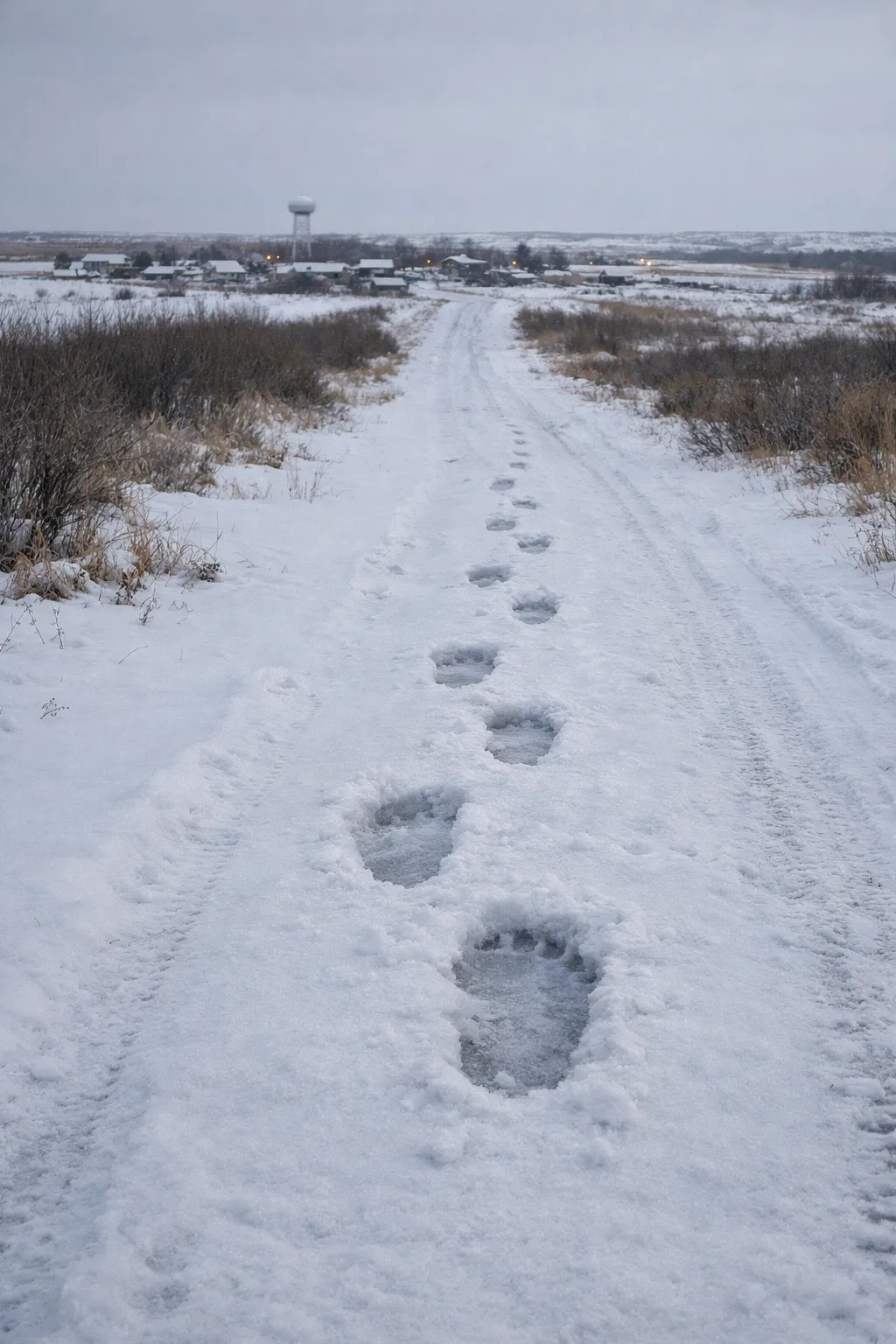
The tracks are the main reason the Fort Berthold case stayed interesting after the sightings faded. On Thursday, 26 February, the older Highway 22 witness reportedly returned to the sighting area with a nephew, a friend, and others. The group claimed to find a long line of footprints in snow running roughly parallel to the road in a southerly direction. The BFRO report says the trackway was estimated at nearly 300 yards, with a four- to five-foot stride, and that some prints were described as 15 to 17 inches long, widening near the toes.[BFRO]bfro.netshow report.aspshow report.asp
The account also mentions clear toe impressions in some tracks and a possible mid-tarsal break, a term Bigfoot enthusiasts use for a flexible mid-foot impression. That sounds impressive, but it is worth slowing down. The measurements and interpretations appear to come from witnesses and a later investigator, not from a controlled cast, a forensic track survey, or a published wildlife-biologist analysis. Snow can preserve excellent tracks, but it can also distort them quickly through melt, refreeze, collapse, wind, and the merging of partial impressions. North Dakota Game and Fish warns in its wildlife track guide that foot patterns vary depending on whether an animal is walking, running, galloping or trotting; in other words, a track is not a fixed stamp but a record of movement, surface, and behaviour.[gf.nd.gov]gf.nd.govTracks and Signs of North Dakota Wildlife | North Dakota Game and FishTracks and Signs of North Dakota Wildlife | North Dakota Game and Fish
On Friday, 27 February, Dennis Fox Jr., identified in the BFRO account as Director of the Independence Program, and Paul Danks, administrator of the Natural Resources Department, reportedly went to photograph the track line. By then, warming temperatures had caused melting, and the track detail was said to have been lost. The related BFRO track report says a tribal government employee viewed a line of large footprints in the snow south of Mandaree, running roughly parallel to Highway 22 for about a quarter of a mile, but that the photographs were taken two days after the tracks had been made and showed only large, round impressions because of thawing.[BFRO]bfro.netshow report.aspshow report.asp
That detail is crucial. The photographs existed, according to the reports, but they were not released for independent analysis, and the investigator who viewed them concluded that the thawing and camera angle prevented firm conclusions beyond the presence of a line of impressions in the snow. The evidence therefore sits in a frustrating middle zone: more than a campfire rumour, less than a testable track record.[BFRO]bfro.netshow report.aspshow report.asp
The witness chain also became complicated by tragedy. The BFRO report states that the older Highway 22 witness died suddenly from a brain aneurysm on 27 February, and that some people around the case connected his distress and death with the sighting. That part of the story should be handled gently. It shows how a local monster report can become emotionally charged within a community, especially when fear, coincidence, and belief meet. It does not provide evidence that the creature was real; it shows how quickly a reported encounter can take on social and symbolic weight.[BFRO]bfro.netshow report.aspshow report.asp
Why the Winter Tracks Are Ambiguous
The Fort Berthold tracks are the heart of the case, but also its main problem. A long line of large impressions in snow sounds like the sort of evidence that should settle things. In practice, snow tracks are some of the easiest evidence to overread.
Fresh snow can record shape, stride and direction, but the record changes as soon as temperature, sun, wind, drifting, or foot traffic disturb it. The Fort Berthold photographs were reportedly taken after warming and melting had already degraded the prints. The BFRO track report itself says the images showed only large, round impressions and did not allow further conclusions.[BFRO]bfro.netshow report.aspshow report.asp
Several ordinary explanations remain possible without accusing anyone of dishonesty:
Human tracks altered by snow. A person walking in boots through soft snow can leave enlarged, rounded impressions, especially after melt-out. If the person steps into previous depressions or walks with long deliberate strides, a trackway may look stranger than it is.
Animal tracks misread after distortion. Deer, dogs, coyotes, mountain lions, and other animals can leave confusing patterns in snow, particularly when prints overlap or melt together. North Dakota Game and Fish notes that even known species produce different ground patterns depending on gait.[gf.nd.gov]gf.nd.govTracks and Signs of North Dakota Wildlife | North Dakota Game and FishTracks and Signs of North Dakota Wildlife | North Dakota Game and Fish
A prank or local performance. Bigfoot history is full of footprint hoaxes, and a long roadside trackway is the sort of evidence a hoaxer could stage. There is no firm proof of a hoax in the Fort Berthold case, but the possibility cannot be dismissed when the physical evidence was not preserved, cast, or independently examined.
A real but ordinary large animal glimpsed under poor conditions. North Dakota has large wildlife, and the western part of the state includes species and habitats that can surprise people. Mountain lions inhabit the badlands and Missouri River breaks, using trees, brush, and rugged topography as stalking cover, though their tracks and body form do not match a huge upright primate.[gf.nd.gov]gf.nd.govMountain Lion | North Dakota Game and FishMountain Lion | North Dakota Game and Fish Black bears are established mainly in north-eastern North Dakota, according to North Dakota Game and Fish, so a bear explanation is not impossible in a broad state-wide sense but is not the neatest fit for a late-February Highway 22 biped report in western Fort Berthold country.[gf.nd.gov]gf.nd.govBlack Bear | North Dakota Game and FishBlack Bear | North Dakota Game and Fish
The strongest sceptical point is not that every witness must have been wrong in the same way. It is that the evidence deteriorated before it could be tested. No clear casts, no released original photographs, no biological material, no independently documented track measurements, and no verified follow-up animal evidence remain. For a claimed large unknown animal, that is a serious limitation. As sceptical Bigfoot writers often note, eyewitness testimony and footprints keep the subject alive culturally, but mainstream science would require hard physical evidence such as a body, bones, teeth, blood, hair, or DNA.[Live Science]livescience.comLive Science Voice of Reason: The Reality of BigfootLive Science Voice of Reason: The Reality of Bigfoot
Why Sparse Reports Still Matter in Prairie Country
A thin case can still be valuable. Fort Berthold matters because it shows how a Bigfoot flap works in a landscape that is not supposed to be “Bigfoot country”. The BFRO investigator emphasised the contrast between open rolling plains and hidden ravines, draws, canyons, wooded drainages and badlands formations that could provide cover.[BFRO]bfro.netshow report.aspshow report.asp The Three Affiliated Tribes Fish & Wildlife Division likewise describes the reservation as having a variety of terrains that support wildlife viewing and hunting.[TAT Fish & Wildlife Division]tatfishandwildlife.comOpen source on tatfishandwildlife.com.
That landscape contrast matters to believers and sceptics alike. To believers, the draws and breaks make it easier to imagine a large animal moving unseen through country that looks open from the road. To sceptics, the same terrain explains how ordinary animals, shadows, brush, snow lines, and partial views can produce strange impressions. The Bigfoot claim does not float above the land; it depends on the land.
Lake Sakakawea also shapes the story. The BFRO account argues that, for the reported path to make sense, the alleged animal would have had to cross the frozen lake, which the investigator said was possible at the time because of winter ice. That detail makes the case memorable but also speculative. It turns separate reports into a possible route, yet the route depends on assuming the same figure was involved in each report and moved in a particular direction.[BFRO]bfro.netshow report.aspshow report.asp
This is where the word “flap” is useful. A flap is not just a cluster of sightings; it is a cluster of interpretation. Once the first report circulates, later ambiguous events can be pulled into the same pattern. Children see something. Adults talk. A road sighting occurs. Tracks are found. Local officials hear stories. A newspaper item appears. Researchers arrive. Each step may feel like confirmation, but each step may also intensify expectation.
What the Fort Berthold Flap Tells Us About North Dakota Monster Lore
The Fort Berthold Bigfoot reports are best understood as a case family rather than a solved mystery. The family includes the New Town trailer-park sighting, the weaker Muskrat Lake report, the Mandaree-area window sighting, the Highway 22 road encounter, and the later snow-track photographs. Together, they form North Dakota’s most compact Bigfoot episode.
The case does not have the deep mythic roots of the Missouri River monster traditions associated with older North Dakota lore, and it should not be casually folded into Mandan, Hidatsa or Arikara tradition without evidence. Its documented form is modern: local witnesses, tribal offices, a regional newspaper, an online Bigfoot database, and winter tracks. That distinction matters. Fort Berthold’s 2004 flap is not automatically “ancient folklore”; it is a modern anomalous-animal claim that happened in a culturally and historically specific place.
Its value is therefore less about proving Bigfoot and more about showing how monster stories behave on the northern plains. In forest-heavy Sasquatch regions, a creature can vanish into endless timber. In Fort Berthold country, the puzzle is sharper: how could something large move through open, snowy terrain and leave so little durable evidence? The answer depends on the reader’s leaning. A believer may point to badlands breaks, frozen lake travel, and multiple witnesses. A sceptic may point to second-hand testimony, degraded snow tracks, unreleased photographs, and the absence of physical proof.
The most balanced conclusion is that something happened socially, whether or not anything extraordinary happened zoologically. People became frightened. Reports were collected. Tracks were discussed and photographed. A small North Dakota Bigfoot flap formed, burned brightly for a few days, and then cooled into local cryptid history. For a state with relatively few Bigfoot claims, that is enough to make Fort Berthold the key case: not a confirmed creature, but a rare, well-defined moment when winter prairie, reservation roads, and monster rumour briefly lined up.
Amazon book picks
Further Reading
Books and field guides related to What Happened in the Fort Berthold Bigfoot Flap?. Use these as the next step if you want deeper reading beyond the article.
Field Guide To Bigfoot, Yeti, & Other Mystery Primates Worldwide
Directly addresses Sasquatch reports and regional sightings.
eBay marketplace picks
Marketplace Samples
Live-tested eBay searches with available results related to this page.
Endnotes
1.
Source: indianz.com
Title: Big Foot sightings reported on N.D. reservation
Link:https://indianz.com/News/2004/000844.asp
2.
Source: bfro.net
Title: Reports for North Dakota
Link:https://www.bfro.net/GDB/state_listing.asp?state=nd
3.
Source: bia.gov
Title: Indian Affairs Fort Berthold Agency | Indian Affairs
Link:https://www.bia.gov/regional-offices/great-plains/north-dakota/fort-berthold-agency
4.
Source: bfro.net
Title: show report.asp
Link:https://www.bfro.net/GDB/show_report.asp?id=8165
5.
Source: gf.nd.gov
Title: Tracks and Signs of North Dakota Wildlife | North Dakota Game and Fish
Link:https://gf.nd.gov/publications/489
6.
Source: bfro.net
Title: show report.asp
Link:https://www.bfro.net/GDB/show_report.asp?id=8130
7.
Source: gf.nd.gov
Title: Mountain Lion | North Dakota Game and Fish
Link:https://gf.nd.gov/wildlife/id/carnivores/mountain-lion
8.
Source: gf.nd.gov
Title: Black Bear | North Dakota Game and Fish
Link:https://gf.nd.gov/wildlife/id/carnivores/black-bear
9.
Source: gf.nd.gov
Title: tracks signs of nd wildlife
Link:https://gf.nd.gov/sites/default/files/publications/tracks_signs_of_nd_wildlife.pdf
10.
Source: gf.nd.gov
Title: wma listing
Link:https://gf.nd.gov/wma-listing
11.
Source: bfro.net
Title: show report.asp
Link:https://www.bfro.net/GDB/show_report.asp?ID=8165&PrinterFriendly=True
12.
Source: bfro.net
Title: state listing.asp
Link:https://www.bfro.net/GDB/state_listing.asp?state=sd
13.
Source: bfro.net
Title: state listing.asp
Link:https://www.bfro.net/GDB/state_listing.asp?state=mt
14.
Source: bfro.net
Link:https://www.bfro.net/GDB/state_listing.asp?state=mn
15.
Source: bfro.net
Link:https://www.bfro.net/GDB/show_county_reports.asp?county=Mountrail&state=ND
16.
Source: mhanation.com
Link:https://www.mhanation.com/
17.
Source: livescience.com
Title: Live Science Voice of Reason: The Reality of Bigfoot
Link:https://www.livescience.com/348-voice-reason-reality-bigfoot.html
18.
Source: tatfishandwildlife.com
Link:https://tatfishandwildlife.com/
19.
Source: Wikipedia
Link:https://en.wikipedia.org/wiki/Bigfoot
20.
Source: dmr.nd.gov
Title: Mountrail County
Link:https://www.dmr.nd.gov/ndgs/landslides/counties/Mountrail_County.pdf
21.
Source: niwa.co.nz
Title: february 2004
Link:https://niwa.co.nz/climate-and-weather/monthly/february-2004
Published: february 2004
22.
Source: livescience.com
Link:https://www.livescience.com/24598-bigfoot.html
23.
Source: fws.gov
Link:https://www.fws.gov/story/snow-tracks
24.
Source: pubs.usgs.gov
Link:https://pubs.usgs.gov/publication/sir20235064H/full
Additional References
25.
Source: ndstudies.gov
Link:https://www.ndstudies.gov/sites/default/files/PDF/Badlands_web.pdf
26.
Source: slc.gov
Link:https://www.slc.gov/parks/animal-tracks-in-snow/
27.
Source: ndstudies.gov
Link:https://www.ndstudies.gov/gr4/american-indians-north-dakota/part-4-reservations-north-dakota/section-2-fort-berthold-reservation
28.
Source: facebook.com
Link:https://www.facebook.com/yellowstoneparamount/posts/a-look-at-some-of-the-trials-traditions-and-triumphs-surrounding-the-broken-rock/1021310169357890/
29.
Source: kaggle.com
Link:https://www.kaggle.com/datasets/chemcnabb/bfro-bigfoot-sighting-report/code
30.
Source: ebsco.com
Link:https://www.ebsco.com/research-starters/social-sciences-and-humanities/bigfoot-cryptozoology
31.
Source: pocketmags.com
Link:https://pocketmags.com/us/skeptical-inquirer-magazine/julyaugust-2026/articles/bigfoot-documentary-s-devastating-debunking?srsltid=AfmBOoq0E3f6YSCAzjd-RoEJ2UB5s_MtGW-FRrf_RhcMY2Dl_ocRI5GD
32.
Source: facebook.com
Link:https://www.facebook.com/RMSOBigfoot/posts/bigfoot-spotted-in-north-dakota-creature-wildman-bigfoot-skunkape-sasquatch-nort/904272901319482/
33.
Source: reddit.com
Link:https://www.reddit.com/r/zoology/comments/156gz5h/bigfoot_almost_certainly_doesnt_exist_but_how/
34.
Source: instagram.com
Link:https://www.instagram.com/reel/DRSBhGLDRb1/?hl=en
Topic Tree