Within Missouri Monsters
When Missouri Wildlife Becomes Monster Lore
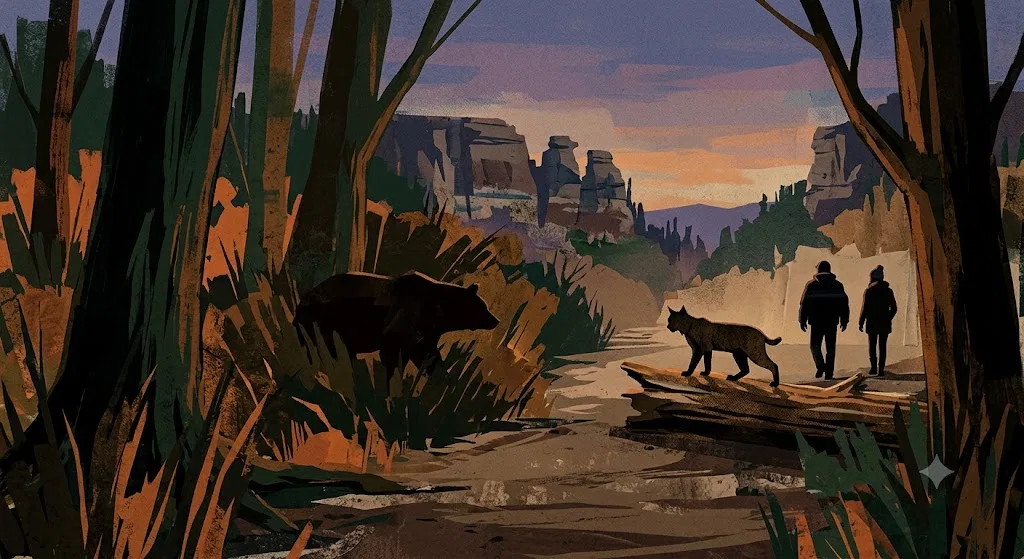
Missouri's real animals help explain why some monster reports may begin as brief glimpses of bears, bobcats, mountain lions or escaped exotics.
On this page
- Bears, bobcats and mountain lion reports
- Why black panther stories persist
- How habitat and brief sightings shape legends
Page outline Jump by section
Introduction
Missouri’s “black panther” stories sit in the grey zone between folklore, wildlife recovery and ordinary mistakes made in difficult viewing conditions. The state does have real large animals that can startle people: black bears are increasing and expanding, mountain lions are occasionally confirmed, and bobcats are common enough to be mistaken for something larger. What Missouri does not have, according to state wildlife evidence, is a confirmed native population of black panthers. The mystery persists because a five-second glimpse on a wooded road, a night-time trail-camera blur or a long dark shape crossing a field can feel more convincing than a cautious official explanation. In Missouri monster lore, the “panther” is less a proven species than a recurring interpretation: a way people make sense of big, dark, fast-moving animals in Ozark woods, river corridors and rural edges where known wildlife already gives the imagination plenty to work with.
The real animals behind Missouri monster reports
Missouri is good country for animal misidentification because so much of its creature lore begins in places where visibility is poor: timbered hollows, road ditches, brushy field edges, wooded suburbs and Ozark slopes. The Missouri Department of Conservation says forests and woodlands predominate in the Ozarks and follow rivers, streams and land too steep or rocky for ploughing; about a third of the state, around 15.5 million acres, is wooded. That matters because a moving animal seen through trunks, headlights, undergrowth or a trail-camera flash is rarely observed like a field-guide illustration.[Missouri Department of Conservation]mdc.mo.govOpen source on mo.gov.
The most important point for a sceptical reader is not that witnesses are foolish. It is that Missouri has enough real wildlife to produce convincing false positives. A bear moving on all fours can look lower, longer or stranger than expected. A bobcat seen without a good size reference can seem like a larger cat. A domestic cat, dog, coyote, fox or deer glimpsed at odd angles may become “large cat” evidence when the observer has only seconds to decide what they saw. MDC’s mountain-lion reporting page is unusually direct on this: it says thousands of reports have come in since 1994, but less than 1 per cent have produced enough physical evidence to confirm a mountain lion, and that dogs, bobcats, house cats, coyotes, foxes and deer have all been mistaken for mountain lions.[Missouri Department of Conservation]mdc.mo.govOpen source on mo.gov.
That does not mean Missouri has no large carnivore reality behind the legends. Mountain lions have been confirmed more than 100 times since they began reappearing in modern records, and the state has a specialist Large Carnivore Response Team to assess reports. But confirmed mountain lions are not the same as a settled population of mystery cats in every county. MDC says it has no evidence of an established breeding population in Missouri, despite occasional confirmed females.[Missouri Department of Conservation]mdc.mo.govOpen source on mo.gov.
Black bears are the clearest example of a once-rare Missouri animal becoming newly familiar. University of Missouri Extension estimated in January 2026 that around 1,000 black bears live in the state, mostly in the southern Ozarks, and explains that bears dispersed north from Arkansas over several decades and mixed with Missouri’s remnant population.[MU Extension]extension.missouri.eduMU Extension Ecology and Management of Black Bears in Missouri | MU ExtensionMU Extension Ecology and Management of Black Bears in Missouri | MU Extension That recovery changes the folklore landscape. A rural resident who never expected to see a bear in Missouri may interpret a bulky dark animal in the timber as something more mysterious, while later reports become part of the local story of “what people have been seeing round here”.
Bears, bobcats and mountain lions are not all the same mystery
Missouri mystery-beast reports often blur different animals together, but the differences matter. A black bear is a native animal with a growing, managed population. A mountain lion is a real species that occasionally passes through Missouri, usually as a wandering individual. A bobcat is a smaller resident wild cat, common enough to be a practical explanation for many “catlike” reports. The folklore problem begins when a witness supplies only a few features: black, large, long-tailed, fast, near the woods.
Bears create monster-like impressions because they are powerful, dark, adaptable and increasingly likely to appear near people. MDC’s bear material describes a population that is growing rapidly, expanding into new areas and capable of using more marginal habitat near human habitation. It also gives examples of bears showing up outside expected settings, including a tagged Christian County bear later seen in Warren County after crossing the Missouri River, and 2018 footage of a bear walking through Ballwin, a St Louis suburb.[Missouri Department of Conservation]mdc.mo.govOpen source on mo.gov. For folklore, those wandering bears matter as much as the population estimate. They show how a real animal can appear in a place where a witness does not expect it, which is exactly the condition in which “monster” language tends to flourish.
Bobcats produce a different kind of confusion. MDC describes the bobcat as yellowish to reddish-brown, streaked and spotted with black, with a short “bobbed” tail, pointed ears and a strong odour around dens.[Missouri Department of Conservation]mdc.mo.govMissouri Department of Conservation Bobcat | Missouri Department of ConservationMissouri Department of Conservation Bobcat | Missouri Department of Conservation That description does not sound much like a huge black panther, but field sightings are not always clean. A bobcat in low light can look darker than it is; a quick view may hide the short tail; and without a fencepost, road lane or known animal beside it, people often overestimate size. MDC’s own mountain-lion materials use silhouettes and scale comparisons precisely because shape and size are easy to misread in gaps between trees.[Missouri Department of Conservation]mdc.mo.govOpen source on mo.gov.
Mountain lions add credibility to the broader “big cat” atmosphere without proving black panthers. MDC’s field guide describes mountain lions as very large, slender cats with small rounded ears, powerful shoulders and hindquarters, and a long heavy cylindrical tail. Adults are uniformly coloured in shades from grey or brown to buff, cinnamon or rufous, with a black tail tip, and males can weigh far more than bobcats.[Missouri Department of Conservation]mdc.mo.govOpen source on mo.gov. So when someone says they saw a tan cougar-like animal in Missouri, that is not impossible. It may be rare, but it fits a confirmed pattern. When the claim becomes a large black panther, the evidence problem changes sharply.
Why black panther stories persist
The phrase “black panther” is powerful because it gives a confusing sighting a ready-made name. In ordinary speech, it does not always mean a precise animal. It may mean “a big black cat”, “a cougar but black”, “something panther-like”, or simply “not a dog and not a house cat”. That loose language helps the story spread, but it also makes evidence harder to evaluate.
MDC’s position is clear: “black panthers” are not native to North America. The agency notes that melanistic, or black-coated, big cats do exist among leopards in Africa and Asia and jaguars in Mexico, Central America and South America, but says a melanistic mountain lion has never been recorded across the species’ range from Canada to South America.[Missouri Department of Conservation]mdc.mo.govOpen source on mo.gov. A 2006 Missouri Conservationist article makes the same point in plainer terms, describing North American black panthers as a popular myth and stating that no black mountain lion has ever been documented.[Missouri Department of Conservation]mdc.mo.govuntain lions missouriuntain lions missouri
That is why official explanations often frustrate witnesses. The witness is not necessarily claiming to have identified a leopard, jaguar or mutant cougar by scientific criteria; they are reporting the felt experience of seeing a large black animal with feline movement. But biology asks a different question: where is the body, the high-quality photograph, the DNA, the track sequence, the hair, the scat, the repeated physical evidence? Missouri has modern trail cameras, hunters, roadkill records and a reporting process. A sustained population of large black cats would be expected to leave more than anecdote.
The most plausible escape hatch is the exotic-animal question. Missouri’s Department of Agriculture says the federal Big Cat Public Safety Act, enacted on 20 December 2022, restricted private ownership of big cats as pets and public contact with them, while Missouri requires a permit for each large carnivore and limits ownership to qualified exhibitors or sanctuaries under state rules.[agriculture.mo.gov]agriculture.mo.govLarge CarnivoreLarge Carnivore That means an escaped exotic cat is not logically impossible. It is also not the same as a hidden breeding population of black panthers in the Ozarks. An escape would be a rare, specific incident requiring evidence, not a general explanation for decades of scattered reports.

A Missouri case study: the Christian County “black animal”
The 2021 Christian County report near Highlandville is a useful example because it has the shape of many modern panther stories: repeated sightings, rural setting, a dark animal, local alarm and media attention. KY3 reported a “mysterious black animal with a long tail” seen several times in rural Christian County, where deer, raccoons and coyotes were ordinary sights. The witness said people were “freaked out” after seeing a big black animal crossing the road, and described one report from her son as a very large black cat, “over 100 pounds”, with light brown spots.[https://www.ky3.com]ky3.comOpen source on ky3.com.
That story is interesting precisely because it does not resolve neatly into folklore or zoology. Light brown spots could point away from a pure “black panther” image and towards a mis-seen domestic animal, dog, young or oddly lit cat, or another non-panther explanation. A long tail pushes people towards “big cat”, but size estimates from a road sighting at night are notoriously unstable. The report became memorable because it contained enough detail to feel vivid, but not enough hard evidence to settle the question.
For Missouri monster lore, that is the common pattern. A local sighting does not need to become a statewide legend like Mo Mo to matter. It can live as neighbourhood knowledge: “people saw something out by Highlandville”, “there’s a big black cat around the holler”, “keep your pets close”. In that form, the story behaves like folklore even when the original witness is sincere. It circulates as warning, wonder and local identity, not as a peer-reviewed wildlife record.
How brief sightings turn wildlife into legend
A good Missouri wildlife mystery usually starts with three ingredients: an animal seen too briefly, a setting that already feels wild, and a remembered category that fits the fear. The Ozarks supply the setting. Bears, bobcats and occasional mountain lions supply the biological possibility. Black panther folklore supplies the ready-made label.
Several mechanisms do much of the work:
- Distance without scale: A house cat, bobcat or coyote crossing a field can look much larger without a fixed object beside it. MDC’s mountain-lion identification materials emphasise silhouettes and height comparisons because size is one of the first things observers get wrong.[Missouri Department of Conservation]mdc.mo.govOpen source on mo.gov.
- Low light and dark coats: Dawn, dusk, headlights and trail-camera infrared can flatten colour. A brown, grey, brindled or spotted animal may be remembered as black, especially if the sighting is emotionally charged.
- Partial views: A tail seen through brush, a shoulder disappearing into timber or a headless silhouette on a camera frame invites the brain to complete the animal.
- Expectation shock: Bears and mountain lions are both real in Missouri in different ways, but many residents still do not expect to meet them. Surprise encourages dramatic naming.
- Story inheritance: Once a county has a “panther” rumour, later ambiguous sightings are easier to slot into the same tradition.
This is why Missouri’s misidentified-wildlife page belongs beside its stranger monster stories rather than outside them. The sceptical explanation is not a killjoy add-on; it is part of how the legends are made. The line between “wildlife report” and “monster tale” is often crossed at the moment a witness retells the sighting with a name attached.
What a stronger case for Wildlife would require
The strongest Missouri big-cat claims are not the most dramatic ones. They are the ones with verifiable evidence. MDC says photos, tracks, hair, scat and videos can be used to confirm mountain lions, and its Large Carnivore Response Team investigates reports and physical evidence.[Missouri Department of Conservation]mdc.mo.govOpen source on mo.gov. A single startled description may be sincere, but it cannot carry the same weight as a clear trail-camera image with scale, a track sequence examined promptly, DNA from hair or scat, or a carcass.
For black panther claims, the evidential bar is even higher because the claim conflicts with the known biology of North American mountain lions. A clear image of a dark animal is not enough if it could be a dog, house cat, bobcat or shadowed bear. Stronger evidence would need to show not just “large and black”, but a diagnosable large cat: body proportions, tail length, head shape, gait, tracks and ideally biological material. Without that, the most cautious reading is that Missouri’s black panthers are a durable folk category built from real animals, poor viewing conditions, escaped-exotic speculation and repeated local storytelling.
This does not strip the stories of value. It makes them more interesting. Missouri’s woods do contain returning bears, wandering cougars and secretive bobcats. They also contain memories, rumours and quick roadside shocks that people keep retelling because they feel too vivid to dismiss. The likely answer to many “black panther” accounts is not one hidden animal, but a recurring Missouri mechanism: real wildlife glimpsed imperfectly, then enlarged by landscape, expectation and lore.
Amazon book picks
Further Reading
Books and field guides related to When Missouri Wildlife Becomes Monster Lore. Use these as the next step if you want deeper reading beyond the article.
Sasquatch: Legend Meets Science
Explores evidence, perception, and interpretation of unusual wildlife reports.
Mysterious America
Shows how misidentifications and legends become regional mysteries.
Bear Attacks
Provides grounding in real animal behavior often confused with monster lore.
eBay marketplace picks
Marketplace Samples
Live-tested eBay searches with available results related to this page.




Endnotes
1.
Source: extension.missouri.edu
Title: MU Extension Ecology and Management of Black Bears in Missouri | MU Extension
Link:https://extension.missouri.edu/publications/g9458
2.
Source: agriculture.mo.gov
Title: Large Carnivore
Link:https://agriculture.mo.gov/animals/largecarnivore.html
3.
Source: ky3.com
Link:https://www.ky3.com/2021/03/06/caught-on-camera-mysterious-animal-on-the-prowl-in-christian-county/
4.
Source: extension.missouri.edu
Title: as states bear population grows mu extension offers guidance
Link:https://extension.missouri.edu/news/as-states-bear-population-grows-mu-extension-offers-guidance
5.
Source: extension.missouri.edu
Link:https://extension.missouri.edu/publications/g9425
6.
Source: extension.missouri.edu
Link:https://extension.missouri.edu/sites/default/files/legacy_media/wysiwyg/Extensiondata/Pub/pdf/agguides/wildlife/g09415.pdf
7.
Source: ky3.com
Title: missouri dept conservation shares danger reminder after recent bobcat sightings
Link:https://www.ky3.com/2022/04/18/missouri-dept-conservation-shares-danger-reminder-after-recent-bobcat-sightings/
8.
Source: ky3.com
Link:https://www.ky3.com/video/2022/04/18/missouri-dept-conservation-shares-danger-reminder-after-recent-bobcat-sightings/
9.
Source: ky3.com
Title: caught camera mysterious animal prowl christian county
Link:https://www.ky3.com/video/2021/03/06/caught-camera-mysterious-animal-prowl-christian-county/
10.
Source: mdc.mo.gov
Link:https://mdc.mo.gov/discover-nature/habitats/forests-woodlands
11.
Source: mdc.mo.gov
Link:https://mdc.mo.gov/wildlife/report-wildlife-sightings/mountain-lion-reports
12.
Source: mdc.mo.gov
Link:https://mdc.mo.gov/missouri-black-bears
13.
Source: mdc.mo.gov
Title: Missouri Department of Conservation Bobcat | Missouri Department of Conservation
Link:https://mdc.mo.gov/discover-nature/field-guide/bobcat
14.
Source: mdc.mo.gov
Link:https://mdc.mo.gov/discover-nature/field-guide/mountain-lion
15.
Source: mdc.mo.gov
Link:https://mdc.mo.gov/wildlife/report-wildlife-sightings/mountain-lion-reports/mountain-lion-facts
16.
Source: mdc.mo.gov
Title: untain lions missouri
Link:https://mdc.mo.gov/magazines/conservationist/2006-06/mountain-lions-missouri
17.
Source: mdc.mo.gov
Title: black bear management missouri
Link:https://mdc.mo.gov/wildlife/mdc-management-plans/black-bear-management-missouri
18.
Source: mdc.mo.gov
Title: W00084 2017 Mountain Lions in Missouri
Link:https://mdc.mo.gov/sites/default/files/2022-03/W00084%202017%20Mountain%20Lions%20in%20Missouri.pdf
19.
Source: mdc.mo.gov
Title: confirmed mountain lion reports
Link:https://mdc.mo.gov/wildlife/report-wildlife-sightings/mountain-lion-reports/confirmed-mountain-lion-reports
20.
Source: mdc.mo.gov
Title: bear reports
Link:https://mdc.mo.gov/wildlife/report-wildlife-sightings/bear-reports
21.
Source: mdc.mo.gov
Link:https://mdc.mo.gov/hunting-trapping/species/bear
22.
Source: mdc.mo.gov
Title: what about bobcat 0
Link:https://mdc.mo.gov/blogs/discover-nature-notes/what-about-bobcat-0
23.
Source: mdc.mo.gov
Title: american black bear
Link:https://mdc.mo.gov/discover-nature/field-guide/american-black-bear
24.
Source: mdc.mo.gov
Title: urban coyotes
Link:https://mdc.mo.gov/magazines/conservationist/2009-08/urban-coyotes
25.
Source: mdc.mo.gov
Link:https://mdc.mo.gov/hunting-trapping/species/bobcat
26.
Source: mdc.mo.gov
Link:https://mdc.mo.gov/hunting-trapping/seasons/species
27.
Source: mdc.mo.gov
Title: bobcat tales
Link:https://mdc.mo.gov/blogs/discover-nature-notes/bobcat-tales
28.
Source: mdc.mo.gov
Title: report mountain lion sighting
Link:https://mdc.mo.gov/wildlife/report-wildlife-sightings/mountain-lion-reports/report-mountain-lion-sighting
29.
Source: mdc.mo.gov
Title: living large carnivores
Link:https://mdc.mo.gov/magazines/conservationist/2012-04/living-large-carnivores
30.
Source: mdc.mo.gov
Title: mystery cats
Link:https://mdc.mo.gov/magazines/xplor/2023-09/mystery-cats
31.
Source: mdc.mo.gov
Title: episode 53 mountain lions transcript
Link:https://mdc.mo.gov/episode-53-mountain-lions-transcript
32.
Source: mdc.mo.gov
Title: 3264 digital
Link:https://mdc.mo.gov/sites/default/files/mdcd7/magazine/2010/03/3264_digital.pdf
33.
Source: mdc.mo.gov
Title: Xplor Sept Oct 2023
Link:https://mdc.mo.gov/sites/default/files/2023-08/Xplor_Sept%20Oct_2023.pdf
34.
Source: wildlifehotline.com
Title: mountain lions
Link:https://wildlifehotline.com/help/mountain-lions/
35.
Source: Wikipedia
Link:https://en.wikipedia.org/wiki/Black
Additional References
36.
Source: youtube.com
Link:https://www.youtube.com/watch?v=s1ldpxXLFrs
Source snippet
Black Panthers in America?! The Mountain Lion Mystery No One Can Explain...
37.
Source: youtube.com
Title: Black Panthers in America?! The Mountain Lion Mystery No One Can Explain
Link:https://www.youtube.com/watch?v=0jIwvBPcVGg
Source snippet
Game Warden Investigates Illegal Mountain Lion Kill...
38.
Source: youtube.com
Title: Game Warden Investigates Illegal Mountain Lion Kill
Link:https://www.youtube.com/watch?v=6qOQxxpLh9A
Source snippet
5 confirmed mountain lion sightings this year in Missouri...
39.
Source: 417mag.com
Link:https://www.417mag.com/outdoors/ozarks-wilderness/
40.
Source: merriam-webster.com
Link:https://www.merriam-webster.com/dictionary/black
41.
Source: facebook.com
Link:https://www.facebook.com/moconservation/posts/bobcats-heres-an-animal-few-people-see-and-yet-theyre-more-common-in-missouri-th/764110835755475/
42.
Source: facebook.com
Link:https://www.facebook.com/moconservation/videos/black-bear-population-in-mo/691699994791337/
43.
Source: safariclubfoundation.org
Link:https://safariclubfoundation.org/projects/missouri-black-bear-project/
44.
Source: facebook.com
Link:https://www.facebook.com/61577385988712/posts/-breaking-black-panther-spotted-near-brumley-locals-warn-to-keep-pets-and-skepti/122141598272912866/
45.
Source: facebook.com
Link:https://www.facebook.com/100069951171618/posts/black-panther-spotted-on-trail-cam-hollister-missouri/1010391251302571/
Topic Tree