Within Arizona Monsters
Was the Red Ghost Really a Camel?
The Red Ghost shows how a real camel from a failed military experiment became a desert monster story.
On this page
- The Army camel experiment behind the legend
- The skeleton rider tale and frontier newspaper drama
- What the rawhide covered camel explains
Page outline Jump by section
Introduction
The Red Ghost was almost certainly not a supernatural monster. It was the frontier memory of a real camel — probably one of the feral or half-feral animals left behind after the United States Army’s failed nineteenth-century camel experiment — magnified by fear, newspaper drama and the genuinely horrific detail that something human may once have been strapped to its back. That is why the story sits so neatly in Arizona’s cryptid tradition: it has the shape of a monster legend, but beneath it is a documented historical explanation involving imported camels, desert transport, abandoned animals and old territorial newspapers.[nps.gov]nps.govNational Park Service The U.SArmy Camel Corps - El Morro National Monument…7 Oct 2022 — In 1855, Major Wayne and others went to Europe and Africa to study the habi…
In its classic Arizona form, the Red Ghost was a huge reddish beast seen in the 1880s around lonely ranches, mining country and river valleys. It was blamed for trampling a woman near Eagle Creek, terrifying prospectors, panicking livestock and carrying a ghastly rider that witnesses gradually described as a skeleton. When the animal was reportedly killed in 1893, the body was said to be that of a red-haired camel scarred by old rawhide straps. The result is one of the rare Western monster tales where the sceptical explanation does not flatten the story. It makes it stranger.[American Heritage]americanheritage.comAmerican Heritage The Red GhostAmerican HeritageThe Red Ghost - AMERICAN HERITAGE… Eagle Creek in the southeastern corner of the Arizona Territory. The men of… cam…
Why was there a camel in Arizona at all?
The Red Ghost only makes sense once the reader knows that camels really did belong, briefly and awkwardly, to the military history of the American Southwest. In the 1850s, U.S. officials were looking for better ways to move supplies across dry western routes where horses and mules struggled with heat, distance and water scarcity. Congress approved funding for the experiment in 1855, and Army officers bought camels in Egypt and Turkey before shipping them to Texas for training.[National Park Service]nps.govNational Park Service The U.SArmy Camel Corps - El Morro National Monument…7 Oct 2022 — In 1855, Major Wayne and others went to Europe and Africa to study the habi…
The animals were not a fantasy project. They were tested seriously. The National Park Service’s account of the Army camel venture notes that Major Henry Wayne and others studied camels abroad, bought 33 animals, brought handlers with them and began training the herd in Texas. The military logic was simple: camels could carry heavy loads, travel in arid country and go longer without water than the pack animals familiar to U.S. soldiers.[National Park Service]nps.govNational Park Service The U.SArmy Camel Corps - El Morro National Monument…7 Oct 2022 — In 1855, Major Wayne and others went to Europe and Africa to study the habi…
Arizona enters the story through the survey work of Edward Fitzgerald Beale. In 1857, Beale used Camp Verde camels while surveying the 35th Parallel Wagon Road from Fort Defiance, then in New Mexico Territory, towards California; that route later became associated with the Beale Wagon Road and the broad corridor remembered in Route 66 history. Hadji Ali, better known in Arizona memory as Hi Jolly, served as one of the best-known camel drivers connected with the experiment.[Texas Highways]texashighways.comTexas Highways The Great Camel ExperimentTexas Highways The Great Camel Experiment
The experiment had practical successes, but it had poor political timing. The Civil War disrupted Army priorities, Jefferson Davis joined the Confederacy, and the military never built the camel service into a lasting institution. According to the Texas State Historical Association, the camels were scattered after the war: some were turned loose, some were used privately, and in 1866 the federal government sold remaining animals at auction. Some California camels were also sold or escaped into the desert.[Texas State Historical Association]tshaonline.orgTexas State Historical Association The Camel Experiment in 19th Century U.SMilitary History1 Aug 1995 — The camels soon were widely scattered; some were turned out on the open range near Camp Verde; some were use…
That scattered afterlife is the bridge between frontier reality and monster folklore. By the 1880s, a lone camel wandering Arizona was not impossible. It was unusual enough to terrify people who did not expect such an animal, but historically plausible enough that the Red Ghost can be read as a distorted animal encounter rather than pure invention.

The skeleton-rider tale and frontier newspaper drama
The core legend begins in 1883, usually near Eagle Creek in south-eastern Arizona Territory. In the version preserved by American Heritage, two women and their children were at a small adobe house while the men were away checking livestock after raiding in the area. One woman went to the spring; the other heard screams, stayed inside in fear, and later the men found the victim trampled near the water. The reported clues were giant hoofprints and long red hairs caught in willow branches.[American Heritage]americanheritage.comAmerican Heritage The Red GhostAmerican HeritageThe Red Ghost - AMERICAN HERITAGE… Eagle Creek in the southeastern corner of the Arizona Territory. The men of… cam…
That opening already shows why the Red Ghost became a monster story rather than merely an odd livestock report. The creature was not first introduced as a camel. It was framed as a huge, reddish, cloven-footed beast, moving through an already tense frontier landscape where ranch families feared raids, isolation, predation and sudden violence. In such a setting, a strange animal could become a demonic intruder before anyone had a calm chance to identify it.
The coroner’s reported verdict adds another layer of uncertainty. American Heritage says the coroner from Solomonsville was suspicious of the story and would have suspected murder without the battered body and remarkable hoofprints, but the jury returned “death in some manner unknown”, as reported in the Mohave County Miner. That matters because it keeps the earliest episode balanced between documented newspaper claim and unresolved frontier testimony. It is not a clean zoological record; it is a dramatic report filtered through fear, local rumour and a weekly newspaper.[American Heritage]americanheritage.comAmerican Heritage The Red GhostAmerican HeritageThe Red Ghost - AMERICAN HERITAGE… Eagle Creek in the southeastern corner of the Arizona Territory. The men of… cam…
As the story travelled, it grew. Later accounts gave the beast a corpse, then a skeleton, then a nearly theatrical identity: the Red Ghost, a desert monster with a dead rider. Reports attached to it included attacks on camps, stampeded horses, ruined cabins, collapsed mine entrances and impossible exaggerations such as a beast thirty feet tall or capable of vanishing. Even sympathetic retellings usually recognise that some of these claims are likely embellishments, misattributions or tall-tale additions rather than reliable observation.[American Heritage]americanheritage.comAmerican Heritage The Red GhostAmerican HeritageThe Red Ghost - AMERICAN HERITAGE… Eagle Creek in the southeastern corner of the Arizona Territory. The men of… cam…
The newspaper setting is essential. Territorial papers often mixed local reporting, hearsay, comic exaggeration and frontier melodrama in ways that make them valuable but slippery sources. The Red Ghost story seems to have gained its staying power precisely because it sat on the boundary between report and campfire tale: enough physical detail to feel grounded, enough horror to be repeated, and enough uncertainty to invite every new teller to improve it.
What the rawhide-covered camel explains
The reported death of the Red Ghost is the point where the legend becomes most interesting for sceptical readers. In the common 1893 account, a rancher named Mizoo Hastings saw a red camel eating in his turnip patch near the San Francisco River and shot it. When the body was examined, it was not a phantom but a camel, covered with old rawhide or leather straps that had tightened, scarred and cut into its flesh.[American Heritage]americanheritage.comAmerican Heritage The Red GhostAmerican HeritageThe Red Ghost - AMERICAN HERITAGE… Eagle Creek in the southeastern corner of the Arizona Territory. The men of… cam…
Those straps are the key to the whole legend. They explain why witnesses could have seen a distorted form on the animal’s back. Rawhide shrinks as it dries, and a badly fitted or deliberately tightened binding could become embedded, painful and disfiguring. A camel carrying loose straps, remnants of a pack frame, or the remains of something once lashed to it would look grotesque from a distance, especially to people already panicked by its size, smell and unfamiliar movement.
They also help explain why the Red Ghost was remembered as more than a misplaced animal. A camel is strange in Arizona only if one forgets the Camel Corps. A camel with scars from old bindings is tragic. A camel once believed to have carried a human skeleton is unforgettable.
Different retellings try to solve the human-rider mystery in different ways:
- A dead or dying traveller theory: a man may have tied himself to the camel hoping it would reach water, though this is hard to square with later claims that the bindings could not have been self-tied.
- A military accident theory: a soldier or rider may have been thrown, trapped or carried away during camel handling.
- A cruel prank or revenge theory: the Mohave County Miner, as quoted in later retellings, reportedly speculated that someone may have tied a corpse to the animal as a grim joke or act of revenge.[Reddit]reddit.comThe Camel Riding Corpse: r/Unresolved MysteriesThe Camel Riding Corpse: r/Unresolved Mysteries
- A legend-growth theory: the camel was real, the straps were real in the 1893 story, but the full skeleton-rider image may have expanded through repeated newspaper and oral retelling.
The rawhide detail does not prove every earlier claim. It does something subtler: it gives the legend a plausible mechanism. A scarred red camel could panic horses, damage camps, trample a person, shed red hair and appear monstrous to isolated witnesses. If part of a human body or pack equipment really had been attached at some point, the monstrous interpretation becomes even easier to understand.
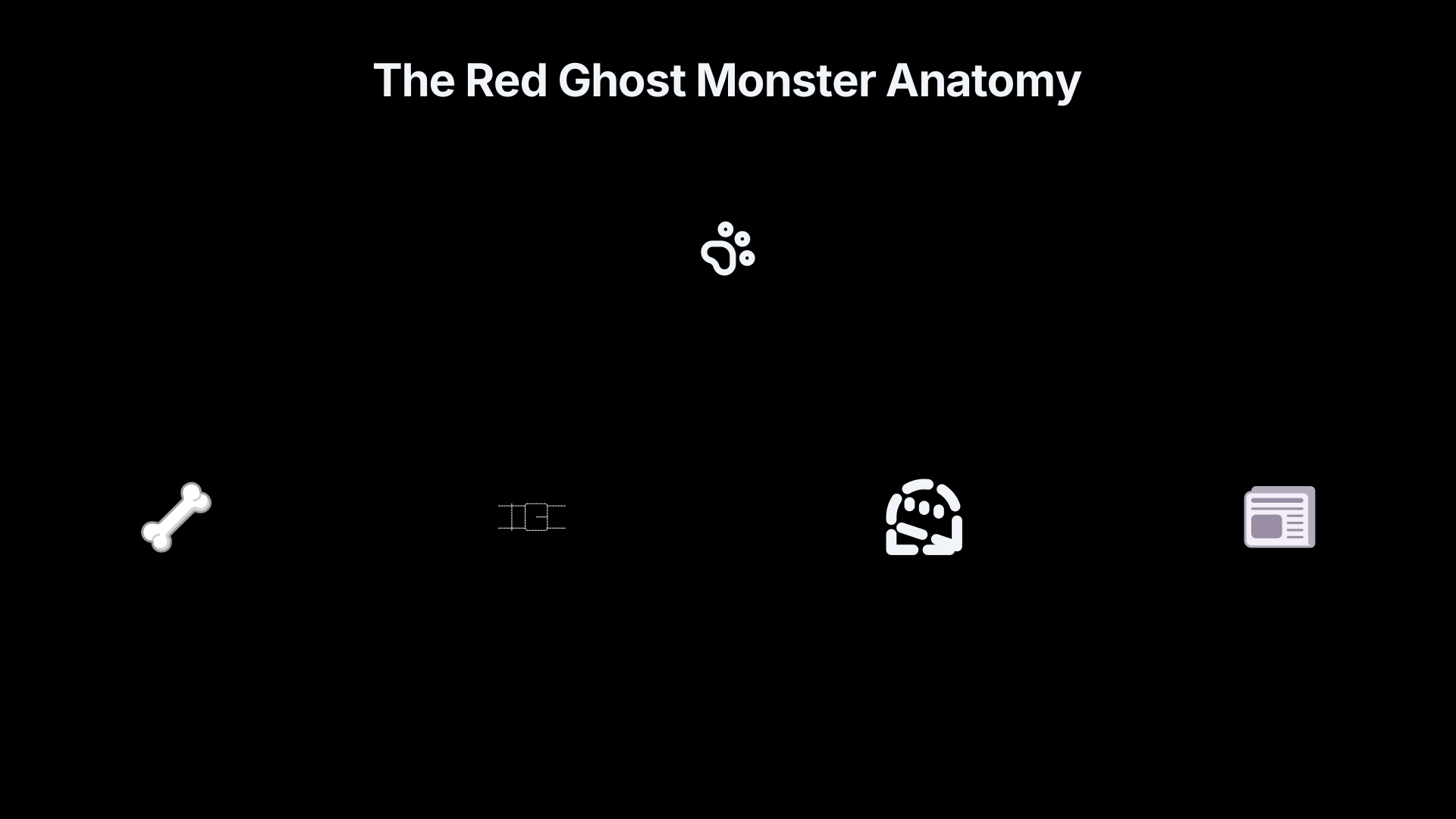
Was the Red Ghost really one animal?
The neat version says there was one camel: the Red Ghost, roaming Arizona for about a decade until Hastings shot it. The more cautious version is that “Red Ghost” may have become a label for several strange camel reports, some real, some exaggerated and some simply borrowed into the growing legend.
That caution is justified because feral camel sightings in the Southwest were not limited to one incident. Smithsonian Magazine’s history of wild camels in the American West notes that the postbellum record includes scattered sightings, with camel reports continuing after the Army experiment had collapsed. The same piece places the Red Ghost within that wider camel afterlife rather than treating it as an isolated impossibility.[Smithsonian Magazine]smithsonianmag.comwhatever happened wild camels american west 180956176whatever happened wild camels american west 180956176
It is also plausible that people attached unrelated damage to the same famous beast. American Heritage is careful on this point, noting that some later depredations blamed on the camel may have been caused by other animals, pranksters or frightened imaginations. The one behaviour that fits a camel especially well is stampeding horses and mules: animals unfamiliar with camels often reacted badly to their appearance and smell.[American Heritage]americanheritage.comAmerican Heritage The Red GhostAmerican HeritageThe Red Ghost - AMERICAN HERITAGE… Eagle Creek in the southeastern corner of the Arizona Territory. The men of… cam…
For an Arizona mystery-beast page, that distinction matters. The Red Ghost is not good evidence for an unknown species. It is good evidence for how a real, unexpected animal becomes a monster tradition. The likely ingredients are:
- a genuinely displaced animal in a harsh landscape;
- witnesses who had little reason to expect a camel;
- a gruesome early death story;[rondungan.com]rondungan.comthe red ghostthe red ghost
- possible physical traces such as red hair, hoofprints and rawhide;
- newspapers that rewarded vivid retelling;
- and a frontier audience already primed for danger.
The Red Ghost may have been one unlucky camel, several camels folded into one name, or a real camel around which a decade of folklore accumulated. The last option is probably the most useful reading: not “fake”, not “proven monster”, but a real animal transformed by narrative pressure.
Why Arizona kept the Red Ghost
Arizona’s creature lore often depends on landscape: forests for the Mogollon Monster, desert roads for phantom cats, mining-town newspapers for giant birds and strange beasts. The Red Ghost belongs to the state for a different reason. It is rooted in Arizona’s frontier transport history, especially the camel routes, military experiments and desert settlements that made the animal’s presence possible.
Hi Jolly’s afterlife helps explain why the camel story remained visible. He died in Quartzsite in 1902, and his grave later became one of Arizona’s best-known camel-related landmarks. The Hi Jolly Monument, a pyramid-like memorial topped with a camel figure, was associated with the Camel Corps in public memory and was added to the National Register of Historic Places in 2011.[Wikipedia]WikipediaHi Jolly MonumentHi Jolly Monument
That monument is not a Red Ghost monument in the strict sense, but it keeps the same historical world in view. It tells visitors that camels were not a joke pasted onto Arizona later; they were part of the territorial story. Roadside culture then does what roadside culture does best: it turns strange history into a stop, a photograph, a local anecdote and a reason to retell the tale.
The Red Ghost also survives because it reverses the usual sceptical payoff. Many cryptid stories become less interesting when the proposed explanation is “misidentified animal”. Here, the misidentified animal is itself bizarre: a feral camel descended from a failed military scheme, roaming Arizona with possible rawhide scars and a legend of a corpse on its back. The explanation is not smaller than the monster. It is the monster’s engine.
How to read the Red Ghost today
The best way to read the Red Ghost is as a frontier legend with a real animal under it. The Camel Corps is well documented. Feral or dispersed camels in the Southwest are historically plausible. The 1893 killing story, rawhide straps and earlier Eagle Creek account belong to a less secure layer of territorial reporting, but they are consistent enough to explain why the tale endured.[nps.gov]nps.govNational Park Service The U.SArmy Camel Corps - El Morro National Monument…7 Oct 2022 — In 1855, Major Wayne and others went to Europe and Africa to study the habi…
What should not be done is to treat every dramatic detail as equally reliable. A camel trampling someone is possible. A strange red animal terrifying horses is plausible. Old rawhide scars are plausible if the 1893 report is accepted. A clean, fully verified skeleton rider with a known identity is not established. A thirty-foot monster, vanishing beast or bear-eating desert demon belongs to the tall-tale layer, not the evidence layer.
That is exactly why the Red Ghost works so well in Arizona’s monster tradition. It sits between categories:
- Folklore: because the story grew through repeated dramatic retelling.
- Newspaper legend: because territorial reports shaped its public form.
- Animal misidentification: because many witnesses likely did not recognise a camel quickly or calmly.
- Historical residue: because the Camel Corps left real animals, memories and routes behind.
- Cryptid-style mystery: because the corpse-rider question remains grisly, unresolved and narratively powerful.
The Red Ghost is not Arizona’s strongest case for an unknown creature. It is something rarer: a monster story where the mundane answer is a scarred desert camel from one of the strangest transport experiments in U.S. military history. That makes it less like a debunked haunting and more like a frontier fossil — a place where failed policy, animal suffering, newspaper imagination and Arizona’s vast empty spaces hardened into legend.

Amazon book picks
Further Reading
Books and field guides related to Was the Red Ghost Really a Camel?. Use these as the next step if you want deeper reading beyond the article.
The United States of Cryptids
Places the Red Ghost among famous American cryptid stories.
eBay marketplace picks
Marketplace Samples
Live-tested eBay searches with available results related to this page.


Endnotes
1.
Source: Wikipedia
Title: Hi Jolly Monument
Link:https://en.wikipedia.org/wiki/Hi_Jolly_Monument
2.
Source: reddit.com
Title: The Camel Riding Corpse: r/Unresolved Mysteries
Link:https://www.reddit.com/r/UnresolvedMysteries/comments/e180y7/the_camel_riding_corpse/
3.
Source: Wikipedia
Title: Red Ghost (folklore)
Link:https://en.wikipedia.org/wiki/Red_Ghost_%28folklore%29
4.
Source: Wikipedia
Title: United States Camel Corps
Link:https://en.wikipedia.org/wiki/United_States_Camel_Corps
5.
Source: reddit.com
Title: The Red Ghost
Link:https://www.reddit.com/r/UrbanMyths/comments/1ho9ez1/the_red_ghost_a_legend_about_a_demonic_figure/
6.
Source: reddit.com
Title: til of the red ghost a legend about a demonic
Link:https://www.reddit.com/r/todayilearned/comments/1h8fh5j/til_of_the_red_ghost_a_legend_about_a_demonic/
7.
Source: armyupress.army.mil
Title: The United States Army Camel Corps 1856 66
Link:https://www.armyupress.army.mil/Journals/Military-Review/Directors-Select-Articles/The-United-States-Army-Camel-Corps-1856-66/
8.
Source: nps.gov
Title: National Park Service The U.S
Link:https://www.nps.gov/elmo/learn/historyculture/the-army-camel-corps.htm
Source snippet
Army Camel Corps - El Morro National Monument...7 Oct 2022 — In 1855, Major Wayne and others went to Europe and Africa to study the habi...
9.
Source: tshaonline.org
Title: Texas State Historical Association The Camel Experiment in 19th Century U.S
Link:https://www.tshaonline.org/handbook/entries/camels
Source snippet
Military History1 Aug 1995 — The camels soon were widely scattered; some were turned out on the open range near Camp Verde; some were use...
10.
Source: americanheritage.com
Title: American Heritage The Red Ghost
Link:https://www.americanheritage.com/red-ghost
Source snippet
American HeritageThe Red Ghost - AMERICAN HERITAGE... Eagle Creek in the southeastern corner of the Arizona Territory. The men of... cam...
11.
Source: astonishinglegends.com
Title: the red ghost
Link:https://astonishinglegends.com/astonishing-legends/2022/10/14/the-red-ghost
Source snippet
Astonishing LegendsThe Red Ghost14 Oct 2022 — On February 25th, 1893, as printed in the Mohave County Miner, the Red Ghost was felled by...
12.
Source: texashighways.com
Title: Texas Highways The Great Camel Experiment
Link:https://texashighways.com/culture/history/the-great-camel-experiment-texas-camel-corps/
13.
Source: smithsonianmag.com
Title: whatever happened wild camels american west 180956176
Link:https://www.smithsonianmag.com/history/whatever-happened-wild-camels-american-west-180956176/
14.
Source: rondungan.com
Title: the red ghost
Link:https://rondungan.com/2022/08/21/the-red-ghost/
15.
Source: atlasobscura.com
Title: hi jolly monument
Link:https://www.atlasobscura.com/places/hi-jolly-monument
16.
Source: cornerstone-environmental.com
Title: Hi Jolly
Link:https://www.cornerstone-environmental.com/publications/item/hi-jolly-the-camel-driver
17.
Source: cryptidz.fandom.com
Title: Red Ghost
Link:https://cryptidz.fandom.com/wiki/Red_Ghost
18.
Source: boozeandspirits.com
Title: the red ghost
Link:https://boozeandspirits.com/2021/01/27/the-red-ghost/
19.
Source: azmemory.azlibrary.gov
Link:https://azmemory.azlibrary.gov/nodes/view/37172?highlights=WyJhcml6b25hIiwiYmx1ZSIsImJvb2siXQ%3D%3D&keywords=arizona+blue+book&type=all
Additional References
20.
Source: youtube.com
Title: Searching for the Ghost Camels of the Southwest & The Hi Jolly Monument
Link:https://www.youtube.com/watch?v=zeMW4s9IQmQ
Source snippet
Wild Camels in Arizona? Marshall Trimble Tells the True Story...
21.
Source: azmemory.azlibrary.gov
Link:https://azmemory.azlibrary.gov/nodes/view/252497
22.
Source: youtube.com
Title: Wild Camels in Arizona? Marshall Trimble Tells the True Story!
Link:https://www.youtube.com/watch?v=Cpe0qb0nqHI
Source snippet
The Oregon Trail of the Southwest | US Camel Corps...
23.
Source: youtube.com
Title: The (Mostly True) Legend of the Red Ghost
Link:https://www.youtube.com/watch?v=JA1gp7SJPjU
Source snippet
Searching for the Ghost Camels of the Southwest & The Hi Jolly Monument...
24.
Source: folkbestiary.com
Link:https://folkbestiary.com/arizona/
25.
Source: arizonahighways.com
Link:https://www.arizonahighways.com/archive/issues/chapter/Doc.124.Chapter.5
26.
Source: facebook.com
Link:https://www.facebook.com/PeterSantenello/posts/great-times-road-tripping-through-some-of-arizonas-most-unusual-towns-in-a-fire-/1503410524479985/
27.
Source: facebook.com
Link:https://www.facebook.com/groups/americansouthwest/posts/1589330455029756/
28.
Source: azoffroad.net
Link:https://azoffroad.net/hi-jolly
29.
Source: intermountainhistories.org
Link:https://www.intermountainhistories.org/files/show/2222
Topic Tree