Within Connecticut Cryptids
Was the Winsted Wild Man Bigfoot Before Bigfoot?
The Winsted Wild Man sits between newspaper hoax, rural wildman folklore, and later Bigfoot-style interpretation.
On this page
- The 1895 newspaper reports
- Louis T. Stone and tall tale journalism
- Why Bigfoot readers still notice the case
Page outline Jump by section
Introduction
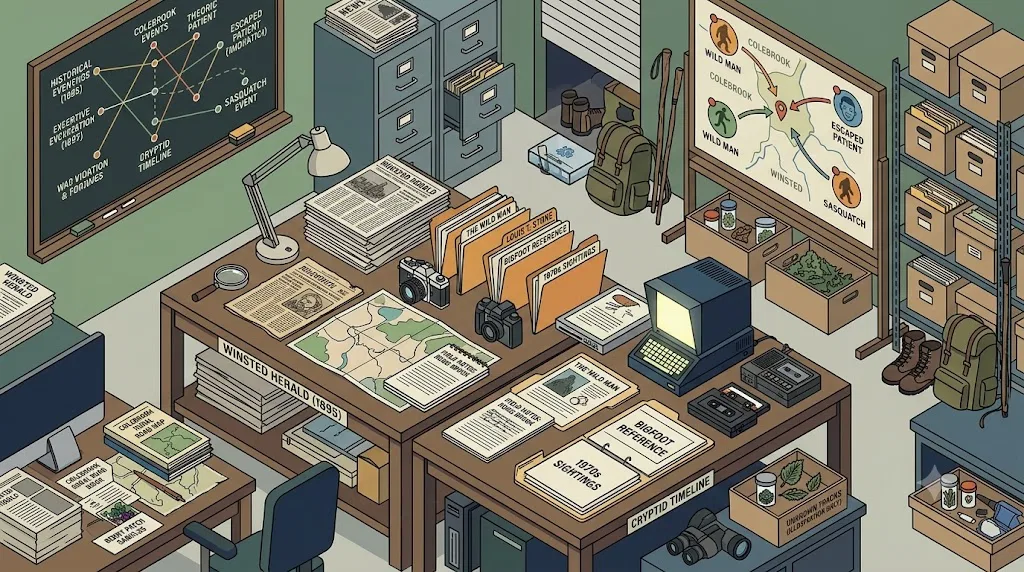
The Winsted Wild Man is best understood as a Connecticut newspaper legend that later became easy to read through a Bigfoot lens. The original 1895 story was not about a named species, a trail of giant footprints, or a hidden ape population. It was a dramatic claim that a naked, hair-covered man had burst from the bushes near Colebrook, frightened Selectman Riley Smith and his bulldog, and vanished into the woods. Within weeks, the tale had grown into a regional sensation involving armed searchers, nervous residents, out-of-town reporters, jokes, possible escaped-patient theories, and increasingly ape-like descriptions.[Colebrook Historical Society]colebrookhistoricalsociety.orgOpen source on colebrookhistoricalsociety.org.
That is why the case still matters in Connecticut cryptid history. It sits in the awkward borderland between rural wildman folklore, 1890s tall-tale journalism, possible hoax, misidentification, and later Sasquatch-style retelling. Calling it “Bigfoot before Bigfoot” is tempting, but slightly misleading: the Wild Man became Bigfoot-like mostly in hindsight.
The 1895 newspaper reports
The story’s most important anchor is the late-August 1895 report from the Winsted-Colebrook area. A local historical account reproduces the Winsted Herald item of 21 August 1895 under the headline “The Wildman – He Appears to Selectman Riley Smith and Scares Riley’s Bulldog Out of a Year’s Growth”. The scene is almost folkloric in its simplicity: Riley Smith had gone to Colebrook on business, stopped to pick berries, and saw his normally brave bulldog run back whining. Moments later, a “large man, stark naked, and covered with hair all over his body” ran from the bushes and disappeared.[Colebrook Historical Society]colebrookhistoricalsociety.orgOpen source on colebrookhistoricalsociety.org.
The follow-up report is just as revealing as the first sighting. On 28 August 1895, the Herald presented Smith as a reliable man “of undoubted pluck and nerve”, then elaborated that the figure had black hair hanging to his shoulders, a thickly hairy body, remarkable agility and the build of a muscular, dangerous man. The paper’s framing mattered: it did not simply report an odd sighting, but vouched for the witness and urged that, for the sake of isolated farmers and women in the area, the figure ought to be captured.[Colebrook Historical Society]colebrookhistoricalsociety.orgOpen source on colebrookhistoricalsociety.org.
The local geography also matters. This was not a city monster in a gothic alleyway. The original claims were tied to roads, fields, bushes, farms and wooded land around Colebrook, in north-eastern Litchfield County near the Massachusetts line. Colebrook’s own town description places it in that rural north-western corner of Connecticut, while the National Register material for Colebrook Center describes a small valley surrounded by wooded hills. That setting gave the story its practical plausibility: a strange figure could be imagined as lurking just beyond a farm lane or stage route.[townofcolebrook.org]townofcolebrook.orgOpen source on townofcolebrook.org.
As the reports multiplied, the Wild Man became less like a single startling human encounter and more like a travelling panic. The 4 September 1895 Herald items, as reproduced by the Colebrook Historical Society, include Jim Maddrah saying he had been chased, Mrs Pulver of Colebrook calling for help after seeing the figure near her house, and a theory that the Wild Man might be Arthur Beckwith, an escaped “insane artist” whose supposed history already sounded like a newspaper melodrama. The same local account notes that reporters from across the north-east pursued the story and went home without a capture, but not without sensational copy.[Colebrook Historical Society]colebrookhistoricalsociety.orgOpen source on colebrookhistoricalsociety.org.
Louis T. Stone and tall-tale journalism
The hoax debate usually turns on Louis T. Stone, the Winsted journalist remembered as the “Winsted Liar”. Stone’s reputation was not that of a sober local recorder whose every item must be treated as literal fact. He became known for comic fabrications about strange local flora, fauna and farmyard impossibilities, including tales of impossible hens, cows and trees. The Museum of Hoaxes describes him as a journalist whose career traded in the affectionate tradition of the local whopper, and the Wild Man story is the one most often attached to his name.[Hoaxes.org]hoaxes.orglou stone the winsted liarlou stone the winsted liar
The difficulty is that “Stone made it up” is cleaner than the surviving evidence seems to be. Modern retellings often state that the Winsted Evening Citizen ran the story on 27 August 1895 and that it also appeared in the Winsted Herald, while the Colebrook Historical Society’s reproduced material identifies an earlier 21 August Herald item as the starting point. CT Insider’s 2015 account follows the Evening Citizen-to-Herald sequence, but the local historical PDF preserves the Herald text and dates that keep the chronology from being perfectly tidy.[CT Insider]ctinsider.comCT Insider The CT Files: The Legend of the Winsted WildmanCT Insider The CT Files: The Legend of the Winsted Wildman
That muddle is important because hoaxes rarely survive as neat single-author events. Even if Stone helped launch or amplify the story, the Wild Man quickly became a collaborative performance involving newspapers, witnesses, jokers, tourists, searchers and readers. A later CT Insider account describes chicken-stealing reports, women who thought the figure might be an ape or gorilla, a police chief losing the trail in a swamp, and a large armed search party. By then, the legend had moved beyond one alleged sighting into a feedback loop: headlines invited sightings, sightings fed headlines, and the creature changed shape as the audience grew.[CT Insider]ctinsider.comCT Insider The CT Files: The Legend of the Winsted WildmanCT Insider The CT Files: The Legend of the Winsted Wildman
This is where the phrase “tall-tale journalism” is more useful than simply calling the whole episode fake. Late-19th-century local papers often mixed civic news, comic exaggeration, sensational animal stories and human-interest oddities. The Wild Man report used recognisable credibility cues — named local man, frightened dog, exact place, physical description — but then let the absurdity bloom. Maddrah’s alleged photograph, with the excuse that the camera had been frightened and misplaced the hair, shows the comic machinery in plain view.[Colebrook Historical Society]colebrookhistoricalsociety.orgOpen source on colebrookhistoricalsociety.org.
Why the story feels like Bigfoot before Bigfoot
The Winsted Wild Man echoes Bigfoot because later readers know the Bigfoot template: a large, hairy, elusive, man-shaped creature glimpsed at the edge of woodland, pursued without success, and never producing a body or conclusive physical evidence. The 1895 descriptions contain several familiar ingredients: hair covering the body, speed, strength, frightening cries, rural woods, ambiguous human-or-animal identity, and a search that produces excitement rather than proof.[Colebrook Historical Society]colebrookhistoricalsociety.orgOpen source on colebrookhistoricalsociety.org.
But the Bigfoot frame did not exist in its modern form in 1895. The name “Bigfoot” became nationally prominent after the 1958 Bluff Creek footprint story in northern California, when large tracks associated with logging-road reports turned into a media sensation; the Smithsonian notes that those tracks were later identified by Ray Wallace’s family as a prank after his death. That later Bigfoot culture gives today’s reader a ready-made category for the Winsted Wild Man, but it also risks flattening an older and more human-centred wildman story into a Sasquatch case.[Smithsonian Magazine]smithsonianmag.comSmithsonian Magazine Why Do So Many People Still Want to Believe in Bigfoot?Smithsonian Magazine Why Do So Many People Still Want to Believe in Bigfoot?
The original Winsted figure was repeatedly described as a man: naked, hairy, perhaps mentally unwell, perhaps a vagabond, perhaps someone who had “lost” himself in the woods. Even the Arthur Beckwith theory, however lurid and unconfirmed, shows that newspapers were trying to explain the figure as a human being before they were treating it as a zoological mystery. The later ape and gorilla language appears as the story expands, not as the clean starting point.[Colebrook Historical Society]colebrookhistoricalsociety.orgOpen source on colebrookhistoricalsociety.org.
That is the key distinction for Connecticut readers. The Wild Man is not strong evidence that Sasquatch was roaming Litchfield County in the 1890s. It is strong evidence that Connecticut already had the cultural ingredients from which a Bigfoot-like legend could be assembled: woods near settled roads, a named witness, newspaper amplification, comic panic, armed searchers, and a creature ambiguous enough to be rewritten by each era.
The 1970s revival and the modern Sasquatch shadow
The reason the Winsted Wild Man remains in cryptid discussion is not only the 1895 flap. It allegedly returned in the 1970s, when Bigfoot was already a national pop-culture figure. CT Insider reports that in July 1972 Wayne Hall and David Chapman said they heard strange noises near Crystal Lake, looked out towards the area, and saw a large furry upright figure cross the road, move around a barn, and return to the woods. The same account says they rejected the suggestion that it had been a bear.[CT Insider]ctinsider.comCT Insider TWISTED HISTORY: The Winsted Wild ManCT Insider TWISTED HISTORY: The Winsted Wild Man
A 2015 CT Insider retelling adds a second 1970s incident: in September 1974, two couples near Rugg Brook Reservoir reportedly told police they had seen a dark-haired creature in the moonlight and fled; a later search found no physical evidence. That absence matters. The 1970s stories are memorable because they map so neatly onto the Bigfoot era — upright hairy creature, reservoirs, night-time fear, no trace afterwards — but they do not supply the kind of biological evidence that would move the case beyond folklore and witness claim.[CT Insider]ctinsider.comCT Insider The CT Files: The Legend of the Winsted WildmanCT Insider The CT Files: The Legend of the Winsted Wildman
The timing makes reinterpretation almost unavoidable. By the early 1970s, American audiences already had the post-1958 Bigfoot image in mind, and the famous 1967 Bluff Creek film had helped cement the silhouette of a large, hairy, bipedal figure in popular culture. When a Connecticut witness described an eight-foot, hairy, upright figure in 1972, readers no longer had to invent a category. They could slot it straight into the Sasquatch file.[Smithsonian Magazine]smithsonianmag.comSmithsonian Magazine Why Do So Many People Still Want to Believe in Bigfoot?Smithsonian Magazine Why Do So Many People Still Want to Believe in Bigfoot?
That does not mean the 1970s witnesses were lying. It means their reports reached the public through a different cultural filter from the 1895 reports. In 1895, the available explanations included wild man, escaped patient, gorilla, devilish nuisance or newspaper joke. In the 1970s, the most obvious label had become Bigfoot.
Hoax, misidentification, or folklore?
The strongest sceptical reading is that the Winsted Wild Man began as a newspaper-driven tall tale and then grew through suggestion, humour and local excitement. The case has several classic warning signs: no body, no verified photograph, no preserved physical evidence, escalating descriptions, comic side reports, and a journalist culture known for exaggeration. The fact that later writers still debate Stone’s exact role does not rescue the creature as a biological claim; it mostly shows how hard it is to reconstruct a local media episode after it has passed through retellings, clippings, books and folklore.[Hoaxes.org]hoaxes.orglou stone the winsted liarlou stone the winsted liar
Misidentification remains plausible for some later sightings, especially in a state where large wildlife does share space with homes, barns, roads and reservoirs. Connecticut’s Department of Energy and Environmental Protection says black bears usually avoid people in wilderness settings but can be drawn near homes by bird feeders, rubbish, pet food, compost, fruit trees and berry-producing shrubs. That does not explain a naked hairy man in 1895, but it does explain why a dark, bulky animal glimpsed in poor light near a road or barn can become something stranger in memory.[portal.ct.gov]portal.ct.govOpen source on ct.gov.
The bear explanation should not be overused either. Witnesses in the 1972 report reportedly rejected it, and a standing or moving bear does not automatically become an eight-foot humanoid. The fairer point is narrower: Connecticut has real large mammals, wooded edges, night-time visibility problems and human expectation effects. Those conditions are enough to generate some sincere mystery-beast reports without requiring a hidden primate population.
Folklore is the third and most durable explanation. The Wild Man works because it is not only a question of what Riley Smith saw, if anything. It is a story about the edge of town: the moment a respectable local man, a brave dog, a berry patch and a wooded road meet something uncivilised. That is why the legend could survive a hoax reputation, fade, revive in Bigfoot language, and remain one of Connecticut’s most discussed hairy-creature tales.

What the Winsted Wild Man adds to Connecticut cryptid history
The Winsted Wild Man is valuable because it shows how a Connecticut monster can be made without a lake, a haunted ruin or a centuries-old supernatural curse. It was built from press culture, rural setting, personality, ambiguity and repetition. Winsted and Colebrook supplied the landscape; local papers supplied the megaphone; named witnesses and alleged searchers supplied credibility; later Bigfoot culture supplied the modern label.[Colebrook Historical Society]colebrookhistoricalsociety.orgOpen source on colebrookhistoricalsociety.org.
It also helps separate different kinds of creature lore within the state. The Black Dog of the Hanging Hills is usually told as omen folklore. The Glastonbury Glawackus belongs more to mystery-predator panic. The Winsted Wild Man is different again: a hairy humanoid story whose most interesting evidence is not biological but journalistic. Its paper trail is the creature’s real footprint.
So, was the Winsted Wild Man Bigfoot before Bigfoot? In the strict sense, no. The 1895 case was a wildman scare and likely a newspaper-amplified hoax or tall tale, not a documented Sasquatch encounter. In the cultural sense, yes, it foreshadowed the way Bigfoot stories would later work: a fleeting figure at the wooded edge, a frightened witness, a cascade of retellings, no hard proof, and a legend sturdy enough to outlive the joke that may have started it.
Amazon book picks
Further Reading
Books and field guides related to Was the Winsted Wild Man Bigfoot Before Bigfoot?. Use these as the next step if you want deeper reading beyond the article.
Abominable Science!
Useful for evaluating whether cases are folklore, hoaxes or misidentifications.
Field Guide To Bigfoot, Yeti, & Other Mystery Primates Worldwide
Connects the Winsted Wild Man to the wider wild-man tradition.
eBay marketplace picks
Marketplace Samples
Live-tested eBay searches with available results related to this page.



Endnotes
1.
Source: townofcolebrook.org
Link:https://www.townofcolebrook.org/about/
2.
Source: hoaxes.org
Title: lou stone the winsted liar
Link:https://hoaxes.org/archive/permalink/lou_stone_the_winsted_liar
3.
Source: portal.ct.gov
Link:https://portal.ct.gov/DEEP/Wildlife/Fact-Sheets/Black-Bear
4.
Source: portal.ct.gov
Link:https://portal.ct.gov/deep/wildlife/bears/the-basics-of-living-with-black-bears
5.
Source: newspapers.com
Title: boston post wild man account 1895
Link:https://www.newspapers.com/article/boston-post-wild-man-account-1895/17486340/
6.
Source: newspapers.com
Title: the herald news
Link:https://www.newspapers.com/article/the-herald-news/164152012/
7.
Source: portal.ct.gov
Title: Report a Wildlife Sighting
Link:https://portal.ct.gov/DEEP/Wildlife/Report-a-Wildlife-Sighting
8.
Source: hoaxes.org
Title: the winsted wild man
Link:https://hoaxes.org/archive/permalink/the_winsted_wild_man
9.
Source: homes.com
Link:https://www.homes.com/local-guide/colebrook-ct/
10.
Source: colebrookhistoricalsociety.org
Link:https://www.colebrookhistoricalsociety.org/PDF%20Images/The%20Winsted%20Wildman.pdf
11.
Source: ctinsider.com
Title: CT Insider The CT Files: The Legend of the Winsted Wildman
Link:https://www.ctinsider.com/connecticutmagazine/news-people/article/The-CT-Files-The-Legend-of-the-Winsted-Wildman-17041808.php
12.
Source: Wikipedia
Title: Louis T. Stone
Link:https://en.wikipedia.org/wiki/Louis_T._Stone
13.
Source: smithsonianmag.com
Title: Smithsonian Magazine Why Do So Many People Still Want to Believe in Bigfoot?
Link:https://www.smithsonianmag.com/history/why-so-many-people-still-believe-in-bigfoot-180970045/
14.
Source: ctinsider.com
Title: CT Insider TWISTED HISTORY: The Winsted Wild Man
Link:https://www.ctinsider.com/news/article/TWISTED-HISTORY-The-Winsted-Wild-Man-12087297.php
15.
Source: Wikipedia
Link:https://en.wikipedia.org/wiki/Bigfoot
16.
Source: colebrookhistoricalsociety.org
Link:https://www.colebrookhistoricalsociety.org/colebrook/
17.
Source: archive.org
Link:https://archive.org/stream/Cryptozoology_201608/Cryptozoology_djvu.txt
18.
Source: archive.org
Link:https://archive.org/download/winsteddevelopme00hulb/winsteddevelopme00hulb.pdf
19.
Source: dsp.domains.trincoll.edu
Link:https://dsp.domains.trincoll.edu/fake-news/fake-news/wildman
Additional References
20.
Source: theguardian.com
Link:https://www.theguardian.com/world/2026/jun/11/sasquatch-bigfoot-sightings-fervour-scepticism-ape-ontario
Source snippet
Sasquatch has long fascinated both believers and sceptics. While some see it as a symbol of the unknown or a spiritual being tied to Indi...
21.
Source: youtube.com
Title: Connecticut’s Village Of The Damned
Link:https://www.youtube.com/watch?v=mRlzkM6k2s4
Source snippet
This video explores the Winsted Wild Man legend directly within its historical Connecticut framework: New England Legends Podcast 30 - Th...
22.
Source: npgallery.nps.gov
Link:https://npgallery.nps.gov/GetAsset/fa54671c-32ba-43d5-84bb-d1cf02a55dad
23.
Source: youtube.com
Title: New England Legends Podcast 30
Link:https://www.youtube.com/watch?v=gmKoRB6_c1Y
Source snippet
THE WINSTED WILDMAN | Rural CreepyPasta Story...
24.
Source: youtube.com
Title: THE WINSTED WILDMAN | Rural Creepy Pasta Story
Link:https://www.youtube.com/watch?v=GWYBcky8zL0
Source snippet
The Winsted Wildman and Bigfoot in Connecticut | Episode 48...
25.
Source: facebook.com
Link:https://www.facebook.com/WTNH8/posts/a-black-bear-has-been-euthanized-in-winchester-after-breaking-into-multiple-home/1502225415283112/
26.
Source: facebook.com
Link:https://www.facebook.com/HattiesburgPocketMuseum/posts/-bigfoot-fact-before-bigfoot-had-a-name-he-had-giant-feetin-1958-workers-buildin/1624055893055541/
27.
Source: bigfootencounters.com
Link:https://www.bigfootencounters.com/articles/winstedwildman.htm
28.
Source: facebook.com
Link:https://www.facebook.com/CTFishAndWildlife/posts/do-not-let-the-recent-frosts-and-chilly-mornings-fool-you-black-bears-can-be-act/756080853226301/
29.
Source: facebook.com
Link:https://www.facebook.com/CTFishAndWildlife/posts/black-bears-are-active-are-you-being-bearwisehere-are-just-a-few-helpful-tips-to/1428282839339429/
Topic Tree