Connecticut's Cryptids: Claims, Creatures and Explanations
Connecticut’s cryptid map is small, wooded, and surprisingly busy.
Page outline Jump by section
Introduction
The evidence is uneven. Some stories began in named newspaper reports, some in oral urban legend, and some in modern sighting databases. State wildlife records also matter, because Connecticut really does have bobcats, black bears, coyotes, fishers, and the occasional confirmed wanderer such as the 2011 mountain lion killed in Milford. That natural context helps explain why the state’s monster lore feels plausible at a glance while remaining unconfirmed as cryptozoology.[ctinsider.com]ctinsider.comCT Insider The legend of the Black Dog of the Hanging Hills has itsCT Insider The legend of the Black Dog of the Hanging Hills has its
Connecticut’s “big three” legends
Connecticut’s modern cryptid conversation often circles back to three stories: a ghostly black dog in Meriden, a screaming hybrid beast in Glastonbury, and a hairy “wild man” in the Winsted-Colebrook area. They work well together because each sits in a different category. The Black Dog is mainly supernatural folklore attached to a real landscape. The Glawackus is a mystery-animal flap rooted in winter 1939 reports of livestock and pet attacks. The Winsted Wild Man is a newspaper-driven wildman story that overlaps with later Bigfoot interpretation.
That distinction matters. A reader looking for “Connecticut cryptids” may expect a list of monsters, but the more useful question is what sort of claim each story is making. The Black Dog is not usually described as a breeding animal. The Glawackus was treated by witnesses and newspapers as a possibly real predator. The Wild Man sat awkwardly between human vagrant, escaped ape, hoax, and proto-Bigfoot. Together, they show how Connecticut’s creature lore moves between folklore, journalism, local humour, and sincere eyewitness claim.[CT Insider]ctinsider.comCT Insider CT cryptids and urban legends explored in an illustratedCT Insider CT cryptids and urban legends explored in an illustrated
The Black Dog of the Hanging Hills: omen, hiking tale, or old-world folklore?
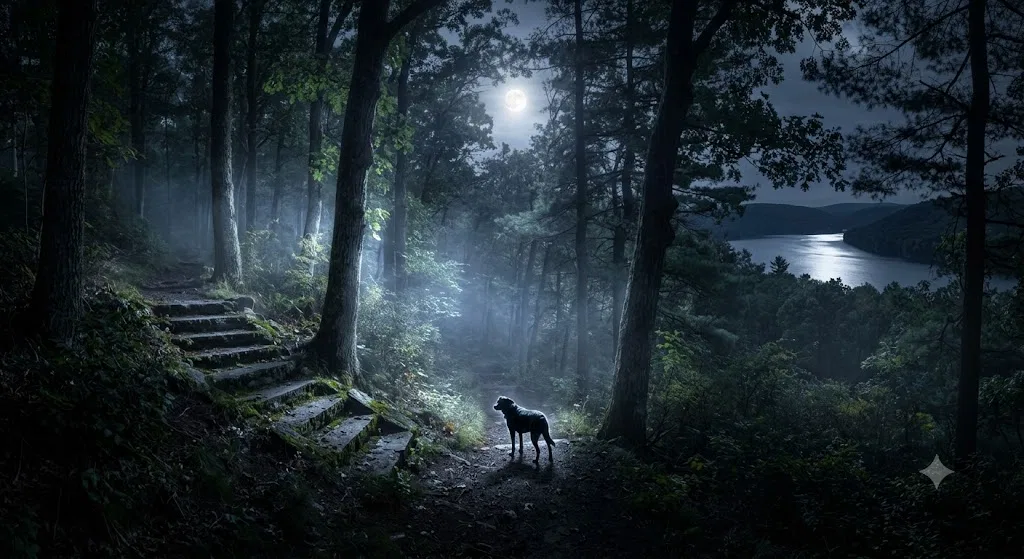
The Black Dog of the Hanging Hills belongs to Meriden’s traprock landscape, especially the ridges around Hubbard Park, Castle Craig, and the Hanging Hills. The core saying is simple and memorable: meeting the dog once brings joy, twice brings sorrow, and a third meeting means death. CT Insider traces the enduring form of the legend to literary lore and to W. H. C. Pynchon’s account in The Connecticut Quarterly, while later retellings place the animal among fatal or near-fatal incidents on the ridges.[CT Insider]ctinsider.comCT Insider The legend of the Black Dog of the Hanging Hills has itsCT Insider The legend of the Black Dog of the Hanging Hills has its
The place itself helps the legend endure. Hubbard Park is not an invented gothic backdrop: Meriden describes it as an 1,800-acre park, with Castle Craig standing over the city, and the wider Hanging Hills are rugged traprock ridges with cliffs, loose rock, reservoirs, forest, and long views. A small black dog appearing on a lonely path is a much stronger story when the path is steep, rocky, and already associated with falls and dangerous footing.[meridenct.gov]meridenct.govHubbard Park | City of Meriden, CTHubbard ParkHubbard Park | City of Meriden, CTHubbard Park
There is also a broader folklore pattern. Black dogs are common in British and Anglo-American ghost traditions, often appearing as omens, guardians, or death warnings on roads, moors, churchyards, and lonely paths. Connecticut’s version looks less like a zoological mystery and more like a New England adaptation of that old-world black-dog motif, given a local address in the Hanging Hills.[Wikipedia]WikipediaBlack dog (folkloreBlack dog (folklore
A sceptical reading does not have to drain the story of interest. The Black Dog is powerful because it turns ordinary hiking risk into a narrative: the cliff, the mist, the sudden animal, the memory of a warning. As a cryptid, it is weak evidence for an unknown species. As regional folklore, it is one of Connecticut’s most durable monster legends.
The Glastonbury Glawackus: Connecticut’s winter predator panic
The Glawackus is Connecticut’s best mystery-beast flap because it has the right ingredients: a specific place, a specific season, alleged animal attacks, confused descriptions, newspaper attention, organised searches, and a name too odd to forget. The first major reports clustered around Glastonbury in January 1939, when residents described a strange creature giving night-time screams, leaving tracks, and attacking pets or livestock. Witnesses compared it to a dog, cat, bear, panther, or some hybrid of them.[wordpress.com]mysterioushillsdotcom.wordpress.comThese Mysterious Hills Remembering the Dreaded GlawackusThese Mysterious Hills Remembering the Dreaded Glawackus
The name itself helped the story survive. Connecticut Magazine reported that “Glawackus” was a playful coinage combining Glastonbury, “wacky”, and a pseudo-scientific Latin ending. That joke did not make the sightings unserious to frightened residents, but it did make the legend portable. A nameless predator story might have faded as a local winter scare. “The Glawackus” became a character.[CT Insider]ctinsider.comCT Insider CT cryptids and urban legends explored in an illustratedCT Insider CT cryptids and urban legends explored in an illustrated
The creature’s description changed as the flap grew. Some reports emphasised a large cat; others leaned towards a dog-like or bear-like beast. New England Legends’ account of the 1939 episode notes how later eyewitness claims became stranger, with talk of blood-curdling screams and increasingly embellished features. CT Insider similarly notes that explanations at the time included mountain lion, large bobcat, or another predator.[ournewenglandlegends.com]ournewenglandlegends.compodcast 100 hunting glastonburys glawackuspodcast 100 hunting glastonburys glawackus
The strongest natural explanation is not one single perfect candidate, but a cluster of plausible confusion. A bobcat can sound startling and look larger in poor light. A black bear can leave dramatic damage and tracks. A loose exotic animal, escaped large dog, or misidentified predator could have fed an initial panic. Connecticut’s present wildlife records make this framework more plausible: bobcats are now found statewide, and black bears have expanded markedly since evidence of a resident population appeared in the 1980s.[portal.ct.gov]portal.ct.govBlack BearBlack Bear
The Glawackus remains interesting because it sits right on the border between monster and wildlife case. Unlike the Black Dog, it was not only an omen story. People were asking a practical question: what is attacking animals in Glastonbury? The answer was never settled in a way that satisfied folklore, but the likely explanations stay within known predator behaviour, misidentification, and newspaper amplification rather than a new species.
The Winsted Wild Man: Bigfoot before “Bigfoot”?
The Winsted Wild Man is the Connecticut creature most often pulled into Bigfoot history. The familiar version begins in August 1895, when the Winsted Evening Citizen ran a report of a large naked man, covered with hair, emerging from bushes near Winsted and Colebrook. CT Insider summarises the original description as a hairy figure who ran from a clump of bushes, while later accounts describe a wave of sightings, search parties, tourists, and journalists.[CT Insider]ctinsider.comThe CT Files The Legend of the Winsted Wildman 17041808The CT Files The Legend of the Winsted Wildman 17041808
The story’s credibility is complicated by its newspaper setting. One widely repeated interpretation links the case to Louis T. Stone, a Winsted newspaperman famous for tall tales and fabricated local oddities. Trinity College’s digital history project describes the Wild Man as an invented story by a journalist with a taste for hoaxes, while other folklore writers have argued that early wildman reports may not all reduce neatly to Stone alone.[dsp.domains.trincoll.edu]dsp.domains.trincoll.eduOpen source on trincoll.edu.
That uncertainty is part of the legend’s afterlife. If the Wild Man is treated as a hoax, it becomes a fine example of 1890s local press culture: a rural scare, a colourful editor, and a creature story that spread because newspapers needed copy. If it is treated as a witness tradition, it becomes an early East Coast hairy-humanoid report that later readers naturally compare with Bigfoot. Either way, the case predates the popular Pacific Northwest “Bigfoot” brand and shows that hairy wildman stories were already available in American folklore and journalism.[medium.com]medium.comThe Winsted Wild ManThe Winsted Wild Man
Modern Bigfoot interest keeps the Winsted story alive because Connecticut continues to receive reported Sasquatch-style claims. The Bigfoot Field Researchers Organization lists Connecticut reports by county, including recent entries in Litchfield, New Haven, Fairfield, and New London counties; its Litchfield County page includes reports near Kent, Torrington, People’s State Forest, New Preston, and Bridgewater. These are reports in a private enthusiast database, not scientific confirmation, but they show where contemporary claim-making clusters.[BFRO]bfro.netstate listing.aspstate listing.asp
A cautious reading is best. Connecticut’s forests and river corridors can feel remote, especially in the Litchfield Hills and eastern state forests, but the state is heavily settled. A large breeding primate population would be expected to leave stronger physical evidence than anecdotes, whoops, and fleeting roadside sightings. The Winsted Wild Man is therefore most valuable as folklore history: an early local wildman panic that later cryptid culture reinterpreted through the Bigfoot lens.
Melon Heads and “Dracula Drive”: when a cryptid is really an urban legend
The Melon Heads are one of Connecticut’s most repeated road legends, especially in south-western towns such as Trumbull, Monroe, Shelton, Newtown, Oxford, Stratford, Milford, and Southbury. The basic tale describes large-headed humanoids living near isolated roads, sometimes said to be escaped asylum patients, inbred woods-dwellers, or children affected by hydrocephalus. Versions often attach the story to a supposed “Dracula Drive”, although accounts vary over which real road is meant.[damnedct.com]damnedct.comthe melon headsthe melon heads
This is not a strong animal-cryptid tradition. It is closer to a teenage legend-trip story: drive down a dark wooded road, repeat the name, watch for figures at the edge of the trees, and scare yourself with local geography. Folklore accounts commonly identify Velvet Street in Trumbull and Monroe, Saw Mill City Road in Shelton, Edmonds Road in Oxford, Zion Hill Road in Milford, Jeremy Swamp Road in Southbury, and roads near Roosevelt Forest as places folded into the legend.[Wikipedia]WikipediaMelon headsMelon heads
The Melon Heads also show why cryptid pages need boundaries. The story often borrows from harmful old asylum folklore, disability fear, and “degenerate backwoods family” tropes. Those ingredients tell us more about social anxieties than about unknown creatures. The real Connecticut texture is the road network: wooded lanes, old institutions, town borders, and the ritual of daring someone to drive through at night.[damnedct.com]damnedct.comthe melon headsthe melon heads
For readers sorting Connecticut legends, the Melon Heads belong on the map, but not in the same evidential basket as the Glawackus. There is no serious biological claim to assess. The useful interpretation is that Connecticut’s suburban woods can feel just wild enough for an urban legend to take root, especially where a road already has an eerie nickname.
Phantom cats, mountain lions, and the power of one confirmed cougar
Few Connecticut mystery-beast subjects are as emotionally charged as big cats. Residents have long reported “mountain lions”, “panthers”, or large tawny cats in woods, fields, and suburban edges. The official position is much narrower: Connecticut does not have a known resident mountain lion population, and most claimed sightings are treated as misidentifications, often of bobcats, coyotes, dogs, deer, or house cats seen badly and briefly. CT Insider reported DEEP’s view that there had been only one confirmed mountain lion in Connecticut since the late 1800s.[CT Insider]ctinsider.comCT Insider There are no mountain lions in Connecticut, so why do weCT Insider There are no mountain lions in Connecticut, so why do we
That one confirmed case is important. In June 2011, a 140-pound male mountain lion was struck and killed by a vehicle in Milford. DNA and physical evidence indicated that it had travelled more than 1,500 miles from South Dakota, and CT Public reported that the animal had been documented along its route through multiple forms of evidence, including trail cameras, hair, and blood samples.[Connecticut Public]ctpublic.orgwildlife biologist breaks down mountain lion sightings in ctwildlife biologist breaks down mountain lion sightings in ct
This does two things at once. It proves that an individual cougar can reach Connecticut. It does not prove that every local big-cat sighting is a cougar, or that a breeding population exists. In fact, the 2011 cat is a useful standard for evidence: when a real mountain lion passed through, it left a trail that biologists could test.[Connecticut Public]ctpublic.orgwildlife biologist breaks down mountain lion sightings in ctwildlife biologist breaks down mountain lion sightings in ct
Bobcats are the more ordinary explanation for many phantom-cat reports. Connecticut wildlife officials and reporting have described bobcats as widespread in all eight counties, with sightings increasing substantially as populations recover and as more people use cameras and online reporting. Bobcats are smaller than cougars, but in poor light, at a distance, or when glimpsed in motion, size can be badly overestimated.[CT Insider]ctinsider.comOpen source on ctinsider.com.
The Glawackus also fits into this phantom-cat tradition. In 1939, some observers wondered whether the Glastonbury beast was a mountain lion or a large bobcat. The continuing appeal of big-cat reports in Connecticut comes from the same tension: cougars once belonged to the eastern landscape, one modern wanderer truly arrived, and yet most present claims still lack the kind of evidence that confirmed the Milford animal.[CT Insider]ctinsider.comHow a blood thirsty hybrid beast terrified 17045202How a blood thirsty hybrid beast terrified 17045202

Bigfoot reports in a small, wooded state
Connecticut is not usually thought of as Bigfoot country, but it has a modest stream of Sasquatch-style reports. The BFRO’s Connecticut listing includes recent claims such as whoops and footprints near Kent in 2026, a late-night motorist sighting in New Haven County in 2024, and howls near Botsford and Upper Stepney in 2023. Its county pages show repeated claims in Litchfield County and a smaller set in places such as New London County, including Pachaug State Forest.[BFRO]bfro.netstate listing.aspstate listing.asp
The geography of those reports makes intuitive sense. Litchfield County, the Housatonic corridor, People’s State Forest, and Pachaug State Forest all offer more cover than a mental picture of suburban Connecticut suggests. But “more wooded than expected” is not the same as “good evidence for an undiscovered primate”. Most reports are brief sightings, sounds, tracks, or impressions; they are not supported by bodies, DNA, clear repeatable photography, or ecological evidence of a breeding population.[BFRO]bfro.netshow county reports.aspshow county reports.asp
The Winsted Wild Man gives these modern reports a local ancestor. Rather than proving continuity, it provides a ready-made story shape: a hairy figure in north-western Connecticut, glimpsed in woodland, debated as man, ape, hoax, or something else. That is why the Wild Man remains a bridge between nineteenth-century newspaper folklore and contemporary Bigfoot culture.[CT Insider]ctinsider.comThe CT Files The Legend of the Winsted Wildman 17041808The CT Files The Legend of the Winsted Wildman 17041808
The most evidence-aware position is to treat Connecticut Bigfoot reports as modern folklore and witness claims rather than as established wildlife. They are still worth studying because they reveal where people experience the state as wild, what sounds and sightings they find hard to classify, and how national Bigfoot mythology adapts to a New England landscape.
Water monsters: Connecticut River serpents and Candlewood campfire stories
Connecticut has fewer famous lake monsters than Vermont’s Lake Champlain or Scotland’s Loch Ness, but water-creature stories do appear. The Connecticut River serpent tradition is usually discussed through old press reports and later New England folklore writing, with one modern Vermont Digger article noting historical newspaper stories of a monster in the Connecticut River. Strange New England also preserves the “Connecticut River Serpent” as a regional legend attached to the river corridor.[VTDigger]vtdigger.orgConnecticut River sightings? Monster or myth?Connecticut River sightings? Monster or myth?
The river setting matters. The Connecticut River is long, tidal in its lower reaches, historically busy, and ecologically rich. Large fish, floating logs, wakes, otters, deer swimming across water, and low-light viewing conditions can all produce strange impressions. Unlike the Glawackus, however, the serpent tradition is scattered and less central to Connecticut identity than it is in lake-monster regions with a single named creature and tourism infrastructure.
Candlewood Lake has its own modern monster jokes and campfire stories, often involving an implausibly giant fish. Local coverage has treated “Candlewood Lake monster” tales as urban legend rather than a serious mystery-animal case, noting versions such as a fictional or rumoured oversized fish around Vaughn’s Neck.[i95 ROCK]i95rock.comdont panic stories of a candlewood lake monster are simply urban legendsdont panic stories of a candlewood lake monster are simply urban legends
These water stories are best read as local colour. They show that Connecticut participates in the broader New England habit of giving big water a creature, but the evidence is thin and the legends are less developed than the state’s ridge, road, and forest monsters.
The wildlife behind the monsters
Connecticut’s real animals are often more important to cryptid interpretation than any monster catalogue. Black bears are now an unmistakable presence. DEEP says evidence of a resident bear population appeared in the 1980s and that annual sighting reports have increased dramatically since then. Recent reporting has described bears appearing in most Connecticut municipalities, with growing human-bear conflicts as animals move through rural and suburban areas.[ct.gov]portal.ct.govBlack BearBlack Bear
Bobcats are equally important for mystery-cat claims. Connecticut reporting based on DEEP information describes bobcats as native, recovering after historic decline, now present in all eight counties, and often mistaken for larger cats. Their twilight habits, short glimpses, and ability to live near suburbs make them ideal fuel for “what was that?” encounters.[CT Insider]ctinsider.comOpen source on ctinsider.com.
The 2011 Milford mountain lion adds a twist because it prevents an overly dismissive answer. Connecticut can receive extraordinary wildlife events. A cougar really did cross more than a thousand miles and die on a Connecticut road. But the same case also shows how strong evidence looks when a rare animal is real: DNA, physical remains, trail-camera documentation, and a trackable route.[Connecticut Public]ctpublic.orgwildlife biologist breaks down mountain lion sightings in ctwildlife biologist breaks down mountain lion sightings in ct
This is the central sceptical lesson for Connecticut cryptids. The state is wild enough for misidentifications, rare wanderers, and surprising encounters. It is also documented enough that extraordinary resident animals should leave more than stories. The most plausible explanations for many reports are known wildlife, unusual behaviour, poor viewing conditions, folklore expectations, and local media amplification.
Why Connecticut’s monster map clusters around ridges, roads, and old towns
Connecticut’s creature lore is unusually place-specific. The Black Dog belongs to the Hanging Hills. The Glawackus belongs to Glastonbury’s winter fields and woods. The Wild Man belongs to Winsted, Colebrook, and north-western hill country. The Melon Heads belong to secluded roads in Fairfield and New Haven County legend. These are not random coordinates. They are places where landscape and story reinforce one another.
Ridges make good omen country because they are beautiful and dangerous. The Hanging Hills have cliffs, rough trails, reservoirs, and dramatic views; a fatal fall can become part of a dog legend far more easily there than on a flat pavement.[newenglandtrail.org]newenglandtrail.orgOpen source on newenglandtrail.org.
Rural-suburban edges make good mystery-beast country because people share space with animals but do not always know what they are seeing. A bobcat crossing a garden, a bear at a feeder, a coyote calling at night, or a fisher screaming in the dark can feel out of place when it appears near homes, roads, and schools. DEEP’s wildlife-sighting systems and public guidance exist partly because these encounters are now common enough to need ordinary reporting channels.[portal.ct.gov]portal.ct.govOpen source on ct.gov.
Old mill towns and newspaper towns make good wildman country because they sit between settlement and woods. The Winsted Wild Man story spread through the press at a moment when local journalism could turn a strange rural anecdote into a regional event. The Glawackus did something similar in 1939, when newspaper naming, public alarm, and organised searching transformed an unknown predator report into a lasting creature.[ctinsider.com]ctinsider.comThe CT Files The Legend of the Winsted Wildman 17041808The CT Files The Legend of the Winsted Wildman 17041808
How later accounts reshaped Connecticut’s cryptid traditions
Connecticut’s cryptids have not stayed fixed. The Black Dog began as a local omen tale and became a staple of haunted Connecticut writing, hiking lore, and regional Halloween coverage. The Glawackus moved from frightening 1939 predator flap to playful local mascot material, with modern coverage even noting its afterlife in sports branding and public folklore.[CT Insider]ctinsider.comCT Insider The legend of the Black Dog of the Hanging Hills has itsCT Insider The legend of the Black Dog of the Hanging Hills has its
The Winsted Wild Man changed most dramatically. In the 1890s it was a wildman or possible hoax story. In later cryptid culture it became a “Connecticut Bigfoot” precursor, not because the original evidence improved, but because the national Bigfoot framework gave older hairy-humanoid stories a new category.[ctinsider.com]ctinsider.comThe CT Files The Legend of the Winsted Wildman 17041808The CT Files The Legend of the Winsted Wildman 17041808
The Melon Heads show another kind of change: spread by repetition rather than documentation. Different towns attach the same basic legend to different roads, and the supposed origin story mutates as it moves. This is classic urban legend behaviour. The important feature is not a stable creature description but the ritual of local retelling.[Wikipedia]WikipediaMelon headsMelon heads
Modern reporting technology has changed the newest claims. Trail cameras, phone cameras, agency sighting forms, online databases, podcasts, and social media all make it easier to report unusual animals — and easier to challenge weak claims. Connecticut’s 2011 mountain lion demonstrates the new evidential standard. A real rare animal can now be genetically tested and geographically reconstructed, which raises the bar for every unconfirmed cougar, Bigfoot, or mystery-beast report that follows.[Connecticut Public]ctpublic.orgwildlife biologist breaks down mountain lion sightings in ctwildlife biologist breaks down mountain lion sightings in ct
What is most likely true?
The most likely truth is that Connecticut has a rich monster tradition but no confirmed cryptid species. The Black Dog is best understood as supernatural folklore attached to a risky and memorable landscape. The Glawackus was probably a real or perceived predator incident magnified by winter fear, inconsistent sightings, and newspaper energy. The Winsted Wild Man is a wildman tale entangled with hoax culture and later Bigfoot reinterpretation. The Melon Heads are road folklore rather than zoology. Phantom cats are a mix of misidentification, rare possibility, and the long shadow of the 2011 confirmed cougar.[ctinsider.com]ctinsider.comCT Insider The legend of the Black Dog of the Hanging Hills has itsCT Insider The legend of the Black Dog of the Hanging Hills has its
That does not make the stories worthless. It makes them more interesting. Connecticut’s cryptids are not simply failed animal reports. They are ways of reading the state’s edges: the cliff path, the wooded road, the winter farm, the reservoir, the old newspaper town, the suburban garden where a bobcat suddenly looks too large. The best Connecticut monster stories survive because they attach strangeness to places people can still visit, recognise, and argue about.
eBay marketplace picks
Marketplace Samples
Live-tested eBay searches with available results related to this page.
Endnotes
1.
Source: portal.ct.gov
Title: Black Bear
Link:https://portal.ct.gov/DEEP/Wildlife/Fact-Sheets/Black-Bear
2.
Source: meridenct.gov
Title: Hubbard Park | City of Meriden, CTHubbard Park
Link:https://www.meridenct.gov/city-services/parks-and-recreation/hubbard-park/
3.
Source: newenglandtrail.org
Link:https://newenglandtrail.org/hike/the-hanging-hills/
4.
Source: Wikipedia
Title: Black dog (folklore)
Link:https://en.wikipedia.org/wiki/Black_dog_%28folklore%29
5.
Source: damnedct.com
Link:https://www.damnedct.com/the-glawackus-glastonbury/
6.
Source: ournewenglandlegends.com
Title: podcast 100 hunting glastonburys glawackus
Link:https://ournewenglandlegends.com/podcast-100-hunting-glastonburys-glawackus/
7.
Source: ournewenglandlegends.com
Title: podcast 30 the wild man of winsted connecticut
Link:https://ournewenglandlegends.com/podcast-30-the-wild-man-of-winsted-connecticut/
8.
Source: dsp.domains.trincoll.edu
Link:https://dsp.domains.trincoll.edu/fake-news/fake-news/wildman
9.
Source: newenglandfolklore.blogspot.com
Link:https://newenglandfolklore.blogspot.com/2016/12/the-winsted-wild-man-history-of.html
10.
Source: medium.com
Title: The Winsted Wild Man
Link:https://medium.com/news-to-table/great-moments-in-fake-news-the-winstead-wild-man-709ad7b1c6d5
11.
Source: hoaxes.org
Title: the winsted wild man
Link:https://hoaxes.org/archive/permalink/the_winsted_wild_man
12.
Source: bfro.net
Title: state listing.asp
Link:https://www.bfro.net/gdb/state_listing.asp?state=ct
13.
Source: bfro.net
Title: show county reports.asp
Link:https://www.bfro.net/GDB/show_county_reports.asp?county=Litchfield&state=CT
14.
Source: bfro.net
Title: show county reports.asp
Link:https://www.bfro.net/GDB/show_county_reports.asp?county=New+London&state=CT
15.
Source: damnedct.com
Title: the melon heads
Link:https://www.damnedct.com/the-melon-heads/
16.
Source: Wikipedia
Title: Melon heads
Link:https://en.wikipedia.org/wiki/Melon_heads
17.
Source: newenglandfolklore.blogspot.com
Title: melonheads part i trip down dracula
Link:https://newenglandfolklore.blogspot.com/2015/08/melonheads-part-i-trip-down-dracula.html
18.
Source: bfro.net
Link:https://www.bfro.net/gdb/
19.
Source: vtdigger.org
Title: Connecticut River sightings? Monster or myth?
Link:https://vtdigger.org/2011/07/29/deen-the-big-conn-monster-or-myth/
20.
Source: strange-new-england.com
Title: the connecticut river serpent
Link:https://www.strange-new-england.com/2017/10/09/the-connecticut-river-serpent/
21.
Source: i95rock.com
Title: dont panic stories of a candlewood lake monster are simply urban legends
Link:https://i95rock.com/dont-panic-stories-of-a-candlewood-lake-monster-are-simply-urban-legends/
22.
Source: portal.ct.gov
Link:https://portal.ct.gov/DEEP/Wildlife/Report-a-Wildlife-Sighting
23.
Source: Wikipedia
Link:https://en.wikipedia.org/wiki/Glawackus
24.
Source: Wikipedia
Title: List of mammals of Connecticut
Link:https://en.wikipedia.org/wiki/List_of_mammals_of_Connecticut
25.
Source: Wikipedia
Title: Jewett City vampires
Link:https://en.wikipedia.org/wiki/Jewett_City_vampires
26.
Source: Wikipedia
Link:https://es.wikipedia.org/wiki/Glawackus
27.
Source: Wikipedia
Title: Hanging Hills
Link:https://en.wikipedia.org/wiki/Hanging_Hills
28.
Source: Wikipedia
Title: Castle Craig
Link:https://en.wikipedia.org/wiki/Castle_Craig
29.
Source: Wikipedia
Title: Hubbard Park (Meriden, Connecticut)
Link:https://en.wikipedia.org/wiki/Hubbard_Park_%28Meriden%2C_Connecticut%29
30.
Source: bfro.net
Title: show report.asp
Link:https://www.bfro.net/GDB/show_report.asp?id=63731
31.
Source: cttrips.blogspot.com
Link:https://cttrips.blogspot.com/2006/01/photo-proof-of-ghostly-black-dog-of.html
32.
Source: cttrips.blogspot.com
Title: hanging hills of meriden legend
Link:https://cttrips.blogspot.com/2006/01/hanging-hills-of-meriden-legend.html
33.
Source: portal.ct.gov
Link:https://portal.ct.gov/-/media/DEEP/geology/QR40pdf.pdf
34.
Source: i95rock.com
Title: bigfoot sighting connecticut
Link:https://i95rock.com/bigfoot-sighting-connecticut/
35.
Source: youtube.com
Link:https://www.youtube.com/watch?v=XI3Y39oPiIA
Source snippet
Hobbomock | The Sleeping Giant...
36.
Source: ctinsider.com
Title: CT Insider The legend of the Black Dog of the Hanging Hills has its
Link:https://www.ctinsider.com/connecticutmagazine/news-people/article/The-legend-of-the-Black-Dog-of-the-Hanging-Hills-17045803.php
37.
Source: ctinsider.com
Title: How a blood thirsty hybrid beast terrified 17045202
Link:https://www.ctinsider.com/connecticutmagazine/news-people/article/How-a-blood-thirsty-hybrid-beast-terrified-17045202.php
38.
Source: ctinsider.com
Title: The CT Files The Legend of the Winsted Wildman 17041808
Link:https://www.ctinsider.com/connecticutmagazine/news-people/article/The-CT-Files-The-Legend-of-the-Winsted-Wildman-17041808.php
39.
Source: ctpublic.org
Title: wildlife biologist breaks down mountain lion sightings in ct
Link:https://www.ctpublic.org/news/2022-08-25/wildlife-biologist-breaks-down-mountain-lion-sightings-in-ct
40.
Source: ctinsider.com
Title: CT Insider CT cryptids and urban legends explored in an illustrated
Link:https://www.ctinsider.com/connecticutmagazine/article/connecticut-cryptids-urban-legends-book-18625686.php
41.
Source: mysterioushillsdotcom.wordpress.com
Title: These Mysterious Hills Remembering the Dreaded Glawackus
Link:https://mysterioushillsdotcom.wordpress.com/2021/01/14/remembering-the-dreaded-glawackus-the-mystery-creature-who-enchanted-ct-the-berkshires/
42.
Source: ctinsider.com
Link:https://www.ctinsider.com/news/article/bobcat-sightings-rise-connecticut-wildlife-20253118.php
43.
Source: ctinsider.com
Title: CT Insider There are no mountain lions in Connecticut, so why do we
Link:https://www.ctinsider.com/connecticutmagazine/article/There-are-no-mountain-lions-in-Connecticut-so-17044867.php
44.
Source: ctinsider.com
Title: state of the bears 2025 report ct deep 20227598
Link:https://www.ctinsider.com/news/article/state-of-the-bears-2025-report-ct-deep-20227598.php
45.
Source: ctinsider.com
Link:https://www.ctinsider.com/news/article/bear-sightings-what-to-do-connecticut-22072477.php
Source snippet
If a bear appears in a yard, DEEP advises residents to retreat indoors and not approach the animal. If necessary, people should make loud...
46.
Source: abcnews.com
Link:https://abcnews.com/US/conn-mountain-lion-made-long-journey-south-dakota/story?id=14169829
47.
Source: youtube.com
Link:https://www.youtube.com/watch?v=FLFL328AVB8
48.
Source: facebook.com
Title: New England Legends
Link:https://www.facebook.com/groups/NewEnglandLegends/posts/1840016233310413/
49.
Source: facebook.com
Title: Hubbard Park
Link:https://www.facebook.com/pages/Hubbard-Park/111985215484551
50.
Source: ctinsider.com
Title: Connecticut Mountain Lion Originated in South 16888952
Link:https://www.ctinsider.com/news/article/Connecticut-Mountain-Lion-Originated-in-South-16888952.php
51.
Source: ctinsider.com
Title: ct bobcat sightings 2026 22210066
Link:https://www.ctinsider.com/news/article/ct-bobcat-sightings-2026-22210066.php
52.
Source: new-cryptozoology.fandom.com
Link:https://new-cryptozoology.fandom.com/wiki/Glawackus
53.
Source: instagram.com
Link:https://www.instagram.com/reel/DP7JwAfkZPM/?hl=en
54.
Source: mythosjourney.com
Link:https://www.mythosjourney.com/encyclopedia/pages/glawackus/
55.
Source: atlasobscura.com
Title: castle craig
Link:https://www.atlasobscura.com/places/castle-craig
56.
Source: hikethehudsonvalley.com
Title: castle craig
Link:https://hikethehudsonvalley.com/hikes/castle-craig/
57.
Source: mprnews.org
Title: mountain lion
Link:https://www.mprnews.org/story/2011/07/27/mountain-lion
Additional References
58.
Source: youtube.com
Title: The Melon Heads of Dracula Drive- ROAD REVEALED
Link:https://www.youtube.com/watch?v=4qDftKfJx7g
Source snippet
Dogg Zzone 9000 - Episode 208, Connecticut Cryptids with Drew Toothpaste and Natalie Dee...
59.
Source: gotbooks.miracosta.edu
Link:https://gotbooks.miracosta.edu/gonp/nyc/parks/loc47.htm
60.
Source: facebook.com
Link:https://www.facebook.com/groups/danburyctpeople/posts/2403199033455253/
61.
Source: reddit.com
Link:https://www.reddit.com/r/bigfoot/comments/1jaujsi/connecticut/
62.
Source: folkbestiary.com
Link:https://folkbestiary.com/connecticut/
63.
Source: facebook.com
Link:https://www.facebook.com/groups/496910110459233/posts/3111384239011794/
64.
Source: hangar1publishing.com
Link:https://hangar1publishing.com/blogs/cryptids/connecticut-bigfoot-sightings?srsltid=AfmBOoptNu5w6qfvHotI-eqEvrMFIFcnP8U10Y5s_Z3UFuEvHNYMRIAM
65.
Source: hangar1publishing.com
Link:https://hangar1publishing.com/blogs/cryptids/connecticut-bigfoot-sightings?srsltid=AfmBOoq5ZBa7Rl_hnlYBfXVdei1SPfmGPrU1N8w-ywOvEgHYXqBslNuV
66.
Source: hangar1publishing.com
Link:https://hangar1publishing.com/blogs/cryptids/connecticut-cryptids?srsltid=AfmBOoqVGzDdNv9YTnE80o3nNENDjVOmfaSNKZpzVn69ei31IVZL8GMJ
67.
Source: hangar1publishing.com
Link:https://hangar1publishing.com/blogs/cryptids/connecticut-cryptids?srsltid=AfmBOoopFx0N16M3MdYtO5umwKgrPjuYVXTahXMtbiIjz0w7V0nZefm9
Topic Tree
Follow this branch
Related pages 49
- Rhode Island Monsters
- Hawaii Monsters
- Illinois Cryptids
- Nebraska Cryptids
- Alabama Cryptids
- +44 more in sidebar