Within Wyoming Monsters
Why Does Yellowstone Lake Sound Haunted?
Yellowstone's eerie lake music is not a monster report, but it shows how strange natural phenomena feed cryptid imagination.
On this page
- Historic descriptions of buzzing lake sounds
- Why this is not a creature claim
- How eerie landscapes invite monster thinking
Page outline Jump by section
Introduction
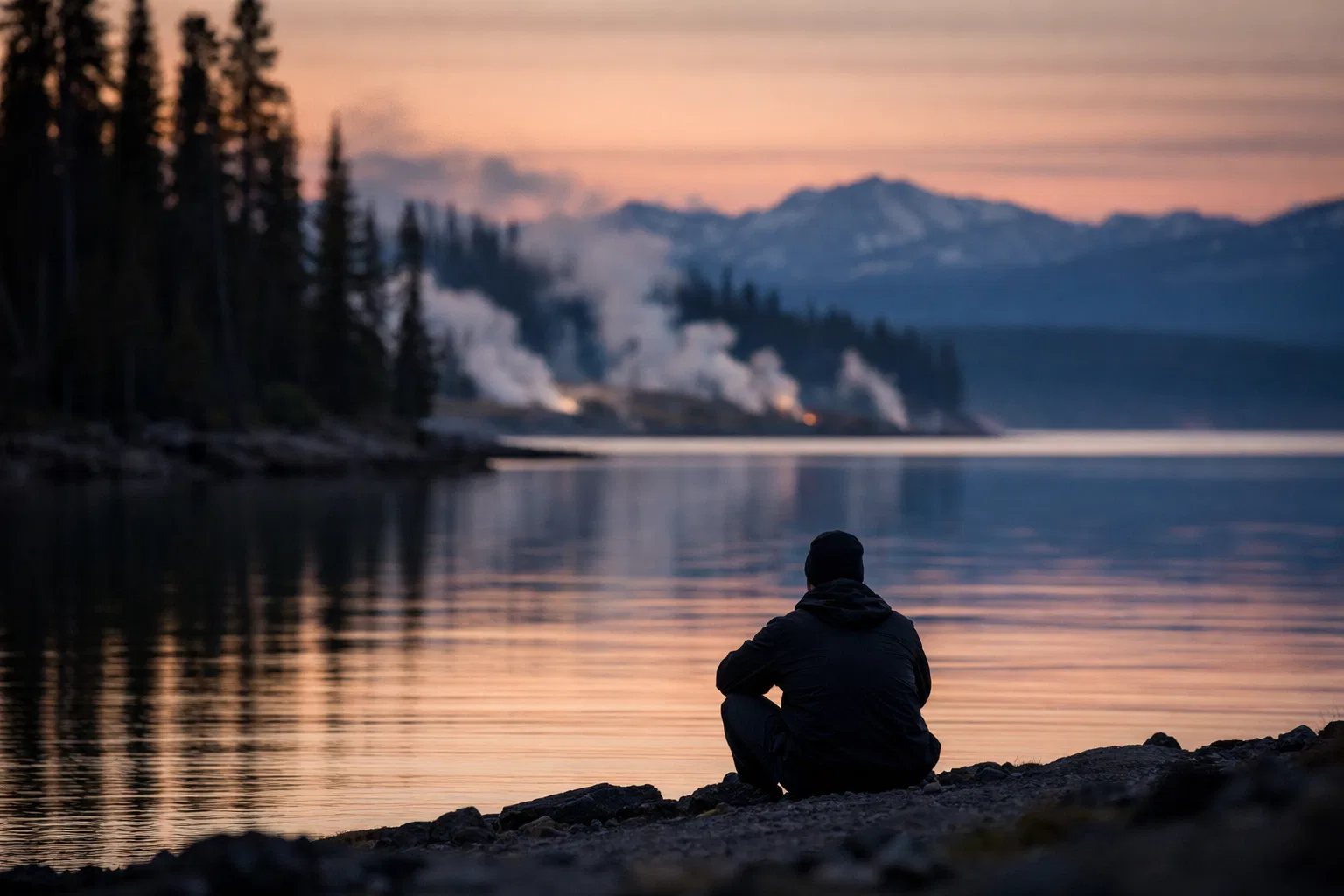
Yellowstone Lake’s “music” is one of Wyoming’s strangest non-creature mysteries: a reported buzzing, humming or ringing sound that seems to move through the air over Yellowstone and nearby Shoshone Lake. It is not a lake-monster sighting, a hidden animal claim, or proof of anything supernatural. It is better understood as an acoustic mystery: a real tradition of witness descriptions, some of them from early scientists and engineers, attached to a landscape already famous for geysers, steam, deep cold water, winter ice, hidden vents and sudden weather shifts. The useful question is not “what beast made the noise?” but “why does a place like Yellowstone make people think in monster-shaped ways?” The answer sits between physics and folklore: unusual sound behaviour, thin evidence, dramatic scenery, and the human habit of giving agency to eerie sensations when no obvious source appears.[National Park Service]nps.govNational Park Service Unexplained and Unreported Phenomenon in YellowstoneNational Park Service Unexplained and Unreported Phenomenon in Yellowstone
What Is Yellowstone Lake Music?
“Lake music” usually refers to odd overhead or lake-borne sounds reported around Yellowstone Lake, especially in calm conditions. Historical descriptions compare it to telegraph wires, bells, a swarm of bees, a harp, wind in pine tops, distant voices, or a metallic hum. The National Park Service describes the phenomenon as a buzzing sound that moves across Lake Yellowstone and notes that reports go back to the late nineteenth century, while also saying no one has been able to conclude what causes it.[National Park Service]nps.govNational Park Service Unexplained and Unreported Phenomenon in YellowstoneNational Park Service Unexplained and Unreported Phenomenon in Yellowstone
The name can be slightly confusing because it covers more than one listening experience. Some accounts describe a summer or clear-weather overhead sound near Yellowstone and Shoshone Lakes. Others refer to the winter “singing” of frozen Yellowstone Lake, when ice reacts to changing temperatures and produces eerie howls, groans and ringing tones. The National Park Service has an audio recording labelled “Singing Lake”, described as the rare wintertime song of Yellowstone Lake as ice reacts to temperature change; the transcript simply records an “eerie, howling noise”.[National Park Service]nps.govNational Park Service Sound LibraryNational Park Service Sound Library
For a cryptid-minded reader, that distinction matters. A lake monster story usually begins with a body, a shape, a wake, a head, a fin, a roar, or a repeated animal-like presence. Yellowstone Lake music begins with disembodied sound. It belongs beside mystery-beast folklore because it shows the same storytelling mechanism at work — an uncanny stimulus in a wild setting — but it should not be filed as a creature report.
The Historic Buzzing Over Yellowstone Lake
One of the strongest reasons the story has lasted is that it was not only told by anonymous tourists. Hiram M. Chittenden, the US Army engineer closely associated with early Yellowstone road and improvement work, included the phenomenon in his 1895 book on the park. He called it a “singular and interesting acoustic phenomenon” and placed it specifically near Shoshone and Yellowstone Lakes. According to Chittenden, the sounds were rarely noticed by tourists, seemed to occur in the morning, lasted only a moment, and appeared to move through the air, generally from north to south.[Project Gutenberg]gutenberg.orgYellowstone National Park, by Hiram Martin Chittenden, a Project Gutenberg eBook…
Chittenden also quoted Edwin Linton, whose account gives the mystery much of its texture. Linton described a sound that seemed to begin at a distance, grow louder overhead, fill the upper air, and suggest several familiar noises at once: wind in pine tops, telegraph wires, repeated bell echoes and the hum of bees. That mixture is important. The witness was not describing a roar from a single point, but an atmospheric sound with no obvious source.[Project Gutenberg]gutenberg.orgYellowstone National Park, by Hiram Martin Chittenden, a Project Gutenberg eBook…
Frank H. Bradley, a geologist with the Hayden surveys, is often cited in later summaries for a similar report from the early park period. He described a sound heard while breakfast was being prepared along Yellowstone Lake: something between a whistle and a hoarse whine, initially hard to locate and first suspected to be waterfowl on the other side of the lake. Later retellings also note that S. A. Forbes, writing from the same scientific milieu, compared the effect to a harp, telegraph wires, or faint voices overhead.[yellowstonegate.com]yellowstonegate.comOpen source on yellowstonegate.com.
The pattern is consistent enough to be interesting but not strong enough to be solved from testimony alone. Reports cluster around large, cold, high-elevation lakes in Yellowstone; they often involve stillness, morning conditions, and an impression of motion overhead. What they do not include is a stable source, a visible animal, a trackway, a carcass, or a repeated biological behaviour. That is why the lake music is best treated as a documented acoustic tradition rather than a cryptid case.

Why This Is Not a Creature Claim
The lake music may sound haunted, but the evidence points away from an animal explanation. Witnesses generally describe a moving sound field rather than calls from a creature. They do not report seeing a body in the water, hearing splashing attached to an animal, finding remains, or observing a pattern that would match a large unknown species.
That difference separates Yellowstone Lake music from Wyoming’s more obviously creature-shaped legends. Lake DeSmet’s “Smetty”, for example, belongs to the lake-monster tradition because it involves claims of something living in the water. The jackalope belongs to tall-tale animal folklore because it has a visible body, even if that body is a taxidermy joke. Yellowstone Lake music has no creature body at all. It is a sensation in the landscape.
The National Park Service itself frames the subject as an unexplained acoustic phenomenon, not as wildlife evidence. Its archive discussion places lake music among unusual Yellowstone reports, but says the park archives do not hold documents that can explain it; it also notes that scientific studies and speculation have not produced a settled cause. That is a far more cautious position than “unknown animal”.[National Park Service]nps.govNational Park Service Unexplained and Unreported Phenomenon in YellowstoneNational Park Service Unexplained and Unreported Phenomenon in Yellowstone
This caution makes the story more, not less, useful. In monster folklore, people often leap from “I experienced something strange” to “something strange must be alive out there”. Yellowstone Lake music shows the earlier stage of that process. It is the raw material from which a monster mood can form: an unexplained signal, a vast setting, and a listener trying to make sense of it.
Natural Mechanisms That Could Make a Lake Sound Haunted
There is no single confirmed explanation for all reports grouped under “lake music”, but several plausible mechanisms help explain why Yellowstone Lake can sound uncanny without requiring a creature.
Ice can sing. In winter, Yellowstone Lake freezes completely in most years. The National Park Service says the lake usually freezes in late December or early January, with ice ranging from a few inches to more than two feet thick, and thaws in late May or early June. Its sound-library entry explicitly connects the rare “Singing Lake” recording to ice reacting to changing temperatures.[National Park Service]nps.govNational Park Service Yellowstone LakeNational Park Service Yellowstone Lake
When ice expands, contracts, cracks and transmits vibrations across a broad sheet, it can produce tones that seem musical, metallic or alive. Yellowstone Forever’s account describes pops, groans and pipe-organ-like tones on the frozen lake, while noting that the exact source is uncertain and that one theory involves freezing, expansion, moving water beneath the ice and travelling cracks.[Yellowstone Forever]yellowstone.orgForever Winter Song: When Yellowstone Lake SingsForever Winter Song: When Yellowstone Lake Sings
Temperature inversions can move sound oddly. A temperature inversion occurs when cooler air sits near the surface and warmer air lies above it. In such conditions, sound can bend back towards the surface and travel farther or seem to arrive from an unexpected direction. A Pennsylvania State University acoustics explainer uses the example of hearing campers across a lake at night because sound is refracted by temperature differences near the lake surface.[Penn State Acoustics]acs.psu.eduPenn State Acoustics Refraction of Sound WavesPenn State Acoustics Refraction of Sound Waves
That idea fits some historic Yellowstone descriptions better than a monster does. Early writers often placed the sound overhead, moving, and heard in calm morning conditions. A temperature inversion or other atmospheric layering over cold water could make distant sources — birds, wind, geothermal activity, people, boats in later periods, or cracking ice — seem displaced, magnified or detached from their origin. It would not prove every account, but it gives a physical pathway for “sound without a visible source”.
The lake bottom is genuinely active. Yellowstone Lake is not an ordinary mountain lake sitting on quiet rock. The National Park Service says the northern half of the lake lies inside the 640,000-year-old Yellowstone Caldera, and surveys from 1999 to 2007 mapped large hydrothermal explosion craters, siliceous spires, hundreds of hydrothermal vents, craters, fissures, young faults, landslide deposits and old submerged shorelines.[National Park Service]nps.govNational Park Service Yellowstone Lake GeologyNational Park Service Yellowstone Lake Geology
Research published in Communications Earth & Environment adds that an acoustic system was deployed at a large thermal field on the floor of Yellowstone Lake, where gas bubbles can act as sound sources. The study found that small pressure changes can trigger carbon dioxide bubble formation in gas-rich hydrothermal fluids, and notes that the lake has experienced multiple hydrothermal explosions since the last glaciation.[Nature]nature.comOpen source on nature.com.
That does not mean the classic lake music is “caused by underwater volcanoes”. It means the setting is acoustically and geologically complicated. A large cold lake over hydrothermal vents, faults, gas-rich fluids and changing ice is exactly the kind of place where ordinary categories — bird, wind, wave, machine — may fail a listener in the moment.

The Winter Song and the Older Overhead Sound
The winter “Singing Lake” and the older “overhead sounds” should be kept related but not collapsed into one tidy explanation. The winter version has a relatively direct mechanism: ice reacting to changing temperature, movement and stress. It has been recorded by the National Park Service, described by park-associated sources, and heard in conditions where ice noise is expected.[National Park Service]nps.govNational Park Service Sound LibraryNational Park Service Sound Library
The older lake music is harder. Chittenden’s account was not simply “ice cracking in winter”. He described morning sounds with apparent movement through the air near Yellowstone and Shoshone Lakes, and Linton’s description emphasised an overhead sound that grew louder and then faded. That is why atmospheric sound refraction, distant-source mirage effects, wind behaviour, birds, geysers, small earthquakes and other possibilities have all been proposed without settling the matter.[Project Gutenberg]gutenberg.orgYellowstone National Park, by Hiram Martin Chittenden, a Project Gutenberg eBook…
A good sceptical reading therefore does two things at once. It accepts that credible observers may have heard something unusual. It also refuses to treat “unexplained” as a blank cheque. The most likely answer may not be one grand cause, but a family of effects: winter ice music in one season, atmospheric sound ducting in another, distant wildlife or geothermal noises in particular conditions, and the occasional human tendency to remember the weirdest version most vividly.
How Eerie Landscapes Invite Monster Thinking
Yellowstone is almost built to make the mind personify nature. Steam rises from holes in the ground. Mud pots gulp. Geysers roar. Lakes freeze, crack and sing. Wildlife appears suddenly and at large scale: bison in the road, elk bugling, wolves calling, bears moving through timber. A visitor does not need to believe in monsters to understand why the park’s sounds can feel intentional.
This is where lake music belongs in Wyoming’s cryptid tradition. It is not a creature story, but it helps explain the emotional environment in which creature stories thrive. A listener hears a hum moving overhead with no visible source. The lake is still. The shore is remote. The air is cold. The park already has a reputation for danger and wonder. In that moment, a natural sound can feel less like weather and more like a presence.
Chittenden noticed this more than a century ago. After giving the Linton description, he wrote that no rational explanation had been advanced and that the weird character of the phenomenon matched its strange surroundings; in other times and places, he suggested, it might have become an object of superstition or dread. That line is almost a blueprint for how mystery landscapes become folklore landscapes.[Project Gutenberg]gutenberg.orgYellowstone National Park, by Hiram Martin Chittenden, a Project Gutenberg eBook…
The point is not that early witnesses were foolish. It is that humans interpret ambiguous signals through setting. A buzzing sound in a city becomes machinery. The same sound moving over a high, cold lake in Yellowstone becomes “music”, “voices”, “whispers”, or perhaps, in another storyteller’s hands, a sign of something watching from the water.
Where Lake Music Fits in Wyoming Mystery Lore
Wyoming’s odd-animal folklore often has a playful or thinly evidenced quality: the jackalope is a celebrated hoax, Bigfoot reports are scattered, and lake monsters such as Smetty depend heavily on local testimony and repetition. Yellowstone Lake music adds a different branch. It shows that the state’s mystery tradition is not only about animals glimpsed at the edge of sight. Sometimes the mystery is environmental: a sound, a pressure change, a vibration, a lake that seems to sing.
That makes it useful as a bridge between creature folklore and natural history. Readers who come looking for monsters may leave with a better sense of how monster stories begin. A strange experience does not have to be fake to be misread. A witness can honestly hear something uncanny, describe it vividly, and still not be reporting an unknown animal.
The strongest evidence for Yellowstone Lake music is therefore not zoological. It is documentary and acoustic: repeated historical descriptions, an official park acknowledgement that reports exist, recorded winter lake sounds, and a setting where ice, air, water and geothermal activity all provide plausible sound-making mechanisms.[nps.gov]nps.govNational Park Service Unexplained and Unreported Phenomenon in YellowstoneNational Park Service Unexplained and Unreported Phenomenon in Yellowstone
What the Haunted Sound Probably Teaches Us
The most careful conclusion is that Yellowstone Lake music is a genuine folklore-and-sound tradition with no confirmed single cause. Some modern “singing lake” sounds are plausibly linked to winter ice reacting to temperature changes. Some older overhead reports may involve atmospheric refraction, distant natural sources, wind effects, or geologic and hydrothermal noise behaving oddly around a huge cold lake. None of the credible evidence requires a hidden creature.
That does not drain the story of its strangeness. It sharpens it. Yellowstone Lake music is memorable because it sits exactly where folklore often begins: not with proof of a monster, but with an experience that feels too patterned to ignore and too elusive to explain on the spot. In Wyoming’s mystery-beast landscape, it is the sound before the sighting — the hum in the air that reminds readers how easily a haunted place can teach the imagination to listen for animals that may not be there.
Amazon book picks
Further Reading
Books and field guides related to Why Does Yellowstone Lake Sound Haunted?. Use these as the next step if you want deeper reading beyond the article.
Abominable Science!
Useful for understanding why unexplained phenomena often attract supernatural interpretations.
The United States of Cryptids
Connects unusual place-based mysteries with the traditions that grow around them.
American Monsters
Provides context for how eerie landscapes generate monster thinking and mystery traditions.
eBay marketplace picks
Marketplace Samples
Live-tested eBay searches with available results related to this page.


Endnotes
1.
Source: gutenberg.org
Title: Project Gutenberg
Link:https://www.gutenberg.org/cache/epub/42112/pg42112-images.html
Source snippet
Yellowstone National Park, by Hiram Martin Chittenden, a Project Gutenberg eBook...
2.
Source: yellowstone.org
Title: Forever Winter Song: When Yellowstone Lake Sings
Link:https://www.yellowstone.org/winter-song/
3.
Source: nature.com
Link:https://www.nature.com/articles/s43247-022-00417-6
4.
Source: yellowstone.org
Title: frightening phenomena in yellowstone national park
Link:https://www.yellowstone.org/frightening-phenomena-in-yellowstone-national-park/
5.
Source: gutenberg.org
Link:https://www.gutenberg.org/files/42112/42112-h/42112-h.htm
6.
Source: archive.org
Link:https://archive.org/download/yellowstonenatio1900chit/yellowstonenatio1900chit.pdf
7.
Source: nps.gov
Title: National Park Service Unexplained and Unreported Phenomenon in Yellowstone
Link:https://www.nps.gov/yell/blogs/unexplained-and-unreported-phenomenon-in-yellowstone.htm
8.
Source: nps.gov
Title: National Park Service Sound Library
Link:https://www.nps.gov/yell/learn/photosmultimedia/sounds-singinglake.htm
9.
Source: yellowstonegate.com
Link:https://www.yellowstonegate.com/?p=1498
10.
Source: yellowstonepark.com
Title: yellowstone mysterious lake music
Link:https://www.yellowstonepark.com/things-to-do/natural-wonders/yellowstone-mysterious-lake-music/
11.
Source: nps.gov
Title: National Park Service Yellowstone Lake
Link:https://www.nps.gov/yell/learn/nature/yellowstone-lake.htm
12.
Source: acs.psu.edu
Title: Penn State Acoustics Refraction of Sound Waves
Link:https://www.acs.psu.edu/drussell/demos/refract/refract.html
13.
Source: nps.gov
Title: National Park Service Yellowstone Lake Geology
Link:https://www.nps.gov/yell/learn/nature/yellowstone-lake-geology.htm
14.
Source: nps.gov
Title: Sound Library
Link:https://www.nps.gov/yell/learn/photosmultimedia/soundlibrary.htm
15.
Source: nps.gov
Link:https://www.nps.gov/yell/learn/upload/ys_11_2_sm.pdf
16.
Source: nps.gov
Link:https://www.nps.gov/yell/learn/historyculture/upload/RG01Geo.pdf
17.
Source: nps.gov
Title: West Thumb, Grant, and the South
Link:https://www.nps.gov/yell/planyourvisit/westthumbgrantvillage.htm
18.
Source: nps.gov
Link:https://www.nps.gov/yell/learn/nature/water.htm
19.
Source: nps.gov
Title: Sound Library
Link:https://www.nps.gov/yell/learn/photosmultimedia/sounds-soundscapes.htm
20.
Source: nps.gov
Title: Hydrothermal Features
Link:https://www.nps.gov/yell/learn/nature/hydrothermal-features.htm
21.
Source: nps.gov
Link:https://www.nps.gov/yell/learn/upload/4_RI_2026_Geology.pdf
22.
Source: nps.gov
Link:https://www.nps.gov/yell/learn/upload/YS_21_1.pdf
23.
Source: nps.gov
Title: Yellowstone Science
Link:https://www.nps.gov/yell/learn/upload/YS_18_1_sm.pdf
24.
Source: nps.gov
Link:https://www.nps.gov/yell/learn/upload/ys_14_4_sm.pdf
25.
Source: home.nps.gov
Title: sounds singinglake
Link:https://home.nps.gov/yell/learn/photosmultimedia/sounds-singinglake.htm
26.
Source: yellowstonenationalparklodges.com
Title: sounds of yellowstone
Link:https://www.yellowstonenationalparklodges.com/connect/yellowstone-hot-spot/sounds-of-yellowstone/
27.
Source: yellowstonenationalparklodges.com
Link:https://www.yellowstonenationalparklodges.com/connect/yellowstone-hot-spot/unexplained/
28.
Source: jstor.org
Link:https://www.jstor.org/stable/1650232
29.
Source: facebook.com
Link:https://www.facebook.com/ynpforever/posts/-no-that-is-not-the-sound-of-strong-winds-you-hear-over-yellowstone-lake-it-is-a/10157028316744650/
30.
Source: reddit.com
Title: yellowstone lake music
Link:https://www.reddit.com/r/UnexplainedPhotos/comments/35amso/yellowstone_lake_music/
31.
Source: govinfo.gov
Link:https://www.govinfo.gov/content/pkg/GOVPUB-I29-PURL-gpo91264/pdf/GOVPUB-I29-PURL-gpo91264.pdf
32.
Source: acousticatlas.org
Title: Yellowstone National Park Collection
Link:https://acousticatlas.org/yellowstone/
Additional References
33.
Source: youtube.com
Title: Acoustic Dispersion (And How You Can Make Your Own)
Link:https://www.youtube.com/watch?v=KO3AjxVx1r0
Source snippet
Artists' Mudpot — ASMR, Sleep, Concentration (Sounds of Yellowstone)...
34.
Source: facebook.com
Link:https://www.facebook.com/OrbitalInsights/posts/a-small-hydrothermal-explosion-at-yellowstone-national-parks-biscuit-basin-creat/1342682258064395/
35.
Source: umt.edu
Link:https://www.umt.edu/crown-yellowstone/documents/e-publications/crown-of-the-continent-and-greater-yellowstone-magazine_issue-15_fall-2016.pdf
36.
Source: facebook.com
Link:https://www.facebook.com/groups/ssainderby/posts/10156067055205899/
37.
Source: facebook.com
Link:https://www.facebook.com/groups/160568857638394/posts/2283043068724285/
38.
Source: facebook.com
Link:https://www.facebook.com/groups/YellowstoneInsidersHub/posts/505899000141338/
39.
Source: abebooks.co.uk
Link:https://www.abebooks.co.uk/Overheard-sounds-Yellowstone-Lake-region-Linton/30671457555/bd
40.
Source: jstor.org
Link:https://www.jstor.org/stable/15493
41.
Source: facebook.com
Link:https://www.facebook.com/YellowstoneNPS/videos/-sound-onice-transforms-yellowstone-each-winter-halting-waterfalls-in-their-trac/264772048317443/
42.
Source: readingroo.ms
Link:https://readingroo.ms/5/9/0/9/59092/59092-h/59092-h.htm
Topic Tree