Within Utah Monsters
Could Monsters Live in the Great Salt Lake?
Old Briney and the whale legend survive because the Great Salt Lake feels uncanny, not because its biology supports monsters.
On this page
- Old Briney and the North Shore tale
- The impossible whale legend
- Salinity, brine shrimp and sceptical biology
Page outline Jump by section
Introduction
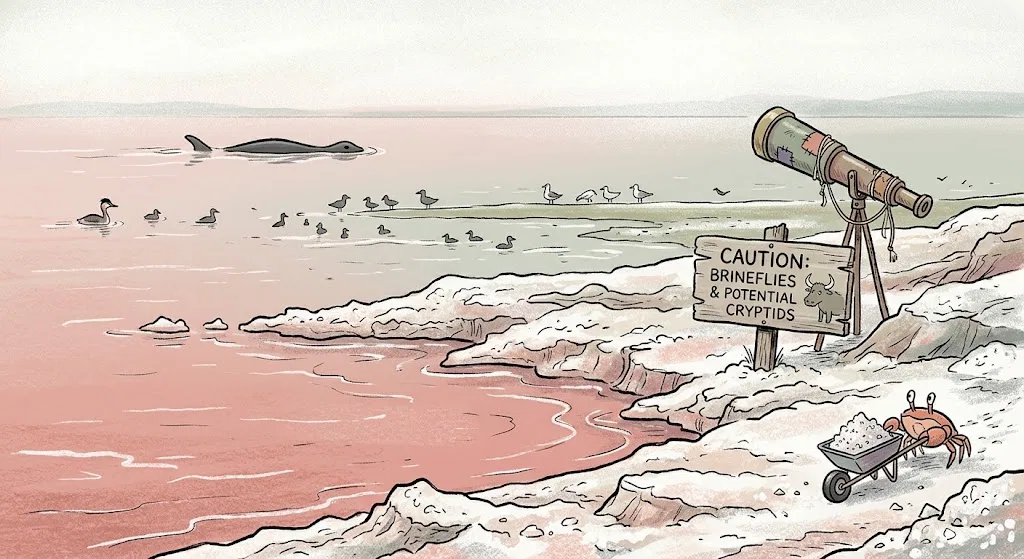
Could monsters live in the Great Salt Lake? As folklore, yes: Utah has an old North Shore monster story, the creature often remembered as Old Briney, plus a wonderfully absurd whale legend that has kept resurfacing in local retellings. As biology, almost certainly not. The lake is hypersaline, shallow, food-limited for large predators, and famous precisely because only highly specialised organisms can live in its main waters. The best-supported reading is that Great Salt Lake monster stories survive because the place feels otherworldly: pink water, salt crust, mirages, flies, brine shrimp, empty islands, and a shoreline that can look more lunar than aquatic.
That makes the Great Salt Lake one of Utah’s most useful cryptid settings. Unlike Bear Lake or Utah Lake, where a reader might imagine hidden fish or a freshwater serpent, the Great Salt Lake forces a harder question: what kind of “monster” could survive in a lake whose real ecology is built on microbes, brine flies, brine shrimp, and birds? The answer is that the legends tell us more about frontier imagination, newspaper humour, and uncanny landscape than about unknown animals. The lake’s chemistry is not a backdrop to the story; it is the story.[deseret.com]deseret.comDeseret NewsGreat tales surrounding the Great Salt Lake Its briny bowels are filled with monster myths – Deseret News…
Old Briney and the North Shore tale
The classic Great Salt Lake monster is usually called the North Shore Monster or Old Briney. The core report dates to the summer of 1877, when J. H. McNeil of Kelton and other employees of Barnes and Co. Salt Works said they saw a huge creature in the lake near Monument Point and the Central Pacific Railroad line. Later retellings describe a beast with a crocodile-like body and a horse-like head, making a bellowing noise and charging towards the workers, who fled up a hillside and hid in brush until morning.[Deseret News]deseret.comDeseret NewsGreat tales surrounding the Great Salt Lake Its briny bowels are filled with monster myths – Deseret News…
That scene has everything a good Utah monster story needs: dusk, industrial isolation, a briny shoreline, frightened workers, and an animal shape just clear enough to be memorable but too strange to verify. The setting matters. Monument Point lies on the lake’s remote north-western side, away from Salt Lake City’s everyday urban frame. A saltworks crew at the edge of a shallow inland sea was already working in a landscape that could feel half-natural and half-alien. A dark shape in the water did not have to be supernatural to become dramatic.
The account is thin as zoological evidence. It is not a specimen, photograph, trackway, repeatable sighting series, or ecological pattern. It is a reported encounter, preserved through newspapers and later folklore. A sceptical explanation sometimes offered is that the “monster” may have been a buffalo or bison in the water, which would at least explain a large, dark, alarming animal form without requiring an unknown lake creature. The horse-headed, crocodile-bodied description does not fit a bison neatly, but eyewitness descriptions made in fear, low light, distance, and excitement often grow sharper and stranger in retelling.[Deseret News]deseret.comDeseret NewsGreat tales surrounding the Great Salt Lake Its briny bowels are filled with monster myths – Deseret News…
Old Briney therefore sits between misidentification and legend. It is not as culturally central as the Bear Lake Monster, but it is more revealing in one way: it places a conventional “lake monster” template inside a lake that is deeply hostile to conventional lake monsters. The story’s force comes from the contradiction. A freshwater serpent in a deep mountain lake can be imagined as elusive. A horse-headed crocodile in the Great Salt Lake has to overcome the lake itself.
The impossible whale legend
The whale legend is even more useful because it almost announces its own impossibility. In one common version, a British entrepreneur or scientist named James Wickham supposedly imported young whales from Australia in the 1870s, shipped them by rail to Utah, and released them into the Great Salt Lake to create a whaling industry. Later newspaper retellings claimed the whales survived, reproduced, and were seen spouting in the lake.[Utah Historical Society]history.utah.govOpen source on utah.gov.
The Deseret News traced the tale to a June 24, 1890, article in the Utah Enquirer, while noting that searches in historical files did not turn up confirming evidence from the supposed 1875 introduction. The same account also included a biological blunder about “whale eggs”, a comic giveaway because whales are mammals and give birth to live young. That detail makes the story read less like a failed scientific report and more like a newspaper tall tale dressed in the language of enterprise and natural history.[Deseret News]deseret.comwhale of a salty tale swims through pages of old paperwhale of a salty tale swims through pages of old paper
The whale story also belongs to a specific 19th-century mood. The Great Salt Lake attracted schemes, rumours, and proposals because it looked like an inland sea and sat beside a growing settler economy. If the lake was salty, why not imagine oysters, fish, crabs, eels, or whales? Deseret News coverage of Great Salt Lake legends notes reports or proposals involving attempts to plant various sea creatures, while also stating that none survived the extreme salinity. The whale tale is the grandest version of that impulse: if the lake resembles the sea, make it host the sea’s largest animals.[Deseret News]deseret.comDeseret NewsGreat tales surrounding the Great Salt Lake Its briny bowels are filled with monster myths – Deseret News…
As a cryptid story, the whales are not a normal “unknown animal” claim. They are closer to a hoax, joke, or civic myth: a deliberately overlarge idea that became memorable because it was so geographically odd. Utah’s lake monster tradition often works by borrowing familiar monster shapes — serpents, crocodiles, porpoises, whales — and dropping them into landscapes that make them stranger. The Great Salt Lake whale is funny because it is too big for the evidence and too biologically awkward for the water.
Why the lake itself rules out big monsters
The Great Salt Lake is a terminal, or endorheic, lake: water flows in but has no natural surface outlet, so dissolved salts accumulate as water evaporates. The U.S. Geological Survey describes it as the shrunken remnant of prehistoric Lake Bonneville and notes that salinity south of the railroad causeway has ranged from 6% to 27% over a 22-year period, or roughly two to seven times saltier than the ocean. That is not a minor inconvenience for a large animal; it is the defining physical condition of the habitat.[U.S. Geological Survey Publications]pubs.usgs.govU.S. Geological Survey PublicationsUSGS WRIR 99-4189: Great Salt Lake, Utah…
A monster large enough to be described as crocodile-bodied, horse-headed, dolphin-like, or whale-sized would need more than water. It would need a stable food supply, tolerable chemistry, enough depth and space, reproductive partners, and a population large enough to avoid disappearing after one generation. The Great Salt Lake’s main open-water food web is real and important, but it is not built to support hidden large predators. Its famous living resources are brine shrimp, brine flies, algae, bacteria, archaea, and the millions of birds that feed on that system.[U.S. Geological Survey Publications]pubs.usgs.govU.S. Geological Survey PublicationsUSGS WRIR 99-4189: Great Salt Lake, Utah…
The lake is also shallow. FRIENDS of Great Salt Lake lists an average depth of about 15 feet and a maximum depth of 33 feet at average elevation, with large changes in surface area caused by relatively small changes in water level. That matters for monster claims because shallow, fluctuating lakes offer fewer places for a large animal to hide long-term. A whale, crocodile-sized reptile, or unknown mammal would not merely need to appear once at dusk; it would have to live, feed, breathe, reproduce, and leave ecological traces in a basin watched by scientists, industries, birders, boaters, and shoreline visitors.[Friends of Great Salt Lake]fogsl.orgFriends of Great Salt LakeFRIENDS of Great Salt Lake - About the Lake…
The north and south arms complicate the picture further but do not help the monster case. The railroad causeway divides the lake into different salinity zones. The north arm, cut off from most freshwater inflow, is so salty that only specialised salt-loving microbes can survive there, giving the water a pinkish colour. The south arm supports the better-known brine shrimp and brine fly food web, but even there salinity changes can push the system towards stress.[Friends of Great Salt Lake]fogsl.orgFriends of Great Salt LakeFRIENDS of Great Salt Lake - About the Lake…
In other words, the lake is not lifeless, but its life is specialised and small-bodied. That is the key distinction. “Nothing can live there” is false; “a large aquatic monster could live there unnoticed” is the claim that collapses.
Brine shrimp are not monster food
The most tempting rescue for a Great Salt Lake monster is to point at the lake’s abundance of brine shrimp. If birds can feed there, why not something larger? The problem is scale and food-chain structure. Brine shrimp are tiny crustaceans, valuable in huge numbers, but a large vertebrate predator would need enough energy to grow, move, thermoregulate, reproduce, and maintain a viable population. A few dramatic sightings cannot supply that ecological budget.
Modern research underlines how narrow and condition-dependent this system is. A 2024 Hydrobiologia study describes the Great Salt Lake’s pelagic food web as dominated by the brine shrimp Artemia franciscana and found that survival, development, and reproduction depend strongly on salinity, temperature, food type, and food amount. Survival was best at 90 parts per thousand salinity, with other life-stage transitions and reproductive modes varying by conditions. That is a sophisticated extremophile ecology, not a simple soup waiting to feed a hidden whale.[Springer]link.springer.comOpen source on springer.com.
The lake’s current conservation worries also show how fragile the food web can be. FRIENDS of Great Salt Lake reports that a healthy salinity range for Gilbert Bay, in the south arm, is about 13–15%, and that in 2022 it reached 19%, approaching the maximum threshold brine shrimp and brine flies can tolerate. If the lake’s keystone invertebrates are themselves threatened by salinity shifts, then a large resident monster depending on them would be even less plausible.[Friends of Great Salt Lake]fogsl.orgFriends of Great Salt LakeFRIENDS of Great Salt Lake - About the Lake…
This is where Great Salt Lake folklore differs sharply from some freshwater lake monster traditions. In a deep freshwater lake, believers may imagine unknown fish, giant eels, or relict reptiles hiding below the surface. In the Great Salt Lake, the real hidden drama is microscopic and invertebrate: algae, microbes, cysts, larvae, salinity gradients, and migratory birds timing their journeys around seasonal abundance. The ecological “monster” is not a beast under the water but a system so extreme that it makes ordinary aquatic assumptions fail.
Why the stories still feel believable at the shoreline
The Great Salt Lake is visually persuasive even when the biology is not. It can look like open sea, desert basin, salt flat, wet mirror, industrial works, bird refuge, and ghost landscape in the same mental image. Its shorelines shift dramatically. Its smell, colours, insect life, salt crusts, mirages, and exposed lakebed all make it feel unstable. For a monster legend, that atmosphere does a lot of work.
Several natural features can encourage strange reports without requiring an unknown animal:
- Low light and distance. The Old Briney account took place at dusk or early evening, when silhouettes on water are easiest to misread and hardest to size accurately.[Deseret News]deseret.comDeseret NewsGreat tales surrounding the Great Salt Lake Its briny bowels are filled with monster myths – Deseret News…
- Real large animals nearby. Bison on Antelope Island and other animals at the lake’s edge provide plausible sources for startling shapes, especially when partly submerged or seen from afar.[Atlas Obscura]atlasobscura.comantelope island great salt lakeantelope island great salt lake
- Bird and insect abundance. The lake hosts huge numbers of migratory and nesting birds, supported by brine shrimp and brine flies. A moving mass of birds, insects, water disturbance, and reflection can make the surface look alive in unexpected ways.[U.S. Geological Survey Publications]pubs.usgs.govU.S. Geological Survey PublicationsUSGS WRIR 99-4189: Great Salt Lake, Utah…
- A landscape already full of legend. Deseret News round-ups of Great Salt Lake lore place monsters alongside whales, whirlpools, underwater quicksand, island mysteries, and other local tales, showing that the lake has long functioned as a magnet for stories about danger and strangeness.[Deseret News]deseret.comDeseret NewsGreat tales surrounding the Great Salt Lake Its briny bowels are filled with monster myths – Deseret News…
None of these explanations proves what McNeil and the saltworks employees saw. They do something more useful: they show why a monster story could form naturally in that place. A cryptid legend does not require a monster to begin. It needs a strange sight, a memorable setting, a retellable shape, and enough uncertainty for the story to keep breathing.
Folklore, hoax, and ecology in one Utah setting
Great Salt Lake monster lore works best when separated into three overlapping categories. Old Briney is a witness-claim legend: a reported encounter with a frightening animal form, later stabilised into a named creature. The whale story is a tall tale or hoax-like newspaper legend: a comic pseudo-industrial fantasy about turning Utah’s inland saltwater into a whaling ground. The lake’s real ecology is neither of those, but it explains why both are so biologically strained.[Deseret News]deseret.comDeseret NewsGreat tales surrounding the Great Salt Lake Its briny bowels are filled with monster myths – Deseret News…
That separation matters because it lets the story stay fun without pretending the evidence is stronger than it is. Old Briney can remain part of Utah’s monster map as a north-shore legend. The whales can remain a brilliant local absurdity. The lake can remain ecologically astonishing in its own right. But the more one learns about salinity, depth, and food webs, the less plausible a large resident creature becomes.
The strongest interpretation is not that Utahns foolishly believed impossible animals lived in the lake. It is that the Great Salt Lake invites impossible animals. It looks marine but is not the sea. It is full of life but hostile to fish. It is vast from the shore but shallow by monster standards. It is beautiful, smelly, productive, depleted, pink, silver, and white by turns. A normal lake monster story asks, “What is hiding down there?” The Great Salt Lake asks a better question: “Why does this place make us want there to be something hiding at all?”
Amazon book picks
Further Reading
Books and field guides related to Could Monsters Live in the Great Salt Lake?. Use these as the next step if you want deeper reading beyond the article.
Abominable Science!
Useful for assessing extraordinary monster claims in unusual environments.
The United States of Cryptids
Places Great Salt Lake monster stories within U.S. cryptid folklore.
eBay marketplace picks
Marketplace Samples
Live-tested eBay searches with available results related to this page.

Endnotes
1.
Source: deseret.com
Link:https://www.deseret.com/1999/8/1/19458498/great-tales-surrounding-the-great-salt-lake-br-its-briny-bowels-are-filled-with-monster-myths/
Source snippet
Deseret NewsGreat tales surrounding the Great Salt Lake<BR> Its briny bowels are filled with monster myths – Deseret News...
2.
Source: history.utah.gov
Link:https://history.utah.gov/blog/gsl-whales/
3.
Source: deseret.com
Title: whale of a salty tale swims through pages of old paper
Link:https://www.deseret.com/1995/10/3/19196613/whale-of-a-salty-tale-swims-through-pages-of-old-paper/
4.
Source: link.springer.com
Link:https://link.springer.com/article/10.1007/s10750-024-05684-2
5.
Source: pubs.usgs.gov
Link:https://pubs.usgs.gov/wri/wri994189/
Source snippet
U.S. Geological Survey PublicationsUSGS WRIR 99-4189: Great Salt Lake, Utah...
6.
Source: fogsl.org
Link:https://fogsl.org/about/map
Source snippet
Friends of Great Salt LakeFRIENDS of Great Salt Lake - About the Lake...
7.
Source: Wikipedia
Title: North Shore Monster
Link:https://en.wikipedia.org/wiki/North_Shore_Monster
8.
Source: atlasobscura.com
Title: antelope island great salt lake
Link:https://www.atlasobscura.com/places/antelope-island-great-salt-lake
Additional References
9.
Source: youtube.com
Link:https://www.youtube.com/watch?v=buHNXLvsfpQ
Source snippet
Secrets of Great Salt Lake - Extremophiles...
10.
Source: youtube.com
Title: Tipping Point – The Great Salt Lake Institute
Link:https://www.youtube.com/watch?v=q3gaRNRCdNw
Source snippet
Toxic Dust and Economic Collapse: The Real Cost of losing the Great Salt Lake...
11.
Source: youtube.com
Title: Secrets of Great Salt Lake
Link:https://www.youtube.com/watch?v=fMFNERsyqTo
Source snippet
Tipping Point – The Great Salt Lake Institute...
12.
Source: youtube.com
Title: Toxic Dust and Economic Collapse: The Real Cost of losing the Great Salt Lake
Link:https://www.youtube.com/watch?v=hK51GxDBDjg
Topic Tree