Within Rhode Island Monsters
Which Real Animals Feed the Legends?
Seals, basking sharks, coyotes, bobcats, black bears, and poor visibility give many Rhode Island monster stories their believable edge.
On this page
- Land animals that surprise people
- Marine animals that look monstrous
- Why brief sightings grow
Page outline Jump by section
Introduction
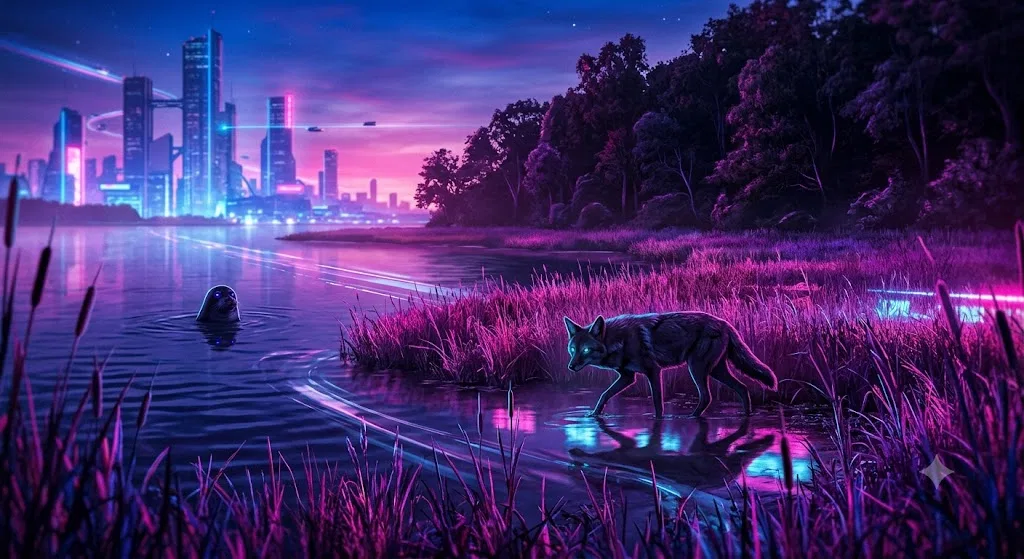
Rhode Island’s monster stories often work because the state’s real animals already behave like half-seen legends. A seal’s head in Narragansett Bay can look oddly doglike or humanlike before it dives. A basking shark fin near Block Island can trigger instant “Jaws” talk even when the animal is a harmless plankton-feeder. A bobcat crossing a suburban driveway at night can become a “big cat” rumour; a transient black bear can lend weight to Bigfoot-like woodland stories; a coyote’s yip, shape or movement can sound stranger than it is in poor light. The point is not that every Rhode Island creature report has a neat explanation. It is that the Ocean State’s coast, ponds, woods and thickly settled edges give ordinary wildlife unusually good conditions for becoming monster material. Rhode Island’s legends feel plausible because the real animals are plausible first.[ri.gov]dem.ri.govFrom September to April, seal counts are conducted monthly at 15 sites around Narragansett Bay, coinciding with the seasonal peak…Read…
Why ordinary Rhode Island animals become extraordinary
Rhode Island is small, but it is not visually simple. A witness may be looking across foggy water, through scrubby coastal vegetation, down a dark road, or into a wooded property line where an animal is visible for only a second. That matters because monster reports rarely begin with a calm, well-lit, repeated observation. They begin with mismatch: the brain sees a head, fin, tail, shape, splash or set of eyes, then tries to name it before the animal is gone.
The state’s wildlife agencies quietly show why this happens. Rhode Island’s Department of Environmental Management asks the public to report sightings of species such as black bear, bobcat, coyote, fisher, fox, beaver, mink, muskrat, river otter and porcupine, not because these are monsters, but because some are secretive, expanding, locally uncommon or easily overlooked. In other words, the official wildlife picture already includes animals that ordinary residents may not expect to meet.[RIDEM]dem.ri.govreport wildlife observationsreport wildlife observations
That surprise is the seed of misidentification. A person who does not expect a bobcat in Warwick, Coventry, Scituate or South Kingstown may reach for “mountain lion” or “mystery cat”. Someone who sees a bear in a state better known for beaches than backwoods may connect it to a hairy humanoid story. Someone who sees a large fin in Great Salt Pond may think “predator” before “basking shark”. The animal is real; the monster is often the interpretation added under pressure.
Land animals that surprise people
Rhode Island’s land-based monster misidentifications are most believable where suburban life meets woods, wetlands and rural roads. The western and southern parts of the state are especially good at producing this effect: not wilderness in the western US sense, but enough forest, swamp, stone walls, deer trails and dark lanes to make a short sighting difficult to judge.
Bobcats are the clearest example. The bobcat is native to Rhode Island, but the state’s own factsheet notes that it has never been considered common or widespread there. Recent evidence points to a comeback: University of Rhode Island researchers launched the Rhode Island Bobcat Project using public reports, camera traps and GPS collars, and by March 2026 the project had passed 1,000 public bobcat sightings. Researchers reported sightings from across the state, with southern Rhode Island and towns such as Charlestown and South Kingstown well represented.[ri.gov]dem.ri.govOpen source on ri.gov.
That is exactly the kind of animal that feeds “phantom cat” thinking. A bobcat is not a cougar, but it has a compact muscular body, short tail, pointed ears and a low, purposeful gait. Seen at night, partly hidden by brush, or enlarged by fear, it can become “too big for a bobcat” in memory. The URI project is useful for sceptical monster reading because it shows both sides at once: people really are seeing more wild cats, but the cats being documented are known bobcats, not evidence of a hidden population of larger exotic felines.[uri.edu]uri.eduhigh interest in uris statewide bobcat projectHigh interest in URI's statewide bobcat project5 Mar 2026 — The information that URI's team has gathered from public reports, alongside c…
Coyotes add a different kind of confusion. Rhode Island’s eastern coyote is a normal resident predator, and the state’s coyote material notes a winter-to-early-spring breeding season, with pups born in spring. Coyotes are also now routine enough in suburban and urban neighbourhoods that DEM has had formal management guidance for public encounters. Their calls can sound eerie, and a coyote moving through a headlight beam can look taller, thinner or stranger than a familiar dog.[RIDEM]dem.ri.govOpen source on ri.gov.
Coyotes are not a perfect explanation for Bigfoot-style reports, but they often explain the supporting atmosphere around them: night sounds, missing-pet rumours, glimpses of “something” crossing a road, or a sense that a familiar patch of woods is suddenly occupied. For Rhode Island monster lore, coyotes help make the landscape feel alive after dark. They are not the monster; they are part of the soundscape that makes the monster seem possible.
Black bears are rarer but more dramatic. DEM’s black bear information says bears were once common in Rhode Island, disappeared around 1800, and that present-day sightings generally involve transient bears. The agency’s “Living Alongside Black Bears” guidance adds that sightings of these transient animals have increased in recent years, including in rural areas, suburbs and highly developed areas.[RIDEM]dem.ri.govOpen source on ri.gov.
A bear is the most important real animal behind some hairy-monster impressions because it can briefly stand upright, move through woodland with surprising silence, and leave a witness with only size, darkness and motion. In a place where many residents do not expect bears, even a real bear can feel impossible. That does not prove “Big Rhodey” or any other Bigfoot variant, but it gives a grounded reason why large, dark, upright-looking shapes in the woods can become memorable creature stories.
Fishers, foxes, otters and other furbearers matter too, especially in smaller reports that never become famous. Rhode Island asks residents to report several furbearers, including fisher, grey fox, red fox, mink, muskrat and river otter. These animals can move quickly, appear at odd hours, and look unfamiliar to people who mainly know squirrels, deer and domestic pets. A fisher’s long body and bounding movement, an otter crossing a road near water, or a fox with mange can all generate a “what was that?” moment without requiring anything unknown.[RIDEM]dem.ri.govreport wildlife observationsreport wildlife observations
Marine animals that look monstrous
Rhode Island’s strongest misidentification engine is the sea. Water hides scale. Waves remove context. Distance flattens shape. A head, fin or carcass can be seen without the body that would make it obvious. That is why Rhode Island’s coastal legends are so often more convincing than its inland ones: the ocean does half the special effects.
Seals are the everyday example. DEM’s seal monitoring programme counts seals monthly from September to April at 15 sites around Narragansett Bay, matching the seasonal peak in local seal presence. Save The Bay’s seal report notes that harbour seals are the most common seals in Narragansett Bay, while grey, harp and hooded seals are occasional visitors; grey seals are more common around Block Island. NOAA also describes harbour seals as common along the US East Coast, often resting on rocks and beaches and feeding in marine and estuarine waters.[ri.gov]dem.ri.govFrom September to April, seal counts are conducted monthly at 15 sites around Narragansett Bay, coinciding with the seasonal peak…Read…
A seal is easy to underestimate as a monster-maker until one is seen badly. A dark, wet head rising from the water can resemble a dog, person, serpent or unknown mammal. A seal swimming low shows little more than a rounded head and wake. A hauled-out group on rocks can look like a pile of dark bodies until binoculars or a boat tour resolves the scene. This is why seal habitat matters for Rhode Island folklore: not because seals are rare, but because they are common enough to be glimpsed by people who are not expecting them.
Basking sharks produce the more spectacular mistake. NOAA notes that basking sharks are often mistaken for great white sharks because of their similar dorsal fin, even though they are filter-feeders that cruise through the water feeding on tiny planktonic prey. That mismatch between frightening silhouette and harmless behaviour is perfect monster fuel.[NOAA Fisheries]fisheries.noaa.govtagging reveals secrets southern californias largest sharksNOAA FisheriesTagging Reveals Secrets of Southern California's Largest…9 May 2019 — Often mistaken for great white sharks because of t…
Block Island supplied a modern demonstration in May 2025, when a roughly 20-foot shark in Great Salt Pond caused excitement and “Jaws” comparisons. Reports identified it as a basking shark, a large but harmless filter-feeder, and noted that such animals can appear alarming when their fin and tail cut through sheltered water near boats and diners. The incident matters for Rhode Island monster lore because it shows the process in real time: a real animal, an unexpected setting, a dramatic silhouette, a film-shaped cultural reference, and rapid online amplification.[foxweather.com]foxweather.comblock island ri great salt pond basking sharkblock island ri great salt pond basking shark
Dead marine animals can be even stranger than living ones. The “Block Ness Monster” tradition is usually discussed as a sea-serpent-style carcass, and the most common sceptical explanation is a decomposed basking shark. This is not a random guess: decaying basking sharks are notorious for becoming “pseudo-sea-serpents” because their gill structures and soft tissues break down, leaving forms that can look long-necked, small-headed and prehistoric to non-specialists. A recent discussion of a similar Canadian sea-monster case explains that, as a basking shark decays, the collapse of the gill basket and loss of body tissues can leave a long spinal structure and small head that look mythological rather than shark-like.[sentinelhillpress.com]sentinelhillpress.comSentinel Hill Press Cryptober day 9 – The Block Ness MonsterSentinel Hill Press Cryptober day 9 – The Block Ness Monster
That is the key to many coastal monster carcasses: decomposition is not neutral. It edits the animal. It removes the familiar parts first and leaves the misleading parts behind. By the time a beachgoer sees the remains, the body may no longer look like the animal it once was.
Why brief sightings grow
A Rhode Island monster report often becomes more convincing after the sighting, not during it. The first moment may be only a splash, a dark shape, a fin, a cry, a track or a road-crossing animal. The story grows as the witness retells it, compares it with local rumours, searches online, or hears someone else say, “That sounds like the thing people saw near there.”
Several mechanisms do the work:
- Scale without reference points. Water and woodland both make size hard to judge. A seal head can look larger without a visible body; a bobcat can look cougar-sized if seen close, low and moving fast; a bear glimpse can become taller in memory if it briefly rises or crosses behind brush.
- Expectation gaps. People misidentify animals more readily when they do not believe the animal should be there. Rhode Island’s documented bobcat comeback and increased transient bear sightings make this especially important: the “impossible” animal may simply be an unfamiliar but real one.[uri.edu]uri.eduhigh interest in uris statewide bobcat projectHigh interest in URI's statewide bobcat project5 Mar 2026 — The information that URI's team has gathered from public reports, alongside c…
- Poor light and partial bodies. Dusk, headlights, fog, rain, choppy water and vegetation all produce fragmentary sightings. The witness may see only a dorsal fin, a tail, a shoulder, reflective eyes or a head above water.
- Local naming. Once a story gains a label such as “Big Rhodey” or “Block Ness Monster”, later reports become easier to attach to it. The label does not create the original sighting, but it gives later witnesses a ready-made box for ambiguous experiences.
- Media and pop culture. The 2025 Block Island basking shark shows how quickly a real animal can be framed through “Jaws”. That does not mean witnesses are foolish; it means popular images supply the first comparison when a large fin appears somewhere unexpected.[CT Insider]ctinsider.comOpen source on ctinsider.com.
This is why sceptical explanations should not be treated as boring debunking. They often make the story more interesting. A vague “sea monster” is one thing; a basking shark that looks like a horror-film predator while quietly filtering plankton is stranger in a better, truer way.
How to read a Rhode Island monster report
The most useful question is not “Was it real or fake?” but “What kind of real thing could create that report?” Rhode Island’s wildlife gives readers a practical way to sort claims without draining the fun from them.
For a large dark shape in the woods, the first checks are bear, deer, human, dog, coyote and shadowed tree movement. Bear matters most if the report includes size, bulk, dark colour, heavy movement or a brief upright posture. DEM’s bear guidance makes clear that modern Rhode Island bear sightings are possible, especially as transient animals move through rural and developed areas.[RIDEM]dem.ri.govDEMLIVING ALONGSIDE BLACK BEARSSightings of these transient bears in Rhode Island have increased in recent years, with bears spotted in…
For a mystery cat, bobcat should be the starting point. A true cougar claim would need stronger evidence than a fleeting glimpse: clear photographs, tracks verified by experts, genetic material, a carcass, or repeated documentation from camera traps. Rhode Island’s current evidence supports bobcats returning and being reported more often, not a confirmed breeding population of larger phantom cats.[ri.gov]dem.ri.govOpen source on ri.gov.
For a strange cry, yelp or night chorus, coyotes are a strong candidate. Their calls carry, vary and overlap in ways that can sound like several animals or something distressed. The more suburban the setting, the more surprising the sound may feel, even though DEM has long treated coyote encounters in developed Rhode Island areas as a routine management issue.[RIDEM]dem.ri.govOpen source on ri.gov.
For a head or body in the bay, seals deserve serious consideration, especially from autumn through spring. Their seasonal presence in Narragansett Bay is not folklore; it is counted, monitored and built into local nature programming.[ri.gov]dem.ri.govFrom September to April, seal counts are conducted monthly at 15 sites around Narragansett Bay, coinciding with the seasonal peak…Read…
For a fin, huge fish or sea-serpent impression near Block Island or the open coast, basking shark belongs high on the list. A living basking shark can look like a dangerous shark from the fin alone; a dead one can look even less like a shark after decomposition.[NOAA Fisheries]fisheries.noaa.govtagging reveals secrets southern californias largest sharksNOAA FisheriesTagging Reveals Secrets of Southern California's Largest…9 May 2019 — Often mistaken for great white sharks because of t…
What the real animals tell us about the legends
The strongest Rhode Island misidentification explanations do not say “nothing happened”. They say something probably did happen: an animal crossed the road, surfaced in the bay, moved through a garden, left a track, cried in the dark or washed ashore in a ruined shape. The mistake comes later, when a brief encounter is asked to carry more certainty than it can bear.
That is why Rhode Island is a good state for evidence-aware monster reading. Its creature lore is not built on vast wilderness or ancient ruins. It is built on compact, ordinary, highly suggestive habitats: Narragansett Bay in winter, Block Island waters in shark season, suburban edges where bobcats now pass through driveways, rural corridors where transient bears appear, and coyote country close enough to hear from the back garden.[ri.gov]dem.ri.govFrom September to April, seal counts are conducted monthly at 15 sites around Narragansett Bay, coinciding with the seasonal peak…Read…
The result is a state where the sceptical explanation often belongs inside the legend rather than outside it. Seals, basking sharks, coyotes, bobcats and bears do not cancel Rhode Island’s monster stories. They explain why the stories keep sounding possible.
Amazon book picks
Further Reading
Books and field guides related to Which Real Animals Feed the Legends?. Use these as the next step if you want deeper reading beyond the article.
National Audubon Society Field Guide to North American Mammals
Useful for bears, bobcats, coyotes and other animals behind legends.
Peterson Field Guide To Mammals Of North America
Supports wildlife-based interpretations of sightings.
eBay marketplace picks
Marketplace Samples
Live-tested eBay searches with available results related to this page.
Endnotes
1.
Source: dem.ri.gov
Link:https://dem.ri.gov/natural-resources-bureau/marine-fisheries/fisheries-science-research/surveys/Seals
Source snippet
From September to April, seal counts are conducted monthly at 15 sites around Narragansett Bay, coinciding with the seasonal peak...Read...
2.
Source: uri.edu
Title: high interest in uris statewide bobcat project
Link:https://www.uri.edu/news/2026/03/high-interest-in-uris-statewide-bobcat-project/
Source snippet
High interest in URI's statewide bobcat project5 Mar 2026 — The information that URI's team has gathered from public reports, alongside c...
3.
Source: fisheries.noaa.gov
Title: tagging reveals secrets southern californias largest sharks
Link:https://www.fisheries.noaa.gov/feature-story/tagging-reveals-secrets-southern-californias-largest-sharks
Source snippet
NOAA FisheriesTagging Reveals Secrets of Southern California's Largest...9 May 2019 — Often mistaken for great white sharks because of t...
Published: May 2019
4.
Source: dem.ri.gov
Title: report wildlife observations
Link:https://dem.ri.gov/natural-resources-bureau/fish-wildlife/report-wildlife-observations
5.
Source: dem.ri.gov
Link:https://dem.ri.gov/ri-wildlife
6.
Source: dem.ri.gov
Link:https://dem.ri.gov/sites/g/files/xkgbur861/files/2023-09/bobcat_0.pdf
7.
Source: uri.edu
Title: new statewide project calls on public to report bobcat sightings
Link:https://www.uri.edu/news/2025/09/new-statewide-project-calls-on-public-to-report-bobcat-sightings/
8.
Source: dem.ri.gov
Link:https://dem.ri.gov/sites/g/files/xkgbur861/files/programs/bnatres/fishwild/pdf/coyote.pdf
9.
Source: dem.ri.gov
Link:https://dem.ri.gov/sites/g/files/xkgbur861/files/programs/bnatres/fishwild/pdf/blackbear.pdf
10.
Source: fisheries.noaa.gov
Link:https://www.fisheries.noaa.gov/species/harbor-seal
11.
Source: people.com
Link:https://people.com/giant-shark-spotted-in-rhode-island-pond-block-island-11743859
12.
Source: fisheries.noaa.gov
Title: narragansett laboratory
Link:https://www.fisheries.noaa.gov/about/narragansett-laboratory
13.
Source: fisheries.noaa.gov
Title: share shore seals new england mid atlantic
Link:https://www.fisheries.noaa.gov/new-england-mid-atlantic/marine-life-viewing-guidelines/share-shore-seals-new-england-mid-atlantic
14.
Source: coast.noaa.gov
Link:https://coast.noaa.gov/data/czm/media/narragansettbay.pdf
15.
Source: blog.nature.org
Title: a field guide to commonly misidentified mammals
Link:https://blog.nature.org/2019/08/20/a-field-guide-to-commonly-misidentified-mammals/
16.
Source: web.uri.edu
Link:https://web.uri.edu/wp-content/uploads/sites/2078/fishers.pdf
17.
Source: web.uri.edu
Link:https://web.uri.edu/rhodeislandwoods/wildlife/
18.
Source: dem.ri.gov
Link:https://dem.ri.gov/sites/g/files/xkgbur861/files/programs/bnatres/fishwild/pdf/black-bear-response.pdf
Source snippet
DEMLIVING ALONGSIDE BLACK BEARSSightings of these transient bears in Rhode Island have increased in recent years, with bears spotted in...
19.
Source: dem.ri.gov
Link:https://dem.ri.gov/media/36161/download
20.
Source: dem.ri.gov
Link:https://dem.ri.gov/sites/g/files/xkgbur861/files/2024-10/furharv.pdf
21.
Source: savebay.org
Link:https://savebay.org/wp-content/uploads/Seal-Report_2021FINAL_web.pdf?srsltid=AfmBOoqij4iDFK8FQW03gvL33hUu8u-C67k7DW7Vm2Ptfopo2BsDOlj&mkevt=1&mkcid=1&mkrid=710-53481-19255-0&campid=5339151051&customid=endnote-source&toolid=10001
22.
Source: foxweather.com
Title: block island ri great salt pond basking shark
Link:https://www.foxweather.com/earth-space/block-island-ri-great-salt-pond-basking-shark
23.
Source: ctinsider.com
Link:https://www.ctinsider.com/news/article/block-island-shark-sighting-great-salt-pond-20352695.php
24.
Source: sentinelhillpress.com
Title: Sentinel Hill Press Cryptober day 9 – The Block Ness Monster
Link:https://sentinelhillpress.com/2020/10/12/cryptober-day-9-the-block-ness-monster/
25.
Source: statecryptids.blogspot.com
Title: block island monster rhode island
Link:https://statecryptids.blogspot.com/2015/09/block-island-monster-rhode-island.html
26.
Source: savebay.org
Link:https://savebay.org/family-fun/seals/?srsltid=AfmBOoqTjPdJxdnD5hpovodqn5Sm9681CVcok24WqorVm6gnvfys3qY-&mkevt=1&mkcid=1&mkrid=710-53481-19255-0&campid=5339151051&customid=endnote-source&toolid=10001
27.
Source: ri.gov
Link:https://www.ri.gov/
28.
Source: dem.ri.gov
Title: coyote mgnt response guide
Link:https://dem.ri.gov/sites/g/files/xkgbur861/files/programs/bnatres/fishwild/pdf/coyote-mgnt-response-guide.pdf
29.
Source: dem.ri.gov
Title: fw newsletter w19
Link:https://dem.ri.gov/sites/g/files/xkgbur861/files/programs/bnatres/fishwild/outreach/wildlife/fw-newsletter-w19.pdf
30.
Source: dem.ri.gov
Link:https://dem.ri.gov/sites/g/files/xkgbur861/files/programs/bnatres/fishwild/pdf/wrispr16.pdf
31.
Source: dem.ri.gov
Title: rhode island bear wise
Link:https://dem.ri.gov/sites/g/files/xkgbur861/files/2022-08/rhode-island-bear-wise.pdf
32.
Source: dem.ri.gov
Link:https://dem.ri.gov/sites/g/files/xkgbur861/files/programs/bnatres/fishwild/pdf/wrispr11.pdf
33.
Source: dem.ri.gov
Title: law enforcement
Link:https://dem.ri.gov/law-enforcement
34.
Source: dem.ri.gov
Title: balance kit educator packet
Link:https://dem.ri.gov/sites/g/files/xkgbur861/files/programs/bnatres/fishwild/outreach/critter-kits/balance-kit-educator-packet.pdf
35.
Source: dem.ri.gov
Title: govwild rhode island
Link:https://dem.ri.gov/sites/g/files/xkgbur861/files/programs/bnatres/fishwild/outreach/explorer/wrie-fa21.pdf
36.
Source: dem.ri.gov
Title: wildri spring25
Link:https://dem.ri.gov/sites/g/files/xkgbur861/files/2025-04/wildri-spring25.pdf
37.
Source: dem.ri.gov
Title: WildRI Spring 2017
Link:https://dem.ri.gov/sites/g/files/xkgbur861/files/programs/bnatres/fishwild/pdf/WildRI_Spring_2017.pdf
38.
Source: dem.ri.gov
Link:https://dem.ri.gov/sites/g/files/xkgbur861/files/programs/bnatres/fishwild/pdf/wrifll19.pdf
39.
Source: dem.ri.gov
Link:https://dem.ri.gov/sites/g/files/xkgbur861/files/programs/director/adminadj/pdfs/11001FaWE.pdf
40.
Source: dem.ri.gov
Title: dfw division overview
Link:https://dem.ri.gov/sites/g/files/xkgbur861/files/programs/bnatres/fishwild/pdf/dfw-division-overview.pdf
41.
Source: dem.ri.gov
Title: wild explorer fa19
Link:https://dem.ri.gov/sites/g/files/xkgbur861/files/programs/bnatres/fishwild/outreach/wildlife/wild-explorer-fa19.pdf
42.
Source: dem.ri.gov
Title: conservation research
Link:https://dem.ri.gov/natural-resources-bureau/fish-wildlife/conservation-research
43.
Source: tripadvisor.com
Title: Save The Bay Seal Watch & Nature Cruises
Link:https://www.tripadvisor.com/Attraction_Review-g60978-d3916216-Reviews-Save_The_Bay_Seal_Watch_Nature_Cruises-Newport_Rhode_Island.html
44.
Source: Wikipedia
Title: Basking shark
Link:https://en.wikipedia.org/wiki/Basking_shark
45.
Source: rhodeislandcurrent.com
Title: save the bay volunteers count nearly 600 seals along rhode island coastline
Link:https://rhodeislandcurrent.com/briefs/save-the-bay-volunteers-count-nearly-600-seals-along-rhode-island-coastline/
46.
Source: youtube.com
Link:https://www.youtube.com/watch?v=BRaSgKZfkEY
Additional References
47.
Source: theguardian.com
Link:https://www.theguardian.com/environment/2026/may/07/basking-shark-sea-monster-canada-marine-mystery-90-years-on
Source snippet
Experts now believe the carcass was likely a decomposing basking shark, known to transform significantly during decay, often appearing as...
48.
Source: youtube.com
Title: We Found The Block Island Basking Shark + Fluke/Stripers
Link:https://www.youtube.com/watch?v=55nuYdLFces
Source snippet
URI's statewide bobcat project passes 1,000 sightings this winter[https://www.youtube.com/watch?v=Bpe-dnXDI-dnX](https://www.youtube.com/watch?v=Bpe-dnXDI-dnX) The University of Rhode Is...
49.
Source: youtube.com
Title: Bears caught on camera in two local communities
Link:https://www.youtube.com/watch?v=VHBEFosGaG8
Source snippet
"Black bear sips from koi pond in West Greenwich[https://www.youtube.com/watch?v=c_X5jMi2aaY..."](https://www.youtube.com/watch?v=c_X5jMi2aaY...")...
50.
Source: facebook.com
Link:https://www.facebook.com/ourplaceflea/videos/-bear-sighting-reported-by-12-news-viewer-in-burrillville-rhode-island-a-12-news/1336643005064793/
51.
Source: reddit.com
Link:https://www.reddit.com/r/sharks/comments/1kz69l0/20ft_shark_spotted_in_block_island_wvideo/
52.
Source: facebook.com
Link:https://www.facebook.com/NBC10Boston/posts/a-20-foot-basking-shark-was-spotted-recently-swimming-near-block-island-off-the-/1117913017035716/
53.
Source: reddit.com
Link:https://www.reddit.com/r/Cryptozoology/comments/1g9h3nf/a_drawing_of_the_block_ness_monster_a_creature/
54.
Source: facebook.com
Link:https://www.facebook.com/RhodeIslandDEM/videos/fisher-pekania-pennanti/287376352642103/
55.
Source: facebook.com
Link:https://www.facebook.com/100044218067114/videos/although-they-are-enormous-and-their-silhouettes-look-remarkably-like-great-whit/323141808965033/
56.
Source: facebook.com
Link:https://www.facebook.com/groups/fansofdeepblue/posts/3152179124920389/
Topic Tree