Within Indiana Monsters
Why Indiana Monsters Gather in Certain Places
Indiana's creature stories cluster where murky water, dark woods and searchable newspaper archives keep rumours alive.
On this page
- Water, woods and poor visibility
- Newspapers as monster making machines
- Archives, festivals and modern retellings
Page outline Jump by section
Introduction
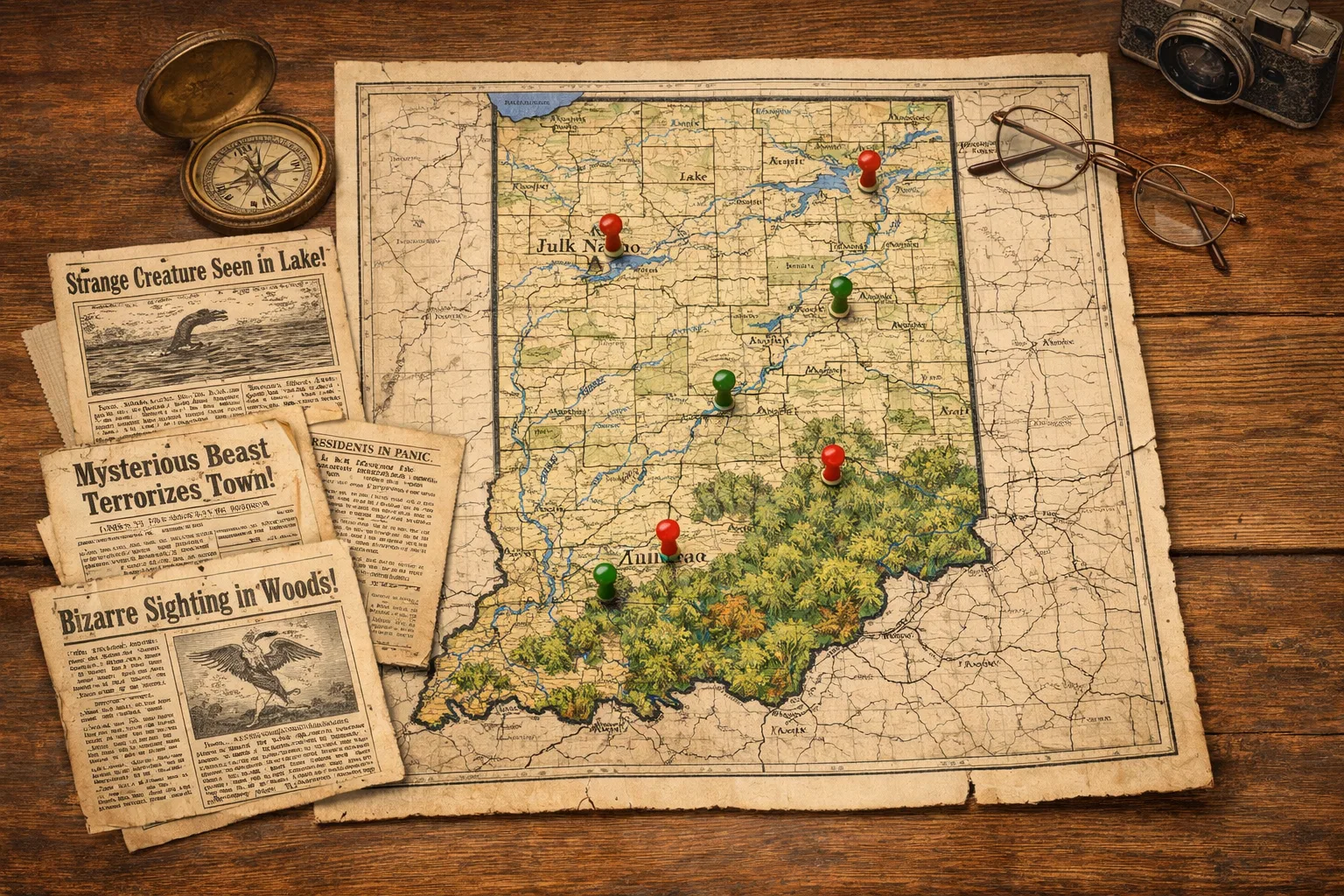
Indiana’s monsters tend to gather in two places at once: in awkward landscapes where people glimpse only part of something, and in newspapers that turn those glimpses into shareable local drama. The state’s creature trail runs through Fulk Lake at Churubusco, Lake Manitou near Rochester, the night sky over Crawfordsville, wooded camp edges, river parks and southern Indiana forest country. In each case, the habitat matters because water, darkness, fog, tree cover, floodplain woods and poor visibility make ordinary animals, pranks or rumours easier to misread. The media trail matters just as much because Indiana’s historic newspapers recorded, amplified, mocked and preserved these stories long before modern cryptid websites existed.
That does not mean Indiana’s monsters are proven animals. It means the state is especially good for watching folklore being made: a sighting becomes a local item, the item becomes a repeated story, and the story later becomes a festival, archive entry, podcast episode, roadside curiosity or “weird Indiana” talking point. Indiana’s monster map is therefore less a zoological map than a map of habitat, attention and memory.
Water, woods and poor visibility
The most famous Indiana monster habitat is murky water. That is not accidental. A pond or lake can hide most of an animal’s body, distort size, and let a floating log, turtle head, muskrat, fish, bird or patch of weeds look much stranger than it would in daylight on dry ground. The Beast of Busco works so well because the claimed creature was not a dragon or alien beast, but an enormous turtle in Fulk Lake near Churubusco. Indiana historians describe it as the state’s most thoroughly newspaper-covered cryptid: Gale Harris reported seeing the turtle in 1948, papers pushed the hunt in 1949, locals tried cranes, divers, lake-draining and bait, and a cash reward was offered, yet no monster was captured.[The Indiana History Blog]blog.history.in.govOpen source on in.gov.
The Busco setting gave the story its plausibility. Indiana really does have large turtles, and the alligator snapping turtle is a useful comparison even if it does not prove Oscar existed. Indiana DNR says the alligator snapping turtle’s status in the state is uncertain, that old records existed in extreme south-west Indiana, that the species was thought extirpated until one was found near the White River in Morgan County in 1991, and that it is considered endangered in Indiana. It also prefers deep pools in large rivers, while also occurring in lakes, swamps, smaller streams and similar waters.[Indiana Government]in.govdiana Government Fish and Wildlife: Alligator Snapping Turtlediana Government Fish and Wildlife: Alligator Snapping Turtle The fit is imperfect: Fulk Lake is a small northern Indiana lake, not the species’ classic large-river habitat. But the comparison shows why a turtle monster could feel almost reasonable to readers. A partly seen aquatic reptile is far easier to believe than a wholly invented beast.
Lake Manitou shows the older, more mythic side of the same water pattern. The Lake Manitou Association says the lake’s name is tied to a Potawatomi word meaning “spirit”, and that people who hunted and fished in the area associated its waters with a monster fish or serpent of supernatural power; early settlers knew it as “Devil’s Lake”.[Lake Manitou Association]lakemanitou.orgLake Manitou Association Manitou Facts & History — Lake Manitou AssociationLake Manitou Association Manitou Facts & History — Lake Manitou Association A later Indiana history account points to an 1838 Logansport Telegraph article describing a lake monster tradition at Manitou, with witnesses estimating a creature sixty feet long, with a cow-like head, tapering neck and yellow-spotted body.[The Indiana History Blog]blog.history.in.govOpen source on in.gov. Here, the “habitat” is not only physical water but inherited meaning: a lake already framed as spiritually charged is more likely to hold a monster in local imagination.
Wooded Indiana produces a different sort of monster. Instead of a single visible lake creature, the typical woodland account depends on edges: a camp boundary, a road through trees, a state forest trail, a park at night, or a property line where a dark figure crosses and disappears. Indiana University’s folklore collections include interviews from the 1960s to the 1980s about local supernatural creatures, including a scout-camp Gullywompus at Camp Louis Ernst in DuPont. Older scouts reportedly led younger scouts to the edge of camp, left them without flashlights, ran through brush making animal noises, and then revealed the scare as a legend.[Indiana University Libraries Blog]blogs.libraries.indiana.eduOpen source on indiana.edu. That is monster habitat in its purest social form: not remote wilderness, but a managed place where darkness, peer pressure and tradition turn ordinary woods into a test of nerve.
Southern Indiana adds real landscape texture to Bigfoot-style reports. Brown County State Park is described by Indiana DNR as nearly 16,000 acres of rugged hills, ridges and fog-shrouded ravines, with steep slopes, deep gullies, tree-lined roads and long views over uninterrupted forestland.[Indiana Government]in.govdiana Government State Parks: Brown County State Parkdiana Government State Parks: Brown County State Park The Bigfoot Field Researchers Organization, a private sightings database rather than official evidence, lists Indiana reports including a 2020 Brown County sighting in Yellowwood State Forest, a 2020 Washington County report near Spurgeon Hollow Lake, and other county entries across the state.[BFRO]bfro.netReports for IndianaReports for Indiana These listings should be read as claims, not confirmation. Their usefulness is geographical: they show that modern hairy-creature reports tend to favour the same environments where witnesses have partial views, night sounds and plenty of cover.
Wetlands and floodplain parks sit between the lake monster and forest monster traditions. Muscatatuck National Wildlife Refuge, for example, is described by the U.S. Fish and Wildlife Service as a pocket of diverse land and water where natural wetlands have long attracted birds and other wildlife.[U.S. Fish and Wildlife Service]fws.govOpen source on fws.gov. Such places are excellent for real animals and also excellent for uncertainty: moving water, reeds, bird calls, low light and distant silhouettes all encourage interpretation. Indiana’s “monster habitats” are often ordinary wildlife habitats seen under poor viewing conditions.
Newspapers as monster-making machines
Indiana’s monster folklore is unusually readable because newspapers did so much of the early monster-making. A claim did not need to be proven to travel. It needed to be vivid, local, repeatable and just plausible enough for editors to print. Once in print, it could be copied, mocked, expanded or revived decades later.
The Crawfordsville Monster is the clearest example. In September 1891, residents of Crawfordsville reported a strange airborne form. Later summaries describe the first reports as coming from ice delivery men and then other witnesses, with newspapers presenting a white, headless, finned, wheezing apparition moving through the night sky. The story spread from local papers to wider newspapers, generated ridicule as well as belief, and was later explained by two local men as a flock of killdeer, possibly disoriented by newly installed electric lights.[Wikipedia]WikipediaCrawfordsville monsterCrawfordsville monster
That explanation matters because it shows the whole mechanism in miniature. The “monster” depended on night work, new urban lighting, birds behaving unusually, and a newspaper culture ready to turn a startling observation into a sensation. The same account could be read three ways: as a witness claim, as a comic newspaper episode, or as an early example of how technological change altered the night sky. Crawfordsville’s monster did not need to live in a cave or lake. Its habitat was the space between birds, electric lights and print culture.
Lake Manitou’s monster also owes much of its survival to print. The 1838 Logansport Telegraph did not merely record a creature story; it gave readers a striking image of a lake already associated with Indigenous and settler legend. Later historical discussion notes that artist George Winter had learned something of the “Devil’s Lake” story and used that material in articles for the Telegraph.[Ray E. Boomhower's Books]rayboomhower.blogspot.comOpen source on blogspot.com. That does not make the lake serpent either true or false in simple terms. It shows a folklore handoff: oral tradition, local interpretation, illustrated newspaper storytelling and later historical memory all reinforce one another.
The Beast of Busco shows the twentieth-century version of the same pattern. In 1949, newspapers helped turn a farm pond report into a public hunt. Headlines, rewards, crowds and repeated failed capture attempts made the turtle more famous with every unsuccessful day. The Indiana history account notes that Churubusco residents became turtle hunters, proposed a display house if the creature were caught, and still celebrate the reptilian resident through Turtle Days.[The Indiana History Blog]blog.history.in.govOpen source on in.gov. In other words, newspaper attention did not simply report the legend; it gave the town a role to perform.
Historic newspaper access now shapes the legend a second time. Hoosier State Chronicles, operated by the Indiana State Library, provides free online access to digitised Indiana newspapers and contains more than 186,000 issues and over 1.5 million pages from 1804 to 2018.[Indiana Government]in.govdiana Government Indiana State Library: Hoosier State Chroniclesdiana Government Indiana State Library: Hoosier State Chronicles That archive lets modern readers trace whether a creature story appears in contemporary reports, later reminiscence, syndicated copy or modern retelling. For Indiana cryptid research, the archive is not just a source cupboard. It is part of the folklore trail itself, because searchable old newspapers decide which monsters can be rediscovered.
How the Indiana monster trail works
A useful Indiana monster map is not a pinboard of “sightings” alone. It is a set of recurring mechanisms. The same ingredients appear again and again, even when the creature changes from turtle to lake serpent to sky spook to hairy park monster.
First, the setting limits what the witness can know. Fulk Lake hides a turtle’s body under water. Lake Manitou enlarges uncertainty with depth, distance and old spiritual associations. Brown County and Yellowwood give only short views through forest. Camp legends use darkness and sound. Wetlands add reeds, birds and reflections. The monster begins where visibility ends.
Second, the creature type usually borrows from local ecology. Indiana’s water monsters often resemble turtles, fish or serpents. Its woods monsters borrow from bears, apes, “wild men” and camp-scare traditions. Its sky monster was later tied to birds and electric light rather than a biological unknown. These stories feel local because they stretch familiar animals and landscapes rather than inventing wholly alien worlds.
Third, newspapers turn uncertainty into a public event. The Crawfordsville Monster became a broader phenomenon because papers repeated the story. The Busco turtle became a town spectacle because the hunt could be followed in print. The Manitou monster survived partly because nineteenth-century newspaper storytelling gave it memorable form. Hoosier State Chronicles now makes this process visible to readers who can compare old items with modern retellings.[Indiana Government]in.govdiana Government Indiana State Library: Hoosier State Chroniclesdiana Government Indiana State Library: Hoosier State Chronicles
Fourth, later retellings decide whether a monster becomes heritage. Busco became civic identity. Crawfordsville became a classic odd newspaper case. Lake Manitou became a blend of lake history, Indigenous-associated tradition and local mystery. Camp monsters became archived examples of how children learn fear through ritual. A creature that is never proven can still become culturally durable if it attaches to a place strongly enough.
Archives, festivals and modern retellings
The afterlife of an Indiana monster often matters more than the original sighting. Churubusco is the best example because the Beast of Busco moved from reported animal to community symbol. The failed hunt is not an embarrassment to the legend; it is the legend. The pumps, divers, crowds, reward and non-capture make Oscar memorable because they turn uncertainty into a shared local episode. Turtle Days keeps the story visible without requiring visitors to believe a giant turtle is still waiting in Fulk Lake.[The Indiana History Blog]blog.history.in.govOpen source on in.gov.
Crawfordsville’s monster has a different afterlife. It is valuable less as a tourist mascot than as a lesson in media ecology. The case is often retold because it has all the pieces a sceptical reader wants: named place, dated reports, multiple witnesses, a startling description, rapid newspaper spread, public debate and a plausible bird explanation. Its modern relevance is not “Indiana once had a flying monster”; it is that Indiana preserved an early example of how a community and its newspapers processed a bizarre aerial sighting.[Wikipedia]WikipediaCrawfordsville monsterCrawfordsville monster
The Mill Race Monster of Columbus shows how the same pattern continued into the 1970s. Modern summaries of the case describe a 1974 town-wide monster hunt after witnesses reported a greenish, hulking figure in the woods of Mill Race Park, with several local newspaper items following the sightings.[One Strange Thing]onestrangethingpodcast.comOpen source on onestrangethingpodcast.com. The park setting is important: this was not deep wilderness, but a public urban green space where floodplain woods, night driving, teenage witnesses, police attention and newspaper coverage could turn a short-lived scare into local folklore. It sits neatly between Bigfoot tradition and small-town media event.
Indiana University’s folklore archive adds a quieter but equally important trail. Student-collected interviews preserve monsters that never became national stories: camp creatures, local scares, warnings and pranks. The Gullywompus account from Camp Louis Ernst is especially useful because it shows folklore being deliberately performed. Older children created the monster encounter for younger children, using darkness, brush and animal sounds to manufacture fear, then folding that fear back into tradition.[Indiana University Libraries Blog]blogs.libraries.indiana.eduOpen source on indiana.edu. Not every monster begins as a sincere misidentification. Some begin as organised play, initiation or local joke.
Modern retellings often flatten these differences. A lake serpent, a turtle hunt, a bird flock, a camp prank and a hairy park scare may all be labelled “cryptids” online. For a reader trying to understand Indiana, the better approach is to sort them by evidence and mechanism:
- Wildlife-adjacent claims: Busco-style turtle stories, where a real animal type exists but size, location or evidence remain disputed.
- Landscape legends: Manitou-style lake stories, where place memory and older tradition are central.
- Media flaps: Crawfordsville-style cases, where newspapers amplify a short-lived mystery and a plausible explanation later emerges.
- Performed folklore: camp monsters such as the Gullywompus, where the story is openly used to scare, test or entertain.
- Modern sighting databases: Bigfoot-style claims, where reports cluster in wooded or rural places but remain unverified.
That sorting keeps the strange flavour without pretending every account has the same evidential weight.
Reading Indiana’s monster map without spoiling the fun
The best way to follow Indiana’s monster trail is to ask two questions at every stop: what could the witness actually see, and how did the story travel afterwards? A creature seen under water is different from a creature seen in a newspaper cartoon. A scout-camp monster performed by older boys is different from a lake tradition attached to a named body of water. A database report is different from a contemporary newspaper item. The story may still be entertaining in every case, but its meaning changes.
This evidence-aware approach actually makes Indiana’s folklore more interesting. The state’s monster places are not random dots. They are places where the environment makes uncertainty easy: farm lakes, old resort lakes, floodplain parks, wetland refuges, camp edges, foggy ravines and wooded southern hills. Its newspaper trail then shows how uncertainty becomes public: a headline, a copied article, a town hunt, a joke, a later archive search, a festival, a podcast, a local book or a road-trip stop.
Indiana monsters gather where the view is bad and the storytelling is good. That is the pattern linking Fulk Lake, Lake Manitou, Crawfordsville, Brown County, Muscatatuck and Mill Race Park. The monsters may not be confirmed animals, but the habitats and headlines that made them memorable are very real.
eBay marketplace picks
Marketplace Samples
Live-tested eBay searches with available results related to this page.

Endnotes
1.
Source: blogs.libraries.indiana.edu
Link:https://blogs.libraries.indiana.edu/iubarchives/2018/10/31/hoosier-monsters/
2.
Source: bfro.net
Title: Reports for Indiana
Link:https://www.bfro.net/GDB/state_listing.asp?state=in
3.
Source: Wikipedia
Title: Crawfordsville monster
Link:https://en.wikipedia.org/wiki/Crawfordsville_monster
4.
Source: Wikipedia
Link:https://en.wikipedia.org/wiki/Indiana
5.
Source: Wikipedia
Title: Beast of Busco
Link:https://en.wikipedia.org/wiki/Beast_of_Busco
6.
Source: Wikipedia
Title: Lake Manitou (Indiana)
Link:https://en.wikipedia.org/wiki/Lake_Manitou_%28Indiana%29
7.
Source: Wikipedia
Title: Brown County State Park
Link:https://en.wikipedia.org/wiki/Brown_County_State_Park
8.
Source: guides.libraries.indiana.edu
Link:https://guides.libraries.indiana.edu/indiana/news
9.
Source: newspapers.com
Title: the indianapolis star mill race monster
Link:https://www.newspapers.com/article/the-indianapolis-star-mill-race-monster/25638086/
10.
Source: newspapers.com
Title: the republic monster 2
Link:https://www.newspapers.com/article/the-republic-monster-2/13466032/
11.
Source: blog.history.in.gov
Link:https://blog.history.in.gov/mermaids-giant-turtles-and-wild-men-oh-my/
12.
Source: in.gov
Title: diana Government Fish and Wildlife: Alligator Snapping Turtle
Link:https://www.in.gov/dnr/fish-and-wildlife/wildlife-resources/animals/alligator-snapping-turtle/
13.
Source: lakemanitou.org
Title: Lake Manitou Association Manitou Facts & History — Lake Manitou Association
Link:https://www.lakemanitou.org/about-lake-manitou
14.
Source: in.gov
Title: diana Government State Parks: Brown County State Park
Link:https://www.in.gov/dnr/state-parks/parks-lakes/brown-county-state-park/
15.
Source: fws.gov
Link:https://www.fws.gov/refuge/muscatatuck
16.
Source: rayboomhower.blogspot.com
Link:https://rayboomhower.blogspot.com/2020/12/the-father-of-indiana-history-and-lake.html
17.
Source: in.gov
Title: diana Government Indiana State Library: Hoosier State Chronicles
Link:https://www.in.gov/library/services-for-libraries/hoosier-state-chronicles/
18.
Source: onestrangethingpodcast.com
Link:https://www.onestrangethingpodcast.com/episodes/episode-69-the-park-monster
19.
Source: in.gov
Link:https://www.in.gov/dnr/forestry/files/fo-StateForests_EA.pdf
20.
Source: fws.gov
Title: proposed listing alligator snapping turtle under endangered species act
Link:https://www.fws.gov/story/2021-11/proposed-listing-alligator-snapping-turtle-under-endangered-species-act
21.
Source: cryptidz.fandom.com
Title: Beast of Busco
Link:https://cryptidz.fandom.com/wiki/Beast_of_Busco
22.
Source: itsmth.fandom.com
Title: Crawfordsville Monster
Link:https://itsmth.fandom.com/wiki/Crawfordsville_Monster
23.
Source: cryptidz.fandom.com
Title: Mill Race Monster
Link:https://cryptidz.fandom.com/wiki/Mill_Race_Monster
24.
Source: aliens.fandom.com
Title: Crawfordsville Monster
Link:https://aliens.fandom.com/wiki/Crawfordsville_Monster
25.
Source: cryptidz.fandom.com
Title: Crawfordsville Monster
Link:https://cryptidz.fandom.com/wiki/Crawfordsville_Monster
26.
Source: usfolktales.com
Title: the crawfordsville monster
Link:https://usfolktales.com/the-crawfordsville-monster/
27.
Source: reddit.com
Link:https://www.reddit.com/r/cryptids/comments/1iznxyl/the_crawfordsville_monster_the_airborne_terror_of/
28.
Source: indianabirdingtrail.com
Title: Muscatatuck National Wildlife Refuge
Link:https://indianabirdingtrail.com/pages/muscatatuck-national-wildlife-refuge-birding-opportunities
29.
Source: futilitycloset.com
Title: the crawfordsville monster
Link:https://www.futilitycloset.com/2008/02/20/the-crawfordsville-monster/
30.
Source: browncounty.com
Title: Brown County State Park
Link:https://browncounty.com/do-list/brown-county-state-park/
31.
Source: hcplibrary.org
Title: hoosier state chronicles
Link:https://www.hcplibrary.org/online-resources/hoosier-state-chronicles
32.
Source: familysearch.org
Title: Indiana Newspapers
Link:https://www.familysearch.org/en/wiki/Indiana_Newspapers
33.
Source: mcpl.info
Title: hoosier state chronicles
Link:https://mcpl.info/resources/hoosier-state-chronicles
34.
Source: paraholics.com
Title: The Mill Race Monster
Link:https://www.paraholics.com/p/the-mill-race-monster
35.
Source: books.google.com
Title: The Mill Race Monster
Link:https://books.google.com/books/about/The_Mill_Race_Monster.html?id=zJ4S0gEACAAJ
Additional References
36.
Source: youtube.com
Title: Indian Legends: Lake Monsters, Spirits, and Bigfoot Stories of Indiana
Link:https://www.youtube.com/watch?v=CvAk_mL_lAE
Source snippet
This Beast of Busco documentary details the historical newspaper reports, regional folklore, and murky lake habitats that fueled Indiana'...
37.
Source: youtube.com
Title: Indiana Lore: Legends of Hoosier Cryptids and Haunts
Link:https://www.youtube.com/watch?v=32NQV4-xXxQ
Source snippet
Indian Legends: Lake Monsters, Spirits, and Bigfoot Stories of Indiana...
38.
Source: youtube.com
Title: The Crawfordsville Monster: The Airborne Terror of Indiana
Link:https://www.youtube.com/watch?v=XcOSGumQUVU
Source snippet
Indiana Lore: Legends of Hoosier Cryptids and Haunts...
39.
Source: youtube.com
Title: The Crawfordsville Monster: An Example of Fake News
Link:https://www.youtube.com/watch?v=gl2zOD3hZgw
Source snippet
The Crawfordsville Monster: The Airborne Terror of Indiana...
40.
Source: youtube.com
Title: The Beast of Busco: Indiana’s Legendary Giant Turtle
Link:https://www.youtube.com/watch?v=PocbPRju-mA
Source snippet
The Crawfordsville Monster: An Example of Fake News...
41.
Source: facebook.com
Link:https://www.facebook.com/orangebeanindiana/posts/78-sightings-have-been-reported-in-the-hoosier-state-in-the-last-50-years-most-f/475986847862768/
42.
Source: inherpatlas.org
Link:https://www.inherpatlas.org/species/macrochelys_temminckii
43.
Source: instagram.com
Link:https://www.instagram.com/reel/CZpjHWhJ7EE/
44.
Source: instagram.com
Link:https://www.instagram.com/p/CYTx1zmM2wb/
45.
Source: bigfootlives.us
Link:https://www.bigfootlives.us/indiana.html
Topic Tree