Within Alaska Cryptids
Did Nantiinaq Haunt Port Chatham?
Nantiinaq turns an abandoned Kenai Peninsula settlement into one of Alaska's most dramatic monster mysteries.
On this page
- Portlock's real settlement history
- Local stories and missing person fears
- Reality television and later amplification
Page outline Jump by section
Introduction
Nantiinaq is the name most often attached to the Port Chatham or Portlock legend: a large, hairy, Bigfoot-like being said to have frightened people away from a once-inhabited settlement on the southern Kenai Peninsula. The story matters because it sits at the crossroads of Alaska’s coastal geography, Suqpiag community memory, ghost-town fascination and modern monster television. The careful answer is that Portlock was a real place, the legend is locally meaningful, and the evidence for a murderous unknown creature is weak. The most dramatic claims — repeated deaths, mutilated bodies, a whole village fleeing in terror — are mostly known through late retellings rather than contemporary records. Yet the legend has endured because Port Chatham is remote, privately held, forested, difficult to visit and tied to families whose old stories were amplified first by newspapers and then by reality television.[wordpress.com]redoubtreporter.wordpress.comOpen source on wordpress.com.
Where the Port Chatham legend lives
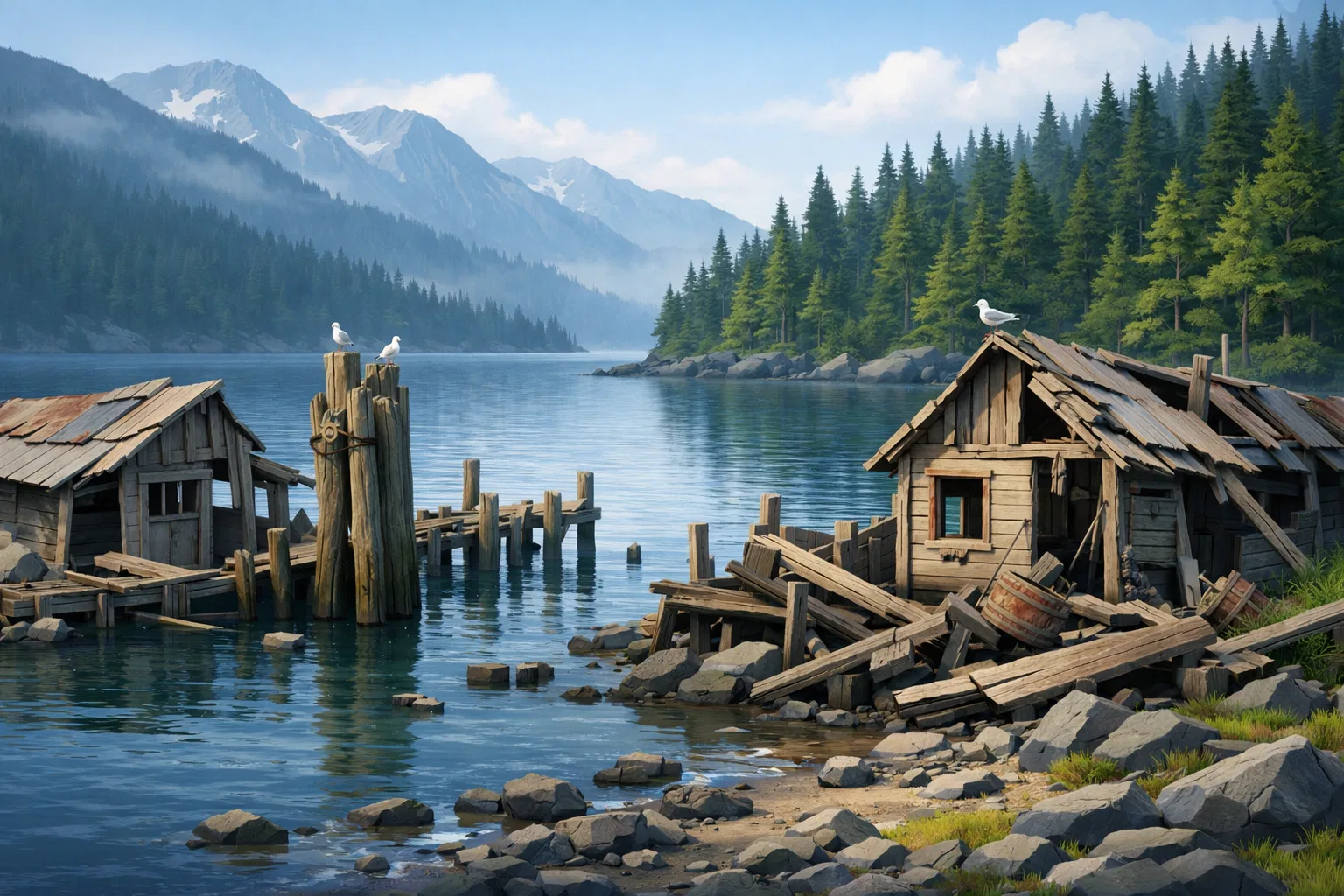
Portlock, often discussed together with Port Chatham, lay near the southern end of the Kenai Peninsula, south of Seldovia and close to the communities of Nanwalek and Port Graham. The setting is important: this is not a roadside ghost town that anyone can casually inspect. The Port Chatham area is coastal, forested, exposed to rough weather and largely reached by boat or aircraft. Homer News reported in 2021 that the Port Chatham area, including the abandoned village of Portlock, is private property belonging mostly to the English Bay Corporation, with some Alaska Native allotments, and that access requires permission.[Homer News]homernews.comHomer News New reality-TV show explores Nantinaq stories | Homer NewsHomer News New reality-TV show explores Nantinaq stories | Homer News
The place also has a documented non-monster history. The U.S. Geological Survey’s Dictionary of Alaska Place Names is a major reference for Alaska’s official and historical place names, recording spellings, variant names, feature types and name origins where possible.[U.S. Geological Survey]pubs.usgs.govU.S. Geological Survey Dictionary of Alaska place namesU.S. Geological Survey Dictionary of Alaska place names Local reporting describes Port Chatham as a sheltered bay where British naval visitors anchored in the eighteenth century, while Portlock developed later as a fishing and cannery settlement with a school, store, post office and other signs of small-community life.[The Mouth of The Kenai]redoubtreporter.wordpress.comOpen source on wordpress.com.
That real settlement history is what gives the monster story its force. Nantiinaq is not simply a creature reported in an empty wilderness; it is attached to a place people say their families left behind.
Portlock’s real settlement history
The most grounded version of the story begins with work, fish and isolation rather than monsters. Portlock is usually described as an early twentieth-century cannery settlement built around salmon and other coastal resources. In the 2009 Homer Tribune account preserved by The Mouth of the Kenai, Malania Helen Kehl was described as having been born at Port Chatham in 1934, in a small village at a sheltered moorage. The same article linked the wider place to Captain Nathaniel Portlock’s 1786 Alaska expedition and to later settlement life on the southern Kenai Peninsula.[The Mouth of The Kenai]redoubtreporter.wordpress.comOpen source on wordpress.com.
By the mid-twentieth century, however, Portlock had faded. The modern legend often says it was abandoned by 1950 because the creature made life impossible. The less theatrical explanation is that remote cannery and mining settlements often declined when work patterns, transport routes, church access, schools and nearby communities changed. Homer News summarised the physical remnants in 2021: by 1950, the once active area, with school, pool hall, store and post office, was abandoned.[Homer News]homernews.comOpen source on homernews.com.
That does not prove no frightening stories existed. It does mean the abandonment itself does not require a monster to explain it. A remote seasonal economy, shifting local opportunity and the pull of Nanwalek and Port Graham are enough to explain why families would leave, especially if the settlement was already becoming less practical.
What people say Nantiinaq was
In modern retellings, Nantiinaq is usually described as a large hairy being: part Bigfoot, part local spirit, sometimes more supernatural than zoological. The 2009 Homer Tribune story translated the name for readers as a “big, hairy creature” and placed it alongside other frightening stories from Port Chatham, including a woman-like apparition in black clothing.[The Mouth of The Kenai]redoubtreporter.wordpress.comOpen source on wordpress.com. Homer News later described the being as something told of by Suqpiag people of the Nanwalek and Port Graham area: a hairy figure said to lurk in the thick forests of the southern Kenai Peninsula, especially around Port Chatham, with stories of tree-uprooting, knocking sounds and disappearances.[Homer News]homernews.comHomer News New reality-TV show explores Nantinaq stories | Homer NewsHomer News New reality-TV show explores Nantinaq stories | Homer News
That mix is one reason the legend is hard to classify. In some accounts, Nantiinaq is treated like an Alaska Sasquatch: a hidden animal leaving tracks and making sounds in the woods. In others, it behaves more like a spirit or taboo presence attached to a dangerous place. The same story can shift depending on who is telling it: local memory, family warning, ghost story, Bigfoot case file or television premise.
For a cryptid page, the distinction matters. A hidden animal claim asks for tracks, hair, photographs, bodies, ecological plausibility and repeated sightings. A place-based warning tale asks different questions: who told it, when, to whom, and what social or cultural work it performed. Nantiinaq sits uneasily between the two.
Local stories and missing-person fears
The most influential public version of the legend came through newspaper retellings. The 2009 Homer Tribune article presented Kehl’s memories, through a translator, as an explanation for why her family left Port Chatham for Nanwalek. It said the fear was not based on one incident but on a long period in which Nantiinaq reportedly terrorised villagers. It also included stories of Kehl’s godfather being killed by a blow from a winch, a gold miner who disappeared, and a sawmill owner who reportedly saw the creature on a beach but chose not to shoot.[The Mouth of The Kenai]redoubtreporter.wordpress.comOpen source on wordpress.com.
The article also reached back to an April 1973 Anchorage Daily News feature, which described rumours from the World War II period: hunters going into the hills and not returning, mutilated bodies allegedly washing into a lagoon, and large man-like tracks following moose tracks before vanishing toward the mountains. The 2009 version is therefore not the first printed appearance of the “Portlock monster” idea, but it is one of the key texts that made the modern internet version vivid and repeatable.[The Mouth of The Kenai]redoubtreporter.wordpress.comOpen source on wordpress.com.
This is where the evidence becomes fragile. These are compelling stories, but they are not the same as police reports, death certificates, search records, dated eyewitness statements or contemporary news coverage of a serial crisis. The most dramatic claims depend on memory, second-hand retelling and later compilation. That does not make them meaningless. It does make them poor proof for an unknown killer creature.
What the record supports about Nantiinaq
The Port Chatham legend has three different evidence layers, and they are often blurred together.
First, there is strong evidence that Portlock existed and was later abandoned. Place-name references, local reporting and census/post-office discussions all support the basic ghost-town frame.[U.S. Geological Survey]pubs.usgs.govU.S. Geological Survey Dictionary of Alaska place namesU.S. Geological Survey Dictionary of Alaska place names
Second, there is evidence that frightening stories about the area have circulated among people connected with Nanwalek, Port Graham and the southern Kenai Peninsula. The 2009 Homer Tribune account, the 2021 Homer News television preview and the 2022 KBBI report all document people speaking about Nantiinaq, Port Chatham and family or elder stories.[wordpress.com]redoubtreporter.wordpress.comOpen source on wordpress.com.
Third, there is much weaker evidence for the claim that a Bigfoot-like being killed multiple people and forced a mass evacuation. The claims are dramatic, but the public record visible in reliable sources is late, thin and contested. Skeptoid’s 2021 episode framed the case as a remote town said to have been abandoned because of violent Bigfoot attacks and treated the story sceptically; later references to the Anchorage Press article similarly describe a debunking of Alaska’s best-known cryptid homicide case.[Skeptoid]skeptoid.comOpen source on skeptoid.com.
The result is a split assessment. As folklore, Nantiinaq is significant. As a confirmed animal or proven killer, the case is not strong.
Why ordinary Alaska explanations still matter
Sceptical explanations do not need to “solve” every campfire sound or family warning to weaken the monster claim. Port Chatham is exactly the kind of place where ordinary hazards can become extraordinary stories: steep terrain, thick forest, wet weather, isolation, bears, moose, tides, boats, mining work, logging work and hunting trips. In the 2009 account itself, the alleged killing of Kehl’s godfather involved a blow from a winch on a boat — a frightening death, but not evidence by itself of a monster.[The Mouth of The Kenai]redoubtreporter.wordpress.comOpen source on wordpress.com.
Bears are the obvious baseline in Alaska hairy-creature claims. A bear standing, moving through brush, raiding camps or leaving tracks in soft ground can look strange in poor conditions. Moose can also make loud, startling noises in forest, and falling timber, surf, wind, rock movement or human activity can be misread at night. None of that proves all reports were misidentifications, but it sets a standard: before Nantiinaq can be treated as a zoological claim, the evidence has to outperform Alaska’s known wildlife and known environmental hazards.
The abandonment story also has a normal human explanation. Small resource settlements vanish when the economic reason to stay disappears. A closed or failing cannery, a declining mine, harder access to services, movement towards neighbouring villages and the inconvenience of an isolated coastal site all make Portlock’s decline plausible without invoking a creature. The mystery becomes less “why would anyone leave?” and more “why did one explanation become so much more memorable than the others?”
Reality television and later amplification
Nantiinaq became much more visible once the Port Chatham legend entered the modern Bigfoot media cycle. Homer News reported that Alaskan Killer Bigfoot, an eight-episode Discovery+ series, premiered in December 2021 and followed a team spending 40 days in the Port Chatham area looking for Nantiinaq. The show used local interviews, game cameras, audio recordings and reality-TV investigation scenes, while also presenting the area as private land that required permission from the English Bay Corporation, villages and village councils.[Homer News]homernews.comHomer News New reality-TV show explores Nantinaq stories | Homer NewsHomer News New reality-TV show explores Nantinaq stories | Homer News
KBBI’s 2022 coverage shows how television changed the legend’s public afterlife. Keith Seville of Nanwalek, described as a descendant of people who left Portlock and one of the show’s stars, said he had grown up hearing stories but became more engaged through the programme. KBBI also reported his view that the show “reawakened” dormant stories and conversations in the community.[KBBI]kbbi.orgLocal lore of Nantinaq documented on Discovery Channel showLocal lore of Nantinaq documented on Discovery Channel show
That amplification cuts both ways. On one hand, television gave local storytellers a platform and made the Port Chatham story part of Alaska’s wider cryptid map. On the other, reality-TV framing rewards suspense: unexplained noises, cliff-hanger evidence, night vigils and dramatic claims. A legend that may once have functioned as a place warning or family story becomes a monster-hunt narrative with episodes, characters and a built-in demand for escalation.
The changing story around Nantiinaq
The Port Chatham legend has become sharper and more violent as it has travelled. Early and local forms appear to mix warnings, frightening experiences, possible disappearances, a ghostly woman, a hairy being and a taboo place. Later internet and television versions often streamline that into a simpler hook: a killer Bigfoot drove an entire Alaska town away.
That simplification is powerful because it gives readers and viewers an instantly graspable story. It also removes uncertainty. “A settlement declined for economic, social and access reasons while frightening local stories attached themselves to the place” is historically plausible but less dramatic. “A murderous creature emptied a town” is easier to sell.
The 2021 Homer News book article illustrates this transition. It connected Port Chatham to older Bigfoot fascination, local author Larry Baxter’s Abandoned: The History and Horror of Port Chatham, Alaska, reported claims of tree knocking and thermal-camera footage, and quoted Baxter saying he tries to eliminate rational explanations before leaning toward Bigfoot.[Homer News]homernews.comOpen source on homernews.com. This is a modern cryptozoology frame: evidence is collected, compared and interpreted as possible Sasquatch activity. That is different from an elder’s warning about a place where people should be careful.
Why Nantiinaq belongs in Alaska’s cryptid history
Nantiinaq belongs in Alaska’s cryptid history because it is not just another imported Bigfoot story. Its power comes from a specific coastal landscape, a real abandoned settlement, nearby Alaska Native communities and a chain of retellings that moved from local memory to newspapers, books, podcasts and television. It shows how Alaska monster stories often form around the meeting point between wilderness risk and community history.
It also shows why “cryptid” is sometimes too narrow a word. Nantiinaq can be read as a Bigfoot-like entity, but the strongest material around it is not a body of hard biological evidence. It is the story of a place people left, a name attached to fear, and a modern audience trying to decide whether an old warning should be read as folklore, memory, misidentification, media invention or a still-unresolved mystery.
The best evidence-aware reading is therefore balanced. Portlock was real. Port Chatham’s eerie reputation is real. Local stories about Nantiinaq are part of the region’s living legend-world. But the claim that an unknown hairy creature committed a series of killings and forced the settlement’s abandonment remains unproven, late-documented and heavily amplified by modern monster media. That tension — real place, real fear, uncertain cause — is exactly why Nantiinaq remains one of Alaska’s most memorable cryptid legends.
Amazon book picks
Further Reading
Books and field guides related to Did Nantiinaq Haunt Port Chatham?. Use these as the next step if you want deeper reading beyond the article.
Sasquatch: Legend Meets Science
Provides a framework for assessing hairy-creature reports.
The United States of Cryptids
Covers major North American monster traditions relevant to Nantiinaq.
eBay marketplace picks
Marketplace Samples
Live-tested eBay searches with available results related to this page.
Endnotes
1.
Source: kbbi.org
Title: Local lore of Nantinaq documented on Discovery Channel show
Link:https://www.kbbi.org/local-news/2022-11-03/local-lore-of-nantinaq-documented-on-discovery-channel-show
2.
Source: skeptoid.com
Link:https://skeptoid.com/episodes/772
3.
Source: live.laborstats.alaska.gov
Link:https://live.laborstats.alaska.gov/cen/histpdfs/1940ak.pdf
4.
Source: gis.data.alaska.gov
Link:https://gis.data.alaska.gov/search?tags=usgs
5.
Source: skeptoid.com
Title: Episode Guide
Link:https://skeptoid.com/episode_guide.php?cat=3
6.
Source: skeptoid.com
Title: Episode Guide
Link:https://skeptoid.com/episode_guide.php?cat=13
7.
Source: skeptoid.com
Link:https://skeptoid.com/episodes/775
8.
Source: www2.census.gov
Link:https://www2.census.gov/library/publications/decennial/1940/population-volume-1/33973538v1ch11.pdf
9.
Source: redoubtreporter.wordpress.com
Link:https://redoubtreporter.wordpress.com/2009/10/28/haunting-memories-%E2%80%94-%E2%80%98nantiinaq%E2%80%99-sightings-spirits-led-to-desertion-of-native-village/
10.
Source: homernews.com
Title: Homer News New reality-TV show explores Nantinaq stories | Homer News
Link:https://www.homernews.com/2021/12/14/new-reality-tv-show-explores-nantinaq-stories/
11.
Source: pubs.usgs.gov
Title: U.S. Geological Survey Dictionary of Alaska place names
Link:https://pubs.usgs.gov/publication/pp567
12.
Source: homernews.com
Link:https://www.homernews.com/2021/04/06/new-book-looks-at-legend-of-alaskas-nantiinaq-or-giant-hairy-thing/
13.
Source: usgs.gov
Link:https://www.usgs.gov/tools/geographic-names-information-system-gnis
14.
Source: pubs.usgs.gov
Link:https://pubs.usgs.gov/bul/0299/report.pdf
15.
Source: usgs.gov
Link:https://www.usgs.gov/faqs/how-can-i-acquire-or-download-geographic-names-information-system-gnis-data
16.
Source: usgs.gov
Link:https://www.usgs.gov/node/25190
17.
Source: Wikipedia
Title: Nathaniel Portlock
Link:https://en.wikipedia.org/wiki/Nathaniel_Portlock
18.
Source: lflank.wordpress.com
Title: alaskas portlock monster
Link:https://lflank.wordpress.com/2025/12/09/alaskas-portlock-monster/
19.
Source: redoubtreporter.wordpress.com
Link:https://redoubtreporter.wordpress.com/2009/10/
20.
Source: redoubtreporter.wordpress.com
Title: cranebrain goose has case of mistaken identity
Link:https://redoubtreporter.wordpress.com/2011/09/14/cranebrain-goose-has-case-of-mistaken-identity/
21.
Source: redoubtreporter.wordpress.com
Link:https://redoubtreporter.wordpress.com/2011/11/02/
22.
Source: cryptidz.fandom.com
Link:https://cryptidz.fandom.com/wiki/Nantinaq
23.
Source: imdb.com
Link:https://www.imdb.com/fr/title/tt33672315/releaseinfo/
24.
Source: edits.nationalmap.gov
Link:https://edits.nationalmap.gov/apps/gaz-domestic/public/search/names/1424573
25.
Source: archives.gov
Link:https://www.archives.gov/research/census/1940
Additional References
26.
Source: youtube.com
Title: How to Stay Alive | Alaskan Killer Bigfoot | discovery+
Link:https://www.youtube.com/watch?v=FHFnZr-gmYY
Source snippet
Alaskan Killer Bigfoot? 40 Days in Portlock...
27.
Source: rowalaska.net
Link:https://rowalaska.net/archives/resources/odds_ends/Leftovers/Alaska_Place_Names.pdf
28.
Source: primevideo.com
Link:https://www.primevideo.com/detail/0OXS2RBT5L3LYI87G5LUHHSUHC
29.
Source: facebook.com
Link:https://www.facebook.com/harpdaddy/posts/any-of-my-people-have-one-of-these-they-no-longer-need-or-use-i-need-for-live-pe/10217438039901456/
30.
Source: bigfootterrorinthewoods.com
Link:https://www.bigfootterrorinthewoods.com/episodes/bigfoot-tiw-61-mystery-of-portlock-alaska-and-the-nantiinaq-and-a-pheasant-hunt-leads-to-a-bigfoot-encounter
31.
Source: facebook.com
Link:https://www.facebook.com/groups/1387894039744041/posts/1523818172818293/
32.
Source: facebook.com
Link:https://www.facebook.com/groups/6219396328152097/posts/7276030779155308/
33.
Source: instagram.com
Link:https://www.instagram.com/p/DPMMxs6DhAl/
34.
Source: toppodcast.com
Link:https://toppodcast.com/podcast_feeds/sasquatch-odyssey/
35.
Source: reddit.com
Link:https://www.reddit.com/r/Cryptozoology/comments/ztewsq/the_true_and_frightening_story_of_portlock_alaska/
Topic Tree