Within Oregon Monsters
What Are Oregon Cryptid Witnesses Really Seeing?
Oregon's forests, mountains, lakes and coast help strange stories grow, but they also create perfect conditions for misread wildlife.
On this page
- Forests, fog and half seen animals
- Bears, cougars and tracks that fool people
- Coastal remains, floating trees and lake monster confusion
Page outline Jump by section
Introduction
Oregon’s cryptid reports often begin with a real problem of perception: the state is full of habitats where ordinary animals can look briefly extraordinary. Dense forests break bodies into fragments. Fog and rain flatten distance. Mud, snow and sand enlarge tracks. Coastal surf turns logs, kelp and carcasses into moving shapes. That does not make every witness careless or every story fake; it means Oregon is unusually good at producing honest mistakes.
The most likely Oregon “monster” misidentifications involve black bears, cougars, dogs, coyotes, bobcats, elk, deer, seals, sea lions, whales, large fish, floating timber and decomposed marine remains. This matters because Oregon’s legends are strongest when read in two ways at once: as folklore shaped by wild places, and as field reports filtered through difficult terrain, poor light and expectation. Oregon’s own Bigfoot tradition is rooted in forested country, but the Oregon Encyclopedia also notes that most scientists treat Bigfoot as mistaken identification of known animals, hoaxes or planted tracks rather than a confirmed species.[Oregon Encyclopedia]oregonencyclopedia.orgBigfoot (Sasquatch) legend…
Forests, fog and half-seen animals
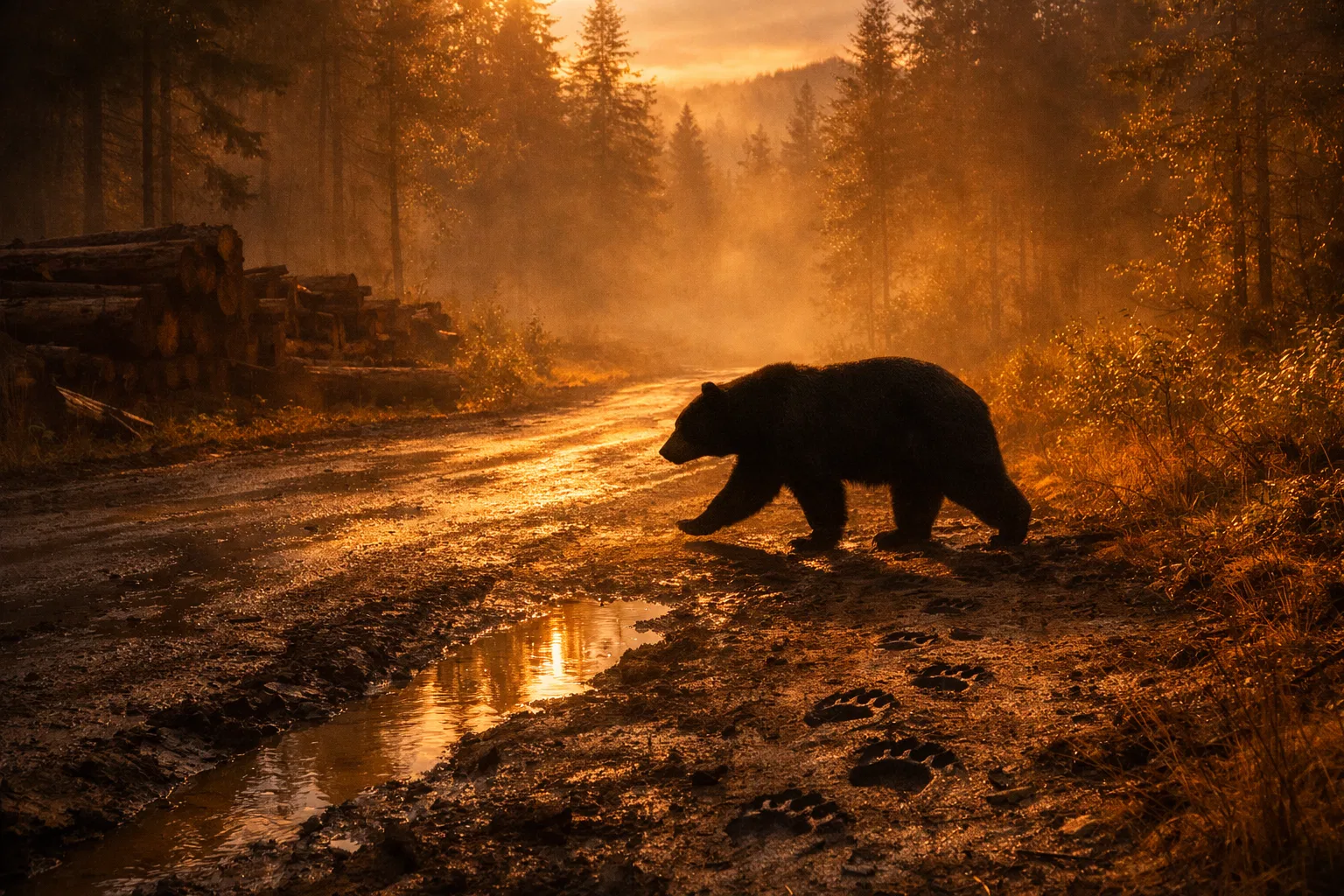
Oregon’s forest cryptid stories work because the landscape rarely gives the witness a clean look. A large shape crossing a logging road at dusk may be visible for only a few seconds. A body seen through Douglas-fir trunks, salal, sword fern, alder or roadside brush can become a shoulder, a back, a head and then nothing. In that setting, the brain does what it is built to do: it completes the pattern.
That is especially important for Oregon Bigfoot reports. The state’s documented Bigfoot tradition, as summarised by the Oregon Encyclopedia, begins with 1904 reports of a hairy “wild man” in the Sixes River area of the Coast Range, then grows through miner, hunter and logging-road stories in later decades. Reports after 1958 often involved creatures seen crossing roads at night, moving through forest and mountain terrain, or leaving large tracks along logging roads.[Oregon Encyclopedia]oregonencyclopedia.orgBigfoot (Sasquatch) legend… Those details are culturally important, but they are also exactly the conditions under which ordinary wildlife becomes hardest to identify.
Oregon’s forest structure adds to the effect. The Oregon Department of Forestry describes the state’s forests as varied, including rain-drenched coastal ecosystems dominated by Sitka spruce, Douglas-fir, red alder and western redcedar, as well as drier forests with true fir, lodgepole and ponderosa pine in other regions.[Oregon]oregon.govfhh report 2024fhh report 2024 In the Coast Range and west Cascades, wet vegetation can hide an animal’s lower body. In the east Cascades, Blue Mountains and Klamath country, broken pine woodland, canyons and shadowed draws can make size and distance surprisingly hard to judge.
Fog and weather matter too. A dark animal viewed through drizzle or headlights is not just “less visible”. It may appear larger because there are few stable reference points. A bear standing momentarily behind brush, a person in dark rain gear, an elk moving through timber, or a stump glimpsed between trunks can all create a story that feels vivid afterwards because the emotional jolt was real, even if the identification was wrong.
The key point is not that forests “explain away” Oregon’s monster lore. It is that Oregon’s most famous cryptid habitat is also a classic misidentification habitat: low light, obstructed views, wet ground, winding roads, startled witnesses and animals that usually vanish before anyone can check.
Bears, cougars and tracks that fool people
The single most important real animal behind Oregon’s mystery-beast confusion is the black bear. Oregon Department of Fish and Wildlife says the state has about 25,000 to 30,000 black bears, and that they are not always black: they may be brown, cinnamon or blond. The agency also stresses that black bears are fast, agile, good climbers and swimmers, and prefer forests, trails and streams.[Oregon Department of Fish & Wildlife]myodfw.comOpen source on myodfw.com. Those facts line up neatly with many forest-creature reports: dark or brown fur, speed, wooded habitat, creek corridors and sudden disappearance.
Black bears are also visually misleading because “bear” does not always look like the mental picture people carry. A bear moving uphill can appear taller than it is. A bear partly hidden by brush may show only its back and shoulders. A cinnamon-phase black bear can be reported as something stranger than a “black” bear, especially by someone who does not know Oregon no longer has grizzlies. ODFW is explicit on that point: there are no grizzly bears in Oregon, and a “brown” bear seen in the state is a black bear.[Oregon Department of Fish & Wildlife]myodfw.comOpen source on myodfw.com.
There is also a broader scientific reason to take the bear explanation seriously. A 2024 Journal of Zoology study modelled Sasquatch sightings and bear populations across the United States and Canada while controlling for human population and forest area; it found that Sasquatch sightings were statistically associated with black bear populations, with each additional 1,000 bears linked to a roughly 4% increase in reported sightings. The author’s cautious conclusion was not “every sighting is a bear”, but that many alleged Sasquatch are likely misidentified known animals.[ZSL Publications]zslpublications.onlinelibrary.wiley.comZSL Publications Bigfoot: If it's there, could it be a bear?ZSL Publications Bigfoot: If it's there, could it be a bear? Earlier ecological niche modelling also showed how a convincing “Sasquatch range” can be generated from questionable sighting data, with strong overlap between predicted Sasquatch distribution and black bear ecology in western North America.[Wiley Online Library]onlinelibrary.wiley.comj.1365 2699.2009.02152.xj.1365 2699.2009.02152.x
Cougars create a different sort of confusion. They are less likely to be mistaken for a giant upright figure, but they are central to Oregon “phantom cat” and mystery-predator reports. ODFW says Oregon has more than 6,000 cougars, that they are secretive and reclusive, and that they occupy most available cougar habitat in the state. The agency also notes that people are more often moving through cougar country for hiking, fishing, hunting and camping, while some young cougars are pushed towards poorer habitat and urban fringes as they disperse.[Oregon Department of Fish & Wildlife]myodfw.comOpen source on myodfw.com.
That creates a perfect rumour environment: a real large cat exists, but it is rarely seen well. ODFW specifically warns that coyotes, bobcats, large house cats and dogs are often mistaken for cougars. It gives practical clues: an adult cougar is much larger than a bobcat or coyote, has an even tan or tawny body colour, and has a long tail nearly three feet long; cougar tracks usually lack claw marks and have a three-lobed heel pad, while dog tracks usually show claws and a rounder rear pad.[Oregon Department of Fish & Wildlife]myodfw.comOpen source on myodfw.com.
Tracks are one of Oregon’s most tempting forms of “evidence”, and one of the easiest to overread. Mud slumps. Snow melts. Sand collapses. A normal print can lengthen as an animal slides, steps twice, or presses into soft ground at an angle. ODFW’s wolf track guidance makes the same practical point for large carnivore tracks: soft mud or melted snow may make a track appear larger than it really is, so observers should measure the actual outline and note the substrate.[dfw.state.or.us]dfw.state.or.usWolf TracksWolf Tracks That advice applies just as well to alleged monster footprints.
Common Oregon track traps include:
- Overlapping prints: a hind foot landing near a front foot can create one distorted shape that looks larger or more humanlike than either print alone.
- Melted snow: a crisp track can widen into a dramatic oval within hours.
- Mud slides: toes, claws and heel pads smear into an elongated mark.
- Roadside expectation: if a witness already thinks they are in “Bigfoot country”, an ambiguous track is more likely to be read as a creature clue.
- Dog and cougar confusion: claw marks, pad shape and gait matter, but many casual observers notice only size.
Oregon’s forests do contain large animals. That is the point. The sceptical explanation is not that witnesses are seeing “nothing”. Often they may be seeing bears, cougars, elk, deer, dogs or people under conditions that make confident identification unrealistic.
Lakes, rivers and moving water
Oregon’s water-monster confusion works differently from its forest confusion. In the woods, the problem is usually partial visibility. On lakes, rivers and bays, the problem is motion. A floating object rises, sinks, turns, catches light, disappears behind a ripple and reappears somewhere else. That is enough to make a log look alive.
Lake-monster sceptics have long pointed to ordinary water objects and animals as lookalikes: otters, beavers, deer, long-necked birds, large fish, bobbing logs, clumps of dislodged lake-bottom debris, wind sticks and boat wakes.[Skeptical Inquirer]skepticalinquirer.orgSkeptical Inquirer Lake Monster LookalikesSkeptical Inquirer Lake Monster Lookalikes Oregon has no shortage of settings where that list matters: forested reservoirs, deep volcanic lakes, timber-fringed rivers, estuaries and windy mountain water.
The mechanism is simple. A line of ducks or otters can look like humps. A swimming deer can show only head and neck. A partly submerged log can rotate in waves. A sturgeon or other large fish breaking the surface may appear prehistoric to someone who sees only a back, tail or wake. In a state where forest, water and recreation overlap, a campfire story can begin with a completely sincere sentence: “I saw something moving out there.”
Rivers add another layer. Oregon’s waterways carry branches, root wads and logging debris. A root mass can look like a head; a stripped trunk can resemble a pale body; a snag caught in current can seem to swim against the flow. When a witness views it from a bridge, boat or dark bank, the movement belongs partly to the water and partly to the object. The result can feel animal even when it is hydrology.
This is why Oregon lake and river reports should be read less like courtroom testimony and more like field notes under stress. What was the distance? Was there a wake? Was the object moving independently or drifting? Did it submerge, or did the wave pattern simply hide it? Were there known logs, seals, otters, birds or fish in the area? Those questions do not kill the story. They make it testable.

Coastal remains and sea-serpent confusion
Oregon’s coast has its own monster logic. The shoreline is dramatic, cold, loud and full of things that are hard to identify even in daylight. Colossal Claude, Oregon’s best-known sea-serpent figure, belongs to this world: the mouth of the Columbia, offshore waters, fishing crews, old newspaper accounts, and shapes seen at a distance in rough water.
The Oregon Encyclopedia records that Oregon sea-serpent sightings were associated with names such as Cadborosaurus and Colossal Claude, and that reports often described camel- or horse-like heads, scaly or smooth bodies, or fur. It also notes a 1950 Delake carcass nicknamed “Old Hairy”, described as a hairy, cowlike body weighing about a thousand pounds; expert suggestions included whale shark, whale blubber and an elasmobranch, but it was never definitively identified.[Oregon Encyclopedia]oregonencyclopedia.orgSea Serpent Lore…
That uncertainty is important. A carcass can be genuinely difficult to identify without specialist examination, especially after decomposition, scavenging, surf damage and bloating. In 2022, for example, a strange stringy mass near Florence was widely discussed as a “globster”, but the Oregon State Marine Mammal Institute told KATU it was likely a badly decomposed whale carcass.[KATU]katu.comLarge, mysterious 'globster' washes up on Oregon coastLarge, mysterious 'globster' washes up on Oregon coast The explanation is mundane only after the expertise arrives; before that, the object can look like a creature from a different world.
Oregon’s beaches also produce moving false monsters. The National Weather Service warns that the Oregon, Washington and northern California coast has steep, tree-lined beaches, cold water and dangerous sneaker waves. It explains that driftwood can be carried by currents and washed ashore, and that even a few inches of water can lift or roll a log weighing hundreds of pounds.[Weather.gov]weather.govSneaker/High Waves and Log Rolls Can Be DeadlySneaker/High Waves and Log Rolls Can Be Deadly A rolling log in surf is not just a beach hazard; at a distance, it can resemble a long body turning in the water.
Add seals, sea lions, whales, kelp beds, floating timber and storm debris, and the coast becomes a machine for monster shapes. A sea lion’s head can look oddly mammalian but not quite familiar. Kelp can trail like hair. A whale carcass can lose the features that make it recognisably a whale. A row of waves passing over a submerged log can produce the classic “humps” of a serpent.
This does not mean every Oregon sea-serpent report has a neat answer. The Oregon Encyclopedia is careful: the identity of some reported creatures remains unclear, and debate has persisted between scientists and cryptozoologists over whether such accounts represent misidentified known animals or something unknown.[Oregon Encyclopedia]oregonencyclopedia.orgSea Serpent Lore… The evidence-aware position is to keep both halves of that sentence: unclear does not mean confirmed monster, and misidentification does not mean the witness saw nothing.
Why Oregon’s habitats keep the legends alive
Oregon’s cryptid ecology is not just about animals. It is about encounters happening in places that feel capable of hiding something. The Coast Range has old “wild man” associations. The Cascades offer dark timber, mountain roads and snow. The Blue Mountains and Klamath country mix forest, canyon and remote travel. The coast supplies fog, carcasses, dangerous surf and maritime folklore. These places do not prove monsters; they make monster interpretations emotionally plausible.
The most useful way to read Oregon witness claims is to separate four layers:
- The setting: forest road, lake, beach, canyon, river mouth or mountain trail.
- The observation: shape, sound, track, smell, carcass, wake or movement.
- The first interpretation: bear, cougar, unknown animal, Bigfoot, sea serpent, phantom cat.
- The later story: newspaper item, campfire retelling, online report, tourist legend or local joke.
Misidentification can enter at any layer. A witness may accurately report a dark upright shape but misjudge its species. A track may be real but distorted. A carcass may be biological but not monstrous. A later article may simplify uncertainty into a better headline. Over time, the strongest details survive because they are memorable, not necessarily because they are the most reliable.
That is why Oregon’s habitats are not just scenery behind cryptid stories. They are active ingredients. Wet forests create partial glimpses. Snow and mud alter tracks. Rugged cougar country produces rare but intense predator encounters. Lakes and rivers animate logs and wakes. The coast turns dead whales and rolling timber into sea-serpent material. Oregon remains wonderful monster country precisely because it is also excellent misidentification country.
A field guide for reading Oregon cryptid reports
A good Oregon cryptid report should not be dismissed automatically, but it should be slowed down. The best question is not “Could this be real?” but “What real thing in this exact habitat could produce this impression?”
For forest reports, start with bears. Oregon has tens of thousands of black bears, they vary in colour, and they live in the forests, trails and stream corridors where many strange-animal reports occur.[Oregon Department of Fish & Wildlife]myodfw.comOpen source on myodfw.com. For big-cat reports, check the cougar basics: size, tan colour, long tail, track shape and whether the supposed animal could instead be a dog, bobcat, coyote or large house cat.[Oregon Department of Fish & Wildlife]myodfw.comOpen source on myodfw.com. For track claims, ask what the substrate was doing: mud, thawing snow and wet sand are not neutral recording surfaces.
For lake and river reports, treat motion carefully. If an object appears to swim, ask whether current, wind, waves or boat wake could explain the movement. If it looks humped, ask whether several animals, floating debris or wave action could be producing separate visible points. If it appears enormous, ask what fixed object allowed the witness to judge scale.
For coastal reports, remember that the Pacific does not return tidy specimens. It returns torn, bloated, pale, hairy-looking, half-scavenged remains. Oregon’s sea-serpent lore includes unresolved and disputed accounts, but modern “globster” episodes show how quickly a decomposed whale can become an apparent monster before marine expertise catches up.[KATU]katu.comLarge, mysterious 'globster' washes up on Oregon coastLarge, mysterious 'globster' washes up on Oregon coast
The result is not a less interesting Oregon. It is a more interesting one. The state’s cryptid stories sit at the crossing point of real wildlife, difficult terrain, old folklore, tourism, memory and mistakes made in good faith. Oregon’s forests, mountains, lakes and coast do not merely hide monsters in the imagination. They teach us how easily the wild can turn a glimpse into a legend.
Amazon book picks
Further Reading
Books and field guides related to What Are Oregon Cryptid Witnesses Really Seeing?. Use these as the next step if you want deeper reading beyond the article.
Sasquatch: Legend Meets Science
Discusses competing explanations for Bigfoot evidence.
Why People Believe Weird Things
Helps explain how sincere witnesses can misinterpret events.
Field Guide To Bigfoot, Yeti, & Other Mystery Primates Worldwide
Provides context for reports often attributed to misidentification.
eBay marketplace picks
Marketplace Samples
Live-tested eBay searches with available results related to this page.
Endnotes
1.
Source: oregonencyclopedia.org
Title: Oregon Encyclopedia
Link:https://www.oregonencyclopedia.org/articles/bigfoot_sasquatch_legend/
Source snippet
Bigfoot (Sasquatch) legend...
2.
Source: oregon.gov
Title: fhh report 2024
Link:https://www.oregon.gov/odf/documents/forestbenefits/fhh-report-2024.pdf
3.
Source: zslpublications.onlinelibrary.wiley.com
Title: ZSL Publications Bigfoot: If it’s there, could it be a bear?
Link:https://zslpublications.onlinelibrary.wiley.com/doi/10.1111/jzo.13148
4.
Source: onlinelibrary.wiley.com
Title: j.1365 2699.2009.02152.x
Link:https://onlinelibrary.wiley.com/doi/abs/10.1111/j.1365-2699.2009.02152.x
5.
Source: dfw.state.or.us
Title: Wolf Tracks
Link:https://dfw.state.or.us/Wolves/docs/Wolf_track_identification.pdf
6.
Source: oregonencyclopedia.org
Title: Oregon Encyclopedia
Link:https://www.oregonencyclopedia.org/articles/sea-serpent-lore/
Source snippet
Sea Serpent Lore...
7.
Source: katu.com
Title: Large, mysterious ‘globster’ washes up on Oregon coast
Link:https://katu.com/news/local/large-globster-washes-up-on-oregon-coast-florence-beach-whale-carcass-marine-biology
8.
Source: weather.gov
Title: Sneaker/High Waves and Log Rolls Can Be Deadly
Link:https://www.weather.gov/safety/ripcurrent-waves
9.
Source: oregon.gov
Title: FWNewsletter 202408
Link:https://www.oregon.gov/osp/Docs/FWNewsletter_202408.pdf
10.
Source: swap.oregon.gov
Title: ponderosa pine woodlands
Link:https://swap.oregon.gov/key-habitat/ponderosa-pine-woodlands/
11.
Source: oregon.gov
Link:https://www.oregon.gov/odf/Documents/workingforests/monitoring-technical-report-13.pdf
12.
Source: oregon.gov
Title: fhh report 2022
Link:https://www.oregon.gov/odf/documents/forestbenefits/fhh-report-2022.pdf
13.
Source: oregon.gov
Title: fhh report 2023
Link:https://www.oregon.gov/odf/documents/forestbenefits/fhh-report-2023.pdf
14.
Source: swap.oregon.gov
Title: late successional mixed conifer forests
Link:https://swap.oregon.gov/key-habitat/late-successional-mixed-conifer-forests/
15.
Source: oregon.gov
Title: fhh report 2025
Link:https://www.oregon.gov/odf/documents/forestbenefits/fhh-report-2025.pdf
16.
Source: swap.oregon.gov
Title: fields peak
Link:https://swap.oregon.gov/conservation-opportunity-area/fields-peak/
17.
Source: oregon.gov
Title: fhh report 2017
Link:https://www.oregon.gov/odf/documents/forestbenefits/fhh-report-2017.pdf
18.
Source: swap.oregon.gov
Title: blue mountains
Link:https://swap.oregon.gov/ecoregion/blue-mountains/
19.
Source: zslpublications.onlinelibrary.wiley.com
Link:https://zslpublications.onlinelibrary.wiley.com/doi/abs/10.1111/jzo.13148
20.
Source: onlinelibrary.wiley.com
Title: j.1365 2699.2009.02152.x
Link:https://onlinelibrary.wiley.com/doi/10.1111/j.1365-2699.2009.02152.x
21.
Source: dfw.state.or.us
Link:https://www.dfw.state.or.us/wildlife/living_with/docs/cougarbroch.pdf
22.
Source: dfw.state.or.us
Link:https://dfw.state.or.us/SWAP-Revision/docs/Habitats_Ponderosa%20Pine%20Review%20Draft.pdf
23.
Source: dfw.state.or.us
Title: spring bear forcast
Link:https://dfw.state.or.us/RR/spring_bear_forcast/
24.
Source: myodfw.com
Link:https://myodfw.com/living-black-bears
25.
Source: myodfw.com
Link:https://myodfw.com/articles/living-cougars
26.
Source: skepticalinquirer.org
Title: Skeptical Inquirer Lake Monster Lookalikes
Link:https://skepticalinquirer.org/newsletter/lake-monster-lookalikes/
27.
Source: facebook.com
Link:https://www.facebook.com/MyODFW/videos/oregon-is-not-made-up-of-just-douglas-fir-and-ponderosa-pines-even-though-these-/1970340540002553/
28.
Source: myodfw.com
Title: 2026 spring bear hunting forecast
Link:https://myodfw.com/articles/2026-spring-bear-hunting-forecast
29.
Source: Wikipedia
Link:https://en.wikipedia.org/wiki/Bigfoot
30.
Source: cryptidz.fandom.com
Title: Colossal Claude
Link:https://cryptidz.fandom.com/wiki/Colossal_Claude
31.
Source: andrewsforest.oregonstate.edu
Link:https://andrewsforest.oregonstate.edu/publications/1244
32.
Source: ir.library.oregonstate.edu
Link:https://ir.library.oregonstate.edu/downloads/vd66w358n
33.
Source: oregonforests.org
Link:https://oregonforests.org/sites/default/files/2018-02/08_Appendix.pdf
34.
Source: oregonwild.org
Link:https://oregonwild.org/resource/sasquatch/
35.
Source: thatoregonlife.com
Title: oregon bigfoot sightings sasquatch
Link:https://thatoregonlife.com/2024/07/oregon-bigfoot-sightings-sasquatch/
36.
Source: science.howstuffworks.com
Link:https://science.howstuffworks.com/science-vs-myth/strange-creatures/bigfoot.htm
37.
Source: tillamookcountypioneer.net
Title: oregon dept of fish wildlife living with wildlife cougars
Link:https://www.tillamookcountypioneer.net/oregon-dept-of-fish-wildlife-living-with-wildlife-cougars/
Additional References
38.
Source: researchgate.net
Link:https://www.researchgate.net/publication/367247671_If_it%27s_there_could_it_be_a_bear
39.
Source: researchgate.net
Link:https://www.researchgate.net/publication/216763696_Predicting_the_Distribution_of_Sasquatch_in_Western_North_America_Anything_Goes_with_Ecological_Niche_Modelling
40.
Source: instagram.com
Link:https://www.instagram.com/reel/DZBXYzUMBOS/
41.
Source: instagram.com
Link:https://www.instagram.com/reel/Cu0B9CNhuoE/?hl=en
42.
Source: facebook.com
Link:https://www.facebook.com/CBSNewsTexas/posts/also-known-as-bigfoot-sasquatch-is-a-mythical-creature-that-in-folklore-is-said-/1033079938849959/
43.
Source: bfro.net
Link:https://www.bfro.net/gdb/
44.
Source: robbiegeorgephotography.com
Link:https://www.robbiegeorgephotography.com/bear-tracks?srsltid=AfmBOopgRREmXjW3VJ6MiFYHqfinPk2dp6QOML_jQBlHWY7SFSHKcB9s
45.
Source: reddit.com
Link:https://www.reddit.com/r/AnimalTracking/comments/1q3fd3i/bear_or_cougar_oregon_mountains/
46.
Source: reddit.com
Link:https://www.reddit.com/r/zoology/comments/156gz5h/bigfoot_almost_certainly_doesnt_exist_but_how/
47.
Source: reddit.com
Link:https://www.reddit.com/r/Cryptozoology/comments/19di7nu/bigfoot_and_black_bears_a_correlational_analysis/
Topic Tree