Within Massachusetts Monsters
What Lives in the Bridgewater Triangle Stories?
The Bridgewater Triangle gathers Bigfoot, thunderbirds, giant snakes, Pukwudgies and odd lights into one dense folklore zone.
On this page
- The Hockomock Swamp setting
- Creatures grouped under one label
- Folklore, tourism and blurred categories
Page outline Jump by section
Introduction
The Bridgewater Triangle is not one monster story so much as a Massachusetts folklore bundle: Bigfoot-like figures, thunderbirds, giant snakes, Pukwudgies, odd lights and “swamp beast” claims have all been gathered into a roughly 200-square-mile zone in south-eastern Massachusetts. The centre of gravity is Hockomock Swamp, a large wetland associated with Bridgewater-area legend, difficult terrain, Indigenous and colonial history, wildlife habitat and decades of paranormal retelling. Bridgewater Public Library summarises the Triangle as an area linked in local lore to UFOs, poltergeist stories, Bigfoot-like sightings, giant snakes and thunderbirds, and notes that the term was coined by New England cryptozoologist Loren Coleman.[Bridgewater Public Library]bridgewaterpubliclibrary.orgOpen source on bridgewaterpubliclibrary.org.
For a cryptid reader, the useful way to understand the Bridgewater Triangle is not to ask, “Which creature lives there?” but “Why do so many different creature claims stick to this one landscape?” The answer lies in the swamp: a real, large, ecologically rich and partially difficult-to-read place where darkness, water, bird calls, mammal movement, local history and modern media all help ambiguous experiences become memorable monster stories. The claims are culturally important, but none of the creatures grouped under the Bridgewater Triangle label has been confirmed as an unknown animal.
The Hockomock Swamp setting
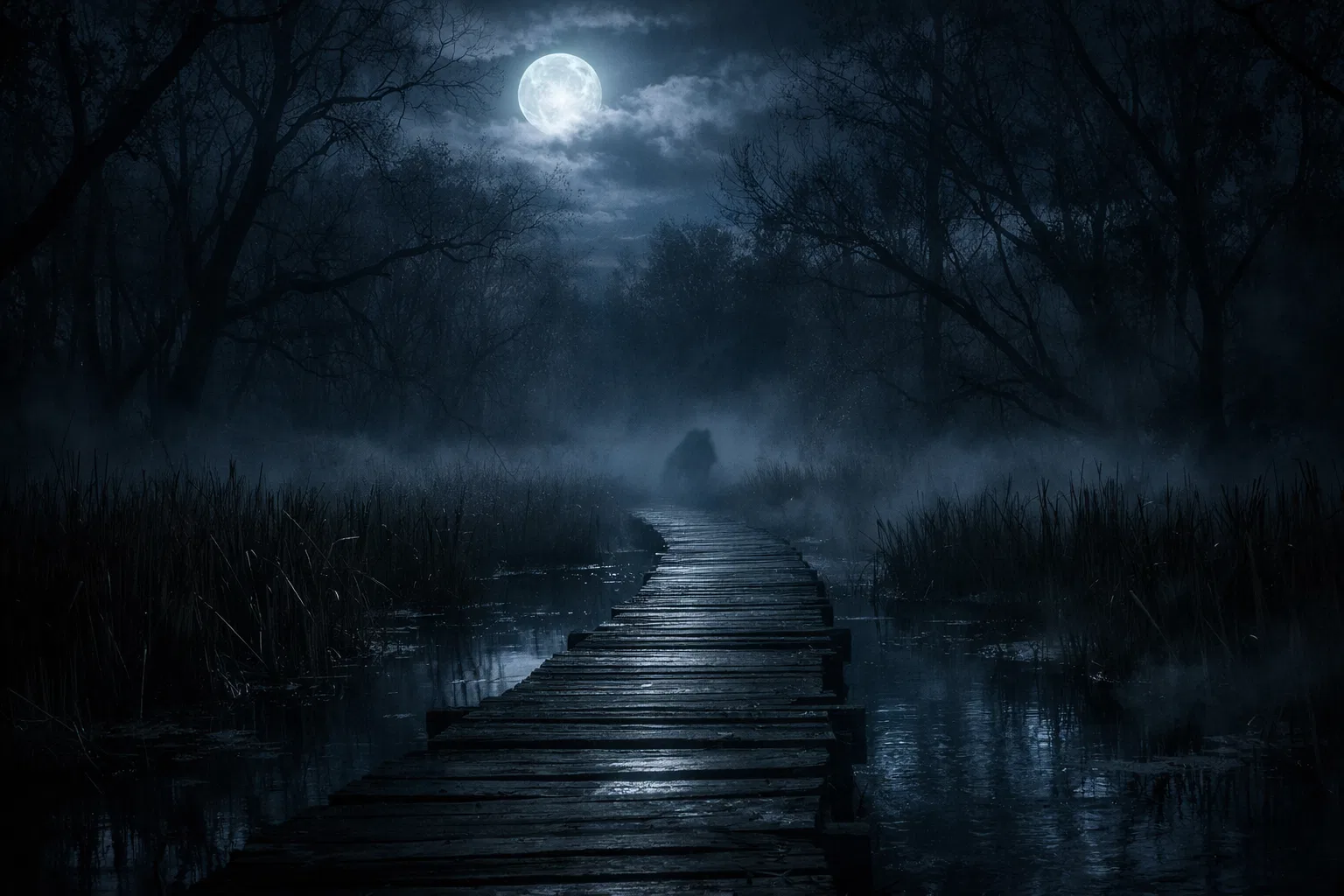
Hockomock Swamp gives the Bridgewater Triangle its strongest sense of place. The swamp is usually described in local sources as a 16,950-acre wetland and the largest freshwater swamp in Massachusetts, associated with the greater Bridgewater area and the wider Triangle legend.[Bridgewater Public Library]bridgewaterpubliclibrary.orgOpen source on bridgewaterpubliclibrary.org. The Massachusetts state listing for the Hockomock Swamp Area of Critical Environmental Concern describes it as a vast natural and scenic area, an irreplaceable wildlife habitat, and a place with at least 13 rare and endangered species; it also notes archaeological sites around the wetland complex spanning about 9,000 years.[Massachusetts Government]mass.govOpen source on mass.gov.
That physical setting matters because swamp folklore often grows from uncertainty rather than clear observation. In a wetland, a witness may hear movement before seeing its source, glimpse an animal through trees, mistake reflections for lights, or judge size badly at dusk. Mass Audubon describes the wider Hockomock area as huge, fragmented and still “relatively unknown” away from access points such as power lines or old railroad dikes; it also notes mammals including mink, fishers and bobcats, plus abundant wetland birds.[Mass Audubon]massaudubon.orgMass Audubon SiteMass Audubon Site
The swamp is therefore not an empty stage for invented stories. It is a real habitat with enough animals, cover, mud, water and poor sightlines to produce sincere but uncertain encounters. That does not turn a strange report into proof of Bigfoot or thunderbirds. It does explain why the setting feels credible to witnesses and why the same place can host many different kinds of creature claim.

Creatures grouped under one label
The Bridgewater Triangle’s creature lore is unusual because it does not revolve around a single signature beast. Instead, the label works like a regional container. Once a place is known as the “Triangle”, later stories about different beings can be added to the same map, even when they do not share the same origin or evidence.
The most commonly repeated creature categories are:
Bigfoot-like figures. Reports usually describe a large, hairy, upright figure in or near swamp and forest areas. Bridgewater Public Library’s local-history page points readers to a 1998 Boston Herald article titled “The Bigfoot of Bridgewater: Is it a man-beast or Hockomock crock?”, showing that by the late twentieth century the Bigfoot angle had become a recognisable local press subject rather than just a private rumour.[Bridgewater Public Library]bridgewaterpubliclibrary.orgOpen source on bridgewaterpubliclibrary.org.
Thunderbirds or giant birds. These are usually described as enormous winged creatures, sometimes interpreted in paranormal retellings as thunderbirds or even pterodactyl-like beings. Atlas Obscura’s account of the Triangle notes a 1980 Boston Magazine report in which police sergeant Thomas Downey was said to have seen a six-foot-tall winged creature while driving late at night on a country road; later paranormal interpreters connected that account with thunderbird lore.[Atlas Obscura]atlasobscura.comAtlas Obscura How Massachusetts Came to Have Its Own Bermuda TriangleAtlas Obscura How Massachusetts Came to Have Its Own Bermuda Triangle
Giant snakes and unusual animals. Giant-snake claims sit beside reports of mystery cats, oversized dogs and other “out of place” animals. The library’s summary includes giant snakes among the standard Bridgewater Triangle claims, but these reports are usually transmitted as local legend or paranormal writing rather than as zoological documentation.[Bridgewater Public Library]bridgewaterpubliclibrary.orgOpen source on bridgewaterpubliclibrary.org.
Pukwudgies. Modern Bridgewater Triangle storytelling often treats Pukwudgies as small, dangerous forest beings, especially around Freetown State Forest and Hockomock lore. This is one of the most complicated parts of the tradition, because popular paranormal use does not map cleanly onto older Indigenous story contexts. Folklore writer Andrew Warburton argues that modern internet and cryptid depictions often turn Pukwudgies into solitary troll-like creatures, while earlier Massachusetts Wampanoag-related stories described them as Little People living in bands, not as cryptid-style monsters.[Fairies of New England]fairiesofnewengland.comOpen source on fairiesofnewengland.com.
Odd lights and “swamp” phenomena. Strange lights are not creatures, but they help hold the creature lore together. Atlas Obscura describes reports around the swamp that include orbs, UFOs and other strange activity, while Bridgewater Public Library’s article collection includes pieces with titles linking Hockomock to ape-like creatures and glowing lights.[Atlas Obscura]atlasobscura.comAtlas Obscura How Massachusetts Came to Have Its Own Bermuda TriangleAtlas Obscura How Massachusetts Came to Have Its Own Bermuda Triangle In folklore terms, lights make the landscape feel active; once a place is already considered uncanny, animal reports are more likely to be interpreted through that frame.
Why Bigfoot fits the swamp story
Bigfoot claims in the Bridgewater Triangle borrow from a broader North American Sasquatch pattern: a large upright figure, often seen briefly near woods, roads, water or remote-feeling land. What makes the Bridgewater version distinct is not a unique creature description, but the contrast between the swamp’s actual geography and its location in relatively populated eastern Massachusetts. Hockomock is near towns and roads, yet it can still feel enclosed, wet and difficult to survey.
That tension helps the legend. A remote mountain report asks readers to imagine wilderness. A Bridgewater Triangle report asks them to imagine a pocket of wilderness close to everyday life. That is why the “man-beast or Hockomock crock” framing is so effective: the claim is both vivid and doubtful, a monster story made stronger because it is happening near familiar towns rather than in a distant forest.[Bridgewater Public Library]bridgewaterpubliclibrary.orgOpen source on bridgewaterpubliclibrary.org.
There are also ordinary candidates for some Bigfoot-style impressions. Massachusetts has black bears, coyotes, fishers, bobcats, deer and other animals capable of producing startling sounds or shapes in poor light. Mass.gov lists black bears in western, central and north-eastern Massachusetts, with occasional records elsewhere, while Mass Audubon notes that the black bear is the state’s only resident bear species and the bobcat its only wild cat.[Massachusetts Government]mass.govOpen source on mass.gov. A bear standing briefly, a deer seen through brush, or a person in dark clothing moving near a woodline will not explain every story, but they are more plausible than an undocumented breeding population of giant apes in south-eastern Massachusetts.
The Bigfoot material is therefore best read as a localised swamp variant of a national legend. Hockomock supplies the mud, cover and atmosphere; the larger American Bigfoot tradition supplies the body shape and expectation.
Why thunderbirds belong in the Triangle
The thunderbird strand is one of the most memorable Bridgewater Triangle claims because it gives the swamp an overhead monster as well as ground-level beasts. The Thomas Downey account, reported through Boston Magazine and repeated in later summaries, is the anchor: a late-night road encounter with a very large winged creature, later folded into thunderbird interpretation.[Atlas Obscura]atlasobscura.comAtlas Obscura How Massachusetts Came to Have Its Own Bermuda TriangleAtlas Obscura How Massachusetts Came to Have Its Own Bermuda Triangle
A sceptical reading does not require accusing a witness of invention. Wetlands are good places to see large birds unexpectedly. Great blue herons, for example, are tall, long-necked birds that can look grey or dark in poor light; Mass Audubon describes them as about four feet tall, and Audubon’s field guide gives a wingspan range of roughly 5 feet 6 inches to 6 feet 7 inches.[Mass Audubon]massaudubon.orgOpen source on massaudubon.org. A heron rising suddenly from a dark roadside wetland can look startlingly prehistoric, especially when seen for only a few seconds.
The thunderbird label also shows how folklore changes a report. A witness may describe “a huge bird”; paranormal retelling may call it a thunderbird; later summaries may make it sound more like a pterosaur or monster. Each step increases drama while moving farther from the original observation. The Bridgewater Triangle is especially good at this kind of transformation because the place already has a reputation as a zone where categories blur.
Pukwudgies and the problem of borrowed folklore
Pukwudgies are now one of the Bridgewater Triangle’s most marketable beings, but they need careful handling. In popular Triangle lore, they are often presented as small, hostile, grey-skinned humanoids lurking in forest or swamp. This version functions like a cryptid: hikers see something, the being vanishes, and the encounter becomes a local monster story.
The older folklore picture is less simple. Warburton’s discussion of Massachusetts Pukwudgies argues that many modern accounts place them in Freetown State Forest or Hockomock Swamp and describe them as troll-like solitary beings, but that earlier Wampanoag-related stories placed Pukwudgies around the salt marshes near Popponesset Bay and treated them as Little People organised in groups.[Fairies of New England]fairiesofnewengland.comOpen source on fairiesofnewengland.com. He also notes that writers such as William Simmons and Stephen Gencarella have read Pukwudgie stories as culturally meaningful narratives rather than as monster zoology, including interpretations tied to colonial conflict and the representation of white people in Wampanoag storytelling.[Fairies of New England]fairiesofnewengland.comOpen source on fairiesofnewengland.com.
That distinction matters for a public-facing cryptid page. Calling Pukwudgies “creatures of the Bridgewater Triangle” may match modern paranormal tourism, but it risks flattening Indigenous story traditions into spooky props. A better reading is to separate three layers:
- Traditional Little People stories, which belong to specific Native storytelling contexts and should not be treated as eyewitness cryptozoology.
- Modern paranormal encounters, where people report small humanoids or eerie presences in forested areas.
- Pop-culture Pukwudgies, shaped by books, internet retellings, ghost tours and fantasy media.
The Bridgewater Triangle did not invent the Pukwudgie, but it has helped turn the name into a local monster brand. That change is part of the lore’s history, not proof that the modern figure accurately preserves older tradition.
Folklore, tourism and blurred categories
The Bridgewater Triangle became powerful because it offered a simple shape for a messy set of stories. Coleman’s naming of the Triangle in the 1970s and his later mapping of a zone from Abington to Rehoboth and Freetown gave scattered accounts a memorable container. Atlas Obscura notes that Coleman helped bring wider attention to the area in Mysterious America, while Bridgewater Public Library records the local archive of Triangle articles, books, documentaries and paranormal-community material.[Atlas Obscura]atlasobscura.comAtlas Obscura How Massachusetts Came to Have Its Own Bermuda TriangleAtlas Obscura How Massachusetts Came to Have Its Own Bermuda Triangle
Once that container existed, reports could reinforce one another even when they were unrelated. A giant bird on a road, a hairy figure near a swamp, a small humanoid in the woods and lights over trees could all be presented as symptoms of the same “Triangle”. That is useful for storytelling, tourism and media, but it weakens the case for any single biological explanation. A real unknown animal would normally produce a narrower pattern: tracks, scat, photographs, roadkill, repeated habitat-specific sightings and expert attention. The Bridgewater Triangle instead produces a wide symbolic pattern: beasts, lights, ghosts, Indigenous legend, colonial memory, abandoned places, forest roads and spooky hikes.
This is why the Triangle is better understood as a folklore zone than as a cryptozoological case file. The stories are not meaningless. They reveal how south-eastern Massachusetts turns wetlands, historical trauma, conservation land and night roads into a shared imaginative landscape. But the evidence is mostly testimonial, mediated and retold through local press, paranormal books, documentaries, blogs and seasonal Halloween coverage rather than through verified biological records.
What the claims say about Massachusetts monster lore
The Bridgewater Triangle is one of Massachusetts’ clearest examples of “habitat folklore”: stories that feel convincing because they are attached to a place that already seems capable of hiding things. Hockomock Swamp is large, ecologically important and locally resonant. It contains rare species, bird habitat, mammals, old travel routes, archaeological depth and areas that remain difficult for casual visitors to read.[Massachusetts Government]mass.govOpen source on mass.gov.
The creatures attached to it do different kinds of cultural work. Bigfoot makes the swamp feel wild. Thunderbirds make the sky above it feel uncanny. Giant snakes make the water and reeds feel dangerous. Pukwudgies bring older Little People traditions into modern paranormal storytelling, though often in altered and contested ways. Odd lights make the whole place seem active after dark.
Taken together, these claims show how a Massachusetts monster tradition can be dense without being evidentially strong. The Bridgewater Triangle is not persuasive because it proves Bigfoot, thunderbirds or Pukwudgies are physically present. It is persuasive as folklore because it gathers many ways of feeling unsettled by the same landscape. That is the real creature at the centre of the story: not one hidden animal, but a swamp that keeps turning uncertainty into legend.
Amazon book picks
Further Reading
Books and field guides related to What Lives in the Bridgewater Triangle Stories?. Use these as the next step if you want deeper reading beyond the article.
Ghosts of the Bridgewater Triangle
Focused specifically on the legends and sightings of the Triangle.
eBay marketplace picks
Marketplace Samples
Live-tested eBay searches with available results related to this page.

Endnotes
1.
Source: mass.gov
Link:https://www.mass.gov/info-details/hockomock-swamp-acec
2.
Source: mass.gov
Link:https://www.mass.gov/info-details/mammals-in-massachusetts
3.
Source: audubon.org
Link:https://www.audubon.org/field-guide/bird/great-blue-heron
4.
Source: mass.gov
Title: into the hockomock where wildlife and stories dwell
Link:https://www.mass.gov/news/into-the-hockomock-where-wildlife-and-stories-dwell
5.
Source: mass.gov
Title: masswildlife monthly october 2025
Link:https://www.mass.gov/info-details/masswildlife-monthly-october-2025
Published: october 2025
6.
Source: mass.gov
Link:https://www.mass.gov/info-details/hockomock-swamp-wma
7.
Source: mass.gov
Link:https://www.mass.gov/learn-about-wildlife
8.
Source: mass.gov
Link:https://www.mass.gov/lists/massachusetts-wildlife-library
9.
Source: mass.gov
Link:https://www.mass.gov/lists/living-with-wildlife-fact-sheet-library
10.
Source: mass.gov
Link:https://www.mass.gov/orgs/division-of-fisheries-and-wildlife
11.
Source: mass.gov
Link:https://www.mass.gov/black-bears-in-massachusetts
12.
Source: mass.gov
Link:https://www.mass.gov/info-details/learn-about-bobcats
13.
Source: bridgewaterpubliclibrary.org
Link:https://bridgewaterpubliclibrary.org/bridgewater-triangle-and-hockomock-swamp
14.
Source: massaudubon.org
Title: Mass Audubon Site
Link:https://www.massaudubon.org/our-work/birds-wildlife/bird-conservation-research/massachusetts-important-bird-areas/iba-sites/hockomock-swamp
15.
Source: atlasobscura.com
Title: Atlas Obscura How Massachusetts Came to Have Its Own Bermuda Triangle
Link:https://www.atlasobscura.com/articles/how-massachusetts-came-to-have-its-own-bermuda-triangle
16.
Source: fairiesofnewengland.com
Link:https://fairiesofnewengland.com/2023/11/30/problem-with-the-massachusetts-pukwudgies/
17.
Source: massaudubon.org
Link:https://www.massaudubon.org/nature-wildlife/mammals-in-massachusetts
18.
Source: massaudubon.org
Link:https://www.massaudubon.org/nature-wildlife/birds/great-blue-herons
19.
Source: Wikipedia
Title: Bridgewater Triangle
Link:https://en.wikipedia.org/wiki/Bridgewater_Triangle
20.
Source: Wikipedia
Title: Hockomock Swamp
Link:https://en.wikipedia.org/wiki/Hockomock_Swamp
21.
Source: Wikipedia
Link:https://en.wikipedia.org/wiki/Pukwudgie
22.
Source: facebook.com
Link:https://www.facebook.com/groups/261844827159601/posts/24860834153500660/
23.
Source: facebook.com
Link:https://www.facebook.com/MassWildlife/photos/what-wildlife-have-you-seen-this-summer/2593628634032587/
24.
Source: bostonghosts.com
Title: bridgewater triangle
Link:https://bostonghosts.com/bridgewater-triangle/
25.
Source: salemghosts.com
Title: the bridgewater triangle
Link:https://salemghosts.com/the-bridgewater-triangle/
26.
Source: massaudubon.org
Link:https://www.massaudubon.org/our-work/birds-wildlife/bird-conservation-research/breeding-bird-atlases/find-a-bird?id=948
27.
Source: bridgewaterpubliclibrary.org
Title: 02 Triangle Collection 001 merged compressed
Link:https://bridgewaterpubliclibrary.org/sites/bridgewaterpubliclibrary.org/files/attachments/02_TriangleCollection_001-merged-compressed.pdf
28.
Source: bridgewaterpubliclibrary.org
Link:https://bridgewaterpubliclibrary.org/sites/bridgewaterpubliclibrary.org/files/attachments/MysteriousAmerica.pdf
29.
Source: medium.com
Title: The Hockomock Swamp
Link:https://medium.com/%40wbhs1965/the-hockomock-swamp-c0ec5092de7c
30.
Source: a-z-animals.com
Link:https://a-z-animals.com/blog/pukwudgie/
31.
Source: strangeandtwisted.com
Title: The Pukwudgie
Link:https://strangeandtwisted.com/blogs/stories/the-pukwudgie-massachusetts-terrifying-forest-spirit-that-haunts-the-bridgewater-triangle?srsltid=AfmBOorODhOMwB6fu2I8zprPNMGB17G5mybfmpnWLD2VPRku_VxdAAA2
32.
Source: theyankeexpress.com
Title: Creatures of The Bridgewater Triangle
Link:https://www.theyankeexpress.com/2022/05/10/399962/creatures-of-the-bridgewater-triangle-part-1
33.
Source: allthatsinteresting.com
Link:https://allthatsinteresting.com/pukwudgie
34.
Source: discovery.com
Title: The Bridgewater Triangle | Expedition X
Link:https://www.discovery.com/shows/expedition-x/6/the-bridgewater-triangle
Additional References
35.
Source: youtube.com
Title: Exploring The Bridgewater Triangle: Massachusetts’s Bermuda Triangle
Link:https://www.youtube.com/watch?v=PitG77LdxHg
Source snippet
America's Most Mysterious Zone - THE BRIDGEWATER TRIANGLE...
36.
Source: youtube.com
Title: Hockomock Swamp: True Paranormal Encounters from the Bridgewater Triangle
Link:https://www.youtube.com/watch?v=9H5wF8FJ4FU
Source snippet
The Creature From the Bridgewater Triangle...
37.
Source: westfordma.gov
Link:https://www.westfordma.gov/151/Information-on-Common-Wildlife-Species
38.
Source: dunstable-ma.gov
Link:https://www.dunstable-ma.gov/conservation-commission/pages/living-wildlife
39.
Source: youtube.com
Title: The Creature From the Bridgewater Triangle
Link:https://www.youtube.com/watch?v=Hu-A71NcaRI
Source snippet
Almost Died Inside The Most Haunted Forest In The World | The Bridgewater Triangle...
40.
Source: youtube.com
Title: The Bridgewater Triangle documentary
Link:https://www.youtube.com/watch?v=aIVKPZLwr0k
Source snippet
Hockomock Swamp: True Paranormal Encounters from the Bridgewater Triangle...
41.
Source: avianreport.com
Link:https://avianreport.com/massachusetts-wetland-birds-id-guide/
42.
Source: instagram.com
Link:https://www.instagram.com/p/DZKqJWgF6n1/
43.
Source: facebook.com
Link:https://www.facebook.com/MassAudubon/posts/although-many-have-left-some-great-blue-herons-can-still-be-found-in-massachuset/729930135834930/
44.
Source: facebook.com
Link:https://www.facebook.com/MassWildlife/videos/come-to-hockomock-swamp-for-the-supernatural-but-stay-for-the-natural-stretching/1471404484143066/
Topic Tree