Indiana's Cryptids: Claims, Creatures and Explanations
Indiana’s cryptid tradition is less about one great monster than a scatter of very Hoosier stories: a giant turtle in farm-country water, a sky “spook” explained as birds, lake-serpent memories tied to treaty-era northern Indiana, Bigfoot-style reports in wooded southern counties, and odd local flaps that live on through archives, festivals and campfire...
Page outline Jump by section
Why Indiana’s monsters gather around water, woods and newspapers
Indiana’s strongest creature stories cluster in places where ordinary visibility is poor: ponds, reservoirs, rivers, wooded state land, old roads and scout camps. That matters because many accounts depend on a brief partial view, a sound in darkness, a shape under water, or a story repeated after the fact. The state has plenty of settings that encourage this: the Ohio River at Evansville, Lake Manitou near Rochester, Fulk Lake near Churubusco, the Muscatatuck River and wooded hills around Crosley Fish & Wildlife Area, and the southern Indiana forest belt around Brown, Monroe, Crawford, Perry and Jennings counties. Indiana University’s folklore archives show that students collected local monster traditions from the 1960s to the 1980s, including camp creatures, road monsters, strip-pit beasts, lake monsters and Busco turtle lore.[indiana.edu]blogs.libraries.indiana.eduOpen source on indiana.edu.
Newspapers also play a large role. Indiana’s 19th- and 20th-century monster stories often became “real” to the public because local papers repeated, embroidered or challenged them. Hoosier State Chronicles, Indiana’s statewide historic newspaper programme, now makes many old papers searchable, which helps modern readers separate a dated newspaper item from a later internet retelling. The Indiana State Library describes the project as a free digital newspaper resource containing historic Indiana newspapers from 1804 to 2018, a reminder that many cryptid legends survive because they were recorded in print at just the right moment.[Indiana Government]in.govdiana Government Indiana State Library: Hoosier State Chroniclesdiana Government Indiana State Library: Hoosier State Chronicles
That does not make the creatures confirmed animals. It does mean Indiana has unusually good material for tracking how a claim changes: a witness report becomes a headline, the headline becomes a local joke or warning, and the joke eventually becomes tourism, a podcast episode, a mural, a festival or a “weird Indiana” guide entry.
The Beast of Busco: Indiana’s most famous monster is a turtle
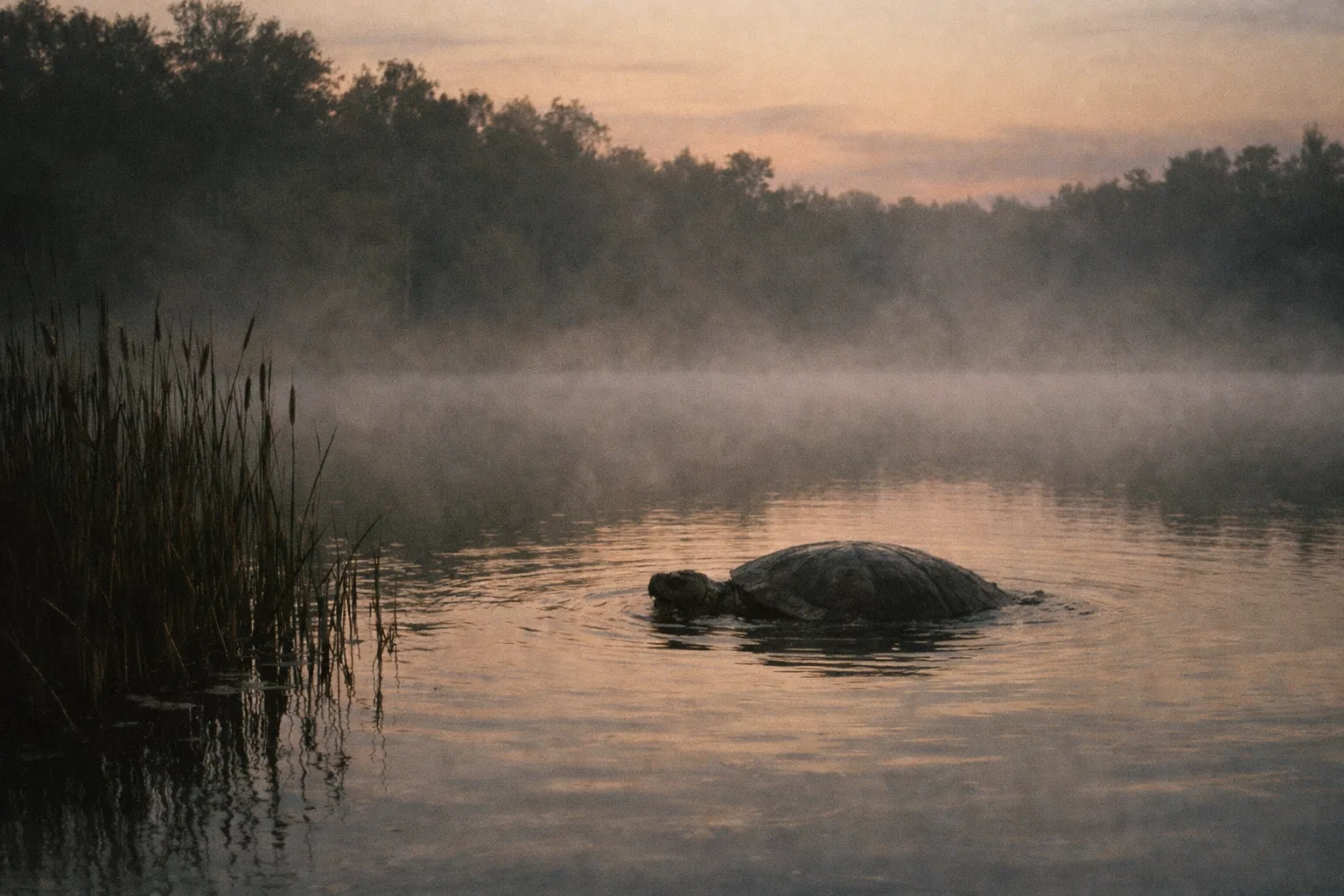
The Beast of Busco is Indiana’s cleanest example of a cryptid becoming civic identity. The claim centres on a huge snapping turtle, nicknamed Oscar, said to live in Fulk Lake near Churubusco in northern Indiana. The older origin story places the first sighting in 1898, when farmer Oscar Fulk supposedly saw a giant turtle in the lake. The modern legend took off in 1948 and 1949, when Gale Harris, then owner of the farm, and others reported a turtle with a shell compared to a dining table. Indiana University’s archive account says Harris’s efforts to capture the animal drew onlookers from across the state, involved failed attempts to drain the lake and use diving equipment, and ended without Oscar being found.[Indiana University Libraries Blog]blogs.libraries.indiana.eduOpen source on indiana.edu.
The Busco story has several features that make it unusually durable. First, the creature is not fantastical in basic type: Indiana really does have large snapping turtles, and the alligator snapping turtle has historical relevance in the region. Indiana DNR says alligator snapping turtles were once thought extirpated from Indiana until one was found near the White River in Morgan County in 1991; the species is now considered endangered in the state and prefers deep pools in large rivers, though it can occur in lakes, swamps and smaller streams.[Indiana Government]in.govdiana Government Fish and Wildlife: Alligator Snapping Turtlediana Government Fish and Wildlife: Alligator Snapping Turtle
Second, the legend has a built-in sceptical explanation that still leaves room for wonder. A large turtle seen partly submerged can look far bigger than it is, especially if the viewer sees the head, shell and water disturbance but not the whole animal. Smithsonian’s 2024 discussion of the Beast of Busco notes that some historians have suggested an alligator snapping turtle, while other experts disagree, keeping the case in the realm of plausible animal story rather than solved zoology.[Smithsonian Magazine]smithsonianmag.comcould citizens of this indiana town have seen a 500 pound turtle 180984659could citizens of this indiana town have seen a 500 pound turtle 180984659
Third, Churubusco embraced the story. Visit Indiana notes that the town placed a 12-foot statue in honour of the “Monster Turtle of Fulk Lake”, and describes Oscar as the inspiration for the annual Turtle Days festival. The result is a rare cryptid afterlife that is cheerful rather than frightening: Busco did not become a place to fear the water, but “Turtle Town”, where a failed monster hunt became a local brand.[Visit Indiana]visitindiana.in.govVisit Indiana Beast of ChurubuscoVisit Indiana Beast of Churubusco
The Crawfordsville Monster: when a sky beast became a lesson in misidentification
The Crawfordsville Monster is one of Indiana’s strangest and most useful cases because the apparent solution arrived almost as part of the original story. In September 1891, residents of Crawfordsville reported a white, shapeless, finned thing moving through the air, with descriptions later repeated in newspapers as a headless or shroud-like aerial creature. The account became famous enough to be picked up beyond Indiana, and later writers folded it into discussions of “living UFOs” and airborne monsters.[Wikipedia]WikipediaCrawfordsville monsterCrawfordsville monster
The most persuasive explanation is not a hidden creature, but birds. Contemporary retellings based on the newspaper record say two local men followed the object and identified it as a flock of many hundreds of killdeer, with the birds possibly disoriented by Crawfordsville’s electric lights. The white underparts and group movement could create the impression of one moving body, especially at night.[Wikipedia]WikipediaCrawfordsville monsterCrawfordsville monster
That explanation is important because it does not make the story worthless. It shows how a sincere witness report can be vivid, consistent and still wrong about the cause. It also shows how new technology can generate new monsters. Electric lighting changed the night-time behaviour of birds and the expectations of human observers; the “monster” emerged from that meeting point. For Indiana cryptid history, Crawfordsville is less a proof of an aerial animal than a classic case of folklore forming around misread wildlife, public excitement and fast-moving newspaper culture.
Lake Manitou and Meshekenabek: monster lore beside Potawatomi history
Lake Manitou near Rochester carries one of Indiana’s older lake-monster traditions. The lake is usually described as a man-made reservoir created in the late 1820s as part of treaty obligations involving the US government and the Potawatomi. Indiana University’s archive summary says an IU student recorded a local version in 1978, in which a fisherman claimed a monster overturned boats until a huge fish was later caught; the student suggested the story helped explain disappearances in the lake.[Indiana University Libraries Blog]blogs.libraries.indiana.eduOpen source on indiana.edu.
Older newspaper history complicates the tale. Ray Boomhower’s account of the Logansport Telegraph’s 1838 lake-monster coverage describes a proposed expedition to capture the creature, notes that the reports faded by September 1838, and records later “monster caught” stories involving large fish. Fulton County’s Lake Manitou history similarly points to large fish catches, including an 1849 report of a buffalo carp weighing several hundred pounds and an 1888 spoonbill catfish weighing 116 pounds that was displayed at Rochester.[rayboomhower.blogspot.com]rayboomhower.blogspot.comthe father of indiana history and lakethe father of indiana history and lake
This is where care matters. Some modern retellings attach the name Meshekenabek and frame the creature as a “great serpent”, but not all details are equally well documented. What is solid is that the lake has a long monster tradition in northern Indiana, that 1830s newspapers treated it as a marvel, and that later large-fish stories offered a naturalised version of the same fear: something big really could be moving under the surface, just not necessarily a supernatural serpent or unknown species.
The Potawatomi context should not be used as decorative spookiness. The same period includes the forced removal of Potawatomi people from northern Indiana in 1838, remembered as the Trail of Death. The Potawatomi Heritage account describes 859 Potawatomi being forced from their homeland on 4 September 1838, with leaders restrained and homes and fields burned to prevent return.[potawatomiheritage.com]potawatomiheritage.comOpen source on potawatomiheritage.com. Monster lore around Lake Manitou therefore sits beside a much heavier history of treaty pressure, removal and settler retelling. A good Indiana cryptid page can mention the legend without pretending that every later monster detail is a verified Indigenous tradition.
Bigfoot in Indiana: southern woods, local variants and the bear problem
Indiana has plenty of Bigfoot-style reports, but they are scattered rather than anchored by one universally recognised state case. The Bigfoot Field Researchers Organization lists Indiana reports by county, including recent entries in Washington, Brown and Martin counties, and older reports in the Hoosier National Forest and southern Indiana. Individual reports include a 2011 account of deep vocalisations near the Grubb Ridge loop south of Lake Monroe and a 1998 backpacking encounter near Brown County. These are witness claims, not biological evidence, but they show where the story tends to settle: wooded, hilly, low-light places where people are camping, hunting or driving at night.[BFRO]bfro.netstate listing.aspstate listing.asp
The Crosley Monster is Indiana’s most named local Bigfoot variant. It is usually associated with Crosley Fish & Wildlife Area near North Vernon in Jennings County. Indiana DNR describes Crosley as a property with 13 ponds and about seven miles of the Muscatatuck River, while Visit Indiana describes it as 4,288 acres of rolling hills, ponds and river habitat, with roughly 80 per cent of the property wooded. That terrain makes it an ideal setting for a large hairy-creature legend even without strong evidence for the creature itself.[Indiana Government]in.govOpen source on in.gov.
Sceptically, Indiana’s Bigfoot reports have two main problems. The first is evidence: there is no confirmed body, DNA sample, breeding population or clear photographic record for a hidden primate in Indiana. The second is misidentification. Indiana DNR says black bears were historically abundant in much of the state but were extirpated by 1850; in recent years, four black bears were confirmed in Indiana in 2015, 2016, 2018 and 2021, usually as wanderers from nearby states.[Indiana Government]in.govdiana Government Fish and Wildlife: Black Beardiana Government Fish and Wildlife: Black Bear A 2024 Journal of Zoology paper found that North American Sasquatch sightings are statistically associated with black bear populations even after adjusting for human population and forest area, supporting the idea that some Bigfoot reports are misidentified known animals.[ZSL Publications]zslpublications.onlinelibrary.wiley.comZSL Publications Bigfoot: If it's there, could it be a bear?ZSL Publications Bigfoot: If it's there, could it be a bear?
That does not mean every Indiana report is a bear. In fact, Indiana’s scarcity of confirmed bears weakens the bear explanation for some local claims compared with states that have stable bear populations. But it strengthens a broader point: large-animal sightings need ordinary wildlife, distance, lighting, expectation and terrain checked before “unknown creature” is treated as the best explanation.

River claws, phantom cats and other local flaps
Indiana’s smaller monster stories often work best as local flaps: brief clusters of claims with enough colour to endure, but too little documentation to support firm conclusions.
The Green-Clawed Beast is the classic Ohio River example. The story usually places Naomi Johnson in the Ohio River near Evansville in August 1955, where something allegedly grabbed her leg underwater, leaving scratches and a greenish stain or handprint. Modern retellings vary on the exact date and details, and the best available versions are mostly secondary local or folklore accounts rather than robust primary documentation. Plausible explanations include fish, submerged debris, panic in murky water, or a gar or catfish encounter exaggerated through retelling; the WKDQ local account itself suggests gar fish and large catfish as possible ordinary culprits.[99.5 WKDQ]wkdq.coman evansville legend the attack of the green clawed monster at dogtownan evansville legend the attack of the green clawed monster at dogtown
Phantom-cat stories fit another familiar pattern. Indiana DNR says seeing a mountain lion in Indiana is unlikely and that bobcats and domestic cats are often misidentified as mountain lions; it also says reports can be confirmed only with strong evidence such as a clear photograph in a verifiable location, track casts with measurements, or other specific signs.[Indiana Government]in.govdiana Government Fish and Wildlife: Mountain Liondiana Government Fish and Wildlife: Mountain Lion That guidance is directly relevant to “mysterious cat” claims: many are not hoaxes, but honest scale errors. A house cat at distance, a bobcat crossing a road, or an escaped exotic animal can become a black panther in memory, especially when the sighting is brief.
The Mill Race Monster of Columbus is another named case, usually described as a green, hairy, upright creature seen by young women near Mill Race Park in 1974. The available web evidence is dominated by cryptid summaries and later retellings rather than easily accessible primary local newspaper scans, so it is safest to treat the case as a reported local monster flap, not a well-established animal mystery.[Cryptid Wiki]cryptidz.fandom.comCryptid Wiki Mill Race Monster | Cryptid WikiCryptid Wiki Mill Race Monster | Cryptid Wiki
Indiana University’s folklore collection is especially helpful for this “small monster” layer. Its examples include the Gullywompus at Camp Louis Ernst in DuPont, which functioned like a scout-camp initiation prank; the Cable Line Monster of Elkhart, tied to a haunted roadside tree and changing descriptions; and a Petersburg strip-pit creature described as a half-man, half-ape figure with huge footprints. These accounts show how Indiana monster lore often works socially: to scare newcomers, explain a dangerous place, dramatise a road accident, or turn a landscape scar such as a strip mine into a story about something watching from the dark.[Indiana University Libraries Blog]blogs.libraries.indiana.eduOpen source on indiana.edu.
What evidence actually exists?
The evidence for Indiana cryptids is uneven. Some cases have strong evidence that a story existed, but weak evidence that the creature existed. That distinction is the key to reading the state’s monster history fairly.
For the Beast of Busco, there is good evidence of a 1949 public hunt, heavy press attention, failed capture attempts and a lasting festival tradition. There is not good evidence of a 500-pound turtle in Fulk Lake. The most reasonable position is that the legend may have grown from one or more real turtle sightings, with size estimates inflated by excitement, partial views and newspaper attention.[indiana.edu]blogs.libraries.indiana.eduOpen source on indiana.edu.
For the Crawfordsville Monster, there is strong evidence of a newspaper-driven sighting flap and a strong ordinary explanation: a flock of killdeer seen under unusual conditions. It is one of Indiana’s best “solved” monster stories, though it remains culturally valuable because it shows how a community can experience a misidentification as a monster.[Wikipedia]WikipediaCrawfordsville monsterCrawfordsville monster
For Lake Manitou, there is good evidence of an old lake-monster tradition, 1830s newspaper interest and later large-fish explanations. There is much weaker evidence for specific modern claims about a named surviving serpent. The most grounded reading is that the legend blends treaty-era local history, settler newspaper curiosity, dangerous-water warnings and real encounters with very large fish.[blogspot.com]rayboomhower.blogspot.comthe father of indiana history and lakethe father of indiana history and lake
For Bigfoot, Crosley and phantom cats, the record is mostly witness testimony, collector databases, local media and folklore. Those are worth preserving, but they are not enough to establish hidden breeding populations of unknown animals. Indiana’s own wildlife authorities offer useful guardrails: bears are only occasional confirmed visitors in the modern state, mountain lions are unlikely and often misidentified, and large reptiles such as alligator snapping turtles are rare and protected rather than common lake monsters.[Indiana Government]in.govdiana Government Fish and Wildlife: Black Beardiana Government Fish and Wildlife: Black Bear

Why these stories still matter
Indiana’s cryptids endure because they are local stories with practical hooks. Busco gives Churubusco a playful identity. Crawfordsville gives readers a near-perfect case study in how newspapers, birds and night lighting made a monster. Lake Manitou ties lake lore to difficult history and real water hazards. Bigfoot and Crosley reports turn southern Indiana’s wooded hills into a stage for the possibility that something large might still be unseen.
They also show that “explained” does not mean “uninteresting”. A flock of killdeer can be as revealing as a monster if the question is how people experience the unknown. A giant turtle story can be culturally true to a town even if Oscar was never captured. A phantom cat report can point to genuine wildlife confusion, escaped exotic animals, or the way humans overestimate size under stress. The best Indiana cryptid history keeps both halves in view: the fun of the strange claim and the discipline of asking what would count as evidence.
A field guide to Indiana’s major creature legends
LegendMain locationCore claimBest readingBeast of BuscoChurubusco / Fulk LakeGiant snapping turtle nicknamed OscarStrong folklore and tourism legacy; possible exaggerated turtle sightingCrawfordsville MonsterCrawfordsvilleWhite finned aerial “monster” seen in 1891Likely killdeer flock misidentified under night-time conditionsLake Manitou Monster / MeshekenabekRochester / Lake ManitouLake serpent or giant water creatureOld lake-monster tradition mixed with treaty-era history and large-fish storiesCrosley MonsterJennings County / Crosley Fish & Wildlife AreaBigfoot-like hairy figure in wooded hillsLocal Sasquatch variant; evidence mainly witness loreGreen-Clawed BeastEvansville / Ohio RiverUnderwater clawed thing attacked swimmer in 1955Thinly documented river flap; possible fish, debris or retelling growthMill Race MonsterColumbus / Mill Race ParkGreen, hairy upright creature reported in 1974Local monster flap with limited accessible primary evidencePhantom catsStatewide, especially rural roads and woodsBlack panthers or mountain lionsOften likely bobcat, domestic cat, scale error or escaped animal claim
Indiana’s monster map is therefore not a single mystery waiting for one solution. It is a set of local traditions shaped by farms, rivers, lakes, woods, newspapers, archives and civic memory. The creatures are strange, but the pattern is recognisably human: people see something, tell someone, the story grows, and a place is never quite ordinary again.
Amazon book picks
Further Reading
Books and field guides related to What Haunts Indiana's Water and Woods?. Use these as the next step if you want deeper reading beyond the article.
Monsters of the Midwest
Covers Midwestern creature lore closely aligned with Indiana stories.
eBay marketplace picks
Marketplace Samples
Live-tested eBay searches with available results related to this page.



Endnotes
1.
Source: blogs.libraries.indiana.edu
Link:https://blogs.libraries.indiana.edu/iubarchives/2018/10/31/hoosier-monsters/
2.
Source: bfro.net
Title: state listing.asp
Link:https://www.bfro.net/GDB/state_listing.asp?state=in
3.
Source: Wikipedia
Title: Churubusco, Indiana
Link:https://en.wikipedia.org/wiki/Churubusco%2C_Indiana
4.
Source: Wikipedia
Title: Crawfordsville monster
Link:https://en.wikipedia.org/wiki/Crawfordsville_monster
5.
Source: rayboomhower.blogspot.com
Title: the father of indiana history and lake
Link:https://rayboomhower.blogspot.com/2020/12/the-father-of-indiana-history-and-lake.html
6.
Source: potawatomiheritage.com
Link:https://www.potawatomiheritage.com/encyclopedia/trail-of-death/
7.
Source: bfro.net
Title: show report.asp
Link:https://www.bfro.net/GDB/show_report.asp?id=29674
8.
Source: bfro.net
Title: show report.asp
Link:https://www.bfro.net/GDB/show_report.asp?id=2461
9.
Source: wkdq.com
Title: an evansville legend the attack of the green clawed monster at dogtown
Link:https://wkdq.com/an-evansville-legend-the-attack-of-the-green-clawed-monster-at-dogtown/
10.
Source: Wikipedia
Title: Beast of Busco
Link:https://en.wikipedia.org/wiki/Beast_of_Busco
11.
Source: Wikipedia
Title: List of cryptids
Link:https://en.wikipedia.org/wiki/List_of_cryptids
12.
Source: Wikipedia
Title: Alligator snapping turtle
Link:https://en.wikipedia.org/wiki/Alligator_snapping_turtle
13.
Source: Wikipedia
Title: Potawatomi Trail of Death
Link:https://en.wikipedia.org/wiki/Potawatomi_Trail_of_Death
14.
Source: bfro.net
Title: show report.asp
Link:https://www.bfro.net/GDB/show_report.asp?id=2469
15.
Source: bfro.net
Title: show report.asp
Link:https://www.bfro.net/GDB/show_report.asp?id=3233
16.
Source: newspapers.com
Title: crawfordsville monster
Link:https://www.newspapers.com/article/12476184/crawfordsville_monster/
17.
Source: youtube.com
Title: The Beast of Busco | Indiana’s Legendary Giant Turtle
Link:https://www.youtube.com/watch?v=PocbPRju-mA
Source snippet
The Crawfordsville Monster | The Airborne Terror of Indiana...
18.
Source: youtube.com
Title: The Crawfordsville Monster | The Airborne Terror of Indiana
Link:https://www.youtube.com/watch?v=XcOSGumQUVU
Source snippet
INDIAN LEGENDS: Lake Monsters, Spirits, and Bigfoot Stories of Indiana...
19.
Source: in.gov
Link:https://www.in.gov/dnr/fish-and-wildlife/properties/crosley-fwa
20.
Source: in.gov
Title: diana Government Indiana State Library: Hoosier State Chronicles
Link:https://www.in.gov/library/services-for-libraries/hoosier-state-chronicles/
21.
Source: smithsonianmag.com
Title: could citizens of this indiana town have seen a 500 pound turtle 180984659
Link:https://www.smithsonianmag.com/science-nature/could-citizens-of-this-indiana-town-have-seen-a-500-pound-turtle-180984659/
22.
Source: in.gov
Title: diana Government Fish and Wildlife: Alligator Snapping Turtle
Link:https://www.in.gov/dnr/fish-and-wildlife/wildlife-resources/animals/alligator-snapping-turtle/
23.
Source: visitindiana.in.gov
Title: Visit Indiana Beast of Churubusco
Link:https://visitindiana.in.gov/listing/beast-of-churubusco/16200/
24.
Source: fultoncountyindiana.com
Title: lake manitou
Link:https://fultoncountyindiana.com/about/lake-manitou/
25.
Source: visitindiana.in.gov
Link:https://visitindiana.in.gov/listing/crosley-fish-%26-wildlife-area/15457/
26.
Source: in.gov
Title: diana Government Fish and Wildlife: Black Bear
Link:https://www.in.gov/dnr/fish-and-wildlife/wildlife-resources/animals/black-bear/
27.
Source: zslpublications.onlinelibrary.wiley.com
Title: ZSL Publications Bigfoot: If it’s there, could it be a bear?
Link:https://zslpublications.onlinelibrary.wiley.com/doi/abs/10.1111/jzo.13148
28.
Source: in.gov
Title: diana Government Fish and Wildlife: Mountain Lion
Link:https://www.in.gov/dnr/fish-and-wildlife/wildlife-resources/animals/mountain-lion/
29.
Source: cryptidz.fandom.com
Title: Cryptid Wiki Mill Race Monster | Cryptid Wiki
Link:https://cryptidz.fandom.com/wiki/Mill_Race_Monster
30.
Source: in.gov
Link:https://www.in.gov/dnr/fish-and-wildlife/nongame-and-endangered-wildlife/amphibians-and-reptiles/
31.
Source: in.gov
Link:https://www.in.gov/dnr/fish-and-wildlife/files/crosley.pdf
32.
Source: in.gov
Link:https://www.in.gov/dnr/fish-and-wildlife/properties/splinter-ridge-fwa
33.
Source: in.gov
Link:https://www.in.gov/dnr/fish-and-wildlife/files/splinter.pdf
34.
Source: in.gov
Link:https://www.in.gov/dnr/static/engineering/2025/en-ENG2502899171-Crosley-NTB.pdf
35.
Source: in.gov
Title: Contact Division of Fish & Wildlife
Link:https://www.in.gov/dnr/fish-and-wildlife/about-us/contact-us-faqs/
36.
Source: in.gov
Title: Hunting & Trapping Check Stations
Link:https://www.in.gov/dnr/fish-and-wildlife/hunting-and-trapping/hunting-trapping-guide/hunting-check-stations
37.
Source: cryptidarchives.fandom.com
Title: Monsters at the Crossroads
Link:https://cryptidarchives.fandom.com/wiki/Monsters_at_the_Crossroads
38.
Source: monster.fandom.com
Title: Crawfordsville Monster
Link:https://monster.fandom.com/wiki/Crawfordsville_Monster
39.
Source: itsmth.fandom.com
Title: Crawfordsville Monster
Link:https://itsmth.fandom.com/wiki/Crawfordsville_Monster
40.
Source: cryptidz.fandom.com
Title: Crawfordsville Monster
Link:https://cryptidz.fandom.com/wiki/Crawfordsville_Monster
41.
Source: cryptidz.fandom.com
Title: Beast of Busco
Link:https://cryptidz.fandom.com/wiki/Beast_of_Busco
42.
Source: cryptidarchives.fandom.com
Title: Beast of ‘Busco
Link:https://cryptidarchives.fandom.com/wiki/Beast_of_%27Busco
43.
Source: obscurban-legend.fandom.com
Title: Green Clawed Beast
Link:https://obscurban-legend.fandom.com/wiki/Green_Clawed_Beast
44.
Source: reddit.com
Title: the beast of busco
Link:https://www.reddit.com/r/Cryptozoology/comments/1k5l69o/the_beast_of_busco/
45.
Source: zslpublications.onlinelibrary.wiley.com
Link:https://zslpublications.onlinelibrary.wiley.com/doi/10.1111/jzo.13148
46.
Source: jstor.org
Link:https://www.jstor.org/stable/27787568
47.
Source: experience.arcgis.com
Title: Black Bear
Link:https://experience.arcgis.com/experience/96b17ba676e74457a560bc324efa0dd6/page/Black-Bear
48.
Source: futilitycloset.com
Title: the crawfordsville monster
Link:https://www.futilitycloset.com/2008/02/20/the-crawfordsville-monster/
49.
Source: copsmodels.com
Title: The Beast of Busco
Link:https://www.copsmodels.com/webhelp/rungtap/hc_beast.htm
50.
Source: extension.purdue.edu
Title: jennings county
Link:https://extension.purdue.edu/pondwildlife/county-resources/jennings-county.html
51.
Source: ouci.dntb.gov.ua
Link:https://ouci.dntb.gov.ua/en/works/4knoOJm7/
52.
Source: usfolktales.com
Title: the crawfordsville monster
Link:https://usfolktales.com/the-crawfordsville-monster/
53.
Source: huntinglocator.com
Title: Crosley Fish & Wildlife Area
Link:https://huntinglocator.com/public-hunting-land/details/Crosley-Fish-Wildlife-Ar-4228-acer-DeerTurkey-hunting-land-in-Jennings-IA
Additional References
54.
Source: youtube.com
Title: INDIAN LEGENDS: Lake Monsters, Spirits, and Bigfoot Stories of Indiana
Link:https://www.youtube.com/watch?v=CvAk_mL_lAE
Source snippet
Indiana Lore: Legends of Hoosier Cryptids and Haunts - Beast of Busco, Willard Library, Mud Mermaids...
55.
Source: youtube.com
Title: Indiana Lore: Legends of Hoosier Cryptids and Haunts
Link:https://www.youtube.com/watch?v=32NQV4-xXxQ
Source snippet
Bigfoot Encounters in the Hoosier National Forest...
56.
Source: whitebearlakemn.gov
Link:https://www.whitebearlakemn.gov/ourcommunity/page/legend-white-bear-lake
57.
Source: skepticalinquirer.org
Link:https://skepticalinquirer.org/2024/10/journal-of-zoology-cites-skeptical-inquirer-if-bigfoot-is-there-it-could-be-a-bear/
58.
Source: researchgate.net
Link:https://www.researchgate.net/publication/367247671_If_it%27s_there_could_it_be_a_bear
59.
Source: facebook.com
Link:https://www.facebook.com/groups/281886105961506/posts/2138328016983963/
60.
Source: inherpatlas.org
Link:https://www.inherpatlas.org/species/macrochelys_temminckii
61.
Source: instagram.com
Link:https://www.instagram.com/p/CYTx1zmM2wb/
62.
Source: facebook.com
Link:https://www.facebook.com/blackwaxcafe/posts/another-bigfoot-sighting-in-southern-indiana/1425401286277705/
63.
Source: mybestruns.com
Link:https://mybestruns.com/running-news.php/9824
Topic Tree
Follow this branch
Related pages 49
- Rhode Island Monsters
- Hawaii Monsters
- Illinois Cryptids
- Nebraska Cryptids
- Alabama Cryptids
- +44 more in sidebar