What Makes Arizona's Monsters Feel So Real?
Arizona’s monster lore is not built around one neat “state cryptid”.
Page outline Jump by section
Why Arizona’s monsters cluster in forests, canyons and borderlands
Arizona’s creature stories often surprise newcomers because the state is popularly imagined as dry desert. In practice, its monster map is split between two Arizonas: the forested high country of the north and east, and the rough desert-and-mountain borderlands of the south. The Mogollon Rim, the state’s most important Bigfoot-style setting, sits at the southern edge of the Colorado Plateau and includes snowmelt drainages, ponderosa pine, fir, aspen and oak habitats — exactly the sort of broken, wooded country where night sounds, animal tracks and half-seen movement can gather mystery.[awcs.azgfd.com]awcs.azgfd.comOpen source on azgfd.com.
That environmental texture matters because many Arizona “cryptid” reports depend on brief perception rather than physical evidence. A shape crosses a road at dusk; something screams from a canyon; a campsite is disturbed; a wake moves across a reservoir; a large cat appears where people did not expect one. Arizona also has real wildlife that can complicate the picture. Black bears are present in woodland, conifer and chaparral habitats, with Arizona Game and Fish reporting the highest relative densities along the Mogollon Rim, the Mazatzal Mountains, and the White and Pinaleño mountains. Mountain lions occur throughout Arizona, especially in rugged mountains, canyons and rocky slopes, and they are usually elusive, crepuscular or nocturnal.[Arizona Game & Fish Department]azgfd.comArizona Game & Fish Department Black BearArizona Game & Fish Department Black Bear
This does not make a seven-foot hairy hominid or giant flying reptile plausible. It does explain why Arizona produces durable monster stories. The landscape supplies darkness, distance and scale; the wildlife supplies ambiguous sounds and tracks; the old frontier press supplies dramatic language; and later tourism, podcasts, books and local festivals keep the names alive.
The Mogollon Monster: Arizona’s Bigfoot in the pines
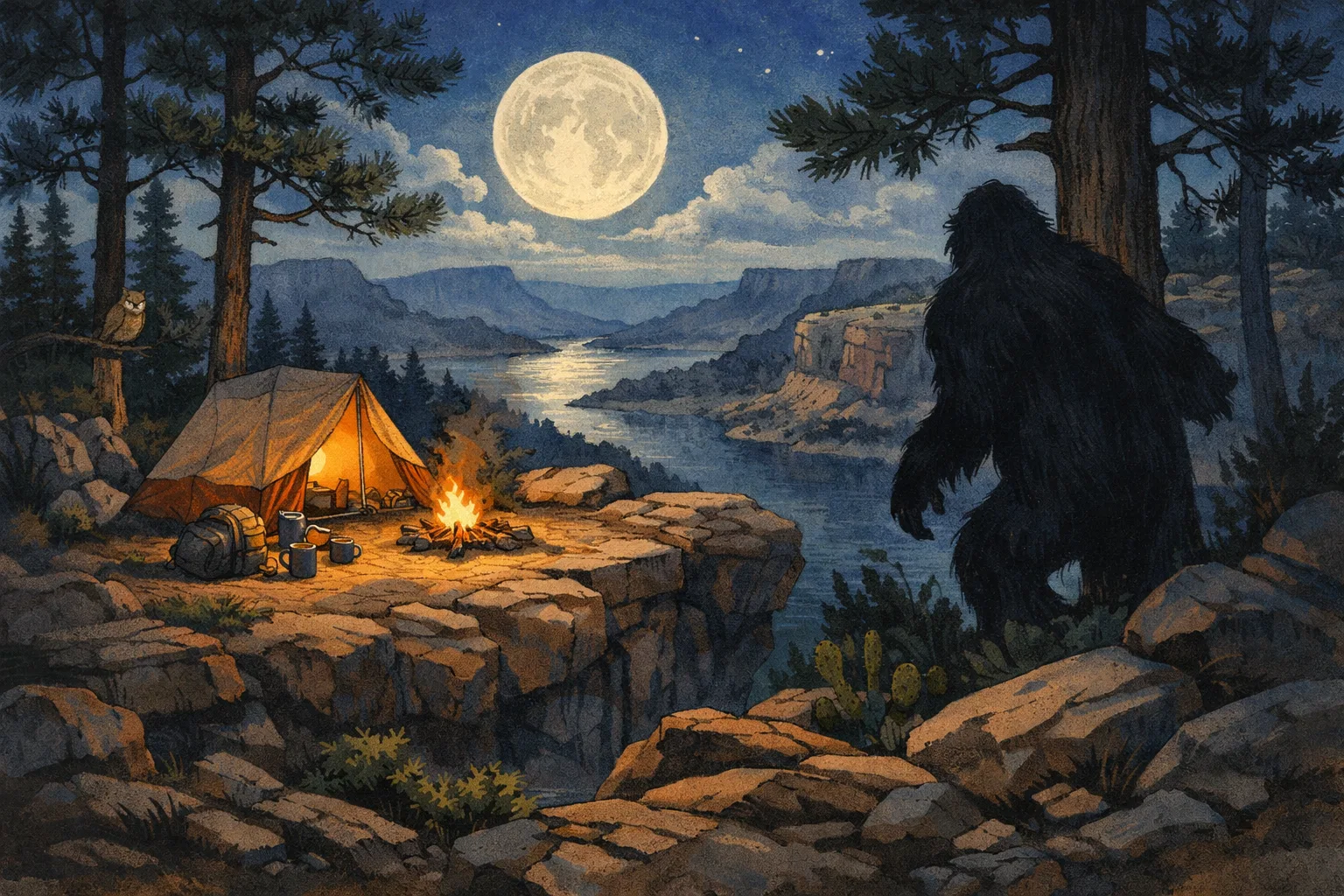
The Mogollon Monster is the state’s signature cryptid: a tall, hairy, Bigfoot-like creature said to roam the pine forests and canyon country around the Mogollon Rim. Modern summaries usually describe it as a large biped, often over seven feet tall, with dark or reddish-brown hair, a strong smell, strange cries and a habit of moving around camps after dark. Those details line up neatly with wider American Sasquatch traditions, but the Arizona version has a particular geography: Rim country, Payson, the White Mountains, Heber-Overgaard, Fort Apache-area stories and the Grand Canyon edge.[Wikipedia]WikipediaMogollon MonsterMogollon Monster
The oldest commonly cited newspaper-style ancestor is a 1903 account in The Arizona Republican involving I.W. Stevens, who described a wild, hairy, clawed figure near the Grand Canyon. Later retellings fold that “wild man” account into the Mogollon Monster tradition, even though the named creature appears to have become clearer only later. Arizona Highways notes that the name “Mogollon Monster” does not seem to appear in newspapers until a 1967 article about a Boy Scout camping trip in the White Mountains, where the creature is mentioned as if readers already know the reference.[Wikipedia]WikipediaMogollon MonsterMogollon Monster
The Boy Scout thread is important because it gives the legend one of its most memorable narrative shapes. Don Davis, later known in Bigfoot circles, described a 1940s Scout-camp encounter near the base of the Rim outside Payson: a reddish-brown figure, odd movement, and camp disturbances afterwards. Whether read as memory, folklore, misidentification or cryptid testimony, the story does what enduring legends do well: it gives a big regional idea a human-scale scene — boys in the woods, a glimpse between trees, missing fish, a scoutmaster worried about a stranger nearby.[Arizona Highways]arizonahighways.comArizona Highways Neither Hide Nor Hair | Arizona HighwaysArizona Highways Neither Hide Nor Hair | Arizona Highways
The sceptical reading is straightforward. No accepted biological evidence has established a breeding population of unknown apes in Arizona. The state’s confirmed large animals — especially black bears, mountain lions and elk — can produce confusing glimpses, noises, tracks, odours and disturbed campsites. Black bears are particularly relevant because they occupy many of the same wooded regions tied to Mogollon Monster stories, can stand or move briefly in ways that look odd to startled witnesses, and are not always black; Arizona Game and Fish notes brown, blond and cinnamon colour phases.[Arizona Game & Fish Department]azgfd.comArizona Game & Fish Department Black BearArizona Game & Fish Department Black Bear
The legend remains culturally useful even without zoological proof. It gives Rim country a campfire mascot, a warning figure for wilderness etiquette, and an Arizona answer to the Pacific Northwest’s Bigfoot. Its staying power comes less from a single decisive case than from repeated local familiarity: people know the terrain, know someone who has heard something, and know the story well enough to make a dark forest feel occupied.
The Red Ghost: when a monster story had a camel underneath
The Red Ghost is one of Arizona’s strangest creature traditions because it sits halfway between frontier horror and historical animal explanation. In the 1880s, stories spread of a huge reddish beast roaming Arizona Territory with a ghastly figure or skeleton on its back. The tale included a trampling death, miners finding a skull, impossible exaggerations about size, and the final revelation that the beast was apparently a feral camel scarred by rawhide straps.[Smithsonian Magazine]smithsonianmag.comwhatever happened wild camels american west 180956176whatever happened wild camels american west 180956176
The historical root is the United States Army’s camel experiment. In the 1850s, Secretary of War Jefferson Davis backed the importation of camels to test whether they could serve military transport in the arid West. The National Museum of the United States Army describes the experiment as a serious attempt to see whether camels could be “economically and usefully employed” in military service, but the project was later overtaken by military reluctance, the Civil War and abandonment.[The Army Historical Foundation]armyhistory.orgOpen source on armyhistory.org.
That background makes the Red Ghost different from most cryptid stories. A mysterious beast in the Arizona desert was not automatically impossible: camels really had been brought into the American Southwest, and some did roam after the official experiment collapsed. Smithsonian’s account places the Red Ghost legend in the 1880s and notes that wild camels genuinely ranged in the West after the Camel Corps episode, even while the skeleton-rider details belong to the darker machinery of legend.[Smithsonian Magazine]smithsonianmag.comwhatever happened wild camels american west 180956176whatever happened wild camels american west 180956176
The most useful version of the Red Ghost is not “a cryptid was real” but “a real animal became a cryptid through fear, rumour and frontier storytelling”. American Heritage quotes the Mohave County Miner report of 25 February 1893, in which Mizoo Hastings shot a big red camel in his garden and found it covered in old knotted rawhide strips, some cutting into the flesh. That report does not prove every dramatic earlier episode, but it shows how an unfamiliar, distressed, large animal could generate a monster legend across a sparsely documented territory.[American Heritage]americanheritage.comred ghostred ghost
The Red Ghost also explains why Arizona folklore often feels more physical than purely supernatural. The state’s legends are full of practical frontier details: pack animals, mining camps, ranch houses, military experiments, newspaper notices, hard travel and bad visibility. The monster is not just “out there”; it is tangled in transport, settlement and the difficulty of knowing what one has seen in a harsh place.
Tombstone’s winged monster and the thunderbird afterlife
Arizona’s most famous winged-monster item comes from The Tombstone Epitaph of 26 April 1890. The Library of Congress’s digitised issue preserves the newspaper page containing the report, usually summarised as a “winged monster” found between the Whetstone and Huachuca mountains. Later retellings turn it into the Tombstone Thunderbird: a huge flying creature, sometimes imagined like a pterosaur, sometimes treated as a frontier tall tale.[The Library of Congress]loc.govOpen source on loc.gov.
The story’s power comes from its newspaper form. A nineteenth-century local paper could print dramatic, humorous, exaggerated or dubious filler, but once the item exists in an archive it gains a second life. Cryptid readers then ask a different question: not “why did a frontier newspaper print a strange story?” but “what if the story records a real unknown animal?” That shift is how an item of newspaper colour becomes a cryptozoological case.
The most famous afterlife is the supposed “lost thunderbird photograph” — an image many people claim to remember seeing, usually described as men posing with a giant bird or reptile-like creature pinned to a wall or barn. The problem is that the photograph has never been reliably produced from the original 1890 issue or another strong primary source. The surviving value of the Tombstone case, then, is not as evidence for a prehistoric survivor but as a lesson in how monster folklore mutates: a newspaper anecdote becomes a thunderbird, the thunderbird becomes a missing photograph, and the missing photograph becomes a memory mystery of its own.[The Library of Congress]loc.govOpen source on loc.gov.
A sceptical explanation does not need to identify a specific bird. The original claim is extravagant, and later versions often grow more extravagant still. Arizona certainly has large birds and dramatic skies, but the Tombstone creature as popularly retold belongs more securely to frontier tall-tale culture and cryptid media than to zoology.

Lake monsters, giant fish and the problem of borrowed legends
Arizona is not a classic lake-monster state in the way Vermont, New York or Scotland are lake-monster settings, but its reservoirs have still attracted monster talk. Roosevelt Lake has had “monster cat” storytelling, with Arizona Highways publishing a 1994 feature in which divers pursue tales of an enormous catfish-like creature. The memorable part of that piece is not a confirmed monster but the dive itself: poor visibility, stirred-up mud, ledges, large bass and the way underwater confusion can make ordinary lake experience feel dramatic.[Arizona Highways]arizonahighways.comArizona Highways Lake Monster Story Lures Divers | Arizona HighwaysArizona Highways Lake Monster Story Lures Divers | Arizona Highways
Lake Powell has a more internet-age legend sometimes called Skin Fin, usually described as a dark, smooth, finned creature. Here the evidence trail is especially thin. The Pine Barrens Institute’s profile is useful because it highlights a common folklore failure: a supposed supporting story about a dead aquatic beast identified as a blacktip shark appears to belong not to Lake Powell in Arizona and Utah, but to Powell Lake in Florida. A similar name, a better monster story, and loose retelling were enough to migrate the anecdote westward.[THE PINE BARRENS INSTITUTE]pinebarrensinstitute.comOpen source on pinebarrensinstitute.com.
That does not mean every lake witness is lying. Large fish, wakes, bubbles, submerged debris, boats, wind shifts and poor depth perception can all produce sincere reports of something “too big” or “not right”. It means Arizona lake monsters are best read as small, local mystery-animal traditions rather than as a deeply rooted state-defining branch of the lore. They are interesting because they show how quickly a reservoir can borrow the structure of Loch Ness: a dark surface, a brief disturbance, an absent photograph, and a story that improves each time it is retold.
Phantom cats, jaguars and why some “impossible” animals are real
Big-cat stories are a special category in Arizona because the state really does sit on the northern edge of jaguar range. Jaguars once ranged more widely in Arizona, and modern camera-trap work has confirmed rare individuals moving through southern Arizona’s borderland corridors. University of Arizona researchers reported in 2025 that 15 years of monitoring had documented jaguar movement in the borderlands, with more than 80 verified historical records over 160 years and recent detections in southern Arizona.[CALeSES]cales.arizona.eduOpen source on arizona.edu.
This matters for cryptid interpretation. In many US states, “black panther” or mystery-cat reports have little local biological support. In Arizona, the baseline is more complicated: mountain lions are widespread, bobcats are common, and jaguars are rare but not imaginary. Arizona Game and Fish lists jaguar as a species of conservation concern, while University of Arizona researchers describe the Sky Islands as corridors linking southern Arizona with larger populations in northern Mexico.[awcs.azgfd.com]awcs.azgfd.comOpen source on azgfd.com.
That still does not validate every phantom-cat report. Most jaguars documented in modern Arizona have been individual, usually male animals, detected by cameras or other confirmable evidence, not a hidden population of oversized mystery cats roaming the whole state. The lesson is more subtle: Arizona is one of the places where a strange-cat report deserves careful checking before dismissal, but careful checking means trail-camera evidence, expert identification, rosette-pattern comparison and habitat context — not just a dramatic sighting at night.
What evidence exists, and what would actually change the picture?
Arizona’s monster traditions are rich in testimony but poor in hard biological evidence. The Mogollon Monster has recurring reports, local familiarity and a plausible habitat mood, but no accepted specimen, DNA, clear body, or unambiguous photographic record. Tombstone’s thunderbird has an archival newspaper item but no reliable physical evidence or recovered photograph. Roosevelt and Lake Powell monster stories have entertaining accounts, but the strongest explanations involve ordinary aquatic animals, borrowed anecdotes, or ambiguous water conditions. The Red Ghost is the exception: not because a supernatural camel existed, but because the legend plausibly grew around real feral camels and at least one reported camel carcass with rawhide scars.[arizonahighways.com]arizonahighways.comArizona Highways Neither Hide Nor Hair | Arizona HighwaysArizona Highways Neither Hide Nor Hair | Arizona Highways
A better evidence standard would look different from most campfire lore. For a large unknown land animal, useful evidence would include clear, dateable images from multiple angles; biological material collected with a documented chain of custody; repeated independent detections in the same habitat; and analysis by qualified wildlife biologists. For mystery cats, Arizona already shows the model: camera traps, long-term monitoring, individual identification and ecological context.[CALeSES]cales.arizona.eduOpen source on arizona.edu.
Sceptical explanations are not a way to drain the fun from the subject. They often make the stories more interesting. A black bear in cinnamon phase is not a boring answer if it explains why a witness saw a reddish upright shape near the Rim. A feral camel is not a dull explanation for the Red Ghost; it is one of the strangest true animal histories in the American West. A misfiled Florida shark story is not just a debunking footnote; it shows exactly how monster legends travel.
How Arizona’s cryptids changed over time
Arizona’s creature lore has moved through several eras. The frontier period produced newspaper monsters and practical terrors: the Red Ghost, strange desert beasts, and dramatic reports printed for readers who lived close to ranching, mining and military roads. The early twentieth century supplied “wild man” material that later readers could fold into Bigfoot traditions. The mid-to-late twentieth century gave the Mogollon Monster a clearer name, a Scout-camp setting and a stronger place in Rim country folklore. The internet age then widened the map, reviving Tombstone thunderbird debates, spreading Skin Fin-style lake stories and turning local legends into searchable cryptid entries.[americanheritage.com]americanheritage.comred ghostred ghost
Tourism also changed the tone. Tombstone already trades on Old West memory, so a winged monster fits naturally beside gunfight lore and frontier newspapers. Rim country uses the Mogollon Monster as a campfire figure, wilderness joke and local curiosity. Quartzsite and camel history keep the Red Ghost close to roadside heritage, especially through the broader memory of Hi Jolly and the Army camel experiment. These afterlives do not prove the creatures, but they explain why the stories survive.
The best way to read Arizona’s monster tradition is as a layered map. Some accounts are likely misidentified wildlife. Some are newspaper exaggerations. Some are imported or confused stories. Some preserve real ecological facts, such as rare jaguars and bear country. Some, like the Red Ghost, show how a documented animal can become almost mythical when fear, distance and poor records do the editing. Arizona’s monsters endure because the state gives them room: dark pines above the desert, canyons that distort sound, reservoirs with hidden depths, and old stories still travelling the back roads.
Amazon book picks
Further Reading
Books and field guides related to What Makes Arizona's Monsters Feel So Real?. Use these as the next step if you want deeper reading beyond the article.
The United States of Cryptids
Includes many regional monster traditions similar to Arizona's legends.
eBay marketplace picks
Marketplace Samples
Live-tested eBay searches with available results related to this page.



Endnotes
1.
Source: awcs.azgfd.com
Link:https://awcs.azgfd.com/conservation-opportunity-areas/terrestrial/mogollon-rim-snow-melt-draws-important-bird-area
2.
Source: azgfd.com
Title: Arizona Game & Fish Department Black Bear
Link:https://www.azgfd.com/species/black-bear/
3.
Source: azgfd.com
Title: Arizona Game & Fish Department Living With Mountain Lions
Link:https://www.azgfd.com/wildlife-conservation/living-with-wildlife/living-with-mountain-lions/
4.
Source: Wikipedia
Title: Mogollon Monster
Link:https://en.wikipedia.org/wiki/Mogollon_Monster
5.
Source: pinebarrensinstitute.com
Link:https://pinebarrensinstitute.com/cryptids/2018/8/19/cryptid-profile-skin-fin-the-lake-powell-monster
6.
Source: cales.arizona.edu
Link:https://cales.arizona.edu/news/following-spots-what-15-years-data-reveal-about-jaguars-and-connectivity-borderlands
7.
Source: awcs.azgfd.com
Link:https://awcs.azgfd.com/species/mammals/panthera-onca
8.
Source: azgfd.com
Link:https://www.azgfd.com/wildlife-conservation/living-with-wildlife/living-with-bears/
9.
Source: Wikipedia
Title: Red Ghost (folklore)
Link:https://en.wikipedia.org/wiki/Red_Ghost_%28folklore%29
10.
Source: Wikipedia
Title: List of cryptids
Link:https://en.wikipedia.org/wiki/List_of_cryptids
11.
Source: Wikipedia
Title: United States Camel Corps
Link:https://en.wikipedia.org/wiki/United_States_Camel_Corps
12.
Source: Wikipedia
Title: Mostro di Mogollon
Link:https://it.wikipedia.org/wiki/Mostro_di_Mogollon
13.
Source: Wikipedia
Title: List of lake monsters
Link:https://en.wikipedia.org/wiki/List_of_lake_monsters
14.
Source: newspapers.com
Title: tombstone epitaph winged monster in ariz
Link:https://www.newspapers.com/article/tombstone-epitaph-winged-monster-in-ariz/2995114/
15.
Source: military.com
Title: how us armys failed camel corps led arizonas most enduring ghost story
Link:https://www.military.com/history/how-us-armys-failed-camel-corps-led-arizonas-most-enduring-ghost-story.html
16.
Source: extension.arizona.edu
Title: Black Bears
Link:https://extension.arizona.edu/sites/extension.arizona.edu/files/attachment/BlackBears.pdf
17.
Source: arizonahighways.com
Title: Arizona Highways Neither Hide Nor Hair | Arizona Highways
Link:https://www.arizonahighways.com/article/neither-hide-nor-hair
18.
Source: smithsonianmag.com
Title: whatever happened wild camels american west 180956176
Link:https://www.smithsonianmag.com/history/whatever-happened-wild-camels-american-west-180956176/
19.
Source: armyhistory.org
Link:https://armyhistory.org/the-u-s-armys-camel-corps-experiment/
20.
Source: americanheritage.com
Title: red ghost
Link:https://www.americanheritage.com/red-ghost
21.
Source: loc.gov
Link:https://www.loc.gov/resource/sn95060905/1890-04-26/ed-1/?dl=page&q=found+on+the+desert&sp=3&st=text
22.
Source: arizonahighways.com
Title: Arizona Highways Lake Monster Story Lures Divers | Arizona Highways
Link:https://www.arizonahighways.com/archive/issues/chapter/Doc.889.Chapter.2
23.
Source: arizonahighways.com
Link:https://www.arizonahighways.com/classroom/black-bear-0
24.
Source: cryptidz.fandom.com
Title: Red Ghost
Link:https://cryptidz.fandom.com/wiki/Red_Ghost
25.
Source: cryptidz.fandom.com
Title: Mogollon Monster
Link:https://cryptidz.fandom.com/wiki/Mogollon_Monster
26.
Source: cryptidz.fandom.com
Title: Lake Monsters
Link:https://cryptidz.fandom.com/wiki/Lake_Monsters
27.
Source: itsmth.fandom.com
Title: Mogollon Monster
Link:https://itsmth.fandom.com/wiki/Mogollon_Monster
28.
Source: cryptidz.fandom.com
Title: Skin fin
Link:https://cryptidz.fandom.com/wiki/Skin_fin
29.
Source: loc.gov
Link:https://www.loc.gov/resource/sn95060905/1890-04-26/ed-1/?q=tombstone+epitaph+april&r=-0.739%2C-0.129%2C2.477%2C1.479%2C0&sp=3
30.
Source: reddit.com
Title: The Red Ghost
Link:https://www.reddit.com/r/UrbanMyths/comments/1ho9ez1/the_red_ghost_a_legend_about_a_demonic_figure/
31.
Source: intermountainhistories.org
Link:https://www.intermountainhistories.org/items/show/527
32.
Source: rondungan.com
Title: the red ghost
Link:https://rondungan.com/2022/08/21/the-red-ghost/
33.
Source: astonishinglegends.com
Title: the red ghost
Link:https://astonishinglegends.com/astonishing-legends/2022/10/14/the-red-ghost
34.
Source: mythfolks.com
Title: arizona folklore
Link:https://www.mythfolks.com/arizona-folklore
35.
Source: palaeoblog.blogspot.com
Title: lake powell monster
Link:https://palaeoblog.blogspot.com/2005/07/lake-powell-monster.html
36.
Source: divergentrays.com
Title: The Mogollon Monster
Link:https://divergentrays.com/mogollonmonster
Additional References
37.
Source: fws.gov
Link:https://www.fws.gov/species/grizzly-bear-ursus-arctos-horribilis
38.
Source: youtube.com
Title: Mogollon Monster: Arizona’s WILD MAN of the Rocks
Link:https://www.youtube.com/watch?v=d9YvtCrCR9o
Source snippet
Is This Proof Arizona's 'Bigfoot' Exists? | UNEXPLAINED...
39.
Source: youtube.com
Title: Is This Proof Arizona’s ‘Bigfoot’ Exists? | UNEXPLAINED
Link:https://www.youtube.com/watch?v=Gfjj2rsbnzg
Source snippet
The (Mostly True) Legend of the Red Ghost...
40.
Source: medium.com
Link:https://medium.com/the-awl/a-guide-to-the-spooky-scary-secret-monsters-of-every-state-c22c148e4f85
41.
Source: facebook.com
Link:https://www.facebook.com/DiscoverTombstoneAZ/posts/discover-tombstone-takes-another-look-at-cryptozoology-the-tombstone-thunderbird/1204617275004062/
42.
Source: northernjaguarproject.org
Link:https://www.northernjaguarproject.org/jaguar/
43.
Source: folkbestiary.com
Link:https://folkbestiary.com/arizona/
44.
Source: satisfyrunning.com
Link:https://satisfyrunning.com/blogs/possessed/arizona-myth-bustin?srsltid=AfmBOor-XKa0Ic5TXI8m9-6we0B3ceUbP9pj-QVhbm23BA8naY6_bfAU
45.
Source: southernstylesweettees.com
Link:https://www.southernstylesweettees.com/blog/april
46.
Source: facebook.com
Link:https://www.facebook.com/groups/ArizonaCampingFamilies/posts/2904468123111411/
Topic Tree
Follow this branch
Related pages 49
- Rhode Island Monsters
- Hawaii Monsters
- Illinois Cryptids
- Nebraska Cryptids
- Alabama Cryptids
- +44 more in sidebar