Within Montana Monsters
Why Does Bigfoot Fit Montana So Well?
Montana's Bigfoot stories draw power from dark timber, mountain roads and the possibility of misread wildlife in remote country.
On this page
- Where reports tend to cluster
- Forests, mountains and witness conditions
- Bears, shadows and the appeal of Sasquatch
Page outline Jump by section
Introduction
Bigfoot fits Montana because the state gives the legend exactly what it needs: deep timber, long mountain roads, active bear country and enough remote western forest to make a fleeting shape feel possible. Montana is not one of the highest-volume Bigfoot states, but the reports that do exist lean heavily towards the forested west: Missoula, Lewis and Clark, Flathead, Lincoln, Mineral, Ravalli and the mountain corridors around the Continental Divide. The best way to read these stories is not as proof of an undiscovered ape, but as a pattern of claims shaped by place. The same country that supports black bears, grizzlies, elk, wolves, logging roads, hunting cabins and dark cedar bottoms also creates ideal conditions for misread wildlife, strange sounds and stories that travel well. BFRO, the best-known Bigfoot report database, lists 55 Montana reports, with Missoula County and Lewis and Clark County among the more active areas in its records.[BFRO]bfro.netReports for MontanaReports for Montana
Where reports tend to cluster
Montana Bigfoot stories are most strongly associated with the western half of the state, where the landscape shifts from open prairie into the Northern Rockies. That matters because “Bigfoot country” is usually imagined as a place with cover: thick conifers, broken slopes, creek bottoms, old logging tracks and enough distance from town for a witness to feel alone. In Montana, those features are not decorative. They define huge stretches of the Kootenai, Flathead, Lolo, Bitterroot and Helena-Lewis and Clark forest regions.
The BFRO database is not a scientific census, and its reports are self-selected rather than independently verified wildlife records. Even so, its geography is useful for seeing where the legend gathers. It lists 55 total reports for Montana. Missoula County has 9 listings, Lewis and Clark County has 8, Gallatin has 4, Flathead has 3, and Lincoln and Mineral each have 2. Those numbers are small, but the pattern is telling: many reports sit close to forested, mountainous western or west-central landscapes rather than in the most open eastern plains.[BFRO]bfro.netReports for MontanaReports for Montana
Lincoln County is a good example of why north-west Montana feels so Bigfoot-ready. The Kootenai National Forest covers more than 2.2 million acres in extreme north-west Montana and north-east Idaho, bordered by British Columbia to the north and Idaho to the west. Its official description emphasises rugged ranges, the Kootenai and Clark Fork river systems, the Yaak, Fisher, Tobacco and Vermillion rivers, and more than 100 lakes within the forest boundary. That is a landscape built for partial sightings: ridges, water, timber, roads and shadows layered together.[US Forest Service]fs.usda.govUS Forest Service Kootenai National Forest | About the Forest | Forest ServiceUS Forest Service Kootenai National Forest | About the Forest | Forest Service
Flathead country adds another classic ingredient: wilderness on a scale that feels almost mythological. The Flathead National Forest covers 2.4 million acres just south of the Canadian border and Glacier National Park, with abundant lakes, wild rivers, rugged wilderness, more than 2,000 miles of trail and year-round recreation. The forest also explicitly warns visitors that it is home to both grizzly bears and black bears, a detail that matters whenever a dark, upright-looking figure is glimpsed briefly in timber.[US Forest Service]fs.usda.govUS Forest Service Home | Flathead National Forest | Forest ServiceUS Forest Service Home | Flathead National Forest | Forest Service
The Bob Marshall Wilderness Complex deepens that sense of possibility. The Great Bear, Bob Marshall and Scapegoat wilderness areas together span more than 1.5 million acres, making the complex the third-largest wilderness area in the lower 48 states. Official descriptions of the area mention rugged peaks, alpine lakes, thickly forested river bottoms and wildlife including black bears, grizzlies, wolverines, lynx, mountain lions, elk and moose. A reader does not have to believe in Sasquatch to see why a story about a huge, hairy figure feels more at home there than it would in a suburban park.[US Forest Service]fs.usda.govUS Forest Service Flathead National Forest | Wilderness | Forest ServiceUS Forest Service Flathead National Forest | Wilderness | Forest Service

Forests, mountains and witness conditions
The strongest Montana Bigfoot stories usually depend on conditions that are ordinary outdoors but tricky for human perception: low light, timber breaks, animal movement, fatigue, weather, distance and surprise. A hunter, trucker or camper may see something for only a few seconds. A sound may come from a ridge, a draw or a river bottom where echoes distort direction and size. A print may be found after rain, thaw or traffic by other animals. The legend grows in the gap between “I know what I saw” and “I could not get a clean look”.
One reported Ravalli County encounter illustrates the classic western-forest pattern. A hunting guide said that during a September 1991 elk-hunting trip near Hamilton or Darby, he was riding down a game trail in “deep dark timber” when his horse became nervous. He then reported seeing a hairy, man-like figure crouched behind the root ball of a downed pine tree only 25 to 30 feet away. Whether one believes the account or not, the setting is exactly the kind of place where Montana Bigfoot stories gain force: elk country, timber, horses, wind direction, a startled animal and a witness already moving through a landscape full of large wildlife.[BFRO]bfro.netshow report.aspshow report.asp
A later report near Hellroaring Ridge has a different texture but the same environmental logic. In 2017, a husband and wife reported tracks and a brief afternoon sighting behind locked gates in an old clear-cut bordered by thick timber and old cedar stumps. The follow-up investigator wrote that one track was described as about 16 inches long and six to seven inches wide, with five toes and no claws, and that the wife saw a black upright figure for about a second while bear hunting. The husband later said he saw a similar black upright figure at 75 to 100 yards, partly screened by young trees.[BFRO]bfro.netshow report.aspshow report.asp
Those details do not prove a creature, but they do show why western Montana produces memorable claims. The figure is seen through saplings, near dusk, in a place already associated with bear hunting. The witness notices the absence of a snout or visible bear-like features; the sceptical reader notices the distance, the vegetation, the short viewing time and the expectation that bears are in the area. The same details feed both interpretations.
This is one reason Montana Bigfoot tales are often more convincing as place-based folklore than as evidence. They are not usually stories of a creature strolling calmly through a town square. They are stories of roads near passes, dark timber above homes, river corridors, high-country ranches, hunting trips and cabins. The claims live in liminal places: not fully wilderness, not fully settled; not empty, but difficult to read quickly.
Bears, shadows and the appeal of Sasquatch
The most plausible natural explanation for many western Montana Bigfoot reports is not one animal but a cluster of ordinary causes: black bears, grizzly bears, people, elk, shadows, tree stumps, tracks altered by melt or mud, and the human tendency to impose a recognisable body shape on a brief glimpse. Bears matter most because Montana has both species, and because even experts warn that quick visual identification can be difficult.
The US Forest Service’s bear-identification guidance for Montana makes the point clearly: colour is not a reliable guide, because many black bears in Montana are brown or blonde, while grizzlies can be very dark or nearly black. Size is also unreliable, because there is overlap between female or young grizzlies and black bears. The guidance tells people to look at a combination of features, such as shoulder hump, facial profile, ears and claws. That is sensible advice for hunters; it is also a warning about cryptid sightings. If trained outdoor users need careful criteria to distinguish one known bear from another, a startled witness in poor light can easily misread a large animal as something stranger.[US Forest Service]fs.usda.govOpen source on usda.gov.
Scientific work on Bigfoot reports has repeatedly pointed towards bears as a powerful explanation. A 2009 Journal of Biogeography paper compared reported Sasquatch locations in western North America with ecological niche modelling for the American black bear and suggested that many sightings of the supposed cryptid may be black bears. A 2024 Journal of Zoology study extended the question across the United States and Canada and found that Sasquatch sightings were statistically associated with bear populations even after adjusting for human population and forest area. The 2024 model estimated that each additional 1,000 bears was associated, on average, with a 4% increase in reported Sasquatch sightings.[Wiley Online Library]onlinelibrary.wiley.comj.1365 2699.2009.02152.xj.1365 2699.2009.02152.x
That does not mean every Montana report is “just a bear” in a lazy, dismissive sense. Witnesses often insist they know bears well, and some reports include details that witnesses see as bear-excluding: no snout, no ears, upright movement, broad shoulders, human-like posture or unusual tracks. But those claims are still filtered through surprise, distance and memory. In forested Montana, the bear explanation is not a debunking afterthought; it is central to understanding why the legend keeps attaching itself to the same habitats where large, dark, powerful animals already live.
The appeal of Sasquatch lies partly in that tension. A bear is impressive but known. A huge upright figure at the edge of the timber is impressive and unknown, at least for the few seconds before the mind settles. Montana’s forests allow both readings to coexist. The believer sees a surviving wild man of the mountains. The sceptic sees a bear, a person, or a shadowed stump animated by fear and expectation. The story survives because neither side can usually replay the moment clearly enough to settle it.
Roads, passes and the moving glimpse
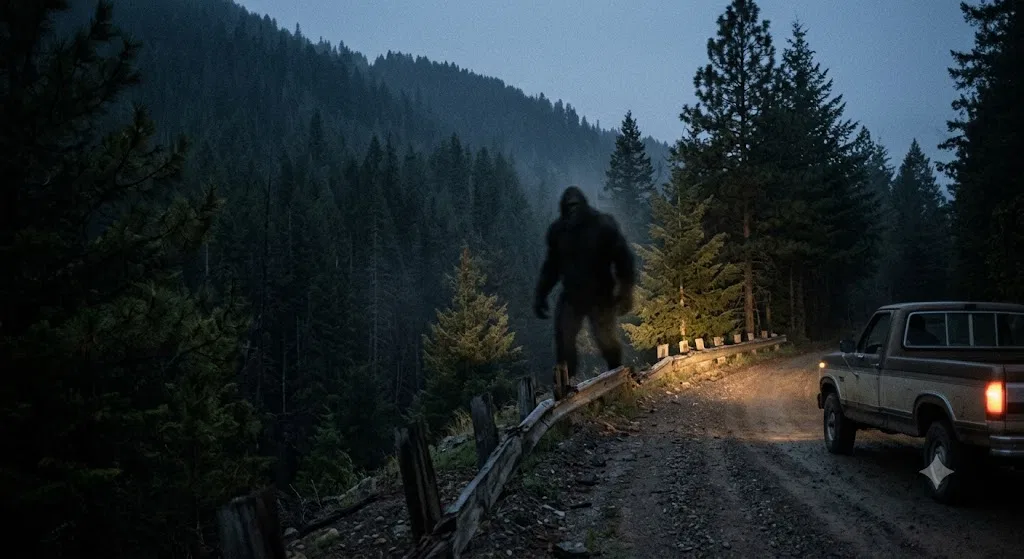
Many western Montana Bigfoot reports are road stories. That is not surprising. Roads create encounters between people and animals that would otherwise avoid each other, and mountain roads often produce poor viewing conditions: bends, headlights, rain, snowbanks, steep shoulders and timber pressing close to the verge. A driver may have only a second or two to classify a moving shape.
The BFRO’s recent Montana list includes an April 2020 Class A report by a trucker on Interstate 90 at Lookout Pass outside Tammany in Mineral County, and a Summer 2024 Class B report of possible footprints and whoops in the Kootenai National Forest near Weasel Cabin, north-east of Eureka. These are not laboratory observations; they are modern additions to a long road-and-forest pattern, where the creature is not sitting still for analysis but crossing, calling, vanishing or leaving ambiguous traces.[BFRO]bfro.netReports for MontanaReports for Montana
This road pattern also helps explain why Montana’s Bigfoot map does not need huge numbers to feel persistent. Reports can be separated by years and miles but still share a recognisable structure: remote road, wooded slope, night or near-dusk, large dark figure, quick disappearance. That repetition builds a legend even when the individual reports remain thin.
It also creates a practical problem for evidence. The more fleeting the encounter, the less likely it is to produce a photograph, sample or trackway. But the more remote and dramatic the place, the more meaningful the story feels to the witness. Montana’s western forests are therefore excellent at producing memorable testimony and poor at producing decisive proof.
The Kootenai warning-sign hoax shows how the legend travels
Not every Montana Bigfoot story begins as a witness claim. Some begin as jokes, tourism texture or internet folklore. In 2018, a fake “Sasquatch warning” flyer circulated online claiming that campers in the Kootenai National Forest should be alert because Sasquatches were coming down from the high country near the Yaak River. Local reporting said the US Forest Service clarified that the poster was not created by, or coming from, the Forest Service or Kootenai National Forest.[krem.com]krem.comOpen source on krem.com.
The hoax is useful because it shows how perfectly the Kootenai landscape fits public expectations. The fake warning did not choose a random shopping centre or wheat field. It chose the Yaak and the Kootenai: remote, wooded, wet, close to the Canadian border, already rich in “if anywhere, here” atmosphere. The joke worked because readers could imagine it being true.
That does not make all Kootenai or Lincoln County stories fake. It does show that Montana Bigfoot culture now moves through several channels at once: witness reports, outdoor gossip, local bars, online databases, spoof posters, podcasts, regional magazines and social media. A reported howl near Libby, a possible track near Eureka, or a fake Yaak warning all feed the same mental map of north-west Montana as Sasquatch-friendly country.
The important distinction is between folklore and evidence. A spoof poster is evidence of cultural appetite, not evidence of an animal. A database report is evidence that someone made a claim, not proof that the claimed creature exists. A wilderness landscape is evidence of suitable conditions for mystery and misidentification, not proof of hidden primates. Keeping those categories separate makes the story more interesting, not less.
Why western Montana keeps the Bigfoot idea alive
Montana’s Bigfoot tradition endures because it joins three powerful things: real wilderness, real wildlife and the emotional charge of uncertainty. In the western forests, a person can still feel small. Roads run through miles of timber. Cabins sit below ridges. Hunters and hikers enter places where bears, elk, wolves, moose and mountain lions are not symbols but practical realities. In that setting, the idea of one more large, elusive figure does not feel absurd to the imagination, even when the evidence remains weak.
The legend also benefits from Montana’s position between better-known Sasquatch regions. To the west are Idaho, Washington and the Pacific Northwest; to the north are British Columbia and Alberta; to the south are the Yellowstone and Greater Rocky Mountain corridors. Montana’s reports can therefore feel like part of a wider mountain-forest tradition without losing their local flavour. The creature imagined here is not a swamp monster or lake serpent. It is a timberline presence: something glimpsed from a logging road, heard from a ridge, or associated with remote drainages and old clear-cuts.
Yet the cautious conclusion is still the strongest one. There is no mainstream physical evidence confirming Bigfoot as a real Montana animal: no verified body, breeding population, DNA record or clear trail-camera documentation. What Montana does have is a landscape that produces credible-feeling experiences, a culture that values wildness, and enough known animal activity to make mistakes both likely and understandable.
That is why Bigfoot fits Montana so well. The story does not need certainty to survive. It needs dark timber, bear country, long roads, startled witnesses and a place large enough for the mind to wonder what just moved between the trees.
Amazon book picks
Further Reading
Books and field guides related to Why Does Bigfoot Fit Montana So Well?. Use these as the next step if you want deeper reading beyond the article.
Sasquatch: Legend Meets Science
Directly addresses Bigfoot evidence, tracks, and sightings.
Where Bigfoot Walks
Explores Bigfoot in the forests and landscapes of the American West.
eBay marketplace picks
Marketplace Samples
Live-tested eBay searches with available results related to this page.
Endnotes
1.
Source: bfro.net
Title: Reports for Montana
Link:https://www.bfro.net/GDB/state_listing.asp?state=mt
2.
Source: bfro.net
Title: show report.asp
Link:https://www.bfro.net/gdb/show_report.asp?id=13383
3.
Source: bfro.net
Title: show report.asp
Link:https://www.bfro.net/GDB/show_report.asp?id=58251
4.
Source: onlinelibrary.wiley.com
Title: j.1365 2699.2009.02152.x
Link:https://onlinelibrary.wiley.com/doi/10.1111/j.1365-2699.2009.02152.x
5.
Source: zslpublications.onlinelibrary.wiley.com
Title: ZSL Publications Bigfoot: If it’s there, could it be a bear?
Link:https://zslpublications.onlinelibrary.wiley.com/doi/10.1111/jzo.13148
6.
Source: bfro.net
Title: show report.asp
Link:https://www.bfro.net/GDB/show_report.asp?id=77957
7.
Source: krem.com
Link:https://www.krem.com/article/news/local/northwest/viral-flyer-about-sasquatch-being-spotted-in-kootenai-national-forest-is-fake/293-572124582
8.
Source: bfro.net
Link:https://www.bfro.net/gdb/
9.
Source: bfro.net
Title: show report.asp
Link:https://www.bfro.net/GDB/show_report.asp?id=77818
10.
Source: bfro.net
Title: show county reports.asp
Link:https://www.bfro.net/GDB/show_county_reports.asp?county=Lewis+And+Clark&state=mt
11.
Source: bfro.net
Title: state listing.asp
Link:https://www.bfro.net/GDB/state_listing.asp?state=id
12.
Source: bfro.net
Title: show report.asp
Link:https://www.bfro.net/GDB/show_report.asp?id=66120
13.
Source: bfro.net
Title: show report.asp
Link:https://www.bfro.net/GDB/show_report.asp?id=65664
14.
Source: bfro.net
Link:https://www.bfro.net/GDB/show_county_reports.asp?county=Flathead&state=mt
15.
Source: bfro.net
Title: show report.asp
Link:https://www.bfro.net/GDB/show_report.asp?id=17292
16.
Source: bfro.net
Title: show county reports.asp
Link:https://www.bfro.net/GDB/show_county_reports.asp?county=Hill&state=mt
17.
Source: zslpublications.onlinelibrary.wiley.com
Link:https://zslpublications.onlinelibrary.wiley.com/doi/abs/10.1111/jzo.13148
18.
Source: onlinelibrary.wiley.com
Title: j.1365 2699.2009.02152.x
Link:https://onlinelibrary.wiley.com/doi/abs/10.1111/j.1365-2699.2009.02152.x
19.
Source: fs.usda.gov
Title: US Forest Service Kootenai National Forest | About the Forest | Forest Service
Link:https://www.fs.usda.gov/r01/kootenai/about-area/about-forest
20.
Source: fs.usda.gov
Title: US Forest Service Home | Flathead National Forest | Forest Service
Link:https://www.fs.usda.gov/r01/flathead
21.
Source: fs.usda.gov
Title: US Forest Service Flathead National Forest | Wilderness | Forest Service
Link:https://www.fs.usda.gov/r01/flathead/wilderness
22.
Source: fs.usda.gov
Link:https://www.fs.usda.gov/r01/custergallatin/safety-ethics/bear-identification
23.
Source: fs.usda.gov
Link:https://www.fs.usda.gov/r01/kootenai
24.
Source: fs.usda.gov
Link:https://www.fs.usda.gov/r01/kootenai/wilderness
25.
Source: fs.usda.gov
Title: flathead national forest releases draft comprehensive river
Link:https://www.fs.usda.gov/r01/flathead/newsroom/releases/flathead-national-forest-releases-draft-comprehensive-river
26.
Source: fs.usda.gov
Link:https://www.fs.usda.gov/r01/kootenai/recreation
27.
Source: fs.usda.gov
Link:https://www.fs.usda.gov/r01/flathead/recreation
28.
Source: fs.usda.gov
Title: camping cabins
Link:https://www.fs.usda.gov/r01/kootenai/recreation/camping-cabins
29.
Source: fs.usda.gov
Title: outdoor science and learning
Link:https://www.fs.usda.gov/r01/flathead/recreation/opportunities/outdoor-science-and-learning
30.
Source: fs.usda.gov
Link:https://www.fs.usda.gov/r01/kootenai/planning
31.
Source: fs.usda.gov
Title: nonwood products
Link:https://www.fs.usda.gov/r01/flathead/forest-products/nonwood-products
32.
Source: fs.usda.gov
Title: maps guides
Link:https://www.fs.usda.gov/r01/kootenai/maps-guides
33.
Source: fs.usda.gov
Link:https://www.fs.usda.gov/r01/flathead/newsroom
34.
Source: fs.usda.gov
Link:https://www.fs.usda.gov/r01/kootenai/projects
35.
Source: fs.usda.gov
Title: bob marshall wilderness complex
Link:https://www.fs.usda.gov/r01/flathead/recreation/bob-marshall-wilderness-complex
36.
Source: fs.usda.gov
Link:https://www.fs.usda.gov/r01/kootenai/recreation/opportunities
37.
Source: fs.usda.gov
Link:https://www.fs.usda.gov/r01/flathead/projects
38.
Source: fs.usda.gov
Link:https://www.fs.usda.gov/r01/kootenai/projects/24882
39.
Source: fs.usda.gov
Title: maps guides
Link:https://www.fs.usda.gov/r01/flathead/maps-guides
40.
Source: usda.gov
Title: loss space threatening north american sasquatch
Link:https://www.usda.gov/about-usda/news/blog/loss-space-threatening-north-american-sasquatch
41.
Source: m.facebook.com
Title: us forest service sasquatch warning
Link:https://m.facebook.com/sasquatchploitation/photos/us-forest-service-sasquatch-warning/1712713202140483/
42.
Source: fwp.mt.gov
Title: grizzly bears
Link:https://fwp.mt.gov/conservation/wildlife-management/grizzly-bears
43.
Source: youtube.com
Link:https://www.youtube.com/watch?v=ik_MaMog3Iw
44.
Source: Wikipedia
Link:https://en.wikipedia.org/wiki/Bigfoot
Additional References
45.
Source: youtube.com
Title: Lumberjacks In Montana Describe Multiple Encounters With Bigfoot In The Woods
Link:https://www.youtube.com/watch?v=GWXqsIpA0Ds
Source snippet
This MONTANA National Forest is HIDING a Terrifying Secret...
46.
Source: youtube.com
Title: MONTANA Hunter Sees 8 to 9 Foot Tall Creature!
Link:https://www.youtube.com/watch?v=5ZCVSUXLoCs
Source snippet
MONTANA Elk Hunters have Horrific Encounter in Great Bear Willderness...
47.
Source: facebook.com
Link:https://www.facebook.com/groups/flathead411/posts/1760020264700419/
48.
Source: researchgate.net
Link:https://www.researchgate.net/publication/367247671_If_it%27s_there_could_it_be_a_bear
49.
Source: researchgate.net
Link:https://www.researchgate.net/publication/216763696_Predicting_the_Distribution_of_Sasquatch_in_Western_North_America_Anything_Goes_with_Ecological_Niche_Modelling
50.
Source: facebook.com
Link:https://www.facebook.com/RMSOBigfoot/posts/after-being-spotted-the-blue-mountain-bigfoot-appeared-sad-bigfoot-sasquatch/1220833156330120/
51.
Source: facebook.com
Link:https://www.facebook.com/groups/1294386217413894/posts/2535251949993975/
52.
Source: hunter-ed.com
Link:https://www.hunter-ed.com/montana/studyGuide/Bear-Identification/20202703_141121/
53.
Source: reddit.com
Link:https://www.reddit.com/r/Cryptozoology/comments/19di7nu/bigfoot_and_black_bears_a_correlational_analysis/
54.
Source: instagram.com
Link:https://www.instagram.com/reel/DaGvE5hyi_C/
Topic Tree