What Monsters Haunt Maine's Wild Places?
Maine’s monster folklore is not built around one single, state-defining beast.
Page outline Jump by section
Introduction
The headline creature is probably Cassie, the Casco Bay sea serpent, a legend with reports stretching from the late eighteenth century into modern local retellings. Bigfoot-style reports also recur, especially in rural and wooded counties, though the evidence remains testimonial. The most instructive modern case is the 2006 Turner “mystery beast”, which drew national attention before DNA testing pointed back to a dog rather than an unknown species. Together, Maine’s cryptid stories work best when read as a mix of maritime folklore, frontier newspaper yarns, wildlife misidentification, local humour, and the lasting romance of a state that still feels partly untamed.
Why Maine makes good monster country
Maine gives strange-animal stories plenty of room to breathe. The state has cold Atlantic waters, island-dotted bays, thick forest, large mammals, remote roads, and a long history of fishing, logging, hunting, guiding, and outdoor storytelling. Those settings matter. A sea serpent report from a boat, a tall dark figure crossing a logging road, or a “panther” glimpsed at dusk all depend on distance, weather, expectation and local animal knowledge.
The ordinary wildlife is already impressive enough to seed legends. Maine’s black bear population has been estimated by the Maine Department of Inland Fisheries and Wildlife at around 25,000 animals, and bears can look startlingly humanlike when briefly seen upright or half-hidden in brush. The same agency notes that it receives and investigates possible wolf and cougar reports, while also stating that wolves were extirpated in Maine by the late nineteenth century and that the last confirmed cougar in Maine was killed in 1938. Those official gaps between memory, habitat and confirmation are exactly where “phantom cat” and “wild man” claims tend to grow.[Maine]maine.govOpen source on maine.gov.
Maine also has a strong culture of telling stories about the woods. Some of those tales are meant as serious claims; others are knowingly comic. The state’s monster map therefore has to be read in layers. Cassie belongs to maritime sea-serpent lore. Bigfoot reports belong to the wider North American Sasquatch tradition. Pamola belongs primarily to Penobscot and Wabanaki sacred story rather than modern cryptid hunting. The Billdad and Tote Road Shagamaw belong to lumberjack “fearsome critter” humour, where absurd animals explain odd tracks, bad luck, or campfire boredom.
Cassie, the Casco Bay sea serpent
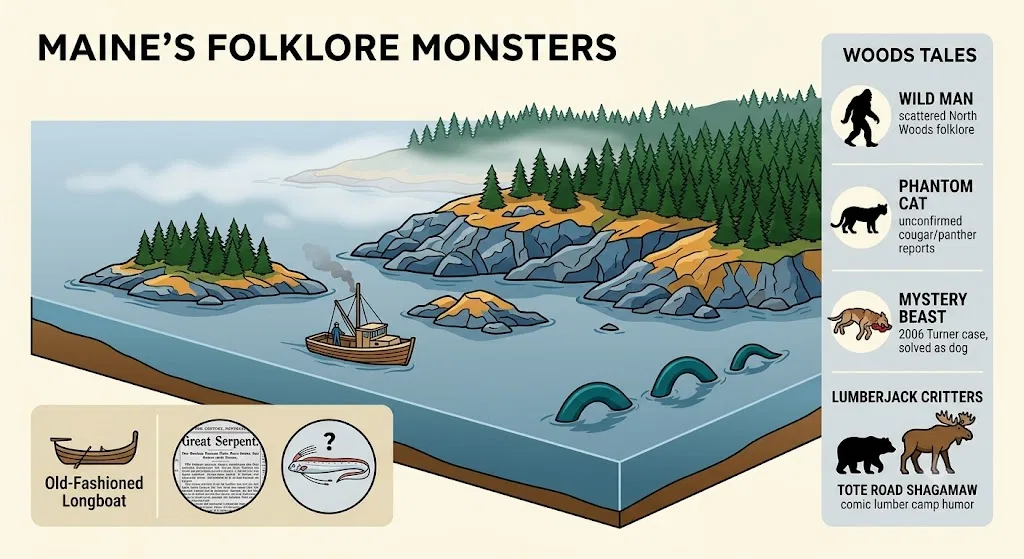
Cassie is Maine’s best-known water monster: a long, serpent-like creature said to haunt Casco Bay and nearby coastal waters. Modern retellings often call it “Cassie”, but the roots are older than the nickname. A South Portland Historical Society account traces early documentation to Edward Preble, later a major naval figure, who as a young sailor in 1779 was reportedly sent in a longboat to investigate a “great serpent” in the waters off Maine. The same historical account notes later reports, including an 1818 Portland Argus item describing a large serpent in Portland Harbour and nineteenth-century maritime sightings in the broader North Atlantic world.[South Portland Historical Society]southportlandhistoricalsociety.wordpress.comOpen source on wordpress.com.
The appeal of Cassie is easy to understand. Casco Bay is full of islands, ledges, fog, tidal movement and working boats. A long back, a line of swimming animals, a floating log, a whale’s body seen in pieces, or a large fish at the surface can become something more dramatic in seconds. That does not mean every witness was lying. It means the sea is a poor courtroom: objects appear, vanish, distort and reappear under conditions that make size and shape hard to judge.
One useful modern explanation comes from an environmental column in the Portland Press Herald, which retells Cassie’s 1779 origin and a 1958 fisherman’s report before pointing to another Maine sea-creature account from New Harbor. In that case, marine biologists reportedly suggested an oarfish as a possible explanation for a serpent-like sighting. Oarfish are not common everyday sights, but their long bodies show why real marine animals have often fed sea-serpent traditions.[The Portland Press Herald]pressherald.comOpen source on pressherald.com.
Cassie survives because the story sits in a sweet spot: old enough to feel historical, local enough to belong to Casco Bay, and vague enough to absorb new sightings. The International Cryptozoology Museum has also helped keep the legend in public circulation, turning Cassie from a loose harbour tale into one of Maine’s recognisable cryptid names.[Emergence Magazine]emergencemagazine.orggreat sea serpentgreat sea serpent
Bigfoot and the Maine “wild man” tradition
Maine does not have the Bigfoot identity of the Pacific Northwest, but it has a surprisingly persistent record of hairy, upright, humanlike creature stories. The Bangor Daily News reported on an 1886 newspaper yarn about a ten-foot “wild man” supposedly killed 100 miles north of Moosehead Lake, and quoted Strange Maine writer Michelle Souliere saying that Maine has a scattered but substantial body of “wild man” and Bigfoot folklore.[Bangor Daily News]bangordailynews.combigfoot in maine 10 foot tall wild man was killed in 1886 newspapers reportedbigfoot in maine 10 foot tall wild man was killed in 1886 newspapers reported
Modern Bigfoot databases also list Maine reports. The Bigfoot Field Researchers Organization’s Maine page includes recent entries from Oxford, York and Aroostook counties, and its county table shows clusters in places such as Oxford, Penobscot and Piscataquis. These reports are useful as folklore and witness-claim data, but they are not scientific confirmation of an undiscovered primate. They are self-selected accounts collected by a Bigfoot research organisation, not a state wildlife agency or peer-reviewed zoological survey.[BFRO]bfro.netReports for MaineReports for Maine
The geography of the reports still tells us something. Sightings tend to sound most plausible to readers when they happen where Maine already feels large and underwatched: near state parks, along powerlines, in blueberry fields, on rural roads, and in the North Woods. A driver has only a few seconds. A camper hears a scream in darkness. A hunter finds tracks after snow. Those are classic Bigfoot conditions across North America, and Maine provides them in abundance.
The sceptical explanations are familiar but important. Black bears can stand, run awkwardly, leave partial tracks, and appear larger in poor light. Moose, especially when glimpsed through trees, can produce confusing impressions of height, bulk and movement. Humans in dark clothing, hoaxes, old newspaper exaggerations and memory reshaping can do the rest. None of this proves that every report is false; it explains why a state with many bears, deep woods and a strong outdoor culture would keep producing Bigfoot-like stories without producing a body, bones, clear DNA, or a stable scientific record.
The Turner Beast and the lesson of the solved monster
The 2006 Turner Beast, also known as the Androscoggin Creature, is one of Maine’s best examples of a modern monster flap moving from local fear to media spectacle to scientific deflation. A strange carcass found in Turner was linked to rumours of a mystery animal that had frightened residents and killed dogs. The story quickly drew attention far beyond Maine, helped by the unsettling appearance of the decomposing animal and by the way the public filled the uncertainty with familiar monster labels.
Then testing changed the story. The Sun Journal reported that tissue sent for DNA analysis at the University of Maine molecular forensics lab indicated the carcass was a dog, with Dr Irv Kornfield saying it had the markers of Canis. The report also noted that people had suggested everything from a Maine Chupacabra to a werewolf, extraterrestrial creature, or mythic bogeyman before the test results arrived.[Lewiston Sun Journal]sunjournal.comLewiston Sun Journal‘Creature’ looks like a canineLewiston Sun Journal‘Creature’ looks like a canine
That makes the Turner Beast more valuable, not less. It shows how a cryptid can be created by a chain of perfectly human reactions: an odd carcass, local rumour, a dramatic photograph, gaps in identification, media attention, and the thrill of maybe having a monster nearby. It also shows why physical evidence matters. Unlike many Bigfoot or sea-serpent claims, the Turner case produced something testable. Once tested, the “unknown beast” became a strange-looking dog carcass, while the wider local rumour of a roaming predator remained part of Maine’s modern folklore.
The case is also a caution against mocking witnesses too quickly. Dead animals can look profoundly unlike themselves after heat, scavenging, water, injury or decomposition. A dog, coyote, fox, raccoon, seal or shark carcass may look monstrous once the familiar features are damaged. The real lesson is not that Mainers were foolish; it is that uncertainty has a short half-life once a good monster story starts spreading.
Phantom cats, wolves and rare mammals
Maine’s phantom-cat tradition is less tidy than Cassie and less theatrical than Bigfoot, but it may be the state’s most believable kind of mystery-beast story. Many residents have reported seeing cougars, panthers or catamounts. Officially, though, Maine treats cougars as extirpated. The Maine Department of Inland Fisheries and Wildlife says occasional cougar sightings are reported but not confirmed, and its rare-mammal guidance says the last cougar in Maine was killed in 1938.[Maine]maine.govOpen source on maine.gov.
That leaves several possibilities. Some witnesses may be seeing bobcats, dogs, fishers, coyotes, deer, house cats at misleading scale, or shadows. Some may be seeing escaped or released captive animals. A truly dispersing cougar is biologically less outlandish than a hidden population of giant apes, especially because cougars are capable of long-distance movement; but an occasional wanderer is not the same thing as a breeding Maine population.
The wolf question follows a similar pattern. Maine once had wolves, and people still report possible wolves or unusually large coyotes. The state’s guidance explicitly asks people to document suspected rare mammals with photos and to contact the department, while also noting that large coyotes over 50 pounds are unusual but possible enough to be reported. That practical advice is a good model for cryptid thinking: photograph, measure, preserve context, and separate “I saw something strange” from “there is a breeding population of an officially absent predator.”[Maine]maine.govOpen source on maine.gov.
Pamola and the problem with calling every creature a cryptid
Pamola is often pulled into modern lists of Maine cryptids, but that label can flatten what the story means. In Penobscot tradition, Pamola is associated with Mount Katahdin, storms, cold and the danger of disrespecting the mountain. Atlas Obscura describes Pamola as a birdlike guardian of Katahdin in Penobscot oral tradition, with later popular renderings turning the being into a more mascot-like figure with moose, human and eagle features.[Atlas Obscura]atlasobscura.comAtlas Obscura The Transformation of Pamola, the Protector of Mount KatahdinAtlas Obscura The Transformation of Pamola, the Protector of Mount Katahdin
That difference matters. A cryptid, in the usual modern sense, is a creature some people claim might be a real but unrecognised animal. Pamola is better understood as a powerful being in Indigenous sacred and cultural tradition, not merely a “monster sighting” to be investigated with trail cameras. Henry David Thoreau’s nineteenth-century account of Katahdin helped carry the story into settler literature, but it did not make Pamola a zoological claim.[Atlas Obscura]atlasobscura.comAtlas Obscura The Transformation of Pamola, the Protector of Mount KatahdinAtlas Obscura The Transformation of Pamola, the Protector of Mount Katahdin
For a Maine monster page, Pamola belongs in the conversation because it has shaped how outsiders imagine Katahdin as a living, dangerous, spiritually charged mountain. But it should be handled differently from Cassie or the Turner Beast. Treating Pamola as just another cryptid risks turning a place-based Indigenous tradition into a collectible monster card. The better reading is that Maine’s creature lore includes both claimed mystery animals and older stories about respect, weather, power and landscape.
Lumberjack monsters: Billdad, Shagamaw and campfire biology
Some Maine creatures were probably never meant to be believed in the same way as sea serpents or Bigfoot. The Billdad and Tote Road Shagamaw belong to the North American “fearsome critter” tradition: comic beasts of lumber camps and frontier storytelling. They are deliberately overdesigned, locally flavoured and absurd.
The Bangor Daily News, drawing on the old fearsome-creature tradition, describes the Tote Road Shagamaw as a creature unique to Maine and New Brunswick, with the front half of a bear and the hindquarters of a moose. Its joke is track-based: it supposedly walks for a quarter-mile on one set of legs, then switches, leaving a baffling trail of bear and moose prints. The same article places the Billdad at Boundary Pond in far north-western Franklin County, describing it as beaver-sized, kangaroo-like, web-footed and hawk-billed, able to leap spectacular distances and catch fish with its tail.[Bangor Daily News]bangordailynews.comOpen source on bangordailynews.com.
These stories are not failed zoology. They are successful jokes. They explain confusing tracks, mock overconfident tenderfoots, and turn the hard, repetitive life of logging camps into a shared imaginative world. In that sense, Maine’s lumberjack monsters are closer to tall tales than eyewitness mysteries. Their value is cultural: they show how working landscapes produce their own comic natural history.
They also help explain why Maine’s monster tradition feels different from states with one dominant cryptid. Maine’s creatures are habitat-specific. The coast gets Cassie. Katahdin gets Pamola. The lumberwoods get Shagamaws and Billdads. Rural roads get Bigfoot and mystery dogs. Each beast belongs to the kind of place that could have invented it.

What evidence would actually change the story?
For Maine’s cryptids, the evidence sits on a sliding scale. At one end are fully folkloric or humorous beings such as the Billdad and Shagamaw. In the middle are serious but unverified witness traditions such as Bigfoot and Cassie. At the more testable end are carcass or track cases, like the Turner Beast, where physical material can be examined.
The most persuasive evidence for an unknown animal would be physical, repeatable and independently examined: a clear body, bones, tissue, high-quality DNA, multiple photographs from different angles, or ecological signs that match a breeding population rather than a one-off sighting. Maine has produced many stories, but not that level of evidence for a new large animal.
That does not make the stories worthless. They preserve local memory, reveal how people read landscapes, and show what kinds of animals feel possible in a place. Cassie expresses the uncertainty of the sea. Bigfoot expresses the scale of the woods. Phantom cats express the tension between official wildlife records and personal outdoor experience. The Turner Beast expresses the speed at which mystery grows when evidence is ugly, partial and public.
The best way to read Maine’s monster map
Maine’s cryptid lore is strongest when it is not forced into a single answer. There is no need to pretend that Cassie is a proven sea serpent, that every Bigfoot report is a bear, or that Pamola belongs in the same category as a roadkill mystery. The more interesting truth is that Maine has several kinds of monster story operating at once.
The coastal legends ask what sailors and fishermen saw in rough water before modern marine science made the deep more legible. The woods reports ask why large, dark, fleeting forms remain so powerful in a state with real bears, moose, coyotes and vast forest. The phantom-cat debate asks how long an animal can remain culturally present after official extirpation. The lumberjack creatures remind us that not every monster is a claim; some are jokes with claws.
That mix is what makes Maine distinctive. Its monsters are not just things people say they saw. They are ways of talking about fog, distance, isolation, animal abundance, old industries, Indigenous mountain traditions, and the stubborn feeling that a place as big and cold and wooded as Maine might still be keeping something back.
Amazon book picks
Further Reading
Books and field guides related to What Monsters Haunt Maine's Wild Places?. Use these as the next step if you want deeper reading beyond the article.
Fearsome Creatures of the Lumberwoods
Important source for Maine lumber-camp fearsome critter traditions.
The United States of Cryptids
Places Maine legends within the wider American cryptid tradition.
eBay marketplace picks
Marketplace Samples
Live-tested eBay searches with available results related to this page.
Endnotes
1.
Source: maine.gov
Link:https://www.maine.gov/ifw/fish-wildlife/wildlife/species-information/mammals/bear.html
2.
Source: maine.gov
Link:https://www.maine.gov/ifw/hunting-trapping/trapping/laws-rules/identify-rare-mammals.html
3.
Source: bfro.net
Title: Reports for Maine
Link:https://www.bfro.net/GDB/state_listing.asp?state=me
4.
Source: maine.gov
Link:https://www.maine.gov/ifw/wildlife-park/wildlife/cougar
5.
Source: bfro.net
Title: show report.asp
Link:https://www.bfro.net/GDB/show_report.asp?id=78973
6.
Source: bfro.net
Link:https://www.bfro.net/gdb/
7.
Source: bfro.net
Title: show report.asp
Link:https://www.bfro.net/GDB/show_report.asp?id=78256
8.
Source: bfro.net
Link:https://www.bfro.net/GDB/show_county_reports.asp?county=Oxford&state=me
9.
Source: bfro.net
Title: show report.asp
Link:https://www.bfro.net/GDB/show_report.asp?id=1189
10.
Source: bfro.net
Title: show report.asp
Link:https://bfro.net/GDB/show_report.asp?id=170
11.
Source: bfro.net
Link:https://www.bfro.net/gdb/show_report.asp?id=66109
12.
Source: bfro.net
Title: show report.asp
Link:https://www.bfro.net/GDB/show_report.asp?id=1188
13.
Source: bfro.net
Title: show report.asp
Link:https://www.bfro.net/GDB/show_report.asp?id=1186
14.
Source: maine.gov
Link:https://www.maine.gov/dmr/science/species-information
15.
Source: maine.gov
Link:https://www.maine.gov/dmr/science/ecology-environment/hms-research
16.
Source: maine.gov
Link:https://www.maine.gov/ifw/hunting-trapping/hunting/laws-rules/identifying-rare-mammals.html
17.
Source: youtube.com
Title: What’s inside Maine’s Bigfoot Museum?
Link:https://www.youtube.com/watch?v=hD3n-9U9M4s
Source snippet
Maine's Bigfoot Festival coming in October...
18.
Source: youtube.com
Title: Maine’s Bigfoot Festival coming in October
Link:https://www.youtube.com/watch?v=pqU0XM6jwSo
Source snippet
Maine Bigfoot Festival...
19.
Source: youtube.com
Title: Maine Bigfoot Festival
Link:https://www.youtube.com/watch?v=O6H62UcPZ0E
Source snippet
Maine cryptids sea serpent Turner mystery beast bigfoot SASQUATCH sighting in UTAH? Mysterious howl #shorts #bigfoot NashPotato...
20.
Source: southportlandhistoricalsociety.wordpress.com
Link:https://southportlandhistoricalsociety.wordpress.com/2025/07/18/the-casco-bay-sea-serpent/
21.
Source: pressherald.com
Link:https://www.pressherald.com/2021/11/04/intertidal-truth-behind-casco-bays-sea-monster-may-be-stranger-than-fiction/
22.
Source: emergencemagazine.org
Title: great sea serpent
Link:https://emergencemagazine.org/essay/great-sea-serpent/
23.
Source: bangordailynews.com
Title: bigfoot in maine 10 foot tall wild man was killed in 1886 newspapers reported
Link:https://www.bangordailynews.com/2013/10/27/news/bigfoot-in-maine-10-foot-tall-wild-man-was-killed-in-1886-newspapers-reported/
24.
Source: sunjournal.com
Title: Lewiston Sun Journal‘Creature’ looks like a canine
Link:https://www.sunjournal.com/2006/08/26/creature-looks-like-canine-2/
25.
Source: atlasobscura.com
Title: Atlas Obscura The Transformation of Pamola, the Protector of Mount Katahdin
Link:https://www.atlasobscura.com/articles/pamola-mount-katahdin
26.
Source: bangordailynews.com
Link:https://www.bangordailynews.com/2020/02/09/arts-culture/in-the-maine-woods-beware-the-tote-road-shagamaw-billdad-and-agropelter/
27.
Source: cryptidz.fandom.com
Link:https://cryptidz.fandom.com/wiki/Cassie
28.
Source: cryptidz.fandom.com
Link:https://cryptidz.fandom.com/wiki/Billdad
29.
Source: cryptidz.fandom.com
Title: Turner Beast
Link:https://cryptidz.fandom.com/wiki/Turner_Beast
30.
Source: cryptidz.fandom.com
Title: Sea Serpents
Link:https://cryptidz.fandom.com/wiki/Sea_Serpents
31.
Source: cryptidz.fandom.com
Link:https://cryptidz.fandom.com/wiki/Pamola
32.
Source: monster.fandom.com
Link:https://monster.fandom.com/wiki/Billdad
33.
Source: youtube.com
Link:https://www.youtube.com/watch?v=qiBdmf022hQ
34.
Source: youtube.com
Link:https://www.youtube.com/watch?v=5_JRbpPBSnc
35.
Source: reddit.com
Link:https://www.reddit.com/r/Maine/comments/1u7ha1h/maine_cryptid_hunters/
36.
Source: reddit.com
Link:https://www.reddit.com/r/Maine/comments/1el3s5z/maine_cryptids/
37.
Source: bangordailynews.com
Title: mainers frightening encounters with bigfoot highlighted in new book and film
Link:https://www.bangordailynews.com/2021/03/23/news/portland/mainers-frightening-encounters-with-bigfoot-highlighted-in-new-book-and-film/
38.
Source: bangordailynews.com
Title: we identify mystery beast n6hjn1me0n
Link:https://www.bangordailynews.com/2022/06/23/outdoors/we-identify-mystery-beast-n6hjn1me0n/
39.
Source: downeast.com
Link:https://downeast.com/arts-leisure/we-want-to-believe/
40.
Source: facebook.com
Link:https://www.facebook.com/Z107.3/posts/maine-cryptids-ever-hear-of-the-wild-man-of-waldoboro-thats-him-more-maine-crypt/1180664520774251/
41.
Source: facebook.com
Link:https://www.facebook.com/baxterstatepark/posts/maine-has-the-largest-black-bear-population-in-the-lower-48-states-and-baxter-st/2678144349071867/
42.
Source: facebook.com
Link:https://www.facebook.com/mefishwildlife/videos/black-bear-research-and-management-in-maine/1289257218366511/
43.
Source: facebook.com
Link:https://www.facebook.com/100069142340865/posts/pomoola-maines-indian-devilpomoola-comes-out-of-native-american-lore-pomoola-liv/863198760430156/
44.
Source: abookofcreatures.com
Link:https://abookofcreatures.com/2021/04/12/billdad/
45.
Source: sunjournal.com
Title: weird wicked weird author chronicles 155 years of maine bigfoot sightings
Link:https://www.sunjournal.com/2017/05/06/weird-wicked-weird-author-chronicles-155-years-of-maine-bigfoot-sightings/
46.
Source: sunjournal.com
Title: woman says turner beast pet dog
Link:https://www.sunjournal.com/2007/05/24/woman-says-turner-beast-pet-dog/
47.
Source: Wikipedia
Link:https://en.wikipedia.org/wiki/Pamola
48.
Source: Wikipedia
Title: Androscoggin Creature
Link:https://en.wikipedia.org/wiki/Androscoggin_Creature
49.
Source: strangenewengland.com
Title: The Billdad
Link:https://strangenewengland.com/podcast/billdad-maines-marsupial/
50.
Source: strangenewengland.com
Link:https://strangenewengland.com/2015/06/21/pamola/
51.
Source: mainetree.org
Title: myths from maines woods
Link:https://www.mainetree.org/post/myths-from-maines-woods
52.
Source: foggymountain.com
Link:https://www.foggymountain.com/black-bear/maine-bear-population/
53.
Source: folkbestiary.com
Link:https://folkbestiary.com/maine/
54.
Source: pressherald.com
Link:https://www.pressherald.com/2015/01/16/video-maine-bigfoot-sighting-goes-viral/
Additional References
55.
Source: facebook.com
Link:https://www.facebook.com/groups/2107225159500244/posts/3698470137042397/
56.
Source: outdoors.org
Link:https://www.outdoors.org/resources/amc-outdoors/history/a-history-of-mount-katahdin/
57.
Source: medium.com
Link:https://medium.com/%40mceachernj63/a-tangent-on-lumberjack-lore-786305972ed6
58.
Source: facebook.com
Link:https://www.facebook.com/100088473548224/posts/a-trail-camera-in-maine-usa-has-captured-a-chilling-image-that-has-sparked-debat/679870644972048/
59.
Source: facebook.com
Link:https://www.facebook.com/DiscoveryUK/posts/an-unidentified-sea-serpent-or-a-disfigured-shark-mysteriesatthemuseum/1043282214505918/
60.
Source: facebook.com
Link:https://www.facebook.com/groups/MAINEAnimals/posts/3353817578091002/
61.
Source: bates.edu
Link:https://www.bates.edu/magazine/back-issues/y2006/fall06/quad-angles/beast-in-show/
62.
Source: sportingjournal.com
Link:https://www.sportingjournal.com/cougars-are-they-in-maine/
63.
Source: cascobay.org
Link:https://www.cascobay.org/crabs-habs-sharks-and-more-a-casco-bay-matters-event/
64.
Source: reddit.com
Link:https://www.reddit.com/r/Cryptozoology/comments/xfq8ek/cryptids_of_maine/
Topic Tree
Follow this branch
Related pages 49
- Rhode Island Monsters
- Hawaii Monsters
- Illinois Cryptids
- Nebraska Cryptids
- Alabama Cryptids
- +44 more in sidebar