Within Nevada Cryptids
Where Would Bigfoot Fit in Nevada?
Nevada's Sasquatch claims make more sense around greener mountain edges than in the state's harsh open desert.
On this page
- Mountain edge sighting patterns
- Why the desert is a poor fit
- Misidentification, memory and regional borrowing
Page outline Jump by section
Introduction
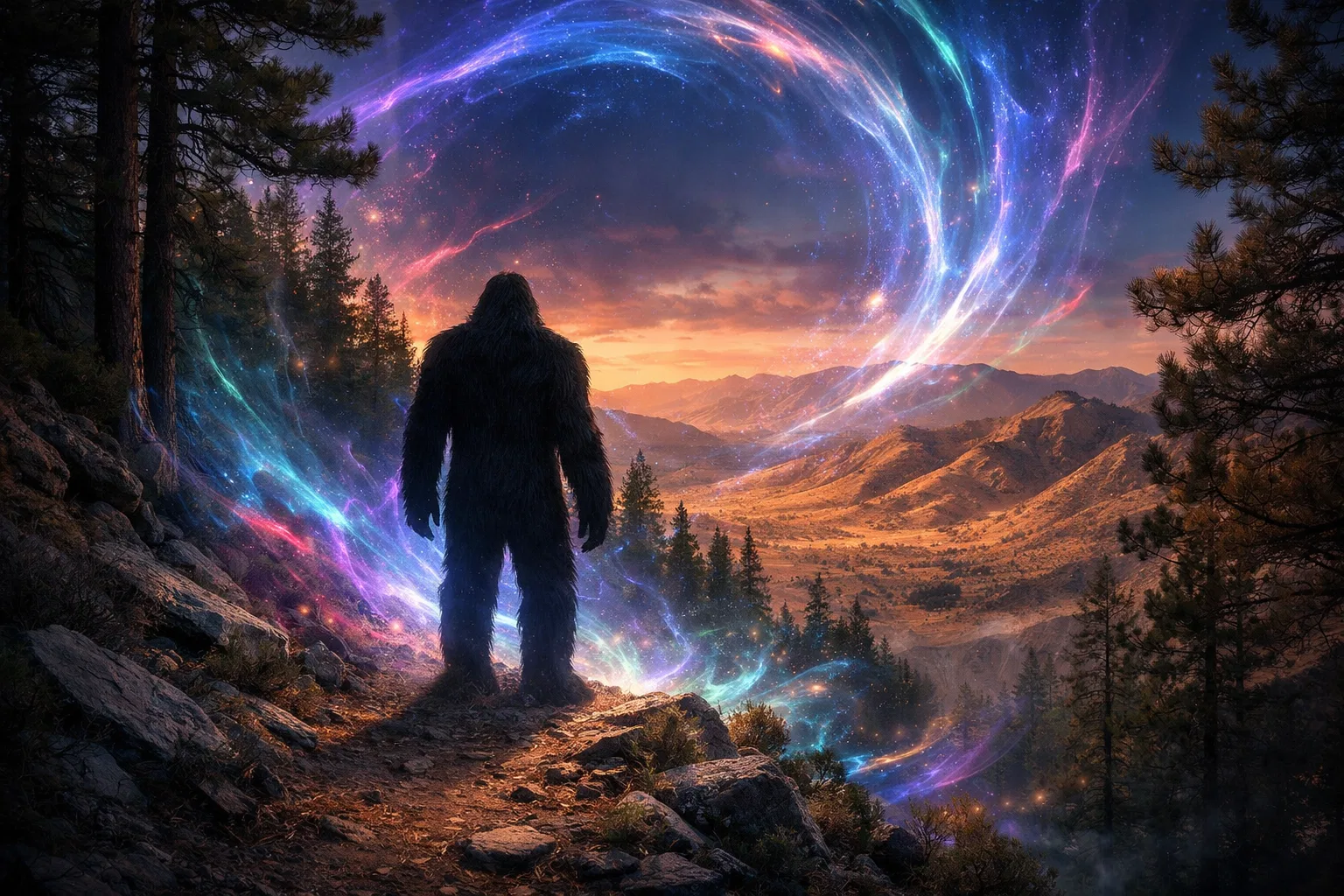
Nevada is not the first place most people picture when they hear “Bigfoot”. The popular image belongs to rainy forests in the Pacific Northwest, not to alkali flats, sagebrush basins and long desert highways. Yet Nevada’s few Sasquatch-style reports are revealing precisely because they avoid the emptiest desert and gather around greener edges: the Sierra-front foothills near Reno and Genoa, Peavine Mountain and Lemmon Valley, the high country around Boundary Peak, and snowy or mountainous ground near Winnemucca. The pattern does not prove a hidden ape is wandering Nevada. It suggests something more useful for readers: Nevada Bigfoot stories make most sense where the state stops looking like open desert and starts offering cover, water, trees, prey, snow, shadows and human memory. The result is a thin but interesting case family, where landscape explains why some claims feel locally plausible while others look borrowed from neighbouring Bigfoot country.[bfro.net]bfro.netReports for NevadaReports for Nevada…
Nevada’s Bigfoot map is small, but it has a shape
The Bigfoot Field Researchers Organization, a pro-Bigfoot volunteer database rather than a neutral scientific agency, lists only nine Nevada reports. That number is tiny beside states such as California, which the same database lists with hundreds of reports, but the Nevada entries are not randomly scattered across the barest parts of the state. They include Washoe County near Reno and Peavine Mountain, Douglas County near Genoa on the Sierra side, Esmeralda County around Boundary Peak, Humboldt County near Winnemucca, Storey County and Nye County newspaper items from 1980.[BFRO]bfro.netReports for NevadaReports for Nevada…
That distribution matters because Nevada is often imagined as one uninterrupted desert. In reality, it is a dry state cut by mountain ranges, forest islands, canyons, snow zones and riparian strips. The Humboldt-Toiyabe National Forest alone covers about 6.3 million acres and is made up of large, non-contiguous sections scattered across Nevada and a portion of eastern California. In other words, Nevada has plenty of rugged, semi-forested country, but it appears as broken habitat rather than one enormous coastal rainforest.[US Forest Service]fs.usda.govOpen source on usda.gov.
For Bigfoot folklore, that brokenness changes the question. The interesting question is not “Could Bigfoot live in the Nevada desert?” but “Why do Nevada’s reports tend to attach themselves to mountain-edge places where the desert gives way to trees, snow, gullies and wildlife corridors?” The state’s reports are best read as edge stories: not deep-desert monsters, but sightings imagined at the boundary between settlement and rough country.
Mountain-edge sighting patterns
The most coherent Nevada cluster sits in the state’s western edge, where Reno, Carson Valley and the Sierra-front foothills create a natural bridge between Nevada and the much larger California Bigfoot tradition. BFRO’s Nevada page lists Washoe County with three reports, Douglas County with one, and Storey County with one; the three Washoe entries all come from 1970–72 and involve Peavine Mountain, Lemmon Valley or terrain near Reno.[BFRO]bfro.netWashoe County, Nevada – Reports & ArticlesWashoe County, Nevada – Reports & Articles
The Peavine and Lemmon Valley accounts are especially useful because they show how Nevada Bigfoot stories often sit in half-developed, half-wild ground. One 1972 Washoe County report describes Lemmon Valley northwest of Reno as high desert at roughly 5,000 feet, with almost no trees on the valley floor but scrub pine beginning on higher ridges and thickening into arid pine forest as elevation increases. The witness frames the story through childhood movement across sparsely populated foothills, rockhounding, hunting, camping and exploring. Whether or not the encounter happened as told, the setting is not empty desert. It is the kind of transitional landscape where a distant animal, a running person, a feral dog pack, a deer, a bear-like shape or a childhood fright could later harden into a Sasquatch memory.[BFRO]bfro.netshow report.aspshow report.asp
Douglas County’s 1984 Genoa report pushes the same pattern closer to the Sierra Nevada proper. BFRO classifies it as a Class A report and summarises it as two hikers having a close encounter near Genoa. Genoa sits below the Carson Range, at a greener, wooded edge of Nevada where the state’s Bigfoot imagination can easily overlap with California’s Sierra stories.[BFRO]bfro.netOpen source on bfro.net.
The later Boundary Peak report, listed by BFRO as an October 2004 Class A daylight sighting by a Reno police officer and companions, adds another version of the mountain-edge pattern. Boundary Peak is Nevada’s highest summit area, on the California line, and the reported animal was not placed in an empty basin but on high, rough mountain terrain. Even if the sighting is no more than an anecdote, its geography is telling: when Nevada Bigfoot reports seek credibility, they often climb into places with elevation, rock cover, scattered trees and proximity to larger western mountain systems.[BFRO]bfro.netOpen source on bfro.net.
The Humboldt County report near Winnemucca, listed as hikers seeing a dark figure on a snowy mountainside in February 2005, also fits this broader rule. Snow, slope, distance and a dark upright shape are all classic ingredients for a puzzling sighting. They also create obvious sceptical problems: scale is hard to judge across open mountain ground, dark animals stand out against snow, and a partly obscured person or known animal can appear stranger than it would at close range.[BFRO]bfro.netOpen source on bfro.net.
Why the open desert is a poor fit
The open desert is a poor fit for a classic Sasquatch claim because the creature usually imagined in Bigfoot lore is large, hairy, mobile and dependent on food, water and cover. Nevada is the driest state in the United States, and the Nevada State Climate Office gives statewide average annual precipitation at about 10.3 inches, with lower averages in southern Nevada and higher averages in the north-east. University of Nevada Extension makes the useful corrective point: Nevada is dry, but it is also mountainous, and the mountains are colder and wetter.[University of Nevada, Reno]unr.eduOpen source on unr.edu.
That distinction explains the geography of the legend. A huge ape-like animal wandering across open playas would be exposed, conspicuous and ecologically difficult to imagine. A strange figure glimpsed along a brushy drainage, snowy ridge, wooded foothill or high pass is easier to fit into the Bigfoot template, even if the evidence remains weak. Nevada’s alleged sightings therefore gravitate towards “more habitat-like” places, not because those places prove Bigfoot exists, but because they supply the scenery that makes a Bigfoot interpretation feel possible.
Real wildlife also favours these greener or rougher edges. Nevada’s Department of Wildlife says black bears are found in the mountainous areas and foothills of the Sierra Nevada and Lake Tahoe region, where streams provide food and forest gives cover. Mule deer occur across Nevada from the Mojave Desert to sub-alpine mountain tops, but their populations are often associated with sagebrush steppe, aspen and mountain shrub communities. Mountain lions occupy rocky terrain across Nevada, especially where mule deer live. These known animals offer two lessons at once: Nevada’s mountains are biologically richer than the stereotype suggests, and several real animals can produce large, dark, fleeting, unnerving impressions in poor viewing conditions.[NDOW]ndow.orgOpen source on ndow.org.
The “desert Bigfoot” problem is therefore not just about disbelief. It is about mismatch. A claim made in a forested canyon, snowy slope or Sierra-front foothill has at least a landscape logic. A claim made in open, water-poor desert has to explain food, concealment, heat, movement and why such an animal would not be repeatedly documented by drivers, hunters, ranchers, trail cameras or wildlife agencies.
What the Nevada reports actually amount to
Nevada’s Bigfoot evidence is almost entirely testimonial: people saw something, heard something, remembered something, or a newspaper repeated a claim. BFRO’s Nevada page lists three “most recent” reports from 1984, 2004 and 2005, but the total state list remains very small, and the database itself is an enthusiast archive that selects and classifies reports according to its own system.[BFRO]bfro.netReports for NevadaReports for Nevada…
A fair reading gives the witnesses their due without overstating the case. Several Nevada reports have details that make them memorable: boys in eroded Washoe County terrain, dogs chasing a supposed Sasquatch, hikers near Genoa, a police officer’s daylight account near Boundary Peak, a dark shape on snow near Winnemucca. These are the kinds of stories that persist because they are concrete enough to retell. They name roads, towns, slopes, weather, dogs, ridges and distances.[BFRO]bfro.netshow report.aspshow report.asp
But concreteness is not the same as confirmation. The reports do not provide a body, bones, verified DNA, repeated tracks in a documented location, or clear imagery that would satisfy mainstream zoology. Scientific sceptics have long argued that Bigfoot claims rely heavily on eyewitness accounts, photographs, tracks and alleged hair samples that do not establish an unknown primate. A 2014 genetic study of hair samples attributed to anomalous primates found that the tested samples came from known animals, while Live Science summarises the mainstream position plainly: there is no hard evidence that Bigfoot exists.[Royal Society Publishing]royalsocietypublishing.orgOpen source on royalsocietypublishing.org.
That does not make the Nevada reports worthless as folklore. It makes them useful in a different way. They show how a national creature legend adapts itself to local geography. In Nevada, Sasquatch does not become a lake serpent or a desert ghost. It becomes a thing glimpsed where the sagebrush begins to rise into mountains.
Misidentification, memory and regional borrowing
The strongest sceptical explanations for Nevada Bigfoot reports are not all the same. Some involve ordinary misidentification; others involve memory, storytelling and cultural borrowing from better-known Bigfoot regions.
Misidentified wildlife is the simplest explanation in some settings. Black bears can stand upright briefly, move through brush, appear much larger in poor light, and leave strong emotional impressions on witnesses. Nevada’s bear range is concentrated in the Sierra Nevada and Lake Tahoe foothills, which overlaps with the western edge of the state’s Bigfoot-style geography. Mountain lions, deer, feral dogs and humans in dark clothing can also become strange at distance, especially against snow, rocks or twilight.[NDOW]ndow.orgOpen source on ndow.org.
Scale mistakes are especially likely in Nevada’s open mountain country. A dark object on a snowy slope may look enormous when there are few nearby reference points. A figure crossing shale or sagebrush can appear oddly fluid or oddly upright depending on viewing angle, distance, adrenaline and how long the witness had to observe it. That is why the Humboldt County snowy mountainside report is interesting but not decisive: the same conditions that make it vivid also make it hard to verify.[BFRO]bfro.netOpen source on bfro.net.
Memory and retelling matter too. Some Nevada reports were submitted decades after the alleged events. The Washoe County accounts, for example, describe events from the early 1970s but were submitted to BFRO in 2003. Long delay does not prove a witness is lying, but it does mean the story has passed through years of memory, interpretation and exposure to a growing Bigfoot culture before being written down.[BFRO]bfro.netshow report.aspshow report.asp
Regional borrowing may be the most important mechanism. Nevada shares a border, a mountain system and a media environment with California. The BFRO database lists California with hundreds of reports, far more than Nevada, and the Sierra Nevada mountains are a recognised Bigfoot storytelling zone in popular mapping and media. Nevada’s western reports can therefore feel less like an independent desert tradition and more like the eastern fringe of a much larger Sierra-Pacific Bigfoot imagination.[BFRO]bfro.netOpen source on bfro.net.
This does not mean every Nevada witness copied a story from elsewhere. It means the interpretive frame was already available. If someone in western Nevada saw a large dark figure in the foothills, the word “Bigfoot” was ready to receive the experience.
How to read Nevada Bigfoot stories without flattening them
The best way to read Nevada’s Bigfoot reports is neither to accept them whole nor to sneer them away. They belong in the state’s cryptid map because they reveal where the Bigfoot idea can attach to Nevada and where it struggles.
A useful reader test is to ask three questions:
- Does the setting provide cover, water and wildlife? Sierra-front foothills, wooded mountain canyons, snowy slopes and high passes make more sense than open desert basins.
- Is there more than one kind of evidence? A sighting plus tracks, photographs, fresh physical traces or independent witnesses would matter more than a single delayed memory.
- Could a known animal, person or distance error explain it? In Nevada, black bears, mountain lions, deer, feral dogs, hikers, shadows and snowfield scale problems all deserve attention before reaching for an unknown primate.
On that test, Nevada remains a weak Bigfoot state but an interesting Bigfoot-edge state. Its reports do not build a strong biological case. They build a landscape case for why some Nevadans and visitors have imagined Sasquatch not in the open desert, but along the state’s greener seams.

Why this smaller legend still matters in Nevada
Nevada’s best-known mystery creatures tend to gather around water: Tahoe Tessie at Lake Tahoe, Cecil the Serpent at Walker Lake, and older Pyramid Lake traditions often reshaped by outsiders into monster or ghost stories. Bigfoot sits differently. It belongs to the mountains, roads, washes and foothills — the places where Nevada’s dry identity starts to blur. That makes it a useful counterweight to the idea that the state’s cryptid life is only aquatic or only desert-strange.
The Bigfoot reports also show how Nevada absorbs national folklore without losing local texture. A Sasquatch claim near Reno is not the same as one in coastal Oregon; a snowy slope near Winnemucca is not the same as a cedar forest in Washington. The Nevada version is thinner, drier, more fragmented and more dependent on edges. It is a borrowed legend reshaped by Basin and Range geography.
That may be the most honest conclusion. Nevada does not offer strong evidence for Bigfoot as a real animal. It offers a set of stories that become more understandable when placed where the state is least like the postcard desert: in foothills, mountain forests, snowy ridges and rough country where a dark shape can cross the edge of vision and leave a witness reaching for the most famous wild-man name in North America.
Amazon book picks
Further Reading
Books and field guides related to Where Would Bigfoot Fit in Nevada?. Use these as the next step if you want deeper reading beyond the article.
Sasquatch: Legend Meets Science
Covers evidence claims and geographic distribution questions.
eBay marketplace picks
Marketplace Samples
Live-tested eBay searches with available results related to this page.

Endnotes
1.
Source: bfro.net
Title: Reports for Nevada
Link:https://www.bfro.net/GDB/state_listing.asp?state=nv
Source snippet
Reports for Nevada...
2.
Source: extension.unr.edu
Link:https://extension.unr.edu/publication.aspx?PubID=2701
3.
Source: bfro.net
Link:https://www.bfro.net/GDB/state_listing.asp?state=ca
4.
Source: bfro.net
Title: Washoe County, Nevada – Reports & Articles
Link:https://www.bfro.net/GDB/show_county_reports.asp?county=Washoe&state=nv
5.
Source: bfro.net
Title: show report.asp
Link:https://www.bfro.net/GDB/show_report.asp?id=5697
6.
Source: bfro.net
Title: show report.asp
Link:https://www.bfro.net/GDB/show_report.asp?id=5770
7.
Source: bfro.net
Link:https://www.bfro.net/GDB/show_report.asp?id=5909
8.
Source: bfro.net
Title: show county reports.asp
Link:https://www.bfro.net/GDB/show_county_reports.asp?county=Douglas&state=NV
9.
Source: bfro.net
Link:https://www.bfro.net/GDB/show_report.asp?id=22386
10.
Source: bfro.net
Title: show county reports.asp
Link:https://www.bfro.net/GDB/show_county_reports.asp?county=Esmeralda&state=NV
11.
Source: bfro.net
Link:https://www.bfro.net/GDB/show_report.asp?ID=20780&PrinterFriendly=True
12.
Source: bfro.net
Title: show county reports.asp
Link:https://www.bfro.net/GDB/show_county_reports.asp?county=Humboldt&state=nv
13.
Source: ndow.org
Link:https://www.ndow.org/species/black-bear/
14.
Source: ndow.org
Link:https://www.ndow.org/species/mule-deer/
15.
Source: ndow.org
Title: Living With Mountain Lions
Link:https://www.ndow.org/blog/living-with-mountain-lions/
16.
Source: bfro.net
Link:https://www.bfro.net/gdb/
17.
Source: ndow.org
Link:https://www.ndow.org/species/mountain-lion/
18.
Source: bfro.net
Title: Father and son hear vocalizations on Peavine Mt
Link:https://www.bfro.net/GDB/show_report.asp?id=5692
19.
Source: bfro.net
Title: Reports for Arkansas Union County (Class B)
Link:https://www.bfro.net/GDB/state_listing.asp?state=ar
20.
Source: bfro.net
Link:https://www.bfro.net/GDB/show_county_reports.asp?county=Elko&state=NV
21.
Source: bfro.net
Title: state listing.asp
Link:https://www.bfro.net/GDB/state_listing.asp?state=az
22.
Source: bfro.net
Link:https://www.bfro.net/
23.
Source: ndow.org
Link:https://www.ndow.org/nevadawildlifediscoverytrail/great-basin-national-park/
24.
Source: forecast.weather.gov
Link:https://forecast.weather.gov/product.php?issuedby=ELY&product=CLS&site=AFC
25.
Source: weather.gov
Link:https://www.weather.gov/wrh/climate
26.
Source: fs.usda.gov
Link:https://www.fs.usda.gov/r04/humboldt-toiyabe
27.
Source: unr.edu
Link:https://www.unr.edu/nevada-climate-office/about-our-climate
28.
Source: royalsocietypublishing.org
Link:https://royalsocietypublishing.org/rspb/article/281/1789/20140161/77194/Genetic-analysis-of-hair-samples-attributed-to
29.
Source: fs.usda.gov
Link:https://www.fs.usda.gov/media/115851
30.
Source: fs.usda.gov
Link:https://www.fs.usda.gov/media/115685
31.
Source: climatehubs.usda.gov
Title: percent normal
Link:https://www.climatehubs.usda.gov/hubs/northwest/topic/percent-normal
32.
Source: royalsocietypublishing.org
Link:https://royalsocietypublishing.org/doi/abs/10.1098/rspb.2014.0161
33.
Source: ncei.noaa.gov
Link:https://www.ncei.noaa.gov/access/monitoring/monthly-report/national/202313
34.
Source: ncei.noaa.gov
Link:https://www.ncei.noaa.gov/access/monitoring/monthly-report/national/202501
35.
Source: unr.edu
Title: bear denning research
Link:https://www.unr.edu/nevada-today/news/2024/bear-denning-research
36.
Source: Wikipedia
Link:https://en.wikipedia.org/wiki/Bigfoot
Additional References
37.
Source: youtube.com
Title: Sasquatch Sierra Sounds by Ron Morehead & Al Berry in (HD)
Link:https://www.youtube.com/watch?v=VGfIIjN-P7o
Source snippet
The Truth Behind Bigfoot | feat. History Daddy | Podcast Episode 78...
38.
Source: clarkcountynv.gov
Link:https://www.clarkcountynv.gov/government/departments/environment_and_sustainability/ccabmw-black-bears
39.
Source: drought.gov
Link:https://www.drought.gov/drought-research/evaluating-nevadas-drought-monitoring-network-improve-drought-early-warning
40.
Source: govinfo.gov
Link:https://www.govinfo.gov/content/pkg/GOVPUB-A13-PURL-LPS68659/pdf/GOVPUB-A13-PURL-LPS68659.pdf
41.
Source: youtube.com
Title: Late at Night Encounter OUTSIDE his Bedroom Window!
Link:https://www.youtube.com/watch?v=MVZbmzaYizo
Source snippet
Sasquatch Sierra Sounds by Ron Morehead & Al Berry in (HD)...
42.
Source: researchgate.net
Link:https://www.researchgate.net/publication/260162296_Bear_Historical_Ranges_Revisited_Documenting_the_Increase_of_a_Once-Extirpated_Population_in_Nevada
43.
Source: parktrust.org
Link:https://parktrust.org/blog/10-national-forests-to-add-to-your-bucket-list/
44.
Source: instagram.com
Link:https://www.instagram.com/p/DZOV13HDi57/
45.
Source: facebook.com
Link:https://www.facebook.com/smltownmonsters/videos/mountains-of-mystery-mountains-of-mystery/2428008180882145/
46.
Source: sci.news
Link:https://www.sci.news/genetics/science-bigfoot-yeti-hair-samples-match-dna-paleolithic-polar-bear-known-mammals-02044.html
Topic Tree