Within Louisiana Monsters
When Louisiana Wildlife Looks Like a Monster
Alligators, feral hogs, black bears and distorted tracks help explain why Louisiana's dark wetlands generate convincing monster stories.
On this page
- Alligators, hogs and bears in the dark
- Mud, water and misleading tracks
- Why swamp habitats make sightings feel plausible
Page outline Jump by section
Introduction
Louisiana’s swamps do not need imaginary animals to feel uncanny. A half-seen alligator, a rank-smelling feral hog, a bear track softened by mud, or a splash in black water can supply enough detail for a convincing mystery-beast report before folklore does the rest. That does not prove famous Louisiana creatures such as the Honey Island Swamp Monster are “really” alligators, hogs or bears. It means the state’s real wetland wildlife gives witnesses, storytellers and sceptics a practical starting point: large animals are genuinely present, they leave dramatic signs, and the habitat often hides the ordinary explanation at the exact moment when fear and imagination take over.
The clearest pattern is ecological rather than supernatural. Louisiana has extensive, changing wetlands; alligators are common wetland predators; feral hogs are widespread, invasive and destructive; and Louisiana black bears use swamp corridors and bottomland forests. In darkness, mud and dense vegetation, those facts matter more than any single debunking theory. They explain why Louisiana monster stories can feel locally believable even when the evidence for an unknown creature remains thin.[fws.gov]fws.govOpen source on fws.gov.
Why Louisiana’s Real Animals Make Monster Stories Work
The useful question is not “which animal explains every report?” It is “what real animals create the sights, sounds, tracks and smells that people later interpret as something stranger?” Louisiana is unusually rich in those ingredients. The U.S. Fish and Wildlife Service says Louisiana supports more than 45% of the intertidal wetlands in the lower 48 states, while also suffering more than 90% of the nation’s coastal wetland loss. That matters for monster lore because wetlands are fragmented, noisy, reflective, difficult to see through and constantly reshaped by water.[U.S. Fish and Wildlife Service]fws.govOpen source on fws.gov.
This is the physical stage behind many Louisiana mystery-beast traditions. The Honey Island Swamp Monster is tied to the Pearl River country near Slidell, where the Pearl River Wildlife Management Area alone covers 35,619 acres and is accessible by road and boat. The Louisiana Department of Wildlife and Fisheries notes that when the Pearl River gauge reaches 16.5 feet, Old Highway 11 and most hunting there close, a reminder that the terrain is not a stable forest floor but a water-driven landscape where access, tracks and visibility change with the river.[wlf.louisiana.gov]wlf.louisiana.govPearl River | Louisiana Department of Wildlife and FisheriesPearl River | Louisiana Department of Wildlife and Fisheries
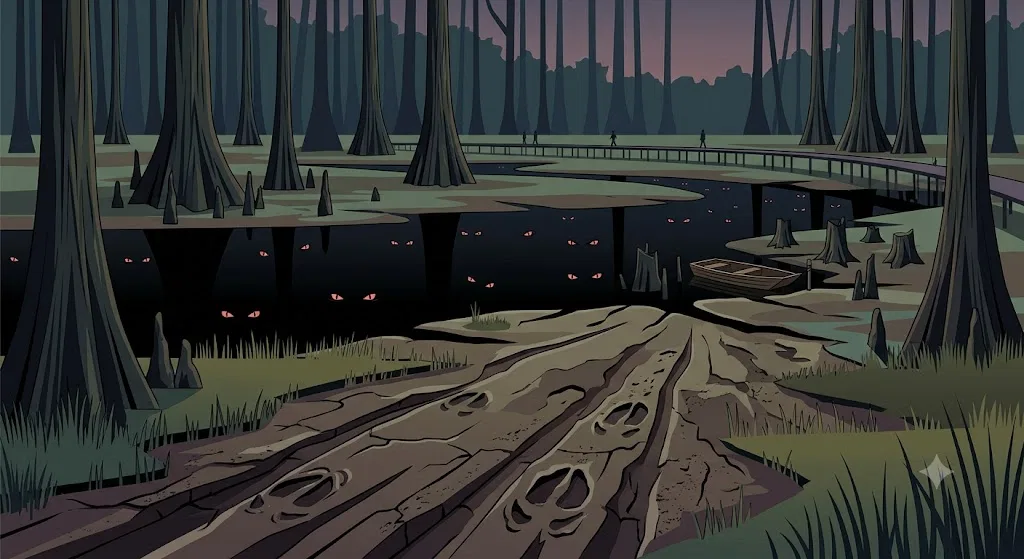
That setting makes reports feel plausible in three ways. First, large animals really are present. Secondly, the evidence they leave behind is often partial: eyes above water, a torn-up bank, a hoofprint, a splash, a body part, a smell. Thirdly, the swamp itself edits the scene. Water stretches distances, mud enlarges prints, vegetation hides the body, and night turns a known animal into a moving outline.

Alligators, Hogs and Bears in the Dark
Alligators are the most obvious candidate behind Louisiana “something in the water” reports. At Jean Lafitte National Historical Park and Preserve’s Barataria Preserve, the National Park Service describes the American alligator as the animal that attracts the most attention and notes that alligators can often be seen sunning on banks or partly submerged with only the eyes and nostrils above the water. That last detail is crucial: a witness may not see an alligator as a whole animal, but as a low, watchful presence cutting the surface.[National Park Service]nps.govNational Park Service AnimalsNational Park ServiceAnimals - Jean Lafitte National Historical Park and Preserve (U.S. National Park Service)…
The alligator also supplies one of the swamp’s most memorable night effects. Florida’s wildlife agency explains that alligator eyeshine comes from the tapetum lucidum, a reflective layer that improves low-light vision; in alligators, that eyeshine is red. In a Louisiana bayou story, glowing eyes across the water are not automatically evidence of a humanoid creature. They may be ordinary crocodilian biology doing exactly what it evolved to do.[FWC]myfwc.comFWCAlligator Facts | FWCFWCAlligator Facts | FWC
Feral hogs add a different kind of monster fuel. LSU AgCenter says feral hogs in Louisiana occupy habitats from tidal marshes to timbered areas, seek water, cover and reliable food, and eat anything from grain to carrion. It also notes that places may suddenly show rooting, wallowing and other signs even after years without sightings. That pattern fits mystery-beast storytelling neatly: a campsite, trail or hunting lease can look “visited” by something large and violent even when the culprit is an invasive pig.[LSU AgCenter]lsuagcenter.comLSU Ag Center Invasive Feral Swine in LouisianaLSU Ag Center Invasive Feral Swine in Louisiana
Federal wildlife guidance gives the field clues: feral swine leave extensive rooting, muddy wallows, tree rubbing, tunnels through thick vegetation, hoof tracks near ponds and streams, and scat that can contain plant matter and animal remains. In a swamp-monster context, those signs can be misread as the trail of a heavy unknown creature, especially if the witness hears crashing brush or smells mud, musk and decay before seeing anything clearly.[APHIS]aphis.usda.govAPHISFeral Swine: Managing an Invasive Species | APHISAPHISFeral Swine: Managing an Invasive Species | APHIS
Black bears are less common in the public imagination than alligators, but they matter because they make the closest thing to “almost human” evidence. Louisiana’s own black bear fact sheet describes the animal as large, shy and bulky, with dense black fur, and says its track pattern is distinctive and almost human-like. It gives front prints of about 12 cm by 8 cm and back prints of about 17 cm by 7 cm. A bear track in clean mud might be identifiable; a smeared or overlapping one can become a much stranger-looking footprint.[wlf.louisiana.gov]wlf.louisiana.govBlack BearBlack Bear
The bear is not merely theoretical in Louisiana wetland country. Bayou Teche National Wildlife Refuge was established to provide critical habitat for the Louisiana black bear, and the U.S. Fish and Wildlife Service says cypress-tupelo swamps there provide food and winter denning habitat. Bears also use spoil banks and elevated land as travel routes through swamp and marsh edges. That makes bears relevant to mystery reports because they move through the same awkward borderlands where human observers are often boating, hunting, camping or walking levees.[U.S. Fish and Wildlife Service]fws.govOpen source on fws.gov.
Mud, Water and Misleading Tracks
Tracks are often treated as the “hard evidence” in mystery-beast stories, but Louisiana mud can be a terrible recording surface. It preserves impressions, then distorts them. A print can slump, fill with water, lose toes, gain drag marks, or be crossed by another animal before anyone finds it. When the claimed creature is large and the observer is already primed by a local legend, a poor track may look more impressive than a clear one.
The Honey Island Swamp Monster shows why this matters. Modern accounts commonly place the start of the famous sighting tradition in 1963 with Harlan Ford and Billy Mills in remote swamp country near Slidell, and later stories focus heavily on alleged tracks. Country Roads Magazine describes Ford as a retired air traffic controller and outdoorsman who spent time documenting wildlife in the area; the Abita Mystery House displays a plaster cast said to come from the monster’s footprint and says Ford cast unusual four-toed tracks in the swamp.[Country Roads Magazine]countryroadsmagazine.comCountry Roads Magazine The Honey Island Swamp MonsterCountry Roads Magazine The Honey Island Swamp Monster
For believers, a strange track is the point: it seems to lift the story above campfire talk. For sceptics, the track is exactly where caution should begin. A four-toed footprint does not by itself establish a new animal, particularly in a wetland full of known animals, soft mud and human handling. Bear tracks can look surprisingly human-like; hog tracks and rooting can suggest heavy movement; alligator slides and tail marks can complicate a muddy bank; and any print photographed or cast after water damage is already partly an artefact of the habitat.
This is why “distorted track” explanations are not a lazy dismissal. They are a serious part of reading Louisiana reports. A useful field question is not only “what made this mark?” but also “what happened to the mark before it was noticed?” In swamp conditions, the second question may matter just as much as the first.
When a Wild Boar Becomes Monster Evidence
One of the most memorable Honey Island details is the reported wild boar with a gashed throat, often paired with the alleged tracks. In monster storytelling, that is a powerful image: a known tough animal apparently killed by something tougher. Yet it also shows why real wildlife can intensify rather than weaken a legend. A boar is not a neutral prop. It is already a dramatic animal in Louisiana’s wetlands.
Feral hogs are bristly, strong, mobile and ecologically disruptive. USDA APHIS describes feral swine as thinner than domestic hogs, often with coarse bristly hair and longer tusks, and lists damage to wetlands, waterways, delicate ecosystems and native wildlife habitat among their impacts. LSU AgCenter adds that feral hogs are omnivorous and may consume carrion. So a dead or injured hog in a swamp is not automatically a clue to an unknown predator; it belongs to a messy food web of scavenging, fighting, disease, hunting, alligator predation and decomposition.[APHIS]aphis.usda.govAPHISFeral Swine: Managing an Invasive Species | APHISAPHISFeral Swine: Managing an Invasive Species | APHIS
That does not mean every “mauled hog” story has a neat answer. It means the evidence needs to be interpreted in context. Was the animal freshly killed or already scavenged? Were the wounds made before or after death? Were there alligator signs nearby? Was the animal shot, trapped, fought by other hogs, or opened by scavengers? Without that kind of detail, the carcass becomes a storytelling engine: it supplies menace, but not proof.
The same problem appears in other swamp reports. A ripped bank, a bad smell, a sudden squeal, a carcass in shallow water or a churned-up trail may be genuinely unsettling. But Louisiana’s real animals are quite capable of producing unsettling scenes without requiring a new creature behind them.
Why Swamp Habitats Make Sightings Feel Plausible
Louisiana swamp stories work because the landscape withholds information. In an open field, a misidentified animal may be corrected after a few seconds. In a cypress swamp, the witness may get only fragments: movement behind trunks, a wake, two eyes, a grunt, a splash, a smell, a broken trail. The missing information becomes part of the experience.
Several habitat features are especially important:
- Low visibility: Cypress, tupelo, Spanish moss, reeds and floating vegetation break animals into glimpses rather than full views.
- Reflective water: Distance and size are harder to judge across dark water, especially from a boat.
- Soft ground: Mud captures tracks but also enlarges, collapses and blends them.
- Real large animals: Alligators, feral hogs and bears are not invented to explain folklore; they are documented parts of the state’s wetland and bottomland ecology.[nps.gov]nps.govNational Park Service AnimalsNational Park ServiceAnimals - Jean Lafitte National Historical Park and Preserve (U.S. National Park Service)…
- Changing access: Flood stages, seasonal closures and boat-only areas make some places feel remote even when they are mapped and managed.[wlf.louisiana.gov]wlf.louisiana.govPearl River | Louisiana Department of Wildlife and FisheriesPearl River | Louisiana Department of Wildlife and Fisheries
This also helps explain why Louisiana cryptid lore often clusters around named habitats rather than random roadsides. Honey Island, Bayou Teche, the Atchafalaya Basin and the Barataria wetlands already carry a sense of ecological strangeness. The Atchafalaya Basin, described by its heritage programme as the nation’s largest river swamp with almost one million acres of bottomland hardwoods, swamps, bayous and backwater lakes, is exactly the kind of landscape where “ordinary animal, extraordinary glimpse” becomes a durable story.[atchafalaya.org]atchafalaya.orgOpen source on atchafalaya.org.

What Wildlife Explanations Can and Cannot Prove
Wildlife explanations are strongest when they explain a mechanism: why eyes glow, why a track looks human-like, why a bank is torn up, why a carcass appears in water, or why a large dark shape might vanish before identification. They are weaker when they try to flatten every story into a single answer. Louisiana’s monster lore is a blend of folklore, tourism, witness claims, memory, habitat and real animal behaviour; no one animal explains all of it.
For the Honey Island Swamp Monster, alligators help explain glowing eyes, water movement and reptilian fear. Feral hogs help explain smells, trails, rooting, wallows, violent noises and carcass scenes. Black bears help explain bulky dark figures and uncanny footprints. Mud and floodwater help explain why all three can leave evidence that looks wrong by the time a person sees it. Together, they make a strong sceptical framework, but not a courtroom-style solution to every anecdote.
That distinction is important for a fair reading of Louisiana legends. A wildlife explanation does not have to mock the witness. Many reports begin with a real encounter under poor conditions. The mistake may come later, when a partial sighting is attached to a famous local name, repeated on tours, retold online, or merged with older bayou folklore. In that sense, Louisiana’s mystery beasts are not just “made up”. They are often built from real swamp material, then shaped by fear, memory and local tradition.
The Practical Test for Louisiana Mystery-Beast Claims
The most useful way to assess a new Louisiana swamp-beast report is to begin with the habitat before jumping to the monster. A good report should say where the encounter happened, what time of day it occurred, how far away the animal was, how long the witness saw it, whether water or vegetation blocked the view, what known wildlife lives there, and whether tracks or sounds were recorded before they could be altered by weather, flooding or other animals.
A sceptical but curious reader can ask five simple questions:
- Could an alligator explain the water sign? Look for low eyes, nostrils, a wake, bank slides, red eyeshine or sudden lunging from stillness.
- Could feral hogs explain the ground damage? Rooting, wallows, muddy trails, hoof marks and strong odours are common clues.
- Could a black bear explain the shape or tracks? Bulky dark bodies and almost human-like prints deserve consideration in bear country.
- Could mud have changed the evidence? Soft ground can distort toes, size, depth and stride.
- Did the story become more specific after the local legend entered it? A vague “large animal” report may later become “the Honey Island Swamp Monster” because the name is already available.
This approach keeps the fun of Louisiana monster stories while giving the real swamp its due. The state’s wetlands are strange enough without inventing evidence, and its wildlife is impressive enough to explain why people keep seeing monsters at the edge of the water.
Amazon book picks
Further Reading
Books and field guides related to When Louisiana Wildlife Looks Like a Monster. Use these as the next step if you want deeper reading beyond the article.
The Beast in the Garden
Shows how real animals generate fear, stories, and misconceptions.
The United States of Cryptids
Helps readers compare folklore explanations across regions.
eBay marketplace picks
Marketplace Samples
Live-tested eBay searches with available results related to this page.
Endnotes
1.
Source: wlf.louisiana.gov
Title: Pearl River | Louisiana Department of Wildlife and Fisheries
Link:https://www.wlf.louisiana.gov/page/pearl-river
2.
Source: myfwc.com
Title: FWCAlligator Facts | FWC
Link:https://myfwc.com/wildlifehabitats/wildlife/alligator/facts/
3.
Source: aphis.usda.gov
Title: APHISFeral Swine: Managing an Invasive Species | APHIS
Link:https://www.aphis.usda.gov/operational-wildlife-activities/feral-swine
4.
Source: wlf.louisiana.gov
Title: Black Bear
Link:https://www.wlf.louisiana.gov/assets/Resources/Publications/Rare_Animal_Species_Fact_Sheets/Mammals/LA_black_bear_fact_sheet.pdf
5.
Source: atchafalaya.org
Link:https://www.atchafalaya.org/atchafalaya-basin
6.
Source: wlf.louisiana.gov
Title: feral hogs
Link:https://www.wlf.louisiana.gov/page/feral-hogs
7.
Source: wlf.louisiana.gov
Title: black bear
Link:https://www.wlf.louisiana.gov/page/louisiana-black-bear
8.
Source: wlf.louisiana.gov
Title: black bear
Link:https://www.wlf.louisiana.gov/species/detail/louisiana-black-bear
9.
Source: wlf.louisiana.gov
Title: ldwf captures black bear in port allen reminds public to be aware
Link:https://www.wlf.louisiana.gov/news/ldwf-captures-black-bear-in-port-allen-reminds-public-to-be-aware
10.
Source: wlf.louisiana.gov
Title: Louisiana Black Bear Management Plan January 2015
Link:https://www.wlf.louisiana.gov/assets/Resources/Publications/Black_Bear/Louisiana_Black_Bear_Management_Plan_January_2015.pdf
Published: January 2015
11.
Source: wlf.louisiana.gov
Title: alligator management
Link:https://www.wlf.louisiana.gov/page/alligator-management
12.
Source: wlf.louisiana.gov
Link:https://www.wlf.louisiana.gov/news/louisiana-department-of-wildlife-and-fisheries-usfws-announce-recovery-of-louisiana-black-bear
13.
Source: wlf.louisiana.gov
Link:https://www.wlf.louisiana.gov/page/alligator
14.
Source: wlf.louisiana.gov
Title: snake species field guide
Link:https://www.wlf.louisiana.gov/snake-species-field-guide
15.
Source: wlf.louisiana.gov
Title: 2024 2025 Alligator Program Annual Report FINAL
Link:https://www.wlf.louisiana.gov/assets/Resources/Publications/Alligator/2024-2025-Alligator-Program-Annual-Report_FINAL.pdf
16.
Source: wlf.louisiana.gov
Title: wmas refuges and conservation areas
Link:https://www.wlf.louisiana.gov/page/wmas-refuges-and-conservation-areas
17.
Source: aphis.usda.gov
Title: Feral Swine WDM Technical Series August 2020
Link:https://www.aphis.usda.gov/sites/default/files/Feral%20Swine_WDM%20Technical%20Series_August%202020.pdf
Published: August 2020
18.
Source: aphis.usda.gov
Link:https://www.aphis.usda.gov/operational-wildlife-activities/feral-swine/identification
19.
Source: bear.org
Link:https://bear.org/bear-facts/bear-tracks-and-trails/
20.
Source: fws.gov
Link:https://www.fws.gov/project/louisiana-ecological-services-coastal-restoration
21.
Source: nps.gov
Title: National Park Service Animals
Link:https://www.nps.gov/jela/learn/nature/animals.htm
Source snippet
National Park ServiceAnimals - Jean Lafitte National Historical Park and Preserve (U.S. National Park Service)...
22.
Source: lsuagcenter.com
Title: LSU Ag Center Invasive Feral Swine in Louisiana
Link:https://www.lsuagcenter.com/portals/communications/publications/agmag/archive/2010/fall/invasive-feral-swine-in-louisiana
23.
Source: fws.gov
Link:https://www.fws.gov/refuge/bayou-teche/species
24.
Source: countryroadsmagazine.com
Title: Country Roads Magazine The Honey Island Swamp Monster
Link:https://countryroadsmagazine.com/outdoors/knowing-nature/the-honey-island-swamp-monster/
25.
Source: abitamysteryhouse.com
Title: Honey Island Swamp Monster
Link:https://abitamysteryhouse.com/honeyislandswampmonster.htm
26.
Source: fws.gov
Link:https://www.fws.gov/species/louisiana-black-bear-ursus-americanus-luteolus
27.
Source: fws.gov
Link:https://www.fws.gov/refuge/atchafalaya/species
28.
Source: Wikipedia
Link:https://en.wikipedia.org/wiki/Louisiana
29.
Source: Wikipedia
Title: Louisiana black bear
Link:https://en.wikipedia.org/wiki/Louisiana_black_bear
30.
Source: Wikipedia
Title: Honey Island Swamp monster
Link:https://en.wikipedia.org/wiki/Honey_Island_Swamp_monster
31.
Source: Wikipedia
Title: Pearl River Wildlife Management Area
Link:https://en.wikipedia.org/wiki/Pearl_River_Wildlife_Management_Area
32.
Source: Wikipedia
Title: Atchafalaya Basin
Link:https://en.wikipedia.org/wiki/Atchafalaya_Basin
33.
Source: cryptidz.fandom.com
Title: Honey Island Swamp Monster
Link:https://cryptidz.fandom.com/wiki/Honey_Island_Swamp_Monster
34.
Source: monster.fandom.com
Title: Honey Island Swamp Monster
Link:https://monster.fandom.com/wiki/Honey_Island_Swamp_Monster
35.
Source: cryptozoologycryptids.fandom.com
Title: Honey Island Swamp Monster
Link:https://cryptozoologycryptids.fandom.com/wiki/Honey_Island_Swamp_Monster
36.
Source: lsuagcenter.com
Link:https://www.lsuagcenter.com/~/media/system/5/c/e/0/5ce0e4b024c291425493f64ea959d6d8/crittercorneroctober2012.pdf
37.
Source: science.howstuffworks.com
Title: honey island swamp monster
Link:https://science.howstuffworks.com/science-vs-myth/strange-creatures/honey-island-swamp-monster.htm
38.
Source: atlasobscura.com
Title: honey island swamp
Link:https://www.atlasobscura.com/places/honey-island-swamp
39.
Source: louisianaherps.com
Title: American Alligator
Link:https://www.louisianaherps.com/american-alligator-alligato.html
40.
Source: discoverwildlife.com
Title: atchafalaya basin
Link:https://www.discoverwildlife.com/environment/atchafalaya-basin
41.
Source: pearlriverswamptours.com
Title: honey island swamp monster
Link:https://www.pearlriverswamptours.com/blog/honey-island-swamp-monster/
42.
Source: msgulfcoastheritage.ms.gov
Title: honey island swamp monster
Link:https://msgulfcoastheritage.ms.gov/historic/sites/honey-island-swamp-monster/
43.
Source: visitthenorthshore.com
Title: pearl river wildlife management area
Link:https://www.visitthenorthshore.com/listing/pearl-river-wildlife-management-area/492/
44.
Source: www2.tulane.edu
Link:https://www2.tulane.edu/~bfleury/envirobio/swamp.html
45.
Source: nature.org
Title: the atchafalaya river basin
Link:https://www.nature.org/en-us/about-us/where-we-work/united-states/louisiana/stories-in-louisiana/the-atchafalaya-river-basin/
46.
Source: peanutgrower.com
Title: lsu agcenter study feral hogs cost louisiana farmers 91 million annually
Link:https://peanutgrower.com/breaking-news/lsu-agcenter-study-feral-hogs-cost-louisiana-farmers-91-million-annually/
Additional References
47.
Source: lacoast.gov
Link:https://lacoast.gov/new/Data/WaterMarks/Watermarks_13.pdf
48.
Source: dwr.virginia.gov
Link:https://dwr.virginia.gov/wp-content/uploads/usda-feral-hog-brochure.pdf
49.
Source: doi.gov
Link:https://www.doi.gov/pressreleases/teddy-bear-back-us-fish-and-wildlife-service-delists-louisiana-black-bear-due-recovery
50.
Source: youtube.com
Title: Marty Stouffer Tracks The Elusive Black Bear In Louisiana Swamps
Link:https://www.youtube.com/watch?v=ajIElxHHPD4
Source snippet
In Search of the Honey Island Swamp Monster...
51.
Source: youtube.com
Title: Feral Swine in America: Episode 6- Louisiana
Link:https://www.youtube.com/watch?v=5q9aX-KgTtU
Source snippet
Marty Stouffer Tracks The Elusive Black Bear In Louisiana Swamps...
52.
Source: youtube.com
Title: Feral Hogs Are Disappearing From This Louisiana Swamp
Link:https://www.youtube.com/watch?v=kzsFLyr1Iuk
Source snippet
Feral Swine in America: Episode 6- Louisiana...
53.
Source: researchgate.net
Link:https://www.researchgate.net/publication/281641170_Louisiana_Black_Bear_Management_Plan
54.
Source: istockphoto.com
Link:https://www.istockphoto.com/photos/black-bear-footprints
55.
Source: lafisheriesforward.org
Link:https://www.lafisheriesforward.org/wp-content/uploads/2022/04/LFF_FastFacts_Alligator_05.pdf
56.
Source: facebook.com
Link:https://www.facebook.com/realwild/videos/bear-vs-alligator-who-will-win-wild-america-real-wild/542790568001892/
Topic Tree