Within Louisiana Monsters
What Is the Letiche of Bayou Folklore?
The Letiche belongs to the stranger side of bayou folklore, where abandoned children, alligators and spirits blur together.
On this page
- The unbaptised child and swamp spirit motif
- Alligator raised children in legend
- Why Letiche and Honey Island get merged
Page outline Jump by section
Introduction
The Letiche is one of Louisiana’s stranger bayou figures: not quite a modern cryptid, not quite a simple ghost, and not quite an animal legend. In its clearest early form, it is the restless soul of an unbaptised infant, haunting children at night; in later monster-lore retellings, it becomes an abandoned child raised by alligators, with webbed limbs, scaly skin and a taste for frightening boaters. The legend matters because it shows a different mechanism in Louisiana monster folklore. Instead of asking readers to believe in an undiscovered species, the Letiche turns family anxiety, Catholic ideas about baptism, dangerous wetlands and alligator country into one compact swamp spirit. The result is a bayou story that feels creature-like, but works more like a warning, a grief image and a local explanation for why children should not drift towards dark water.[louisiana-anthology.org]louisiana-anthology.orgSaxon. "Gumbo Ya-Ya.Saxon. "Gumbo Ya-Ya.
What Is the Letiche of Bayou Folklore?
The most careful place to start is Gumbo Ya-Ya, the 1945 Louisiana folklore collection assembled from the Louisiana Writers’ Program of the Work Projects Administration. Its preface says the project set out to collect the folklore of Louisiana’s different racial and cultural groups, including Creole and Cajun material gathered by workers familiar with those communities. In that collection, the Letiche is not introduced as a seven-foot swamp beast or an ape-like creature. It is described as the soul of an unbaptised infant, a wandering young spirit without peace, haunting small children in their beds at night.[louisiana-anthology.org]louisiana-anthology.orgSaxon. "Gumbo Ya-Ya.Saxon. "Gumbo Ya-Ya.
That detail is important. Many internet summaries now lead with the alligator-child version, because it is more visually dramatic. But the older printed folklore record places the Letiche in a cluster of intimate supernatural fears: children in bed, night-time haunting, restless infant spirits and household warnings. The creature’s power comes less from claws or footprints than from the idea that a child who never received the proper religious and social passage into safety remains unsettled.
The same archival trail also places “letiche” beside other Creole and French Louisiana supernatural tales. A finding aid for the Federal Writers’ Project Collection at Northwestern State University lists “Creole and French Loup-Garou tales” that include loup-garou, “letiche” as a ghost child, mermaids, sirens and related stories collected by Breaux, McKinney and Arguedas. That grouping tells us how the Letiche originally sat in local lore: not as a stand-alone biological mystery, but as part of a spoken world of water beings, moral monsters and night spirits.[documentproviderviewer.nsula.edu]documentproviderviewer.nsula.eduOpen source on nsula.edu.
The Unbaptised Child and Swamp Spirit Motif
The unbaptised-child element gives the Letiche its emotional logic. In a strongly Catholic folk environment, baptism was not just a church formality; it marked protection, belonging and the child’s safe passage into a moral community. Louisiana folklife writing repeatedly shows that unofficial Catholic practice in Cajun and Creole communities was not confined to Sunday worship. Prayers, saints, healing customs, St Joseph altars and domestic devotions all formed part of everyday religious life.[Louisiana Folklife]louisianafolklife.orgOpen source on louisianafolklife.org.
In that setting, a story about an unbaptised infant’s soul has a clear function. It is a warning about spiritual neglect, but it is also a way of speaking about infant death, illegitimacy, abandonment and family shame without turning those painful subjects into plain social accusation. A Letiche story can frighten children, but it also carries adult anxieties: What happens to a child who is not protected? What does a community owe to its weakest members? What does the swamp take when people fail?
This is where the Letiche differs from the Rougarou, even though both belong to the broader Louisiana monster landscape. The Rougarou is often a moral enforcer: a shape-shifter used to warn children about behaviour, curfew or religious obligations such as Lent. 64 Parishes notes that the Rougarou functions both as a children’s bogeyman and as an adult tale about sin, curse and punishment. The Letiche is smaller, sadder and more water-bound. It does not begin as a sinner transformed into a beast; it begins as a child who was never properly brought into safety.[64 Parishes]64parishes.orgOpen source on 64parishes.org.
The early Letiche is therefore best read as a spirit-mechanism rather than a cryptid claim. Its “evidence” is not a carcass, trackway or repeated sighting file. Its evidence is its position inside Louisiana’s recorded folk tradition: a named figure, remembered strongly enough to enter WPA-era folklore collections, but not developed in those sources as a zoological creature.

Alligator-Raised Children in Legend
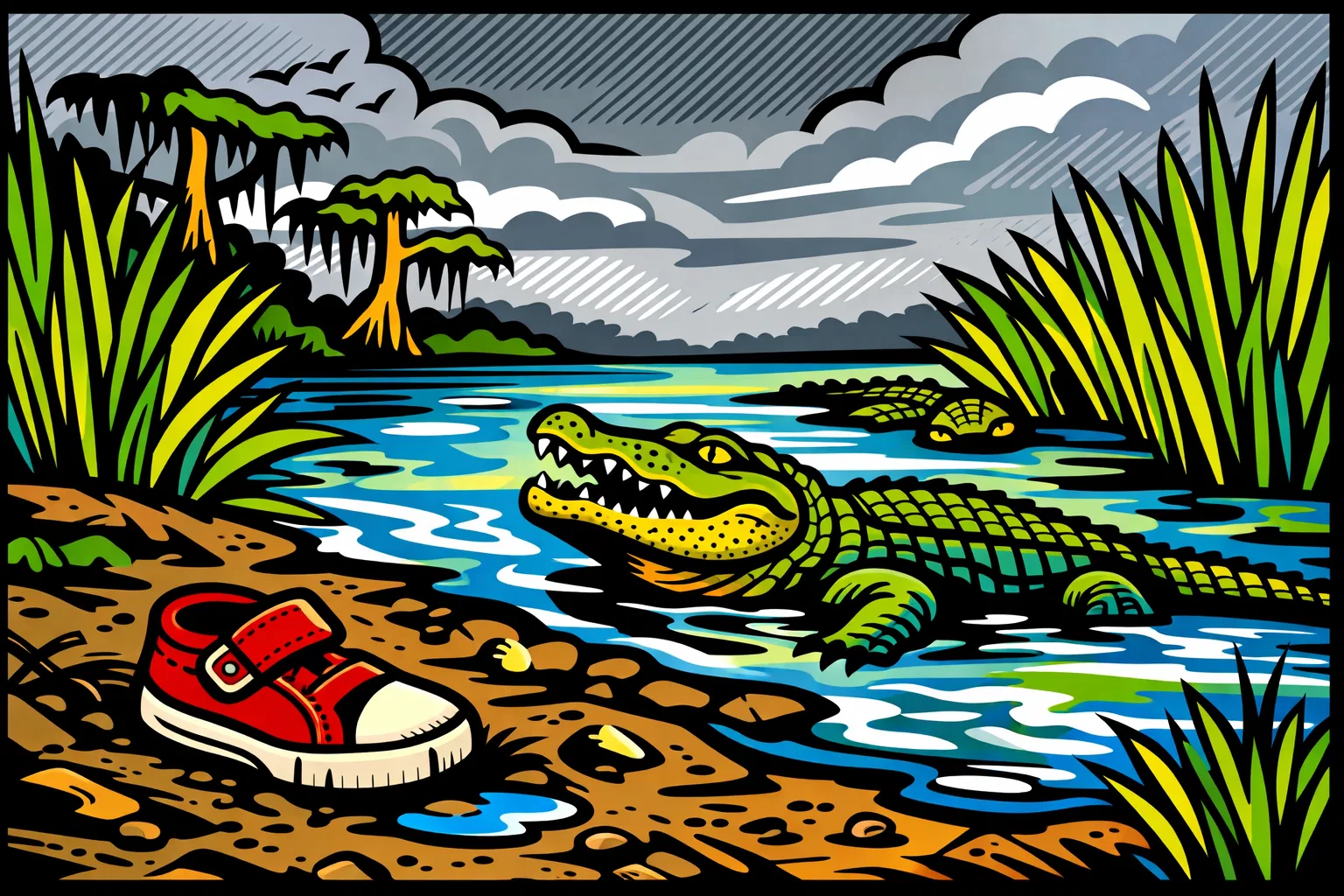
The alligator-raised-child version is the form that makes the Letiche feel most like a swamp monster. In this telling, a child abandoned or lost in the bayou is reared by alligators and becomes partly like them: amphibious, dangerous, sometimes described with webbed hands and feet, scaly skin or glowing eyes. Modern summaries often blend this with the older ghost-child motif, saying the Letiche may be either an unbaptised infant’s soul or a human child raised by alligators.[Wikipedia]WikipediaOpen source on wikipedia.org.
That transformation makes sense in Louisiana. The state’s real alligators are not exotic background decoration; they are major wetland animals, managed by the Louisiana Department of Wildlife and Fisheries as part of the state’s wetland ecosystem. LDWF says its alligator programme grew from research into habitat and nesting requirements, and that conserving wetland habitat was central to restoring alligator populations.[wlf.louisiana.gov]wlf.louisiana.govAlligator Management | Louisiana Department of Wildlife and FisheriesAlligator Management | Louisiana Department of Wildlife and Fisheries
So the Letiche borrows credibility from a very real animal environment. In a bayou setting, an alligator is not an imaginary monster. It is a visible predator, a food source, an economic resource, a tourist draw and a practical danger around water. A story about a child becoming alligator-like uses that ecological fact to make a moral tale feel physically local. The swamp does not merely hide ghosts; it can raise them, alter them and return them in animal form.
The motif also has a practical warning built into it. Children near bayous, marshes and canals face real risks: drowning, getting lost, snakes, alligators, sudden weather and deep mud. A Letiche story turns those hazards into a memorable figure. “Do not go near the water alone” becomes more powerful when the water is imagined as home to a child who crossed that boundary and never came back as fully human.
Why Terrebonne and Bayou Country Fit the Story
The Letiche is often loosely attached to “the bayous”, but Terrebonne Parish and the wider Bayou Country setting fit the legend especially well. Gumbo Ya-Ya places its brief Letiche passage near a comment that children in Terrebonne Parish spoke familiarly of mermaids, with siren stories also alive among Cajun fishermen. That does not prove a single fixed Letiche sighting area, but it does place the creature inside a South Louisiana water-folklore environment where children, fishermen and supernatural beings belonged naturally in the same story-world.[louisiana-anthology.org]louisiana-anthology.orgSaxon. "Gumbo Ya-Ya.Saxon. "Gumbo Ya-Ya.
The physical landscape reinforces the association. The Terrebonne Basin covers about 1,712,500 acres of southern Louisiana, including roughly 728,700 acres of wetlands, according to coastal restoration data. It is a place of marsh loss, navigation channels, saltwater intrusion, subsidence and fragile wetland change. In folklore terms, that means a setting where land and water are never neatly separated.[lacoast.gov]lacoast.govThe Terrebonne Basin…
That instability is exactly the kind of environment that produces water-edge monsters. A child can vanish into reeds. A log can look like a creature. A splash in the dark can become a warning. A dead-end bayou can feel like a threshold between the ordinary world and another one. The Letiche does not need a castle, cave or mountain lair; it needs a place where every crossing from porch to pirogue, bank to boat, and land to water already feels slightly uncertain.
Why Letiche and Honey Island Get Merged
The Letiche becomes confusing when it is merged with the Honey Island Swamp Monster. Honey Island lore is a different kind of Louisiana monster story: a modern cryptid case centred on St Tammany Parish, the Pearl River area, named witnesses, alleged tracks and a large hairy creature. One swamp-tour retelling says Harlan Ford and Billy Mills claimed a 1963 encounter with a grey-haired, foul-smelling, seven-foot creature near a dead boar, then links older local tradition to a being called Letiche: a meat-eating human-like creature, living on land and in water, believed to have begun as an abandoned child raised by alligators.[Pearl River Swamp Tours, New Orleans]pearlriverswamptours.comOpen source on pearlriverswamptours.com.
That is the point where two traditions start to slide into one another. The Letiche supplies an older, stranger origin story: abandoned child, alligators, water and land. The Honey Island Swamp Monster supplies the modern cryptid furniture: named hunters, a claimed sighting date, footprint casts, body size, smell, hair and a continuing tourism-friendly mystery. They are compatible in atmosphere, but not identical in structure.
A useful way to separate them is this:
- The Letiche is a motif: a ghost child or alligator-raised child shaped by bayou danger, Catholic anxiety and water folklore.
- The Honey Island Swamp Monster is a case tradition: a reported ape-like swamp creature with named witnesses, alleged tracks and twentieth-century media afterlife.
- The merger is a storytelling bridge: it gives Honey Island a deeper folklore pedigree and gives the Letiche a more visible monster body.
The merger also shows how folklore adapts for audiences. A ghost child haunting beds is a powerful local tale, but it is not as easy to market on a swamp tour as a hulking creature with tracks and a named swamp. Once the Letiche is attached to Honey Island, it becomes more legible to modern cryptid fans: part Bigfoot, part alligator, part tragic child, part bayou monster.
What Evidence Exists?
The evidence for the Letiche is primarily folkloric, not zoological. Its strongest support is documentary survival in Louisiana folklore collection: the Gumbo Ya-Ya passage, the Federal Writers’ Project listing of “letiche” as a ghost child among Creole and French tales, and later folkloric and cryptid references that repeat or elaborate the unbaptised-infant and alligator-raised-child forms.[louisiana-anthology.org]louisiana-anthology.orgSaxon. "Gumbo Ya-Ya.Saxon. "Gumbo Ya-Ya.
That makes the Letiche different from cases built around alleged physical traces. There are no widely accepted Letiche specimens, photographs, casts or field reports that would make it a plausible unknown animal. Even the later scaly, webbed version reads more like a symbolic body than a natural-history description. It takes the qualities of the bayou’s most feared animal and gives them to a lost child.
The Honey Island material has a different evidence profile, but it does not rescue the Letiche as biology. The Honey Island Swamp Monster has named witnesses and alleged tracks, but sceptical treatments have argued that such evidence is weak, easy to fake or embedded in a long tradition of swamp “man-beast” stories. Joe Nickell’s Skeptical Inquirer discussion, summarised in search results and later references, treats the Letiche as one antecedent in a wider swamp-monster mythology rather than as independent zoological evidence.[skepticalinquirer.org]skepticalinquirer.orgOpen source on skepticalinquirer.org.
The fairest reading is therefore simple: the Letiche is well supported as a remembered Louisiana folk figure, thinly supported as a sighting tradition, and unsupported as a real animal. Its value lies in what it reveals about how monster stories form, not in proving that an alligator-child still swims the bayous.
What the Letiche Explains Better Than a Modern Cryptid
The Letiche answers questions that a modern cryptid label tends to flatten. A cryptid frame asks: “Could this creature exist?” The Letiche asks something more interesting: “What kinds of fear turn into a creature?”
First, it explains how child-focused warnings become monsters. Like the Rougarou, the Letiche helps adults make danger memorable. But where the Rougarou often polices behaviour, the Letiche polices thresholds: bed and night, bank and water, home and swamp, baptised and unbaptised, human and animal.
Second, it explains why Louisiana swamp folklore often blurs spirits and animals. Bayou creatures do not have to choose between ghost story and beast story. A Letiche can be a soul, a feral child, an alligator-like being or a night presence because the swamp itself is imagined as a place where categories soften. The same landscape that supports real alligators, fish, birds, snakes, marsh grass and cypress roots can also support stories that refuse tidy classification.
Third, it explains why later monster culture keeps borrowing the motif. The abandoned-child origin gives a swamp beast emotional depth. It is creepier than “unknown ape” because it begins with human failure. Someone left a child, lost a child or failed to protect a child. The monster is the return of that failure with teeth.
The changing story around Letiche
The Letiche appears to have moved through three broad stages. The earliest clear printed layer is the ghost-child layer: the unbaptised infant’s soul, restless and troubling children at night. This is the most compact and spiritually charged version, preserved in the WPA-era folklore record.[louisiana-anthology.org]louisiana-anthology.orgSaxon. "Gumbo Ya-Ya.Saxon. "Gumbo Ya-Ya.
The second layer is the alligator-child form. Here the Letiche becomes more bodily and more bayou-specific. It is still tragic, but now the swamp has actively reshaped the child. Alligators are no longer only dangers in the environment; they become foster-parents, models and mythic kin. This version is the one that most clearly bridges folklore and cryptid imagery.[Wikipedia]WikipediaOpen source on wikipedia.org.
The third layer is the cryptid-merger layer, especially through Honey Island retellings. The Letiche is folded into a larger creature story with twentieth-century witnesses, tourism, footprints and Bigfoot-like description. That version is more dramatic, but it can obscure what makes the Letiche distinctive. The original force of the legend is not that Louisiana might hide a swamp ape. It is that bayou folklore can turn an unprotected child into a spirit-animal warning that belongs nowhere but the water’s edge.
Why the Letiche Still Belongs in Louisiana Monster Lore
The Letiche deserves a place in Louisiana monster lore precisely because it does not fit the usual modern cryptid template. It is not a clean “mystery animal” case. It is a mechanism for turning spiritual unease, child safety, alligator country and bayou geography into a creature people can remember.
That makes it one of the most revealing minor monsters in the Louisiana tradition. The Rougarou shows how French werewolf lore became a Cajun and Creole moral shape-shifter. The Honey Island Swamp Monster shows how a modern hairy-hominid case can grow around claimed sightings and swamp tourism. The Letiche shows something quieter and more unsettling: how a lost child can become part of the swamp itself.
Read that way, the Letiche is not weakened by the lack of hard evidence. It was never strongest as a field-guide animal. It is strongest as a bayou motif: a small, sad, dangerous figure at the place where family, faith, water and wildlife meet.

Amazon book picks
Further Reading
Books and field guides related to What Is the Letiche of Bayou Folklore?. Use these as the next step if you want deeper reading beyond the article.
The United States of Cryptids
Helps readers compare local legends with national monster traditions.
Swamp Monsters, Bigfoot and Louisiana Legends
Explores how bayou legends evolve into creature stories.
eBay marketplace picks
Marketplace Samples
Live-tested eBay searches with available results related to this page.
Endnotes
1.
Source: louisiana-anthology.org
Title: Saxon. “Gumbo Ya-Ya.”
Link:https://louisiana-anthology.org/texts/saxon/saxon–gumbo_ya_ya.html
2.
Source: documentproviderviewer.nsula.edu
Link:https://documentproviderviewer.nsula.edu/?id=2761
3.
Source: bigfootencounters.com
Link:https://www.bigfootencounters.com/articles/skeptical2001.htm
4.
Source: 64parishes.org
Link:https://64parishes.org/entry/rougarou
5.
Source: Wikipedia
Link:https://en.wikipedia.org/wiki/Letiche
6.
Source: wlf.louisiana.gov
Title: Alligator Management | Louisiana Department of Wildlife and Fisheries
Link:https://www.wlf.louisiana.gov/page/alligator-management
7.
Source: lacoast.gov
Link:https://lacoast.gov/new/About/Basin_data/te/Default.aspx
Source snippet
The Terrebonne Basin...
8.
Source: Wikipedia
Title: Honey Island Swamp monster
Link:https://en.wikipedia.org/wiki/Honey_Island_Swamp_monster
9.
Source: wlf.louisiana.gov
Link:https://www.wlf.louisiana.gov/page/alligator
10.
Source: deq.louisiana.gov
Link:https://www.deq.louisiana.gov/assets/docs/Water/Whats_In_Your_Water/TerrebonneBasinBrochure.pdf
11.
Source: wlf.louisiana.gov
Title: alligator hunting
Link:https://www.wlf.louisiana.gov/page/alligator-hunting
12.
Source: Wikipedia
Link:https://ff.wikipedia.org/wiki/Letiche
13.
Source: Wikipedia
Link:https://en.wikipedia.org/wiki/Cajuns
14.
Source: Wikipedia
Title: Terrebonne Basin
Link:https://en.wikipedia.org/wiki/Terrebonne_Basin
15.
Source: Wikipedia
Title: Fauna of Louisiana
Link:https://en.wikipedia.org/wiki/Fauna_of_Louisiana
16.
Source: Wikipedia
Title: Fouke Monster
Link:https://en.wikipedia.org/wiki/Fouke_Monster
17.
Source: Wikipedia
Link:https://en.wikipedia.org/wiki/Rougarou
18.
Source: lacoast.gov
Title: Watermarks 60
Link:https://lacoast.gov/new/Data/WaterMarks/Watermarks_60.pdf
19.
Source: 64parishes.org
Title: louisiana folktales
Link:https://64parishes.org/entry/louisiana-folktales
20.
Source: 64parishes.org
Link:https://64parishes.org/keyword/rougarou
21.
Source: 64parishes.org
Title: why not boogie with the boogie man
Link:https://64parishes.org/why-not-boogie-with-the-boogie-man
22.
Source: youtube.com
Title: The History of 12 Louisiana Cryptids
Link:https://www.youtube.com/watch?v=9qbyTfOX51o
Source snippet
Letiche - American FolkLore...
23.
Source: youtube.com
Link:https://www.youtube.com/watch?v=amL4LMle-Ys
Source snippet
The Letiche...
24.
Source: youtube.com
Title: The Letiche
Link:https://www.youtube.com/watch?v=fCC5T6Yw5oo
Source snippet
The enigma of the Letiche...
25.
Source: louisianafolklife.org
Link:https://www.louisianafolklife.org/lt/articles_essays/culturalcatholicism.html
26.
Source: pearlriverswamptours.com
Link:https://www.pearlriverswamptours.com/legends/
27.
Source: skepticalinquirer.org
Link:https://skepticalinquirer.org/2001/07/tracking-the-swamp-monsters/
28.
Source: facebook.com
Link:https://www.facebook.com/groups/1068401990729996/posts/1564345591135631/
29.
Source: facebook.com
Title: The Honey Island Swamp Monster
Link:https://www.facebook.com/groups/ADNMNOLA/posts/10158887710445638/
30.
Source: mythus.fandom.com
Link:https://mythus.fandom.com/wiki/Letiche
31.
Source: cryptidz.fandom.com
Title: Honey Island Swamp Monster
Link:https://cryptidz.fandom.com/wiki/Honey_Island_Swamp_Monster
32.
Source: eerie-worlds.fandom.com
Link:https://eerie-worlds.fandom.com/wiki/Letiche
33.
Source: myths-in-media.fandom.com
Link:https://myths-in-media.fandom.com/wiki/Letiche
34.
Source: non-aliencreatures.fandom.com
Title: Honey Island Swamp Monster
Link:https://non-aliencreatures.fandom.com/wiki/Honey_Island_Swamp_Monster
35.
Source: monster.fandom.com
Title: Honey Island Swamp Monster
Link:https://monster.fandom.com/wiki/Honey_Island_Swamp_Monster
36.
Source: centerforinquiry.org
Link:https://centerforinquiry.org/blog/category/investigative-briefs/page/18/
37.
Source: countryroadsmagazine.com
Title: the honey island swamp monster
Link:https://countryroadsmagazine.com/outdoors/knowing-nature/the-honey-island-swamp-monster/
38.
Source: daviddonar.com
Link:https://daviddonar.com/rougarou/
39.
Source: louisianafolklife.org
Link:https://www.louisianafolklife.org/lfp/main_prog_past_current.html
40.
Source: thecreaturecodex.wordpress.com
Link:https://thecreaturecodex.wordpress.com/2018/08/08/letiche/
41.
Source: science.howstuffworks.com
Title: honey island swamp monster
Link:https://science.howstuffworks.com/science-vs-myth/strange-creatures/honey-island-swamp-monster.htm
42.
Source: folklore.usc.edu
Link:https://folklore.usc.edu/rougarou/
Additional References
43.
Source: youtube.com
Title: The enigma of the Letiche
Link:https://www.youtube.com/watch?v=FgwHPKPUD9Q
Source snippet
Folklore Function: Like the Rougarou (the regional werewolf variant) or the Feu Follet (will-o'-the-wisp), the Letiche serves primarily a...
44.
Source: instagram.com
Link:https://www.instagram.com/64parishes/
45.
Source: reddit.com
Link:https://www.reddit.com/r/bigfoot/comments/115fjbe/8mm_original_film_footage_by_harlan_ford_honey/
46.
Source: lafisheriesforward.org
Link:https://www.lafisheriesforward.org/wp-content/uploads/2022/04/LFF_FastFacts_Alligator_05.pdf
47.
Source: facebook.com
Link:https://www.facebook.com/bigfootcrossroads/posts/a-strange-skeleton-measuring-nearly-8-ft-in-length-is-found-in-the-swamps-of-eas/1379669280833534/
48.
Source: facebook.com
Link:https://www.facebook.com/groups/281886105961506/posts/1958387094978057/
49.
Source: aitcla.org
Link:https://aitcla.org/alligators
50.
Source: facebook.com
Link:https://www.facebook.com/houmatoday/posts/as-halloween-draws-near-you-may-be-interested-in-learning-louisiana-folklore-her/1710402896559358/
51.
Source: rougaroufest.org
Link:https://rougaroufest.org/awards/
52.
Source: res.us
Link:https://res.us/projects/bayou-terrebonne-wetland-mitigation/
Topic Tree