Within Wisconsin Monsters
How Did the Hodag Become Rhinelander's Monster?
The Hodag began as a showman's prank, then became Rhinelander's most durable monster mascot.
On this page
- Eugene Shepard and the original prank
- Logging folklore and fearsome critters
- Mascots, statues and tourist afterlives
Page outline Jump by section
Introduction
The Hodag became Rhinelander’s monster because it did something most hoaxes do not manage: it outlived its exposure. The creature began in the 1890s as a deliberately theatrical prank by Eugene “Gene” Shepard, a Rhinelander lumberman, timber cruiser, resort operator and local humorist. He promoted a monstrous Northwoods beast, staged a dramatic “capture”, displayed a supposed live specimen, and then watched the story spread beyond Oneida County before the fake animal was finally acknowledged as fake.[Rhinelander Historical Society]rhinelanderhistoricalsociety.orgOpen source on rhinelanderhistoricalsociety.org.
Yet the joke did not collapse the legend. Instead, Rhinelander adopted it. The Hodag became a civic symbol, a high-school mascot, a roadside statue, a tourism brand and a shorthand for Northwoods eccentricity. Its importance to Wisconsin monster folklore is not that anyone produced good evidence for a real horned beast. It is that a known prank became real local identity: a fake monster that people stopped treating as zoology and started treating as home.[Rhinelander Chamber of Commerce]rhinelanderchamber.comOpen source on rhinelanderchamber.com.
Eugene Shepard and the original prank
The Hodag’s modern story is inseparable from Eugene Simeon Shepard. The Rhinelander Historical Society identifies Shepard as a lumberman, resort operator and humorist, born in Green Bay in 1854 and later associated strongly with Rhinelander. It also credits him with developing the Hodag monster hoax that helped make Oneida County a tourist destination.[Rhinelander Historical Society]rhinelanderhistoricalsociety.orgOpen source on rhinelanderhistoricalsociety.org.
The earliest famous public form of the story appeared in Rhinelander’s weekly newspaper, The New North, on 28 October 1893. The Rhinelander Historical Society preserves the “Capture of a Hodag” text, a comic tall tale in which hunters, dogs, rifles, knives, birch bark, dynamite and even squirt guns are thrown into a ludicrous battle with a terrifying swamp creature. The language is deliberately excessive: the Hodag slashes timber, its breath becomes choking smoke, and the scene becomes a noisy pile-up of gunfire, falling trees, dogs and explosions.[Rhinelander Historical Society]rhinelanderhistoricalsociety.orgOpen source on rhinelanderhistoricalsociety.org.
That matters because the first Hodag was not presented in the sober style of a natural-history report. It was a performance. Shepard was drawing on the comic violence and exaggeration of lumber-camp storytelling, where impossible animals could be described with a straight face for the amusement — and sometimes the fooling — of outsiders. The 1893 story works because it pretends to be local news while behaving like a campfire boast.
Wisconsin 101, a public-history project from the University of Wisconsin, summarises the classic version: Shepard claimed to have seen a beast as large as a bear, with fangs and spikes down its back, then joined other lumbermen in killing it with dynamite and circulating a photograph of the remains. That image and story travelled beyond Rhinelander, helping turn a local prank into a wider newspaper curiosity.[Wisconsin 101]wi101.wisc.eduonsin 101The Myth of the Hodag in Rhinelanderonsin 101The Myth of the Hodag in Rhinelander
The prank escalated in 1896, when Shepard claimed not merely to have killed a Hodag but to have captured one alive. Local and later accounts describe a dark display at the first Oneida County Fair, where a fabricated creature could be made to move by hidden wires or pulleys. The point was not only to show a monster, but to manage the audience: dim light, growls, movement and showman’s timing made the fake animal briefly feel present.[Wisconsin 101]wi101.wisc.eduonsin 101The Myth of the Hodag in Rhinelanderonsin 101The Myth of the Hodag in Rhinelander
The usual end of the live-Hodag episode comes with the Smithsonian story. As the tale spread, scientists from the Smithsonian Institution were reportedly expected to inspect the creature, forcing Shepard to admit the specimen was a hoax. Whether retold as embarrassment, comic timing or civic origin myth, the point is consistent: the Hodag’s evidential status was settled very early. It was not a misidentified animal later explained away. It was a constructed monster, knowingly presented as a prank.[Wisconsin 101]wi101.wisc.eduonsin 101The Myth of the Hodag in Rhinelanderonsin 101The Myth of the Hodag in Rhinelander

What kind of creature was the Hodag supposed to be?
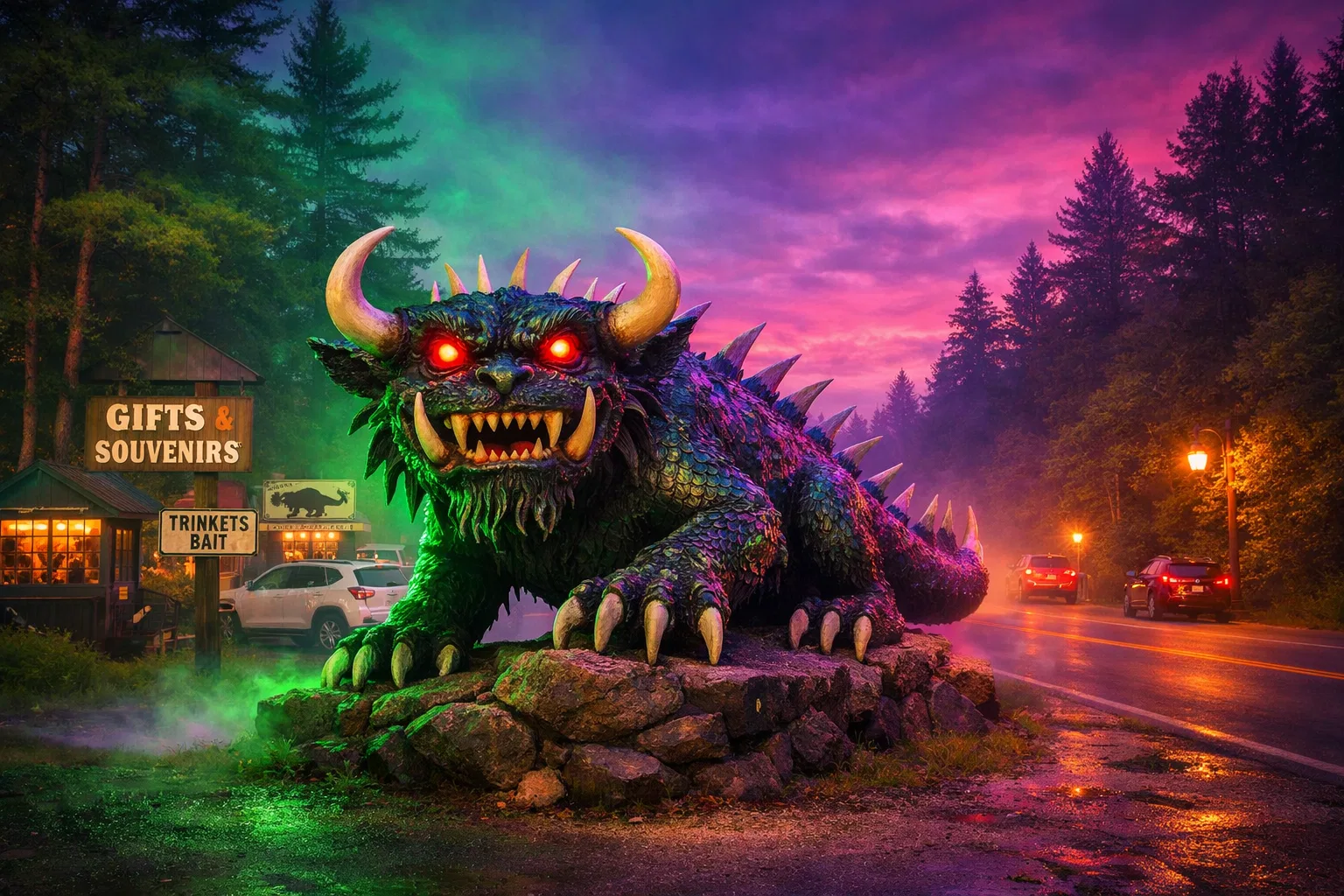
The Hodag is usually imagined as an ugly, hybrid Northwoods beast: horns, fangs or tusks, claws, a spiny back, a long tail and a body that mixes reptile, mammal and dinosaur-like features. Modern Rhinelander tourism material describes it as a mythical, mischievous creature first “discovered” in Rhinelander in the late 19th century and now visible across the city in signs, statues and local branding.[Explorer Rhinelander]explorerhinelander.comExplorer Rhinelander Meet the HodagExplorer Rhinelander Meet the Hodag
The creature’s details vary because it was never a stable animal description. In the original comic tradition, the Hodag could be reshaped to fit a joke. One version emphasised a bear-sized monster with fangs and spikes. Another described a “Black Hodag” fought in a tamarack swamp. Later tellings add horns, a spiked tail, bulldog-eating habits, oxen-related origin myths or mock-scientific names. This instability is not a weakness in the folklore. It is the folklore.
A useful way to read the Hodag is as a local “fearsome critter”. Fearsome critters were impossible animals in North American lumber-camp humour: beasts that could be blamed for strange noises, used to tease newcomers, or recited as mock field knowledge by men who knew the woods well. William T. Cox’s 1910 Fearsome Creatures of the Lumberwoods is one of the key printed collections of this tradition, presenting invented woodland beasts in the style of a comic naturalist’s guide.[DigitalCommons]digitalcommons.unl.eduOpen source on unl.edu.
The Hodag fits that tradition, but it also differs from many fearsome critters because Shepard gave it a public stage and a home town. Many lumber-camp monsters lived mainly as jokes in print or oral tradition. The Hodag acquired a supposed photograph, a newspaper origin point, a fairground display, and then a municipal afterlife. It crossed the line from bunkhouse tall tale to civic emblem.
Why Rhinelander was ready for a monster
The Hodag was born at a moment when Rhinelander and the wider Northwoods were changing. Wisconsin 101 places the legend in the late-19th-century transition away from the first boom of unregulated logging. Wisconsin’s lumber industry had expanded in the mid-19th century, but by the 1890s heavy cutting, falling production and the wider financial panic of 1893 created economic pressure in timber towns. Rhinelander, like other communities, had reason to seek a distinct identity beyond raw lumber extraction.[Wisconsin 101]wi101.wisc.eduonsin 101The Myth of the Hodag in Rhinelanderonsin 101The Myth of the Hodag in Rhinelander
That setting helps explain why the Hodag worked. It was funny, but it was also useful. A town with pine forests, lakes, logging memory and a taste for local oddity could turn a monster story into a form of recognition. Shepard himself was not simply a prankster in isolation; local history sources present him as a booster, resort operator and promoter whose Hodag story helped draw attention to the area.[Rhinelander Historical Society]rhinelanderhistoricalsociety.orgOpen source on rhinelanderhistoricalsociety.org.
The Hodag also allowed Rhinelander to keep the logging past without treating it only as hardship or environmental loss. The creature is ridiculous, but the world behind it was real: timber crews, oxen and horses, forest camps, difficult labour, economic uncertainty and a community trying to define itself. The joke softened that history into something marketable, memorable and repeatable.
This is why the Hodag is more than a simple “gotcha” hoax. A hoax normally depends on belief; once exposed, it loses power. The Hodag shifted categories. It stopped needing belief and became a shared local performance. The question changed from “Is it real?” to “Are you in on the joke?”
Logging folklore and fearsome critters
The Hodag’s deepest folkloric relatives are not lake monsters or Bigfoot reports, but the impossible beasts of lumber-camp humour. Fearsome critters often exaggerated the dangers of the woods into absurd animal forms. Some were built around a single joke: a creature that could only walk downhill, an animal that made strange noises, or a beast with a diet so specific that the description became the punchline.
Printed collections helped preserve and reshape that oral culture. Cox’s Fearsome Creatures of the Lumberwoods treated these imaginary animals like entries in a field guide, complete with names, habits and habitats, while later writers such as Henry H. Tryon continued the tradition of cataloguing lumberjack monsters.[DigitalCommons]digitalcommons.unl.eduOpen source on unl.edu.
The Hodag also appears in the orbit of Lake Shore Kearney’s 1928 The Hodag and Other Tales of the Logging Camps, a collection associated with logging-camp tales and the wider Paul Bunyan world. Wisconsin 101 notes that Kearney’s material helped connect the Hodag to stories about abused oxen and the memory of lumberjack culture.[Wisconsin 101]wi101.wisc.eduonsin 101The Myth of the Hodag in Rhinelanderonsin 101The Myth of the Hodag in Rhinelander
One recurring origin story says the Hodag came from the ashes of abused oxen. In that version, the monster is not just a random beast; it is a grotesque return of mistreated labour animals, shaped by the violence and exhaustion of logging work. Wisconsin 101 treats this as one possible reading of the myth: the Hodag can be understood as a symbol of animal cruelty, environmental destruction and the strange moral residue of the lumber era.[Wisconsin 101]wi101.wisc.eduonsin 101The Myth of the Hodag in Rhinelanderonsin 101The Myth of the Hodag in Rhinelander
Another reading is more nostalgic. The Hodag may have helped turn a rough working-class logging past into colourful heritage. Instead of remembering the timber era only through cutover land, dangerous labour and economic decline, Rhinelander could remember it through jokes, tall tales, old photographs and a monster that belonged to nobody else. That does not make the legend false in a cultural sense. It makes it a story about how a town digests its own past.
How the hoax became Rhinelander identity
The Hodag survived because Rhinelander made it useful, visible and affectionate. Today, local tourism material calls the creature the official symbol of Rhinelander and notes that it is also the local high-school mascot. Visitors are encouraged to “meet” the Hodag through statues, signs and themed stops around the city.[Rhinelander Chamber of Commerce]rhinelanderchamber.comOpen source on rhinelanderchamber.com.
The most obvious modern anchor is the large Hodag statue outside the Rhinelander Area Chamber of Commerce at 450 W. Kemp Street. Travel Wisconsin, the state’s official tourism site, lists the World’s Largest Hodag Statue as a Rhinelander attraction and frames the creature as both fierce monster and misunderstood woodland resident, depending on the teller.[Travel Wisconsin]travelwisconsin.comOpen source on travelwisconsin.com.
That double tone is important. Rhinelander does not have to choose between scary Hodag and friendly Hodag. The same creature can be a grotesque beast in the old story, a proud school identity on a sports uniform, a photo stop for families, a souvenir design, and a playful emblem of “Hodag Country”. The monster’s meaning changes by setting.
The Hodag Country Festival is another major afterlife. The official festival history says the country music event began in 1978 and has hosted major performers while maintaining band contests and local traditions. Explore Rhinelander describes it as an annual music festival held in Rhinelander since 1978, welcoming notable country acts to the Northwoods.[Hodag Country Festival]hodag.comOpen source on hodag.com.
The school mascot has also kept the creature alive in everyday identity. Rhinelander High School’s athletic site brands the teams as the Hodags, and local reporting noted that the Rhinelander Hodags won a national “Best High School Mascot” contest in 2022 with 183,455 votes. That is a telling modern twist: the Hodag began as a fake animal that tricked outsiders, then became a symbol locals could mobilise with pride.[Rhinelander Hodags]rhinelanderhodags.comRhinelander Hodags Rhinelander High SchoolRhinelander Hodags Rhinelander High School
Why the Hodag still feels “real” without being a real animal
The Hodag is not a strong cryptozoological case. There is no serious biological evidence for a horned, spined Northwoods beast matching Shepard’s creation, and the central exhibit was a known fake. In evidence terms, the Hodag belongs with hoaxes, tall tales and folklore rather than unresolved animal reports.
But folklore does not become irrelevant when zoology says no. The Hodag feels “real” in Rhinelander because it is embedded in place. You can visit the statue, see the mascot, attend the festival, find the name on local businesses, and hear residents explain the story as part of who they are. The creature is not real as wildlife, but it is real as a civic language.
That is why the Hodag occupies a special place among Wisconsin monster legends. Compared with witness-driven traditions such as werewolf-like roadside reports or Northwoods Bigfoot claims, the Hodag is unusually transparent. Its origin is documented, its showman is named, and its trickery is part of the charm. The mystery is not whether Shepard built a fake monster. The interesting question is why a community chose to keep it.
The answer is that the Hodag gives Rhinelander something rare: an identity that is local, funny, visually memorable and historically rooted. It carries the Northwoods, the logging era, newspaper humour, civic boosterism, tourism and school pride in one strange green body. Many places have mascots. Rhinelander has a mascot with an origin story good enough to retell.
What the Hodag reveals about Wisconsin monster folklore
The Hodag shows that Wisconsin’s monster map is not only about sightings. It is also about storytelling economies: how a place turns landscape, labour history and local humour into an enduring legend. In this case, the “evidence” is not a trackway, carcass or credible eyewitness chain. The evidence is a paper trail of performance — newspaper articles, staged photographs, fairground display, local histories, statues, festivals and institutional memory.[Rhinelander Historical Society]rhinelanderhistoricalsociety.orgOpen source on rhinelanderhistoricalsociety.org.
That makes the Hodag a useful test case for reading other cryptid traditions carefully. Some monster stories ask whether witnesses saw a misidentified bear, wolf, cougar, dog or shadow. The Hodag asks a different question: what happens when everyone knows the beast is fake, but the story is too good to abandon?
In Rhinelander, the answer is visible across town. The hoax became heritage. The prank became branding. The monster became a resident. And in that sense, the Hodag may be Wisconsin’s most honest cryptid: not a hidden animal pretending to be proven, but a public joke that became a lasting local truth.
Amazon book picks
Further Reading
Books and field guides related to How Did the Hodag Become Rhinelander's Monster?. Use these as the next step if you want deeper reading beyond the article.
Fearsome Creatures of the Lumberwoods
Provides the folkloric tradition that helped shape the Hodag.
eBay marketplace picks
Marketplace Samples
Live-tested eBay searches with available results related to this page.


Endnotes
1.
Source: lumberwoods.com
Link:https://www.lumberwoods.com/hodagthebook.htm
2.
Source: hodag.com
Link:https://www.hodag.com/country-music/faq/
3.
Source: rhinelanderhistoricalsociety.org
Link:https://rhinelanderhistoricalsociety.org/article/eugene-shepard/
4.
Source: rhinelanderhistoricalsociety.org
Link:https://rhinelanderhistoricalsociety.org/article/hodag-capture/
5.
Source: rhinelanderchamber.com
Link:https://www.rhinelanderchamber.com/about-the-hodag/
6.
Source: wi101.wisc.edu
Link:https://wi101.wisc.edu/object-history-hodag-decanter/
7.
Source: wi101.wisc.edu
Title: onsin 101The Myth of the Hodag in Rhinelander
Link:https://wi101.wisc.edu/the-myth-of-the-hodag-in-rhinelander/
8.
Source: Wikipedia
Link:https://en.wikipedia.org/wiki/Hodag
9.
Source: explorerhinelander.com
Title: Explorer Rhinelander Meet the Hodag
Link:https://explorerhinelander.com/meet-the-hodag/
10.
Source: digitalcommons.unl.edu
Link:https://digitalcommons.unl.edu/cgi/viewcontent.cgi?article=1008&context=nebraskianapubs
11.
Source: abookofcreatures.com
Title: fearsome critters
Link:https://abookofcreatures.com/2017/02/08/fearsome-critters/
12.
Source: rhinelanderhistoricalsociety.org
Title: RR4 Chronicles of the unsung game changers
Link:https://rhinelanderhistoricalsociety.org/wp-content/uploads/2024/02/RR4-Chronicles-of-the-unsung-game-changers.pdf
13.
Source: travelwisconsin.com
Link:https://www.travelwisconsin.com/things-to-do/attractions/tours-and-excursions/world-s-largest-hodag-statue
14.
Source: explorerhinelander.com
Title: Explorer Rhinelander Hodag Country Festival
Link:https://explorerhinelander.com/all-events/hodag-country-festival/
15.
Source: rhinelanderhodags.com
Title: Rhinelander Hodags Rhinelander High School
Link:https://www.rhinelanderhodags.com/
16.
Source: spectrumnews1.com
Title: rhinelander hodags win best high school mascot in america
Link:https://spectrumnews1.com/wi/milwaukee/news/2022/11/05/rhinelander-hodags-win–best-high-school-mascot-in-america-
17.
Source: facebook.com
Title: Hodag Country Festival
Link:https://www.facebook.com/WJFWNews/posts/hodag-country-festival-official-dates-back-to-1978-and-draws-tens-of-thousands-o/10159725679242194/
18.
Source: facebook.com
Link:https://www.facebook.com/RhinelanderChamber/videos/rhinelander-home-of-the-hodag/950845368624334/
19.
Source: explorerhinelander.com
Title: Who discovered the Hodag?
Link:https://explorerhinelander.com/who-discovered-the-hodag/
20.
Source: rhinelanderhistoricalsociety.org
Title: e s shepard hodag capture story
Link:https://rhinelanderhistoricalsociety.org/document/e-s-shepard-hodag-capture-story/
21.
Source: rhinelanderhistoricalsociety.org
Title: Rhinelander History Books Directory
Link:https://rhinelanderhistoricalsociety.org/wp-content/uploads/2024/03/Rhinelander-History-Books-Directory.pdf
22.
Source: Wikipedia
Title: Hodag Country Festival
Link:https://en.wikipedia.org/wiki/Hodag_Country_Festival
23.
Source: Wikipedia
Title: Rhinelander High School
Link:https://en.wikipedia.org/wiki/Rhinelander_High_School
24.
Source: reddit.com
Title: the hodag
Link:https://www.reddit.com/r/wisconsin/comments/1s309lt/the_hodag/
25.
Source: wi101.wisc.edu
Title: paul bunyan and the hodag
Link:https://wi101.wisc.edu/paul-bunyan-and-the-hodag/
26.
Source: books.google.com
Title: Fearsome Creatures of the Lumberwoods
Link:https://books.google.com/books/about/Fearsome_Creatures_of_the_Lumberwoods.html?id=yCYI0QEACAAJ
27.
Source: tripadvisor.com
Title: Hodag Statue
Link:https://www.tripadvisor.com/Attraction_Review-g60229-d26725936-Reviews-Hodag_Statue-Rhinelander_Wisconsin.html
28.
Source: cryptidz.fandom.com
Link:https://cryptidz.fandom.com/wiki/Hodag
29.
Source: rhinelanderpphc.com
Link:https://rhinelanderpphc.com/hodags/
30.
Source: outdoorsy.com
Link:https://www.outdoorsy.com/guide/hodag-country-festival
31.
Source: viberate.com
Title: hodag country festival
Link:https://www.viberate.com/festival/hodag-country-festival/
Additional References
32.
Source: youtube.com
Title: What is the Hodag of Wisconsin? Monsterology
Link:https://www.youtube.com/watch?v=zkdZjjNC2Bo
Source snippet
This documentary on the Legend of the Hodag breaks down the history of Eugene Shepard's elaborate hoax and details how it ultimately help...
33.
Source: youtube.com
Title: Hodag Hijinks
Link:https://www.youtube.com/watch?v=30MBjZkuXZ0
Source snippet
What is the Hodag of Wisconsin? Monsterology...
34.
Source: pilchbarnet.com
Link:https://pilchbarnet.com/case-study/explore-rhinelander/
35.
Source: amazon.com
Link:https://www.amazon.com/Fearsome-Creatures-Lumberwoods-Desert-Mountain/dp/1168673801?tag=searcht-20
36.
Source: goodreads.com
Link:https://www.goodreads.com/en/book/show/1440819.Fearsome_Creatures_Of_The_Lumberwoods
37.
Source: filson.com
Link:https://www.filson.com/blogs/journal/field-notes-fearsome-creatures-of-the-lumberwoods
38.
Source: happy-the-hodag.com
Link:https://happy-the-hodag.com/pages/about-us?srsltid=AfmBOop_i7Lioua7fJu1dh0LH7_OU8hwDBG7lbdXYGVOf-RSMOPSOK-k
39.
Source: happy-the-hodag.com
Link:https://happy-the-hodag.com/pages/about-us?srsltid=AfmBOooGQ1ldJpo8RYeqRzRQixw3-WaR5ZicaNe818WBB10HHg-c95vb
40.
Source: happy-the-hodag.com
Link:https://happy-the-hodag.com/pages/about-us?srsltid=AfmBOoqEMrNq87ufaUMls0bwoqykMHureH9tMgmiLt9hhL9YCZltbODB
41.
Source: kbtx.com
Link:https://www.kbtx.com/video/2022/11/02/rhinelander-hodag-voted-best-high-school-mascot-america/
Topic Tree