Within Virginia Cryptids
What Really Started the Bunny Man Legend?
The Bunny Man began with two reported 1970 incidents before growing into Northern Virginia's famous bridge-haunting legend.
On this page
- The two Fairfax County incidents in 1970
- How Guinea Road became Bunny Man Bridge folklore
- Why suburbia helped the legend spread
Page outline Jump by section
Introduction
The Bunny Man is one of Virginia’s strangest documented legends because it begins not with a supposed unknown animal, but with two reported Fairfax County incidents in October 1970: a man in a rabbit-like outfit, a hatchet or axe, and angry warnings about trespassing. Those reports were real enough to appear in police and newspaper accounts, but the famous “Bunny Man Bridge” story that later grew around them is mostly folklore: escaped inmates, murdered children, rabbit carcasses and Halloween curses added by retelling rather than verified evidence. Fairfax County historian-archivist Brian A. Conley found no evidence for the bridge murders, asylum backstory or earlier 1900s origin, and identified the 1970 Guinea Road incidents as the likely seed of the modern legend.[The Washington Post]washingtonpost.comThe Washington Post Boo! It's the Bunny Man!The Washington PostBoo! It's the Bunny Man! - The Washington Post…
That is what makes the Bunny Man useful in a Virginia cryptid and monster-lore map. He is not a mystery beast hiding in the woods. He is a rare case where a local monster figure can be watched forming: a police mystery becomes a teenage scare story, a road location becomes a ritual destination, and a suburban county gives itself a creature with a civic address.
The two Fairfax County incidents in 1970
The most evidence-backed version of the Bunny Man begins on Guinea Road in Burke, not at the Colchester Overpass. In the first widely cited incident, Air Force Academy cadet Robert Bennett and his fiancée reported that they were sitting in a car near Bennett’s uncle’s home when a man in a white suit with long rabbit-like ears shouted that they were on private property and threw a hatchet through the car window. They were not injured, and police reportedly had the hatchet but little else to work with. WETA’s Boundary Stones account cites the original Washington Post story “Man in Bunny Suit Sought in Fairfax”, published on 22 October 1970.[Boundary Stones]boundarystones.weta.orgOpen source on weta.org.
The second core incident followed less than two weeks later. Private security guard Paul Phillips, working at a construction site, reported seeing a man in a rabbit suit near a new, unoccupied house. In the newspaper and later retellings, the figure was not simply “haunting” the place; he was said to be angry about trespassing and development. Phillips reported that the man threatened him and fled into the woods. Boundary Stones cites the Washington Post follow-up “The Rabbit Reappears”, published on 31 October 1970, and a Fairfax County Police investigation report dated 29 October 1970.[Boundary Stones]boundarystones.weta.orgOpen source on weta.org.
Those details matter because they keep the Bunny Man grounded. The documented figure is not described as a supernatural animal, a ghost, or a serial killer. He is a person, apparently male, using a costume or white covering and a weapon to frighten people away from land he considered wrongly used. The repeated complaint about trespassing gives the earliest Bunny Man a motive that is much more local and social than monstrous: property, privacy, and a landscape changing around him.
Even the “rabbit suit” itself is not as clean a fact as the later legend makes it sound. Later discussion of Conley’s research notes that one account may have described a white covering on the man’s head, possibly read by others as rabbit ears or a costume. Conley told a local audience that a Fairfax Globe story from 29 October 1970 did not necessarily say “bunny suit” in the tidy form remembered today, and that somebody appears to have added or sharpened that image in retelling.[Fairfax Station Connection]fairfaxstationconnection.comFairfax Station Connection The Elusive Trail of the Bunnyman Urban MythFairfax Station Connection The Elusive Trail of the Bunnyman Urban Myth
The result is a perfect folklore starter. A witness claim with a physical object, a police report, newspaper headlines, a costume detail odd enough to repeat, and no identified suspect. The case was not solved, which left a gap. Local legend moved into that gap.

How Guinea Road became Bunny Man Bridge folklore
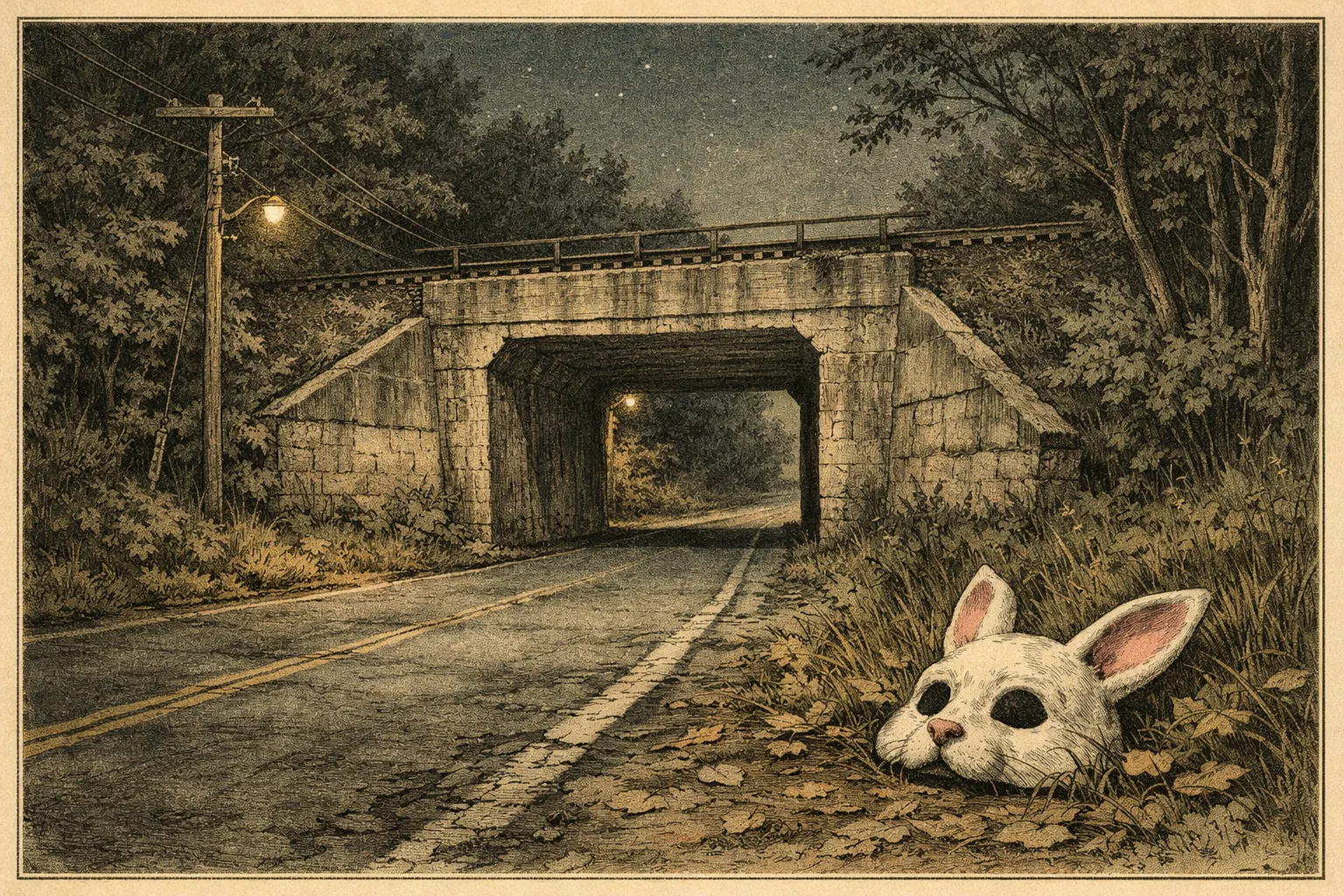
The famous bridge is the Colchester Overpass near Clifton, a narrow railway underpass on Colchester Road. In many modern versions, this is where the Bunny Man killed children, hung victims, mutilated rabbits, or appears at midnight on Halloween. Yet the best-supported 1970 incidents were on Guinea Road in the Burke/Fairfax area, several miles away from the bridge now associated with the legend. A 2017 Fairfax Station Connection report on Conley’s work puts the point bluntly: the Guinea Road case was in Burke, “miles away from the bridge”.[Fairfax Station Connection]fairfaxstationconnection.comFairfax Station Connection The Elusive Trail of the Bunnyman Urban MythFairfax Station Connection The Elusive Trail of the Bunnyman Urban Myth
So why did the story attach itself to the bridge? Because folklore likes a stage. The Colchester Overpass gives the tale a physical setting that feels designed for a dare: a single-lane tunnel, railroad tracks above, woods nearby, poor lighting, awkward access and enough seclusion for teenagers to test each other’s nerve. The Washington Post’s 2003 feature described the bridge in precisely those terms: a 60-foot tunnel, narrow road, dark surroundings and an atmosphere that made it attractive to thrill-seekers even for people who did not believe the story.[The Washington Post]washingtonpost.comThe Washington Post Boo! It's the Bunny Man!The Washington PostBoo! It's the Bunny Man! - The Washington Post…
Conley’s research also undercuts the older “asylum” version. The common bridge legend claims that a mental institution near Clifton closed around 1904 or 1905, that inmates were moved towards Lorton, that one or more escaped, and that the Bunny Man emerged from this disaster. Conley found no evidence for murders at the bridge, no matching county murder cases, no Fairfax County asylum fitting the tale, and noted that Lorton Prison was built after the supposed events in some versions.[The Washington Post]washingtonpost.comThe Washington Post Boo! It's the Bunny Man!The Washington PostBoo! It's the Bunny Man! - The Washington Post…
That does not make the bridge irrelevant. It makes it a folklore magnet rather than the scene of the founding incidents. The real-world Bunny Man reports supplied the costume, weapon and threat. The bridge supplied the mood, geography and ritual. Together they made a story that could be told in a car, on Halloween, to someone who was already nervous before the punchline arrived.
Why suburbia helped the legend spread
The Bunny Man is often treated as a spooky rural tale, but its timing is deeply suburban. Fairfax County was changing rapidly in the decades around 1970. A county demographic profile recorded Fairfax’s population rising from 248,897 in 1960 to 455,021 in 1970, an increase of 83 per cent, with net in-migration accounting for a large share of that growth.[Fairfax County]fairfaxcounty.govprofile 1973profile 1973 A Fairfax County planning page on modern historic resources similarly describes post-war growth from about 99,000 residents in 1950 to 596,000 by 1980, demanding new subdivisions, commercial corridors and public facilities.[Fairfax County]fairfaxcounty.govmcm surveymcm survey
That growth gives the 1970 incidents an important setting. The second report involved a construction site. The alleged Bunny Man’s words, in several accounts, focused on trespassers and people “messing up” property. This does not prove the culprit’s identity or motives, but it fits a county where fields, woods and old local boundaries were being converted into subdivisions and commuting landscapes.
In that sense, the Bunny Man is not only a monster in a rabbit suit. He is a figure of suburban friction. He appears where private land, new housing, teenage driving, construction security and old rural roads overlap. Unlike Virginia’s mountain Bigfoot stories, which draw power from remote forests and the possibility of hidden wildlife, the Bunny Man belongs to a built environment in transition. His “territory” is not wilderness; it is the edge of development.
Suburbia also gave the story its audience. Northern Virginia had plenty of teenagers with cars, newly built neighbourhoods, dark roads near home and a taste for local dares. The Washington Post quoted urban-legend scholar Jan Harold Brunvand placing the Bunny Man beside familiar youth-centred scare tales such as “The Hook” and “The Killer in the Back Seat”: stories aimed at teenagers, often set where courtship, cars, darkness and adult disapproval meet.[The Washington Post]washingtonpost.comThe Washington Post Boo! It's the Bunny Man!The Washington PostBoo! It's the Bunny Man! - The Washington Post…
That comparison is useful because it explains why the Bunny Man did not need to make sense as zoology. He only needed to make sense as a warning story. Do not park there. Do not trespass. Do not go under the bridge at midnight. Do not test the legend unless you are ready for something to step out of the woods.
What the evidence supports, and what it does not
The Bunny Man case has more documentation than many American monster legends, but that documentation supports a narrower story than the popular version. The strongest evidence supports these points: in October 1970, two incidents were reported in Fairfax County involving a strange man, a rabbit-like outfit or white head covering, and a hatchet or axe; the suspect was not identified; and the reports helped generate a wave of sightings and rumours. WETA’s summary cites both Washington Post stories and a Fairfax County Police report, while the Washington Post later reported that Conley considered the two 1970 stories the likely basis of the folk tale.[Boundary Stones]boundarystones.weta.orgOpen source on weta.org.
The evidence does not support the most gruesome claims. Conley found no proof of murders at the bridge, no evidence that “28 horrible deaths” or similar body-count stories happened there, and no local asylum history matching the classic escaped-inmate narrative. The Fairfax Station Connection account of his presentation adds that named details from some online versions did not check out, including a supposed Old Clifton Library source that did not exist.[The Washington Post]washingtonpost.comThe Washington Post Boo! It's the Bunny Man!The Washington PostBoo! It's the Bunny Man! - The Washington Post…
A key turning point in the legend’s growth came after the original scare. Search-result summaries of Conley’s work and later articles note that a 1973 University of Maryland student paper by Patricia Johnson collected 54 variations of the Bunny Man story, showing how quickly the tale had begun mutating from a small set of reported events into a many-version legend.[Wikipedia]WikipediaBunny ManBunny Man
That multiplication is exactly what one would expect from an urban legend with a strong image but a thin official ending. The unanswered questions invite additions: Who was he? Why a rabbit suit? Was the hatchet attack random? Was the bridge connected? Why did he vanish? Every retelling can fill those gaps differently while keeping the central image intact.
How the Bunny Man changed over time
The earliest Bunny Man is a threatening trespass enforcer. The later Bunny Man is usually a bridge-haunting killer. That transformation added several ingredients not firmly present in the 1970 reports:
- A fixed haunted site: the story moved from Guinea Road incidents to the Colchester Overpass.
- A deeper false history: versions pushed the origin back to 1904 or 1905, using invented asylum or convict material.
- More victims: later tellings added murdered children, dead teenagers, hanging bodies and mutilated animals.
- A Halloween ritual: the bridge became a place to visit at midnight, often with a warning that the Bunny Man appears or kills on Halloween.
- A supernatural afterlife: the culprit shifted from unidentified man to ghost, curse, or undead local monster.
The Washington Post’s 2003 feature shows this mature form already thriving: multiple versions, bridge dares, supposed surveillance, claims of hauntings, local Halloween displays, and police efforts to manage curious visitors. The paper also quoted a Fairfax County police spokeswoman saying there had been no heinous crimes at the bridge, only the usual calls about juvenile trespassing or suspicious vehicles in the area.[The Washington Post]washingtonpost.comThe Washington Post Boo! It's the Bunny Man!The Washington PostBoo! It's the Bunny Man! - The Washington Post…
The internet then amplified the most elaborate version. Later summaries of Conley’s research identify a 1999 Castle of Spirits posting by “Timothy J. Forbes” as a highly influential written version, full of specific names, dates and institutional claims. Its detail made it feel more credible, but Conley found the specifics false.[Offbeat NOVA]offbeatnova.comOffbeat NOVA“I am Rabbit. I can be anywhere”: The Legend of the BunnyOffbeat NOVA“I am Rabbit. I can be anywhere”: The Legend of the Bunny
That is a common feature of durable legends: invented precision can feel like evidence. A named convict, a dated transfer, an alleged library archive and a named bridge give readers the feeling of documentation even when the documents do not exist. The Bunny Man is therefore not just a spooky tale; it is a lesson in how false detail can harden into “local history” if repeated often enough.
Why the bridge still works as a legend site
The Colchester Overpass remains the public face of the Bunny Man because it offers something the original Guinea Road reports cannot: a destination. A person can drive to the bridge, stand under it, take a photograph, tell the story and feel the acoustics and darkness do half the work. Atlas Obscura presents the site as a Virginia railway overpass associated with a serial-killer-in-a-rabbit-costume legend, even while its account reflects the later folklore rather than the documented origin.[Atlas Obscura]atlasobscura.comAtlas Obscura Bunny Man Bridge in Fairfax StationAtlas Obscura Bunny Man Bridge in Fairfax Station
Local authorities have had to deal with that popularity. In 2003, the Connection Newspapers reported that Fairfax County Police blocked the Colchester Road segment near Fairfax Station Road on Halloween to protect residents from visitors seeking a paranormal experience at Bunny Man Bridge.[The Connection Newspapers]connectionnewspapers.comlegend lives on at bunnyman bridgelegend lives on at bunnyman bridge The Washington Post also reported in 2003 that police planned to close down access for Halloween gawkers.[The Washington Post]washingtonpost.comThe Washington Post Boo! It's the Bunny Man!The Washington PostBoo! It's the Bunny Man! - The Washington Post…
This is where the Bunny Man crosses from story into behaviour. People do not simply read about him; they travel to a place, especially around Halloween, and act out a ritual of fear. In folklore studies this is often called “legend tripping”: visiting a reputed haunted or cursed site to test the story, scare friends, or create a personal encounter narrative. The Bunny Man Bridge is well suited to that because the dare does not require belief. Even sceptics can be startled by a dark tunnel, a passing train, headlights behind them, or the knowledge that generations of locals have used the same place for the same game.
The bridge’s fame also feeds local culture. Northern Virginia articles have connected the legend to Halloween attractions, local businesses, horror films, music and community retellings. A Virginia craft-beer industry article on Bunnyman Brewing, located near Guinea Road, explicitly linked the business to the local legend while noting Conley’s conclusion that the real origin lay in the 1970 Guinea Road reports rather than the bridge mythology.[Virginia Craft Brewers]virginiacraftbrewers.orgVirginia Craft Brewers Bunnyman Brewing Aims For Summer Opening In BurkeVirginia Craft Brewers Bunnyman Brewing Aims For Summer Opening In Burke
What really started the Bunny Man legend?
The most careful answer is: a pair of reported 1970 Fairfax County confrontations probably started it, and the bridge-haunting version grew later through teenage folklore, local geography, newspaper attention and internet embellishment. The “creature” remembered today is not a cryptid in the animal sense. It is a documented legend: a real police-era mystery wrapped in decades of invented horror.
That makes the Bunny Man one of Virginia’s most revealing monster stories. The state has wilder-sounding traditions — Bigfoot-like figures in the mountains, sea-serpent reports in the Chesapeake, swamp rumours in the east — but the Bunny Man shows the machinery of legend-making with unusual clarity. A strange event happens. Newspapers give it a memorable image. Police cannot close the story neatly. Teenagers move it to a better stage. Later writers add names, deaths and false archives. Visitors arrive, police respond, local culture absorbs the figure, and the legend becomes more famous than the incident that began it.
The Bunny Man endures because he sits at the crossroads of the believable and the absurd. A man in a rabbit suit with a hatchet sounds ridiculous until the 1970 reports make it hard to dismiss entirely. A haunted bridge full of murdered children sounds dramatic until the records fail to support it. The lasting fascination lies in that gap: not proof of a monster, but proof that Northern Virginia turned one unresolved suburban scare into a piece of modern folklore with teeth.
eBay marketplace picks
Marketplace Samples
Live-tested eBay searches with available results related to this page.



Endnotes
1.
Source: boundarystones.weta.org
Link:https://boundarystones.weta.org/2012/10/31/bizarre-true-story-behind-legend-bunny-man
2.
Source: Wikipedia
Title: Bunny Man
Link:https://en.wikipedia.org/wiki/Bunny_Man
3.
Source: Wikipedia
Link:https://en.wikipedia.org/wiki/Rabbit
4.
Source: Wikipedia
Title: Fairfax Media
Link:https://en.wikipedia.org/wiki/Fairfax_Media
5.
Source: Wikipedia
Title: Fairfax County, Virginia
Link:https://en.wikipedia.org/wiki/Fairfax_County%2C_Virginia
6.
Source: dhr.virginia.gov
Title: FX 877 Fairfax Postmodern Selective Survey Context 2025 RA Report
Link:https://www.dhr.virginia.gov/wp-content/uploads/2025/09/FX-877_Fairfax_Postmodern_Selective_Survey_Context_2025_RA_Report.pdf
7.
Source: roads.maryland.gov
Title: Suburbanization Context Addendum Final 2019
Link:https://www.roads.maryland.gov/OPPEN/Suburbanization%20Context%20Addendum_Final-2019.pdf
8.
Source: washingtonpost.com
Title: The Washington Post Boo! It’s the Bunny Man!
Link:https://www.washingtonpost.com/archive/lifestyle/2003/10/31/boo-its-the-bunny-man/75237ae1-2bdf-4e1a-9c91-c0f2f0ed0191/
Source snippet
The Washington PostBoo! It's the Bunny Man! - The Washington Post...
9.
Source: fairfaxstationconnection.com
Title: Fairfax Station Connection The Elusive Trail of the Bunnyman Urban Myth
Link:https://www.fairfaxstationconnection.com/news/2017/oct/18/elusive-trail-bunnyman-urban-myth/
10.
Source: fairfaxcounty.gov
Title: profile 1973
Link:https://www.fairfaxcounty.gov/demographics/sites/demographics/files/assets/fairfaxcountyprofiles/profile_1973.pdf
11.
Source: fairfaxcounty.gov
Title: mcm survey
Link:https://www.fairfaxcounty.gov/planning-development/historic/mcm-survey
12.
Source: offbeatnova.com
Title: Offbeat NOVA“I am Rabbit. I can be anywhere”: The Legend of the Bunny
Link:https://offbeatnova.com/2020/10/31/i-am-rabbit-i-can-be-anywhere-the-legend-of-the-bunny-man-in-northern-virginia/
13.
Source: atlasobscura.com
Title: Atlas Obscura Bunny Man Bridge in Fairfax Station
Link:https://www.atlasobscura.com/places/bunny-man-bridge-2
14.
Source: connectionnewspapers.com
Title: legend lives on at bunnyman bridge
Link:https://www.connectionnewspapers.com/news/2003/nov/04/legend-lives-on-at-bunnyman-bridge/
15.
Source: virginiacraftbrewers.org
Title: Virginia Craft Brewers Bunnyman Brewing Aims For Summer Opening In Burke
Link:https://www.virginiacraftbrewers.org/bunnyman-brewing-aims-for-summer-opening-in-burke-area/
16.
Source: research.fairfaxcounty.gov
Link:https://research.fairfaxcounty.gov/local-history/bunnyman
17.
Source: fairfaxcounty.gov
Link:https://www.fairfaxcounty.gov/planning-development/sites/planning-development/files/assets/documents/historic/history275.pdf
18.
Source: fairfaxcounty.gov
Link:https://www.fairfaxcounty.gov/planning-development/sites/planning-development/files/Assets/Documents/comprehensiveplan/planhistoric/2017/area3/pohick/11-18-2025.pdf
19.
Source: fairfaxcounty.gov
Title: profile 1975
Link:https://www.fairfaxcounty.gov/demographics/sites/demographics/files/assets/fairfaxcountyprofiles/profile_1975.pdf
20.
Source: fairfaxcounty.gov
Link:https://www.fairfaxcounty.gov/planning-development/sites/planning-development/files/Assets/Documents/ComprehensivePlan/planhistoric/2017/area2/fairfax/3-21-2023.pdf
21.
Source: atlasobscura.com
Link:https://www.atlasobscura.com/things-to-do/fairfax-station-virginia/bridges
22.
Source: washingtonpost.com
Link:https://www.washingtonpost.com/archive/local/1978/07/19/fairfax-study-finds-county-in-surge-of-growth/fcd39ffc-1ce1-45b4-84eb-194ffd7325a1/
23.
Source: hklaw.com
Title: fairfax county va releases draft text of policy plan updates
Link:https://www.hklaw.com/en/insights/publications/2025/05/fairfax-county-va-releases-draft-text-of-policy-plan-updates
24.
Source: mcguirewoods.com
Link:https://www.mcguirewoods.com/client-resources/alerts/2026/3/fairfax-county-releases-draft-housing-and-development-streamlining-plan-what-stakeholders-need-to-know/
25.
Source: ffxnow.com
Link:https://www.ffxnow.com/2025/07/14/fairfax-county-demographics-report-shows-record-population-dip-in-household-income/
26.
Source: offbeatnova.com
Link:https://offbeatnova.com/tag/halloween/
27.
Source: the-line-up.com
Title: bunny man bridge
Link:https://the-line-up.com/bunny-man-bridge
28.
Source: revengerists.fandom.com
Title: Bunny Man
Link:https://revengerists.fandom.com/wiki/Bunny_Man
29.
Source: metazooed.neocities.org
Title: bunny man
Link:https://metazooed.neocities.org/beastiary/bunny-man
Additional References
30.
Source: youtube.com
Title: The Bunny Man of Clifton: Northern Virginia’s Most Terrifying Urban Legend
Link:https://www.youtube.com/watch?v=-dX_uUcaB2E
Source snippet
The Terrifying True Story of Virginia's Bunny Man...
31.
Source: fairfaxva.gov
Link:https://www.fairfaxva.gov/files/assets/city/v/2/development/documents/comprehensive-plan/chapter-2-land-use.pdf
32.
Source: youtube.com
Title: What is the Origin of This Creepy Urban Legend? | Bunny Man
Link:https://www.youtube.com/watch?v=HZIF9gLqBYI
Source snippet
The Frighteningly Bizarre Story of Virginia's Bunny Man...
33.
Source: bunnymanbrewing.com
Link:https://bunnymanbrewing.com/about/
34.
Source: facebook.com
Link:https://www.facebook.com/hauntedhuntclubfarm/posts/did-you-know-every-state-has-a-scary-urban-legend-virginia-the-bunny-manit-sound/10161341629569619/
35.
Source: fairfaxfoundation.com.au
Link:https://www.fairfaxfoundation.com.au/
36.
Source: afr.com
Link:https://www.afr.com/company/fxj-l4
37.
Source: virginiaplaces.org
Link:https://www.virginiaplaces.org/nova/grandkids.html
38.
Source: facebook.com
Link:https://www.facebook.com/groups/10187715121/posts/10162557566660122/
39.
Source: instagram.com
Link:https://www.instagram.com/reel/DPWoLpgDQoB/?hl=en
Topic Tree