Within New Mexico Monsters
Does the Mogollon Monster Belong Here?
The Mogollon Monster is mainly an Arizona legend, but New Mexico's Mogollon landscapes make the border of the story blurry.
On this page
- Arizona Legend, New Mexico Place Names
- How Regional Bigfoot Stories Blur Borders
- What Counts as a New Mexico Tradition
Page outline Jump by section
Introduction
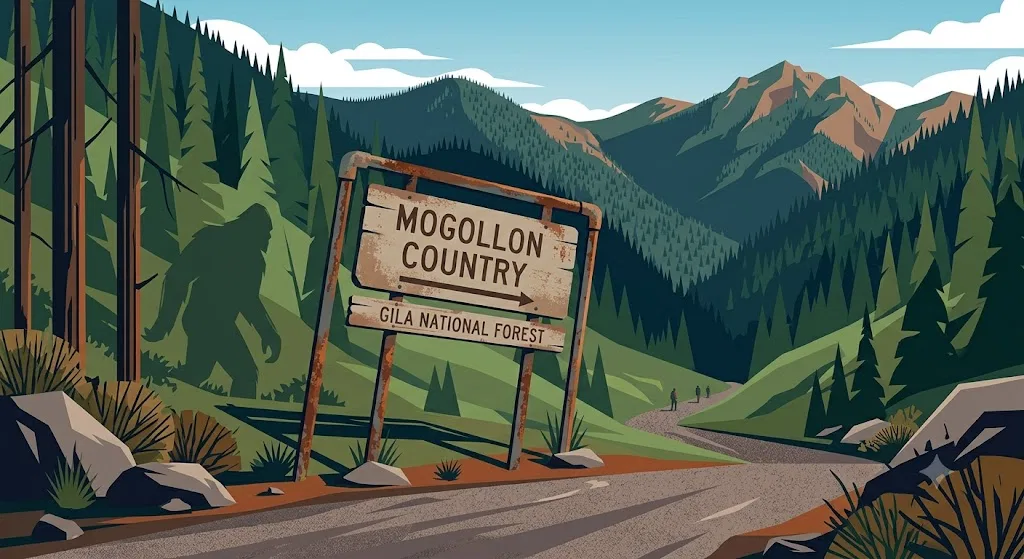
The Mogollon Monster belongs first and foremost to Arizona, not New Mexico. It is usually described as Arizona’s Bigfoot: a tall, hairy, foul-smelling, nocturnal figure associated with the Mogollon Rim and with forested country around places such as Payson, Williams, Show Low and the White Mountains. New Mexico enters the story in a more subtle way. The word “Mogollon” is not confined to Arizona: it is attached to New Mexico mountains, trails, archaeological language, cliff dwellings, wilderness routes and high forest country in the Gila. That shared name, plus a scattering of New Mexico Bigfoot-style claims in Mogollon landscapes, makes the border of the legend blurry without making the Mogollon Monster a fully New Mexican tradition.[wikipedia.org]WikipediaMogollon MonsterMogollon Monster
That distinction matters because Southwestern monster names often travel more easily than the evidence behind them. A New Mexico sighting in the Gila Mountains may look and feel like a Mogollon Monster tale, but it is usually better read as part of New Mexico’s wider Bigfoot/Sasquatch reporting unless the witness, local retelling or source explicitly uses the Mogollon Monster name. The useful question is not “which state owns the monster?” but “when does an Arizona legend become a New Mexico tradition, and when is it just a shared landscape label?”
Arizona Legend, New Mexico Place Names
The classic Mogollon Monster story is tied to the Mogollon Rim, the long escarpment across northern and eastern Arizona. In popular summaries, the creature is a Bigfoot-like being reported along the Rim, with familiar cryptid details: great height, heavy hair, large footprints, a pungent smell, strange screams or whistles, night-time movement, and a habit of unsettling campsites. The legend’s best-known geography runs through Arizona’s high country rather than New Mexico’s, and many retellings treat it as “Arizona’s Bigfoot” rather than a general Southwestern monster.[wikipedia.org]WikipediaMogollon MonsterMogollon Monster
New Mexico’s connection begins with the name. The National Park Service explains that the Tularosa Mogollon label used at Gila Cliff Dwellings comes from the Mogollon mountain range in the Gila Wilderness, itself named after Juan Ignacio Flores Mogollón, governor of Santa Fe de Nuevo México from 1712 to 1715. That means a New Mexico reader can encounter “Mogollon” in a perfectly official, historical setting long before meeting the monster story at all.[National Park Service]nps.govNational Park Service The MogollonNational Park ServiceThe Mogollon - Gila Cliff Dwellings National Monument (U.S. National Park Service)…
There is also a broader archaeological meaning. Archaeology Southwest describes the Mogollon tradition as belonging to high-altitude and desert areas across what is now central Arizona, west-central and southern New Mexico, western Texas, and parts of northern Mexico. This does not make the Mogollon Monster an ancient Indigenous creature tradition; it simply explains why the name feels regional rather than state-bound. The danger, for modern cryptid writing, is to slide too easily from “Mogollon as a historical-cultural and geographical term” to “Mogollon Monster as a New Mexico legend”. Those are not the same claim.[Archaeology Southwest]archaeologysouthwest.orgArchaeology Southwest Who or What Is the Mogollon?Archaeology Southwest Who or What Is the Mogollon?
In New Mexico, the word also appears on the ground. The Gila National Forest lists trails and features in and around the Mogollon Range, including Crest Trail #182 along the high crest of the Mogollon Mountains, Upper Mogollon Creek Trail, Mogollon Trail #153 and routes near Mogollon Baldy Peak. These names make the Arizona legend feel close, especially to hikers and readers browsing maps, but place-name overlap is not the same as a local monster tradition.[US Forest Service]fs.usda.govUS Forest Service Gila National Forest | Trails | Forest ServiceUS Forest Service Gila National Forest | Trails | Forest Service
Why the Border Feels Blurry
The Mogollon Monster spills toward New Mexico because the landscape itself refuses to behave like a neat folklore boundary. The Gila National Forest covers a vast sweep of south-western New Mexico, with forested and woodland mountains nourished by the Gila River, and the Forest Service emphasises the solitude visitors feel once they leave the main highways. That is exactly the kind of setting where Bigfoot-style stories flourish: large, quiet, forested, difficult to scan, and full of ordinary wildlife that can become strange in poor light.[US Forest Service]fs.usda.govUS Forest Service Home | Gila National Forest | Forest ServiceUS Forest Service Home | Gila National Forest | Forest Service
The geography is especially suggestive in the Blue Range Wilderness, on New Mexico’s western border. The Forest Service describes it as adjoining Arizona’s Blue Range Primitive Area and being “halved by the Mogollon Rim”, with grassland foothills rising through juniper woodland to ponderosa pine, spruce and fir. A trail there can even start in New Mexico and end in Arizona. For a walker, hunter or storyteller, that is not a hard cultural wall; it is a corridor.[US Forest Service]fs.usda.govUS Forest Service Gila National Forest | Blue Range Wilderness | Forest ServiceUS Forest Service Gila National Forest | Blue Range Wilderness | Forest Service
That corridor matters because Arizona’s Mogollon Monster is already a high-country forest legend rather than a desert-flat monster. The creature is usually imagined among pines, canyons, ridges and remote campsites. New Mexico’s western Gila country offers similar mood and habitat: deep canyons cut by the Gila River, high ridges, overlooks, and peaks over 10,000 feet on the western side of the forest. The atmosphere matches even when the tradition’s centre of gravity remains across the state line.[US Forest Service]fs.usda.govUS Forest Service Gila National Forest | Geologic Wonders | Forest ServiceUS Forest Service Gila National Forest | Geologic Wonders | Forest Service
This is why New Mexico can plausibly host Mogollon-flavoured Bigfoot talk without having a famous, independent “New Mexico Mogollon Monster” canon. The shared ingredients are real: the name, the Rim, the mountains, the Arizona-New Mexico forest belt, and a wider Southwestern appetite for hairy-man stories. The missing ingredient is a strong body of named New Mexico Mogollon Monster cases comparable to the Arizona Rim tradition.
How Regional Bigfoot Stories Blur Borders
A useful way to read the spillover is to separate three overlapping things: the Mogollon Monster name, Bigfoot-style witness claims, and the New Mexico landscape where such claims are placed. The Bigfoot Field Researchers Organization lists New Mexico reports separately from Arizona, and its New Mexico page includes a June 2024 Catron County report described as a father-and-son close-range encounter with a Bigfoot on a jeep trail in the Gila Mountains, south-west of Albuquerque and south-east of Reserve. That is very relevant to New Mexico’s mountain Bigfoot tradition, but the database frames it as Bigfoot, not as the Mogollon Monster.[BFRO]bfro.netstate listing.aspstate listing.asp
The same pattern appears in Arizona in reverse. A BFRO report from Fools Hollow Lake near Show Low mentions local stories of the Mogollon Monster as a Sasquatch-like creature roaming the Mogollon Rim. There, “Mogollon Monster” functions as a local Arizona name for the broader Bigfoot idea. Cross into New Mexico, and the same kind of report tends to lose that label unless a witness or reteller deliberately imports it.[BFRO]bfro.netshow report.aspshow report.asp
That is how regional cryptid names travel. A creature may not change at all in description, but the local label changes with the map. In the Pacific Northwest it might be Sasquatch; in Arizona, the Mogollon Monster; in New Mexico’s Gila country, simply Bigfoot, a hairy man, or an unexplained figure on a forest road. The story’s body is portable, but its name is local.
The Catron County/Gila Mountains example is therefore important, but not because it proves the Mogollon Monster has migrated into New Mexico. It shows something more modest and more interesting: New Mexico has contemporary Bigfoot-style claims in landscapes that share the Mogollon name and sit close to the Arizona tradition. That is spillover by setting and association, not by a firmly documented local monster identity.

What Counts as a New Mexico Tradition?
A New Mexico Mogollon Monster tradition would need more than geography. It would need repeated local use of the name, named sighting areas inside New Mexico, newspaper or community retellings that identify the creature as the Mogollon Monster, and some continuity over time. At present, the stronger evidence points to a different conclusion: New Mexico has Mogollon place names and Bigfoot-like reports, while Arizona has the recognised Mogollon Monster legend.
A fair test is to ask what role the story plays locally. In Arizona, the Mogollon Monster has become part of state folklore, appearing in popular articles, encyclopaedic folklore summaries, podcasts, tourism-adjacent retellings and outdoor-race culture. EBSCO’s research-starter summary, for example, describes the creature as part of the local cultural landscape around the Rim and notes modern cultural afterlives such as a folk song and the Mogollon Monster 100 endurance race.[EBSCO]ebsco.comOpen source on ebsco.com.
In New Mexico, the “Mogollon” identity is anchored differently. It appears in public history at Gila Cliff Dwellings, in archaeological discussion, and in official forest geography. These uses are important, but they are not monster uses. The Gila Cliff Dwellings page discusses the Tularosa Mogollon, drought, occupation dates, construction materials and animal remains; it does not present a hairy monster tradition.[National Park Service]nps.govNational Park Service The MogollonNational Park ServiceThe Mogollon - Gila Cliff Dwellings National Monument (U.S. National Park Service)…
So the best answer is cautious: the Mogollon Monster can belong on a New Mexico cryptid page as a border-blurring comparison, especially for the Gila, Blue Range and Catron County Bigfoot context. It should not be presented as one of New Mexico’s core home-grown monsters unless stronger local sources are found. A heading such as “Mogollon Monster Spillover into New Mexico” is accurate; “New Mexico’s Mogollon Monster” would overstate the case.
What Might People Be Seeing?
Sceptical explanations do not have to flatten the folklore. They help explain why a specific landscape keeps producing similar stories. New Mexico has large animals that can look startling at dusk, in headlights, or at the edge of camp. The state’s black bears are not always black: the New Mexico Department of Game and Fish notes colour phases ranging from black and brown to cinnamon, reddish and blonde. A bear briefly upright, partly lit, or moving through brush can become a very different animal in memory.[NMDOW]wildlife.dgf.nm.govOpen source on nm.gov.
Cougars add another layer of unease. New Mexico’s wildlife agency describes cougars, also called mountain lions or pumas, as large predators with adult males sometimes measuring up to eight feet in length and weighing 150–200 pounds. A cougar does not explain a classic upright hairy humanoid, but it can explain screams, sudden movement, livestock anxiety, glowing eyeshine, and the feeling of being watched in remote country.[NMDOW]wildlife.dgf.nm.govOpen source on nm.gov.
Wolves complicate the borderland atmosphere too. The US Fish and Wildlife Service says Mexican wolf recovery in the United States is focused south of Interstate 40 in Arizona and New Mexico, within the Mexican Wolf Experimental Population Area. Their presence is not evidence for Bigfoot, of course, but it reminds readers that this is a real predator landscape, not an empty stage onto which monster stories are projected.[U.S. Fish and Wildlife Service]fws.govOpen source on fws.gov.
The more ordinary explanation is often perceptual rather than zoological. Remote country magnifies uncertainty. A bear’s smell, a cougar’s cry, elk movement, coyotes, ravens, wind in timber, tree knocks, poor distance judgement and the adrenaline of night camping can all combine into a story that feels creature-shaped. In a region already primed by Arizona’s Mogollon Monster lore, the label is ready and waiting.

Why the Spillover Still Matters
Even if the Mogollon Monster is not truly New Mexico’s monster, its spillover tells us something useful about New Mexico cryptid history. The state is not isolated from neighbouring legends. Arizona’s Rim stories, New Mexico’s Gila Bigfoot claims, Apache-Sitgreaves and Gila forest corridors, and the shared Mogollon name all create a regional story-world where borders are administrative but the mood is continuous.
That makes the Mogollon Monster a good cautionary case. Cryptid maps often imply clean ownership: one creature, one state, one pin on a map. The Southwest does not work that way. Names move through guidebooks, podcasts, search results, trail culture, campfire talk and tourism copy. A monster may be famous in one state while feeling strangely at home in another because the mountains, forests and place names line up.
For New Mexico, the honest version is also the more interesting one. The state does not need to claim the Mogollon Monster outright to make the story relevant. Its own Mogollon landscapes explain why the Arizona legend can echo eastward; its Gila and Catron County reports show that Bigfoot-style claims have a local foothold; and its wildlife, wilderness and border geography explain why the legend remains easy to borrow.
The Bottom Line
The Mogollon Monster “belongs” in New Mexico only in a spillover sense. The named legend is Arizona’s, especially the Mogollon Rim’s. New Mexico’s role is as a neighbouring Mogollon landscape with official place names, Gila wilderness terrain, Blue Range border corridors, and a small but real body of Bigfoot-style reporting.
That makes it a useful side page in a New Mexico cryptid guide, not because it reveals a hidden state monster, but because it shows how Southwestern creature legends cross lines on a map. The Mogollon Monster is strongest as an Arizona tradition; in New Mexico, it is a borrowed shadow cast across very real mountains.
Amazon book picks
Further Reading
Books and field guides related to Does the Mogollon Monster Belong Here?. Use these as the next step if you want deeper reading beyond the article.
Sasquatch: Legend Meets Science
Relevant to Bigfoot-like reports across Arizona and New Mexico.
Mysterious America
Provides context for regional monster traditions and border-crossing legends.
Where Bigfoot Walks
Explores the landscapes and folklore that sustain Sasquatch stories.
eBay marketplace picks
Marketplace Samples
Live-tested eBay searches with available results related to this page.


Endnotes
1.
Source: Wikipedia
Title: Mogollon Monster
Link:https://en.wikipedia.org/wiki/Mogollon_Monster
2.
Source: arizonahighways.com
Link:https://www.arizonahighways.com/article/neither-hide-nor-hair
3.
Source: ebsco.com
Link:https://www.ebsco.com/research-starters/religion-and-philosophy/mogollon-monster-mythology
4.
Source: bfro.net
Title: state listing.asp
Link:https://www.bfro.net/GDB/state_listing.asp?state=nm
5.
Source: bfro.net
Title: show county reports.asp
Link:https://www.bfro.net/GDB/show_county_reports.asp?county=Catron&state=NM
6.
Source: bfro.net
Title: show report.asp
Link:https://www.bfro.net/gdb/show_report.asp?id=47536
7.
Source: bfro.net
Link:https://www.bfro.net/news/roundup/arizona.asp
8.
Source: wildlife.dgf.nm.gov
Link:https://wildlife.dgf.nm.gov/hunting/information-by-animal/big-game/bear/
9.
Source: wildlife.dgf.nm.gov
Link:https://wildlife.dgf.nm.gov/hunting/information-by-animal/big-game/cougar/
10.
Source: bfro.net
Title: show report.asp
Link:https://www.bfro.net/GDB/show_report.asp?id=77610
11.
Source: Wikipedia
Title: Mogollon culture
Link:https://en.wikipedia.org/wiki/Mogollon_culture
12.
Source: Wikipedia
Title: Mostro di Mogollon
Link:https://it.wikipedia.org/wiki/Mostro_di_Mogollon
13.
Source: Wikipedia
Title: Mexican wolf
Link:https://en.wikipedia.org/wiki/Mexican_wolf
14.
Source: arizonahighways.com
Link:https://www.arizonahighways.com/article/native-species
15.
Source: wolf.org
Link:https://wolf.org/wow/united-states/new-mexico/
16.
Source: nps.gov
Title: National Park Service The Mogollon
Link:https://www.nps.gov/gicl/learn/historyculture/the-mogollon.htm
Source snippet
National Park ServiceThe Mogollon - Gila Cliff Dwellings National Monument (U.S. National Park Service)...
17.
Source: fs.usda.gov
Title: US Forest Service Home | Gila National Forest | Forest Service
Link:https://www.fs.usda.gov/r03/gila
18.
Source: archaeologysouthwest.org
Title: Archaeology Southwest Who or What Is the Mogollon?
Link:https://www.archaeologysouthwest.org/free-resources/fact-sheets/who-or-what-is-mogollon/
19.
Source: fs.usda.gov
Title: US Forest Service Gila National Forest | Trails | Forest Service
Link:https://www.fs.usda.gov/r03/gila/recreation/trails
20.
Source: fs.usda.gov
Title: US Forest Service Mogollon Trail #153
Link:https://www.fs.usda.gov/r03/gila/recreation/trails/mogollon-trail-153
21.
Source: fs.usda.gov
Title: US Forest Service Gila National Forest | Blue Range Wilderness | Forest Service
Link:https://www.fs.usda.gov/r03/gila/recreation/blue-range-wilderness
22.
Source: fs.usda.gov
Title: US Forest Service Gila National Forest | Geologic Wonders | Forest Service
Link:https://www.fs.usda.gov/r03/gila/recreation/geologic-wonders
23.
Source: fws.gov
Link:https://www.fws.gov/program/conserving-mexican-wolf/what-we-do
24.
Source: fs.usda.gov
Link:https://www.fs.usda.gov/r03/gila/recreation
25.
Source: fs.usda.gov
Title: discover history
Link:https://www.fs.usda.gov/r03/gila/recreation/discover-history
26.
Source: fs.usda.gov
Link:https://www.fs.usda.gov/r03/gila/wilderness
27.
Source: fs.usda.gov
Title: glenwood ranger district
Link:https://www.fs.usda.gov/r03/gila/recreation/glenwood-ranger-district
28.
Source: fs.usda.gov
Title: outdoor science and learning
Link:https://www.fs.usda.gov/r03/gila/recreation/opportunities/outdoor-science-and-learning
29.
Source: cryptidz.fandom.com
Title: Mogollon Monster
Link:https://cryptidz.fandom.com/wiki/Mogollon_Monster
30.
Source: nps.gov
Link:https://www.nps.gov/subjects/swscience/mogollon.htm
31.
Source: nps.gov
Title: FY2017 September2017 forWeb
Link:https://www.nps.gov/aboutus/foia/upload/FY2017_September2017_forWeb.pdf
32.
Source: mountainlion.org
Title: new mexico
Link:https://mountainlion.org/us/new-mexico/
33.
Source: ehrafarchaeology.yale.edu
Link:https://ehrafarchaeology.yale.edu/traditions/nt85/summary
34.
Source: azbugztwo.blogspot.com
Title: The Mogollon Monster
Link:https://azbugztwo.blogspot.com/2014/05/the-mogollon-monster.html
35.
Source: peakvisor.com
Title: gila mountains
Link:https://peakvisor.com/range/gila-mountains.html
Additional References
36.
Source: youtube.com
Title: Arizona’s Bigfoot Legend in the Mogollon Rim | Wild Stories Ep. 01
Link:https://www.youtube.com/watch?v=7LlUdLkAnUM
Source snippet
Terrifying Encounters with Arizona's Bigfoot: The Mogollon Monster...
37.
Source: youtube.com
Title: Mogollon Monster: Arizona’s WILD MAN of the Rocks
Link:https://www.youtube.com/watch?v=d9YvtCrCR9o
Source snippet
Exploring the Mogollon Rim's Creepiest Secrets (Abandoned Tunnel + Mogollon Monster)...
38.
Source: cabq.gov
Link:https://www.cabq.gov/abq-wildlife-coexistence/be-a-friend-to-bears
39.
Source: youtube.com
Title: Terrifying Encounters with Arizona’s Bigfoot: The Mogollon Monster
Link:https://www.youtube.com/watch?v=zWM_FhcoyAk
Source snippet
Mogollon Monster: Arizona's WILD MAN of the Rocks...
40.
Source: youtube.com
Title: The Mogollon Monster; Arizona’s bigfoot
Link:https://www.youtube.com/watch?v=qp2FxCFS0xk
Source snippet
Arizona's Bigfoot Legend in the Mogollon Rim | Wild Stories Ep. 01...
41.
Source: folkbestiary.com
Link:https://folkbestiary.com/arizona/
42.
Source: instagram.com
Link:https://www.instagram.com/reel/DZfYZBGg2uH/
43.
Source: facebook.com
Link:https://www.facebook.com/groups/ArizonaCampingFamilies/posts/2904468123111411/
44.
Source: facebook.com
Link:https://www.facebook.com/groups/americansouthwest/posts/1791744318121701/
45.
Source: facebook.com
Link:https://www.facebook.com/groups/467857417314430/posts/1658460838254076/
Topic Tree