Within Florida Monsters
Is Florida's Skunk Ape Evidence Convincing?
Florida's Skunk Ape stories mix eyewitness reports, foul smells, footprints, photos and videos with a stubborn lack of hard proof.
On this page
- What witnesses usually report
- Photos, videos and footprint claims
- Why sceptics remain unconvinced
Page outline Jump by section
Introduction
Florida’s Skunk Ape evidence is intriguing as folklore, but weak as proof of an unknown animal. The strongest claims usually fall into three buckets: eyewitness reports from swamp roads and backcountry camps, alleged tracks or casts, and a small set of photographs or videos, especially the Ochopee-area reports of the late 1990s, Dave Shealy’s 2000 Everglades footage, and the famous Myakka photographs mailed anonymously to Sarasota authorities in 2000. None has produced the kind of hard evidence that would convince mainstream wildlife experts: a body, bones, verified DNA, clear repeatable camera-trap footage, or a documented breeding population.
That does not make the legend uninteresting. It makes it more revealing. Skunk Ape reports show how Florida’s real landscape — Big Cypress, the Everglades, Myakka, palmetto scrub, black bear habitat, non-native animal worries and roadside tourism — gives an old “hairy wild man” story a very local, very swampy form. Florida Memory’s archive of the failed 1978 “Florida Skunk Ape Protection Act” notes that purported sightings have been reported since the nineteenth century, while also identifying the creature as an alleged sasquatch-like cryptid rather than a recognised species.[Florida Memory]floridamemory.comFlorida Memory Bill File, House Bill 58The Florida Skunk Ape Protection…This bill did not pass in 1978. The Florida Skunk Ape is a cryptid alleged to be a sasquatch-like cr…
What witnesses usually report
Skunk Ape witnesses tend to describe a large, hairy, upright figure seen briefly in difficult conditions: across a road, at the edge of swamp vegetation, near a camp, or moving through water and tall grass. The “skunk” part matters. Many accounts include a foul smell, often compared in modern coverage to rotten eggs, faeces, mould or decaying matter, which helps separate the Florida version from more generic Bigfoot stories. ClickOrlando’s 2024 account, drawing on recent Florida sighting claims and comments attributed to state wildlife officials, summarised the creature as a foul-smelling Florida Bigfoot and listed recent claimed sightings in Naples in July 2020, Inverness in January 2021 and Sewall’s Point in February 2021.[WKMG]clickorlando.comWKMGFlorida 'Skunk Ape' reported across the stateHere's where…May 3, 2024 — 3 May 2024 — Vote now! · July 2020: Naples, Collier County · January 2021: Inverness, Citrus County · Febru…
The sighting map is not random. Reports often cluster around places that already feel plausible to a witness: Big Cypress, the Everglades, Ochopee, Myakka River country, Collier County, and wooded inland corridors where roads cut through dense habitat. The Bigfoot Field Researchers Organization’s Florida listings are not scientific proof, but they do show how the claim tradition is organised by county and place, with Collier County entries including Big Cypress, Bear Island Campground, Naples-area property and Route 41 near Ochopee.[BFRO]bfro.netReports for FloridaMaps for Florida. Map type: Reports by County, Reports by County with Roads, Terrain & Roads, Reports & Population…[BFRO]bfro.netshow county reports.aspCollier County, Florida – Reports & ArticlesNovember 2012 (Class A) - Daylight sighting of a man-like ape while target shooting in t…
The most memorable reports often involve a fleeting mismatch between what the witness expects and what they think they saw. A bear, hog, person, escaped animal or shadow should behave in one way; the reported Skunk Ape behaves in another. In claimant accounts, it may stride upright, move too quickly through wet ground, leave unusually large tracks, raid bait or fruit, or vanish into vegetation before anyone can get a clear look. That pattern is part of the legend’s staying power: the report is dramatic enough to remember, but incomplete enough to argue about.
The late-1990s Ochopee and Big Cypress cluster is a good example. BFRO’s archived report package on a series of six Skunk Ape reports quotes contemporary newspaper material saying that several people had reported creatures fitting the description to officials at Big Cypress National Preserve, and that Ochopee Fire Control District chief Vince Doerr said he saw a strange creature cross Burns Road.[BFRO]bfro.netOpen source on bfro.net. A Miami New Times feature from 1998 treated the same flap with caution, noting Doerr’s own ambivalence: his photograph helped spread the story, but he also thought some later appearances were probably people “playing games”.[Miami New Times]miaminewtimes.comMiami New Times Creature FeatureMiami New Times Creature Feature
That mix — an apparently sincere witness, an unclear image, a local rumour wave, and possible copycat activity — is typical of Skunk Ape evidence. The reports are rarely ridiculous at the level of human experience. People do see startling things in poor conditions. The problem is that the evidence usually stops at the moment when it would need to become testable.

Photos, videos and footprint claims
The Skunk Ape’s best-known “evidence” is visual, but the visuals are exactly where the case becomes most fragile. Blurry images can preserve a mystery, yet they also remove the details needed to settle it: scale, anatomy, gait, distance, lighting, provenance and independent verification.
Dave Shealy’s 2000 footage is the modern centrepiece. Shealy, associated with the Skunk Ape Research Headquarters in Ochopee, says he filmed a dark bipedal figure moving through the Everglades on 8 July 2000. Smithsonian Magazine later embedded and discussed the footage in a 2014 feature, describing Shealy as Florida’s self-proclaimed Skunk Ape expert and showing the now-famous clip of a distant figure crossing the swamp landscape.[Smithsonian Magazine]smithsonianmag.comSmithsonian Magazine On the Trail of Florida's Bigfoot—the Skunk ApeSmithsonian Magazine On the Trail of Florida's Bigfoot—the Skunk Ape The Smithsonian video page preserves the clip as “Dave Shealy’s 2000 Skunk Ape Footage”, with a running time of 2 minutes 17 seconds.[Smithsonian Institution]si.eduyt Lm RBUSK Dsgyt Lm RBUSK Dsg
As evidence, the Shealy clip has a built-in tension. Supporters value it because it appears to show the right kind of figure in the right kind of habitat, and because Shealy has long connected his life, business and reputation to Skunk Ape claims. Sceptics point out that the figure is distant, the footage is not independently repeatable, and the clip does not show enough detail to rule out a person, staged performance or misperception. ClickOrlando’s 2024 treatment captured this middle ground neatly: the footage went viral and shows a dark bipedal figure in the South Florida landscape, but it is “far from definitive proof”.[WKMG]clickorlando.comWKMGFlorida 'Skunk Ape' reported across the stateHere's where…May 3, 2024 — 3 May 2024 — Vote now! · July 2020: Naples, Collier County · January 2021: Inverness, Citrus County · Febru…
The Myakka photographs are even more famous among cryptid enthusiasts. In December 2000, two photographs and an anonymous letter were reportedly sent to the Sarasota Sheriff’s Department by a woman who said an orangutan-like creature had been stealing apples from her back porch near Interstate 75. The letter, as reproduced by later accounts, described a large primate-like animal and a lingering awful smell; importantly, the writer framed it as a possible escaped orangutan, not as a confirmed Skunk Ape.[Futility Closet]futilitycloset.comFutility Closet Skunk ApeFutility Closet Skunk Ape Local and cryptid-focused retellings identify the images as the “Myakka Skunk Ape” photos, but there is no official authentication establishing what the subject was, who took the images, or whether the scene was staged.[HowStuffWorks]science.howstuffworks.comHow Stuff Works Skunk Ape: A Swamp-dwelling Sasquatch in FloridaHow Stuff Works Skunk Ape: A Swamp-dwelling Sasquatch in Florida
Those photographs remain compelling to some viewers because they appear more creature-like than many cryptid images: orange-brown hair, reflective eyes, a face-like shape, and vegetation that suggests a Florida back garden or scrub edge. But their weaknesses are serious. The photographer was anonymous. The original context cannot be cross-examined. The animal’s size is hard to establish. No physical trace from the scene was verified. No escaped orangutan matching the story was publicly confirmed. Once the image is detached from testable provenance, debate shifts from evidence to interpretation: orangutan, suit, model, hoax, escaped animal, or unknown primate.
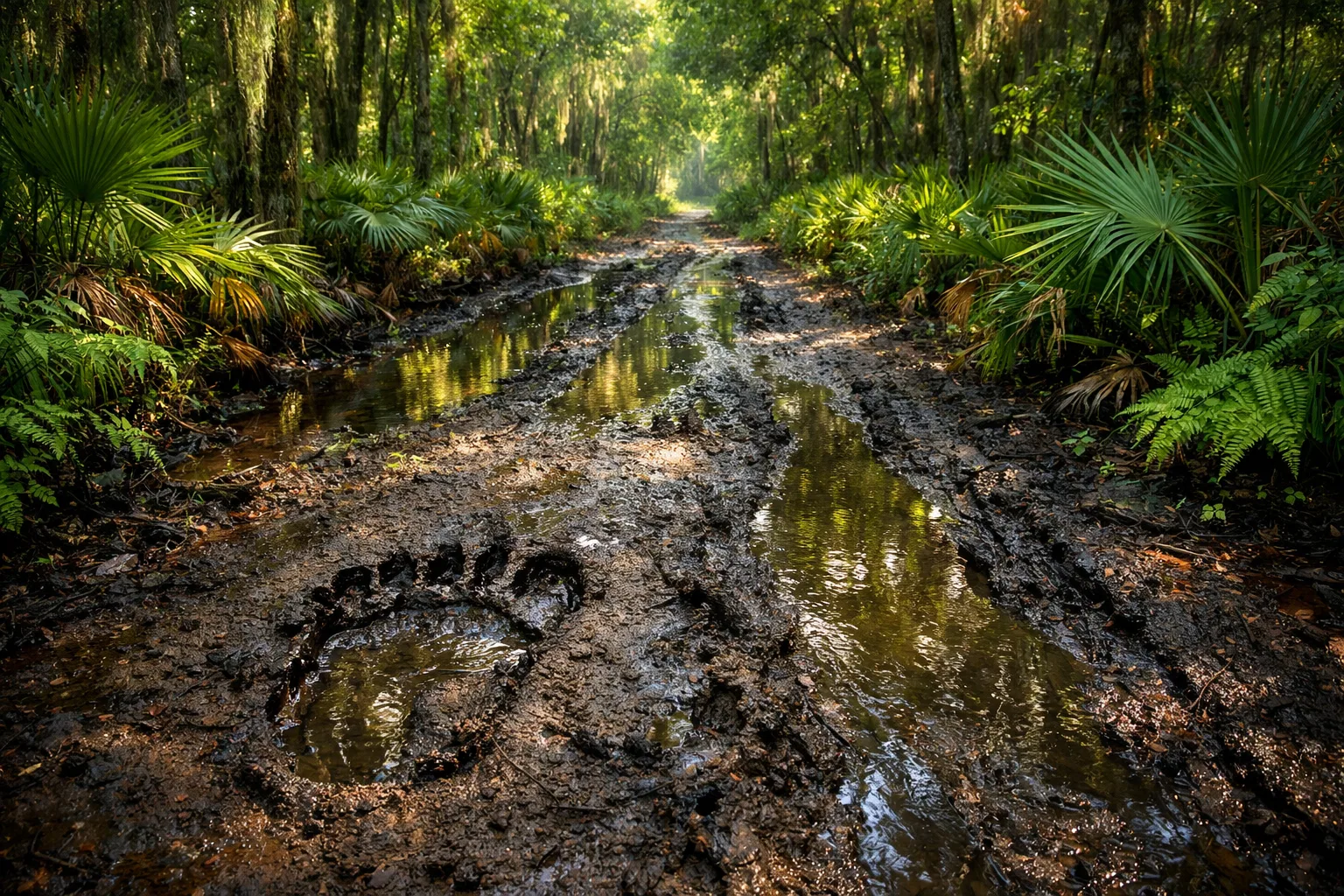
Footprint claims have the same problem in a different form. Tracks are part of the Skunk Ape tradition because swamps, mud, sand roads and campgrounds are believable places to find impressions. Shealy and other enthusiasts have displayed alleged casts and track photographs, and ClickOrlando’s 2024 piece showed Shealy holding an alleged Skunk Ape track outside the Ochopee headquarters.[WKMG]clickorlando.comWKMGFlorida 'Skunk Ape' reported across the stateHere's where…May 3, 2024 — 3 May 2024 — Vote now! · July 2020: Naples, Collier County · January 2021: Inverness, Citrus County · Febru… Yet a footprint cast, by itself, is not a species. To become strong evidence, it would need careful chain of custody, multiple clear trackways, stride analysis, substrate documentation, expert examination, and ideally biological material such as hair, tissue or DNA. Most Skunk Ape track claims circulate without that level of documentation.
This is why Skunk Ape evidence often feels stronger in a museum, roadside attraction or story circle than in a biological file. A cast, a blurry still and a witness statement are evocative. They help visitors imagine a creature moving through cypress and sawgrass. They do not, so far, meet the standard used to recognise a large unknown mammal.
Why Florida makes the claims feel plausible
Florida gives the Skunk Ape legend a better stage than many cryptid stories get. Big Cypress National Preserve alone includes swamp, hardwood hammocks, pinelands and dense understory, and the National Park Service notes that Florida black bears use those habitats, including swamp and dense cover.[National Park Service]nps.govNational Park Service MammalsNational Park Service Mammals The Florida Fish and Wildlife Conservation Commission also identifies Big Cypress Wildlife Management Area as habitat for rare and common wildlife including the Florida panther and black bear.[FWC]myfwc.comOpen source on myfwc.com.
That matters because witnesses are not inventing the wildness of the setting. South Florida really does contain large animals, low visibility, deep vegetation, wet footing, heat shimmer, insects, night sounds and roads that cut through habitat. A person who glimpses a large dark animal at dawn or dusk may have only a few seconds to decide what it was. A bear on hind legs, a person in dark clothing, a hog crashing through brush, a deer glimpsed through palmetto, or an escaped exotic animal rumour can all become stranger when filtered through fear, distance and expectation.
Florida also has a real history of non-native wildlife, which gives “escaped animal” explanations more cultural traction than they might have elsewhere. The state wildlife agency has an entire non-native fish and wildlife programme and asks residents to report sightings of non-native species.[FWC]myfwc.comOpen source on myfwc.com. That does not make an unknown swamp ape likely. It does mean that when a witness says “maybe it was an escaped primate”, the idea lands in a state where exotic animal stories are already part of public life.
The black bear explanation is especially important. FWC says black bears are the only bear species found in Florida and estimates roughly 4,050 in the state; adult males usually weigh 250 to 350 pounds, and the largest recorded adult male in Florida weighed 760 pounds.[FWC]myfwc.comOpen source on myfwc.com. FWC also notes that while most Florida black bears are black, they can appear tan or brown in some areas because of the absence of outer black guard hairs.[FWC]myfwc.comOpen source on myfwc.com. A bear seen briefly, partly upright, wet, moulting, backlit, or moving through dense cover can become a surprisingly good candidate for some “hairy upright creature” reports.
This does not explain every detail in every account. Bears do not walk like humans for long distances, and a witness who reports a fast, sustained bipedal stride is describing something more specific than “large animal in the brush”. But sceptical explanations do not need one answer for every report. They only need enough ordinary mechanisms — bears, hoaxes, poor visibility, expectation, escaped-animal rumours, faulty scale estimates and retellings — to explain why a stream of reports can persist without requiring a breeding population of unknown apes.
Why sceptics remain unconvinced
The central sceptical objection is simple: Florida has stories, but not a specimen. For a large primate-like animal to live in Florida, it would need food, habitat, mates, a breeding population and a long-term presence. Over time, that should produce more than occasional blurry media. It should produce bones, roadkill, clear trail-camera sequences, reliable hair or scat samples, or unambiguous DNA. So far, the Skunk Ape file has not produced that level of evidence.
Sceptical investigator Joe Nickell’s “Tracking Florida’s Skunk Ape” for Skeptical Inquirer framed the creature as a shaggy man-beast reported especially from Florida wilderness areas, but treated the evidence as part of a wider pattern of folklore, hoaxing and misidentification rather than proof of a hidden animal.[Skeptical Inquirer]skepticalinquirer.orgtracking floridas skunk apetracking floridas skunk ape EBSCO’s research-starter summary similarly states that park rangers, law enforcement officials and wildlife experts do not consider the creature to exist, and that experts generally treat sightings and videos as misidentified animals or hoaxes.[EBSCO]ebsco.comOpen source on ebsco.com.
The “no body” objection is sometimes dismissed by believers, who point out that swamps can hide remains. That is partly fair: Florida’s wetlands are not tidy laboratories, and scavengers, water and vegetation can erase traces quickly. But the Skunk Ape is not claimed as a single ghostly event. It is claimed as a recurring animal tradition across decades. Repeated animals leave repeated biological evidence. Florida wildlife biologists document bears, panthers, invasive reptiles and other elusive animals because those species leave tracks, DNA, carcasses, camera images, road incidents and ecological patterns. The Skunk Ape has not crossed that threshold.
Hoax risk is also unusually high because Skunk Ape evidence has entertainment value. The creature is now part of Florida roadside culture, local media, conferences, souvenirs and cryptid tourism. Ochopee’s Skunk Ape Research Headquarters openly functions as a destination as well as a claim centre, placing the legend on the Tamiami Trail at Trail Lakes Campground.[Garden & Gun]gardenandgun.coma close encounter with the florida skunk apea close encounter with the florida skunk ape[Countere Magazine]countere.comfloridas bigfoot everglades dave shealy legend of the skunk apefloridas bigfoot everglades dave shealy legend of the skunk ape That does not mean every witness is lying. It means the story-world rewards new sightings, new images and new “maybe” moments, which makes strict evidence handling even more important.
The late-1990s Big Cypress flap shows why scepticism does not have to be cynical. Some witnesses may have reported exactly what they thought they saw. Some later reports may have been copycats. Some images may have been ambiguous rather than fraudulent. Some local excitement may have amplified ordinary events. A legend can grow through sincere mistakes and playful hoaxes at the same time.
A practical way to judge a Skunk Ape claim
A reader does not need to be a zoologist to sort stronger Skunk Ape claims from weaker ones. The key is to ask what would still be persuasive after the excitement is removed.
A stronger claim would have several features:
- Clear provenance: who recorded it, where, when, and under what conditions.
- Independent witnesses: not just friends repeating one person’s interpretation.
- Scale markers: trees, roads, fences, known distances, or measurements that make size testable.
- Continuous footage: not only a single blurry frame or cropped still.
- Physical follow-up: tracks photographed in sequence, hair or scat collected properly, and the site documented quickly.
- Expert review: wildlife biologists, trackers, primatologists or forensic image analysts able to examine original material rather than social-media copies.
- Repeatability: more than one incident in the same area that produces consistent physical evidence, not just similar stories.
Most famous Skunk Ape evidence falls short on several of these points. The Myakka photos have atmosphere but weak provenance. The Shealy video has place and continuity but poor detail and no independent biological confirmation. Track casts are suggestive but vulnerable to misreading, fabrication or missing context. Eyewitness accounts are valuable as human testimony, but they are weakest when used as biological proof.
That is the fairest answer to the page’s central question: Florida’s Skunk Ape evidence is convincing as evidence of a durable regional legend, but not convincing as evidence of a confirmed unknown primate. The reports are still worth reading because they reveal how people experience Florida’s wild edges: not as empty scenery, but as places where sound, smell, movement and imagination can briefly combine into something that feels alive just beyond the beam of the torch.
What the evidence really proves
The Skunk Ape evidence proves that Florida has one of America’s most persistent local Bigfoot traditions. It proves that certain landscapes — Big Cypress, the Everglades, Myakka and the wooded corridors around them — are especially good at producing believable mystery-beast stories. It proves that eyewitnesses often organise strange encounters around a consistent image: upright, hairy, foul-smelling, evasive and swamp-adapted.
It does not prove that an undiscovered ape is living in Florida. The available record is too dependent on anecdotes, blurry visuals, disputed photographs, roadside displays and claims that cannot be independently tested. The best sceptical explanations are not dismissive one-liners; they are a stack of ordinary possibilities that fit Florida well: black bears in dense cover, brief sightings in poor conditions, escaped-animal assumptions, hoaxes, tourist storytelling, and the way a famous legend shapes what later witnesses think they have seen.
That unresolved gap is exactly why the Skunk Ape survives. If the evidence were better, it would move from folklore into zoology. If the stories were weaker, the legend would fade. Instead, Florida has something in between: a swamp creature with just enough testimony, photographs, tracks and local confidence to keep people looking over their shoulder on dark roads through palmetto and cypress.
Amazon book picks
Further Reading
Books and field guides related to Is Florida's Skunk Ape Evidence Convincing?. Use these as the next step if you want deeper reading beyond the article.
Sasquatch: Legend Meets Science
Directly addresses the types of evidence cited for the Skunk Ape.
Field Guide To Bigfoot, Yeti, & Other Mystery Primates Worldwide
Catalogs mystery-primate evidence claims from many regions.
eBay marketplace picks
Marketplace Samples
Live-tested eBay searches with available results related to this page.
Endnotes
1.
Source: clickorlando.com
Title: WKMGFlorida ‘Skunk Ape’ reported across the state
Link:https://www.clickorlando.com/features/2024/05/03/florida-skunk-ape-reported-across-the-state-heres-where-its-been-sighted/
Source snippet
Here's where...May 3, 2024 — 3 May 2024 — Vote now! · July 2020: Naples, Collier County · January 2021: Inverness, Citrus County · Febru...
Published: May 3, 2024
2.
Source: bfro.net
Link:https://www.bfro.net/GDB/state_listing.asp?state=fl
Source snippet
Reports for FloridaMaps for Florida. Map type: Reports by County, Reports by County with Roads, Terrain & Roads, Reports & Population...
3.
Source: bfro.net
Title: show county reports.asp
Link:https://www.bfro.net/GDB/show_county_reports.asp?county=Collier&state=fl
Source snippet
Collier County, Florida -- Reports & ArticlesNovember 2012 (Class A) - Daylight sighting of a man-like ape while target shooting in t...
Published: November 2012
4.
Source: bfro.net
Link:https://www.bfro.net/GDB/show_report.asp?id=721
5.
Source: science.howstuffworks.com
Title: How Stuff Works Skunk Ape: A Swamp-dwelling Sasquatch in Florida
Link:https://science.howstuffworks.com/science-vs-myth/strange-creatures/skunk-ape.htm
6.
Source: myfwc.com
Link:https://myfwc.com/recreation/cooperative/big-cypress/
7.
Source: myfwc.com
Link:https://myfwc.com/wildlifehabitats/nonnatives/
8.
Source: myfwc.com
Link:https://myfwc.com/wildlifehabitats/wildlife/bear/facts/
9.
Source: myfwc.com
Link:https://myfwc.com/wildlifehabitats/wildlife/bear/living/myths/
10.
Source: ebsco.com
Link:https://www.ebsco.com/research-starters/social-sciences-and-humanities/skunk-ape-cryptozoology
11.
Source: countere.com
Title: floridas bigfoot everglades dave shealy legend of the skunk ape
Link:https://www.countere.com/home/floridas-bigfoot-everglades-dave-shealy-legend-of-the-skunk-ape
12.
Source: bfro.net
Title: show report.asp
Link:https://www.bfro.net/gdb/show_report.asp?id=38924
13.
Source: bfro.net
Link:https://www.bfro.net/gdb/
14.
Source: bfro.net
Title: show report.asp
Link:https://www.bfro.net/gdb/show_report.asp?id=32227
15.
Source: bfro.net
Title: show county reports.asp
Link:https://www.bfro.net/GDB/show_county_reports.asp?county=Hendry&state=FL
16.
Source: youtube.com
Link:https://www.youtube.com/watch?v=LmRBUSK_Dsg
Source snippet
Smithsonian Magazine...
17.
Source: floridamemory.com
Title: Florida Memory Bill File, House Bill 58
Link:https://www.floridamemory.com/items/show/351325
Source snippet
"The Florida Skunk Ape Protection...This bill did not pass in 1978. The Florida Skunk Ape is a cryptid alleged to be a sasquatch-like cr...
18.
Source: miaminewtimes.com
Title: Miami New Times Creature Feature
Link:https://www.miaminewtimes.com/news/creature-feature-6360117/
19.
Source: smithsonianmag.com
Title: Smithsonian Magazine On the Trail of Florida’s Bigfoot—the Skunk Ape
Link:https://www.smithsonianmag.com/science-nature/trail-floridas-bigfoot-skunk-ape-180949981/
20.
Source: si.edu
Title: yt Lm RBUSK Dsg
Link:https://www.si.edu/object/yt_LmRBUSK_Dsg
21.
Source: futilitycloset.com
Title: Futility Closet Skunk Ape
Link:https://www.futilitycloset.com/2007/02/24/skunk-ape/
22.
Source: nps.gov
Title: National Park Service Mammals
Link:https://www.nps.gov/bicy/learn/nature/mammals.htm
23.
Source: skepticalinquirer.org
Title: tracking floridas skunk ape
Link:https://skepticalinquirer.org/newsletter/tracking-floridas-skunk-ape/
24.
Source: gardenandgun.com
Title: a close encounter with the florida skunk ape
Link:https://gardenandgun.com/a-close-encounter-with-the-florida-skunk-ape
25.
Source: nps.gov
Title: Black Bear
Link:https://www.nps.gov/bicy/learn/nature/black-bear.htm
26.
Source: instagram.com
Title: Florida Skunk Ape Protection Act
Link:https://www.instagram.com/p/DBjMi2IOjTs/
27.
Source: skepticalinquirer.org
Link:https://skepticalinquirer.org/authors/joe-nickell/page/4/
28.
Source: skepticalinquirer.org
Link:https://skepticalinquirer.org/newsletter-volume/sb-23-3/
29.
Source: Wikipedia
Title: Skunk ape
Link:https://en.wikipedia.org/wiki/Skunk_ape
30.
Source: Wikipedia
Title: Skunk Ape
Link:https://de.wikipedia.org/wiki/Skunk_Ape
31.
Source: cryptidz.fandom.com
Title: Skunk Ape
Link:https://cryptidz.fandom.com/wiki/Skunk_Ape
32.
Source: de-academic.com
Title: Skunk Ape
Link:https://de-academic.com/dic.nsf/dewiki/1295835
33.
Source: westpalmbeach.com
Title: The Skunk Ape
Link:https://www.westpalmbeach.com/the-skunk-ape/
34.
Source: smithsonianmag.com
Title: dave shealys 2000 skunk ape clip
Link:https://www.smithsonianmag.com/videos/dave-shealys-2000-skunk-ape-clip/
35.
Source: skunkapeevents.weebly.com
Title: why skunk ape
Link:https://skunkapeevents.weebly.com/why-skunk-ape.html
Additional References
36.
Source: youtube.com
Title: The Full Story Behind the Skunk Ape Photos
Link:https://www.youtube.com/watch?v=LTtWmyJoD1E
Source snippet
The Skunk Ape Wreaks Havoc on Florida | The Proof Is Out There...
37.
Source: researchgate.net
Link:https://www.researchgate.net/figure/Density-surface-map-for-Florida-black-bears-in-the-Big-Cypress-study-area-Florida-USA_fig2_318174222
38.
Source: facebook.com
Link:https://www.facebook.com/ExpeditionUnknownTV/posts/over-a-decade-ago-josh-investigated-a-monster-in-the-swamps-of-floridanow-heathe/1012226397367246/
39.
Source: floridawildlifefederation.org
Link:https://floridawildlifefederation.org/florida-black-bear/
40.
Source: instagram.com
Link:https://www.instagram.com/p/DSBL-D3jymj/
41.
Source: reddit.com
Link:https://www.reddit.com/r/bigfoot/comments/18vl8h4/have_the_skunk_ape_photos_been_debunkedalsowhat/
42.
Source: facebook.com
Link:https://www.facebook.com/gatorland/posts/have-you-ever-wondered-what-gatorlands-social-distancing-skunk-ape-thinks-about-/10160560135713066/
43.
Source: facebook.com
Link:https://www.facebook.com/groups/1347341528780832/posts/2642376665943972/
44.
Source: reddit.com
Link:https://www.reddit.com/r/cryptids/comments/10qv4j4/is_this_picture_of_the_skunk_ape_genuine/
45.
Source: instagram.com
Link:https://www.instagram.com/reel/DQr73xXD8T1/?hl=en
Topic Tree