Within North Dakota Monsters
Why North Dakota Makes Monsters Out of Water
North Dakota's creature lore often begins with real landscape hazards: shifting water, spring ice, mirages, and sudden wildlife encounters.
On this page
- Spring ice as a monster making event
- Mirages and distant animals on open water
- Prairie visibility, rumour, and brief sighting clusters
Page outline Jump by section
Introduction
North Dakota’s monster lore is not only a catalogue of strange beasts. It is also a study in how a hard northern landscape makes brief, dramatic impressions: ice buckles and roars on the Missouri River; Devils Lake changes shape, colour, salinity and shoreline; distant birds and animals shimmer across open water; and a few seconds of poor visibility can become a serpent, river monster or “something impossible”. The strongest evidence for this page is not proof of unknown animals, but a set of recurring mechanisms that help explain why North Dakota has produced water monsters, ice-breaker beings, serpent tales and misidentified creatures in the first place. The useful question is not simply “was it real?” but “what did the witness, storyteller or newspaper have in front of them?” In this state, the answer often begins with spring break-up, mirage-prone horizons, big fish, waterfowl, wind, flooded basins and stories already attached to dangerous water.
Spring ice as a monster-making event
The clearest North Dakota example is the Miniwashitu, the Missouri River being commonly retold as a one-eyed, red, shaggy creature that breaks up the river ice in spring. Its important early printed source is Melvin Randolph Gilmore’s Prairie Smoke, where the story appears under the heading “Cause of the Breaking Up of the Ice in the Missouri River in Springtime”. In that version, the being is not introduced as a modern animal report. It is a Dakota story explaining a frightening seasonal event: the return of movement, noise and danger to a frozen river.[Project Gutenberg]gutenberg.orgA Myth of the Dakota Nation. It is said that in the long ago there was a mysterious…Read more…
That matters because river ice does behave in ways that can feel alive. The North Dakota Department of Water Resources explains that ice jams are difficult to predict, are most common during spring snowmelt, and can also form during freeze-up or break-up. The same state guidance distinguishes gradual “thermal” break-up from “mechanical” break-up, when rising water and flow forces tear strong ice apart and move it downstream before it has weakened. That is exactly the kind of sudden, grinding, destructive event a monster story can turn into a body: a jagged back, a roar, a force travelling through the river.[swc.nd.gov]swc.nd.govice jams on north dakota riversMay 28, 2026 — 14 Apr 2025 — In North Dakota, ice jams are most common during the spring snowmelt period but also form anytime during the…
The Miniwashitu is therefore best read as a monster-shaped account of river power rather than a failed field guide entry. Its saw-like backbone fits the visual logic of broken ice plates. Its springtime movement fits the timing of meltwater and river break-up. Its terror fits a real hazard: ice jams can restrict flow, push water levels up, and produce rapid flooding. The National Weather Service has warned in North Dakota spring outlooks that Missouri River ice can become unstable and move, while the state’s ice-jam guidance notes that spring break-up jams are usually more destructive than freeze-up jams because of the volume of ice involved.[Weather.gov]weather.govSpring Runoff Season To ContinueSPRING RUNOFF SEASON TO CONTINUE Most of the tributaries to the Missouri River have been under a very act…
This does not make the older story “just science in disguise”. It is folklore, not a hydrology bulletin. But the fit between the creature and the event is too strong to ignore. The monster gives a dangerous process a memorable form. In a state where winter is long and rivers are working routes, boundaries and hazards, the sound of spring ice would not need much embellishment to become a being that lives under the water and announces itself by breaking the surface.
Devils Lake and the problem of unstable water
Devils Lake is North Dakota’s natural home for lake-monster thinking because it is not a neat, stable blue patch on a map. It is the state’s largest natural lake, a closed-basin lake whose water level has swung dramatically over time. NASA’s Earth Observatory compared satellite images from 1984 and 2009 and showed how visibly the lake expanded as water levels rose, while the Devils Lake Basin Joint Water Resource Board records a rise from 1,422.6 feet in 1993 to 1,454.3 feet in 2011.[NASA Science]science.nasa.govScience Devils Lake, North DakotaScience Devils Lake, North Dakota
That instability gives the lake an unusually strong atmosphere for strange stories. Roads, farms, old shorelines, islands, coulees and basins can appear, disappear or reconnect as water rises and falls. A lake that shifts its boundaries is easier to imagine as inhabited by something powerful, especially when stories of sacred water, mistranslation, drowned warriors, serpents and tourist promotion have already gathered around the name. North Dakota tourism material notes that Devils Lake derives from the Native name Miniwaukan, commonly rendered as “Spirit Water”, and that early translation and booster storytelling helped attach “Devils Lake” to legends of drowned warriors and lake monsters.[devilslakend.com]devilslakend.comOpen source on devilslakend.com.
The lake-monster tradition itself was repeatedly amplified in the late nineteenth century. Prairie Public’s Dakota Datebook says the Great Northern Railway connected Devils Lake to the tourist trade in 1883, after which local boosters revived older monster legends; it also describes an 1894 newspaper report of picnickers from Larimore supposedly seeing an amphibious serpent along the shore. Later retellings mention sensational newspaper claims, including a fisherman allegedly being towed around the lake by a hooked monster.[Prairie Public]news.prairiepublic.orgPrairie Public Devils Lake Sea MonsterPrairie Public Devils Lake Sea Monster
The sceptical reading is not that every witness lied. It is that Devils Lake had the perfect ingredients for exaggerated interpretation: a dramatic name, tourist incentives, shifting water, Indigenous sacred geography filtered through settler misunderstanding, and a lake surface where wind, wakes, birds, fish and distance could create odd impressions. A monster was not simply “seen” there; it was made plausible by the whole setting.
Mirages and distant animals on open water
Mirages are especially important to North Dakota monster stories because the state offers long sightlines: open prairie, broad water, low horizons and few visual reference points. A distant object on Devils Lake or another open water body may not look like itself if the air is layered by temperature. Atmospheric-optics explainers describe mirages as products of refraction, where light bends through air layers of different temperature and density; related effects can make distant objects appear lifted, stretched, lowered or distorted.[HyperPhysics]hyperphysics.phy-astr.gsu.eduOpen source on gsu.edu.
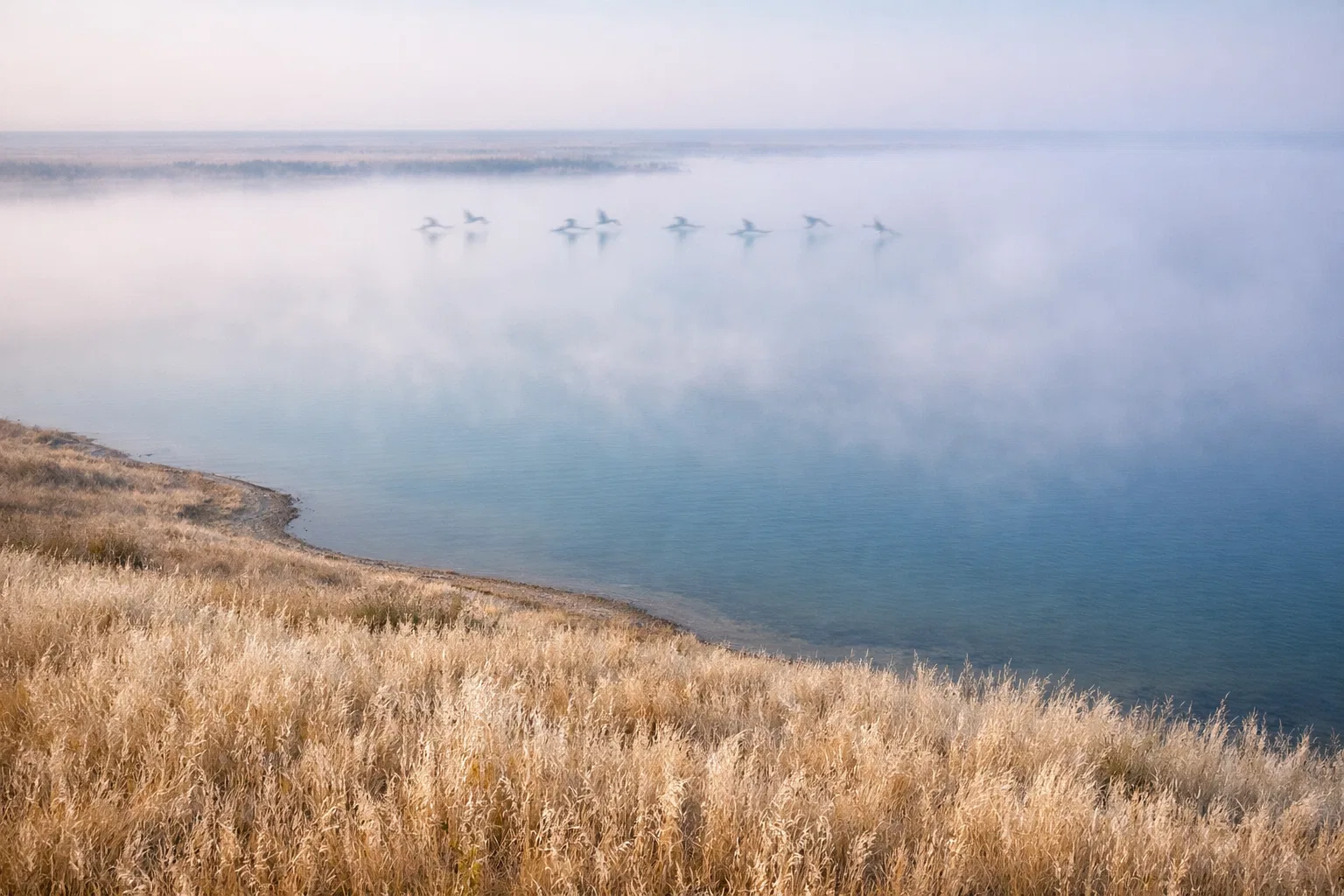
That helps explain why “serpent” reports often favour brief, distant, low-detail views. A line of swimming birds, a muskrat, a floating log, a fish wake, or a partially submerged animal can become a long body when seen across glare and rippled water. A mirage does not invent an object from nothing; it alters the object’s apparent position, shape or scale. In creature-lore terms, that is exactly the dangerous middle ground: enough real stimulus to be persuasive, but enough distortion to make ordinary identification fail.
Devils Lake’s name history even contains a mirage clue in some summaries. Accounts of the lake’s Dakota-derived name often stress “sacred” or “spirit” water rather than a Christian devil, while later English-language explanations sometimes connect the “spirit” element with mirage-like appearances across the lake and the “bad” element with salinity. The important point for monster interpretation is not to flatten Dakota sacred meaning into a weather trick, but to recognise that settlers, visitors and newspapers were already reading the lake through confusion, translation error and optical strangeness.[Wikipedia]WikipediaDevils Lake (North DakotaDevils Lake (North Dakota
This makes mirage a useful explanation but a risky one if used carelessly. It should not be waved at every story as a one-size-fits-all debunk. It works best where the report is distant, brief, low on detail, tied to water or horizon views, and lacking physical evidence. It is weaker when a claim involves close-range interaction, tracks, capture, multiple independent angles or a detailed animal description. For North Dakota’s water monsters, however, many of the famous claims are precisely the kind that mirage, glare and distance can complicate.

Misidentified monsters in a state full of real animals
North Dakota does not need unknown animals to produce strange-looking encounters. It already has large fish, waterfowl, semi-aquatic mammals, deer, coyotes, cattle, bison in managed settings, and occasional out-of-place or poorly seen animals. On water, even common species can become unfamiliar because the viewer sees only a head, back, wake or silhouette.
Devils Lake is a strong example. Official and tourism sources identify it as a major fishery with walleye, perch, northern pike and white bass, while North Dakota Game and Fish notes that trophy-sized northern pike are available in Devils Lake and Stump Lake. Pike are long-bodied predators with large teeth, and the department’s fish guide describes both northern pike and muskellunge as long-bodied fish with long snouts and large teeth. That does not make a pike into an eighty-foot serpent, but it does provide a real, local animal that can produce startling glimpses, violent surface movement and exaggerated dockside stories.[ndtourism.com]ndtourism.comOpen source on ndtourism.com.
Large fish are not the only candidates. The Prairie Pothole Region, which includes North Dakota, is a landscape of glacially formed wetlands that support major waterfowl populations. The U.S. Fish and Wildlife Service describes prairie potholes as freshwater marshes of the Dakotas and Minnesota, while the Environmental Protection Agency explains that these wetlands were formed by glacial scraping during the Pleistocene. Devils Lake Wetland Management District alone includes 257 waterfowl production areas across 48,885 acres.[fws.gov]fws.govOpen source on fws.gov.
That means the “monster-making” field is crowded with real moving parts. A line of pelicans, cormorants, ducks or geese can look segmented at a distance. Diving birds can create repeated humps. A muskrat or beaver can appear larger than expected when only its wet head and wake are visible. Deer or livestock entering water can make unfamiliar splashes. Under low sun, wind chop or haze, these ordinary animals can become the raw material for a “serpent” or “lake creature”, especially if the viewer already knows the place has a monster tradition.
The same logic applies to land and shoreline reports. Open prairie can make animals visible from far away but hard to scale. A coyote, dog, deer, escaped livestock animal or large bird can seem odd when seen for seconds across fields, through heat shimmer, from a moving vehicle, or at dawn or dusk. North Dakota’s monster lore often thrives in that gap between visibility and certainty: people can see a long way, but not always clearly enough to know what they have seen.
Prairie visibility, rumour and brief sighting clusters
North Dakota’s open spaces create a particular kind of rumour ecology. A strange sighting can feel more credible because the landscape appears exposed: if there are few trees, surely the witness had a good view. But that confidence can be misleading. Long distance, flat light, glare, snow, blowing dust, water reflection and lack of scale can all make an object harder to judge, not easier.
This is why short-lived sighting clusters deserve caution. A first report gives people a search image: a serpent, a hairy thing, a winged shape, a monster in the lake. Later witnesses may then interpret ambiguous sights through the same frame. Newspapers, radio, local talk, tourism pages and modern cryptid sites can preserve and sharpen the label long after the original evidence has vanished. Prairie Public’s account of the Devils Lake sea monster is especially revealing because it places the 1890s serpent stories alongside railway-era tourism and town boosterism, not in a vacuum of neutral observation.[Prairie Public]news.prairiepublic.orgPrairie Public Devils Lake Sea MonsterPrairie Public Devils Lake Sea Monster
This does not mean rumour is worthless. Local stories preserve what communities found memorable: dangerous ice, sacred water, sudden waves, large fish, treacherous crossings, and the feeling that some places demand respect. But rumour changes the evidence question. A biological claim asks for bodies, photographs, repeated close observation, environmental fit and independent records. A folklore claim asks why the story stuck, who repeated it, what landscape feature it explained, and how later tellers changed it.
North Dakota’s monster stories often become clearer when those two questions are kept separate. The Miniwashitu belongs to a traditional explanation of spring ice. The Devils Lake serpent belongs to a mixed world of sacred-water traditions, mistranslation, tourism, newspaper drama and possible misidentification. Modern brief sightings around lakes, rivers and prairie roads belong to a world of optical effects, wildlife and expectation. They overlap, but they are not the same kind of evidence.

How to read North Dakota’s water monsters without draining the mystery
The best sceptical reading of North Dakota creature lore does not mock the stories. It asks what the landscape was doing at the moment the monster appeared. Was ice breaking? Was the water rising? Was the lake windy, bright or hazy? Was the animal distant, partly submerged or seen from a moving car? Was a newspaper or tourist industry already primed to turn a strange sight into a local attraction?
A useful North Dakota checklist looks like this:(#endnote-7 “Endnote 7”)[Wikipedia]WikipediaDevils Lake (North DakotaDevils Lake (North Dakota
- Water behaviour first: sudden waves, wakes, ice movement, floodwater and wind chop can create the impression of a large body moving below the surface.
- Distance and distortion next: mirage, glare and open horizons can stretch or lift ordinary animals into stranger shapes.
- Known animals before unknown ones: pike, waterfowl, beavers, muskrats, deer, coyotes and livestock should be considered before inventing a new creature.
- Story setting matters: sacred places, mistranslated names, dangerous crossings and spring hazards give reports a meaning beyond simple zoology.
- Media incentives matter too: railway-era tourism, local boosterism and sensational newspapers could turn a brief claim into a durable monster.
That approach leaves room for the pleasure of the legend while keeping the evidence honest. North Dakota’s monsters are strongest when treated as landscape stories: beings made from water, ice, distance, danger and memory. The strangeness is real in the sense that the conditions are real. Rivers do roar under breaking ice. Devils Lake really has swallowed and revealed land. Distant animals really do change shape in haze and glare. What is doubtful is the leap from those experiences to a hidden species. The monster, in many cases, is what happens when a difficult landscape is seen quickly, remembered vividly and retold well.
Amazon book picks
Further Reading
Books and field guides related to Why North Dakota Makes Monsters Out of Water. Use these as the next step if you want deeper reading beyond the article.
Lake Monster Mysteries
Focuses on misidentifications, water conditions and perception.
Why People Believe Weird Things
Addresses perception, rumour and extraordinary claims.
Field Guide To Bigfoot, Yeti, & Other Mystery Primates Worldwide
Provides comparison points for unexplained sightings.
eBay marketplace picks
Marketplace Samples
Live-tested eBay searches with available results related to this page.
Endnotes
1.
Source: gutenberg.org
Link:https://www.gutenberg.org/ebooks/36012.epub.noimages
Source snippet
A Myth of the Dakota Nation. It is said that in the long ago there was a mysterious...Read more...
2.
Source: swc.nd.gov
Title: ice jams on north dakota rivers
Link:https://www.swc.nd.gov/pdfs/ice_jams_in_north_dakota.pdf
Source snippet
May 28, 2026 — 14 Apr 2025 — In North Dakota, ice jams are most common during the spring snowmelt period but also form anytime during the...
Published: May 28, 2026
3.
Source: weather.gov
Link:https://www.weather.gov/bis/SpringRunoffSeasonToContinue
Source snippet
Spring Runoff Season To ContinueSPRING RUNOFF SEASON TO CONTINUE Most of the tributaries to the Missouri River have been under a very act...
4.
Source: science.nasa.gov
Title: Science Devils Lake, North Dakota
Link:https://science.nasa.gov/earth/earth-observatory/devils-lake-north-dakota-42624/
5.
Source: devilslakend.com
Link:https://www.devilslakend.com/things-to-do/devils-lake/
6.
Source: Wikipedia
Link:https://en.wikipedia.org/wiki/Looming_and_similar_refraction_phenomena
7.
Source: Wikipedia
Title: Devils Lake (North Dakota)
Link:https://en.wikipedia.org/wiki/Devils_Lake_%28North_Dakota%29
8.
Source: gf.nd.gov
Title: 2025 north dakota fishing waters
Link:https://gf.nd.gov/magazine/2025/mar-apr/2025-north-dakota-fishing-waters
9.
Source: gf.nd.gov
Link:https://gf.nd.gov/sites/default/files/publications/fishes-of-nd.pdf
10.
Source: epa.gov
Title: US EPAPrairie Potholes
Link:https://www.epa.gov/wetlands/prairie-potholes
11.
Source: swc.nd.gov
Link:https://www.swc.nd.gov/basins/devils_lake/outlets/
12.
Source: swc.nd.gov
Title: wr22 report
Link:https://www.swc.nd.gov/info_edu/reports_and_publications/pdfs/wr_investigations/wr22_report.pdf
13.
Source: gf.nd.gov
Link:https://gf.nd.gov/history
14.
Source: Wikipedia
Title: Prairie Pothole Region
Link:https://en.wikipedia.org/wiki/Prairie_Pothole_Region
15.
Source: weather.gov
Link:https://www.weather.gov/bis/SpringFloodandWaterResourcesOutlookMissouriRiverBasin
16.
Source: weather.gov
Link:https://www.weather.gov/bis/SpringFloodandHydrologicResourcesOutlook
17.
Source: weather.gov
Link:https://www.weather.gov/bis/ice_in_bisman
18.
Source: devilslakend.com
Link:https://www.devilslakend.com/blog/author/north-dakota-game-%26-fish/64e904c097d2903aa70112d6/
19.
Source: devilslakend.com
Link:https://www.devilslakend.com/things-to-do/devils-lake/fishing/
20.
Source: ntrs.nasa.gov
Title: 2025Sum MA NorthDakotaWater TechPaper FD final
Link:https://ntrs.nasa.gov/api/citations/20250008915/downloads/2025Sum_MA_NorthDakotaWater_TechPaper_FD-final.pdf
21.
Source: ducks.org
Link:https://www.ducks.org/conservation/where-ducks-unlimited-works/prairie-pothole-region
22.
Source: news.prairiepublic.org
Title: Prairie Public Devils Lake Sea Monster
Link:https://news.prairiepublic.org/show/dakota-datebook-archive/2022-05-22/devils-lake-sea-monster
23.
Source: hyperphysics.phy-astr.gsu.edu
Link:https://hyperphysics.phy-astr.gsu.edu/hbase/atmos/mirage.html
24.
Source: ndtourism.com
Link:https://www.ndtourism.com/cities/devils-lake
25.
Source: fws.gov
Link:https://www.fws.gov/rivers/apps/carp/carp/rivers/glossary/prairie-potholes
26.
Source: fws.gov
Link:https://www.fws.gov/refuge/devils-lake-wetland-management-district
27.
Source: cryptidz.fandom.com
Link:https://cryptidz.fandom.com/wiki/Miniwashitu
28.
Source: cryptidz.fandom.com
Title: Devils Lake Serpent
Link:https://cryptidz.fandom.com/wiki/Devils_Lake_Serpent
29.
Source: fws.gov
Link:https://www.fws.gov/service/wetland-easements
30.
Source: ebsco.com
Link:https://www.ebsco.com/research-starters/science/mirage
Additional References
31.
Source: atlasobscura.com
Title: miniwashitu missouri river north dakota
Link:https://www.atlasobscura.com/articles/miniwashitu-missouri-river-north-dakota
Source snippet
Atlas ObscuraIn North Dakota, the Hideous Miniwashitu Ushers in Spring5 May 2023 — Miniwashitu is described as a frightening-looking crea...
Published: May 2023
32.
Source: usgs.gov
Link:https://www.usgs.gov/publications/summary-surface-water-quality-ground-water-quality-and-water-withdrawals-spirit-lake
33.
Source: researchgate.net
Link:https://www.researchgate.net/publication/235091985_Summary_of_Surface-Water_Quality_Ground-Water_Quality_and_Water_Withdrawals_for_the_Spirit_Lake_Reservation_North_Dakota
34.
Source: semanticscholar.org
Link:https://www.semanticscholar.org/paper/Atmospheric-Refraction-A-Study-of-Mirage-Fu-Hin/b4fdaefcdfa30d67aaab69b4210e3ea4826c45ff
35.
Source: sraproject.org
Link:https://sraproject.org/community-story/citizens-standing-up-fighting-back-doug-yankton-ramsey-county-north-dakota/
36.
Source: reddit.com
Link:https://www.reddit.com/r/northdakota/comments/1b7d3w6/devils_lake_monster/
37.
Source: onxmaps.com
Link:https://www.onxmaps.com/fish/spots/x06pm852w6ko/devils-lake
38.
Source: dvlnd.com
Link:https://www.dvlnd.com/departments/public-works/water-sewer/p/item/2805/drinking-water
39.
Source: facebook.com
Link:https://www.facebook.com/PetersonFarmBros/posts/enjoyed-speaking-in-devils-lake-nd-yesterday-first-time-in-that-particular-area-/1460521765432445/
40.
Source: devilslakewisconsin.com
Link:https://devilslakewisconsin.com/learning-center/fish-of-devils-lake/
Topic Tree