Within Hawaii Monsters
When Is a Hawaiian Shark More Than a Shark?
Hawaiian shark stories blur real animals, family guardians, taboo and transformation rather than pointing to an unknown species.
On this page
- Real sharks and ancestral guardians
- Shark men, transformation and taboo
- Why shark lore is weak zoological evidence
Page outline Jump by section
Introduction
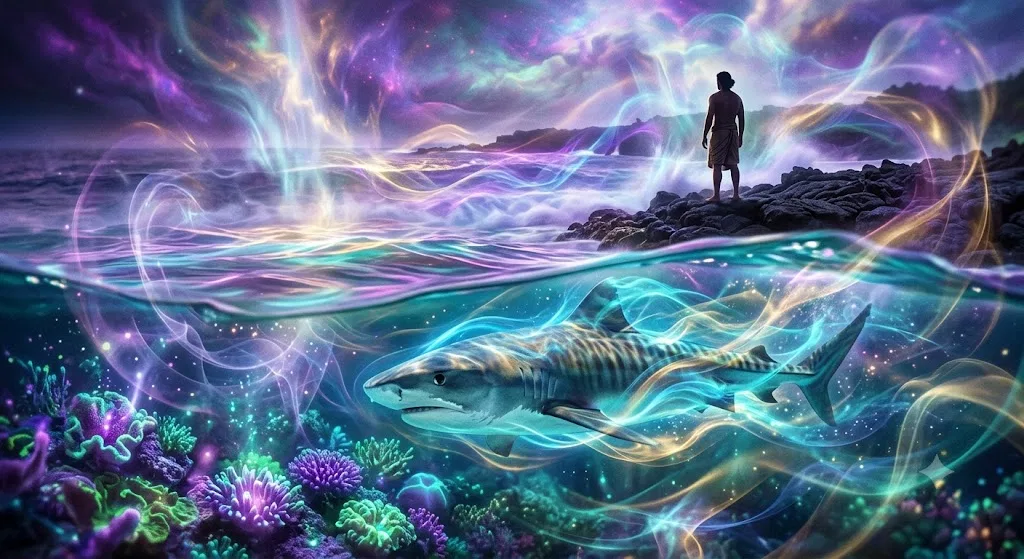
Hawaiian shark lore is best understood as a creature tradition, not a claim that an unknown shark species is hiding offshore. The “more than a shark” stories usually fall into two linked patterns: ancestral guardian sharks that protect, warn, punish or guide particular families, and shark-men such as Nanaue, a human-shark figure whose story turns on transformation, taboo and dangerous appetite. These accounts matter to Hawaii’s cryptid map because they look, at first glance, like monster reports: named beings, repeated places, human-animal bodies, disappearances and dangerous water. But the evidence points much more strongly to folklore, religious memory and moral storytelling than to zoology. Hawaii has real large sharks, especially tiger sharks, and those animals provide the living ecological backdrop; the “cryptid” layer begins when a shark is treated as ancestor, deity, shapeshifter or warning rather than simply as a predator.[hawaii.gov]dlnr.hawaii.govDLNRFact Sheet – Hawaiʻi SharksDLNRFact Sheet – Hawaiʻi Sharks
Real Sharks and Ancestral Guardians
The first thing to separate is the biological shark from the guardian shark. Hawaii’s waters really do contain large, impressive predators, and the State of Hawaii’s shark safety material identifies tiger sharks as the species most often implicated when the attacking shark can be identified. The same source stresses that shark bites in Hawaiian waters are rare, averaging about three or four per year, and that fatal bites are extremely rare given how many people use the ocean.[Hawaii DLNR]dlnr.hawaii.govDLNRFact Sheet – Hawaiʻi SharksDLNRFact Sheet – Hawaiʻi Sharks
That real-world background helps explain why sharks became such powerful figures in story. A tiger shark moving near a reef, stream mouth or fishing ground is not an abstract symbol; it is a dangerous, visible animal with its own seasonal movements, feeding habits and place in the marine food web. Modern tracking work around Maui and Oahu has shown that tiger sharks can move between main Hawaiian islands and often use shelf habitat near popular ocean recreation areas, even though routine shark presence does not translate into routine attacks on people.[Pacioos]pacioos.hawaii.eduPacioos Hawaiʻi Tiger Shark Tracking | Pac IOOSPacioos Hawaiʻi Tiger Shark Tracking | Pac IOOS
The guardian tradition adds a different layer. In Hawaiian accounts, a family guardian may appear in animal form, including as a shark. Martha Warren Beckwith’s discussion of guardian gods says shark guardians were especially popular among fishing people, and describes a shark guardian as a familiar, named presence that could be fed, could help drive fish into nets, and could save a fisherman if his canoe capsized. That is not a field note about an anomalous species; it is a record of a relationship between family, ancestor, sea and animal.[Internet Sacred Text Archive]sacred-texts.comOpen source on sacred-texts.com.
One of the most important details for sceptical reading is that the guardian is not usually “all sharks everywhere”. State shark-education material points readers to Hawaiian cultural interpreters such as Parley Kanakaole and Herb Kawainui Kane, both connected with the state’s Shark Task Force, precisely because the issue is cultural meaning as well as public safety. Kane’s paper, prepared for the task force, dealt with ancestral spirits and the cultural significance of sharks, showing how seriously this tradition has been treated in public education rather than just tourist folklore.[Hawaii DLNR]dlnr.hawaii.govDLNRHawaiians’ Relationship with Sharks – Hawaiʻi SharksDLNRHawaiians’ Relationship with Sharks – Hawaiʻi Sharks
For a cryptid reader, this changes the question. The claim is not “witnesses saw an unknown shark”. It is closer to: “A known shark, or a particular shark-like presence, was understood as a family ancestor, messenger or protector.” That means the strongest evidence is not carcasses, photographs or measurements. It is repeated naming, place attachment, family memory and old narrative collections.
The Named Shark Gods Behind the Legend
Hawaiian shark lore includes named shark gods and ancestral shark beings, not just vague sea monsters. Beckwith’s summary of guardian gods lists important ancestral sharks including Ku-hai-moana, Kane-huna-moku, Kauhuhu, Ka-moho-ali‘i and Kane-i-kokala. These beings have sharply different roles: some are fierce, some are protective, and some are tied to particular places, taboos or families.[Internet Sacred Text Archive]sacred-texts.comOpen source on sacred-texts.com.
Kamohoaliʻi is especially important because he connects shark lore to wider Hawaiian myth rather than to isolated monster gossip. The University of Hawaii’s Kahoʻiwai resource describes Kamohoaliʻi as a renowned ancestral shark god, the older brother and navigator of Pele’s family, and a being who takes both shark and human form. The same source links him to Nanaue, the shark-man, as his child with a woman named Kalei.[University of Hawaii]hawaii.eduUniversity of Hawaii Kamohoaliʻi | KahoʻiwaiUniversity of Hawaii Kamohoaliʻi | Kahoʻiwai
That matters because “shark-men” in Hawaii do not function like a modern laboratory anomaly. They belong to a mythic genealogy. A being may be shark, human, god, ancestor, family protector or danger depending on the story. This is why flattening the material into “Hawaii has a shark cryptid” loses the most interesting part. The old stories are not trying to classify a species. They are explaining how power moves between sea, family, taboo, food, danger and obligation.
The guardian side can even be affectionate. Beckwith says the relationship between a fisherman’s family and its shark guardian could be friendly and intimate, with the shark’s tangible presence reducing rather than increasing horror. That is the opposite emotional structure from a typical monster flap. The shark is frightening to outsiders, but to the right family it may be kin, helper or judge.[Internet Sacred Text Archive]sacred-texts.comOpen source on sacred-texts.com.
Shark-Men, Transformation and Taboo
The shark-man Nanaue is the clearest bridge between Hawaiian shark lore and modern cryptid lists. He has the elements a monster reader recognises immediately: a hidden abnormal body, disappearances, water attacks, transformation into a shark and a trail across islands. But the source tradition presents him as a mythic being with moral and social meaning, not as a misidentified animal.[Hawaiian Collection]hli.librarieshawaii.orgHawaiian Collection Hawaiian Legends IndexHawaiian Collection Hawaiian Legends Index
The Hawaiian Legends Index maintained by the Hawaii State Library’s Hawaii and Pacific Section lists multiple Nanaue references, including “The Shark-Man, Nanaue” in Thomas G. Thrum’s Hawaiian Folk Tales, “The Shark-Man of Waipio Valley” in W. D. Westervelt’s Hawaiian Legends of Ghosts and Ghost-Gods, and later retellings in other Hawaiian legend collections. That spread is important: Nanaue is not just a one-off internet invention, but a recurring figure in published Hawaiian legend literature.[Hawaiian Collection]hli.librarieshawaii.orgHawaiian Collection Hawaiian Legends IndexHawaiian Collection Hawaiian Legends Index
In the Thrum version, credited to Emma M. Nakuina, Kamohoalii courts Kalei of Waipio by taking human form. Before leaving, he warns that their child will have a dual nature and must not be fed animal flesh. Nanaue is then born looking like an ordinary boy except for a shark’s mouth between his shoulder blades, a hidden feature his family conceals out of fear that chiefs might kill him.[Internet Sacred Text Archive]sacred-texts.comOpen source on sacred-texts.com.
The taboo is the story’s hinge. Nanaue’s grandfather ignores the warning and feeds him meat, hoping the boy will become strong and warrior-like. In the story, that appetite grows into a hunger for human flesh. Nanaue swims alone, changes into a shark in pools and near the sea, hides his second mouth under a cloak, and people begin to disappear. He even issues ominous warnings before victims are bitten or vanish.[Internet Sacred Text Archive]sacred-texts.comOpen source on sacred-texts.com.
When Nanaue’s shark mouth is exposed during communal labour for King Umi, the hidden monster becomes public knowledge. He is condemned, escapes by calling on his shark-god father, leaps into the water and turns into a large shark in front of the assembled people. The story then sends him from Hawaii to Maui and on to Molokai, where he is finally trapped and destroyed after further attacks.[Internet Sacred Text Archive]sacred-texts.comOpen source on sacred-texts.com.
Read as a cryptid claim, Nanaue looks like a were-shark. Read in context, he is more specific than that: a taboo-breaking shark-human whose danger comes from appetite uncontrolled by family instruction, social rule and divine command. The monster is not merely “a shark that walks”. He is a story about what happens when a being who belongs to two worlds is raised without respecting the rules that keep those worlds apart.

Where the Stories Cluster
The strongest place-cluster for Nanaue begins at Waipio on Hawaii Island. Thrum’s version places Kamohoalii’s deep-sea caves along the coast from Waipio toward Kohala and puts Kalei’s early encounters with the shark god around Waipio’s river, pools and beach. That setting is not decorative. It gives the story the kind of geography that later makes creature lore feel report-like: named valleys, bathing pools, cliffs, beaches and passages between land and sea.[Internet Sacred Text Archive]sacred-texts.comOpen source on sacred-texts.com.
The tale then becomes inter-island. Nanaue escapes from Hawaii, goes to Kipahulu on Maui, resumes human shape, marries, returns to killing, and flees again to Molokai. The Molokai episode ends at Kainalu, where the story explains local landscape features such as Shark Hill and grooves in rock or hillside as traces of the shark-man’s defeat.[Internet Sacred Text Archive]sacred-texts.comOpen source on sacred-texts.com.
That kind of place-marking is common in legend. It does not prove the events happened as literal zoology, but it does show why the story is durable. A listener is not being told about a monster “somewhere in the Pacific”. They are being given a map: Waipio, Kipahulu, Molokai, Kainalu, the sea path between islands, the pools where people bathe, the beaches where people fish.
Guardian shark stories also cluster around fishing, canoe travel, dangerous channels and coastal families. Beckwith records accounts in which a shark guardian saves people from drowning, protects fishermen, drives fish, or acts as an agent of punishment. These are not random wilderness sightings. They sit exactly where sharks and people actually meet: near canoes, reefs, fishing grounds, stormy channels and shoreline food gathering.[Internet Sacred Text Archive]sacred-texts.comOpen source on sacred-texts.com.
Why Shark Lore Makes Weak Zoological Evidence
Hawaiian shark traditions are rich evidence for cultural history, but weak evidence for a hidden animal. The creatures described are not unknown species with consistent anatomy. Guardian sharks may be ordinary-looking sharks made extraordinary by relationship, name, behaviour or possession. Shark gods may take human form. Nanaue is a man with a shark mouth on his back who can become a shark. These are transformation claims, not natural-history descriptions.
Modern shark science also explains why some real encounters feel uncanny without requiring a cryptid. Hawaii’s state shark material notes that tiger sharks are attracted to stream mouths after heavy rain, to murky water where prey is easier to locate, and to waters around fishing boats where remains and blood may be present. It also says tiger sharks have varied diets and may bite for reasons that are still not fully known.[Hawaii DLNR]dlnr.hawaii.govDLNRFact Sheet – Hawaiʻi SharksDLNRFact Sheet – Hawaiʻi Sharks
Recent research adds another useful caution. A 2025 study of Hawaiian shark bites from 1995 to 2024 found a marked October spike: 32 of 165 unprovoked bites occurred in October, with tiger sharks accounting for 77 of the total bites and 20 of the confirmed tiger-shark bites in October. The paper argues that the seasonal pattern is likely connected to tiger shark reproductive cycles and changes in abundance or behaviour, not to a supernatural wave of shark activity.[Frontiers]frontiersin.orgOpen source on frontiersin.org.
That does not “debunk” the folklore in the cheap sense. It simply answers a different question. Science can tell us that tiger sharks move between islands, use certain habitats, respond to ecological conditions and very rarely bite people. Folklore tells us why a particular shark might be treated as an ancestor, why a taboo mattered, why a pool or beach became dangerous in memory, and why a shark-human story could carry lessons about appetite, secrecy and kinship.
For cryptid classification, the cleanest reading is:
- Real animal basis: Hawaii has real sharks, including large tiger sharks capable of dangerous encounters.
- Folklore transformation: Some stories turn shark power into gods, guardians, ancestors and human-shark beings.
- Witness-claim weakness: The older material is legend literature and cultural memory, not a chain of modern sightings with testable physical evidence.
- Misidentification risk: Real shark encounters, especially in murky water or near fishing activity, can produce frightening reports without needing an unknown creature.
- Cultural risk: Treating guardian sharks as “just cryptids” can strip away the family, spiritual and place-based meanings that make the stories Hawaiian.
How the Legend Changed in Modern Cryptid Culture
In older Hawaiian collections, shark beings are embedded in relationships: family guardians, named deities, taboo, fishing practice, voyaging, punishment and protection. In modern cryptid culture, they are often simplified into categories such as “shark-men”, “were-sharks” or “Hawaiian sea monsters”. Nanaue especially survives well in this new format because his story has a memorable visual hook: a handsome man hiding a shark mouth on his back.[Hawaiian Collection]hli.librarieshawaii.orgHawaiian Collection Hawaiian Legends IndexHawaiian Collection Hawaiian Legends Index
That shift changes the centre of gravity. The older Nanaue story is not only about a monster who eats people. It is about parental warning, a broken food taboo, the danger of concealed nature, the responsibility of chiefs, and the intervention of shark gods and local powers. The modern “cryptid” version tends to keep the transformation and the attacks while losing the social machinery around them.[Internet Sacred Text Archive]sacred-texts.comOpen source on sacred-texts.com.
Kamohoaliʻi has also moved between sacred story, cultural education and pop culture. The University of Hawaii’s Kahoʻiwai resource treats him as a major ancestral shark god tied to Pele’s family and to Nanaue, while museum and popular-culture discussions often note that modern shark-man characters have drawn on or echoed Hawaiian mythology. The result is a layered afterlife: a being rooted in Hawaiian tradition can become, for wider audiences, a sea-monster archetype.[University of Hawaii]hawaii.eduUniversity of Hawaii Kamohoaliʻi | KahoʻiwaiUniversity of Hawaii Kamohoaliʻi | Kahoʻiwai
The useful public-facing approach is not to ban the cryptid comparison, but to handle it carefully. Shark guardians and shark-men belong on a Hawaii mystery-creature page because they are repeatedly animal-shaped, place-linked and strange. They should not be presented as evidence for an undiscovered species. Their real value is that they show how Hawaii’s creature lore differs from mainland American monster hunting: the animal may be real, but the mystery lies in kinship, transformation and meaning.
The Best Evidence-Aware Reading
A Hawaiian shark becomes “more than a shark” when the story gives it a role ordinary zoology cannot carry: ancestor, family protector, divine messenger, taboo enforcer, shapeshifter or moral danger. Guardian sharks are remembered less as monsters than as powerful relatives. Shark-men such as Nanaue are remembered as boundary-breakers whose bodies and appetites cross the line between human society and the sea.
The evidence is strongest for the tradition itself. There are named figures, old published collections, state cultural-education materials, place-linked stories, and modern shark science that explains why sharks remain such vivid presences in Hawaiian waters. The evidence is weak for cryptozoology in the strict sense. Nothing in the best-supported material requires an unknown animal. The same real shark can be predator, ancestor, warning and story-being, depending on who is speaking and what relationship is being remembered.
eBay marketplace picks
Marketplace Samples
Live-tested eBay searches with available results related to this page.




Endnotes
1.
Source: dlnr.hawaii.gov
Title: DLNRFact Sheet – Hawaiʻi Sharks
Link:https://dlnr.hawaii.gov/sharks/shark-safety/fact-sheet/
2.
Source: pacioos.hawaii.edu
Title: Pacioos Hawaiʻi Tiger Shark Tracking | Pac IOOS
Link:https://www.pacioos.hawaii.edu/projects/sharks/
3.
Source: dlnr.hawaii.gov
Title: DLNRHawaiians’ Relationship with Sharks – Hawaiʻi Sharks
Link:https://dlnr.hawaii.gov/sharks/hawaiian-mythology/hawaiians-relationship-with-sharks/
4.
Source: hawaii.edu
Title: University of Hawaii Kamohoaliʻi | Kahoʻiwai
Link:https://www.hawaii.edu/kawaihapai/akua-list/kamohoali%CA%BBi/
5.
Source: dlnr.hawaii.gov
Title: APaperby Herb Kane
Link:https://dlnr.hawaii.gov/sharks/files/2014/07/APaperbyHerbKane.pdf
6.
Source: dlnr.hawaii.gov
Title: a modern story the shark that came to watch
Link:https://dlnr.hawaii.gov/sharks/hawaiian-mythology/a-modern-story-the-shark-that-came-to-watch/
7.
Source: dlnr.hawaii.gov
Title: close encounters
Link:https://dlnr.hawaii.gov/sharks/shark-safety/close-encounters/
8.
Source: dlnr.hawaii.gov
Title: incidents list
Link:https://dlnr.hawaii.gov/sharks/shark-incidents/incidents-list/
9.
Source: www2.hawaii.edu
Link:https://www2.hawaii.edu/~dennisk/texts/introoahu.html
10.
Source: hilo.hawaii.edu
Link:https://hilo.hawaii.edu/maunakea/library/ref/214
11.
Source: evols.library.manoa.hawaii.edu
Link:https://evols.library.manoa.hawaii.edu/items/665b10a7-5711-4517-9311-74ea84157516
12.
Source: himb.hawaii.edu
Title: Tiger Shark Active Tracking
Link:https://www.himb.hawaii.edu/ReefPredator/Tiger%20Shark%20Active%20Tracking.htm
13.
Source: himb.hawaii.edu
Title: Tiger Shark Research
Link:https://www.himb.hawaii.edu/ReefPredator/Tiger%20Shark%20Research.html
14.
Source: evols.library.manoa.hawaii.edu
Link:https://evols.library.manoa.hawaii.edu/items/2df3be32-4ea6-4b88-a2f9-7fb8d0e1ea9a
15.
Source: to-hawaii.com
Link:https://www.to-hawaii.com/legends/nanaue.php
16.
Source: archive.org
Title: hawaiianlegendso00west 0
Link:https://archive.org/details/hawaiianlegendso00west_0
17.
Source: archive.org
Title: jstor 660008
Link:https://archive.org/details/jstor-660008
18.
Source: archive.org
Link:https://archive.org/details/hawaiianmytholog00beck
19.
Source: sacred-texts.com
Link:https://sacred-texts.com/pac/hm/hm11.htm
20.
Source: sacred-texts.com
Link:https://sacred-texts.com/pac/hft/hft27.htm
21.
Source: hli.librarieshawaii.org
Title: Hawaiian Collection Hawaiian Legends Index
Link:https://hli.librarieshawaii.org/Legends/Single-Box/subjectsearch.php?q=Nanaue
22.
Source: frontiersin.org
Link:https://www.frontiersin.org/journals/marine-science/articles/10.3389/fmars.2025.1587902/full
23.
Source: Wikipedia
Link:https://en.wikipedia.org/wiki/Hawaii
24.
Source: Wikipedia
Link:https://en.wikipedia.org/wiki/Nanaue
25.
Source: sacred-texts.com
Link:https://sacred-texts.com/pac/hlog/index.htm
26.
Source: mythus.fandom.com
Link:https://mythus.fandom.com/wiki/Nanaue
Additional References
27.
Source: sharkstewards.org
Link:https://sharkstewards.org/auamakua-hawaiis-spiritual-connection-to-the-shark/
28.
Source: hawaii-aloha.com
Link:https://www.hawaii-aloha.com/blog/when-are-sharks-likely-to-attack-in-hawaii/
29.
Source: facebook.com
Link:https://www.facebook.com/61562148406652/posts/hawaii-has-40-species-of-shark-in-its-waters-only-5-have-ever-bitten-a-human-but/122157045554404946/
30.
Source: sharkstewards.org
Link:https://sharkstewards.org/hawaiis-spiritual-connection-to-the-shark/
31.
Source: carenloebelfried.com
Link:https://www.carenloebelfried.com/hawaiian-legends-of-the-guardian-spirits
32.
Source: ulukau.org
Link:https://ulukau.org/ulukau-books/?a=d&d=EBOOK-BECKWIT1.2.11.8&l=haw
33.
Source: scispace.com
Link:https://scispace.com/pdf/hawaiian-shark-aumakua-1od6orciw5.pdf
34.
Source: ulukau.org
Link:https://www.ulukau.org/ulukau-books/?a=d&d=EBOOK-QLCC1.2.3.41&l=haw
35.
Source: ancestry.com
Link:https://www.ancestry.com/first-name-meaning/nanaue
36.
Source: facebook.com
Link:https://www.facebook.com/groups/191429933832545/posts/561788243463377/
Topic Tree