Within Hawaii Monsters
Why Bigfoot Does Not Fit Hawaii Well
Hawaii's animal history makes mainland-style apes and phantom predators far less plausible than folklore, misidentification or introduced wildlife.
On this page
- The hoary bat and Hawaii's native mammal problem
- Introduced pigs, cats and mongooses as confusion sources
- Modern cryptid lists, television and tourism add ons
Page outline Jump by section
Introduction
Hawaii is a poor fit for a mainland-style Bigfoot story, and that is exactly what makes the question useful. A large, breeding population of hidden apes would need an evolutionary route into the islands, enough habitat and food to persist, a trail of physical remains, and a pattern of reports stronger than internet list-making. Hawaii offers almost the opposite: an extremely isolated island chain, no native land mammals apart from the Hawaiian hoary bat, and a modern land-mammal fauna largely built from animals humans introduced. The result is not a debunking of Hawaiian monster lore as a whole, but a sorting tool. Menehune, water beings, shark guardians and other place-based traditions belong to folklore and cultural history; Bigfoot belongs mostly to imported American cryptid branding. The ecological check matters because it stops every strange noise, shadow or forest tale from being squeezed into the same hairy-giant template.[Hawaii DLNR]dlnr.hawaii.govDLNRWildlife – Division of State ParksDLNRWildlife – Division of State Parks
The island test Bigfoot fails first
The simplest problem is geography. Hawaii is not just “remote” in the casual holiday-brochure sense; it is one of the most isolated island groups on Earth. The US Geological Survey notes that the islands formed by volcanic action roughly 4,000 km from the nearest continental land mass, and that, apart from the Hawaiian bat, no terrestrial mammal naturally colonised them. That is a severe filter for any claim about a native population of large, non-flying, non-swimming primates.[USGS]usgs.govVolcano Watch — Small mammal predators invade Hawai‘i | U.S. Geological SurveyVolcano Watch — Small mammal predators invade Hawai‘i | U.S. Geological Survey
This does not mean islands cannot hold surprises. Islands often produce odd evolution, small founding populations, and animals that look unlikely to outsiders. Hawaii’s actual natural history is spectacular for exactly that reason: endemic birds, marine mammals, sea turtles, insects, land snails and plants evolved in ways shaped by isolation. But those are not hints of hidden apes. They are evidence of how strongly the island filter worked. A Bigfoot-like animal would have to cross open ocean, establish a viable breeding population, avoid genetic collapse, leave no recognised bones or remains, and remain largely absent from the local report record.
That is why the Hawaii question is different from a Pacific Northwest Bigfoot debate. In Washington, Oregon, northern California or British Columbia, believers imagine a creature hiding inside a continuous continental landscape of mountains, forests, deer, elk and bears. Hawaii has forests too, including remote and rugged places, but it lacks the mainland mammal history that makes the Sasquatch idea feel biologically intuitive to some readers. The absence is not just “no confirmed Bigfoot”. It is “no native ecological pathway for Bigfoot”.
The hoary bat and Hawaii’s native mammal problem
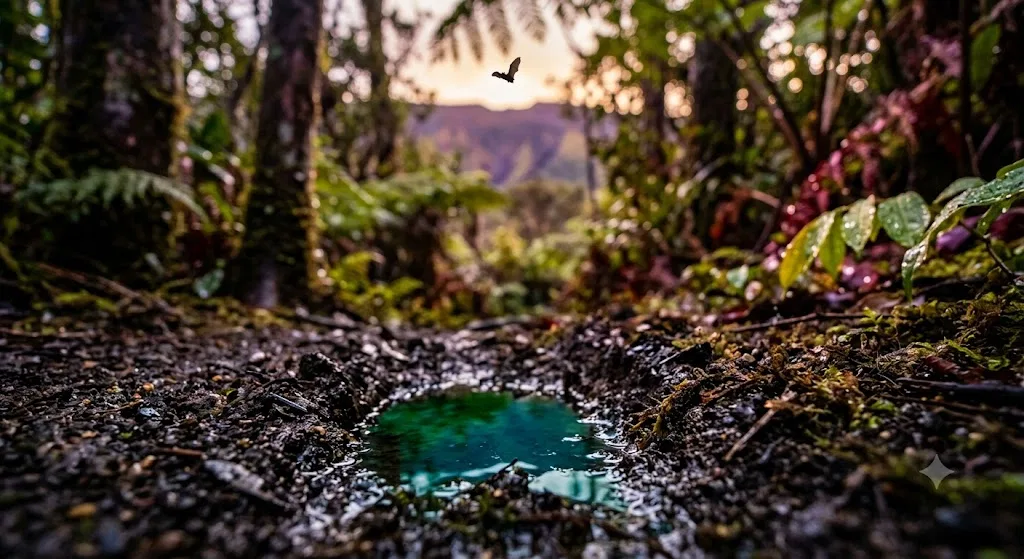
The Hawaiian hoary bat is the key fact that resets the whole cryptid conversation. Hawaii’s Division of State Parks describes the islands as having no native land mammals except the small, reclusive Hawaiian hoary bat, while the National Park Service likewise identifies it as the only native land mammal in Hawaii. The state wildlife agency also notes that the bat was designated Hawaii’s official state mammal in 2015 and that sub-fossil evidence shows at least one other bat species once lived in the islands.[hawaii.gov]dlnr.hawaii.govDLNRWildlife – Division of State ParksDLNRWildlife – Division of State Parks
That “bat exception” is important. Bats can arrive where apes cannot. They can fly across water, colonise islands, roost in trees, and remain difficult for casual observers to notice. A bat’s presence in Hawaii therefore supports the island-filter argument rather than weakening it. The kind of mammal that made it naturally was small, airborne and nocturnal, not a large ground-dwelling primate.
It also explains why Hawaii’s old land-animal ecology was so vulnerable once humans and their companion species arrived. Native plants and animals evolved without the same pressure from mammalian grazers and predators seen on continents. USGS describes Hawaiian native species as having gradually lost defences against mammalian predators, which made later introductions especially damaging. For cryptid interpretation, that matters because the animals most likely to be seen, heard, tracked or misread in forests today are not relic native beasts. They are introduced mammals living inside ecosystems that did not evolve with them.[USGS]usgs.govVolcano Watch — Small mammal predators invade Hawai‘i | U.S. Geological SurveyVolcano Watch — Small mammal predators invade Hawai‘i | U.S. Geological Survey
Introduced animals explain more than hidden apes
Most plausible “mystery animal” explanations in Hawaii begin with introduced species, not undiscovered primates. These animals do not explain every strange story, and they do not turn folklore into zoology, but they do provide real bodies, tracks, smells, night noises and sudden movements in the landscape.
Feral pigs are the most obvious large-animal confusion source. The National Park Service says pigs were among the first animals introduced by humans, that European pigs arrived with Captain Cook in 1778, and that today’s pigs are descendants of European stock. It also describes them as widespread, especially in wet forests, where they root the ground, damage native vegetation, disperse invasive plants and create standing water that helps mosquitoes breed. A recent genome-wide study of 608 Hawaiian feral pigs similarly found mixed ancestry, dominated by European lineages with Asian and possible Polynesian contributions, underlining that the modern animal is a complicated human-introduction story rather than a mysterious native survivor.[National Park Service]nps.govNational Park Service Invasive AnimalsNational Park Service Invasive Animals
A pig does not look like Bigfoot in daylight. But many “large thing in the brush” reports are not daylight identifications. A heavy animal moving through wet forest, crashing through undergrowth, grunting, rooting, leaving disturbed ground or appearing briefly at the edge of a trail can become something larger in memory, especially if the witness is already primed by Bigfoot media. In Hawaii, the ecological question is not “could a pig be mistaken for a seven-foot ape at close range?” It is “what known animal is far more likely to produce the sensory cue that later becomes a monster story?”
Feral cats and mongooses supply the smaller, quicker end of the same problem. Hawaii’s Invasive Species Council says feral cats were introduced by Europeans, now have established populations on all eight main Hawaiian Islands, and can live in all habitat types, including upland areas. The same state source describes mongooses as long, low, weasel-like animals introduced in 1883 by the sugar industry to control rats, now widespread on Hawaii Island, Oahu, Maui and Molokai, with no known established populations on Lanai and Kauai.[Hawaii DLNR]dlnr.hawaii.govDLNRFeral Cats | Hawaii Invasive Species CouncilDLNRFeral Cats | Hawaii Invasive Species Council
These are not Bigfoot candidates either. Their relevance is pattern recognition. A fleeting animal seen at dusk, a road-crossing shape, a cry in vegetation, a den, a carcass or a trail-camera blur often enters the mystery-beast pipeline before it enters the biology pipeline. In Hawaii, the known animal list is already strange enough for visitors used to mainland wildlife: pigs in rain forest, cats in remote habitats, mongooses in daylight, goats and other ungulates in rugged country, and invasive frogs changing the night soundscape. A hidden ape is not needed to make the landscape feel uncanny.

Why Hawaii has folklore, not a Sasquatch tradition
The Bigfoot problem also has a cultural side. Hawaii has many powerful creature traditions, but they do not line up neatly with the modern Sasquatch model. The most commonly rebranded candidate is the Menehune: small hidden people associated in popular retellings with forests, valleys and extraordinary building works. Modern cryptid sites often file them under “island cryptids” or even cross-link them with Bigfoot, but that is a contemporary classification choice, not proof that Hawaii has an indigenous Sasquatch tradition. One popular cryptid database, for example, describes Menehune as small people from Hawaiian mythology and notes their appearance in the television programme Finding Bigfoot, showing how a folklore figure can be pulled into a Bigfoot entertainment frame.[Cryptid Wiki]cryptidz.fandom.comCryptid Wiki Menehune | Cryptid Wiki | FandomCryptid Wiki Menehune | Cryptid Wiki | Fandom
That rebranding changes the reader’s expectations. A folklore being can be tied to genealogy, landscape, warning, humour, sacredness, labour, political memory or storytelling style. A cryptid hominid claim asks a different question: is there an unrecognised animal population? Confusing the two makes Hawaii look like a missing chapter in the mainland Bigfoot map, when it is better understood as a place where older traditions have been repackaged by national monster culture.
The distinction is especially important because Hawaii’s best-known creature traditions are not weak because they fail a Bigfoot test. They are simply operating in a different register. A shark guardian does not need to behave like an undiscovered shark species to matter. A water being does not need to become a lake monster. A hidden people story does not become stronger when forced into the shape of a North American ape-man.
Modern lists, television and tourism add-ons
The strongest modern evidence for “Bigfoot in Hawaii” is often not evidence of sightings at all, but evidence of circulation. Bigfoot databases, ranking articles, fan wikis, paranormal television and social-media posts work by completing maps: every state needs a creature, every creature needs an episode, every episode needs a local hook. Hawaii’s problem, from that content-machine point of view, is that its ecology and folklore do not naturally produce a standard Bigfoot.
The Bigfoot Field Researchers Organization’s public geographical database is useful here because it shows how heavily the classic American Bigfoot map belongs to the continental states. The database presents itself as a collection of credible Bigfoot and Sasquatch reports from the United States and Canada and lists state entries with report totals; in the visible state table, Hawaii is not listed among the state report pages shown, while continental states have entries ranging from a handful to hundreds.[bfro.net]bfro.netBFR O Geographical Database of Bigfoot Sightings & ReportsBFR O Geographical Database of Bigfoot Sightings & Reports
That absence should not be overplayed as a perfect census of belief. Databases depend on submissions, screening, site design and publication choices. But it does match the ecological expectation: Hawaii is not a natural Bigfoot-report hotspot. Where Hawaii enters modern Bigfoot culture, it is more often through adaptation. Television can ask whether the Menehune are “little foot”; fan pages can fold Hawaiian folklore into a cryptid index; tourism and novelty media can use the language of monsters because it is familiar to visitors. Those are afterlives of a national cryptid brand, not strong evidence for a Hawaiian ape.
How to read a Hawaiian “Bigfoot” claim
A useful Hawaii Bigfoot test starts with ecology, then moves to testimony. The first question is not “could the witness be sincere?” A witness can be sincere and still misread a sound, animal, scale, distance or cultural reference. The better first question is: what known process would have to be true for this claim to work?
For Hawaii, the checklist is demanding:
- A native ape lineage would need a credible arrival route. Hawaii’s native land-mammal record points to bats, not large ground mammals.[Hawaii DLNR]dlnr.hawaii.govDLNRWildlife – Division of State ParksDLNRWildlife – Division of State Parks
- A modern introduced ape population would need a documented source. Escaped pets, zoo animals or deliberate releases leave paperwork, news reports, owner networks or at least a much clearer trail than vague forest rumours.
- A breeding population would need ecological signs. Large mammals leave scat, hair, feeding damage, tracks, carcasses, roadkill, camera-trap records and repeated local knowledge.
- Known introduced animals should be checked first. Pigs, cats, mongooses and other introduced species are already present in the landscapes where strange animal impressions may arise.[nps.gov]nps.govNational Park Service Invasive AnimalsNational Park Service Invasive Animals
- Folklore should not be treated as failed zoology. A story about hidden builders, guardians or dangerous places may be meaningful without being a field report of an undiscovered animal.
This approach does not drain the strangeness from Hawaii. It protects the strangeness from being flattened. The islands are full of stories that belong to particular waters, cliffs, fishponds, valleys and families. The Bigfoot template is too blunt for that material.
Why the sceptical answer is still interesting
The best answer to “Does Hawaii have Bigfoot?” is not merely “no”. It is that Hawaii shows why state-by-state cryptid lists can mislead. A list wants symmetry: one state, one monster. Ecology is asymmetrical. Folklore is asymmetrical. Hawaii’s native mammal history is unlike that of the mainland United States, and its monster lore follows different routes through landscape, ancestry, danger, memory and modern entertainment.
That makes Hawaii a useful cautionary case for cryptid readers. In some states, a mystery-beast discussion turns on whether a large known animal was misidentified: a bear, cougar, elk, seal, sturgeon or escaped exotic pet. In Hawaii, the first-order question is more basic. Which mammals should be there at all? Once that question is asked, the mainland Sasquatch model loses most of its force.
The more compelling Hawaiian mystery-beast material sits elsewhere: in the way introduced animals make island forests feel newly haunted; in the way old stories become tourist icons; in the way television imports Bigfoot logic into places where it does not quite fit; and in the way a small, endangered bat can tell us more about island possibility than any giant footprint. Hawaii does not need a hidden ape to be strange. Its ecology is already a warning that the wrong animal in the wrong island can change everything.
Amazon book picks
Further Reading
Books and field guides related to Why Bigfoot Does Not Fit Hawaii Well. Use these as the next step if you want deeper reading beyond the article.
The Song Of The Dodo
Explains island biogeography and why large hidden mammals are unlikely.
eBay marketplace picks
Marketplace Samples
Live-tested eBay searches with available results related to this page.
Endnotes
1.
Source: dlnr.hawaii.gov
Title: DLNRWildlife – Division of State Parks
Link:https://dlnr.hawaii.gov/dsp/wildlife/
2.
Source: usgs.gov
Title: Volcano Watch — Small mammal predators invade Hawai‘i | U.S. Geological Survey
Link:https://www.usgs.gov/news/volcano-watch-small-mammal-predators-invade-hawaii
3.
Source: dlnr.hawaii.gov
Link:https://dlnr.hawaii.gov/wildlife/opeapea/
4.
Source: dlnr.hawaii.gov
Title: DLNRFeral Cats | Hawaii Invasive Species Council
Link:https://dlnr.hawaii.gov/hisc/info/invasive-species-profiles/feral-cats/
5.
Source: dlnr.hawaii.gov
Title: DLNRMongoose (Urva auropunctata) | Hawaii Invasive Species Council
Link:https://dlnr.hawaii.gov/hisc/mongoose-urva-auropunctata/
6.
Source: bfro.net
Title: BFR O Geographical Database of Bigfoot Sightings & Reports
Link:https://www.bfro.net/gdb/
7.
Source: dlnr.hawaii.gov
Title: invasive species profiles
Link:https://dlnr.hawaii.gov/hisc/info/invasive-species-profiles/
8.
Source: wildlife.org
Title: feral pigs may usher nonnative plants into hawaii
Link:https://wildlife.org/feral-pigs-may-usher-nonnative-plants-into-hawaii/
9.
Source: wildlife.org
Title: researchers trace hawaiian hoary bat origins
Link:https://wildlife.org/researchers-trace-hawaiian-hoary-bat-origins/
10.
Source: usgs.gov
Title: origins hawaiian hoary bat revealed
Link:https://www.usgs.gov/news/state-news-release/origins-hawaiian-hoary-bat-revealed
11.
Source: scholarspace.manoa.hawaii.edu
Link:https://scholarspace.manoa.hawaii.edu/items/6156eee4-a112-4765-b80d-8b3bae46fc20
12.
Source: hilo.hawaii.edu
Link:https://hilo.hawaii.edu/maunakea/library/ref/3328
13.
Source: manoa.hawaii.edu
Link:https://manoa.hawaii.edu/exploringourfluidearth/biological/mammals/introduction-mammals
14.
Source: nps.gov
Title: National Park Service Mammals
Link:https://www.nps.gov/puho/learn/nature/mammals.htm
15.
Source: nps.gov
Title: National Park Service Invasive Animals
Link:https://www.nps.gov/havo/learn/nature/invasive-animals.htm
16.
Source: cryptidz.fandom.com
Title: Cryptid Wiki Menehune | Cryptid Wiki | Fandom
Link:https://cryptidz.fandom.com/wiki/Menehune
17.
Source: Wikipedia
Title: Hawaiian hoary bat
Link:https://en.wikipedia.org/wiki/Hawaiian_hoary_bat
18.
Source: cryptidz.fandom.com
Link:https://cryptidz.fandom.com/wiki/Bigfoot/Sightings
19.
Source: nps.gov
Link:https://www.nps.gov/havo/learn/nature/hawaiian-bat.htm
20.
Source: parkplanning.nps.gov
Title: show File.cfm
Link:https://parkplanning.nps.gov/showFile.cfm?projectID=19367&sfid=149262
21.
Source: youtube.com
Link:https://www.youtube.com/watch?v=w7FAWy9cexQ
22.
Source: nene.org
Link:https://nene.org/threats/cats
23.
Source: oahunaturetours.com
Title: hawaiian hoary bat
Link:https://oahunaturetours.com/hawaiian-hoary-bat/
24.
Source: brainly.com
Link:https://brainly.com/question/51636936
Additional References
25.
Source: youtube.com
Link:https://www.youtube.com/watch?v=NEiayE02hhA
Source snippet
What is the Theory of Island Biogeography? Very Important to Understand Conservation Biology...
26.
Source: youtube.com
Link:https://www.youtube.com/watch?v=ApIazbqsBOs
Source snippet
Islands Are Weird: Adaptive Radiation, Island Biogeography, and Invasive Species...
27.
Source: youtube.com
Title: Searching for Bigfoot in Hawaii | Aloha | The Telepathy Tapes??
Link:https://www.youtube.com/watch?v=EgmSg2buZGc
Source snippet
Green Children of Woolpit, Solway Spaceman, Hawaiian Cryptids | EP.132 | Ninjas Are Butterflies...
28.
Source: youtube.com
Title: Islands Are Weird: Adaptive Radiation, Island Biogeography, and Invasive Species
Link:https://www.youtube.com/watch?v=u_yGYmlL5kc
Source snippet
AP Environmental Science - Island Biogeography...
29.
Source: reddit.com
Link:https://www.reddit.com/r/invasivespecies/comments/1nd4i8e/a_live_mongoose_has_been_captured_on_kauai_where/
30.
Source: facebook.com
Link:https://www.facebook.com/KNWAnews/posts/according-to-the-bigfoot-field-researchers-organization-the-top-state-for-sasqua/579615254208104/
31.
Source: medium.com
Link:https://medium.com/klipsun/bigfoot-doesnt-care-if-you-believe-cf354a6a5766
32.
Source: reddit.com
Link:https://www.reddit.com/r/zoology/comments/156gz5h/bigfoot_almost_certainly_doesnt_exist_but_how/
33.
Source: conservationgateway.org
Link:https://www.conservationgateway.org/collections/people/genetic-hybridization-cultural-ecological-impacts-feral-pigs-hawaii/
34.
Source: researchgate.net
Link:https://www.researchgate.net/publication/226193690_Ecological_impacts_of_feral_pigs_in_the_Hawaiian_Islands
Topic Tree