Within Oregon Monsters
Why Bigfoot Became Oregon's Headline Monster
Oregon's Sasquatch tradition runs from early wild man reports to modern sightings, tracks, tourism and sceptical explanations.
On this page
- Early wild man reports in the Coast Range
- Where Oregon sightings cluster today
- Tracks, hoaxes, bears and better explanations
Page outline Jump by section
Introduction
Oregon’s Bigfoot story is best read as an evidence trail rather than a solved zoological case. The creature being claimed is the familiar Pacific Northwest Sasquatch: a large, hair-covered, human-shaped figure said to move through remote forests and leave unusually large footprints. In Oregon, that trail runs from early “wild man” stories in the Coast Range, through logging-road and hunting reports, to modern online sighting databases, wood-knock claims, footprint casts, museum culture and the state’s famously unsuccessful Bigfoot trap. The interesting point is not that Oregon has proved Bigfoot exists. It has not. The point is that Oregon has produced one of America’s richest Bigfoot claim traditions, and the evidence itself shows why the legend persists: dense forests, real bears, unreliable sightings, sincere witnesses, old newspaper habits, tourism, hoaxes and a landscape that constantly offers just enough uncertainty to keep the story alive.[oregonencyclopedia.org]oregonencyclopedia.orgbigfoot sasquatch legendbigfoot sasquatch legend
Why Bigfoot became Oregon’s headline monster
Oregon is almost custom-built for Sasquatch stories. Nearly half the state is forestland, with dense Douglas-fir forests in western Oregon, ponderosa pine country in the Cascades and Blue Mountains, and mixed conifers in the south-west. That geography matters because Oregon Bigfoot reports are rarely urban legends in the strict sense. They are usually outdoor stories: a hunter hears heavy movement beyond the firelight, a driver sees a dark figure cross a rural road, a hiker finds tracks near a creek, or campers hear knocks from the timber after midnight.[Oregon]oregon.govOpen source on oregon.gov.
The Oregon Encyclopedia places the state’s documented Bigfoot record in the early twentieth century, beginning with 1904 reports of a hairy “wild man” in the Sixes River area of the Coast Range. That older language is important. Before “Bigfoot” became the standard popular name, Oregon’s reports often sounded like frontier mystery tales: “wild men”, “ape men”, hairy strangers and frightening beings glimpsed around mining districts, rivers and timber country. The modern Sasquatch is therefore not just a movie-era monster pasted onto Oregon. It is a newer name laid over older settler-era story patterns, Indigenous traditions, outdoor rumours and newspaper-ready mystery-beast accounts.[Oregon Encyclopedia]oregonencyclopedia.orgbigfoot sasquatch legendbigfoot sasquatch legend
The story also became strongly regional because Oregon sits inside the wider Pacific Northwest Sasquatch belt. Washington has Mount St Helens and Ape Canyon; northern California has Bluff Creek and the Patterson-Gimlin film; Oregon has the Coast Range, the Cascades, the Rogue/Applegate country and a long chain of claimed encounters in between. Oregon’s version is less dependent on one famous film or one single incident. Its force comes from accumulation: many scattered reports, repeated habitats, and a public culture in which Bigfoot feels like a plausible mascot for deep timber even when the physical evidence remains weak.
Early wild man reports in the Coast Range
The Sixes River material is the natural starting point for Oregon’s Bigfoot evidence trail because it shows the legend before the word “Bigfoot” carried today’s assumptions. The Oregon Encyclopedia identifies the Sixes River area as the beginning of Oregon’s historical record of hairy “wild man” sightings, while regional folklore sources preserve stories of the “South Sixes River ape man” or “Saucer Eyes”, a figure said to startle miners in the old Sixes gold district. These accounts are not scientific records. They are remembered tales, filtered through local storytelling and later retellings. But they do show that south-western Oregon had a hairy forest-being tradition well before modern Bigfoot media standardised the creature.[Oregon Encyclopedia]oregonencyclopedia.orgbigfoot sasquatch legendbigfoot sasquatch legend
What makes the Coast Range useful for understanding Oregon Bigfoot is the mix of believable setting and unstable evidence. The region has steep, wet, heavily forested terrain where visibility can be poor and animals can vanish quickly. Oregon State University Extension describes Douglas-fir and western hemlock forests in the Coast Range and western Cascades as part of western Oregon’s forest system, with very high precipitation in some Coast Range areas. That sort of landscape encourages brief glimpses rather than sustained observation: movement through brush, a shape between trunks, a sound carried through damp air.[OSU Extension Service]extension.oregonstate.eduOSU Extension Service Managing Douglas-fir–western hemlock forests of the CoastOSU Extension Service Managing Douglas-fir–western hemlock forests of the Coast
The evidence problem begins there. Old wild man reports rarely provide the details a modern investigator would want: exact location, date, witness interview, track measurements, photographs, chain of custody for casts, or independent corroboration. They are valuable as folklore and local history, but weak as zoological evidence. In that sense, the early Coast Range stories set the pattern for much of Oregon Bigfoot: memorable, place-specific and culturally durable, yet difficult to test after the fact.

Where Oregon sightings cluster today
Modern sighting databases make Oregon’s Bigfoot tradition look more measurable, but they need careful reading. The Bigfoot Field Researchers Organization, or BFRO, lists Oregon reports by county and currently shows especially active clusters in forested or mountainous counties such as Clackamas, Josephine, Douglas, Lane, Umatilla and Jackson. The entries include recent Class B claims from Jackson County in 2025 involving wood knocks around the Hyatt Lake/Pacific Crest Trail area and mountains north-east of Medford, as well as earlier Clackamas County reports near Mount Hood.[BFRO]bfro.netstate listing.aspstate listing.asp
That does not mean those counties contain an undiscovered primate. A sighting database records submissions, not confirmed animals. Its map is partly a map of forests, roads, recreation, hunting, local interest and willingness to report. Places with many hikers, campers and hunters may generate more reports because more people are in the woods. Places with strong Bigfoot culture may generate more reports because people know where to send them. Still, the pattern is useful because it shows what “Oregon Bigfoot country” means in practice: not one hidden valley, but a string of wooded corridors from Mount Hood and the Cascades to the Coast Range, southern Oregon and the Blue Mountains.
The types of modern Oregon reports also show how the evidence has changed. Older stories often centred on a figure seen at a distance. Modern entries frequently include sounds: knocks, whoops, heavy footfalls, branch breaks, or vocalisations heard at night. That shift reflects wider Bigfoot culture, where “wood knocks” have become a recognised sign. It also creates a sceptical problem, because sounds are even harder than sightings to identify. A dark shape might at least be compared with a bear, elk or person. A knock in the forest may be anything from falling timber to another human, a bird, a deer, a bear, or ordinary acoustic confusion in rough terrain.
The Umatilla noise flap shows the pattern. In 2013, strange sounds near a swamp on the Umatilla Indian Reservation drew public attention, with some residents linking them to Sasquatch because local tradition includes such a being. The same episode was also framed in news coverage as “Bigfoot or animals?”, which is exactly the evidential fork most Oregon reports face: the claim becomes interesting because it is culturally recognisable, but the data rarely exclude ordinary wildlife or environmental causes.[indianz.com]indianz.comStrange noises at swamp cause stir on Umatilla ReservationStrange noises at swamp cause stir on Umatilla Reservation
The Bigfoot trap is Oregon’s strangest evidence monument
The most concrete Bigfoot object in Oregon is not a body, a bone or a verified DNA sample. It is a wooden trap on the Collings Mountain Trail in the Rogue River-Siskiyou National Forest. The U.S. Forest Service says the trap was built in 1974 by the North American Wildlife Research Team after miner Perry Lovell reportedly found 18-inch human-like tracks with a six-foot stride near the Applegate River. The trap was baited with carcasses for six years. The result was not a captured Sasquatch. According to the Forest Service, it caught a couple of bears.[US Forest Service]fs.usda.govcollings mountain trail 943collings mountain trail 943
That failed trap may be the best single symbol of Oregon’s evidence trail. It began with a track claim, turned into a physical attempt to catch the claimed creature, produced ordinary animal results, and then became a heritage curiosity. Today, the Collings Mountain route is promoted as a hike where visitors can see the inactive Bigfoot trap, along with Applegate Lake views, old mining features and south-western Oregon forest. Travel Oregon notes that the trap sits about three-quarters of a mile up the trail, while Forest Service pages describe it as inactive and associated with the Collings Mountain/Hart-Tish Park trailhead.[Travel Oregon]traveloregon.comOpen source on traveloregon.com.
For believers, the trap can be read as evidence that people took the claims seriously enough to build something substantial. For sceptics, it is almost a controlled experiment with a comic outcome: bait a giant creature trap in alleged Sasquatch country and catch bears. For Oregon culture, it does something else. It turns the lack of proof into a destination. The trap survives because Bigfoot in Oregon is now both a mystery claim and a roadside-outdoor tradition, the kind of thing that fits a hike, a family trip, a museum stop or a campfire argument.
Tracks, casts and the footprint problem
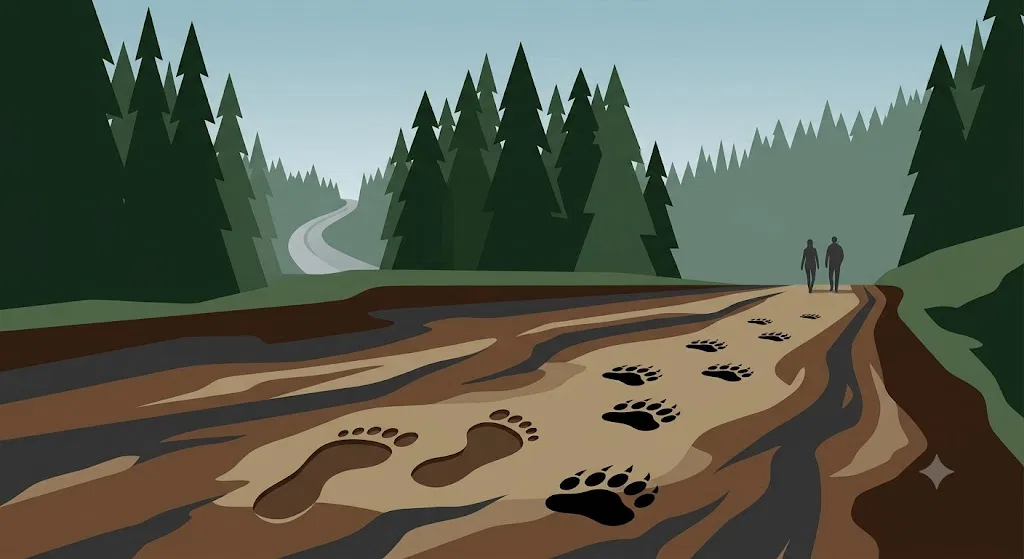
Footprints are the classic Bigfoot evidence because they seem more durable than a glimpse. Oregon reports often involve large human-like tracks, and the Applegate story behind the Bigfoot trap is one of the state’s best-known examples. Tracks feel persuasive because they appear to be physical traces: something pressed into mud, snow or soil. But tracks are also among the easiest forms of evidence to misread or fake. Soil collapses. Snow melts. Bear prints overlap. Human tracks distort. A deep heel or sliding step can enlarge a print. A hoaxer needs only a carved foot, a fake cast or even hand-shaped impressions in suitable ground.
The wider Sasquatch footprint debate has long focused on details such as dermal ridges, the fine skin patterns sometimes claimed in plaster casts. Some advocates have argued that such details would be hard to fake. But sceptical work has challenged that confidence, noting experimental and practical ways that apparent ridge detail can arise or be manufactured. The result is not that every track is proven fake. It is that tracks alone rarely settle the question unless their discovery, documentation, casting, photography, surrounding trackway and later analysis are all unusually strong.[Skeptical Inquirer]skepticalinquirer.orgSkeptical Inquirer Experiments Cast Doubt on Bigfoot 'EvidenceSkeptical Inquirer Experiments Cast Doubt on Bigfoot 'Evidence
That is why Oregon’s footprint trail remains intriguing but not conclusive. A single cast from a muddy road or garden is a story starter, not proof of an unknown primate. To move the case forward, a track find would need careful scale photography, multiple prints in sequence, clear substrate records, independent witnesses, prompt expert examination, and ideally associated biological evidence such as hair, scat or environmental DNA that could be tested. Most Bigfoot track claims, in Oregon and elsewhere, do not reach that standard.

Bears, hoaxes and better explanations
The strongest sceptical explanation for many Oregon Bigfoot reports is not that witnesses are lying. It is that Oregon contains real animals and real landscapes that can fool honest observers. The Oregon Department of Fish and Wildlife estimates that the state has about 25,000 to 30,000 black bears. They are the only bear species in Oregon, can be black, brown, cinnamon or blond, and are found statewide, with concentrations in the Coast Range, Cascades and Blue Mountains. In other words, the same regions that feel like Bigfoot country are also very much bear country.[myodfw.com]myodfw.comOpen source on myodfw.com.
Black bears are not usually mistaken for giant apes at close range in good light. The problem is that Bigfoot reports often happen in bad light, at distance, through timber, or during a moment of surprise. A bear standing briefly, climbing, turning, or moving behind brush can present a confusing silhouette. A brown-phase black bear can look unlike the “black bear” a witness expects. Tracks can overlap or degrade into shapes that seem more human than they are. Scent, snapped branches and heavy movement also fit ordinary large wildlife.
Statistical work has supported the bear-misidentification problem at a broad level. A 2024 paper in the Journal of Zoology found that reported Sasquatch sightings are associated with black bear populations and concluded that many supposed Sasquatch are likely misidentified known animals. That kind of analysis cannot explain every Oregon story individually, but it does fit Oregon’s ecology uncomfortably well for believers: a heavily forested state with many black bears will naturally generate some large, dark, fleeting, half-seen animal reports.[ZSL Publications]zslpublications.onlinelibrary.wiley.comZSL Publications Bigfoot: If it's there, could it be a bear?ZSL Publications Bigfoot: If it's there, could it be a bear?
Hoaxes are the other unavoidable part of the trail. Bigfoot history across North America includes planted tracks, staged photographs, costume claims and attention-seeking stories. Oregon’s record should not be treated as uniquely fraudulent, but neither should it be treated as immune. The Bigfoot trap itself began with a track claim that was never converted into biological proof. Modern online reports may be sincere, embellished, mistaken or deliberately false; from the outside, those categories can be hard to separate. That is why the most responsible reading is neither “everyone is lying” nor “every unexplained report is a creature”. It is that Oregon’s evidence is a mixed file of folklore, testimony, physical traces of uncertain origin and ordinary wildlife explanations.
How Indigenous tradition fits without flattening it
Oregon Bigfoot writing often gestures towards Indigenous traditions, but this needs more care than many monster guides give it. The Oregon Encyclopedia notes that Bigfoot has been connected by some Native communities with older “wild man” or “stick Indian” traditions, while also making clear that such beings carry cultural and spiritual meanings that are not identical to modern cryptozoology. Treating every Indigenous forest being as a Bigfoot sighting flattens living traditions into evidence for a hobbyist monster hunt.[Oregon Encyclopedia]oregonencyclopedia.orgbigfoot sasquatch legendbigfoot sasquatch legend
For an Oregon evidence page, the safer distinction is this: Indigenous traditions help explain why the Pacific Northwest already had powerful stories about non-human or more-than-human forest beings before modern Bigfoot culture. They do not, by themselves, prove that a biological Sasquatch exists. They belong to specific communities, languages and contexts, not to a single statewide cryptid file. The Bigfoot legend has borrowed some of that atmosphere, but the evidence trail discussed here is mostly a settler, newspaper, outdoor recreation and modern database trail.
That distinction also makes the Oregon story more interesting, not less. It shows that “Bigfoot” is not one simple thing. In one setting it is a claimed animal. In another it is a warning or spiritual presence. In another it is a tourist logo, a plaster cast, a database entry, a podcast episode or a hiking destination. Oregon’s headline monster survives partly because it can move between these meanings without ever being pinned down by one kind of evidence.
Evidence needed to test Bigfoot
The Oregon Bigfoot file is large in stories and thin in decisive proof. That is not a contradiction; it is the central feature of the legend. The strongest claims usually involve converging details: a sighting in plausible habitat, tracks nearby, multiple witnesses, no obvious bear explanation, and a witness with outdoor experience. But even those better cases usually stop short of the evidence required to establish a large unknown primate in North America.
For Oregon’s evidence trail to change substantially, it would need evidence that is testable, independently recoverable and difficult to explain as bear, human, hoax or error. The most important forms would include:
- A body, bones or teeth with clear recovery records and independent scientific examination.
- DNA from hair, scat or tissue that can be replicated by credible labs and shown not to belong to known animals or humans.
- A trackway, not just one print, documented immediately with scale, substrate detail, photographs, casts and independent witnesses.
- Clear video or trail-camera footage with location, original files, metadata and enough detail to assess body shape, gait and scale.
- Repeatable evidence from one site, where different investigators can return and document the same phenomenon under controlled conditions.
This standard may sound severe, but it is the normal burden for adding a large mammal to the known fauna of a well-studied region. Oregon has many remote-feeling places, yet it also has hunters, foresters, biologists, trail cameras, roads, search-and-rescue teams and wildlife agencies. The longer a large breeding population is proposed without bones, bodies or reliable genetic evidence, the harder the biological claim becomes to sustain.
Why the legend keeps working in Oregon
Oregon Bigfoot endures because the story sits in a productive gap. The forests are real. The bears are real. The old reports are real as historical artefacts. The witnesses may be sincere. The trap is real enough to hike to. The modern databases are real as collections of claims. What remains unproven is the creature itself.
That unresolved status is exactly why Bigfoot became Oregon’s headline monster. A lake monster needs a lake; a sea serpent needs a coast; a phantom cat needs a run of livestock scares or night-road sightings. Bigfoot can inhabit almost any wooded Oregon margin: the Coast Range, Mount Hood country, the Rogue/Applegate region, the Umatilla area, the Cascades, the Blue Mountains, or a logging road a few miles from town. The creature maps neatly onto the state’s sense of itself as forested, outdoorsy, independent and still partly wild.
The evidence trail, then, leads to a balanced answer. Oregon is one of America’s great Bigfoot states because it has the right landscape, a long “wild man” tradition, many modern sighting claims, a famous failed trap and a culture that enjoys the mystery. But the same trail also leads towards caution: many reports are anecdotal, tracks are vulnerable to error and hoaxing, sounds are hard to identify, and black bears occupy the very habitats where Sasquatch is most often claimed. Oregon’s Bigfoot is compelling folklore with a long paper trail, not a confirmed animal with a scientific specimen.
Amazon book picks
Further Reading
Books and field guides related to Why Bigfoot Became Oregon's Headline Monster. Use these as the next step if you want deeper reading beyond the article.
Sasquatch: Legend Meets Science
Directly examines tracks, sightings and scientific claims.
Field Guide To Bigfoot, Yeti, & Other Mystery Primates Worldwide
Surveys Bigfoot traditions and reported evidence.
Where the Footprints End
Explores persistence of Bigfoot reports and witness experiences.
eBay marketplace picks
Marketplace Samples
Live-tested eBay searches with available results related to this page.

Endnotes
1.
Source: oregon.gov
Link:https://www.oregon.gov/odf/forestbenefits/pages/aboutforests.aspx
2.
Source: myodfw.com
Link:https://myodfw.com/living-black-bears
3.
Source: bfro.net
Title: state listing.asp
Link:https://www.bfro.net/GDB/state_listing.asp?state=or
4.
Source: bfro.net
Title: show county reports.asp
Link:https://www.bfro.net/GDB/show_county_reports.asp?county=Jackson&state=or
5.
Source: indianz.com
Title: Strange noises at swamp cause stir on Umatilla Reservation
Link:https://indianz.com/News/2013/01/22/strange-noises-at-swamp-cause.asp
6.
Source: myodfw.com
Link:https://myodfw.com/big-game-hunting/species/black-bear
7.
Source: bfro.net
Title: oregon cascades 2017.asp
Link:https://www.bfro.net/news/roundup/oregon_cascades_2017.asp
8.
Source: bfro.net
Title: show county reports.asp
Link:https://www.bfro.net/GDB/show_county_reports.asp?county=Multnomah&state=or
9.
Source: bfro.net
Title: show county reports.asp
Link:https://www.bfro.net/GDB/show_county_reports.asp?county=Washington&state=OR
10.
Source: bfro.net
Title: show report.asp
Link:https://www.bfro.net/GDB/show_report.asp?id=3209
11.
Source: bfro.net
Title: Reports for Washington Bigfoot Field Researchers
Link:https://www.bfro.net/GDB/state_listing.asp?state=wa
12.
Source: bfro.net
Title: show report.asp
Link:https://www.bfro.net/GDB/show_report.asp?id=7658
13.
Source: bfro.net
Link:https://www.bfro.net/gdb/
14.
Source: bfro.net
Title: show report.asp
Link:https://www.bfro.net/GDB/show_report.asp?id=1318
15.
Source: bfro.net
Title: show county reports.asp
Link:https://www.bfro.net/GDB/show_county_reports.asp?county=Columbia&state=or
16.
Source: bfro.net
Title: show county reports.asp
Link:https://www.bfro.net/GDB/show_county_reports.asp?county=Marion&state=or
17.
Source: bfro.net
Link:https://www.bfro.net/news/roundup/oregon.asp
18.
Source: bfro.net
Title: show report.asp
Link:https://www.bfro.net/GDB/show_report.asp?id=85
19.
Source: bfro.net
Title: show county reports.asp
Link:https://www.bfro.net/GDB/show_county_reports.asp?county=Douglas&state=or
20.
Source: bfro.net
Link:https://www.bfro.net/GDB/show_county_reports.asp?county=Yamhill&state=or
21.
Source: myodfw.com
Link:https://myodfw.com/search?activity=All&phrase=black+bear&type=All
22.
Source: indianz.com
Link:https://indianz.com/News/2013/008254.asp
23.
Source: oregonencyclopedia.org
Title: bigfoot sasquatch legend
Link:https://www.oregonencyclopedia.org/articles/bigfoot_sasquatch_legend/
24.
Source: oregonforestfacts.org
Title: OFRI ForestFacts2025 DIGITAL
Link:https://oregonforestfacts.org/sites/default/files/2025-05/OFRI-ForestFacts2025_DIGITAL.pdf
25.
Source: extension.oregonstate.edu
Title: OSU Extension Service Managing Douglas-fir–western hemlock forests of the Coast
Link:https://extension.oregonstate.edu/catalog/em-9440-managing-douglas-fir-western-hemlock-forests-coast-range-western-cascades-fire-mind
26.
Source: learnforests.org
Link:https://learnforests.org/media/92
27.
Source: fs.usda.gov
Title: collings mountain trail 943
Link:https://www.fs.usda.gov/r06/rogue-siskiyou/recreation/trails/collings-mountain-trail-943
28.
Source: fs.usda.gov
Title: jackson campground
Link:https://www.fs.usda.gov/r06/rogue-siskiyou/recreation/jackson-campground
29.
Source: traveloregon.com
Link:https://traveloregon.com/things-to-do/outdoor-recreation/hiking-backpacking/collings-mountain-trail/
30.
Source: fs.usda.gov
Title: US Forest Service Collings Mountain
Link:https://www.fs.usda.gov/r06/rogue-siskiyou/recreation/collings-mountain-hart-tish-park-trailhead
31.
Source: skepticalinquirer.org
Title: Skeptical Inquirer Experiments Cast Doubt on Bigfoot ‘Evidence’
Link:https://skepticalinquirer.org/newsletter/experiments-cast-doubt-on-bigfoot-evidence/
32.
Source: zslpublications.onlinelibrary.wiley.com
Title: ZSL Publications Bigfoot: If it’s there, could it be a bear?
Link:https://zslpublications.onlinelibrary.wiley.com/doi/10.1111/jzo.13148
33.
Source: oregonforests.org
Link:https://oregonforests.org/sites/default/files/2021-01/OFRI_2021ForestFacts_WEB3.pdf
34.
Source: oregonforests.org
Link:https://oregonforests.org/sites/default/files/2023-01/OFRI_2022ForestFacts_Web.pdf
35.
Source: Wikipedia
Title: Bigfoot trap
Link:https://en.wikipedia.org/wiki/Bigfoot_trap
36.
Source: Wikipedia
Title: Ape Canyon
Link:https://en.wikipedia.org/wiki/Ape_Canyon
37.
Source: Wikipedia
Link:https://en.wikipedia.org/wiki/Bigfoot
38.
Source: fs.usda.gov
Title: rogue siskiyou
Link:https://www.fs.usda.gov/r06/rogue-siskiyou
39.
Source: fs.usda.gov
Link:https://www.fs.usda.gov/media/217847
40.
Source: fs.usda.gov
Link:https://www.fs.usda.gov/media/162817
41.
Source: fs.usda.gov
Title: outdoor science and learning
Link:https://www.fs.usda.gov/r06/rogue-siskiyou/recreation/opportunities/outdoor-science-and-learning?page=%2C1
42.
Source: fs.usda.gov
Title: horse riding and camping
Link:https://www.fs.usda.gov/r06/rogue-siskiyou/recreation/opportunities/horse-riding-and-camping?page=%2C2
43.
Source: fs.usda.gov
Link:https://www.fs.usda.gov/visit/destinations?category=169&page=253
44.
Source: oregonhikers.org
Title: Bigfoot Trap
Link:https://www.oregonhikers.org/field_guide/Bigfoot_Trap
45.
Source: oregonhikers.org
Title: Bigfoot Trap Hike
Link:https://www.oregonhikers.org/field_guide/Bigfoot_Trap_Hike
46.
Source: oregonhikers.org
Link:https://www.oregonhikers.org/forum/viewtopic.php?t=3578
47.
Source: traveloregon.com
Title: a family friendly getaway to grants pass
Link:https://traveloregon.com/things-to-do/trip-ideas/favorite-trips/a-family-friendly-getaway-to-grants-pass/
48.
Source: traveloregon.com
Link:https://traveloregon.com/places-to-go/cities/applegate/
49.
Source: curtdeatherage.wordpress.com
Title: bigfoot country
Link:https://curtdeatherage.wordpress.com/2019/05/18/bigfoot-country/
50.
Source: skepticalinquirer.org
Link:https://skepticalinquirer.org/2017/09/bigfoot-as-big-myth-seven-phases-of-mythmaking/
51.
Source: oregonwild.org
Link:https://oregonwild.org/resource/sasquatch/
52.
Source: oregonwild.org
Link:https://oregonwild.org/resource/black-bear/
53.
Source: science.howstuffworks.com
Link:https://science.howstuffworks.com/science-vs-myth/strange-creatures/bigfoot.htm
54.
Source: oregonencyclopedia.org
Link:https://www.oregonencyclopedia.org/about/authors/1000018/
55.
Source: thatoregonlife.com
Title: oregon bigfoot sightings sasquatch
Link:https://thatoregonlife.com/2024/07/oregon-bigfoot-sightings-sasquatch/
Additional References
56.
Source: youtube.com
Title: What’s INSIDE Oregon’s Hidden BIGFOOT TRAP? | Alone in the Woods…
Link:https://www.youtube.com/watch?v=0bJ_2byMrN4
Source snippet
Call it Bigfoot, Sasquatch or Istiyehe: Indigenous peoples know it as Protector | Oregon Experience...
57.
Source: youtube.com
Title: Is Bigfoot real? Inside Oregon’s North American Bigfoot Center
Link:https://www.youtube.com/watch?v=NKG1gQt507I
Source snippet
What's INSIDE Oregon's Hidden BIGFOOT TRAP? | Alone in the Woods…...
58.
Source: usgs.gov
Link:https://www.usgs.gov/publications/douglas-fir-forests-cascade-mountains-oregon-and-washington-abundance-small-mammals
59.
Source: youtube.com
Title: Investigating 122 Squatch Prints in Oregon | Finding Bigfoot
Link:https://www.youtube.com/watch?v=stR9HhlRN4s
Source snippet
LIVE: Hunting for Bigfoot in Boring, Oregon...
60.
Source: youtube.com
Title: LIVE: Hunting for Bigfoot in Boring, Oregon
Link:https://www.youtube.com/watch?v=wmhajFJH1ho
Source snippet
Is Bigfoot real? Inside Oregon's North American Bigfoot Center...
61.
Source: atlasobscura.com
Link:https://www.atlasobscura.com/things-to-do/united-states/bigfoot
62.
Source: atlasobscura.com
Link:https://www.atlasobscura.com/things-to-do/united-states/cryptozoology
63.
Source: atlasobscura.com
Link:https://www.atlasobscura.com/lists/oregon-trail
64.
Source: atlasobscura.com
Link:https://www.atlasobscura.com/things-to-do/oregon/forests
65.
Source: amazon.co.uk
Link:https://www.amazon.co.uk/Bigfoot-Gorillas-Monsters-California-Washington-ebook/dp/B079PHTTG7?tag=searcht-20
Topic Tree