Within Hawaii Monsters
Were the Menehune Creatures, People or Memory?
Menehune stories turn old fishponds, ditches and night-building legends into Hawaii's most search-friendly cryptid puzzle.
On this page
- Alekoko Fishpond and the one night building legend
- Kikiaola Ditch and the puzzle of cut basalt
- Commoners, earlier peoples and cryptid rebranding
Page outline Jump by section
Introduction
The Menehune are Hawaii’s most tempting “hidden people” puzzle because their stories are not just campfire mist. They are attached to visible works: old fishpond walls, watercourses, cut basalt blocks and named places on Kauai. In popular retellings they become tiny night-builders who live out of sight in forests and valleys. In more careful readings, they sit at a three-way junction: folklore about supernatural builders, possible memory of earlier or lower-status peoples, and later cryptid-style rebranding that turns cultural history into a search for a lost race. The strongest evidence is not for a confirmed non-human creature, but for a durable Hawaiian tradition wrapped around real engineering achievements, especially Alakoko Fishpond and Kikiaola, the Menehune Ditch.[gohawaii.com]gohawaii.comOpen source on gohawaii.com.
Why the Menehune became Hawaii’s hidden builders
Menehune stories have a natural advantage over many American mystery-creature legends: the landscape seems to point back. A lake monster may leave only a ripple; a shadowy ape may leave only a footprint. The Menehune, by contrast, are associated with structures people can still visit, photograph and argue over. That has made them unusually durable in Hawaii’s folklore map and unusually easy to repackage for tourists, children’s books and cryptid lists.
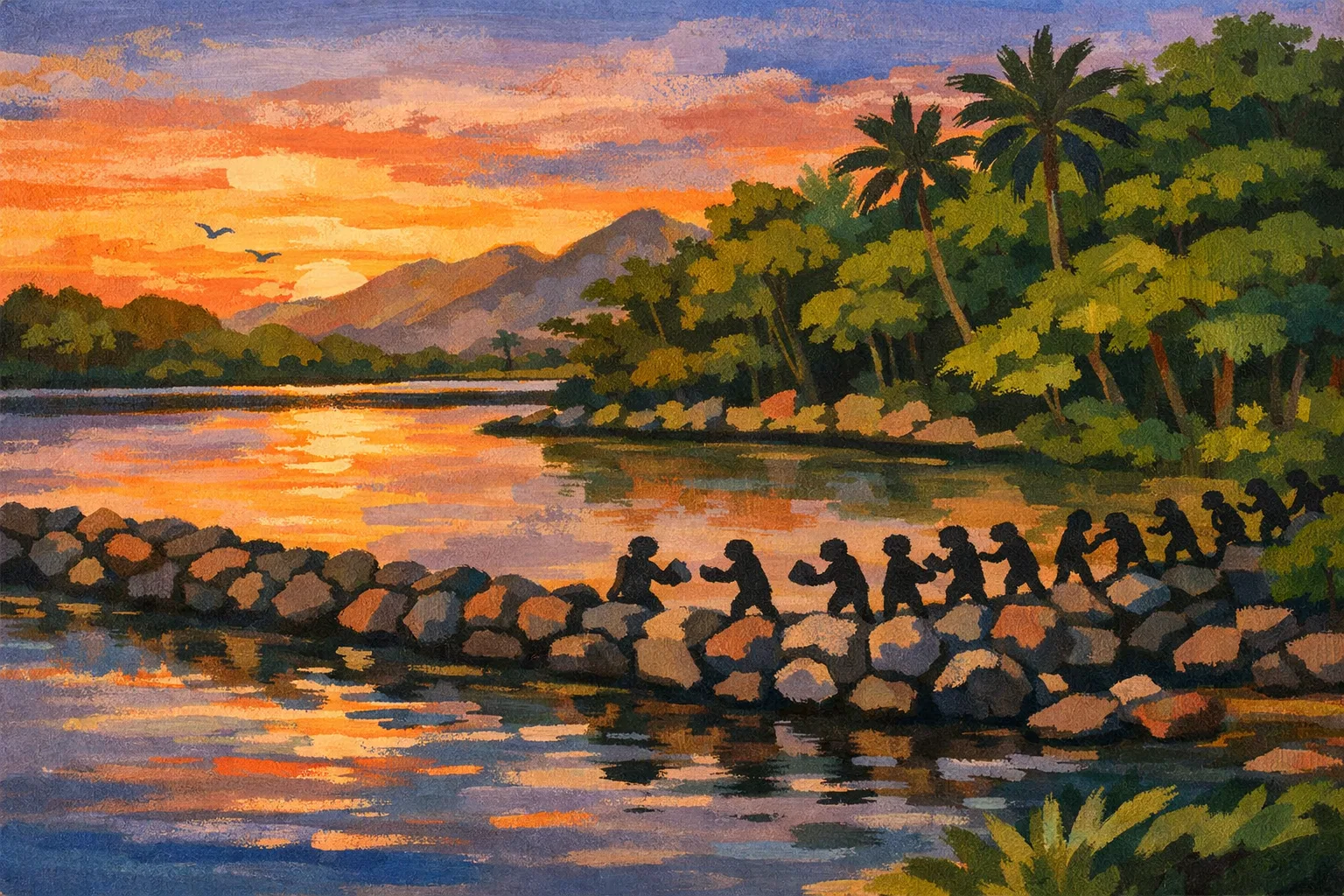
The common modern image is a small, secretive people who work at night and avoid being seen by ordinary humans. The official Hawaii tourism account of Alakoko Fishpond says the Menehune lived in the forest, hid from humans and built the whole fishpond in one night by passing stones hand-to-hand along a long line from Makaweli to the pond site.[Go Hawaii]gohawaii.comOpen source on gohawaii.com.
That story is memorable because it gives the legend three things at once: a hidden race, an impossible deadline and a physical result. It also helps explain why Menehune lore is so search-friendly today. It sounds like a local version of the “little people” traditions found in many parts of the world, but it is rooted in Hawaiian places rather than in generic fairyland. A 2020 comparative study of Polynesian “dwarf people” motifs notes that many Hawaiian Menehune myths concern roads, shrines, ponds and waterways, and that some of these works survive as landscape features attributed to them.[SAV]sav.skMÝTICKÍ STAVITELIA V POLYNÉZIIMÝTICKÍ STAVITELIA V POLYNÉZII
For a cryptid-minded reader, the important question is not whether the old stonework is real. It plainly is. The question is what kind of claim the stonework supports. A wall or ditch can prove that skilled people built something impressive; it does not, by itself, prove that the builders were a vanished race of tiny forest-dwellers. That is where the Menehune become more interesting than a simple “real or fake?” creature story.
Alakoko Fishpond and the one-night building legend
Alakoko Fishpond, often promoted as the Menehune Fishpond, is the centrepiece of the builder legend. It lies near Lihue and Nawiliwili on Kauai, by the Huleia River. Hawaii’s tourism authority describes it as an ancient Hawaiian fishpond built nearly 1,000 years ago and listed on the National Register of Historic Places since 1973. It also identifies it as one of the finest examples of ancient Hawaiian aquaculture.[Go Hawaii]gohawaii.comOpen source on gohawaii.com.
The legend says the Menehune formed a human chain and passed stones from Makaweli, many miles away, to build the fishpond in a single night. In one retelling published by Ka Wai Ola, the Office of Hawaiian Affairs newspaper, the workers carried rough stones from Wahiawa to Niumalu, and the place-name explanation turns on the workers’ bloodied hands after handling sharp rocks. That article presents the Menehune not as European-style magical dwarfs but as an independent people remembered for construction skill.[Ka Wai Ola]kawaiola.newsKa Wai Ola The Menehune: A true race of peopleKa Wai Ola The Menehune: A true race of people
There is a useful tension here. The one-night story is not a construction report in the modern sense. It belongs to the language of legend: speed, secrecy, taboo, collective labour and the cost of looking too closely. Yet the structure itself is not imaginary. The tourism page describes the wall separating the pond from Huleia Stream as a lava-rock wall hundreds of feet long and around five feet high.[Go Hawaii]gohawaii.comOpen source on gohawaii.com.
Recent restoration makes the fishpond even more relevant to modern readers. The Trust for Public Land reports that Alakoko Fishpond and surrounding acreage were protected after the site faced development pressure in 2021; more than 5,500 community members signed a petition, and the land was transferred into local stewardship with plans to restore the pond as a working food source and outdoor classroom.[Trust for Public Land]tpl.orgTrust for Public Land Alakoko FishpondTrust for Public Land Alakoko Fishpond Mālama Huleia, the local stewardship organisation, says the purchase placed the 102-acre property under protection in perpetuity and connected restoration with education, habitat recovery and traditional fishpond systems.[malamahuleia.org]malamahuleia.orgMālama Hulē'ia has purchased the Alakoko property (NovMālama Hulē'ia has purchased the Alakoko property (Nov
That modern restoration changes how the legend reads. The fishpond is not just a spooky relic attached to a hidden-people story. It is a working cultural landscape, with real labour continuing in public view. In 2024, Hawaii’s Department of Land and Natural Resources reported volunteer work on the Alakoko wall and noted earlier removal of 26 acres of invasive mangrove by Mālama Huleia.[Hawaii DLNR]dlnr.hawaii.govthousands of hands help restore 600 year old alakoko fishpond wallthousands of hands help restore 600 year old alakoko fishpond wall The “one-night builders” motif may be legendary, but the broader theme of communal construction, repair and stewardship remains very real.
Kikiaola Ditch and the puzzle of cut basalt
If Alakoko gives the Menehune legend its most famous fishpond, Kikiaola gives it its sharpest engineering puzzle. Kikiaola, commonly called the Menehune Ditch, is a historic irrigation channel near Waimea on Kauai. Historic Hawaii Foundation describes it as a stone-lined watercourse said to have been built by Menehune and notes that its finely cut basalt blocks make it exceptional among Hawaiian irrigation channels.[Historic Hawai‘i Foundation]historichawaii.orgOpen source on historichawaii.org.
The National Register nomination is more precise and more interesting than the tourist shorthand. It says Kikiaola was built prehistorically to irrigate taro patches in lower Waimea Valley. It records a tradition in which Ola, king of Waimea, through his priest Pi, caused the great watercourse to be built; Pi then contacted the Menehune, described in the form as a legendary small people known for overnight construction, to make the ditch features in one night.[Historic Hawai‘i Foundation]historichawaii.orgHistoric Hawai‘i Foundation
The same nomination includes an early European description by Captain George Vancouver, who saw the site in 1792. Vancouver was impressed by a high wall of stones and clay beside the cliff, serving both as a passageway and an aqueduct. That matters because it shows that the engineering feature was already striking to outsiders at the end of the eighteenth century, before the modern tourism industry or internet cryptid culture could amplify it.[Historic Hawai‘i Foundation]historichawaii.orgHistoric Hawai‘i Foundation
Kikiaola’s distinctive detail is the stonework. The National Register statement of significance calls the construction unique for its dressed and jointed stones and says the original wall would have been impressive, with a 24-foot-high faced wall. It also notes that only the upper courses now suggest the former scale because road construction in 1920 buried much of the structure.[Historic Hawai‘i Foundation]historichawaii.orgHistoric Hawai‘i Foundation
This is where the mystery should be kept honest. The cut basalt blocks are unusual, not supernatural. The nomination discusses practical construction questions: possible quarry distance, rough dressing at the quarry, final fitting at the site, and pecking and grinding as probable methods of cutting because the stone would not have split easily.[Historic Hawai‘i Foundation]historichawaii.orgHistoric Hawai‘i Foundation In other words, the ditch is a real archaeological and engineering problem, but the available evidence points towards skilled Hawaiian construction rather than an unknown species or a confirmed hidden race.
Were the Menehune people, spirits or social memory?
The hardest part of the Menehune question is that different answers may be partly true in different registers. Folklore can preserve memory without functioning as literal census data. A name can begin as a social category, become a legendary people, and later be turned into a cryptid-like creature by outsiders and popular media.
One line of interpretation connects Menehune with earlier or subordinate peoples. Ka Wai Ola’s 2022 article presents the Menehune as a real independent people, associated with the Tahitian term “Manahune” and with a subservient class in an ancestral homeland, later remembered in Hawaii as skilled builders.[Ka Wai Ola]kawaiola.newsKa Wai Ola The Menehune: A true race of peopleKa Wai Ola The Menehune: A true race of people A University of Hawaii library guide on historical censuses notes that the first historical population census was undertaken in Wainiha Valley on Kauai near the beginning of the nineteenth century, a point often drawn into discussions of whether “Menehune” could have referred to a real category of people rather than to fantasy beings alone.[guides.library.manoa.hawaii.edu]guides.library.manoa.hawaii.eduOpen source on hawaii.edu.
A second line treats the Menehune as folklore beings whose stories cluster around the traits of hidden people: small size, remote dwellings, night activity, unusual strength, noise, craft skill and avoidance of ordinary society. The 2020 comparative study notes that many myths locate them especially on Kauai, Oahu, Molokai and Maui; it also says they are often regarded simultaneously as real people and supernatural beings, with some people understanding them as real earlier inhabitants who were later folklorised.[SAV]sav.skMÝTICKÍ STAVITELIA V POLYNÉZIIMÝTICKÍ STAVITELIA V POLYNÉZII
A third line is the modern cryptid reading. This version asks whether the Menehune were physically small humanoids still hiding in forests. That is the least supported reading if treated as a zoological claim. The stories are rich, but they do not come with the kind of physical evidence that would establish an unknown living population: no verified remains, no modern biological record, no repeatable sightings in the sense used for animal identification. The stronger material is cultural, linguistic, historical and archaeological.
For readers of strange-creature lore, that does not make the Menehune boring. It makes them a better test case. They show how a “hidden people” tradition can be built from several layers at once:
- A remembered labour force: people who built fishponds, ditches and walls under chiefly direction.
- A social label: a word possibly linked with commoners or people of lower rank.
- A folklore pattern: small, secretive, skilled night-workers who complete great tasks before dawn.
- A landscape explanation: impressive old stonework attributed to extraordinary builders.
- A modern cryptid rebrand: a search for little forest humanoids, often detached from Hawaiian cultural context.
That layered reading is more convincing than either extreme: “they were definitely monsters” or “it is all just nonsense”. The legend has survived because it attaches wonder to real places and because those places still raise fair questions about memory, labour and interpretation.
Why Kauai became the Menehune stronghold
Kauai matters because the Menehune are not evenly distributed in popular imagination. The island has become their strongest modern home, especially through Alakoko, Kikiaola, Waimea traditions and forest-valley settings. The comparative study notes that many Menehune myths come from Kauai and that Kauai’s relative isolation and cultural distinctiveness shaped local traditions.[SAV]sav.skMÝTICKÍ STAVITELIA V POLYNÉZIIMÝTICKÍ STAVITELIA V POLYNÉZII
This helps explain the hidden-people atmosphere. Kauai’s valleys, cliffs, river corridors and old agricultural works provide the kind of terrain where stories of unseen builders feel plausible to the imagination. A tiny race hiding in an urban grid is hard to picture. A people associated with mountains above Waimea, inaccessible valleys and night work fits the island’s storyscape much better. The same study records traditions of the Menehune living in caves, valleys and mountains, with accounts of distinctive behaviour, sports and noisy gatherings.[SAV]sav.skMÝTICKÍ STAVITELIA V POLYNÉZIIMÝTICKÍ STAVITELIA V POLYNÉZII
But Kauai’s importance should not be flattened into a treasure-map claim. The island is not “evidence” of a surviving hidden species. It is the place where several strands overlap: historic irrigation, fishpond aquaculture, named legendary builders, local pride, older recorded traditions and modern visitor storytelling. That overlap made Kauai the natural centre of the Menehune as Hawaii’s most recognisable hidden-people legend.
How tourism and cryptid culture changed the story
Modern readers often meet the Menehune through travel pages, souvenir culture or online cryptid lists. Those formats tend to simplify. The Menehune become “Hawaii’s little people”, “mischievous dwarfs” or “tiny builders”, and the complicated question of social memory disappears behind a charming miniature race.
Official visitor material still preserves part of the older place-based story. Hawaii’s tourism page ties Alakoko directly to ancient aquaculture, the National Register and the one-night building legend, while also giving a sceptical note that the word may relate to a term for commoner or someone small in social rank rather than small in body.[Go Hawaii]gohawaii.comOpen source on gohawaii.com. That is a helpful bridge between folklore tourism and historical caution.
The risk comes when the Menehune are treated like a Hawaiian Bigfoot. Hawaii does not need that import. The Menehune tradition is not mainly a modern eyewitness chase through the woods. Its strongest anchors are older narratives and constructed places. Treating it as a simple undiscovered-humanoid hunt strips away the very features that make it distinct: collective labour, chiefly command, water management, stone skill, social rank and memory of earlier peoples.
The better cryptid-page approach is to keep two truths together. First, the Menehune are not confirmed creatures in the biological sense. Second, their legend is not empty. It is a serious hidden-people tradition attached to real Hawaiian engineering, especially on Kauai, and it has continued to change as Hawaiians, scholars, visitors and internet audiences ask different questions of the same old stones.
The best answer to the hidden-people question
So were the Menehune creatures, people or memory? The most evidence-aware answer is: memory and folklore first, possible people in some traditions, cryptid creature only in later rebranding.
Alakoko Fishpond and Kikiaola Ditch show why the legend endured. Both are impressive built places. Both have strong Kauai associations. Both invite the feeling that ordinary explanations are not enough, even though the archaeological evidence points towards skilled human construction rather than non-human builders.[gohawaii.com]gohawaii.comOpen source on gohawaii.com.
The “hidden people” question remains powerful because it asks more than whether tiny beings once carried stones in the dark. It asks how communities remember old labour, how social categories turn into mythic peoples, how engineering becomes wonder, and how modern cryptid culture can both revive and distort local tradition. In Hawaii’s monster-and-mystery landscape, the Menehune are therefore not best understood as a lost animal. They are a folklore doorway into Kauai’s old stoneworks, water systems and contested memories of who built the islands’ most storied places.
Amazon book picks
Further Reading
Books and field guides related to Were the Menehune Creatures, People or Memory?. Use these as the next step if you want deeper reading beyond the article.
Native Planters in Old Hawaii: Their Life, Lore, and Environment
Provides historical context for interpretations of Menehune stories.
Tales from the Night Rainbow
Introduces traditional Hawaiian worldviews and oral history.
eBay marketplace picks
Marketplace Samples
Live-tested eBay searches with available results related to this page.
Endnotes
1.
Source: sav.sk
Title: MÝTICKÍ STAVITELIA V POLYNÉZII
Link:https://www.sav.sk/journals/uploads/1204091203_Buckova_FINAL.pdf
2.
Source: malamahuleia.org
Title: Mālama Hulē’ia has purchased the Alakoko property (Nov
Link:https://malamahuleia.org/2021/11/19/purchase-complete-alakoko-is-protected-forever/
3.
Source: dlnr.hawaii.gov
Title: thousands of hands help restore 600 year old alakoko fishpond wall
Link:https://dlnr.hawaii.gov/occl/2024/08/08/thousands-of-hands-help-restore-600-year-old-alakoko-fishpond-wall/
4.
Source: historichawaii.org
Title: Historic Hawai‘i Foundation
Link:https://historichawaii.org/wp-content/uploads/NR_Kauai_Waimea_MenehuneDitch84000270.pdf
5.
Source: guides.library.manoa.hawaii.edu
Link:https://guides.library.manoa.hawaii.edu/c.php?g=105181&p=684171
6.
Source: kauai.com
Link:https://www.kauai.com/menehune-fishpond
7.
Source: dlnr.hawaii.gov
Title: HistoricRegisters 08Sept2022.xlsx
Link:https://dlnr.hawaii.gov/shpd/files/2022/09/HistoricRegisters_08Sept2022.xlsx
8.
Source: dlnr.hawaii.gov
Title: HistoricRegisters 09Mar2026 1.xls
Link:https://dlnr.hawaii.gov/shpd/files/2026/03/HistoricRegisters_09Mar2026-1.xls
9.
Source: dlnr.hawaii.gov
Title: Review and Compliance Report March 16 2018
Link:https://dlnr.hawaii.gov/shpd/files/2018/03/Review-and-Compliance-Report-March-16-2018.pdf
10.
Source: dlnr.hawaii.gov
Link:https://dlnr.hawaii.gov/occl/files/2017/12/Loko-Ia-KA-18-01-Alekoko.pdf
11.
Source: dlnr.hawaii.gov
Title: Determinations Report January 1 December 30 2016
Link:https://dlnr.hawaii.gov/shpd/files/2013/08/Determinations-Report-January-1-December-30-2016.pdf
12.
Source: files.hawaii.gov
Title: Historical Statistics of Hawaii
Link:https://files.hawaii.gov/dbedt/economic/data_reports/Historical-Statistics-of-Hawaii.pdf
13.
Source: sav.sk
Link:https://www.sav.sk/journals/uploads/0528085402_Buckova_PART2_FINAL.pdf
14.
Source: malamahuleia.org
Title: kauai high athletes remove mangrove from alakoko
Link:https://malamahuleia.org/2019/08/26/kauai-high-athletes-remove-mangrove-from-alakoko/
15.
Source: malamahuleia.org
Link:https://malamahuleia.org/
16.
Source: malamahuleia.org
Link:https://malamahuleia.org/huleia-mangrove-removed/
17.
Source: library.honolulu.hawaii.edu
Link:https://library.honolulu.hawaii.edu/hawlit
18.
Source: scholarspace.manoa.hawaii.edu
Link:https://scholarspace.manoa.hawaii.edu/bitstreams/f7cf1cea-afb0-4de1-bfe0-8ef7b6417326/download
19.
Source: historic.one
Link:https://historic.one/amp/hi/kauai-county/national-register-listing/kikiaola
20.
Source: youtube.com
Title: Alekoko Fishpond, Nawiliwili, Kauai, Hawaii
Link:https://www.youtube.com/watch?v=jALOeVluVk8
Source snippet
Go Hawaii...
21.
Source: gohawaii.com
Link:https://www.gohawaii.com/islands/kauai/regions/lihue/alekoko-fishpond
22.
Source: historichawaii.org
Link:https://historichawaii.org/historic-property-ka/kikiaola-menehune-ditch/
23.
Source: kawaiola.news
Title: Ka Wai Ola The Menehune: A true race of people
Link:https://kawaiola.news/columns/ka-naauao-o-na-kupuna/the-menehune-a-true-race-of-people/
24.
Source: tpl.org
Title: Trust for Public Land Alakoko Fishpond
Link:https://www.tpl.org/our-work/alakoko-fishpond
25.
Source: historichawaii.org
Link:https://historichawaii.org/historic-property-ka/menehune-fishpond-alekoko-fishpond/
26.
Source: historichawaii.org
Link:https://historichawaii.org/wp-content/uploads/Kauai_Lihue_Menehune-Fishpond_NR-Nomination-Form.pdf
27.
Source: historichawaii.org
Title: the alakoko pond nawiliwili 2009
Link:https://historichawaii.org/mes/the-alakoko-pond-nawiliwili-2009/
28.
Source: Wikipedia
Link:https://en.wikipedia.org/wiki/Menehune
29.
Source: Wikipedia
Title: Menehune Fishpond
Link:https://en.wikipedia.org/wiki/Menehune_Fishpond
30.
Source: Wikipedia
Link:https://de.wikipedia.org/wiki/Menehune
31.
Source: ulukau.org
Link:https://www.ulukau.org/ulukau-books/?a=d&d=EBOOK-BECKWIT1.1.368
32.
Source: kawaiola.news
Title: news briefs december 2021
Link:https://kawaiola.news/nuhou/pokenuhou/news-briefs-december-2021/
Published: december 2021
33.
Source: catalogue.nla.gov.au
Link:https://catalogue.nla.gov.au/catalog/1975305
34.
Source: shakaguide.com
Title: The Menehune
Link:https://www.shakaguide.com/article/kauai/the-menehune—leprechauns-or-natives
35.
Source: tpl.org
Title: kauai alakoko menehune ancient fishpond protected
Link:https://www.tpl.org/blog/kauai-alakoko-menehune-ancient-fishpond-protected
36.
Source: worldhistory.org
Link:https://www.worldhistory.org/Menehune/
37.
Source: aubreyresearch.com
Title: Menehune Fishpond | Historic Lihue, Hawaii
Link:https://www.aubreyresearch.com/us/historic-sites/hi/menehune-fishpond
Additional References
38.
Source: youtube.com
Title: The Menehune: Did The Tiny Natives Of Ancient Hawaii Actually Exist?
Link:https://www.youtube.com/watch?v=1DPSjRdBE18
Source snippet
Hawaii's Legend of the Menehune | STUFF YOU MISSED IN HISTORY CLASS...
39.
Source: youtube.com
Title: Hawaii’s Legend of the Menehune | STUFF YOU MISSED IN HISTORY CLASS
Link:https://www.youtube.com/watch?v=VlQ5DNe6wBw
Source snippet
Tales of the Menehune with Auntie Aletha...
40.
Source: facebook.com
Link:https://www.facebook.com/civilbeat/posts/roughly-2000-volunteers-helped-build-the-final-380-feet-of-a-wall-enclosing-an-8/1284021113770034/
41.
Source: facebook.com
Link:https://www.facebook.com/100090372200308/posts/hawaiian-traditions-describe-the-menehune-as-a-race-of-small-highly-skilled-buil/923710030651395/
42.
Source: facebook.com
Link:https://www.facebook.com/ourfakehistory/posts/in-the-latest-episode-we-explore-the-tales-of-the-menehune-hawaiis-beloved-magic/1192221665552952/
43.
Source: facebook.com
Link:https://www.facebook.com/groups/1478535869139825/posts/3519873475006044/
44.
Source: facebook.com
Link:https://www.facebook.com/ikaikaloha239/videos/k%C4%ABk%C4%ABaola-also-known-as-the-menehune-ditch-is-a-historic-%CA%BBauwai-system-located-in/1199413958003782/
45.
Source: instagram.com
Link:https://www.instagram.com/reel/DVJQa6Gj_Dv/?hl=en
46.
Source: instagram.com
Link:https://www.instagram.com/malama_huleia/
47.
Source: scribd.com
Link:https://www.scribd.com/document/515856454/Menehune
Topic Tree