Within Arizona Monsters
Is the Mogollon Monster Arizona's Bigfoot?
Arizona's Bigfoot story lives in the pine forests, Scout-camp tales and bear country of the Mogollon Rim.
On this page
- Where the Rim country sightings cluster
- The Scout camp story and early wild man accounts
- Bears, darkness and the evidence problem
Page outline Jump by section
Introduction
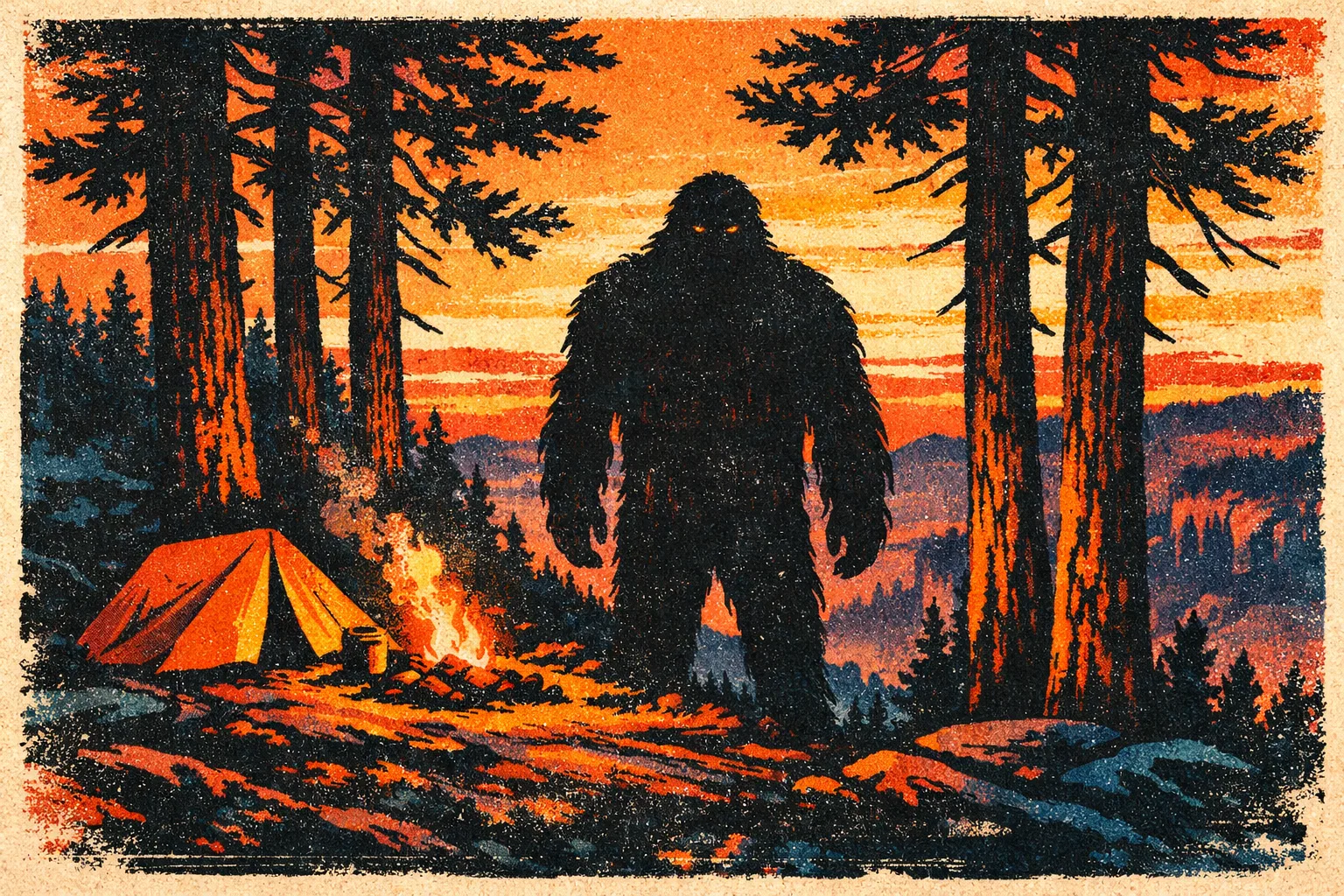
The Mogollon Monster is best understood as Arizona’s own Bigfoot tradition: a tall, hairy, bad-smelling, mostly nocturnal figure said to haunt the forests, camps and canyon edges of the Mogollon Rim. The legend matters because it is not simply a copy of Pacific Northwest Sasquatch lore dropped into the desert. It belongs to Arizona’s high country: the pine belt above Payson, the White Mountains, old Scout-camp storytelling, reservation-area reports and the long, shadowy escarpment where the Colorado Plateau falls away into central Arizona. The evidence, however, is thin. What exists is a chain of newspaper-style wild-man tales, campfire accounts, witness claims, alleged sounds, footprints and hair, but not a verified body, DNA sample, clear photograph or accepted zoological record. The strongest sceptical explanations are misidentified bears or other wildlife, darkness, expectation, folklore repetition, hoaxes and the simple difficulty of judging size, sound and movement in rugged forest at night.[EBSCO]ebsco.comMogollon Monster (mythology) | Religion and Philosophy | Research Starters | EBSCO Research…
Where the Rim-country sightings cluster
Mogollon Monster reports are usually placed in the band of high country that runs across north-central and eastern Arizona rather than in the state’s low desert. The geographical centre is the Mogollon Rim, a long escarpment that marks the southern edge of the Colorado Plateau. The U.S. Forest Service describes the Mogollon Rim Ranger District as a 506,840-acre area of rugged escarpment, dropping as much as 2,000 feet in places and combining plateau views, canyon country, lakes, trails and forest recreation. That is exactly the kind of terrain in which a glimpse across distance, a crash in the brush or a scream from a draw can become difficult to interpret.[US Forest Service]fs.usda.govOpen source on usda.gov.
The tourist version of the same landscape reinforces why the legend feels local rather than generic. Visit Arizona describes the Rim as cutting about 200 miles across north-eastern Arizona, with dense pine forests, cool mountain lakes, high summer recreation areas and communities such as Payson, Pine-Strawberry, Heber-Overgaard, Show Low and Pinetop-Lakeside forming part of the visitor corridor. Those are not incidental details. The Mogollon Monster is repeatedly remembered around roads, lakes, campsites and summer escape routes where people from lower, hotter Arizona enter darker, cooler forests and expect a different sort of wilderness.[Visit Arizona]visitarizona.comVisit Arizona Mogollon Rim | Visit ArizonaVisit Arizona Mogollon Rim | Visit Arizona
Folklore summaries usually place the sighting belt around the Rim edge and nearby mountain towns. EBSCO’s mythology overview says the creature is associated with the pine-covered hills of the Mogollon Rim and notes that reports are more common near Prescott, Williams, Winslow and Payson. Other retellings extend the range eastward towards the White Mountains, Show Low, Alpine and Fort Apache-area communities. The exact boundary shifts from source to source, which is itself revealing: this is not a biological range map, but a story map built from repeated claims, outdoor memories and local names.[EBSCO]ebsco.comMogollon Monster (mythology) | Religion and Philosophy | Research Starters | EBSCO Research…
That flexible map gives the Mogollon Monster one of its strongest narrative advantages. The Rim is large enough to feel secretive but accessible enough for ordinary campers, anglers, hunters, Scouts and hikers to imagine themselves near the creature’s territory. A monster in a completely unreachable wilderness would be remote folklore; a monster near familiar forest roads and lakes becomes a story people can retell after every strange noise outside the tent.
The Scout-camp story and early wild-man accounts
The story’s oldest commonly cited ancestor is not originally called the Mogollon Monster. It is the “wild man” account linked to I.W. Stevens in 1903, usually described as a newspaper tale involving a strange hairy figure near the Grand Canyon. Later cryptid summaries say Stevens described a long-haired, bearded, grey-bodied creature, seen near a dead cougar, and folded this dramatic account into the Mogollon Monster’s prehistory. Arizona Highways treats the 1903 “Wild Man in Grand Canyon” story as the legend’s “urtext”, while later secondary accounts identify Stevens’s creature as a wild-man precursor rather than firm evidence of a named species.[Arizona Highways]arizonahighways.comOpen source on arizonahighways.com.
That distinction matters. A “wild man” report from the early twentieth-century frontier press is not the same as a modern Bigfoot sighting. Old newspapers often printed sensational wilderness stories, and the Stevens account includes melodramatic details — a club, claws, blood, a frightening scream — that read more like a tall tale than field observation. It still matters because it supplies motifs that later Mogollon Monster stories reuse: hairiness, violence, remote canyon terrain, a human-like shape and a sound that feels beyond ordinary wildlife.[EBSCO]ebsco.comMogollon Monster (mythology) | Religion and Philosophy | Research Starters | EBSCO Research…
The more recognisably local strand comes through Scout-camp storytelling. Arizona Highways notes that the name “Mogollon Monster” does not appear to surface in newspapers until a 1967 article about a Boy Scout camping trip in the White Mountains; the article reportedly mentions the creature as though readers already understand the reference, saying some boys claimed to have seen it. That is a useful clue. By the time the name reached print, the legend may already have been circulating orally around camps, cabins and youth trips.[Arizona Highways]arizonahighways.comOpen source on arizonahighways.com.
One of the best-known Scout-related accounts is associated with Don Davis, later known in Bigfoot circles, who said he saw a large reddish-brown figure during a Scout trip near the base of the Rim outside Payson in the early 1940s. Retellings describe a bulky, hairy, square-headed figure, sometimes with a hairless face and a strong smell. Whether treated as memory, testimony or folklore, the story helped lock the Mogollon Monster into a particular social setting: boys in the woods, adults retelling the tale, and Arizona’s high-country camps turning a scary night into local tradition.[Arizona Highways]arizonahighways.comOpen source on arizonahighways.com.
What witnesses tend to claim
Most Mogollon Monster descriptions follow the broader Bigfoot pattern but with a Rim-country flavour. The creature is usually described as taller than a person, covered in dark, brown or reddish hair, walking upright, giving off a foul smell and appearing at night or in low light. Some accounts add red or green eyes, long strides, large footprints, stone-throwing, whistling, camp disturbance, screams and strange silence in the woods before the encounter. EBSCO’s overview summarises the common image as a hair-covered humanoid at least seven feet tall, with a hairless face and unusually large footprints, while noting that credible scientific evidence has not been found.[EBSCO]ebsco.comMogollon Monster (mythology) | Religion and Philosophy | Research Starters | EBSCO Research…
The most interesting modern cluster is not just “someone saw a Bigfoot”. It is the way reports combine small physical traces with powerful sensory impressions. A 2006 report by Scott Davis for 3TV, later archived from the Arizona Daily Star/Tucson.com, opened with “footprints in the mud”, “tufts of hair on a fence” and night-time screeches in the White Mountains. The same story quoted White Mountain Apache spokeswoman Collette Altaha saying there had been more sightings than before, and it described Marjorie Grimes as one of several people claiming sightings over a 25-year span, including one in 2004 while driving home from Cibecue.[archive.ph]archive.phStory, video: Apaches go public with Bigfoot sightingsStory, video: Apaches go public with Bigfoot sightings
Those claims are valuable as folklore evidence, not zoological proof. They show that the creature story has been meaningful enough for residents, reporters and Bigfoot investigators to discuss publicly. They do not show that a breeding population of unknown primates lives in Arizona. Hair on a fence can come from known animals; tracks in mud can distort; screams are difficult to identify; and witness sincerity does not guarantee accurate perception. The White Mountains accounts are therefore best read as a serious local claim cluster, but one still lacking the sort of physical chain of custody that would move the case from legend into biology.[archive.ph]archive.phStory, video: Apaches go public with Bigfoot sightingsStory, video: Apaches go public with Bigfoot sightings
Bigfoot enthusiast databases keep the tradition active by collecting individual Arizona reports. For example, the Bigfoot Field Researchers Organization lists Arizona claims around places such as Fool Hollow Lake near Show Low and the rugged Mogollon Rim, with reports involving sightings, knocks or vocalisations. Such databases are useful for seeing where believers and witnesses place the pattern, but they are not neutral scientific surveys. They collect self-reported cases from people already framing an experience as potentially Bigfoot-related.[bfro.net]bfro.netshow report.aspshow report.asp

Bears, darkness and the evidence problem
The main sceptical explanation is not that every witness is lying. It is that the Rim has the right ingredients for honest mistakes. Arizona Game and Fish says black bears occupy about 10,000 square miles of non-tribal lands in Arizona, mostly in the north and eastern half of the state, and that relative densities are highest along the Mogollon Rim, the Mazatzal Mountains, and the White and Pinaleño mountains. In other words, the best-known Mogollon Monster zone overlaps strongly with real bear country.[Arizona Game & Fish Department]azgfd.comArizona Game & Fish Department Black BearArizona Game & Fish Department Black Bear
Black bears are not normally seven-foot ape-men, but they can look startlingly human-like in fragments. A bear standing briefly on its hind legs, moving behind trees, crossing a road at dusk or rummaging near a campsite can become larger and stranger in memory. Arizona Game and Fish also warns that people create bear conflicts by recreating or living in bear habitat and giving bears access to human food. That detail fits many camp-based monster stories: something large, dark and smelly near a tent or cabin may be mysterious in the moment but still entirely consistent with known wildlife.[Arizona Game & Fish Department]azgfd.comArizona Game & Fish Department Living With BearsArizona Game & Fish Department Living With Bears
Older “wild man” claims sometimes draw a further animal comparison: grizzly bears. The U.S. Fish and Wildlife Service notes that grizzlies had been reduced to close to 2 per cent of their former range in the contiguous United States by the 1930s, while conservation summaries commonly describe Arizona grizzlies as extirpated by the mid-1930s. That makes grizzlies a possible historical context for some early Arizona monster or wild-animal fear, but not a good explanation for present-day Mogollon Monster sightings. For modern reports, black bears, elk, mountain lions, humans, shadows and hoaxes are more plausible candidates.[U.S. Fish and Wildlife Service]fws.govOpen source on fws.gov.
The sound problem is just as important as the sight problem. Many Mogollon Monster accounts emphasise screams, whistles or whoops. Night sounds in forests travel oddly, especially around canyons, lakes and slopes. A frightened listener may not know whether a call came from a mountain lion, fox, elk, owl, person, bear or something else. Once the Mogollon Monster is already part of the local story-world, an unidentified scream is no longer just an unidentified scream. It arrives with a ready-made name.
The hardest evidence problem is absence. If a large unknown primate or hominid lived across central and eastern Arizona, sceptics would expect more than stories: clear repeated photographs, roadkill, bones, scat, unambiguous hair DNA, museum specimens, reliable tracks with context, or ecological evidence of a breeding population. Arizona Highways summarises the position neatly for general readers: there have been sightings in the White Mountains and along the Mogollon Rim, but no definitive proof after all these years.[Arizona Highways]arizonahighways.comOpen source on arizonahighways.com.
Why the legend survives without proof
The Mogollon Monster survives because it is a good Arizona story even when treated sceptically. It turns the state’s familiar contrast — desert below, pine forest above — into a monster map. It gives Scout camps, Rim Road, Payson-area lakes and White Mountains drives a shared piece of spooky local colour. It also offers a regional answer to a national question: if the Pacific Northwest has Sasquatch, what does Arizona have in its own forests?
The legend has also moved beyond sightings into recreation and branding. The Mogollon Monster 100, a demanding trail race near Pine, uses the name partly because the course itself is a “monster” and partly because the mythical Bigfoot-like creature is allegedly associated with the area. Race descriptions emphasise the rugged Rim terrain, steep climbs and long distance, which shows how the name now works even for people who do not believe in the creature. The monster has become shorthand for the Rim’s difficulty, wildness and local identity.[Aravaipa Running]aravaiparunning.comOpen source on aravaiparunning.com.
This afterlife does not prove the creature exists, but it does prove the legend has cultural weight. A weak cryptid story fades when nobody repeats it. The Mogollon Monster keeps being useful: as a campfire scare, a regional Bigfoot variant, a tourism hook, a race name, a local mystery and a way to make Arizona’s high forests feel less ordinary.
The fairest conclusion is therefore double-sided. As folklore, the Mogollon Monster is one of Arizona’s strongest creature traditions, rooted in specific places, repeated through Scout and camp culture, and refreshed by White Mountains and Rim-country sighting claims. As evidence for an unknown animal, it remains unconvincing. The sightings are intriguing, sometimes sincere and often vivid, but the explanations offered by known wildlife, darkness, memory, expectation and storytelling still do more work than the monster itself.
Amazon book picks
Further Reading
Books and field guides related to Is the Mogollon Monster Arizona's Bigfoot?. Use these as the next step if you want deeper reading beyond the article.
eBay marketplace picks
Marketplace Samples
Live-tested eBay searches with available results related to this page.




Endnotes
1.
Source: ebsco.com
Link:https://www.ebsco.com/research-starters/religion-and-philosophy/mogollon-monster-mythology
Source snippet
Mogollon Monster (mythology) | Religion and Philosophy | Research Starters | EBSCO Research...
2.
Source: archive.ph
Title: Story, video: Apaches go public with Bigfoot sightings
Link:https://archive.ph/Iwz0d
3.
Source: bfro.net
Title: show report.asp
Link:https://www.bfro.net/gdb/show_report.asp?id=47536
4.
Source: bfro.net
Title: show report.asp
Link:https://www.bfro.net/gdb/show_report.asp?id=28642
5.
Source: azgs.arizona.edu
Title: john bezys mogollon rim arizona geology vegetation wildlife
Link:https://azgs.arizona.edu/news/john-bezys-mogollon-rim-arizona-geology-vegetation-wildlife
6.
Source: azgs.arizona.edu
Link:https://azgs.arizona.edu/about-us/news?page=6
7.
Source: azgs.arizona.edu
Title: island mountains southeastern arizona new down earth booklet
Link:https://azgs.arizona.edu/news/island-mountains-southeastern-arizona-new-down-earth-booklet
8.
Source: arizonahighways.com
Link:https://www.arizonahighways.com/article/neither-hide-nor-hair
9.
Source: fs.usda.gov
Link:https://www.fs.usda.gov/r03/coconino/recreation/mogollon-rim-ranger-district
10.
Source: visitarizona.com
Title: Visit Arizona Mogollon Rim | Visit Arizona
Link:https://www.visitarizona.com/places/parks-monuments/mogollon-rim
11.
Source: Wikipedia
Title: Mogollon Monster
Link:https://en.wikipedia.org/wiki/Mogollon_Monster
12.
Source: azgfd.com
Title: Arizona Game & Fish Department Black Bear
Link:https://www.azgfd.com/species/black-bear/
13.
Source: azgfd.com
Title: Arizona Game & Fish Department Living With Bears
Link:https://www.azgfd.com/wildlife-conservation/living-with-wildlife/living-with-bears/
14.
Source: fws.gov
Link:https://www.fws.gov/species/grizzly-bear-ursus-arctos-horribilis
15.
Source: aravaiparunning.com
Link:https://www.aravaiparunning.com/mogollon-monster-2/
16.
Source: visitarizona.com
Link:https://www.visitarizona.com/events/mogollon-monster-100
17.
Source: Wikipedia
Link:https://en.wikipedia.org/wiki/Arizona
18.
Source: Wikipedia
Title: Mogollon Rim
Link:https://en.wikipedia.org/wiki/Mogollon_Rim
19.
Source: Wikipedia
Link:https://en.wikipedia.org/wiki/Bigfoot
20.
Source: facebook.com
Link:https://www.facebook.com/azgfd/posts/with-more-than-5000-black-bears-roaming-arizonas-forests-and-high-country-these-/902333835259022/
21.
Source: azgfd.com
Link:https://www.azgfd.com/hunting/hunt-draw-and-licenses/species-hunt-information/black-bear-hunting-in-arizona/
22.
Source: awcs.azgfd.com
Title: bear springs
Link:https://awcs.azgfd.com/conservation-opportunity-areas/terrestrial/bear-springs
23.
Source: awcs.azgfd.com
Title: conservation opportunity areas
Link:https://awcs.azgfd.com/conservation-opportunity-areas
24.
Source: azgfd.com
Link:https://www.azgfd.com/2025/10/02/hunters-check-harvest-thresholds-before-bear-hunts/
25.
Source: azgfd.com
Title: wild about arizona black bear natural history and biology
Link:https://www.azgfd.com/event/wild-about-arizona-black-bear-natural-history-and-biology/
26.
Source: fs.usda.gov
Link:https://www.fs.usda.gov/wildflowers/regions/southwestern/RimLakes/index.shtml
27.
Source: cryptidz.fandom.com
Title: Mogollon Monster
Link:https://cryptidz.fandom.com/wiki/Mogollon_Monster
28.
Source: itsmth.fandom.com
Title: Mogollon Monster
Link:https://itsmth.fandom.com/wiki/Mogollon_Monster
29.
Source: arizonahighways.com
Link:https://www.arizonahighways.com/archive/issues/chapter/Doc.540.Chapter.1
30.
Source: ultrasignup.com
Title: Mogollon Monster 100
Link:https://ultrasignup.com/register.aspx?did=130408
31.
Source: aravaiparunning.com
Title: my mogollon monster 100 experience
Link:https://www.aravaiparunning.com/2017/09/29/my-mogollon-monster-100-experience/
32.
Source: aravaiparunning.com
Link:https://aravaiparunning.com/network/wp-content/uploads/2019/08/MOG-100-2019-Race-Manual.pdf
33.
Source: visitarizona.com
Link:https://www.visitarizona.com/like-a-local/hunting-and-fishing-in-arizona-payson-and-the-mogollon-rim
34.
Source: visitarizona.com
Link:https://www.visitarizona.com/
35.
Source: divergentrays.com
Title: The Mogollon Monster
Link:https://divergentrays.com/mogollonmonster
36.
Source: tripadvisor.com
Title: Mogollon Rim
Link:https://www.tripadvisor.com/Attraction_Review-g31305-d263143-Reviews-Mogollon_Rim-Payson_Arizona.html
Additional References
37.
Source: az.gov
Link:https://az.gov/
38.
Source: youtube.com
Title: Is This Proof Arizona’s ‘Bigfoot’ Exists? | UNEXPLAINED
Link:https://www.youtube.com/watch?v=Gfjj2rsbnzg
Source snippet
Bigfoot News! The Mogollon Monster Photo Breakdown...
39.
Source: youtube.com
Title: Mogollon Monster: Arizona’s WILD MAN of the Rocks
Link:https://www.youtube.com/watch?v=d9YvtCrCR9o
Source snippet
Is This Proof Arizona's 'Bigfoot' Exists? | UNEXPLAINED...
40.
Source: pinterest.com
Link:https://www.pinterest.com/seanwade6/bigfoot/
41.
Source: facebook.com
Link:https://www.facebook.com/bradysealsmusic/posts/25-days-yall-until-my-greatest-hits-a-few-family-gems-record-drops-its-sneakin-u/1308252681109326/
42.
Source: instagram.com
Link:https://www.instagram.com/reel/DCnOLAOSpLR/?hl=en
43.
Source: instagram.com
Link:https://www.instagram.com/reel/DTWOMfemNso/
44.
Source: scribd.com
Link:https://www.scribd.com/document/485796257/American-Myths-Legends-and-Tall-Tales-An-Encyclopedia-of-American-Folklore-3-Volumes
45.
Source: fvza.org
Link:https://fvza.org/prbigfoot.html
46.
Source: facebook.com
Link:https://www.facebook.com/RogerNaylorinAZ/posts/arizona-is-known-as-the-grand-canyon-state-but-another-geological-feature-define/801695917978901/
Topic Tree