Within Tennessee Monsters
What Made the White Bluff Screamer So Frightening?
The White Bluff Screamer shows how a terrifying night sound can grow into one of Tennessee's most memorable local monsters.
On this page
- Trace Creek and the family legend
- Missing evidence for the massacre story
- Animal screams and community memory
Page outline Jump by section
Introduction
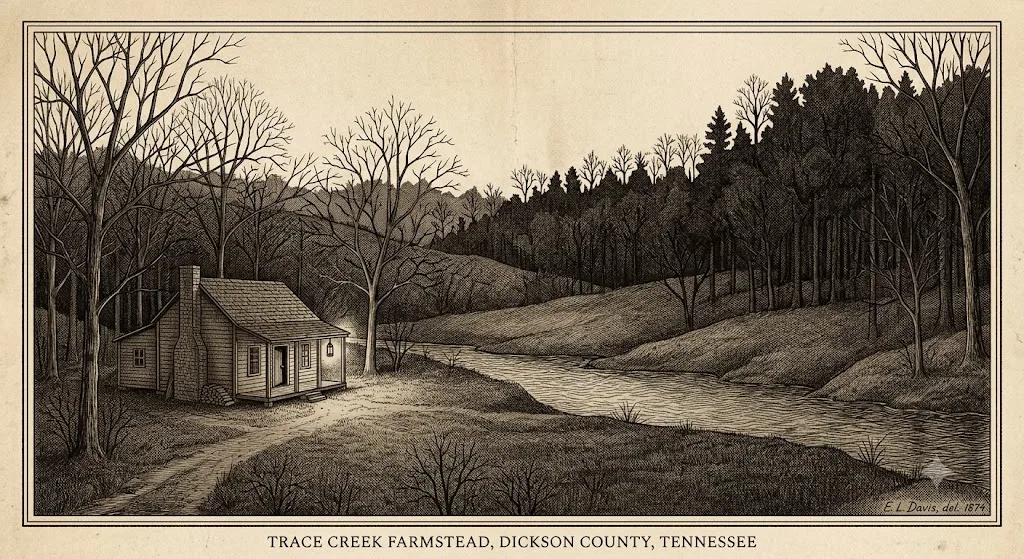
The White Bluff Screamer is not a well-documented animal case so much as a lesson in how a sound can become a monster. The legend belongs to White Bluff and the Trace Creek area of Dickson County, Tennessee, where later tellings place a 1920s family, night-time screams from the woods, a father who went out with a gun, and a dreadful return to a cabin where his wife and children had supposedly been killed. The strongest modern local account openly says there is no historical evidence for that massacre, but it also records something more durable: residents remembered strange screams, possible sightings, and a creature imagined as large, pale, and cat-like.[Dickson County History]dicksoncountyhistory.comOpen source on dicksoncountyhistory.com.
That combination is what makes the story frightening. The Screamer does not begin with a clear body, track, photograph or specimen. It begins with a noise that sounds almost human, travels strangely through wooded hollows, and invites people to supply the missing shape. In Tennessee’s broader cryptid landscape, that makes it different from a Bigfoot-style sighting. The White Bluff Screamer is a local legend made from sound first and creature second.
Trace Creek and the family legend
The best-known version places the story in the 1920s, “in the hollers of Trace Creek near the old town of White Bluff”, where a man, his wife and seven children began hearing night cries from the surrounding woods. The sound is important because it is described in two overlapping ways: like an animal, but also like “the screams of a young girl”. That ambiguity is the engine of the legend. If it had sounded only like a dog, owl or fox, it might have stayed a nuisance. Because it sounded partly human, the family’s fear becomes believable even before any monster appears.[Dickson County History]dicksoncountyhistory.comOpen source on dicksoncountyhistory.com.
The narrative then turns into a classic backwoods warning tale. The father, unable to sleep and wanting to protect his family, takes his gun and follows the cries into the woods. The screaming stops, then begins again from the direction of the house. He runs back and finds, in the legend’s most gruesome detail, that his family has been “torn to shreds” by an unknown beast. After that, other residents are said to have reported howls and screams, and the thing gains its name: the White Bluff Screamer.[Dickson County History]dicksoncountyhistory.comOpen source on dicksoncountyhistory.com.
A later folkloric retelling keeps the same core but intensifies the atmosphere. It places Trace Creek near modern Highway 47, southwest of Montgomery Bell State Park, and describes the father struggling to locate the cries because the sound seems to move around him, echo through the trees, or even circle him. That is a useful detail, whether or not one accepts the tale literally, because it captures how sound behaves in wooded hollows: direction can be hard to judge, especially at night, in fog, or under fear.[Lyle S. Russell]lylerussell.netOpen source on lylerussell.net.
White Bluff itself gives the story a fitting setting. The town traces its name to white bluffs near Turnbull Creek and to early nineteenth-century settlement around Fort White Bluffs and the White Bluff Iron Forge. It is not an invented horror-map location; it is a real Middle Tennessee community with old roads, creek bottoms, farms and woods close enough to Nashville for the legend to travel, but rural enough for a screaming thing in the dark to feel locally plausible.[Town of White Bluff]townofwhitebluff.govTown of White Bluff History of White Bluff | Town of White BluffTown of White Bluff History of White Bluff | Town of White Bluff

Why the scream matters more than the monster
Many cryptid stories begin with a shape: a tall hairy figure, a winged silhouette, a black panther crossing a road. The White Bluff Screamer begins with an acoustic problem. People hear something they cannot place, then memory and storytelling build a creature around the gap.
That is why the Screamer can shift between forms. In one local account, nobody really knows what it looks like, though one White Bluff resident thought of it as a “large cat-like animal”, similar to a mountain lion. In another version, the father sees either a ghostly female figure in white mist or a huge white-furred beast with claws and teeth. Those are not minor differences. They show the legend changing according to the teller’s preferred explanation: animal, cryptid, ghost, warning spirit, or campfire monster.[Dickson County History]dicksoncountyhistory.comOpen source on dicksoncountyhistory.com.
The name also does careful work. “White Bluff Screamer” sounds specific, local and repeatable. It does not say “unknown animal near White Bluff” or “possible cougar scream”; it turns a place and a noise into a character. Once that happens, later experiences can attach themselves to the same label. A frightening cry in the woods, a camping scare, a story from a parent, or a rumour about an old cabin can all become “the Screamer” rather than separate incidents.
The local account also makes clear that the legend was used socially. People in White Bluff told the story to scare children or campers, especially outdoors. That does not make it worthless; it tells us what kind of folklore it is. The Screamer works as a boundary-marker story: it makes the woods beyond the house feel alive, risky and watched.[Dickson County History]dicksoncountyhistory.comOpen source on dicksoncountyhistory.com.
Missing evidence for the massacre story
The weakest part of the legend is the massacre. A family of nine supposedly killed in a rural Tennessee cabin in the twentieth century should, in principle, have left some kind of trace: newspaper coverage, death records, court records, burial records, local legal memory, or at least names. The modern Dickson County history account says that local historian Tony England found no historical evidence that the Screamer killed the family in the story. Another retelling likewise says that no records of such a terrible murder could be found.[Dickson County History]dicksoncountyhistory.comOpen source on dicksoncountyhistory.com.
That absence matters. It does not prove that nobody ever heard strange cries around Trace Creek. It does mean the massacre should be treated as legend rather than documented history. The family in many tellings is unnamed, the dates are vague, and the story’s structure is almost too neat: repeated warning cries, a protector lured away, the household destroyed, and the creature’s name born from community terror.
The better evidence is not evidence for a monster, but evidence for the legend’s local life. The same Dickson County account records several memory claims: a possible sighting by a couple in the 1930s, a man who said his father heard the Screamer as a teenager in the 1940s, and a 1970s camping incident in which a family fled after hearing a strange sound near Trace Creek and later saw large cat-like paw prints. These are not verified zoological records, but they show how the Screamer moved through generations as a remembered sound and a family story.[Dickson County History]dicksoncountyhistory.comOpen source on dicksoncountyhistory.com.
The 1970s camping account is especially revealing because nobody saw the creature. The experience still became part of the Screamer tradition because it had the right ingredients: night, woods, fear, something close behind a tree, abandoned camping gear, and tracks interpreted after the event. In folklore terms, that is how a local monster remains active even when its body never quite comes into view.
Animal screams and community memory
The most plausible explanations for many “screaming thing in the woods” stories are ordinary animals making extraordinary noises. Tennessee has several candidates, and none requires a new species.
Bobcats are especially relevant because they are common across Tennessee, and the Tennessee Wildlife Resources Agency describes the bobcat as the state’s widespread wildcat, a stealthy hunter with strong senses and a size range that can reach 40 pounds. Bobcats are also often confused with cougars, which matters because local Screamer accounts repeatedly lean towards a large cat explanation.[Tennessee State Government]tn.govOpen source on tn.gov.
Red foxes also fit the sound profile. TWRA says red foxes are found statewide in Tennessee, often use forest edges, fields and urban areas, and become more vocal around the January-February breeding season. National Geographic’s wildlife reporting notes that red fox cries can sound surprisingly like a human in distress, with males giving short screams and females producing shrieks associated with mating.[Tennessee State Government]tn.govTennessee State Government Find information about the Red FoxTennessee State Government Find information about the Red Fox
Cougars are trickier. Mountain lions can produce famous screams during breeding season, and the National Park Service describes the female’s scream as a mate-attracting call. But Tennessee is not a place where every eerie cat-like cry should be casually assigned to a resident cougar. TWRA says there were no confirmed Tennessee cougar sightings between 1900 and 2015, and that later confirmed records were few, with many reports turning out to be bobcats, dogs, coyotes, house cats, poor night images or hoaxes.[National Park Service]nps.govNational Park Service Mountain LionNational Park Service Mountain Lion
That leaves a sensible hierarchy. A fox or bobcat is a stronger everyday explanation for a human-like scream in Dickson County woods than a surviving unknown monster. A transient cougar is biologically possible in a broad modern sense, but it is a weak explanation for a 1920s legend unless supported by good physical evidence. A supernatural banshee-style reading explains the story’s mood, but not its evidence.
How a sound became a Tennessee creature
The White Bluff Screamer shows a common mechanism in local legend-making: uncertainty becomes identity. First there is a repeated sound. Then people compare it to a human scream. Then the story gains a place, Trace Creek. Then it gains a family tragedy, even though the tragedy lacks records. Then later residents attach memories, sightings and camping scares to the same name.
Several features helped the Screamer endure:
- A precise local map. Trace Creek, White Bluff, Highway 47 and the woods near Montgomery Bell give the story geography rather than a vague “somewhere in Tennessee” setting.[Lyle S. Russell]lylerussell.netOpen source on lylerussell.net.
- A sound anyone can imagine. A scream in the dark is more immediately frightening than a technical creature description.
- A missing body. Because the Screamer is not clearly seen, each generation can remake it as a cat, ghost, white-furred beast or unknown animal.
- A cautionary function. The story works around campfires because it tells listeners that the woods can answer back.
- A local-history tension. Residents remember the legend, but the most dramatic event in it has not been historically verified.[Dickson County History]dicksoncountyhistory.comOpen source on dicksoncountyhistory.com.
The nearby Montgomery Bell landscape also matters. The state describes the Montgomery Bell natural area as oak-hickory forest within a larger state park, with ridges, shallow valleys and local relief of about 130 feet. Those are exactly the kinds of places where sound can carry, bounce, vanish and seem to come from the wrong direction. A scream heard there is not just a noise; it becomes an event shaped by terrain.[Tennessee State Government]tn.govTennessee State Government Montgomery Bell State Natural AreaTennessee State Government Montgomery Bell State Natural Area

What made the White Bluff Screamer so frightening?
The frightening part of the White Bluff Screamer is not that it is Tennessee’s best-evidenced cryptid. It is that the legend preserves a very real human experience: hearing something in the dark that seems too animal to be human and too human to be safely dismissed as an animal.
As a creature claim, the Screamer remains thin. There is no confirmed specimen, no strong photograph, no verified massacre record, and no stable description of the thing itself. As folklore, however, it is unusually effective. It ties a local soundscape to a named place, turns uncertainty into a monster, and lets ordinary wildlife noises become part of a larger Tennessee tradition of strange things in wooded hollows.
The most evidence-aware reading is therefore also the most interesting one: the White Bluff Screamer is probably not a proven unknown animal, but it is a genuine local legend built around frightening night sounds, remembered across generations and repeatedly reshaped by the people of Dickson County. Its power lies in the moment before explanation, when the woods scream and the listener has to decide what kind of story they are standing inside.
Amazon book picks
Further Reading
Books and field guides related to What Made the White Bluff Screamer So Frightening?. Use these as the next step if you want deeper reading beyond the article.
The United States of Cryptids
Broadens a very local Screamer page into the wider American cryptid-reading lane.
Cryptozoology A To Z
Gives readers background on mystery animals, phantom cats and monster-report patterns.
Monsters of the Midwest
Is scaring yourself silly by telling creepy tales around a campfire your idea of a good time? Paranormal investigators Jessica Freeburg a...
Spooky Tennessee
Supports the Tennessee spooky-story lane around woods, screams and rural legends.
eBay marketplace picks
Marketplace Samples
Live-tested eBay searches with available results related to this page.
Endnotes
1.
Source: dicksoncountyhistory.com
Link:https://www.dicksoncountyhistory.com/newspaper-articles/halloween-stories/white-bluff-screamer
2.
Source: lylerussell.net
Link:https://lylerussell.net/2022/09/25/tn-gl-episode-3-the-white-bluff-screamer-and-werewolf-springs/
3.
Source: townofwhitebluff.gov
Title: Town of White Bluff History of White Bluff | Town of White Bluff
Link:https://townofwhitebluff.gov/community/history-of-white-bluff/
4.
Source: tn.gov
Link:https://www.tn.gov/twra/wildlife/mammals/large/bobcat.html
5.
Source: tn.gov
Title: Tennessee State Government Find information about the Red Fox
Link:https://www.tn.gov/twra/wildlife/mammals/large/red-fox.html
6.
Source: nps.gov
Title: National Park Service Mountain Lion
Link:https://www.nps.gov/brca/learn/nature/mountainlion.htm
7.
Source: tn.gov
Link:https://www.tn.gov/twra/wildlife/mammals/large/cougars.html
8.
Source: tn.gov
Title: Tennessee State Government Montgomery Bell State Natural Area
Link:https://www.tn.gov/environment/program-areas/na-natural-areas/natural-areas-middle-region/middle-region/na-na-montgomery-bell.html
9.
Source: tn.gov
Link:https://www.tn.gov/twra/wildlife/mammals/large.html
10.
Source: tn.gov
Link:https://www.tn.gov/twra/wildlife/birds/forest-birds/fox-sparrow.html
11.
Source: tn.gov
Link:https://www.tn.gov/twra.html
12.
Source: tn.gov
Title: Small Game Hunting and Trapping Benton
Link:https://www.tn.gov/twra/hunting/small-game-regulations.html
13.
Source: tn.gov
Link:https://www.tn.gov/twra/wildlife/mammals/medium.html
14.
Source: tn.gov
Title: 2026 spring squirrel hunting season to open may 9
Link:https://www.tn.gov/twra/news/2026/5/4/2026-spring-squirrel-hunting-season-to-open-may-9.html
15.
Source: tn.gov
Link:https://www.tn.gov/twra/wildlife/mammals/large/coyotes.html
16.
Source: tn.gov
Link:https://www.tn.gov/twra/wildlife-management-areas/cumberland-plateau-r3/catoosa-wma.html
17.
Source: tn.gov
Title: black bayou refuge
Link:https://www.tn.gov/twra/wildlife-management-areas/west-tennessee-r1/black-bayou-refuge.html
18.
Source: tnstateparks.com
Title: montgomery bell
Link:https://tnstateparks.com/parks/montgomery-bell
19.
Source: lylerussell.net
Link:https://lylerussell.net/author/lylerussell/
20.
Source: dicksoncountyhistory.com
Title: Halloween Stories
Link:https://www.dicksoncountyhistory.com/newspaper-articles/halloween-stories
21.
Source: dicksoncountyhistory.com
Title: Werewolf Springs
Link:https://www.dicksoncountyhistory.com/newspaper-articles/halloween-stories/werewolf-springs
22.
Source: dicksoncountyhistory.com
Title: Main Street Ghost
Link:https://www.dicksoncountyhistory.com/newspaper-articles/halloween-stories/main-street-ghost
23.
Source: dicksoncountyhistory.com
Title: Discovering Dickson County
Link:https://www.dicksoncountyhistory.com/discovering-dickson-county
24.
Source: dicksoncountyhistory.com
Title: Newspaper Articles
Link:https://www.dicksoncountyhistory.com/newspaper-articles
25.
Source: dicksoncountyhistory.com
Title: 16. Highway Number One
Link:https://www.dicksoncountyhistory.com/newspaper-articles/16-highway-number-one
26.
Source: dicksoncountyhistory.com
Title: 06. The Second Charter
Link:https://www.dicksoncountyhistory.com/newspaper-articles/06-the-second-charter
27.
Source: dicksoncountyhistory.com
Title: 04 great fire of 1893
Link:https://www.dicksoncountyhistory.com/newspaper-articles/04-great-fire-of-1893
28.
Source: dicksoncountyhistory.com
Link:https://www.dicksoncountyhistory.com/newspaper-articles/dickson-high-school-series/1919-1920
29.
Source: dicksoncountyhistory.com
Link:https://www.dicksoncountyhistory.com/newspaper-articles/dickson-high-school-series/1945-1946
30.
Source: poddtoppen.se
Title: White Bluff Screamer
Link:https://poddtoppen.se/podcast/1538275859/within-the-mist/white-bluff-screamer
31.
Source: Wikipedia
Title: Montgomery Bell State Park
Link:https://en.wikipedia.org/wiki/Montgomery_Bell_State_Park
32.
Source: Wikipedia
Title: Tennessee Wildlife Resources Agency
Link:https://en.wikipedia.org/wiki/Tennessee_Wildlife_Resources_Agency
33.
Source: nps.gov
Title: Your Safety in Mountain Lion Habitat
Link:https://www.nps.gov/pore/planyourvisit/yoursafety_mountainlions.htm
34.
Source: townofwhitebluff.com
Title: White Bluff Strategic Plan 2008
Link:https://townofwhitebluff.com/wp-content/uploads/2021/02/White-Bluff-Strategic-Plan-2008.pdf
35.
Source: tennesseeencyclopedia.net
Title: dickson county
Link:https://tennesseeencyclopedia.net/entries/dickson-county/
36.
Source: nature.org
Link:https://www.nature.org/content/dam/tnc/nature/en/documents/UT_WingsWater_WetlandsMammals_Jan19.pdf
Additional References
37.
Source: youtube.com
Link:https://www.youtube.com/watch?v=EoRCK_yR8so
Source snippet
Scared to Death | What Else Could Be Out Here?...
38.
Source: youtube.com
Title: 867: “The White Bluff Screamer”
Link:https://www.youtube.com/watch?v=VQEbnMdp3mY
Source snippet
Exploring Tennessee's Weird Folklore (Volume 2): Myths and Legends of the United States...
39.
Source: instagram.com
Link:https://www.instagram.com/p/DaQSg03jTd2/
40.
Source: facebook.com
Link:https://www.facebook.com/hannahmcdonaldnc5/videos/are-cougars-recolonizing-in-tennessee/2145887382168317/
41.
Source: instagram.com
Link:https://www.instagram.com/reel/DNu68tU5I9Y/?hl=en
42.
Source: facebook.com
Link:https://www.facebook.com/BigSouthForkNPS/posts/for-this-last-spookysunday-were-telling-a-true-big-south-fork-ghost-storyhave-yo/3649877488408435/
43.
Source: goodnovel.com
Link:https://www.goodnovel.com/qa/t_blind-man-s-bluff-the-untold-story-of-american-submarine-espionage
44.
Source: instagram.com
Link:https://www.instagram.com/reel/DRp6Vz4DyK9/
45.
Source: uu.edu
Link:https://www.uu.edu/dept/biology/cougar-sightings/
46.
Source: spookyappalachia.com
Link:https://www.spookyappalachia.com/cryptids/
Topic Tree