Within Kansas Monsters
When Real Animals Become Kansas Monsters
Cougars, bears, wolves, coyotes and large birds show how real animal surprises can become monster stories in Kansas.
On this page
- Confirmed wanderers and rare visitors
- Why eyewitness reports can mislead
- How ordinary wildlife feeds extraordinary folklore
Page outline Jump by section
Introduction
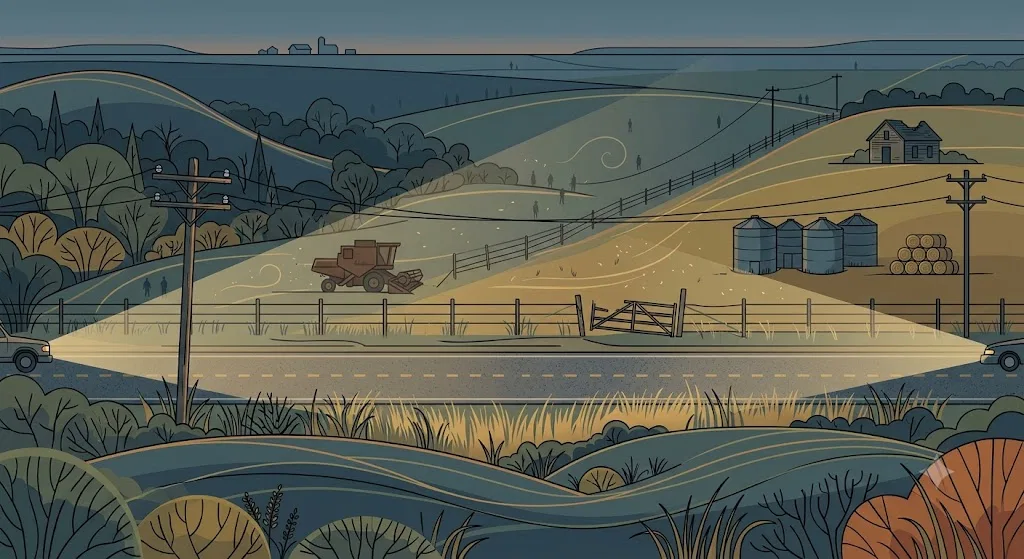
Kansas monster sightings often begin in a very ordinary way: someone sees a real animal, but sees it briefly, at dusk, from a moving vehicle, through brush, beside water, or in a place where that animal feels out of bounds. A cougar becomes a “black panther”. A coyote in a driveway becomes a possible bear. A great blue heron or crane becomes a “pterodactyl”. A fox, raccoon, bobcat, wolf-like dog or large bird supplies just enough shape, motion and surprise for the mind to finish the picture.
That does not make every witness foolish, and it does not make every strange story worthless. Kansas really does get rare wildlife visitors. Mountain lions have been confirmed in the state again since 2007, black bears have occasionally been documented since the nineteenth century, and wolves have been confirmed only twice in modern records. The key point for Kansas monster lore is that a genuine animal surprise can be the seed of an exaggerated creature story, especially when the sighting spreads faster than the evidence.[ksoutdoors.gov]ksoutdoors.govwildlife sightingsKansas Department of Wildlife and Parks…
The Kansas Animals Most Likely To Become Monsters
Kansas is useful for sceptical monster study because it sits between expectation and possibility. It is not empty prairie, but it is also not a landscape where most residents expect to meet bears, wolves or big cats. That gap between “this should not be here” and “this can very occasionally be here” is exactly where mystery-beast stories grow.
The strongest example is the mountain lion. The Kansas Department of Wildlife and Parks says mountain lions were eradicated from Kansas by the early 1900s, with the first confirmed modern case documented in Barber County in 2007. The agency now says confirmed mountain lion sightings have occurred in 49 of the state’s 105 counties. KCUR reported in 2025 that state wildlife supervisor Jon Beckmann put the number at 117 confirmed sightings since 2007, including 65 since 2023, while also stressing that Kansas still had no evidence of a resident, breeding mountain lion population at that time.[ksoutdoors.gov]ksoutdoors.govwildlife sightingsKansas Department of Wildlife and Parks…
That is a perfect folklore engine. A real cougar can pass through Kansas, and a person who glimpses one may be reporting something genuinely unusual. But many alleged cougar or “panther” reports elsewhere turn out to be other animals seen badly. The Mountain Lion Foundation notes that most reported mountain lion sightings are actually large dogs, coyotes, bobcats or deer seen in low light, at distance, or for only a moment. It also points to track details that matter: cougar tracks are usually rounder, often lack claw marks because the claws retract, and show a distinct heel pad, while coyote or dog tracks tend to show claws and a narrower, more oval shape.[Mountain Lion Foundation]mountainlion.orgMountain Lion Foundation Mountain Lion SightingMountain Lion Foundation Mountain Lion Sighting
Black bears create a similar problem. They were historically associated with eastern Kansas woodlands and the Red Hills, not the open grasslands, and Kansas wildlife officials describe them as only occasional in the state since the 1880s. Nearby established populations in Missouri, Arkansas and Oklahoma make wandering bears possible, but not common. That means a “bear” report in Kansas cannot be dismissed automatically, yet it also deserves careful checking before it becomes a monster rumour.[ksoutdoors.gov]ksoutdoors.govwildlife sightingsKansas Department of Wildlife and Parks…
Wolves sit even further towards the rare end. Kansas wildlife officials say gray wolves once roamed the state in abundance but were gone by the early 1900s; since then, only two have been confirmed in Kansas, one in northwest Kansas in 2012 and one in south-central Kansas in 2017. A large, long-legged canid seen at night may feel like a wolf, dogman or something worse, but the ordinary candidates — coyote, domestic dog, wolf-dog or a fox seen under strange conditions — are usually more plausible unless there is solid evidence.[ksoutdoors.gov]ksoutdoors.govwildlife sightingsKansas Department of Wildlife and Parks…
The most common monster-maker may be the coyote, precisely because it is not rare. Kansas wildlife officials describe coyotes and red foxes as common across the state, including cities, and note that coyotes use parks, undeveloped edges and residential or commercial areas, mainly at night. Their presence in urban Kansas is described as relatively recent compared with some other states, which makes them familiar enough to be encountered but unfamiliar enough to startle people in the wrong setting.[ksoutdoors.gov]ksoutdoors.govwildlife sightingsKansas Department of Wildlife and Parks…
Confirmed Wanderers And Rare Visitors
The best way to handle Kansas monster claims is not to ask, “Could any large animal ever be here?” The answer is yes. The better question is, “What evidence would show that this particular animal was here at this particular time?”
Mountain lions offer the cleanest model. Kansas officials look for tracks, scat and prey remains when investigating possible detections. KCUR’s 2025 report quotes Beckmann explaining that tracks are especially important, because mountain lions leave distinctive signs and because their retractable claws usually do not mark the ground the way a coyote’s claws do. A blurred glimpse alone may start the story, but physical sign is what moves it towards confirmation.[KCUR]kcur.orgKansas mountain lions are returning. Here's what to know | KCURKansas mountain lions are returning. Here's what to know | KCUR
That distinction matters for old and new “monster cat” accounts. A tawny cougar crossing a road can look enormous in headlights. A bobcat can look larger when seen from below or through grass. A dark dog moving low across a field can become a “black panther” in retelling. Kansas has confirmed real mountain lions, but that fact does not validate every big-cat rumour. It simply means the sceptical explanation has to be more careful than “no cougars here”.
Black bear stories need the same caution. In August 2025, a Shawnee Heights driveway photo sparked speculation about a possible bear in north-east Kansas. WIBW reported that Google Images suggested black bear, while local experts rejected that identification: a Topeka Zoo carnivore keeper leaned towards coyote, the zoo’s conservation director said even a bear cub would be much larger than the photographed animal, and Kansas wildlife biologist Matt Peek said it appeared to be a raccoon, possibly sick, though the image was inconclusive.[https://www.wibw.com]wibw.comOpen source on wibw.com.
That small case is almost a laboratory version of a Kansas monster sighting. The ingredients were all present: a surprising image, a dramatic first label, online attention, disagreement between observers, and a creature that looked wrong enough to invite speculation. Nothing supernatural was needed. Even trained people disagreed at first glance, and the most conservative reading was not “mystery beast”, but “poor image of a known animal”.
Wolves are rarer still, and that rarity can inflate the emotional force of canid sightings. A person who sees a large dog-like animal along a field edge may reach for wolf, werewolf, dogman or monster because the shape is powerful and the setting is lonely. Yet Kansas’s confirmed wolf record is so sparse that any modern wolf claim needs much more than size, fear or a night-time silhouette.[ksoutdoors.gov]ksoutdoors.govwildlife sightingsKansas Department of Wildlife and Parks…
Why Eyewitness Reports Can Mislead
Most Kansas wildlife mistakes are not caused by one big error. They are caused by small uncertainties stacking together. Distance hides scale. Dusk removes colour. Headlights flatten shape. Tall grass cuts off the legs. A running animal looks longer than a standing one. A startled witness may get one feature right — the tail, the shoulders, the sound — while misreading the whole animal.
Tracks and traces are not simple either. New Mexico State University’s guide to wildlife tracks warns that track size varies by age, sex and individual animal, that a perfect track is not always found, and that guides should not be treated as rigid keys. It also notes that some species cannot always be distinguished by tracks alone. That is directly relevant to Kansas monster claims built around footprints, claw marks or “something huge passed through here” impressions.[Publications]pubs.nmsu.eduIdentifying and Preserving Wildlife Tracks | New Mexico State University - BE BOLD. Shape the Future…
Kansas Bigfoot reports show how quickly ordinary uncertainty can become creature language. The Bigfoot Field Researchers Organization lists 51 Kansas reports, with recent entries including claims from Douglas County, Jackson County and Kingman County. Several are tied to rivers, lakes, wooded corridors or dusk travel — exactly the kinds of edge habitats where real animals move and where human perception is least reliable.[BFRO]bfro.netReports for KansasReports for Kansas
That does not prove the reports are misidentified wildlife. It shows why the reports need a careful frame. A fisherman at Clinton Lake, motorists near the South Fork Ninnescah River, or someone moving through a wooded Johnson County trail may truly experience a startling encounter. But the evidentiary question remains: was there a clear view, reliable scale, physical evidence, multiple independent observers, or only a moment that later became more definite in memory?
One BFRO-listed Johnson County account from a wooded trail near Lenexa, for example, describes loud knocks, brush movement and a feeling of being watched. The witness also mentions knowing the area’s wildlife, including deer, bobcats and a claimed mountain lion encounter. For a folklore reader, the report is interesting because it shows how place, sound and expectation work together. For a wildlife analyst, it is also full of ambiguity: a noise in brush, a possible falling tree, animal movement and an emotional impression do not identify a species by themselves.[BFRO]bfro.netshow report.aspshow report.asp
How Birds Become Kansas “Pterodactyls”
Kansas has an especially good setting for flying-monster confusion because its bird life is genuinely spectacular. Central Kansas sits on major migration routes, and places such as Cheyenne Bottoms and Quivira National Wildlife Refuge bring immense numbers of birds into open view. The Nature Conservancy describes Cheyenne Bottoms as a 41,000-acre wetland complex and one of the top shorebird and waterfowl staging areas in the United States, with tens of thousands of shorebirds and up to a quarter million waterfowl during migrations.[The Nature Conservancy]nature.orgOpen source on nature.org.
The Kansas Department of Wildlife and Parks says Cheyenne Bottoms is especially active in spring and fall, with waterfowl and sandhill cranes arriving as early as February, herons and egrets in March and April, shorebirds in late April and May, and great blue herons often remaining until the marsh freezes. To a birder, that is a rich seasonal pattern. To a startled driver or child looking up from a field road, it can be a huge, unfamiliar silhouette with trailing legs, slow wingbeats and a prehistoric profile.[ksoutdoors.gov]ksoutdoors.govcheyenne bottoms wildlife areaKansas Department of Wildlife and Parks…
This matters because Kansas has modern “living pterosaur” or “pterodactyl-like bird” stories in its cryptid culture. A Kansas-focused cryptid page collects reports from Garden City, Hudson and an unnamed farm-road setting, including descriptions of huge leathery wings, a long beak and a tail-like feature. The same page also includes an unusually useful self-correction: the writer says they once thought they had seen a pterosaur-like creature, then realised it was a common heron, whose legs in flight can look like a tail.[clkeating.infprojects.fhsu.edu]clkeating.infprojects.fhsu.eduCryptids of KansasCryptids of Kansas
That is one of the most valuable lessons in Kansas monster lore. The witness did not need to invent anything. The bird was real. The impression was real. The interpretation changed with experience. Herons, cranes, pelicans, cormorants, vultures and eagles can all look strange when scale is misjudged or when the viewer sees a silhouette rather than plumage. Kansas’s fossil history may make “pterodactyl” feel locally poetic, but living bird misidentification is a much simpler explanation for many winged-creature claims.
Large birds also behave in ways that can seem uncanny. They may rise suddenly from water, trees or roadkill; they may glide with little flapping; they may appear larger when flying low; and they may be seen in groups during migration. Quivira National Wildlife Refuge adds another layer, with the U.S. Fish and Wildlife Service describing hundreds of migratory bird species using the refuge and noting that Kansas is part of the Central Flyway. The state really does put dramatic birds in dramatic places.[U.S. Fish and Wildlife Service]fws.govOpen source on fws.gov.
How Ordinary Wildlife Feeds Extraordinary Folklore
A Kansas monster story often begins when an animal violates expectation. A coyote in a pasture is normal; a coyote slipping through a suburban street at night feels eerie. A raccoon is familiar; a sick or wet raccoon, hunched and poorly photographed, becomes hard to name. A cougar in the Rockies is ordinary; a cougar on a Kansas trail camera feels like proof that the map has changed.
The Shawnee Heights “bear” photo shows how quickly identification can become social. First comes the image. Then comes an automated label. Then neighbours, news outlets and experts weigh in. The final animal may be ordinary, but the public moment has already produced a mystery-beast story: “What was that thing in Kansas?”[https://www.wibw.com]wibw.comOpen source on wibw.com.
Bigfoot-style reports use a different path. They often begin not with a clear animal but with a pattern: knocks in timber, a dark upright form, large footprints near water, a bad smell, a sense of being watched, or movement just beyond sight. Kansas’s rivers and wooded corridors give these stories a believable stage because they break up the open prairie image of the state. Even when the evidence is weak, the setting feels right enough for the story to travel.[BFRO]bfro.netReports for KansasReports for Kansas
Winged monsters work through silhouette and scale. A large bird seen well is a bird. A large bird seen against the sky, with legs trailing and feathers invisible, can become a dragon, thunderbird or pterosaur. Kansas wetlands make this especially easy because they concentrate birds that many casual observers do not see every day.[ksoutdoors.gov]ksoutdoors.govcheyenne bottoms wildlife areaKansas Department of Wildlife and Parks…
The same pattern applies to phantom cats and wolves. Kansas has enough real rare-animal history to keep the door open, but not enough everyday familiarity for instant recognition. That is why official wildlife confirmation is so important. It protects both sides of the story: it prevents real wandering animals from being dismissed as nonsense, and it prevents every blurry animal from becoming a monster by default.

A Practical Sceptic’s Guide To Kansas Monster Sightings
The most useful question is not “Do you believe the witness?” It is “What would separate a memorable encounter from a reliable animal record?” Kansas wildlife mistakes become easier to sort when the report is tested against a few grounded checks.
Look for evidence beyond the glimpse. A clear photograph, repeated trail-camera images, tracks with scale, scat, hair, prey remains or multiple independent observers are stronger than a single startled sighting. Kansas officials use physical signs such as tracks and scat when assessing mountain lion possibilities.[KCUR]kcur.orgKansas mountain lions are returning. Here's what to know | KCURKansas mountain lions are returning. Here's what to know | KCUR
Ask whether the animal is rare, common or merely unexpected. Mountain lions are confirmed but still not known to be resident breeders in Kansas as of the 2025 KCUR report. Black bears are occasional. Wolves are extremely rare in confirmed modern records. Coyotes, foxes, bobcats, raccoons, deer and large birds are much more likely starting points.[ksoutdoors.gov]ksoutdoors.govwildlife sightingsKansas Department of Wildlife and Parks…
Treat night, distance and motion as error multipliers. A fast animal crossing a road is hard to size. A shape seen through grass may appear to walk differently. A bird seen from below may lose all the details that make it recognisable. Many “monster” features are created when the view is incomplete.
Be careful with apps and instant image labels. The Shawnee Heights case is a useful warning: an image search suggested black bear, but local experts disagreed and the likely options moved towards coyote or raccoon. Automated identification can start a rumour before the photograph has been properly examined.[https://www.wibw.com]wibw.comOpen source on wibw.com.
Keep the story without overstating the animal. A good Kansas monster tale can remain interesting even when the likely explanation is wildlife. In fact, the wildlife explanation often makes it better. It connects the legend to real migration corridors, recovering predator ranges, urban coyotes, wetlands, river cover and the uneasy feeling of seeing something alive where the mind did not expect it.
What These Mistakes Reveal About Kansas Monster Lore
Wildlife mistakes do not drain Kansas monster stories of meaning. They explain why those stories keep happening in the places they do. River bottoms, reservoirs, suburban edges, farm roads, wetlands and wooded corridors are not random backdrops. They are where real animals travel, where visibility is patchy, and where ordinary creatures can briefly look extraordinary.
This is why Kansas is more interesting than the flat-state stereotype suggests. Its monster lore is not built only from invented beasts. It is built from ecological surprise: cougars returning through the Great Plains, bears wandering near state borders, coyotes adapting to cities, cranes and herons filling the wetlands, and people trying to name what they saw before the shape disappears.
The most honest reading is also the most enjoyable one. Kansas monsters are not confirmed hidden species, but many are not empty fantasies either. They are encounters at the edge of recognition. Sometimes the answer is a cougar. Sometimes it is a raccoon. Sometimes it is a heron with its legs stretched behind it like a tail. And sometimes the only thing that can be confirmed is the oldest rule of monster country: a real animal, seen badly in the right place, can become a legend before morning.
Amazon book picks
Further Reading
Books and field guides related to When Real Animals Become Kansas Monsters. Use these as the next step if you want deeper reading beyond the article.
Tracking the Chupacabra
Shows how folklore, media and animal misidentification interact.
eBay marketplace picks
Marketplace Samples
Live-tested eBay searches with available results related to this page.



Endnotes
1.
Source: ksoutdoors.gov
Title: wildlife sightings
Link:https://www.ksoutdoors.gov/discover-learn/wildlife-of-kansas/wildlife-sightings
Source snippet
Kansas Department of Wildlife and Parks...
2.
Source: kcur.org
Title: Kansas mountain lions are returning. Here’s what to know | KCUR
Link:https://www.kcur.org/environment-agriculture/2025-09-26/mountain-lions-are-returning-to-kansas-heres-how-to-tell-if-one-has-passed-through-your-area
3.
Source: ksoutdoors.gov
Title: wildlife damage control
Link:https://www.ksoutdoors.gov/programs-services/wildlife-damage-control
Source snippet
Kansas Department of Wildlife and Parks...
4.
Source: wibw.com
Link:https://www.wibw.com/2025/08/05/bear-sighting-sparks-disagreement-among-kansas-wildlife-professionals/
5.
Source: bfro.net
Title: Reports for Kansas
Link:https://www.bfro.net/GDB/state_listing.asp?state=ks
6.
Source: bfro.net
Title: show report.asp
Link:https://www.bfro.net/GDB/show_report.asp?id=55789
7.
Source: nature.org
Link:https://www.nature.org/en-us/get-involved/how-to-help/places-we-protect/cheyenne-bottoms-preserve/
8.
Source: ksoutdoors.gov
Title: cheyenne bottoms wildlife area
Link:https://www.ksoutdoors.gov/about-kdwp/where-we-work/wildlife-areas/cheyenne-bottoms-wildlife-area
Source snippet
Kansas Department of Wildlife and Parks...
9.
Source: clkeating.infprojects.fhsu.edu
Title: Cryptids of Kansas
Link:https://clkeating.infprojects.fhsu.edu/final/pterosaur.html
10.
Source: bfro.net
Title: show report.asp
Link:https://www.bfro.net/GDB/show_report.asp?id=739
11.
Source: bfro.net
Link:https://www.bfro.net/gdb/
12.
Source: bfro.net
Title: show county reports.asp
Link:https://www.bfro.net/GDB/show_county_reports.asp?county=Kingman&state=ks
13.
Source: ksoutdoors.gov
Link:https://www.ksoutdoors.gov/discover-learn/wildlife-of-kansas/wildlife-sightings/mountain-lions-in-kansas
14.
Source: ksoutdoors.gov
Link:https://www.ksoutdoors.gov/
15.
Source: ksoutdoors.gov
Link:https://ksoutdoors.gov/content/search/%28offset%29/320?SearchText=use+harvest+report
16.
Source: ksoutdoors.gov
Link:https://www.ksoutdoors.gov/outdoor-activities/hunting-in-kansas/what-to-hunt/small-game-furbearing-animals
17.
Source: ksoutdoors.gov
Link:https://ksoutdoors.gov/content/search/%28offset%29/270?SearchText=PROBLEMGO.COM+commission+report+use+prior+have+use+d%27argent
18.
Source: ksoutdoors.gov
Link:https://ksoutdoors.gov/content/search/%28offset%29/100?SearchText=one+office+PROBLEMGO.COM+boat+garden+approved+within+county
19.
Source: ksoutdoors.gov
Link:https://www.ksoutdoors.gov/programs-services/grantmaking
20.
Source: ksoutdoors.gov
Link:https://www.ksoutdoors.gov/programs-services/law-enforcement/regulations-statutes/hunting-regulations
21.
Source: ksoutdoors.gov
Link:https://www.ksoutdoors.gov/licenses-permits-fees/hunting-licenses-permit-fees
22.
Source: ksoutdoors.gov
Link:https://www.ksoutdoors.gov/about-kdwp/where-we-work/nature-centers/milford-nature-center
23.
Source: ksoutdoors.gov
Link:https://ksoutdoors.gov/content/download/7651/38459/file/Snowy%20Plover.pdf
24.
Source: ksoutdoors.gov
Link:https://ksoutdoors.gov/content/download/24906/169546/version/1/file/River%2BOtter%2BFinal%2BReport%2Bfrom%2BKSU.pdf
25.
Source: ksoutdoors.gov
Link:https://www.ksoutdoors.gov/about-kdwp/where-we-work/nature-centers/kansas-wetlands-education-center
26.
Source: wetlandscenter.fhsu.edu
Title: recent bird sightings November 9
Link:https://wetlandscenter.fhsu.edu/news/bird-watch/2016/recent%20bird%20sightings-November%209.html
27.
Source: clkeating.infprojects.fhsu.edu
Link:https://clkeating.infprojects.fhsu.edu/final/bigfoot.html
28.
Source: wetlandscenter.fhsu.edu
Title: Summer Birding at Cheyenne Bottoms
Link:https://wetlandscenter.fhsu.edu/news/bird-watch/2015/Summer%20Birding%20at%20Cheyenne%20Bottoms.html
29.
Source: wetlandscenter.fhsu.edu
Link:https://wetlandscenter.fhsu.edu/about/wetlands-of-international-importance/index.html
30.
Source: wetlandscenter.fhsu.edu
Link:https://wetlandscenter.fhsu.edu/news/bird-watch/2025/index.html
31.
Source: kansas.com
Link:https://www.kansas.com/news/state/article312604325.html
32.
Source: portal.kansas.gov
Link:https://portal.kansas.gov/
33.
Source: mountainlion.org
Title: Mountain Lion Foundation Mountain Lion Sighting
Link:https://mountainlion.org/mountain-lion-sighting/
34.
Source: pubs.nmsu.edu
Link:https://pubs.nmsu.edu/_circulars/CR561/
Source snippet
Identifying and Preserving Wildlife Tracks | New Mexico State University - BE BOLD. Shape the Future...
35.
Source: fws.gov
Link:https://www.fws.gov/story/helping-wildlife-thrive-kansas
36.
Source: Wikipedia
Link:https://en.wikipedia.org/wiki/Kansas
37.
Source: Wikipedia
Link:https://vi.wikipedia.org/wiki/Kansas
38.
Source: facebook.com
Link:https://www.facebook.com/KansasWildlifeandParks/photos/migration-is-in-full-swing-at-cheyenne-bottoms-and-the-wetlands-are-alive-with-b/1321125536717054/
39.
Source: wildlife.k-state.edu
Link:https://www.wildlife.k-state.edu/species/
40.
Source: geokansas.ku.edu
Title: cheyenne bottoms
Link:https://geokansas.ku.edu/cheyenne-bottoms
41.
Source: mountainlion.org
Title: first mountain lion sighting in kansas since 2012
Link:https://mountainlion.org/2014/10/23/first-mountain-lion-sighting-in-kansas-since-2012/
42.
Source: yellow-wave-0e513e510.3.azurestaticapps.net
Title: Cheyenne Bottoms
Link:https://yellow-wave-0e513e510.3.azurestaticapps.net/issues/volume-v-issue-1/cheyenne-bottoms/
Additional References
43.
Source: youtube.com
Title: Black Panthers in America?! The Mountain Lion Mystery No One Can Explain
Link:https://www.youtube.com/watch?v=0jIwvBPcVGg
Source snippet
Black Mountain Lions Black Cougars -Jaguars -What Are People Seeing?...
44.
Source: nps.gov
Link:https://www.nps.gov/mora/planyourvisit/upload/Carnivore-Tracks-12-20-21_508.pdf
45.
Source: westfordma.gov
Link:https://www.westfordma.gov/151/Information-on-Common-Wildlife-Species
46.
Source: facebook.com
Link:https://www.facebook.com/wetlandscenter/videos/migrationmonday-cheyenne-bottoms-the-largest-wetland-complex-in-the-interior-of-/1351793149298094/
47.
Source: facebook.com
Link:https://www.facebook.com/KAKEnews/posts/tbt-a-mountain-lion-is-caught-on-camera-in-southwest-kansas-chelsea-hennigh-ulys/1459659132870445/
48.
Source: researchgate.net
Link:https://www.researchgate.net/publication/361364482_Wildlife_Understanding_the_Tracks_and_Signs
49.
Source: facebook.com
Link:https://www.facebook.com/groups/844377736762129/posts/889880395545196/
50.
Source: facebook.com
Link:https://www.facebook.com/WOR710/posts/a-photo-of-a-mystery-creature-spotted-by-a-kansas-resident-has-drawn-divided-opi/1290120969751527/
51.
Source: hangar1publishing.com
Link:https://hangar1publishing.com/blogs/cryptids/kansas-bigfoot-sightings?srsltid=AfmBOopAcIC2AlhCQky5Wu7BRHfDb8OcZh_os87RtQA9Pk5I5w_JLtYm
52.
Source: hangar1publishing.com
Link:https://hangar1publishing.com/blogs/cryptids/kansas-bigfoot-sightings?srsltid=AfmBOopYj45hprVKpL_YLc-1pRM3bkYCKqVmZX8Xy17KZtxwKeQBwS5E
Topic Tree